5,536 words

George H.W. Bush. Image courtesy of Wikimedia Commons
The common narrative regarding the career of George Herbert Walker Bush, is that the 41st US President was a good man who put a steady hand upon the tiller of the ship of state. In international affairs, this was unquestionably true. He successfully managed the collapse of the Soviet Union and avoided a possible “World War III” which could have formed in the post-Soviet power vacuum. His handling of the Persian Gulf War was indeed masterful. Fighting the war itself was questionable, but Bush’s leadership during the conflict was solid. So solid in fact, one must wonder if his energies would have been better spent taking back Cuba and ignoring the Middle East entirely. On the domestic front, Bush was a disaster, especially for white interests.
A Man of His Social Class
George H.W. Bush was from a prominent family whose founders included Mayflower passengers, Connecticut Puritans, and Tidewater Maryland plantation owners. Bush’s forebearers were wealthy generations before his father, US Senator Prescott Bush of Connecticut, was born. None of Bush’s ancestors married badly and there were no series of hard-luck generations where the father died early, and the children were plunged into poverty as a result.
Bush was born in 1924, went to prominent boarding schools and upon graduation, joined the Navy. Bush was commissioned as an ensign in 1943, and he went to war as a carrier pilot. He was shot down over the island of Chichi Jima in 1944. Bush was the only man aboard the aircraft to survive the crash and was rescued by a submarine. He married Barbara Pierce while still in the Navy in early 1945. Barbara was from a prominent family also. She was descended from successful ministers and judges. She was also related to President Franklin Pierce.
After World War II, when Bush decided to move to Texas, he arrived with money to invest in the oil industry and connections through his father to the political structure in Washinton D.C. In Texas at the time, the Democratic Party was dominant. The local Republican Party was associated with Reconstruction and had been unelectable for decades. Elections were decided in the Democratic Party’s primaries and the party was divided into liberal and conservative wings.
George H.W. Bush & the GOP’s “Civil Rights” Betrayal
The Democratic Party’s liberal wing was very leftist indeed. Franklin Delano Roosevelt’s New Dealers contained a core of “civil rights” believers who were constructing an obedient army of leftist radicals as early as 1948. The conservative Democrats consisted of the Party’s traditional base, Catholics, especially of Irish ancestry in the North and white Southern Protestants. [1]
Bush’s wealth, war record, and family connections made him an ideal recruit for elected office in Texas. Prominent locals in that state tried to get him to become a Democrat, but he refused to leave the GOP. He decided to run for the US Senate seat in 1964, where he aligned with Barry Goldwater and claimed to not support the 1964 Civil Rights Act. He was defeated.
Bush was continually bedevilled by conservative Democrats in Texas. The Democratic brand was well liked and well-established in Texas in the 1960s. Should an election have a down ballot referendum on making liquor sales legal by the drink, white Southern Protestants in East Texas would turn out and the Democrats would win in a landslide. Additionally, Democrats could run to the right or left of him and still win.
In 1966, Bush ran for Congress and won a seat representing the Houston area. Two years later he ran again – this time with no opposition. It was during his two terms in Congress when Bush’s anti-white, elitist tilt first manifested. At one point, Bush’s constituents were angry over de-segregation problems and the nation-wide black rioting of the late 1960s. They were especially angry over Bush’s support for the (mostly toothless) 1968 Civil Rights Act that dealt with housing and loans. On April 17, 1968, he pleaded his case to his constituents at a high school gym saying,
In Vietnam I chatted with many Negro soldiers. They were fighting, and some were dying for the ideals of this Country; some talked about coming back to get married and to start their lives over.
Somehow it seems fundamental that this guy should have a hope. A hope that if he saves some money, and if he wants to break out of a ghetto, and if he is a good character and if he meets every requirement of a purchaser – the door will not be slammed solely because he is a Negro, or because he speaks with a Mexican accent.
In these troubled times, fair play is basic. The right to hope is basic. [2]
In this speech, one can see the problems. The desegregated military created a caste of privileged black soldiers who formed an internally dysfunctional, highly defeatable military force. Indeed, the Vietnam War was lost in part because the military was integrated. Then, Bush, like all believers in “civil rights,” misread the data. As a group, sub-Saharans were also not looking to become married. The Great Society giveaway programs and “civil rights” made whites unable to enforce their norms on black Africans which caused the “black family” to collapse into units run by single mothers. Single mother “families” in Africa is the norm.
Then one sees the bad idea that blacks should be able to “break out of a ghetto” by getting mortgages should they meet “every requirement” to get a loan. It turns out that the banks’ “requirements” can be rendered meaningless by government pressure; therefore, banks are pressured to give loans to blacks who cannot possibly make the payments. Bush’s remarks about “Mexican accents” restricting loan opportunities is also a problem. In addition to giving loans to Mexicans who cannot make the mortgage payments, it also means that foreigners – even hostile foreigners who are wealthy – can get loans. This contributes to the Great Replacement. The seeds of the 2008 mortgage crisis and the Great Recession were planted by George H.W. Bush and his colleagues in 1968.
In 1970, Bush decided to give up his safe seat in the House and run for the Senate again. By this time the “civil rights” revolution was an obvious disaster, and it had an impact on the election. Bush’s biographer Jon Meacham writes,
The key voter in the early 1970s was a forty-seven-year-old-suburban housewife in Dayton, Ohio, married to a machinist. Nixon was particularly impressed with this passage from [a book by Richard Scammon and Ben Wattenburg called The Real Majority which said,] “To know that the lady in Dayton is afraid to walk the streets alone at night, to know that she has a mixed view about blacks and civil rights because before moving to the suburbs she lived in a neighborhood that became all black, to know that her brother-in-law is a policeman, to know that she does not have the money to move if her new neighborhood deteriorates, to know that she is deeply distressed that her son is going to a community junior college where LSD is found on the campus – to know all this is the beginning of contemporary political wisdom.” [3]
Bush was defeated that year by Lloyd Bentsen, a conservative Democrat who demonstrated to the voters that he understood the problems described by Scammon and Wattenburg better than Bush. President Nixon then sought to get Bush on his White House staff, where it is possible he would have been tripped up by the Deep State’s Watergate Coup later. Bush, however, took the job as the Republican Party Chairman and then got the position as Ambassador to the United Nations. At the UN, he forged friendly connections with the leadership of many nations. After Ford replaced Nixon, Bush was appointed “Ambassador” to China (technically he was a Special Liaison due to the diplomatic situation at the time).
Bush was recalled by Ford to oversee the Central Intelligence Agency, which was wracked by scandals and Congressional hearings. Bush thrived at the Central Intelligence Agency, but resigned after Jimmy Carter was elected in 1976. Bush returned to Houston, worked at a bank, taught part time, and served on the Trilateral Commission while laying the groundwork for his 1980 presidential campaign.
As for Jimmy Carter’s Presidency, everything that could go wrong, went wrong and by 1979 he was facing a primary challenge and the Iranian Hostage Crisis. While Carter crashed, Ronald Reagan surged in popularity by leading what’s come to be called the mainstream conservative wing of the Republican Party. The ideology of this faction was a mixture of neo-liberal economic beliefs, a policy of reducing government regulations and government departments, and social conservativism. Reagan also had help from extraordinary people, especially Phyllis Schlafly.
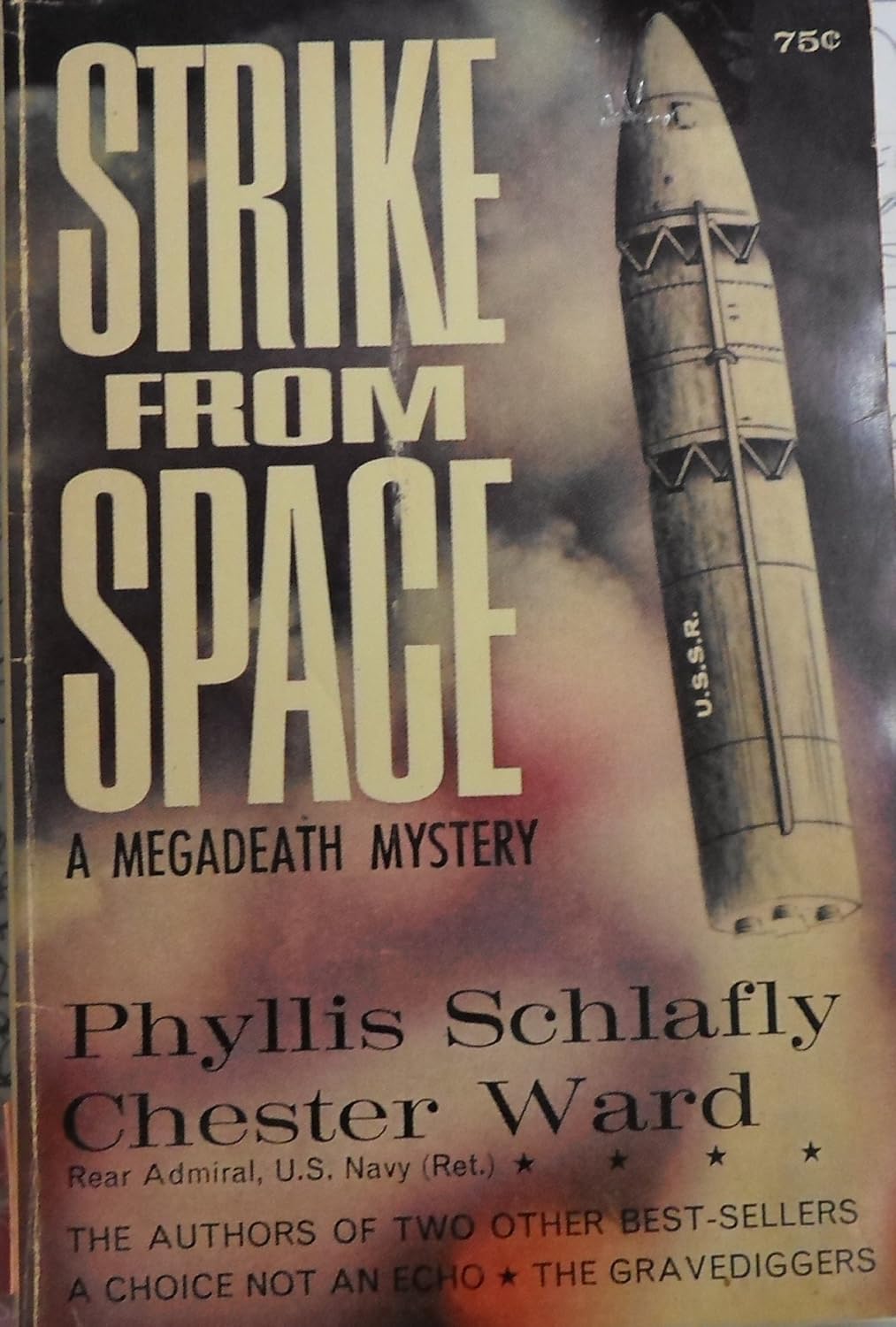
It is remarkable how many “right-wing” figures are productive outside politics. In 1966, Phyllis Schlafly and Rear Admiral (Retired) Chester Ward published a book about orbital bombers. The ideas in this book, reworked, formed the basis of Reagan’s Strategic Defense Initiative which sought to emplace defensive weapons in space to intercept any Soviet missiles. This project helped bring down the Soviet Union.
George H.W. Bush campaigned hard against Reagan in 1980, but his campaign didn’t get enough traction. Regardless, Bush’s political stances were perfectly balanced between the mainstream conservatives and the liberal, internationalist wing of the party called the Rockefeller Republicans. At the GOP’s convention in Detroit, Bush’s fortunes turned around. Former President Ford was expected to be the Vice President, but in a media interview, he hinted that he’d be a “co-president.” Reagan was shocked and decided to round out his ticket with Bush. Barbara told the Reagan’s they’d work hard as they could for them, thereby cementing the relationship between the two families.
Reagan’s Rightist Allies
To understand George H.W. Bush’s relationship with white advocates and other Rightists of the 1980s, one must first understand Ronald Reagan’s use of pro-whites during his time in office. Ronald Reagan understood the far-Right. There is a case to be made that the blueprint for Reagan’s presidency can be found in the racially aware, right-wing book, The Iron Curtain Over America (1951). Whether or not Reagan read the book is unknown, but it hardly matters, the anti-Communist fighters on his staff certainly read the book.
Ronald Reagan also did a campaign stop in Philadelphia, Mississippi in 1980. The stop was highly symbolic. Philadelphia was a place that “civil rights” activists claimed was a racist city after the bodies of one black and two Jewish “civil rights” activists who’d been murdered in the early 1960s were found nearby. In the campaign speech there, Reagan said,
I believe in states’ rights; I believe in people doing as much as they can for themselves at the community level and at the private level. And I believe that we’ve distorted the balance of our government today by giving powers that were never intended in the constitution to that federal establishment. And if I do get the job I’m looking for, I’m going to devote myself to trying to reorder those priorities and to restore to the states and local communities those functions which properly belong there.
Left-wing “civil rights” supporters are correct about Reagan’s remarks being a “dog whistle” for white advocates. Calling for “states’ rights” at the time was a veiled rejection of the desegregation and black uplift efforts of the 1960s. “States’ rights” is not a viable policy for white advocates to follow if one of the states is oppressing whites, however. The problem is the presence of non-whites, not centralism verses localism.
Reagan was also hinting that the 1964 Civil Rights Act was an oppressive law, however he not able to overturn ‘64’s illicit second constitution. Reagan did attempt to stop a “civil rights” law called the Civil Rights Restoration Act of 1987 with a veto, but congress overrode his veto.
Reagan also employed white advocates who were members of armed “militias” of varying seriousness and sent them to Central America. One such advocate was Thomas Posey. After the Soviets shot down a civilian airliner, Posey started an anti-Communist group called the Civilian Matériel Assistance (CMA). Posey’s CMA supplied weapons and highly skilled technical volunteers to the anti-Communists in Central America. Posey also supported civilian border patrols but ended his support for that due to pressure from the Reagan administration. Greg Grandin writes,
Loss in Vietnam radicalized a generation of veterans, pushing many into the ranks of white-supremacist groups. Ronald Reagan, as the standard bearer of an ascendant New Right, effectively tapped into this radicalization, which helped lift him to victory in his 1980 presidential campaign. Once he was in office, Reagan’s re-escalation of the Cold War allowed him to contain the radicalization, preventing it from spilling over (too much) into domestic politics. Anti-communist campaigns in Central America – a region Reagan called “our southern frontier” – were especially helpful in focusing militancy outward. But Reagan’s Central American wars (which comprised support for the Contras in Nicaragua and death squads in El Salvador, Guatemala, and Honduras) generated millions of refugees, many, perhaps most, of whom fled to the United States. As they came over the border, they inflamed the same constituencies that Reagan had mobilized to wage the wars that had turned them into refugees in the first place. For its part, the White House continued to deflect, venting revanchism outward (back toward Central America and other places in the third world, including Afghanistan). It was, to say the least, a highly volatile game Reagan and his “cowboys” were playing, one that could only continue as long as the frontier remained open. [4]
In addition to the refugee problem, Reagan’s “cowboys,” who consisted of the men on his National Security team, Oliver North, Robert McFarlane, etc., worked on funding the operations in Central America through various legal and (possibly) illegal means.
Reagan also reached out to wealthy Arabs to help fund the operations. Aligning with the Arabs to fight Communism was a strategy proposed by genuine far-Right men such as William Potter Gale in the 1970s. Gale was not the only person advocating reaching out to the Arabs during the Cold War. Wilmot Robertson, George Lincoln Rockwell, and the State Department’s Arabist wing also proposed this. What is remarkable is that this collection of anti-Zionists came up with a viable plan to outflank the Soviets. The so-called state of Israel has always been a burden, even during the Cold War.
Regardless, the situation in Central America became a mess. There were rumors of US government involvement in drug smuggling and using the profits from that to help fund the anti-Communists. Whether or not that is true it is certain that many people, including the anti-Communists in the region, were involved in drug smuggling.
The Right and Reagan’s Second Term
While Ronald Reagan successfully employed white advocates and other Rightists, he was still unable to get to the root cause of the problem – immigration, “civil rights,” and too much Jewish influence over American society. Genuine far-Right activists were also active in a way that was completely outside of Regan’s control during his time in office. In 1984, during the election season, [5] William Potter Gale organized a group which declared the Articles of Confederation were still in effect and then launched a tax protest by filing bogus forms, and another group, The Order, committed various crimes.
Reagan’s focus was the Cold War, so it is entirely possible that he only had a cursory awareness of any of these events. The Justice Department – which is a Jewish led organization that is a law unto itself – waged lawfare against these advocates. It was at this time that the Justice Department acquired the taste for repressing old-stock American whites expressing frustration with Zionist control and “civil rights.”
In the late 1980s, Bo Gritz, not a full white advocate, but a Rightist in the militaristic, “leave no man behind,” and anti-Communist sense, went to Southeast Asia looking for Americans captured during the Vietnam War that were alleged to be still held as prisoners. While on this mission, he met a Burmese heroin producer who claimed that US government officials were involved in smuggling drugs. Gritz believed this drug producer’s story. Gritz wasn’t a simpleton being credulous, either. He’d served in Central America where he was very aware of the Panamanian government’s involvement in drug distribution. Gritz accused one of George H.W. Bush’s friends, Dick Armitage, of involvement. No definitive proof of this has ever emerged, but the accusations had the ring of possible truthfulness. The billionaire Ross Perot believed the stories and he raised enough of a fuss to damage Armitage politically.
The Torch is Passed
By the end of the 1980s, the Soviet Union was collapsing. On the other hand, the American economy was expanding rapidly. Ronald Reagan’s success and attention to cultural issues made him incredibly popular. The Republican primary consisted of Bush, who promised to carry on Reagan’s policies, Pat Robertson, a Religious Right conservative alarmed by the Democratic Party’s homosexual activism and other social matters, and Bob Dole, a personally ambitious, extreme cuckservative.
Donald Trump also hinted that he would run in 1988, and he ran advertisements pointing out that America’s foreign aid to wealthy countries was a problem. Trump was also frustrated that America was defending Japan when that nation was becoming economically as powerful as America. Trump was a fringe candidate, but it is notable that the fringes in the 1988 election recognized that America’s military alliances were a burden well before the rest of the nation. In the late 1980s, activists on the fringes and some white advocates were starting to become indifferent the Soviet threat, perhaps recognizing that the Evil Empire was collapsing before anyone else, including the expert Kremlinologists.
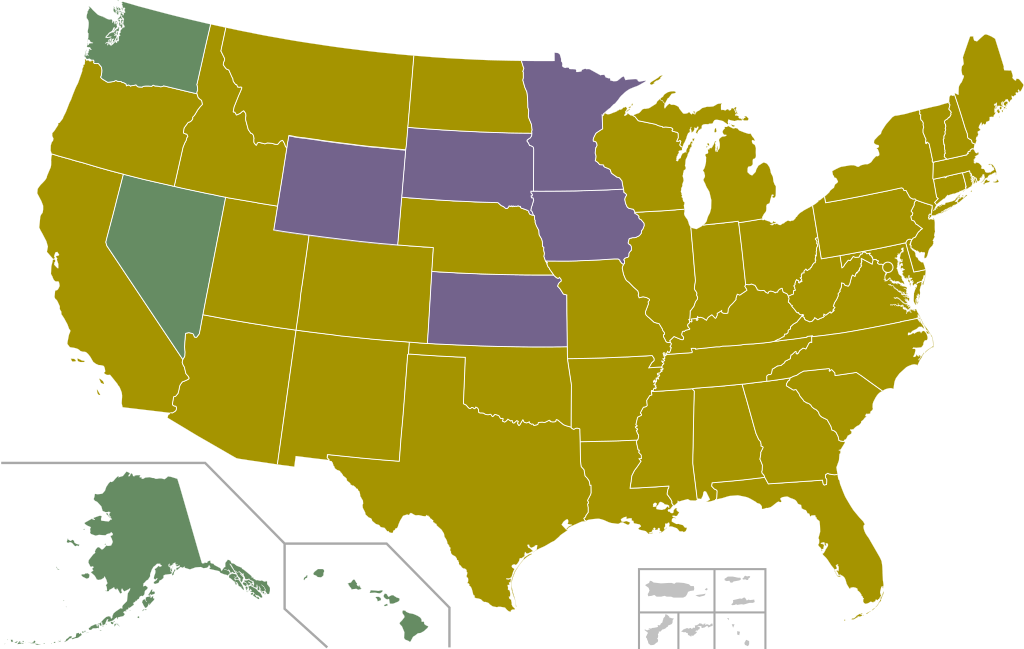
The results of the 1988 Republican Party primary.
As for the Democrats, their primary was a circus in 1988. The most notable events were a sex scandal involving US Senator Gary Hart of Colorado, and the fact that blacks started to emerge as a major bloc within the Party. Jessie Jackson, a black race-activist, won in the South Carolina primary and collected delegates in states with large African populations.
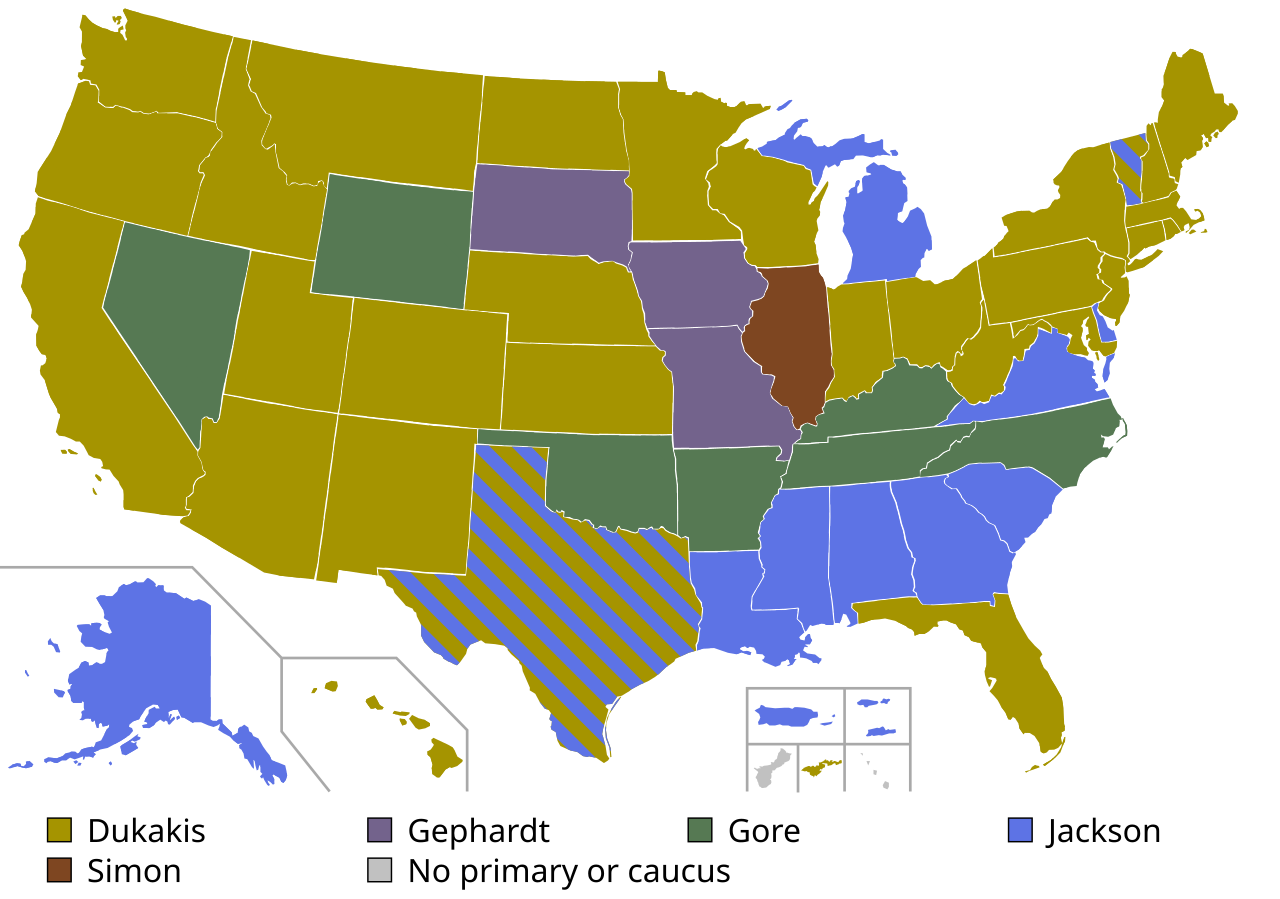
The 1988 Democratic Party primary was notable in that blacks became a major bloc within the party.
Throughout the 1988 election season, genuine far-Right activists were suffering from Justice Department lawfare. William Potter Gale was tried and convicted for his tax protest in 1987, and he died with his case still on appeal in 1988. At Fort Smith, Arkansas, the Justice Department tried fourteen white advocates for sedition. The case hinged upon the testimonies of two highly compromised informants, so it was dubious from the get-go. The process, however, was the punishment. On April 7, 1988, the defendants were acquitted although some were involved in other cases and went to prison anyway.
That year in Colorado, the Colorado Secretary of State accused a small Christian Identity church near Fort Collins of violating election law when its pastor, Peter J. Peters, ran an advertisement arguing against a local homosexual bill. The bill was a result of the Democratic Party putting homosexual issues on its plank in the 1984 election. In Idaho, the FBI recruited informants infiltrated the church of a Christian Identity minister named Richard Grint Butler. Butler had been one of the defendants in the sedition trial.
Ironically, while the Justice Department attacked white advocates. Bush won in 1988 by acknowledging concerns of whites over the ongoing black crime wave. His rival, Democrat Michael Dukakis, as governor of Massachusetts, had implemented a weekend furlough policy for prisoners. One of the prisoners, a murderer named Willy Horton, fled Massachusetts while on weekend pass and went on to commit a string of serious crimes in Maryland where he was caught. Bush’s campaign, through a series of surrogates, aired a commercial about Horton and it doomed Dukakis.
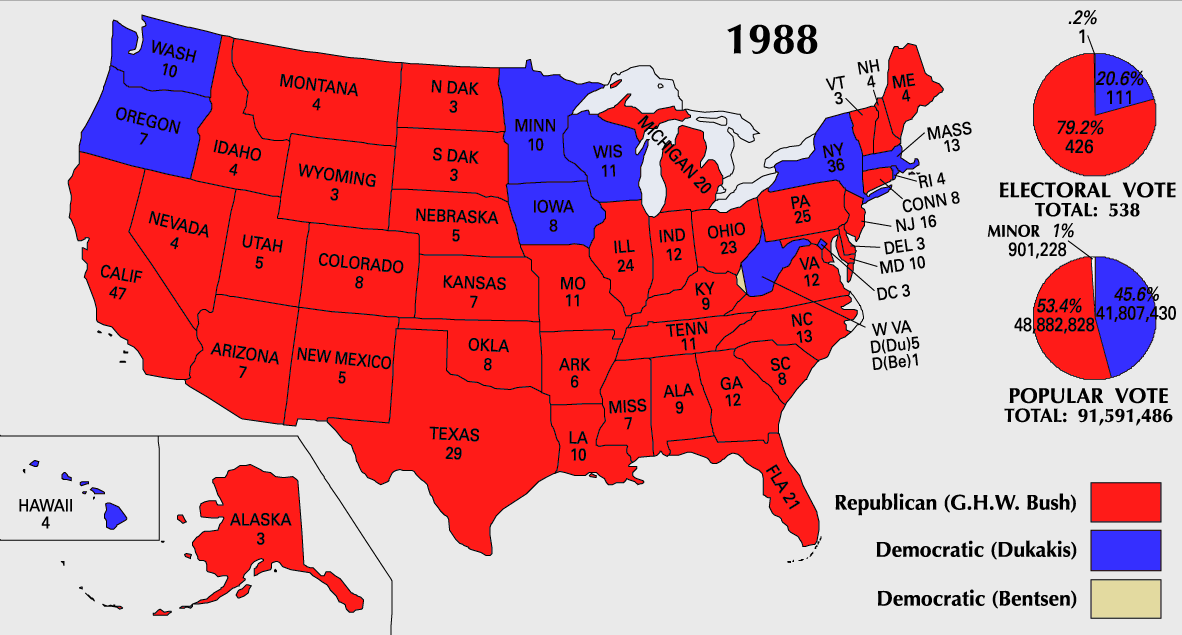
George H.W. Bush won most of the country in 1988.
On the international scene, President Bush did well. In June of 1989, the Communist Chinese maintained their hold on power by crushing a protest movement at Tiananmen Square. While China remained Communist in name, the protests in Beijing were a harbinger indicating the end of Communist governments in most places. In November, the Berlin Wall came down due to a surprising mass protest movement, and Eastern Europeans ditched their Communist governments in a matter of weeks. In December, Bush ordered the invasion of Panama, which ended the rule of America’s man in Panama. (It is possible this move was partially a reaction to accusations of US government involvement in drug smuggling.) Then came the Persian Gulf War which further drew America into the Middle East.
The most significant domestic event for Bush was the Rodney King Riots. The tinder for this conflagration was laid down in the 1960s. Los Angeles was a city of Midwesterners built upon a core of old-Spanish Californians. Unfortunately, the dynamism of the city attracted non-white immigrants including blacks from the South and Koreans. Government policy during this time should have been seeking to recolonize blacks back to Africa and keep out Koreans, but obviously, this didn’t happen.
Tensions between the Koreans and blacks were high in the early 1990s, especially after a black girl was shot by a Korean shopkeeper. The Korean was given a light sentence although found guilty of murder. Meanwhile, the Los Angeles Police Department, which was the best in the world, came under mainstream media supported criticism from black activists. A bystander videotaped a black man named Rodney King getting beaten by police for non-compliance during a traffic stop. The police were charged with assault but were acquitted by a jury. In response, sub-Saharans, encouraged by their ministers and the media, rioted. The Bush administration appeared aloof and helpless during the affray.
Read My Lips – It Was All About Race
Bush’s re-election chances were probably tanked on 11 September 1990. Bush gave a speech to Congress where he mentioned that “a new world order” was about to emerge. This innocuous phrase – the new world order – became a target for conspiracies over a pending One World Government. Despite the conspiratorial and fantastic nature of these concerns, they were not entirely unfounded. In 1943, Wendle Willke, a liberal candidate for the presidency, published a best-selling book titled One World. The book called for greater American involvement overseas, a form of world government, support for Jewish aims, and “civil rights.” These ideas led to the United Nations and all its negatives, as well as Zionism and the Negro crime wave unleashed by “civil rights.” Bush’s service on the Trilateral Commission, Ambassadorship to the UN, and support for what would become NAFTA fed into concerns over a New World Order staffed by globalist liberals and hostile to American whites.
With concerns over the New World Order in the background, the 1992 election season started with the incumbent president thriving internationally but struggling with domestic problems. At the start of campaign, the economy was in a recession which had begun just after the Gulf War ended on 28 February 1991. The Rodney King riots ended in early May 1992, leaving a great deal of lingering anger. Bush had also angered “the Right” by his budget deal of 1990 which raised the tax rate from 28% to 31%. Bush’s tax increase was a violation of a campaign pledge where he said, “Read my lips – no new taxes.” The anger however, not about the tax raise, it was really about Bush’s attack on white advocates and other Rightists throughout his time in office.
Ronald Reagan had raised taxes many times during his two terms. Only economic wonks noticed. There was never an anti-Reagan revolt over Reagan’s tax adjustments. This is because Reagan was able to secure the support, however disingenuously, of white advocates by sending them to Central America or employing them elsewhere. Reagan also invoked the shibboleths of the pro-whites of the time; states’ rights, ending “bussing,” etc. So, Reagan had no trouble from that quarter. By the end of Reagan’s second term, however, white advocates were subjected to lawfare from the Justice Department.
Bush lost the genuine far-Right when he laid off many white advocates after he shifted policy in Central America. Bush also made the illicit second constitution that is the 1964 Civil Rights Act more powerful with the 1991 Civil Rights Act. In the wake of the Rodney King Riots, Bush sent the Justice Department to charge the policemen who were found not-guilty of criminally beating King with “civil rights” violations in federal court.
In the strictest sense, charging the police with federal crimes was not double jeopardy, since a different government (or sovereign) was accusing the men for a different crime. Nonetheless, the attack on the policemen was an attack on an institution heavily influenced by far-Rightists and white advocates. Black race advocates in southern California claimed the LA’s police chief, William Parker, recruited officers at Klan rallies in the late 1940s. The California Klan of the time was of a different origin than the Klan of the South. The California Klan was allegedly formed by Wesly A. Swift, a Christian Identity minister who was a Yankee. The mainstream media’s narrative regarding Swift’s involvement with the California Klan might not be entirely true of course, but the LAPD certainly did carry out pro-white actions by aggressively policing feral black populations, so the accusations are believable.
There is also the case of the dog that didn’t bark – Bush did nothing about out-of-control crime. Serious criminal misconduct was appalling in the 1980s, and very little was done about it. The only federal crime law passed was one that merely protected federal officials. The failure to deal with crime was a major lapse and it was mentioned by Bush’s primary rivals. The lapse was also unnecessary Bush had few black voters, but blacks were the bedrock cause of all the crime. Bush could have done something. The late 1980s was when pro-crime gangsta rap became a cultural force.
Bush’s Racially Aware Rivals
The first primary challenge Bush faced came on 4 December 1991, less than a year after Bush’s overwhelming victory in Kuwait. The principled white advocate, Dr. David Duke of Louisiana, announced his candidacy as a Republican. He mentioned Bush’s betrayal on taxes and Bush’s bad free trade policies, but underneath his economic criticisms was the race issue. During Duke’s press conference, a heckler called him a “Nazi” and she was escorted out. Duke also mentioned Bush’s support for “civil rights.” Duke finished his statement with a call for ending immigration and supporting America’s Christian heritage.
Pat Buchanan was next to declare his own run. On 10 December 1991, Buchanan declared his candidacy, also citing Bush’s tax increases as a reason for his primary challenge. He also mentioned ending foreign deployments and the bad “free trade” deals Bush was supporting. Buchanan was a social conservative, not a white advocate in the strictest sense. He was, however, aware of the immigration problems and the negatives of “civil rights.”
Another critical candidate was Bo Gritz. He ran as the candidate for the Populist Party, which had been formed by the white advocate Willis Carto. Gritz is more significant to the 1992 election than the small number of votes which he received would indicate. Like Buchanan, Gritz was not a white advocate in the strictest sense, but he did tack closely to white advocacy.
Gritz was involved the biggest battle Bush waged with the genuine far-Right during his presidency. George H.W. Bush might not have even been aware he was in a battle with the genuine far-Right, at the time, however. The affair took place when Hurricane Andrew crashed into south Florida, so media and government attention was focused on that event. The crisis started when the US Justice Department – which is effectively a Zionist organization – attempted to build a stable of informants to use against a Chrisitan Identity Church in northern Idaho.
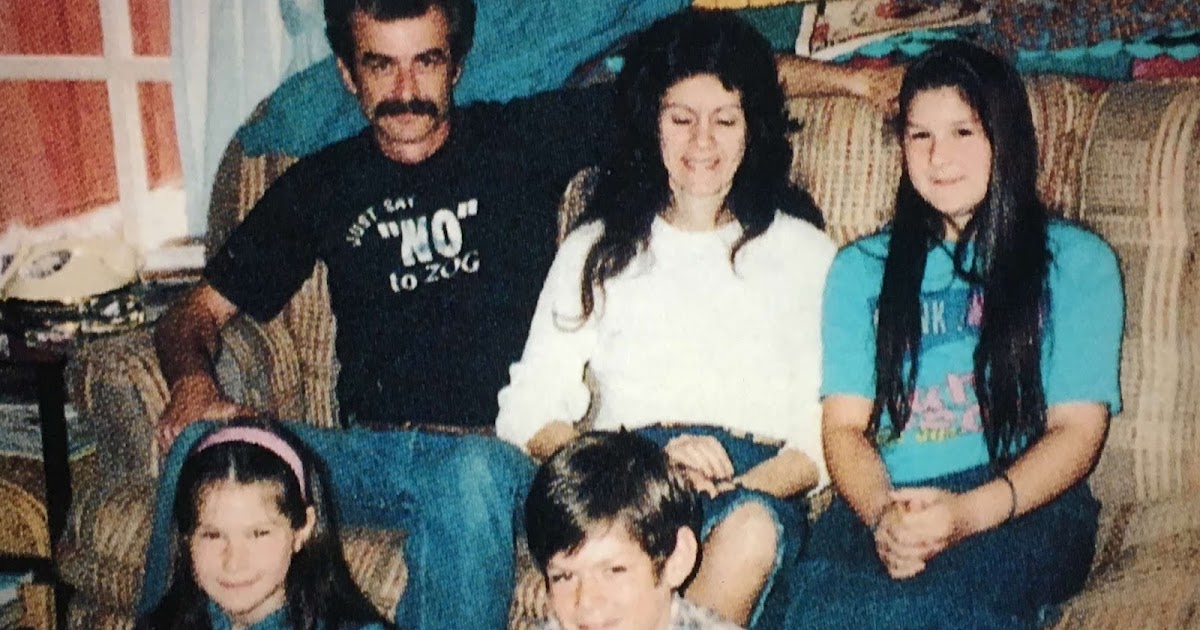
Randy Weaver was not a white advocate, he was a white separatist who didn’t want to be bothered. However, ZOG came looking for him.
One of the targets was Randy Weaver, who lived in a cabin nearby. Weaver was enticed by an undercover agent to saw off the barrel of a shotgun. When the agent promised to drop the charges stemming from this illegal act in exchange for him becoming an informant, Weaver refused. Later, a scheduling snafu regarding Weaver’s court date caused Weaver to miss his hearing which led, ultimately to a shootout with US Marshals in which Weaver’s son killed and another young man injured, and then a siege during which Weaver’s wife was shot by an Oriental sniper.
Gritz went to Idaho at the request of several Rightist Christian ministers. He ended up serving as a go-between the FBI and the Weaver family and helped end the siege. Gritz had a history with the Bush administration. In 1989, he’d been the victim of lawfare directed by Bush after he and Ross Perot made drug smuggling accusations against Dick Armitage.
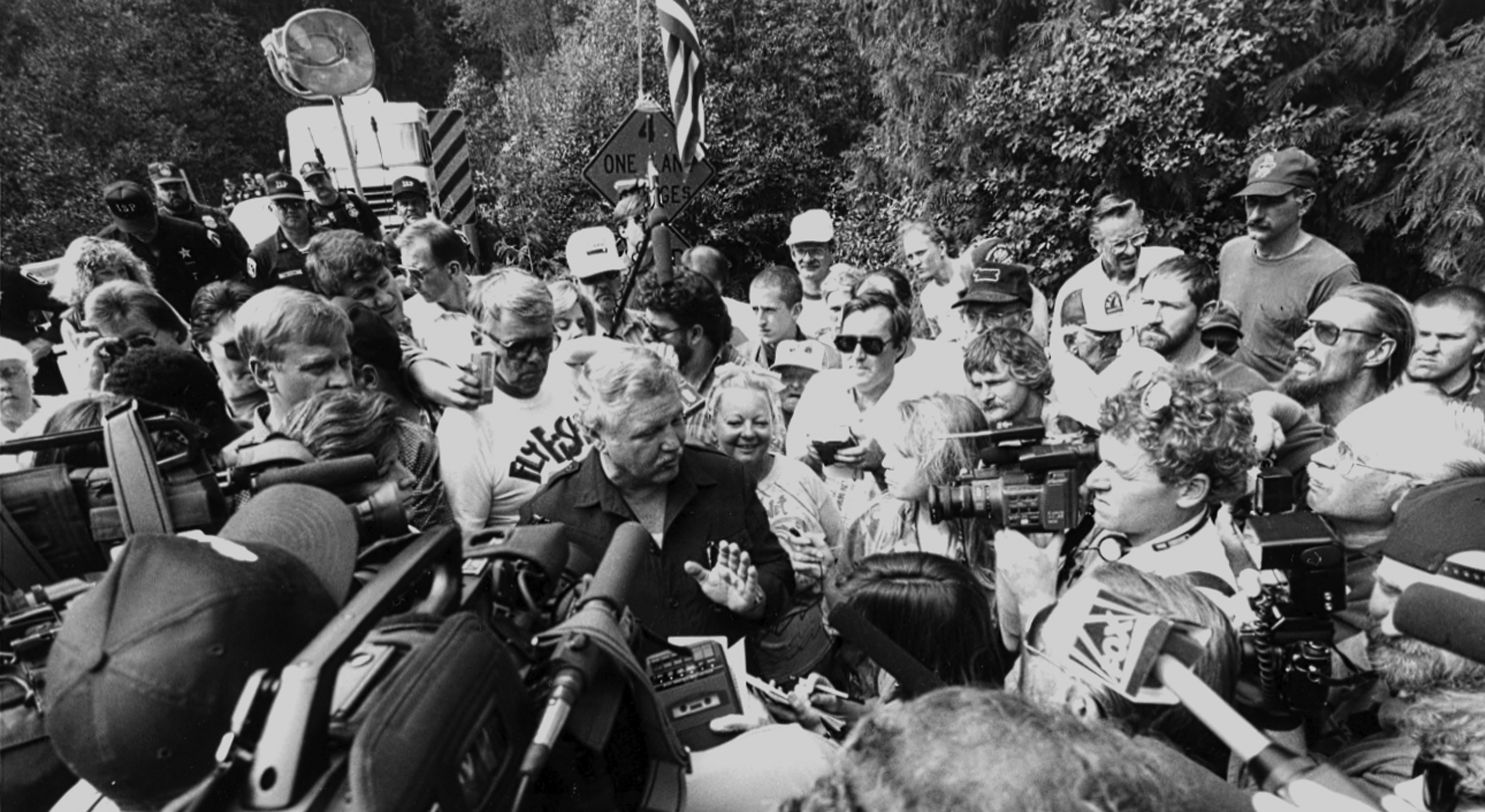
Ross Perot, whose Third Party presidential run destroyed George H.W. Bush’s chances at re-election, was, through Bo Gritz, only one degree of separation from Randy Weaver.
So, when Ross Perot ran against Bush in 1992, he was, through Gritz, only one degree of separation from Randy Weaver, who was aware of the Jewish Question. Perot had also seen the lawfare against Gritz, therefore Perot’s claims of Bush carrying out dirty tricks, like using the FBI to spy on his children were not so far-fetched.
The lawfare wave which started in the late 1980s, when Reagan was cognitively declining and dealing with Iran-Contra, and continuing through the Bush 41 administration didn’t end until after Clinton was sworn in. The four LA policemen unjustly tried by Bush’s prosecutors for violations of Rodney King’s “civil rights” ended with a guilty verdict on 25 February 1993. The lawfare against Christian Identity minister Peter J. Peters for his advertisement against a homosexual bill ended with a police raid on his church on 26 February 1993. On the 28th, of that month the Bureau of Alcohol, Tobacco, and Firearms raided a “cult compound” in Waco to gain publicity. The raid ended badly.
Meanwhile, on 26 February 1993, while the US Justice Department continued to carry out its Bush-fueled lawfare against white Americans, Islamic terrorists made their first attempt to bring down the Twin Towers of New York’s World Trade Center. In October 1993, US Army soldiers were killed in an unexpected battle in Mogadishu, Somalia. The troops had been deployed there by Bush after he’d lost the 1992 election The deployment itself could have been a deliberate act of spite on Bush’s part. Involvement in Somalia was and is absolutely unnecessary and damaging to whites. President Clinton, who was president by this time, therefore paid the price for his predecessor’s poor decisions.
Bush’s problems show just how important and influential the efforts of white advocates and the genuine far-Right and white advocates are. Most, if not all successful white advocates tend to be talented at other things, so they punch above their weight in social influence. Then, white advocates don’t teach their ideology to anyone. Instead, white advocacy is learned by intelligent people noticing patterns who then go looking for answers provided by the genuine far-Right. The propaganda surrounding a guy getting loan to get “out of a ghetto” melts in the face of reality. George H.W. Bush, shrouded in a cocoon of a lucky break while in the military, inherited wealth, and naive views of non-whites, allowed his bureaucracy to go to war against Rightists and white advocates, and his presidency was destroyed as a result.
Notes
[1] The split between the two wings of that party is partially the reason why President Kennedy was in Dallas on 22 November 1963, where his motorcade passed the location where a self-radicalized antifa gunman stood by, ready to murder him. Kennedy had won Texas in 1960 through election fraud, so it was critical for Kennedy to keep the feuding wings together in 1963 so that a second fraud could occur should it be necessary.
[2] Jon Meacham, Destiny and Power: The American Odyssey of George Herbert Walker Bush, (New York: Random House, 2015) p. 138
[3] ibid. p. 148
[4] Greg Grandin, The End of the Myth: From the Frontier to the Border Wall in the Mind of America, (New York, Metropolitan Books, 2019) p. 228
[5] The Democratic Party had a very hard time finding an issue to use against Ronald Reagan during the 1984 election. Eventually they made the homosexual agenda a key plank. In the mid-1980s, the AIDS crisis was at its peak. The disease was 100% fatal and had no known cure or treatment. The Democratic Convention was held in San Francisco – which was ground zero for the AIDS crisis. Although the Democratic Party lost, the homosexual activists won. After 1984, homosexuals moved from victory to victory. Having an issue at the national political level is the first step towards that issue’s victory even if it goes down to electoral defeat in the short term.
Bibliography
Kathleen Belew, Bring the War Home: The White Power Movement and Paramilitary America, (Cambridge, Massachusetts: Harvard University Press, 2018)
H.W. Brands, Reagan: The Life, (New York: Doubleday, 2015)
Greg Grandin, The End of the Myth: From the Frontier to the Border Wall in the Mind of America, (New York: Metropolitan Books, 2019) p. 228
Bo Gritz, Called to Serve (Sandy Valley, Nev.: Lazarus Publishing, 1991)
Bo Gritz, My Brother’s Keeper (Sandy Valley, N. V.: Lazarus Publishing, 2003)
Jon Meacham, Destiny and Power: The American Odyssey of George Herbert Walker Bush, (New York: Random House, 2015)
Gerald Posner, Citizen Perot: His Life & Times, (New York: Random House, 1996)
1 comment
The 1990s were probably the last time that a straight up political solution was feasible to secure the interests of White Americans. This decade was in the aftermath of the two popular Reagan terms, the demoralization of the international Left in the wake of the dissolution of the Soviet Union, the rise of rightwing talk radio personalities like Rush Limbaugh, and even Bill Clinton was pushing welfare reform and war on crime.
What conservatives could have done at this point included:
_ Passing laws prohibiting affirmative action.
_ Defunding university ethnic studies programs which were becoming fronts for anti-White agitprop.
_ Supporting the proto-ethno-nationalist factions on the Right (some of which were mentioned in the article) as well as forming a militant student movement to regain control of the campuses.
_ And oh yeah, closing the border.
Having had some experience in campus activism at this time, I’ll observe that such programs would have had widespread support. Many students were fed up with the Left and there was still a pretense of Free Speech. Many right activists were looking to launch a counteroffensive in the emerging culture war. What was lacking was national level leadership and organization.
The above listed policies would have undercut the emerging Left base in identity politics which have come to dominate political culture today. Bear in mind that at this time White people still had a considerable demographic edge in America while patriotism was still the “in” thing. But the conservatives cucked out and that’s one reason Whites face an historical crisis today.
Let me add one more item to the above list:
_Provide American support to White run South Africa.
Comments are closed.
If you have a Subscriber access,
simply login first to see your comment auto-approved.
Note on comments privacy & moderation
Your email is never published nor shared.
Comments are moderated. If you don't see your comment, please be patient. If approved, it will appear here soon. Do not post your comment a second time.