Counter-Currents
  • Advertise
  • Private Events
  • T&C
  • About
  • Contact
  • RSS
    • Main feed
    • Podcast feed
    • Videos feed
    • Comments feed
  • Welcome
  • Webzine
  • Books
  • Merch
  • Podcasts
  • Videos
  • Donate
  • Patrons
  • Subscribe
  • Crypto

LEVEL2

Donate Now Mailing list

Writers of May

(2 votes) Morris van de Camp David M. Zsutty Derek Stark Jayant Bhandari Greg Johnson

Articles of May

The Lunch Wars by David M. Zsutty Heidegger on Nietzsche, Part One by Collin Cleary 2 votes
  • Welcome
  • Webzine
  • Books
  • Merch
  • Podcasts
  • Videos
  • Donate
  • Patrons
  • Subscribe
  • Crypto
    • Small Is Beautiful:
      The Napoleon of Notting Hill and G. K. Chesterton Upon Defending One’s Homeland from Others—and Itself

      Steven Tucker

      2

    • The Psychology Behind MrBeast’s Moronic Thought Experiment

      Endeavour

      9

    • On the Roots of Anti-Immigrant Sentiment in Contemporary Britain

      Lipton Matthews

      6

    • Remembering Enoch Powell:
      June 16, 1912–February 8, 1998

      Greg Johnson

      15

    • Counter-Currents Radio Podcast No. 691
      Rob Rundo Returns

      Counter-Currents Radio

    • The Fragile Polity that is Syria

      Morris van de Camp

      2

    • Nigel Farage Calls Britain a Two-Tier State

      Mark Gullick

      4

    • Nationalism This Week
      Letter to J. D. Vance

      Greg Johnson

      32

    • Lost In Trans-Mission:
      How the Media Fails To Reveal the Inconvenient Truth About the Usual Suspects

      Steven Tucker

      10

    • Liar, Liar, Pants on Fire!

      Beau Albrecht

      7

    • Editor’s Update
      Rob Rundo on Counter-Currents Radio, Fundraiser Update, & a New $20,000 Matching Grant

      Greg Johnson

    • The Bitter End of Western Metaphysics:
      Heidegger on Nietzsche, Part Three

      Collin Cleary

      10

    • Uncivil War

      Mark Gullick

      50

    • Exclusive Interview with Karel Veliky:
      The Final Chapter in the Film Series! Part II

      Ondrej Mann

      2

    • Happy Birthday to Us!

      Greg Johnson

      6

    • Zsutty’s Maximum

      David M. Zsutty

      16

    • Exclusive Interview with Karel Veliky:
      The Final Chapter in the Film Series! Part I

      Ondrej Mann

      2

    • The Union Jackal, June 2026

      Mark Gullick

      23

    • The Inferiority Behind Immigrant Superiority

      Jayant Bhandari

      15

    • Counter-Currents Radio Podcast No. 690
      Greg Johnson & David Zsutty Discuss Current Things: AI, Henry Nowak, the Iran Crisis, & More

      Counter-Currents Radio

      7

    • Collin Cleary: What Rome Means to Me

      Collin Cleary

      4

    • Paul Krugman: Closet Bolshevik

      Spencer J. Quinn

      21

    • Fugue of Ideas:
      Ibram X. Kendi’s Chain of Ideas

      Greg Johnson

      19

    • Based Blacks

      Lipton Matthews

      24

    • Black Intellectual Fatigue

      Derek Stark

      41

    • Why White Advocates Should Avoid “Based Blacks”

      Dani Vypont

      32

    • Nietzsche & Race

      Mark Gullick

    • Editor’s Update
      Rob Rundo Rescheduled to Next Week on Counter-Currents Radio;
      Tonight Greg Johnson & David Zsutty Answer Your Questions;
      Fundraiser Update & a New $20,000 Matching Grant

      Greg Johnson

    • The Counter-Currents 2026 Fundraiser
      Lifetime Subscriber Welcome Packages Extended

      Greg Johnson

    • Nationalism This Week
      Who’s Looking Back?

      Greg Johnson

      29

    • China’s Threat to American Security:
      Food, Farmland, Foreign Control, & Energy Policy

      Lipton Matthews

      5

    • The Bitter End of Western Metaphysics:
      Heidegger on Nietzsche, Part Two

      Collin Cleary

      16

    • The Killing of Henry Nowak

      Mark Gullick

      38

    • The Crisis of Chinese Technology Thieves

      Morris van de Camp

      1

    • The Strange World of Gender Bender Fiction:
      & What This Genre Tells Us About Autosexuality

      Dani Vypont

      3

    • Watching the Watchers:
      The Dark Triad Question

      David M. Zsutty

      14

    • The Remigration Movement Solidifies

      F. Roger Devlin

      2

    • Casting Aspersions:
      The Fatal Consequences of Race-Swapped Casting, From Helen of Troy to Henry of Southampton

      Steven Tucker

      20

    • The Murder of Henry Nowak

      Millennial Woes

      23

    • Don’t Forget to Vote in Our Writer & Article of the Month Poll

      Greg Johnson

    • The Robot Hotdog Stand

      Greg Johnson

      37

    • Laughing Our Way to Victory

      Dave Chambers

      7

    • The Zodiac Killer

      Mark Gullick

      11

    • Jared Taylor: What Rome Means to Me

      Jared Taylor

      1

    • An Interview with Endeavour:
      My Way of Life Is an Adventure!

      Ondrej Mann

      6

    • José Pedro Zúquete’s The Identitarians

      Greg Johnson

      3

    • Editor’s Update
      Fundraiser Update & How to Watch the Remigration Summit

      Greg Johnson

      5

    • The Bitter End of Western Metaphysics:
      Heidegger on Nietzsche, Part One

      Collin Cleary

      12

    • Berlin: City of Stones

      Spencer J. Quinn

      6

    • True Folk-Horror Is Horror of Your Own Folk:
      Mark Gatiss vs the Brexit Blind Dead  

      Steven Tucker

      4

    • Beau Albrecht

      Remembering Enoch Powell:
      June 16, 1912–February 8, 1998

      At the time, Britain was still only experiencing the thin end of the wedge as far as migration goes...

    • Peter Quint

      Remembering Enoch Powell:
      June 16, 1912–February 8, 1998

      Okay, so he has two White Nationalist speeches to his credit. 🦈

    • Livla

      The Psychology Behind MrBeast’s Moronic Thought Experiment

      From a biological perspective, this thought experiment is the equivalent of a selection event that...

    • Adrian Roberts

      Remembering Enoch Powell:
      June 16, 1912–February 8, 1998

      In Mein Kampf, Hitler argued that the side which makes war inevitable is the side most responsible...

    • Adrian Roberts

      Remembering Enoch Powell:
      June 16, 1912–February 8, 1998

      So the English owe everybody reparations? Damn.

    • Wasili

      The Psychology Behind MrBeast’s Moronic Thought Experiment

      Great article!  Indeed, the following point can’t be emphasized enough: The [insert non-white...

    • Will Williams

      On the Roots of Anti-Immigrant Sentiment in Contemporary Britain

      Ecological experts call the replacement of one species by another as habitat succession. In my...

    • Douglas Mercer

      Remembering Enoch Powell:
      June 16, 1912–February 8, 1998

      In 1977 Powell gave a speech called The Road To National Suicide: “On the other hand there are at...

    • JayeRyanOD

      The Fragile Polity that is Syria

      I strongly support ex Syrian President Assad supported by my kinsmen the Russians . Before the...

    • Joe Gould

      The Psychology Behind MrBeast’s Moronic Thought Experiment

      I don’t see the decline of real, useful work as alarming or surprising, rather it is inevitable.We...

    • E_Perez

      On the Roots of Anti-Immigrant Sentiment in Contemporary Britain

      A little soft, the article, especially when its title promised to go to the roots. "The...

    • Elear

      Small Is Beautiful:
      The Napoleon of Notting Hill and G. K. Chesterton Upon Defending One’s Homeland from Others—and Itself

      A wonderful essay about things so small yet so precious. Fighting off the invaders is meaningless if...

    • Quu

      The Psychology Behind MrBeast’s Moronic Thought Experiment

      Thank you, yes, it's very interesting, revealing a predisposition that isn't globally normal, and...

    • The Laughing cavalier

      Remembering Enoch Powell:
      June 16, 1912–February 8, 1998

      It was England who declared war - both times - and neither time was England under any threat. It'...

    • TheLau ghin gCavalier

      The Psychology Behind MrBeast’s Moronic Thought Experiment

      A version of this scenario did the rounds on 4chan where red was "nothing happens" and blue was "50...

    • Peter Quint

      Small Is Beautiful:
      The Napoleon of Notting Hill and G. K. Chesterton Upon Defending One’s Homeland from Others—and Itself

      The Secret People G. K. ChestertonThey have given us into the hands of new unhappy lords,Lords...

    • Douglas Mercer

      Remembering Enoch Powell:
      June 16, 1912–February 8, 1998

      The UK now has 19 percent non-White which is more than double what it had in 2001 which was 8...

    • Lexi

      Nationalism This Week
      Letter to J. D. Vance

      They irrationally love Trump; their support for JDV is only an extension of this. Who loves JDV for...

    • Adrian Roberts

      The Psychology Behind MrBeast’s Moronic Thought Experiment

      I puzzled over the thought experiment for several minutes before reading the rest of the article....

    • Scott

      Remembering Enoch Powell:
      June 16, 1912–February 8, 1998

      I'm not an expert on postwar Albion, but I think the impressive colored invasion there is mostly a...

    • Earth Day Special

      John Morgan

      12

    • A Robertson Roundup
      Remembering Wilmot Robertson
      (April 16, 1915 – July 8, 2005)

      Margot Metroland

      13

    • The Paranoid Style in White Nationalism

      Greg Johnson

      30

    • Join the Dance!

      Andrew Hamilton

      1

    • We Can’t Save the Earth Without Reducing African Birth Rates

      James Dunphy

      36

    • “I’m Not a Conspiracy Theorist, but . . .”:
      Jeffrey Epstein’s Death Gives New Life to “Conspiracy Theories”

      Greg Johnson

      22

    • Sylvia Plath: Stasis in Darkness

      Vic Olvir

      17

    • Vanguardism, Vantardism, & Mainstreaming

      Greg Johnson

      80

    • Aviation, Geography, & Race

      Charles Lindbergh

      3

    • Some Thoughts on Yule

      Collin Cleary

      4

    • Living in Truth:
      A Yuletide Homily

      Jef Costello

      7

    • John Kennedy Toole’s A Confederacy of Dunces

      Greg Johnson

      20

    • On Aleksandr Solzhenitsyn’s Warning to the West

      Spencer J. Quinn

      7

    • Elitism, British Modernism, & Wyndham Lewis

      Jonathan Bowden

      6

    • Philip K. Dick’s Do Androids Dream of Electric Sheep? as Anti-Semitic/Christian-Gnostic Allegory

      Greg Johnson

      20

    • “Conspiracy Theory” or Conspiracy?

      Andrew Hamilton

      21

    • Remembering H. P. Lovecraft
      (August 20, 1890–March 15, 1937)

      Greg Johnson

      3

    • Who Are We?
      Nordics, Aryans, & Whites

      Greg Johnson

      71

    • Remembering William Gayley Simpson
      (July 23, 1892–December 31, 1990)
      A Pleasant Afternoon with Harriet & Bill Simpson

      Margot Metroland

      18

    • Here are the Young Men
      Remembering Ian Curtis
      (July 15, 1956–May 18, 1980)

      Mark Gullick

      18

    • Percy Grainger
      Artist of the Right

      Alex Graham

      7

    • Remembering Revilo Oliver
      (July 7, 1908–August 20, 1994)

      Greg Johnson

      18

    • The Meaning of July 4th for the White Man

      Gregory Hood

      13

    • The Front National’s Evolution

      Bruno Mégret

    • Merwin K. Hart
      Forgotten American Hero & Man of the Right

      Morris van de Camp

      10

    • George Orwell’s Nineteen Eighty-Four

      Jonathan Bowden

      8

    • Carleton S. Coon
      Scientist & Reluctant White Advocate

      Morris van de Camp

      3

    • The Kwanzaa Absurdity Will Be Dwarfed by Juneteenth

      Robert Hampton

      10

    • Stravinsky

      Alex Graham

      7

    • Like the Roman:
      Remembering Enoch Powell (1912-1998)

      Mark Gullick

      23

    • The 1970s: The Golden Age of Hijacking

      Morris van de Camp

      21

    • Jonathan Bowden’s Deliverance
      Part 6

      Jonathan Bowden

    • Do You Want to Play a Game?

      Mark Gullick

      1

    • Sexually Incontinent on the Indian Subcontinent:
      Who Rapes More Animals, Indians or Pakistanis? The Battle Continues!

      Steven Tucker

      3

    • Neo-Fascism in Film
      Part 5

      Karel Veliky

      15

    • The Game of Tarot

      Mark Gullick

      2

    • Institutions Cannot Be Transplanted

      Jayant Bhandari

      5

    • Jonathan Bowden’s Deliverance
      Part 5

      Jonathan Bowden

    • Crosstown Traffic:
      Jimi Hendrix & The Post-War Rock ‘N’ Roll Revolution

      Mark Gullick

      1

    • Slaves from the North:
      Finns & Karelians in the East European Slave Trade, 900–1600

      Lipton Matthews

      14

    • Neo-Fascism in Film
      Part 4

      Karel Veliky

      2

    • David Lean’s A Passage to India

      Spencer J. Quinn

      1

    • Elites are Essential to Development

      Lipton Matthews

      7

    • Jonathan Bowden’s Deliverance
      Part 4

      Jonathan Bowden

    • Neo-Fascism in Film
      Part 3

      Karel Veliky

      6

    • E. M. Forster’s A Passage to India & the Indian Mentality

      Spencer J. Quinn

      25

    • Jonathan Bowden’s Deliverance
      Part 3

      Jonathan Bowden

    • The Rest Is Silence
      Heidegger’s Quietism

      Mark Gullick

      2

    • Dispelling the Historical Fallacy of Indian Nationalism

      Lipton Matthews

      8

    • Neo-Fascism in Film
      Part 2

      Karel Veliky

      8

    • Jonathan Bowden’s Deliverance
      Part 2

      Jonathan Bowden

    • Life of a Klansman

      Mark Gullick

      8

    • Jonathan Bowden’s Deliverance, Part 1

      Jonathan Bowden

    • Decolonial Ideas are Holding Back Developing Countries

      Lipton Matthews

      8

    • Neo-fascism in Film, Part 1

      Karel Veliky

      21

    • Jonathan Bowden’s Onslaught, Part 8
      Divigations on Decadence

      Jonathan Bowden

    • Jonathan Bowden’s Onslaught, Part 7
      Intrigues in the National Front

      Jonathan Bowden

      1

    • Rotten to the Core

      Mark Gullick

      8

    • Strauss on Husserl’s “Philosophy as Rigorous Science”

      Greg Johnson

    • Jonathan Bowden’s Onslaught, Part 6
      Francis Bacon & Right-Wing Nihilism

      Jonathan Bowden

    • András László
    • Derek Hawthorne
    • Beau Albrecht
    • Alain de Benoist
    • Kerry Bolton
    • Jonathan Bowden
    • Collin Cleary
    • Jef Costello
    • Savitri Devi
    • Julius Evola
    • Jim Goad
    • Gregory Hood
    • Juleigh Howard-Hobson
    • Greg Johnson
    • Charles Krafft
    • Anthony M. Ludovici
    • Trevor Lynch
    • H. L. Mencken
    • J. A. Nicholl
    • James J. O’Meara
    • Christopher Pankhurst
    • Tito Perdue
    • Michael Polignano
    • Spencer J. Quinn
    • Fenek Solère
    • Irmin Vinson
    • Leo Yankevich
    • Francis Parker Yockey
    • Multiple authors
  • Editor-in-Chief

    • Greg Johnson, Ph.D.

    Featured Writers

    • Beau Albrecht
    • Gunnar Alfredsson
    • Collin Cleary, Ph.D.
    • Jef Costello
    • Morris V. de Camp
    • F. Roger Devlin, Ph.D.
    • Stephen Paul Foster, Ph.D.
    • Jim Goad
    • Alex Graham
    • Mark Gullick, Ph.D.
    • Greg Johnson, Ph.D.
    • Travis LeBlanc
    • Trevor Lynch
    • Margot Metroland
    • James J. O’Meara
    • Angelo Plume
    • Spencer J. Quinn
    • Fred Reed
    • Clarissa Schnabel
    • Michael Walker
    • David M. Zsutty

    Frequent Writers

    • Asier Abadroa
    • Aquilonius
    • Alain de Benoist
    • Kerry Bolton, Ph.D.
    • Dave Chambers
    • Steven Clark
    • James Dunphy
    • Endeavour
    • Richard Houck
    • Jason Kessler
    • Titus Livius
    • Ondrej Mann
    • Lipton Matthews
    • Mark Mazari
    • John Morgan
    • Jaroslav Ostrogniew
    • Kathryn S.
    • Christian Secor
    • Anne Wilson Smith
    • Thomas Steuben
    • William De Vere
    • Kenneth Vinther
    • Max West

    Classic Authors

    • Maurice Bardèche
    • Jonathan Bowden
    • Julius Evola
    • Guillaume Faye
    • Ernst Jünger
    • Kevin MacDonald, Ph.D.
    • D. H. Lawrence
    • Charles Lindbergh
    • Jack London
    • H. P. Lovecraft
    • Anthony M. Ludovici
    • Sir Oswald Mosley
    • National Vanguard
    • Friedrich Nietzsche
    • Revilo Oliver
    • William Pierce
    • Ezra Pound
    • Saint-Loup
    • Savitri Devi
    • Carl Schmitt
    • Miguel Serrano
    • Oswald Spengler
    • P. R. Stephensen
    • Jean Thiriart
    • John Tyndall
    • Dominique Venner
    • Leo Yankevich
    • Francis Parker Yockey

    Other Authors

    • Howe Abbott-Hiss
    • Michael Bell
    • Giles Corey
    • Jack Donovan
    • Richardo Duchesne, Ph.D.
    • Emile Durand
    • Guillaume Durocher
    • Mark Dyal
    • Tom Goodroch
    • Andrew Hamilton
    • Robert Hampton
    • Huntley Haverstock
    • Derek Hawthorne
    • Gregory Hood
    • Juleigh Howard-Hobson
    • Alexander Jacob
    • Ruuben Kaalep
    • Tobias Langdon
    • Julian Langness
    • Patrick Le Brun
    • G A Malvicini
    • John Michael McCloughlin
    • Millennial Woes
    • Michael O’Meara
    • Christopher Pankhurst
    • Michael Polignano
    • J. J. Przybylski
    • Quintilian
    • Edouard Rix
    • C. B. Robertson
    • C. F. Robinson
    • Herve Ryssen
    • Alan Smithee
    • Fenek Solere
    • Ann Sterzinger
    • Robert Steuckers
    • Tomislav Sunic
    • Donald Thoresen
    • Marian Van Court
    • Irmin Vinson
    • Book Reviews
    • Movie Reviews
    • TV Reviews
    • Music Reviews
    • Art Criticism
    • Graphic Novels & Comics
    • Video Game Reviews
    • Fiction
    • Poems
    • Interviews
    • Videos
    • English Translations
    • Other Languages
      • Arabic
      • Bulgarian
      • Croatian
      • Czech
      • Danish
      • Dutch
      • Estonian
      • Finnish
      • French
      • German
      • Greek
      • Hungarian
      • Italian
      • Lithuanian
      • Norwegian
      • Polish
      • Portuguese
      • Romanian
      • Russian
      • Slovak
      • Spanish
      • Swedish
      • Ukrainian
    • Commemorations
    • Why We Write
  • Archives
  • Top 100 Commenters
  • The Looney Bin
  • Advertise
  • Private Events
  • T&C
  • About
  • Contact
  • RSS
    • Main feed
    • Podcast feed
    • Videos feed
    • Comments feed
Sponsored Links
Europa.com Above Time Coffee Antelope Hill Publishing Paul Waggener IHR-Store Spencer J. Quinn American Renaissance Jim Goad The Occidental Observer
Print May 7, 2026 2 comments

The Game of Tarot

Mark Gullick

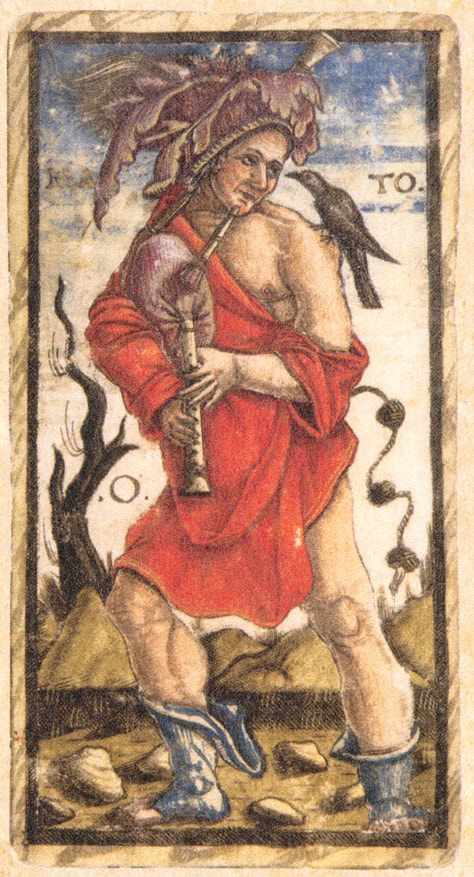
The Fool from the Sola Busca deck.

3,533 words

“Tarot” is a strange word because everyone and no one knows what it means. Ask anyone over 20 what “Tarot” means, and the likelihood is that they will recognize it in the simplest, most popular way; A deck of cards which can tell the future. Like so many modern myths, that is misleading on both counts. Although there are decks of Tarot cards, and they predated its study, Tarot is also the school of thought behind the meaning of the cards, rather than just the cards themselves and any simple meanings which might become attached to them. And they certainly can’t tell the future. They can, however, help to make sense of the present. It was predictable that Carl Jung would have taken a passing interest in Tarot, and he strips it of its divinatory reputation:

[W]e can predict the future, when we know how the present moment evolved from the past.

Tarot is culturally important in different ways. Historically, it is a conundrum which has been all but academically abandoned. It is aesthetically very beautiful, and yet tied inexorably to the occult. Where did these strange cards come from?

The first point of interest in the history of the Tarot is that no one can agree what it is. Richard Cavendish, in his beautifully illustrated 1975 book, The Tarot, gives a picture of confusion when it comes to the provenance of the cards:

All sorts of theories and legends have gathered round the cards, because of their puzzling but enticing symbolism and the uncertainty of their origin. It has been said that they came from China or India or Persia, that they were brought to the West by the gypsies, or by returning Crusaders, or by the Arab invaders of Sicily or Spain, or alternatively that they had nothing to do with the East and were invented in Europe.

A suitably mysterious and shrouded beginning for a pack of cards which would later be used by every famous occultist from the 18th century onwards.

The appearance of Tarot cards in Europe can be roughly dated by noting which famous authors don’t mention the cards. Petrarch, Boccaccio, and Chaucer make no mention of them in the 14th century, and would surely have done so had they seen them. By the 16th century, however, the first verifiable progenitor of today’s deck appears, and the Venetian or Piedmontese Tarot would become the more familiar Marseille deck. The Catholic Church kept a watchful eye over this new fad, pressuring the producers of the decks to change certain cards—The Pope, Female Pope, Empress, and Emperor—into other figures. The same redaction would be practiced by French Tarot producers during the Revolution in 1789, who would be careful to remove the heads from the four kings. Perhaps it was the Church’s reliance on pictorial symbolism (as a religion of the largely illiterate) that made it so suspicious of what was, at the time, simply a game. The Catholic Church was not amused by the game of Trionfi—or “Trumps”—perhaps suspecting that the cards would one day be put to diabolical use. Referring to the Tarot deck as “the Devil’s picture-book,” the Church even placed Tarot cards on their list of forbidden books, the index prohibitorum. The Church’s suspicions echo centuries later, as T. S. Eliot, in The Waste Land, depicts “Madame Sosostris… With a wicked pack of cards.” Eliot goes on to describe a very strange three-card layout which has puzzled Tarot scholars ever since, and which he provides a footnote on. Eliot’s mystery woman was of course, using the cards for divination. At what point did Tarot go from being a game to being an occult sideshow?

Ronald Decker and Michael Dummett find the origin of the use of Tarot for divination in A History of the Occult Tarot:

Modern cartomancy arose only in the XVIIIth century: packs of cards were shuffled, dealt and spread in prescribed formats for telling the future. The earliest instance of Tarot cartomancy occurred in Bologna, but the familiar variety, surviving today, descends from French fortune-tellers.

The use of Tarot cards as a fortune-telling device, although present from the early 18th century, only came to prominence academically in the 19th century via the work of Éliphas Lévi and Antoine Court du Gébelin, and so the greater part of Tarot’s history was indeed as a game, Tarocchi in Italian, and Tarok in France. So, divination begins as a parlour-game which itself is descended from an intellectual game on a par with chess. It is in fact Michael Dummett who writes most convincingly on this in his book, The Game of Tarot. Carlo Penco, who met the philosopher at a conference in Sicily in 1991, was interested to hear that Dummett was interested in Tarot, and questioned him as to why. The young man received a terse reply:

I have no interest in the divinatory use of Tarot cards; it is completely spurious and has no connection with the origin of the game.

Dummett was more interested in Tarot as system, and we will have to have a brief look at the composition of the Tarot deck to understand what that system is.

There is a first and obvious correspondence between Tarot cards and any ordinary casino deck you would see today, and that is the equivalence of the suits:

Spades = Swords.
Hearts = Cups.
Clubs = Wands.
Diamonds = Coins (also Pentacles or Disks).

With the Tarot deck, the pip cards are the same, ace to ten, but it is when we arrive at court that things change. Whereas today’s club deck has Jack-Queen-King, the Tarot suit has Page-Knight-Queen-King. We have added some cavalry to the deck. So much for the Minor Arcana. It is the Major Arcana that is the real mystery of the Tarot.

The 22 Major Arcana cards in a standard Tarot deck are as follows:

0. The Fool.
1. The Magician.
2. The High Priestess (also, The Female Pope).
3. The Empress.
4. The Emperor.
5. The Pope.
6. The Lovers.
7. The Chariot.
8. Strength.
9. The Hermit.
10. The Wheel of Fortune.
11. Justice.
12. The Hanged Man.
13. Death.
14. Temperance.
15. The Devil.
16. The Falling Tower.
17. The Star.
18. The Moon.
19. The Sun.
20. Judgment.
21. The World.

Some packs have minor differences. Aleister Crowley’s reverses the positions of Strength and Justice, for example. Also, the use of Zero for The Fool has caused disputes about order. But these are the type of tiny academic fire-fights you will get in any field of study. It is part of the enjoyment of Tarot to compare systems and observations.

The Minor Arcana, then, are almost exactly the same as our familiar pack of cards, with the simple addition of the Knight. The Major Arcana, although more famous, are far more unfamiliar, and it is the mystery of their addition to the basic deck that interests Dummett, although from the point of view of Tarot as a game and not as a tool of divination, fortune-telling or cartomancy. Dummett views the cards as “clear and unclouded by the smoke of the sorcerer’s incantations.”
You can buy James J. O’Meara’s Mysticism After Modernism here.

The Major Arcana were originally known as Triumphs, Trionfi in Italian, and Dummett’s question is; what are these cards doing in their additional role to a pack of cards clearly used for gaming, if that explanation does not have an occult or magical answer, as he believes they do not? His answer is a philosophical one, and will take us into the idea—an important one in Tarot—of correspondences, that is, the cards viewed not merely in isolation with simple meanings that can be read off, but elements in a game that have different meanings or implications depending on their relation to one another. And so Dummett had no interest in Tarot cards as some sort of Mystic Meg, the famous 1980s British TV fortune-teller. He saw divinatory use of the cards as useless in and of itself. But he didn’t see what it signified philosophically as useless.

The “fallen” nature of the Tarot, from a complex game of strategy to a slightly scary parlor-game for bored ladies, like an Ouija board, is often a subject for remorse. Jessie Weston’s book on the Grail legend, From Ritual to Romance, is one of those books that stars briefly in the movies, turning up as it does on the bedside table of Brando’s Kurtz in Apocalypse Now. Ms. Weston also regrets the cheapening of a game with intellectual depth rather than a parlor-trick:

Today the Tarot has fallen somewhat into disrepute, being principally used for purposes of divination, but its origin, and precise relation to our current playing-cards, are questions of considerable antiquarian interest. Were these cards the direct parents of our modern pack, or are they entirely distinct therefrom.

There is a feeling among many who have studied Tarot that its transformation from being a game played with beautiful cards into some occult mystery was simply an operetta composed and performed by men who thought they were magicians, and not just the bored and idle rich with a book of spells. Tarot certainly feels more dignified as both game and subject of interest, and the idea that its use in the occult is somehow intellectually superior to its role in gaming is absurd. Penco writes, in Dummett and the Game of Tarot:

Certainly playing the original Tarot game in its variants is more difficult than playing with Major Arcana for the purpose of divination…

Games have a social history and an educational role. Children learn from games, both to develop social relations with other children, and also to learn that there are rules, in life as much as in playground games, which must be adhered to and with which all players must be in agreement. Watch children at play, see how seriously they take their games. Egyptian rulers used to do just that, watching the little ones at play and taking note of what they said and how they acted, seeing this apparently innocent gamboling as suggestions affecting the affairs of state. Why should Tarot not be a game children play? Could it be less instructive than whatever they waste their time with online? Jung suggests a role for the cards in just this way:

[The cards] combine in certain ways, and the different combinations correspond to the playful development of mankind.

Tarot cards are also things of great beauty. Some of the lush Minchiate packs (with more cards than the regular 78) of the 18th century are miniaturist works of art, like Renaissance lockets. Visually, the three most famous Tarot decks are the Marseille, the Rider-Waite-Smith, and the Crowley-Harris. While the Marseille deck dates back as far as the 15th century, and was probably originally produced using wood-blocks, the latter pair are from the 20th century, and both artists were women.

Pamela Colman Smith created the Rider-Waite-Smith deck in 1909. It had previously been simply the Rider-Waite deck, after its non-artistic creator, Arthur Rider-Waite. Waite was a member of the Hermetic Order of the Golden Dawn, as were Aleister Crowley and W. B. Yeats. This somewhat dubious organization was responsible in large part for nurturing the association between Tarot cards and the occult. At the Golden Dawn headquarters, Rider-Waite met Smith, who agreed to work on a new Tarot deck. Smith was a charming, slightly feral, elfin woman who enjoyed performing with a puppet theater she had had since childhood. Her early art had been influenced by the great French painter and lithographer, Odilon Redon, and the Rider-Waite-Smith deck has something of the cartoon about it, or at least the graphic novel. Perhaps the reason that the deck became so popular after World War 2 is explained by Dawn G. Robinson, the author of Pamela Colman Smith’s biography:

Tarot for the masses rather than simply occultists was a paradigm shift occurring in the late 1950s.

The artist who produced the paintings reduced to decorate Aleister Crowley’s deck couldn’t have been more different. Never an aristocrat by birth, Lady Frieda Harris insisted on her title, and was responsible for far more than the brushwork commissioned by the “Great Beast 666.” Crowley wanted her to design a traditional pack, but she persuaded him to incorporate his intellectual and cult pursuits into the cards. The Crowley-Harris deck is always seen as the most spectacular, the Rider-Waite-Smith the most “friendly.”

There are, of course, thousands of decks available today. There’s quite a Tarot industry out there, although the literature is a bit hippy-dippy for my tastes. What I would be interested in reading though, is the following. I Googled “Tarot therapy” and got dozens of hits, including an “extensive guide to Tarot use for psychotherapists in counselling.” Why not? I bet Big Pharma seethes at this sort of thing, which produces revenue for no one (except maybe Agmüller, the famous Swiss printers of Tarot decks).

Then there are the cards themselves seen not just as objets d’art, but as signs in a sign system which must be read off, must be interpreted if there is to be a system to study at all. And, if there is, then to study is to read.

It is said that Tarot cards are “read.” There is a reader, and a querent. And this act of reading symbols which tell of greater things is firmly within a tradition of the universe as a book. Galileo uses a famous image:

Philosophy is written in that great book which ever lies before our eyes – I mean the universe – but we do not understand it if we do not first learn the language and grasp the symbols, in which it was written.

There are several antiquarian but charming theories that Tarot is a “speculum mundi,” a mirror of the world, and that the cards and their combinations lead to higher things and more rarified realms of thought. In this way, the cards instruct the initiate not as to his future, but to the world in which he finds himself. The idea of a deck of cards providing an education was present as early as the 15th century in Europe, when a set of 50 instructional playing-cards were made and attributed to the great court artist, Andrea Mantegna.

To read is to be able to interpret signs. That is what is deficient in people who can’t read; they can see the signs, but they don’t know how to interpret them. They can’t process the meaningless letters they see on the page. And so the understanding of signs is vital at the base level of simple literacy. It is no small wonder that when given a mysterious deck of cards rather than another Victorian tract on metaphysics and the infinite, occultists headed for the card-table to begin the work of interpretation.

Aleister Crowley was a complex man, to put it very mildly. A drug addict and serial abuser of women, a mountaineer whose mistake on an expedition may have cost lives, and dubbed by the Daily Mail as the “wickedest man in the world,” Crowley’s writing on Tarot is among the finest in the field. Crowley centers his theory of Tarot on correspondences. This system has a long history, and is based around the working belief that things in the simple sense “correspond” with one another by virtue of differing orders of similarity. This can lead the student into as large a labyrinth as he cares to build. So we see Crowley, having forged a connection between The Fool card, zero, and the Egyptian vulture-goddess Maut (“The Fool” in many of the non-English Tarot decks is named “Le Mat” or “Il Mato”) whose legends are taken up by Crowley. The vulture has a spiral neck in myth, analogous to the form of the energy which comprises the universe. In a short paragraph, Crowley mentions Zoroaster and Einstein. Also, the vulture of legend procreates using the wind, and Crowley directs us to the Greek belief that life was inherent in the movement of air (Crowley is quite right to say this), and to the pre-Socratic school of the philosopher Anaximenes.

Everything, for Crowley, leads to everything else. This could lead to ontological confusion, to a lack of fixed study, but Crowley encourages the cross-pollination of legend as essential to the awakening of an image. In his great book on Tarot, The Book of Thoth, Crowley writes:

It has seemed convenient to deal separately with these main forms of the idea of The Fool, but no attempt has been made, or should be made, to prevent the legends overlapping and coalescing.

Crowley allows myth and legend, the zodiac and the Hebrew alphabet, the planets and the metals, to weave one another’s narratives around the others. For Crowley, the Tarot begins as a deck of cards and leads inwards, to the self, and outward, to the world.

The cards should never be taken at naïve face value, as the best Tarot scholars show. Here, Crowley is discussing the famous card number 6, The Lovers;

The subject of this card is analysis, followed by synthesis. The first question asked by science is: “Of what are things composed?” This having been answered, the next question is: “How shall we recombine them to our greater advantage?”

Compare this with an explanation of The Lovers from a contemporary online Tarot service:

The Lovers card symbolizes love, harmony, and relationships, and values alignment.

This is not to disparage the Tarot industry. It is far better to spend your time with Tarot cards than with much of the toxic pastimes the modern world has to offer. It’s not necessary to have a deep, esoteric understanding of Tarot, it can be relaxing and meditative in its own right.

P.D. Ouspensky, the Russian mystic philosopher and disciple of Gurdjeff, also writes superbly on Tarot. He sees that “this work could not have been invented by illiterate gypsies of the 14th century.” He also explains the simple appeal of the Tarot for purposes of divination:

The Tarot makes it possible to ‘seek gold’, ‘to evoke spirits’, and ‘to draw horoscopes’, simply by means of this pack of cards without the complicated paraphernalia and ceremonies of an alchemist, astrologer or magician.

Ouspensky has a point. Aside from the willow-stalk runes or coins of the I Ching, Tarot readers are able to travel light. Ouspensky’s explanations of the cards are more symbolic and traditionalist, different from Crowley’s pseudo-science. Here, his text does not describe the card, The Sun, as you might expect. Instead, it occurs during the meaning of the famous Death card:

The sun sinks at one point and rises at another. Each moment of its motion is a descent at one point and an ascent at another. It understood that it rises while sinking and sinks while rising, and that in life, in coming to birth, dies, and in dying, comes to birth.

To us, that may sound like hippie drivel. But it is a reminder that, at one time, the idea of death was inextricably linked in the pre-modern mind with the idea of rebirth. The Tarot card shows Death as the reaper, working in the field among scattered limbs, but also green shoots. For simpler souls than ours, the cards were moral homilies, not some crystal ball gimmick.

Unsurprisingly, Tarot has become the victim of the modern in that it is offered as a lifestyle choice, an appurtenance to make you seem special and somehow apart. The flimsy nature of much “new age” thought is responsible for this. Anything with a whiff of the occult, Kabbalah, the Ouija board, I Ching, runes, crystals and a whole inventory of mysterious “portal studies,” will always attract the woolly-minded and imprecise, those who find the modern world too intellectually demanding, or perhaps too insistent on them having gainful employment, and would prefer to retreat into a safe haven where nothing can be disproved.

But Tarot is really something far more than that. There is no need to stalk around like a pantomime villain, as members of the Hermetic Order of the Golden Dawn tended to, to study Tarot. I have studied it for 30 years, not intensely but as a sort of odd side-road off the main street of philosophy. I can read the cards but I rarely do, although I did once read for un brujo, a Nicaraguan witch, at a bar in San Carlos. Fairly scary, but a good snapshot for the memory. And the memory is something else the study of Tarot will assist.

I recommend anyone buy a Tarot deck. They are beautiful things to handle and look at. Who knows, you may find yourself arranging the Major Arcana cards into different orders to tell different stories, as an inquisitive scholar in 17th-century Europe would have done. A Tarot deck is a fascinating thing if you are a scholar, an aesthete, or just want that whiff of brimstone the occult brings with it. Unfortunately, the Tarot cards will never tell you your fortune, not even if you cross the gypsy’s palm with silver, but they can give you a new perspective on thinking which Ouspensky recognized in A New Model of the Universe:

Who knows, for instance, that an ordinary pack of playing-cards contains a profound and harmonious philosophical system?

The Game of Tarot

The%20Game%20of%20Tarot%0A

Share

  • Gab

Enjoyed this article?

Be the first to leave a tip in the jar!

Instant Echeck GreenPay™

Related

  • Nigel Farage Calls Britain a Two-Tier State

  • Uncivil War

  • The Union Jackal, June 2026

  • Nietzsche & Race

  • The Killing of Henry Nowak

  • The Strange World of Gender Bender Fiction

  • The Zodiac Killer

  • Headbanging Lite

Tags

Aleister CrowleyAntoine Court de GebelinArthur Edward WaiteCarl JungCarlo PencoDawn G. RobinsonEliphas LeviFrieda HarrishistoryMark GullickMichael DummettoccultismP. D. OuspenskyPamela Colman SmithpsychologyRichard CavendishRonald DeckerTarot

Previous

« Elon Musk and White Identity Politics

Next

» The West’s Forgotten Gift: Rediscovering Lost Civilizations

2 comments

  1. James Kirkpatrick says:
    May 8, 2026 at 4:56 am

    I’ve been looking forward to this article, which I figured you’d eventually write, given your occasional mention of tarot, MG.

    “This is not to disparage the Tarot industry. It is far better to spend your time with Tarot cards than with much of the toxic pastimes the modern world has to offer. It’s not necessary to have a deep, esoteric understanding of Tarot, it can be relaxing and meditative in its own right.”

    I got interested in tarot myself about fifteen years ago.  I guess I was looking for a little mystery in my life, following a fresh crisis of faith.  For some time I relied heavily on it, for guidance, insight, etc.  Anyone exposed to tarot will pretty soon recognize what I’d consider the two major approaches to reading: 1. fortune-teller (FT), and 2. Jungian-archetypes (JA)

    Frankly, I was glad to discover the JA path, as divination wasn’t my thing.  Although, my first experience with card reading (not tarot exactly, rather carte napoletane) was of the FT variety, in Italy.  Not for pay, an older friend’s girlfriend read for me (which did in fact turn out to be quite prescient.)

    What type of deck did you learn on, MG?  And which do you prefer now?  I started on a RWS-style deck, then later moved on to TDM.  Jodorowsky’s Way of the Tarot convinced  me that TDMs were the more “authentic” option, and so I succumbed to peer pressure and got into them.  (Then ceased being so malleable and gave myself permission not to be an insufferable hipster.)

    I did eventually buy a Crowley Thoth deck, something I’d avoided doing for years, as the occasional images I’d come across didn’t resonate with me, at all.  I opened it, looked through it once, then walked outside and threw it into the river.

    I liked this article very much, although I do hope you will consider, in the future, telling us more about your own personal experiences with reading (for both yourself and others), other tarot-related experiences, and books you’d recommend, in another tarot-related article!

    Jodorowsky’s Way of the Tarot, and Yoav Ben-Dov’s Tarot—The Open Reading are both worth one’s time, among others.

    0
    0
    Reply
  2. Lord Snooty says:
    June 8, 2026 at 9:11 pm

    “It had previously been simply the Rider-Waite deck, after its non-artistic creator, Arthur Rider-Waite.”


    Rider is the name of the publisher; A.E. Waite (Edward) is the one responsible for the commentary. Never heard it referred to as the “Rider-Waite-Smith” deck; always just “Rider-Waite”. Feminist witches must have been casting spells to push through that change.

    Pamela Coleman Smith’s colours seem a bit muted. (She may have had no final say in the matter.) In 1968, the American Frankie Albano released a version of Rider-Waite in which the colours are psychedelically bright. (It was the sixties!) Looks much better.


    0
    0
    Reply

If you have a Subscriber access,
simply login first to see your comment auto-approved.

Post a comment Cancel reply

Note on comments privacy & moderation

Your email is never published nor shared.

Comments are moderated. If you don't see your comment, please be patient. If approved, it will appear here soon. Do not post your comment a second time.

Writers of May

(2 votes) Morris van de Camp David M. Zsutty Derek Stark Jayant Bhandari Greg Johnson

Articles of May

The Lunch Wars by David M. Zsutty Heidegger on Nietzsche, Part One by Collin Cleary 2 votes
    • Small Is Beautiful:
      The Napoleon of Notting Hill and G. K. Chesterton Upon Defending One’s Homeland from Others—and Itself

      Steven Tucker

      2

    • The Psychology Behind MrBeast’s Moronic Thought Experiment

      Endeavour

      9

    • On the Roots of Anti-Immigrant Sentiment in Contemporary Britain

      Lipton Matthews

      6

    • Remembering Enoch Powell:
      June 16, 1912–February 8, 1998

      Greg Johnson

      15

    • Counter-Currents Radio Podcast No. 691
      Rob Rundo Returns

      Counter-Currents Radio

    • The Fragile Polity that is Syria

      Morris van de Camp

      2

    • Nigel Farage Calls Britain a Two-Tier State

      Mark Gullick

      4

    • Nationalism This Week
      Letter to J. D. Vance

      Greg Johnson

      32

    • Lost In Trans-Mission:
      How the Media Fails To Reveal the Inconvenient Truth About the Usual Suspects

      Steven Tucker

      10

    • Liar, Liar, Pants on Fire!

      Beau Albrecht

      7

    • Editor’s Update
      Rob Rundo on Counter-Currents Radio, Fundraiser Update, & a New $20,000 Matching Grant

      Greg Johnson

    • The Bitter End of Western Metaphysics:
      Heidegger on Nietzsche, Part Three

      Collin Cleary

      10

    • Uncivil War

      Mark Gullick

      50

    • Exclusive Interview with Karel Veliky:
      The Final Chapter in the Film Series! Part II

      Ondrej Mann

      2

    • Happy Birthday to Us!

      Greg Johnson

      6

    • Zsutty’s Maximum

      David M. Zsutty

      16

    • Exclusive Interview with Karel Veliky:
      The Final Chapter in the Film Series! Part I

      Ondrej Mann

      2

    • The Union Jackal, June 2026

      Mark Gullick

      23

    • The Inferiority Behind Immigrant Superiority

      Jayant Bhandari

      15

    • Counter-Currents Radio Podcast No. 690
      Greg Johnson & David Zsutty Discuss Current Things: AI, Henry Nowak, the Iran Crisis, & More

      Counter-Currents Radio

      7

    • Collin Cleary: What Rome Means to Me

      Collin Cleary

      4

    • Paul Krugman: Closet Bolshevik

      Spencer J. Quinn

      21

    • Fugue of Ideas:
      Ibram X. Kendi’s Chain of Ideas

      Greg Johnson

      19

    • Based Blacks

      Lipton Matthews

      24

    • Black Intellectual Fatigue

      Derek Stark

      41

    • Why White Advocates Should Avoid “Based Blacks”

      Dani Vypont

      32

    • Nietzsche & Race

      Mark Gullick

    • Editor’s Update
      Rob Rundo Rescheduled to Next Week on Counter-Currents Radio;
      Tonight Greg Johnson & David Zsutty Answer Your Questions;
      Fundraiser Update & a New $20,000 Matching Grant

      Greg Johnson

    • The Counter-Currents 2026 Fundraiser
      Lifetime Subscriber Welcome Packages Extended

      Greg Johnson

    • Nationalism This Week
      Who’s Looking Back?

      Greg Johnson

      29

    • China’s Threat to American Security:
      Food, Farmland, Foreign Control, & Energy Policy

      Lipton Matthews

      5

    • The Bitter End of Western Metaphysics:
      Heidegger on Nietzsche, Part Two

      Collin Cleary

      16

    • The Killing of Henry Nowak

      Mark Gullick

      38

    • The Crisis of Chinese Technology Thieves

      Morris van de Camp

      1

    • The Strange World of Gender Bender Fiction:
      & What This Genre Tells Us About Autosexuality

      Dani Vypont

      3

    • Watching the Watchers:
      The Dark Triad Question

      David M. Zsutty

      14

    • The Remigration Movement Solidifies

      F. Roger Devlin

      2

    • Casting Aspersions:
      The Fatal Consequences of Race-Swapped Casting, From Helen of Troy to Henry of Southampton

      Steven Tucker

      20

    • The Murder of Henry Nowak

      Millennial Woes

      23

    • Don’t Forget to Vote in Our Writer & Article of the Month Poll

      Greg Johnson

    • The Robot Hotdog Stand

      Greg Johnson

      37

    • Laughing Our Way to Victory

      Dave Chambers

      7

    • The Zodiac Killer

      Mark Gullick

      11

    • Jared Taylor: What Rome Means to Me

      Jared Taylor

      1

    • An Interview with Endeavour:
      My Way of Life Is an Adventure!

      Ondrej Mann

      6

    • José Pedro Zúquete’s The Identitarians

      Greg Johnson

      3

    • Editor’s Update
      Fundraiser Update & How to Watch the Remigration Summit

      Greg Johnson

      5

    • The Bitter End of Western Metaphysics:
      Heidegger on Nietzsche, Part One

      Collin Cleary

      12

    • Berlin: City of Stones

      Spencer J. Quinn

      6

    • True Folk-Horror Is Horror of Your Own Folk:
      Mark Gatiss vs the Brexit Blind Dead  

      Steven Tucker

      4

    • Beau Albrecht

      Remembering Enoch Powell:
      June 16, 1912–February 8, 1998

      At the time, Britain was still only experiencing the thin end of the wedge as far as migration goes...

    • Peter Quint

      Remembering Enoch Powell:
      June 16, 1912–February 8, 1998

      Okay, so he has two White Nationalist speeches to his credit. 🦈

    • Livla

      The Psychology Behind MrBeast’s Moronic Thought Experiment

      From a biological perspective, this thought experiment is the equivalent of a selection event that...

    • Adrian Roberts

      Remembering Enoch Powell:
      June 16, 1912–February 8, 1998

      In Mein Kampf, Hitler argued that the side which makes war inevitable is the side most responsible...

    • Adrian Roberts

      Remembering Enoch Powell:
      June 16, 1912–February 8, 1998

      So the English owe everybody reparations? Damn.

    • Wasili

      The Psychology Behind MrBeast’s Moronic Thought Experiment

      Great article!  Indeed, the following point can’t be emphasized enough: The [insert non-white...

    • Will Williams

      On the Roots of Anti-Immigrant Sentiment in Contemporary Britain

      Ecological experts call the replacement of one species by another as habitat succession. In my...

    • Douglas Mercer

      Remembering Enoch Powell:
      June 16, 1912–February 8, 1998

      In 1977 Powell gave a speech called The Road To National Suicide: “On the other hand there are at...

    • JayeRyanOD

      The Fragile Polity that is Syria

      I strongly support ex Syrian President Assad supported by my kinsmen the Russians . Before the...

    • Joe Gould

      The Psychology Behind MrBeast’s Moronic Thought Experiment

      I don’t see the decline of real, useful work as alarming or surprising, rather it is inevitable.We...

    • E_Perez

      On the Roots of Anti-Immigrant Sentiment in Contemporary Britain

      A little soft, the article, especially when its title promised to go to the roots. "The...

    • Elear

      Small Is Beautiful:
      The Napoleon of Notting Hill and G. K. Chesterton Upon Defending One’s Homeland from Others—and Itself

      A wonderful essay about things so small yet so precious. Fighting off the invaders is meaningless if...

    • Quu

      The Psychology Behind MrBeast’s Moronic Thought Experiment

      Thank you, yes, it's very interesting, revealing a predisposition that isn't globally normal, and...

    • The Laughing cavalier

      Remembering Enoch Powell:
      June 16, 1912–February 8, 1998

      It was England who declared war - both times - and neither time was England under any threat. It'...

    • TheLau ghin gCavalier

      The Psychology Behind MrBeast’s Moronic Thought Experiment

      A version of this scenario did the rounds on 4chan where red was "nothing happens" and blue was "50...

    • Peter Quint

      Small Is Beautiful:
      The Napoleon of Notting Hill and G. K. Chesterton Upon Defending One’s Homeland from Others—and Itself

      The Secret People G. K. ChestertonThey have given us into the hands of new unhappy lords,Lords...

    • Douglas Mercer

      Remembering Enoch Powell:
      June 16, 1912–February 8, 1998

      The UK now has 19 percent non-White which is more than double what it had in 2001 which was 8...

    • Lexi

      Nationalism This Week
      Letter to J. D. Vance

      They irrationally love Trump; their support for JDV is only an extension of this. Who loves JDV for...

    • Adrian Roberts

      The Psychology Behind MrBeast’s Moronic Thought Experiment

      I puzzled over the thought experiment for several minutes before reading the rest of the article....

    • Scott

      Remembering Enoch Powell:
      June 16, 1912–February 8, 1998

      I'm not an expert on postwar Albion, but I think the impressive colored invasion there is mostly a...

    • Earth Day Special

      John Morgan

      12

    • A Robertson Roundup
      Remembering Wilmot Robertson
      (April 16, 1915 – July 8, 2005)

      Margot Metroland

      13

    • The Paranoid Style in White Nationalism

      Greg Johnson

      30

    • Join the Dance!

      Andrew Hamilton

      1

    • We Can’t Save the Earth Without Reducing African Birth Rates

      James Dunphy

      36

    • “I’m Not a Conspiracy Theorist, but . . .”:
      Jeffrey Epstein’s Death Gives New Life to “Conspiracy Theories”

      Greg Johnson

      22

    • Sylvia Plath: Stasis in Darkness

      Vic Olvir

      17

    • Vanguardism, Vantardism, & Mainstreaming

      Greg Johnson

      80

    • Aviation, Geography, & Race

      Charles Lindbergh

      3

    • Some Thoughts on Yule

      Collin Cleary

      4

    • Living in Truth:
      A Yuletide Homily

      Jef Costello

      7

    • John Kennedy Toole’s A Confederacy of Dunces

      Greg Johnson

      20

    • On Aleksandr Solzhenitsyn’s Warning to the West

      Spencer J. Quinn

      7

    • Elitism, British Modernism, & Wyndham Lewis

      Jonathan Bowden

      6

    • Philip K. Dick’s Do Androids Dream of Electric Sheep? as Anti-Semitic/Christian-Gnostic Allegory

      Greg Johnson

      20

    • “Conspiracy Theory” or Conspiracy?

      Andrew Hamilton

      21

    • Remembering H. P. Lovecraft
      (August 20, 1890–March 15, 1937)

      Greg Johnson

      3

    • Who Are We?
      Nordics, Aryans, & Whites

      Greg Johnson

      71

    • Remembering William Gayley Simpson
      (July 23, 1892–December 31, 1990)
      A Pleasant Afternoon with Harriet & Bill Simpson

      Margot Metroland

      18

    • Here are the Young Men
      Remembering Ian Curtis
      (July 15, 1956–May 18, 1980)

      Mark Gullick

      18

    • Percy Grainger
      Artist of the Right

      Alex Graham

      7

    • Remembering Revilo Oliver
      (July 7, 1908–August 20, 1994)

      Greg Johnson

      18

    • The Meaning of July 4th for the White Man

      Gregory Hood

      13

    • The Front National’s Evolution

      Bruno Mégret

    • Merwin K. Hart
      Forgotten American Hero & Man of the Right

      Morris van de Camp

      10

    • George Orwell’s Nineteen Eighty-Four

      Jonathan Bowden

      8

    • Carleton S. Coon
      Scientist & Reluctant White Advocate

      Morris van de Camp

      3

    • The Kwanzaa Absurdity Will Be Dwarfed by Juneteenth

      Robert Hampton

      10

    • Stravinsky

      Alex Graham

      7

    • Like the Roman:
      Remembering Enoch Powell (1912-1998)

      Mark Gullick

      23

    • The 1970s: The Golden Age of Hijacking

      Morris van de Camp

      21

    • Jonathan Bowden’s Deliverance
      Part 6

      Jonathan Bowden

    • Do You Want to Play a Game?

      Mark Gullick

      1

    • Sexually Incontinent on the Indian Subcontinent:
      Who Rapes More Animals, Indians or Pakistanis? The Battle Continues!

      Steven Tucker

      3

    • Neo-Fascism in Film
      Part 5

      Karel Veliky

      15

    • The Game of Tarot

      Mark Gullick

      2

    • Institutions Cannot Be Transplanted

      Jayant Bhandari

      5

    • Jonathan Bowden’s Deliverance
      Part 5

      Jonathan Bowden

    • Crosstown Traffic:
      Jimi Hendrix & The Post-War Rock ‘N’ Roll Revolution

      Mark Gullick

      1

    • Slaves from the North:
      Finns & Karelians in the East European Slave Trade, 900–1600

      Lipton Matthews

      14

    • Neo-Fascism in Film
      Part 4

      Karel Veliky

      2

    • David Lean’s A Passage to India

      Spencer J. Quinn

      1

    • Elites are Essential to Development

      Lipton Matthews

      7

    • Jonathan Bowden’s Deliverance
      Part 4

      Jonathan Bowden

    • Neo-Fascism in Film
      Part 3

      Karel Veliky

      6

    • E. M. Forster’s A Passage to India & the Indian Mentality

      Spencer J. Quinn

      25

    • Jonathan Bowden’s Deliverance
      Part 3

      Jonathan Bowden

    • The Rest Is Silence
      Heidegger’s Quietism

      Mark Gullick

      2

    • Dispelling the Historical Fallacy of Indian Nationalism

      Lipton Matthews

      8

    • Neo-Fascism in Film
      Part 2

      Karel Veliky

      8

    • Jonathan Bowden’s Deliverance
      Part 2

      Jonathan Bowden

    • Life of a Klansman

      Mark Gullick

      8

    • Jonathan Bowden’s Deliverance, Part 1

      Jonathan Bowden

    • Decolonial Ideas are Holding Back Developing Countries

      Lipton Matthews

      8

    • Neo-fascism in Film, Part 1

      Karel Veliky

      21

    • Jonathan Bowden’s Onslaught, Part 8
      Divigations on Decadence

      Jonathan Bowden

    • Jonathan Bowden’s Onslaught, Part 7
      Intrigues in the National Front

      Jonathan Bowden

      1

    • Rotten to the Core

      Mark Gullick

      8

    • Strauss on Husserl’s “Philosophy as Rigorous Science”

      Greg Johnson

    • Jonathan Bowden’s Onslaught, Part 6
      Francis Bacon & Right-Wing Nihilism

      Jonathan Bowden

    • András László
    • Derek Hawthorne
    • Beau Albrecht
    • Alain de Benoist
    • Kerry Bolton
    • Jonathan Bowden
    • Collin Cleary
    • Jef Costello
    • Savitri Devi
    • Julius Evola
    • Jim Goad
    • Gregory Hood
    • Juleigh Howard-Hobson
    • Greg Johnson
    • Charles Krafft
    • Anthony M. Ludovici
    • Trevor Lynch
    • H. L. Mencken
    • J. A. Nicholl
    • James J. O’Meara
    • Christopher Pankhurst
    • Tito Perdue
    • Michael Polignano
    • Spencer J. Quinn
    • Fenek Solère
    • Irmin Vinson
    • Leo Yankevich
    • Francis Parker Yockey
    • Multiple authors
  • Editor-in-Chief

    • Greg Johnson, Ph.D.

    Featured Writers

    • Beau Albrecht
    • Gunnar Alfredsson
    • Collin Cleary, Ph.D.
    • Jef Costello
    • Morris V. de Camp
    • F. Roger Devlin, Ph.D.
    • Stephen Paul Foster, Ph.D.
    • Jim Goad
    • Alex Graham
    • Mark Gullick, Ph.D.
    • Greg Johnson, Ph.D.
    • Travis LeBlanc
    • Trevor Lynch
    • Margot Metroland
    • James J. O’Meara
    • Angelo Plume
    • Spencer J. Quinn
    • Fred Reed
    • Clarissa Schnabel
    • Michael Walker
    • David M. Zsutty

    Frequent Writers

    • Asier Abadroa
    • Aquilonius
    • Alain de Benoist
    • Kerry Bolton, Ph.D.
    • Dave Chambers
    • Steven Clark
    • James Dunphy
    • Endeavour
    • Richard Houck
    • Jason Kessler
    • Titus Livius
    • Ondrej Mann
    • Lipton Matthews
    • Mark Mazari
    • John Morgan
    • Jaroslav Ostrogniew
    • Kathryn S.
    • Christian Secor
    • Anne Wilson Smith
    • Thomas Steuben
    • William De Vere
    • Kenneth Vinther
    • Max West

    Classic Authors

    • Maurice Bardèche
    • Jonathan Bowden
    • Julius Evola
    • Guillaume Faye
    • Ernst Jünger
    • Kevin MacDonald, Ph.D.
    • D. H. Lawrence
    • Charles Lindbergh
    • Jack London
    • H. P. Lovecraft
    • Anthony M. Ludovici
    • Sir Oswald Mosley
    • National Vanguard
    • Friedrich Nietzsche
    • Revilo Oliver
    • William Pierce
    • Ezra Pound
    • Saint-Loup
    • Savitri Devi
    • Carl Schmitt
    • Miguel Serrano
    • Oswald Spengler
    • P. R. Stephensen
    • Jean Thiriart
    • John Tyndall
    • Dominique Venner
    • Leo Yankevich
    • Francis Parker Yockey

    Other Authors

    • Howe Abbott-Hiss
    • Michael Bell
    • Giles Corey
    • Jack Donovan
    • Richardo Duchesne, Ph.D.
    • Emile Durand
    • Guillaume Durocher
    • Mark Dyal
    • Tom Goodroch
    • Andrew Hamilton
    • Robert Hampton
    • Huntley Haverstock
    • Derek Hawthorne
    • Gregory Hood
    • Juleigh Howard-Hobson
    • Alexander Jacob
    • Ruuben Kaalep
    • Tobias Langdon
    • Julian Langness
    • Patrick Le Brun
    • G A Malvicini
    • John Michael McCloughlin
    • Millennial Woes
    • Michael O’Meara
    • Christopher Pankhurst
    • Michael Polignano
    • J. J. Przybylski
    • Quintilian
    • Edouard Rix
    • C. B. Robertson
    • C. F. Robinson
    • Herve Ryssen
    • Alan Smithee
    • Fenek Solere
    • Ann Sterzinger
    • Robert Steuckers
    • Tomislav Sunic
    • Donald Thoresen
    • Marian Van Court
    • Irmin Vinson
    • Book Reviews
    • Movie Reviews
    • TV Reviews
    • Music Reviews
    • Art Criticism
    • Graphic Novels & Comics
    • Video Game Reviews
    • Fiction
    • Poems
    • Interviews
    • Videos
    • English Translations
    • Other Languages
      • Arabic
      • Bulgarian
      • Croatian
      • Czech
      • Danish
      • Dutch
      • Estonian
      • Finnish
      • French
      • German
      • Greek
      • Hungarian
      • Italian
      • Lithuanian
      • Norwegian
      • Polish
      • Portuguese
      • Romanian
      • Russian
      • Slovak
      • Spanish
      • Swedish
      • Ukrainian
    • Commemorations
    • Why We Write
  • Archives
  • Top 100 Commenters
  • The Looney Bin
Sponsored Links
Europa.com Above Time Coffee Antelope Hill Publishing Paul Waggener IHR-Store Spencer J. Quinn American Renaissance Jim Goad The Occidental Observer
Donate Now Mailing list
Books for sale
  • The Philosopher Is In
  • Sexual Utopia in Power (Expanded Edition)
  • In Defense of Prejudice
  • Loving Our Own
  • Tyranny & Wisdom
  • The Populist Moment
  • Is America Doomed?
  • To all books
Copyright © 2026 Counter-Currents Publishing, Ltd.

Paywall Access


Please enter your email address.

Lost your password?

Edit your comment

Writer & Article of the Month May 2026

Voting for this month has concluded. Here are the final results!

Top Writers

  • #1 Morris van de Camp 2 votes
  • #2 David M. Zsutty 2 votes
  • #3 Derek Stark 2 votes
  • #4 Jayant Bhandari 2 votes
  • #5 Greg Johnson 2 votes
  • #6 Jared Taylor 1 vote
  • #7 Collin Cleary 1 vote
  • #8 Spencer J. Quinn 1 vote
  • #9 Mark Gullick 1 vote
  • #10 Lipton Matthews 1 vote
  • #11 Keith Woods 1 vote
  • #12 Steven Tucker 1 vote

Top Articles

  • #1 The Lunch Wars 2 votes
  • #2 Heidegger on Nietzsche, Part One 2 votes
  • #3 Lothrop Stoddard’s The Revolt Against Civilization 1 vote
  • #4 Could Fascism Work? 1 vote
  • #5 Jared Taylor's Elevator Pitch to a Billionaire 1 vote
  • #6 Predation Wearing the Mask of Civilization 1 vote
  • #7 Peak Fatigue in Fort Wayne 1 vote
  • #8 Keith Wood's Elevator Pitch to a Billionaire 1 vote
  • #9 Do You Want to Play a Game? 1 vote
  • #10 Why Billionaires Should Fund White Identity Politics 1 vote
  • #11 The 1970s: The Golden Age of Hijacking 1 vote
  • #12 True Folk-Horror Is Horror of Your Own Folk 1 vote
  • #13 Finding Atlantis Part 4 1 vote
  • #14 Berlin: City of Stones 1 vote
  • #15 The Ghost of the Confederacy 1 vote

Total votes cast: 17

Insert/edit link

Enter the destination URL

Or link to existing content

    No search term specified. Showing recent items. Search or use up and down arrow keys to select an item.