 3,518 words
Edward Ball
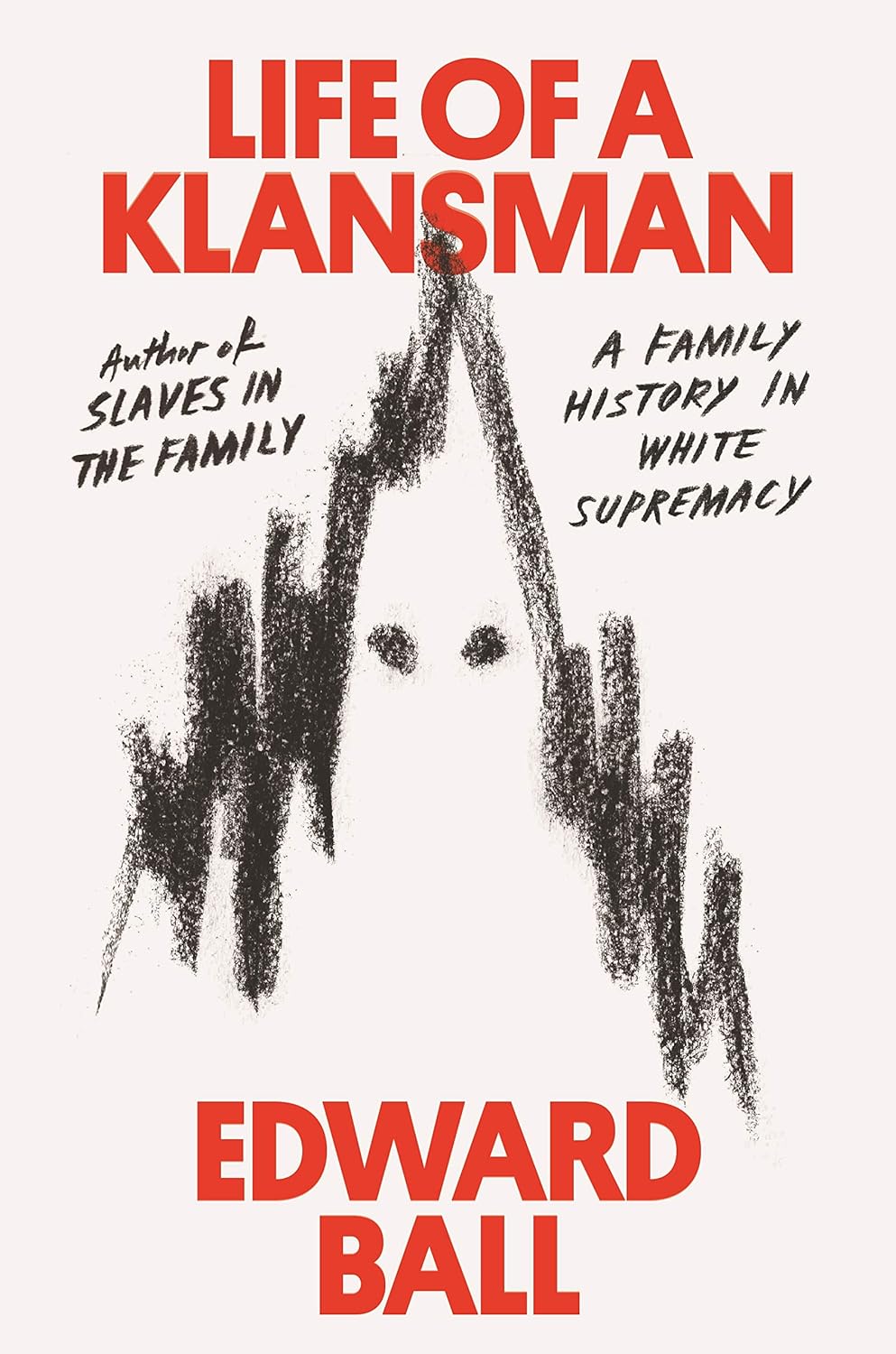
Life of a Klansman: A Family History in White Supremacy
Farrar, Straus and Giroux, 2020
It is 2013 in the deep South of America, and deep in the woods it seems a historical film-set is in production. A dozen or so actors portraying men from America’s famous and notorious Ku Klux Klan are recreating the ceremony of the lighting of the burning cross. “Do you accept the light?” each Klansman is asked as he is handed a lit brand. Their uniforms are not the familiar white sheets and conical masks associated with the Klan, an image seared into the American psyche largely due to D. W. Griffith’s 1915 silent film, The Birth of a Nation. Instead, they have been modernized, doubtless by the wardrobe department of whichever studio is producing the movie. They look tailored and richly colorful, as though some New York couturier had designed them. The cross is lit, and speeches made to the glory of God. But this is not a film-set, and the men are not actors, they are present-day Klansmen. The only camera present belongs to ABC News, and this is a news piece. A truncated version of it can be seen here.
In the same year, 2013, a man takes a manila folder from an old oak desk in New Orleans. He himself had put it there ten years earlier while cleaning the family house following the death of his mother. Her family name was Lecorgne, of French extraction, like many names in New Orleans. The man’s name is Edward Ball, and the result of the research which begins with the manila folder is a book, Life of a Klansman: A Family History in White Supremacy (Farrar, Straus and Giroux, 2020). The folder contained family trees, notes, photographs, and newspaper-clippings, and the book covers the life and times of his grandmother’s grandfather, Polymark Constant Lecorgne, who the family had always referred to as “our Klansman.” The Ku Klux Klan would eventually become the “White League,” the difference being that the League was not a secret, and the role of the Klan is a secret Ball wishes to bring into the light. Ball quotes a Creole saying; “Wash your dirty laundry inside the family.” The author wishes to do the opposite.
The Ku Klux Klan began in the decade of Reconstruction following the American Civil War. A second version revived the Klan in the 1910s, and was followed by a third incarnation during the Civil Rights movement of the 1960s. As noted, the Klan still exists today, although they have tidied up the brand somewhat. No more burning crosses on lawns, but rather open days and websites. Then, the Klan may have been relatively marginal but, in these days of white hereditary guilt, Ball produces an interesting demographic formula:
The four million Klansmen of 1925 have as their direct descendants in 2025 about 137 million living white Americans… one-half of the population of the United States. Fifty percent of whites can claim a family link to the Ku-Klux.
These Americans include Donald Trump, whose father was arrested during a Klan rally in 1927. Thus, the author writes, white supremacy as represented by the Klan “is not a marginal ideology. It is the early build of the country.” Ball’s book is not a shameful confession, he writes. Instead, it is meant to show that “whiteness and its tribal nature are normal, everywhere, and seem as permanent as the sunrise.”
The history begins with a raid on a precinct police station in New Orleans in 1873 and partly led by Ball’s ancestor, Constant Lecorgne. The Klansmen are armed but hoodless. This is not a symbolic night-ride designed to intimidate les nègres, it is a guerilla attack intended as the first skirmish in a new civil war intended to free whites from “the tyranny of the nigger.” Hoods would have got in the way. All the men had been soldiers in the Civil War, and attacked calling out the “Rebel Yell.” There was fierce fighting, but the police got the better of the Klansmen, the survivors of whom were indicted under the 1871 Ku Klux Klan Act. Constant Lecorgne did not hang. If he had, Mr. Ball would not have been able to write his book.
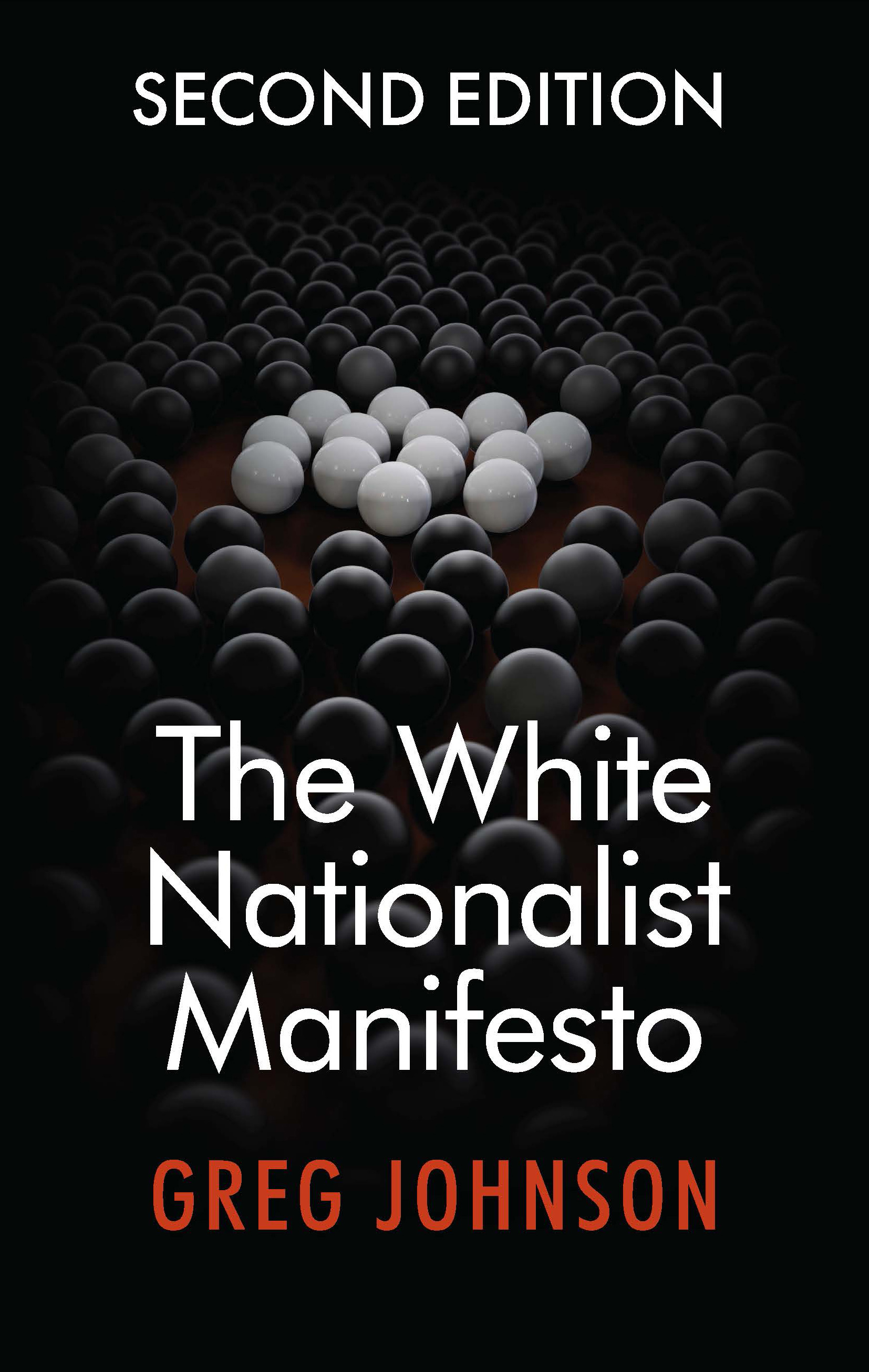
You can buy Greg Johnson’s The White Nationalist Manifesto here.
Ball’s manila folder must have contained extensive documentation, because the history of his family extends to minutiae, including an 18th-century family wedding in which one of the wedding gifts was a black maid. The idea of blacks as chattels was to become one of the central issues of the Civil War, and proprietary documents of the time refer to them as “items.” The number of slaves a family owned was a symbol of status. The wedding united a high-born lady of Louisiana with a French immigrant named Le Corgne, who had witnessed the French Revolution as a boy and been an officer in Napoleon’s army. This represents a fascinating cross-pollination between two mighty nations. Napoleon did not think his American colonies were worth the upkeep, and sold Louisiana to American diplomats for $15 million in 1803.
In 1832, Ball’s ancestors had a child, Polycarp Constant Lecorgne, named for a Catholic saint. He is the man who will go on to be “our Klansman.” The boy grows up viewing blacks through the lens of the Code Noir, a regulatory document intended to keep unruly negroes in order. He also sees the more ignorant blacks practicing voudou, and superstitiously wearing their talismanic amulets. He is fascinated by their crazed dancing to huge drums. He also watches the slave auctions which helped make his family rich. Ball does not make the mistake of retrospective morality, judging the past by the moral standards of today (whatever they might be). He simply notes that the whole internal slave trade was “a nasty business.”
The boy also hears of a natural scientist named Samuel Morton. Morton collects and examines skulls, and has theories concerning race and “polygenesis,” or the idea of men as originally being of different species, and having different origins. In 1839, he published a book titled Crania Americana. Morton viewed himself as “an impartial measurer of forms”, and his work was scientifically well received, and confirmatory of the developing notion of the negro as an inferior race, backed by the science of the day.
As the Civil War approached, “our Klansman” lived in a world of “nigger minstrels,” whites in blackface, alongside the first published negro poetry (obviously a key document in today’s version of black history). He sees orgiastic and surreal black carnivals (which would evolve into Mardi Gras), blacks dragged into the fields for 12-hour working days in blazing heat, and the licentiousness of black brothels. We are also reminded that it was the Democrats who were the party of slavery, while the Republicans were not directly opposed to it, just not so much in favor. The abolitionists’ voices, such as those of Frederick Douglass, were growing in volume, and town-hall meetings as well as race science began to turn its attention to the differences between the races. Men such as Noot, Morton, and Agassiz were being openly talked about “not in the drunken barrel houses, but in libraries and cafés.” This rapidly developing new field of studies was sometimes referred to as “niggerology,” and Ball’s exposition is of the evolution of a new science which will eventually be threatened by a different theory of evolution. The Americans flooding into Louisiana after its acquisition had brought the word “nigger” along with them, along with the milder “darkie.”
When a Dr. Samuel Cartwright moved to Louisiana, his lectures were well attended and his publications widely read. His theory of race is forthright:
The ultimate limit of progress the negro race has ever made stops within the limits of barbarism. But the white type has ever forced its way and maintained its position in that high order of civilization where moral virtue, clad in intellectual light, rules society.
This is a view of natural racial hierarchy, of which even a mild version of which would today lose a university lecturer his tenure, and in Britain possibly also his liberty. We recall the tragedy of Dr. James Watson, hounded to a pauper’s death for mild remarks about African IQ disparities. The church agreed with Cartwright. A Presbyterian minister told his flock that the “providential Trust of the South… is to conserve and to perpetuate the institution of domestic slavery as now existing.”
By 1860, slavery was now “on the national ballot” and had been highlighted after the Mexican-American War of 1848. Republicans decreed that the newly acquired lands should have no new slavery, and political differences were widening. The North and the South were at loggerheads which would result in the Civil War. Lincoln won the White House in 1860, “and around the South, guns were taken from closets to be lovingly cleaned.” On April 12, 1861, the American Civil War began. Blacks would fight in the war, and a group known as the “Native Guards” was the first, drilling like white men. Ball calls this “a survival tactic, a piece of theater,” but many in the South saw this as a sign of things to come. Rumors of a coming negro insurrection were rife, exacerbated by the sight of armed blacks. Lincoln signed the draft of the “Emancipation Proclamation,” adding to the tension between what was rapidly becoming two nations. In New Orleans, blacks were forbidden to publish anything but “gentle poetry,” and a black newspaper was torched. There appeared to be two civil wars taking place in synchronicity.
The Emancipation Proclamation was enacted on New Year’s Day, 1863. As Yankee soldiers begin to occupy Southern states, as the grands blancs women of New Orleans saw it, “repellent blacks fill the gaps.” The South was sliding towards defeat, black units were now fully incorporated into the Yankee ranks, and many in the South were beginning to blame the entire war on the slaves. A new constitution in Louisiana contained provisions for the abolition of slavery, public education for blacks, and a dual education system with separate schools. The new constitution, however, did not make provision for funding black schools, only white ones. “It was a clever omission,” Ball writes.
As the war ground to its bloody end, enter the Ku Klux Klan. An ex-general, Nathan Forrest, mobilized a new rebel force which would mutate into the Klan, and was formed “to right the deformed world in which blacks give orders to whites.” Polycarp Constant Lecorgne signed an Oath of Loyalty to the United States, but felt more disunited than ever from the Union. Blacks were not allowed to smoke before the war. Now they “stand on corners and bring out cheap cigars.” Everywhere the signs of emancipation were not to the taste of Southerners who never wanted equality. Once-quiet streets were now a din as blacks drank openly and “stand on the corner with their banjoes from the jungle and howl their stupid songs.” Lecorgne is lucky not to be living in today’s musical cacophony. Between 1860 and 1870, the black population of New Orleans doubled as the white population thinned out, with many leaving for Texas, Mexico, and Brazil, where slavery remained in place. Many had lost fortunes in the war, but some of those that remained were vowing revenge for a humiliation they saw as instituted by the now-assassinated Lincoln and the North, but meted out by the same blacks who used to work in the fields for them. Andrew Johnson (who would become one of only three US Presidents to be impeached, later joined by Bill Clinton and Donald Trump—twice) moved into the White House, and Reconstruction began in earnest. But resistance was beginning to form.
Alcibiade DeBlanc, a flamboyant lawyer with an “old money” family background, began a reconstruction of his own. The end of slavery, he said, was illegal, as slavery was in the Constitution and thus incontrovertible:
[Emancipation] is nothing less than the abolition of labor, and will convert our hordes of laborers into hordes of vagrants, useless to themselves, their families, and the state.
The author’s ancestor, Polycarp Constant Lecorgne “will walk in LeBlanc’s footsteps.”
LeBlanc was joined by Colonel Fred Ogden in 1865, who formed the Young Man’s Democratic Association. “We hold this government”, he wrote, “to be a Government of White People, made and to be perpetuated for the exclusive benefit of the white race. . . People of African descent cannot be considered as citizens of the United States.” A new “Rebel Legislature” was one of the founding documents of the Klan. In 1866, some ex-rebels gathered to drink together and reminisce, a common enough occurrence, except that this featured a toast during the dead of night. It was somewhat theatrical, and some present had been members of Greek societies, or “fraternities,” as they came to be known. Suddenly, the Ku Klux Klan had found its name:
A lawyer in the room pulls a fraternity word from his memory and suggests a name for their bitching society. It is Kuklos, or “circle” in Greek. Things are under way.
It was suggested that the word “Clan” be appended to the Greek, but it was mis-spelled and came out as “Klan.” This mutated into “Ku-Klux-Klan,” probably after a night of heavy drinking had made proper spelling irrelevant. Klan militias soon formed, and a second Rebel army with it.
The US Congress passed the first Civil Rights Act in 1866, almost exactly a century before the 1964 Act with which Americans are more familiar today. This was despite unanimous Democratic opposition. It defined birthright citizenship, starting an argument that has raged ever since and is currently starting a brush-fire in Britain. Blacks could now own property, vote, and employ others. The Thirteenth Amendment, outlawing slavery, had been ratified, and equality (if not the currently fabled “equity”) was now becoming a reality, to the increasing anger of many in the defeated South. In ensuing rioting in Memphis, 46 people were killed, and many women raped. The violence many thought laid to rest, just as one in ten of the USA’s fighting-age men had in the recent internecine conflict, was coming back to life. At the Mechanics Hall, in Louisiana, Klan members joined with many firemen, an integral part of the new movement. This new fighting force invaded a black meeting, and what has become known as the “Mechanics Hall Institute massacre” ended in slaughter.
Edward Ball is honest about the points in his account where he lacks much in the way of documentation, and cannot say for certain how involved his great-great-grandfather was in the massacre. Some 200 people were killed, and the New York Tribune accurately assessed the aftermath:
This was almost a St. Bartholomew massacre, and it was intended to begin the reign of Terror in the South.
The Mechanics Institute massacre was, Ball writes, “the first spasm of the panic that goes under the name of Ku-Klux.”
On March 4, 1867, the first Ku Klux Klan pageant featured 2,000 firemen in full dress uniform. It was just before Mardi Gras, then almost exclusively a black affair. The firemen’s pageant was the monochromatic opposite. Tension not felt since the Civil War was thick in the air, and the resentment on both sides was palpable. Afterwards, DeBlanc formed the Knights of the Golden Circle to defend white interests against what they viewed as black cultural incursion symbolized by an ordered pageant of uniformed men set against a grotesque carnival of debauch. DeBlanc’s grander ideas included extending the South by annexing Cuba and Central America. From there, the Knights would invade the islands of the Caribbean and begin a new slave empire. DeBlanc changed the name to the Knights of the White Camellia, whose purpose was “to protect our race from amalgamation and miscegenation and other degradations.” What is now called “White supremacy” was consolidating its power bases, and the term “Ku-Klux appears for the first time in the New Orleans press.” Other papers follow the scent, The Daily Picayune running a strange ad which begins:
In hoc sign, X22.
The Great Past Grand Giant commands you. The dark and dismal hour draws nigh…
It is signed by “Great Grand Cyclops, G.C.T.”
A coded message, it sets a date for a meeting on March 22 at 10:00pm. The organization which has become the Ku Klux Klan is now fully in operation, and images familiar to us from contemporary mythology begin to emerge:
The Ku Klux Klan parade the streets, masked, visiting the houses of well-known Republicans, white and black. The gangs affix to their doors threatening placards, breathing blood and murder, and bearing such emblems as pistols, bowie-knives, death’s heads, and coffins.
It is noted that the Klan went after white Republicans as well as blacks. The night-rides began in earnest, random beatings and whippings started, and recruitment to the Klan was beginning to increase rapidly. As with today, there is strategic denial, with New Orleans newspaper The Daily Picayune calling the Klan “a figment of the imagination.” But they were very real and very serious, excepting a strange chapter in their history when they literally turned farcical. A showbusiness publication announced a new production at a New Orleans playhouse:
The first night of the New Sardonic, Sensational, Musical Mysticism, by J. E. Durivage, called “Ku Klux Klan.”
Six months into their existence, the Klan had been turned into a musical. What a Broadway revival that would make today.
Polymark is inducted into the Klan. Like the Freemasons and early Christians, Klan members had secret signs to indicate membership. The left index finger drawn across the left eye told one member he was in the presence of another. “Where were you born?” one would ask. “On Mount Caucasus” came the reply. The induction ceremony shared elements with Masonic induction as well as the Greek Eleusinian Mysteries into which Greeks were initiated:
COMMANDER: Who comes there?
GUARD: A son of your race.
COMMANDER: What must be done?
GUARD: The cause of our race must triumph.
No deviation from the script was permitted. Random shootings of blacks were common, and violence spread throughout Louisiana, Mississippi, Alabama and beyond. Whippings, beatings, and night-time raids proliferated. The famous costume was part disguise, part intimidation, with “Minstrel masks” being worn and the famous cone headpiece intended to increase the apparent size of the wearer.
Legislation was passed to prevent the Klan from operating. No night-rides, no costumes, and a restricted use of firearms pushed the Klan and the White Camellias into semi-retirement, and a type of cold war ensued for over a year. By now, there were blacks in the army, in the local councils, and being sent up to Congress. The author’s ancestor was arrested and incarcerated, but the Klan were only in remission. Visible signs of their failure to disband became more apparent, including a Klan float in a parade in New Orleans, including a banner reading “White supremacy” and grotesque caricatures of monkey-men. A sort of “spasm war” ensued and threatened to grow into a second, more localized civil war.
In the end, Reconstruction was a failure, and segregation would be the next chapter in the ongoing American race war which still rages today. Jim Crow laws leading to separate schools, buses, and drinking-fountains have become one of many badges of shame white America is supposed to wear and display at all times. How tiresome it all is. Where does the author stand regarding the “white guilt” currently being force-fed to whites across America, many of whom—as Ball notes—are descended from the white-sheeted night marauders? He writes:
I am trying to open a small window into US history. I am trying to bring whiteness up from its unconscious storage place into nascence, which is that feeling just sort of consciousness.
When you read the word “unconscious” used in the context of race and racism, you may as well put the book down and reach for something with more intellectual sustenance. An airport magazine, perhaps. The Left’s club-footed use of the Freudian unconscious is a tale for another day, but it is an un-disprovable, and so fertile ground for the intellectually negligible Left. Here, the history of the author’s great-great-grandfather—who died in 1886, aged 54—is a thoroughly well-researched account of one of America’s most violent and key periods. Ball is guilt-ridden about his lineal past, and has much to say about modern whites and racism. That said, he is not unhinged in the way the modern Left seem to be. In the final chapter, Redemption, the author addresses his connection with the Klan, and the fact that—as he himself notes—many millions of others share his lineage. “The Ku Klux Klan are the boogeymen of American history,” he writes. One thing Ball’s book brings home is that the Ku Klux Klan was not some loose terrorist group of outriders, but an organized militia in close combat with other, increasingly colored, militias. As for white Americans of the present day, with a black problem of their own, one of Ball’s final comments has resonance:
“Do the marauders of the Ku Klux Klan bring down calamity on their children, their children’s children? Do we, does anyone, have hell to pay.”
8 comments
I’d have to say that the author of this interesting book has his details a little fuzzy in a lot of places. Other than that, it seems that he badly missed the historical context of the times, if the worst of the Radical Reconstruction was questionable banjo music. As for the conclusion, oh dear…
As I said to the other fellow, I call it as I see it, on a case-by-case basis. It has stirred the pot, clearly, which is part of the point. My reviews deal with the books alone, and I have little time to examine any scholarly context. A riposte, perhaps between you and “Wu”, would be a good read, as long as you are not lynching the messenger. Do it.
To clarify, you wrote a fine review, just as your work is always first-rate. As for Mr. Ball, I have to wonder if in any of his lengthy research he got any inkling as to why Southerners felt it necessary to form a resistance organization.
Don’t worry, Beau. I’m not 17. I’m not fishing for dopamine hits. And thank you for your compliment. I aim to please. He was restrained because he cannot hate niggers the way I do. His mindset will not allow that. I moved 5000 miles from my home city to get away from these apes. I am the real racist they fear. I want the Klan 2.0, believe me. His documentary evidence, transmitted via his liberal sensibilities, is all I had to go on. Anyway, good day to you.
I am related to Edward Ball.
In his book Slaves in the Family, he blatantly lies about what was said in certain interviews with family members.
A new book needs to be written, an expose of Edward Ball: Liar in the Family.
Interesting. As you know, I move over a lot of fields, and just report what I read. Perhaps someone ought to write it.
It sounds like you have some unique perspectives on all that. If you’d like to set the record straight, perhaps we can work together on that. To reach me, follow the cookie crumbs here:
About Rainbow “Beau” Albrecht
Great article! Edward Ball—the typical leftist liberal. Still, I wonder who did all the sewing on those fancy KKK outfits. 🙃
If you have a Subscriber access,
simply login first to see your comment auto-approved.
Note on comments privacy & moderation
Your email is never published nor shared.
Comments are moderated. If you don't see your comment, please be patient. If approved, it will appear here soon. Do not post your comment a second time.