 1,789 words
Part 6 of 8
Edited by Greg Johnson and Peter Jacobi
In 1995, Jonathan Bowden self-published his Collected Works in 6 volumes (London: Avant-Garde, 1995), edited by Jürgen Schwartz, one of Bowden’s pen names. The six volumes comprise 27 distinct books, 12 of which had been previously published. Altogether, the Collected Works contain more than 2,600 pages of rare early Bowden.
Onslaught is the third book in volume 2. It had not been previously published. We will publish it online in 8 installments. The titles are editorial. This particular selection is a long excursus from a discussion of the National Front and the new British National Party, which we will publish in the next installment.
Like many of the Collected Works volumes, Onslaught covers a wide range of political and cultural topics, interspersed with fictional narratives that may be loosely based on real people and events.
Eventually, a fully annotated version of Onslaught will appear at the Jonathan Bowden Archive. It will then be followed by similar editions of the rest of the Collected Works, plus a couple more early volumes that were not included. — Greg Johnson
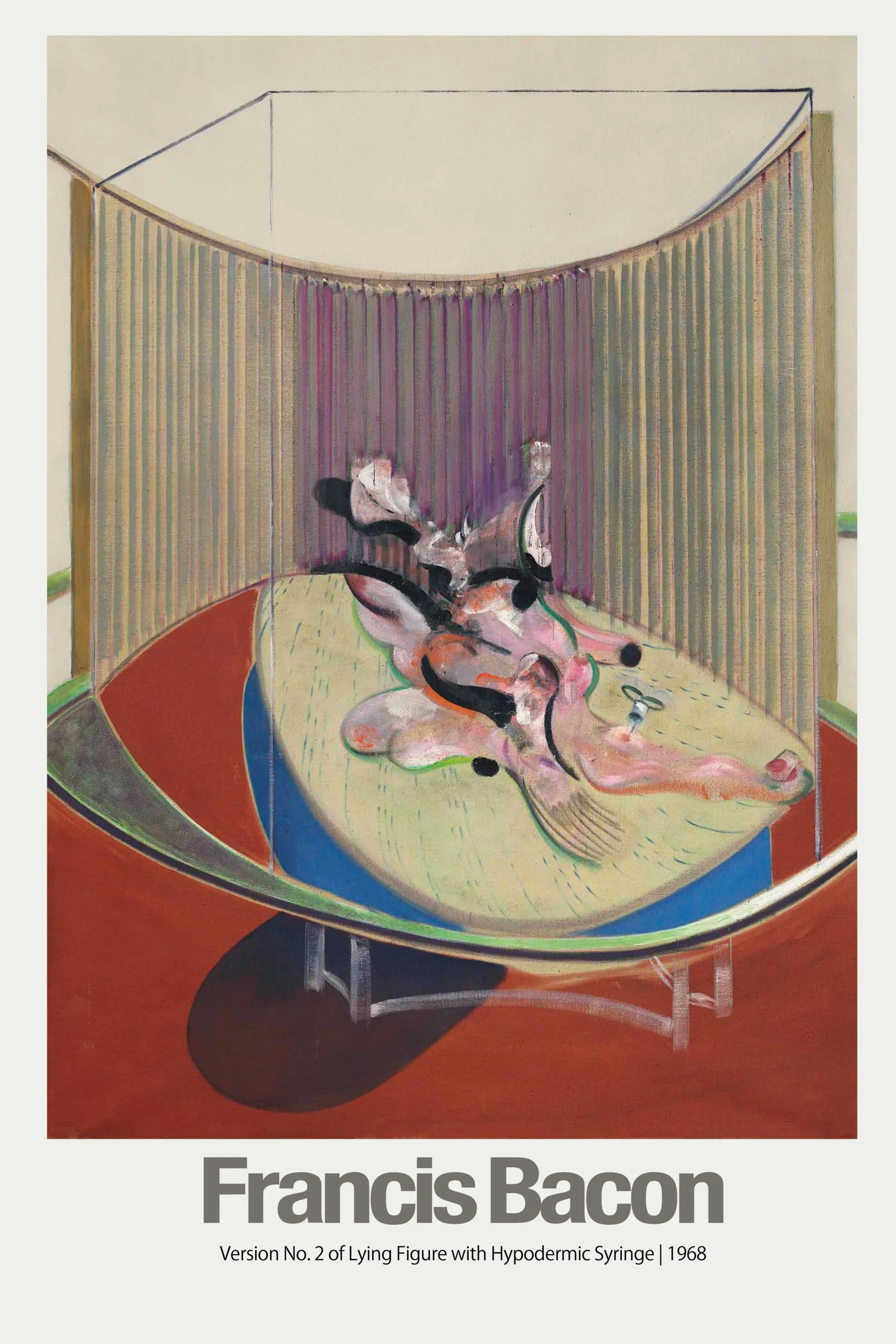
Indeed, we can see a simulacrum [of the attractiveness of the Right to degenerates]—an objective correlative as T. S. Eliot would have called it in The Criterion—in the work of the Anglo-Irish painter Francis Bacon. When the appeal, even the negative appeal, of Bacon’s work is its tableaux vivant quality, its manufacture of a new wave in sensibility—something which relates it very strongly to images of racial degeneration in Count Arthur Gobineau’s Essay on the Inequality of the Human Races.
Such a sensibility can be seen in Bacon’s painting The Lying Figure (1969), where a being of indeterminate sex sprawls on a coverlet beneath a naked light. The interesting thing about the painting is its casual decadence—its epicene fury—which is in turn a nihilistic lack of excess. Like all of Bacon’s subsequent paintings this image is disassociative—it brings together shards of an existence which do not fit together. In a sense it is a rummaging around, in a psychic manner, in the alimentary canal, amongst the fundamental lesions of the flesh. As a consequence, these paintings represent a form of anal fundamentalism gone awry, a form of talking from the belly, as with a ventriloquist. For the paint which Bacon uses deliberately cauterizes the flesh—it traps it under the glare of the lights—only to release it in a meaningless fashion. Indeed, the whole composition (christened Lying Figure) is a metaphor for Burrough’s Naked Lunch—another sodomitic irrelevancy—another turning, in redundancy and despair, to the values of the “right.” Hence, we see the syringe, the empty phial of divine liquid—of spiritual intoxicant—which Bacon jabs in the arm of the “patient” at a moment’s notice. As a result, many of Bacon’s critics would drool over this painting, seeing in it a pastiche upon the issue of drug abuse, the misuse of heroin and so on. When in actual fact this painting has no moral purpose—it is essentially valueless—and in a sense it is an exercise in anti-critique; in short, it is a critique of criticism itself—it is a moment of studied meaninglessness and as such incapable of development. We might say, therefore, that far from being a radical gesture this painting represents the futility of any gestures whatsoever, and as a consequence, it represents a neo-conservative bias.

You can buy Jonathan Bowden’s Reactionary Modernism here.
As a result, Bacon’s work can be used to illustrate a fundamental cleavage—almost a religious division between right and left. Particularly when we understand that right and left are spiritual transpondencies, in that they correspond to the values of a non-secular society. Nevertheless, there is a certain eschatological valency—a religious fury—a profound discontinuity between the two sides in political life. Of course, some people declare that right and left are essentially meaningless terms—moreover, they are not entirely wrong about this. As a result, such individuals are heard to declare that right and left are only of historical import, in that they relate to seating arrangements in various constitutional assemblies during the French Revolution. In a narrow sense this is true enough; and right and left metamorphosed over time in relation to various sectional committees—hence proving the mutability of these terms, when the Estates-General during the French Revolution became the Constitutional Assembly, the Legislative Assembly, and then the Convention, which then took on the executive forms of the Mountain, the Thermidoreans, the Directory, Consulate, and Empire before being prorogued altogether.
Yet this leaves out of account the essential differences between right and left—what makes them different from each other. When the Right believes that human beings are a flawed and irrelevant species, a token of failure and divine disparagement. As a result, human beings were born to die alone and in squalor and agony, bereft of comfort and lacking the solace of grace. The human species, if you like, is a failed conception—a doomed irrelevancy—destined to hopelessness, fury, the inevitability of death, and the possibility of love. As such the human species is bereft of glamour—it is fallen—with or without the religious and Biblical associations of that term. Moreover, human beings were born relatively bereft of talents and yet strikingly unequal in the possession of such abilities. From the very beginning, therefore, human beings have been involved in a war against the nature of their own emptiness—when we understand human life to be forlorn and hopeless, save in the expectancy with which it waits for death. As a consequence, if human life is beyond the wit of human fury to pronounce upon, then when does it end? . . . Towards what does it portend? The simple answer, of course, is that it is meaningless—it has no end and no beginning—except one which is prescribed for it, one which is given to it by human beings. Although human beings do not create their own worlds—they merely react to the consequences of their own creation. In short, they act on the provender which is given them not necessarily by Heaven but certainly by those who are opposed to their will. In a sense, therefore, human beings are free to make their own history within parameters which render them completely unfree to begin with. You see, human beings were born into a meaningless and contingent fate—devoid of truth, beauty, and honor; human beings have to make these up for themselves. All of which is not to say that these categories lack wit or purpose; indeed, they have relevance and function and they are vitally necessary. Without them human beings could not function in relation to the maelstrom of their own identity; in short, human beings are bereft of everything except one chance of redemption. We can go on to say, therefore, that the human species is unredemptive—lacking in honor—with the sole exception of what it creates for itself. In a sense, though, human beings are aware of the contingency, the viduity, and hopelessness of their own existence; after all, they live with it everyday. Indeed, this is one of the reasons why the earliest societies—Ancient Egypt, the Tibetan rituals associated with their Book of the Dead—together with the historically discontinuous Aztec “death cult” in Mexico—all revered death more than life. Such cultures understand that life was meaningless anyway and it was certainly meaningless without the foreknowledge of death, the prospect of redemption. Particularly when one realizes that there is no after-life to begin with—all of that is heedless folly, mere religious delusion—a betrayal of the true alchemy of religious belief, its understanding of the presence of no future whatsoever.
You can buy Jonathan Bowden’s Western Civilization Bites Back here.
Yet if human life has no ultimate purpose—if it is a mere exercise in the relaxation of the bowels—what is it for? The answer, of course, is that its meaning is its absence of meaning; in other words, its sheer purposelessness is inevitably the only reason it has a purpose. Moreover, if life is an exercise in despair, a redundant gesture in relation to the absence of God, the absence of the prospect of God, then why live at all? Indeed, if life has no ulterior purpose—if it is a matter of mud and flies—then why does the human species not extinguish itself in relation to the nature of its own futility? In short, why does humanity not commit suicide en masse?—the question asked by Albert Camus in The Myth of Sisyphus—and the answer to that is relatively straightforward: in that human life has no ulterior purpose and yet we give it a meaning by virtue of the nature and direction of our drives. Yet if the nature of the terrain, the circumambience of human existence, is the devil’s route, is the fly-pit—is the landscape of mud and irrelevancy à la Samuel Beckett—what does this have to say about morality and the problem of evil?
The nature of evil in Francis Bacon’s work, however, is best seen in a portrait such as Head of a Man—Study of a drawing by Van Gogh which was produced in 1959. In a sense, therefore, the nature of evil in Bacon’s work is predicated on a discussion about its absence. In this particular portrait, for instance, Bacon has allowed the skull—the bones of the man concerned—to penetrate through the flesh of the face which was represented. While in another portrait, such as Fragment of a Crucifixion (1950), Bacon deals in what we might call the anthropology of the scream, its morphic trace-element. In this picture, for instance, a number of doodles—a certain amount of ratiocination appears—in relation to his former work, the work which appeared before he became famous. These are in the form of distended figures—lines which are in some way reminiscent of the spatial correspondences of Michaux, an artist whom Bacon admires—when his work consists of lines, meshed and crossed together, which signify nothing by their presence but the beauty of their absence. In a sense, therefore, they represent the tendrils, the spirals, of a spider’s legs on paper once it has wandered into some ink. Yet the elegance; indeed the joie de vivre, the lightness of the composition is its artlessness; its stringent absence concerning the meaning of form. Nevertheless sub species aeternatis the other thing which captures the eye in this painting is Bacon’s use of roadsters, those canvases which typified his pre-war sketches—when we remember that this was the era of the news-reels and the dictators who were driven about in open-topped limousines surrounded by guards.
If you have a Subscriber access,
simply login first to see your comment auto-approved.
Note on comments privacy & moderation
Your email is never published nor shared.
Comments are moderated. If you don't see your comment, please be patient. If approved, it will appear here soon. Do not post your comment a second time.