Counter-Currents
  • Advertise
  • Private Events
  • T&C
  • About
  • Contact
  • RSS
    • Main feed
    • Podcast feed
    • Videos feed
    • Comments feed
  • Welcome
  • Webzine
  • Books
  • Merch
  • Podcasts
  • Videos
  • Donate
  • Patrons
  • Subscribe
  • Crypto

LEVEL2

Donate Now Mailing list
  • Welcome
  • Webzine
  • Books
  • Merch
  • Podcasts
  • Videos
  • Donate
  • Patrons
  • Subscribe
  • Crypto
    • The Remigration Movement Solidifies

      F. Roger Devlin

    • Casting Aspersions:
      The Fatal Consequences of Race-Swapped Casting, From Helen of Troy to Henry of Southampton

      Steven Tucker

      4

    • The Murder of Henry Nowack

      Millennial Woes

      9

    • Don’t Forget to Vote in Our Writer & Article of the Month Poll

      Greg Johnson

    • The Robot Hotdog Stand

      Greg Johnson

      23

    • Laughing Our Way to Victory

      Dave Chambers

      2

    • The Zodiac Killer

      Mark Gullick

      8

    • Jared Taylor: What Rome Means to Me

      Jared Taylor

    • An Interview with Endeavour:
      My Way of Life Is an Adventure!

      Ondrej Mann

      6

    • José Pedro Zúquete’s The Identitarians

      Greg Johnson

      3

    • Editor’s Update
      Fundraiser Update & How to Watch the Remigration Summit

      Greg Johnson

      5

    • The Bitter End of Western Metaphysics:
      Heidegger on Nietzsche, Part One

      Collin Cleary

      10

    • Berlin: City of Stones

      Spencer J. Quinn

      6

    • True Folk-Horror Is Horror of Your Own Folk:
      Mark Gatiss vs the Brexit Blind Dead  

      Steven Tucker

      4

    • Counter-Currents Radio Podcast No. 689
      Thomas Massie, the America 2050 Bust, the Need for Whites to Divest from America, the AI Economic Apocalypse, & Pro-White Project Pitches to Billionaires

      Counter-Currents Radio

      7

    • Nationalism This Week
      Remigration is Inevitable, Part 3

      Greg Johnson

      25

    • Why Billionaires Should Fund White Identity Politics

      Lipton Matthews

      8

    • How Cold War Two Came About

      Morris van de Camp

      5

    • Now Available for Pre-Order at a Special Price!
      Greg Johnson’s The Philosopher Is In

      Greg Johnson

    • David Zsutty’s Elevator Pitch to a Billionaire

      David M. Zsutty

      1

    • Headbanging Lite

      Mark Gullick

      5

    • White Advocacy Past and Present

      Peter Bradley

      13

    • The Lunch Wars

      David M. Zsutty

      46

    • The Russians are Coming/The Russians are Coming

      Steven Clark

      1

    • Peak Fatigue in Fort Wayne

      Gabriel Anderson

      24

    • Keith Woods’ Elevator Pitch to a Billionaire

      Keith Woods

    • The Cruelty of Kindness

      Morris van de Camp

      9

    • Predation Wearing the Mask of Civilization

      Jayant Bhandari

      13

    • The Mandalorian & Grogu

      Trevor Lynch

      24

    • Editor’s Update
      Fundraiser Update & a New $20,000 Matching Grant
      Greg Johnson & David Zsutty Discuss Thomas Massie on Counter-Currents Radio

      Greg Johnson

      2

    • How the Jews Defeated Thomas Massie—& Themselves

      David M. Zsutty

      24

    • Jared Taylor’s Elevator Pitch to a Billionaire

      Jared Taylor

      15

    • Nationalism This Week
      Remigration Is Inevitable, Part 2

      Greg Johnson

      8

    • Could Fascism Work?

      Mark Gullick

      40

    • Jonathan Bowden’s Deliverance
      Part 7

      Jonathan Bowden

    • China’s Quiet Hand:
      Influence, Infiltration, & the Western Blind Spot

      Lipton Matthews

      9

    • Counter-Currents Radio Podcast No. 688
      Tyler Dykes on Running for US Congress in South Carolina

      Counter-Currents Radio

      3

    • Lothrop Stoddard’s The Revolt Against Civilization

      Spencer J. Quinn

      14

    • Lewis Strauss Did Nothing Wrong:
      How the politics of the Atom Bomb during the early Cold War Apply to Artificial Intelligence Today

      Morris van de Camp

      14

    • The Ghost of the Confederacy

      Dave Chambers

      12

    • America’s Century of Humiliation has Begun

      Greg Johnson

      27

    • Prepare for Africans & Schizophrenics!
      Welcome to the New Canadian Military

      Gunnar Alfredsson

      6

    • Remembering Julius Evola:
      May 19, 1898–June 11, 1974

      Greg Johnson

    • About Film “From the Right”

      Karel Veliky

    • Nostalgia Ain’t What It Used To Be. . . Now It’s Racist

      Steven Tucker

      8

    • To Depose The King

      Mark Gullick

      7

    • Editor’s Update
      Tyler Dykes on Counter-Currents Radio & The Best of Trevor Lynch Now in French

      Greg Johnson

    • Nationalism This Week
      Remigration Is Inevitable

      Greg Johnson

      21

    • You’re Nicked! The Story of The Sweeney

      Mark Gullick

      12

    • The Counter-Currents Fundraiser 2026:
      Help Us Provide You With All the News That’s Unfit To Print—Because It’s Actually Worth Reading!

      Steven Tucker

      3

    • Will Williams

      The Zodiac Killer

      Derek Stark: June 2, 2026 …[T]here are more black serial killers per capita than white ones in the...

    • Vagrant Rightist

      The Murder of Henry Nowak

      Weren't Sikhs supposed to be the 'good ones' ? So much for that lie. Thanks MW, for the detailed...

    • Peter Quint

      The Murder of Henry Nowak

      Carry a Para-Ordnance 45 cal. sidearm everywhere like I do. 🙃

    • Peter Quint

      The Murder of Henry Nowak

      That is the same message White people in America have been getting for decades. 🙃

    • Thomas Johnson

      The Murder of Henry Nowak

      The message to white people in the UK is clear: if the nonwhite criminals don't get you, the coppers...

    • Glide Ratio 0:1

      Casting Aspersions

      Surprised you called Nyongongo Mgolo "average". As far as my eyes can see she's a black 2. Well...

    • Vagrant Rightist

      Casting Aspersions

      I'd be very surprised if Nolan himself believes in this stuff, but he knows full well his overlords...

    • Beau Albrecht

      The Robot Hotdog Stand

      Anyone remember this quote? "The simple statement that the People are not there for the sake of...

    • Greg Johnson

      The Robot Hotdog Stand

      You're arguing that a huge wave of post-AI business investment will employ the millions of people...

    • Peter Quint

      Casting Aspersions

      Great article! Margot Robbie would have been the best choice for Helen of Troy. Gerard Butler would...

    • YT

      The Murder of Henry Nowak

      People in UK (and everywhere) need to start saying online, in graffiti, in rough encounters in...

    • BigJimSportCamper

      The Murder of Henry Nowak

      Can I get a religious exemption to open carry my AR15 everywhere? That's what I thought...

    • Peter Quint

      The Murder of Henry Nowak

      We simply shouldn’t be living like this. Great article! You’ll get used to it, the constant...

    • YT

      The Robot Hotdog Stand

      Every time in economic history that there’s been a major technological improvement resulting in mass...

    • DarkPlato

      The Murder of Henry Nowak

      I hardly think the stabber could have gone into a “fight or flight” state of mind because of an...

    • Beau Albrecht

      Casting Aspersions

      I also hear that in the movie, they're casting a girlie for Achilles.  At that rate, they might as...

    • DM

      The Murder of Henry Nowak

      Lt. Col. Dave Grossman in his book, _On Combat: The Psychology and Physiology of Deadly Conflict in...

    • Greg Johnson

      The Robot Hotdog Stand

      Yes, and if AI makes us replaceable, it makes them replaceable too.

    • Ondrej Mann

      The Robot Hotdog Stand

      Has there ever been a time when civil service positions disappeared? Yes, after the fall of the...

    • Chad Malkinson

      The Robot Hotdog Stand

      is there an “AI bubble”? Was there not also Internet or.com bubble? if you take a look at some of...

    • Earth Day Special

      John Morgan

      12

    • A Robertson Roundup
      Remembering Wilmot Robertson
      (April 16, 1915 – July 8, 2005)

      Margot Metroland

      13

    • The Paranoid Style in White Nationalism

      Greg Johnson

      30

    • Join the Dance!

      Andrew Hamilton

      1

    • We Can’t Save the Earth Without Reducing African Birth Rates

      James Dunphy

      36

    • “I’m Not a Conspiracy Theorist, but . . .”:
      Jeffrey Epstein’s Death Gives New Life to “Conspiracy Theories”

      Greg Johnson

      22

    • Sylvia Plath: Stasis in Darkness

      Vic Olvir

      17

    • Vanguardism, Vantardism, & Mainstreaming

      Greg Johnson

      80

    • Aviation, Geography, & Race

      Charles Lindbergh

      3

    • Some Thoughts on Yule

      Collin Cleary

      4

    • Living in Truth:
      A Yuletide Homily

      Jef Costello

      7

    • John Kennedy Toole’s A Confederacy of Dunces

      Greg Johnson

      20

    • On Aleksandr Solzhenitsyn’s Warning to the West

      Spencer J. Quinn

      7

    • Elitism, British Modernism, & Wyndham Lewis

      Jonathan Bowden

      6

    • Philip K. Dick’s Do Androids Dream of Electric Sheep? as Anti-Semitic/Christian-Gnostic Allegory

      Greg Johnson

      20

    • “Conspiracy Theory” or Conspiracy?

      Andrew Hamilton

      21

    • Remembering H. P. Lovecraft
      (August 20, 1890–March 15, 1937)

      Greg Johnson

      3

    • Who Are We?
      Nordics, Aryans, & Whites

      Greg Johnson

      71

    • Remembering William Gayley Simpson
      (July 23, 1892–December 31, 1990)
      A Pleasant Afternoon with Harriet & Bill Simpson

      Margot Metroland

      18

    • Here are the Young Men
      Remembering Ian Curtis
      (July 15, 1956–May 18, 1980)

      Mark Gullick

      18

    • Percy Grainger
      Artist of the Right

      Alex Graham

      7

    • Remembering Revilo Oliver
      (July 7, 1908–August 20, 1994)

      Greg Johnson

      18

    • The Meaning of July 4th for the White Man

      Gregory Hood

      13

    • The Front National’s Evolution

      Bruno Mégret

    • Merwin K. Hart
      Forgotten American Hero & Man of the Right

      Morris van de Camp

      10

    • George Orwell’s Nineteen Eighty-Four

      Jonathan Bowden

      8

    • Carleton S. Coon
      Scientist & Reluctant White Advocate

      Morris van de Camp

      3

    • The Kwanzaa Absurdity Will Be Dwarfed by Juneteenth

      Robert Hampton

      10

    • Stravinsky

      Alex Graham

      7

    • Like the Roman:
      Remembering Enoch Powell (1912-1998)

      Mark Gullick

      23

    • Crosstown Traffic:
      Jimi Hendrix & The Post-War Rock ‘N’ Roll Revolution

      Mark Gullick

    • Slaves from the North:
      Finns & Karelians in the East European Slave Trade, 900–1600

      Lipton Matthews

      14

    • Neo-Fascism in Film
      Part 4

      Karel Veliky

      2

    • David Lean’s A Passage to India

      Spencer J. Quinn

      1

    • Elites are Essential to Development

      Lipton Matthews

      7

    • Jonathan Bowden’s Deliverance
      Part 4

      Jonathan Bowden

    • Neo-Fascism in Film
      Part 3

      Karel Veliky

      6

    • E. M. Forster’s A Passage to India & the Indian Mentality

      Spencer J. Quinn

      25

    • Jonathan Bowden’s Deliverance
      Part 3

      Jonathan Bowden

    • The Rest Is Silence
      Heidegger’s Quietism

      Mark Gullick

      2

    • Dispelling the Historical Fallacy of Indian Nationalism

      Lipton Matthews

      8

    • Neo-Fascism in Film
      Part 2

      Karel Veliky

      8

    • Jonathan Bowden’s Deliverance
      Part 2

      Jonathan Bowden

    • Life of a Klansman

      Mark Gullick

      8

    • Jonathan Bowden’s Deliverance, Part 1

      Jonathan Bowden

    • Decolonial Ideas are Holding Back Developing Countries

      Lipton Matthews

      8

    • Neo-fascism in Film, Part 1

      Karel Veliky

      21

    • Jonathan Bowden’s Onslaught, Part 8
      Divigations on Decadence

      Jonathan Bowden

    • Jonathan Bowden’s Onslaught, Part 7
      Intrigues in the National Front

      Jonathan Bowden

      1

    • Rotten to the Core

      Mark Gullick

      8

    • Strauss on Husserl’s “Philosophy as Rigorous Science”

      Greg Johnson

    • Jonathan Bowden’s Onslaught, Part 6
      Francis Bacon & Right-Wing Nihilism

      Jonathan Bowden

    • London After (& Before) Midnight:
      Aleister Crowley, The Landlord’s Worst Nightmare

      James J. O'Meara

      2

    • Jonathan Bowden’s Onslaught, Part 5
      The Post-War British Far Right

      Jonathan Bowden

    • No Rules: Rollerball

      Mark Gullick

      4

    • Jonathan Bowden’s Onslaught, Part 3
      Brett Easton Ellis’ American Psycho

      Jonathan Bowden

    • An Alternate History of the Harris Presidency

      Beau Albrecht

      5

    • The Origins of Mass Education:
      Augustina S. Paglayan’s Raised to Obey

      Francis Rockwell

      4

    • Jonathan Bowden’s Onslaught, Part 2
      Louis-Ferdinand Céline

      Jonathan Bowden

      1

    • The Four Philosophers of the Apocalypse

      Mark Gullick

      4

    • András László
    • Derek Hawthorne
    • Beau Albrecht
    • Alain de Benoist
    • Kerry Bolton
    • Jonathan Bowden
    • Collin Cleary
    • Jef Costello
    • Savitri Devi
    • Julius Evola
    • Jim Goad
    • Gregory Hood
    • Juleigh Howard-Hobson
    • Greg Johnson
    • Charles Krafft
    • Anthony M. Ludovici
    • Trevor Lynch
    • H. L. Mencken
    • J. A. Nicholl
    • James J. O’Meara
    • Christopher Pankhurst
    • Tito Perdue
    • Michael Polignano
    • Spencer J. Quinn
    • Fenek Solère
    • Irmin Vinson
    • Leo Yankevich
    • Francis Parker Yockey
    • Multiple authors
  • Editor-in-Chief

    • Greg Johnson, Ph.D.

    Featured Writers

    • Beau Albrecht
    • Gunnar Alfredsson
    • Collin Cleary, Ph.D.
    • Jef Costello
    • Morris V. de Camp
    • F. Roger Devlin, Ph.D.
    • Stephen Paul Foster, Ph.D.
    • Jim Goad
    • Alex Graham
    • Mark Gullick, Ph.D.
    • Greg Johnson, Ph.D.
    • Travis LeBlanc
    • Trevor Lynch
    • Margot Metroland
    • James J. O’Meara
    • Angelo Plume
    • Spencer J. Quinn
    • Fred Reed
    • Clarissa Schnabel
    • Michael Walker
    • David M. Zsutty

    Frequent Writers

    • Asier Abadroa
    • Aquilonius
    • Alain de Benoist
    • Kerry Bolton, Ph.D.
    • Dave Chambers
    • Steven Clark
    • James Dunphy
    • Endeavour
    • Richard Houck
    • Jason Kessler
    • Titus Livius
    • Ondrej Mann
    • Lipton Matthews
    • Mark Mazari
    • John Morgan
    • Jaroslav Ostrogniew
    • Kathryn S.
    • Christian Secor
    • Anne Wilson Smith
    • Thomas Steuben
    • William De Vere
    • Kenneth Vinther
    • Max West

    Classic Authors

    • Maurice Bardèche
    • Jonathan Bowden
    • Julius Evola
    • Guillaume Faye
    • Ernst Jünger
    • Kevin MacDonald, Ph.D.
    • D. H. Lawrence
    • Charles Lindbergh
    • Jack London
    • H. P. Lovecraft
    • Anthony M. Ludovici
    • Sir Oswald Mosley
    • National Vanguard
    • Friedrich Nietzsche
    • Revilo Oliver
    • William Pierce
    • Ezra Pound
    • Saint-Loup
    • Savitri Devi
    • Carl Schmitt
    • Miguel Serrano
    • Oswald Spengler
    • P. R. Stephensen
    • Jean Thiriart
    • John Tyndall
    • Dominique Venner
    • Leo Yankevich
    • Francis Parker Yockey

    Other Authors

    • Howe Abbott-Hiss
    • Michael Bell
    • Giles Corey
    • Jack Donovan
    • Richardo Duchesne, Ph.D.
    • Emile Durand
    • Guillaume Durocher
    • Mark Dyal
    • Tom Goodroch
    • Andrew Hamilton
    • Robert Hampton
    • Huntley Haverstock
    • Derek Hawthorne
    • Gregory Hood
    • Juleigh Howard-Hobson
    • Alexander Jacob
    • Ruuben Kaalep
    • Tobias Langdon
    • Julian Langness
    • Patrick Le Brun
    • G A Malvicini
    • John Michael McCloughlin
    • Millennial Woes
    • Michael O’Meara
    • Christopher Pankhurst
    • Michael Polignano
    • J. J. Przybylski
    • Quintilian
    • Edouard Rix
    • C. B. Robertson
    • C. F. Robinson
    • Herve Ryssen
    • Alan Smithee
    • Fenek Solere
    • Ann Sterzinger
    • Robert Steuckers
    • Tomislav Sunic
    • Donald Thoresen
    • Marian Van Court
    • Irmin Vinson
    • Book Reviews
    • Movie Reviews
    • TV Reviews
    • Music Reviews
    • Art Criticism
    • Graphic Novels & Comics
    • Video Game Reviews
    • Fiction
    • Poems
    • Interviews
    • Videos
    • English Translations
    • Other Languages
      • Arabic
      • Bulgarian
      • Croatian
      • Czech
      • Danish
      • Dutch
      • Estonian
      • Finnish
      • French
      • German
      • Greek
      • Hungarian
      • Italian
      • Lithuanian
      • Norwegian
      • Polish
      • Portuguese
      • Romanian
      • Russian
      • Slovak
      • Spanish
      • Swedish
      • Ukrainian
    • Commemorations
    • Why We Write
  • Archives
  • Top 100 Commenters
  • The Looney Bin
  • Advertise
  • Private Events
  • T&C
  • About
  • Contact
  • RSS
    • Main feed
    • Podcast feed
    • Videos feed
    • Comments feed
Sponsored Links
Europa.com Above Time Coffee Antelope Hill Publishing Paul Waggener IHR-Store Spencer J. Quinn American Renaissance Jim Goad The Occidental Observer
Print April 21, 2026 9 comments

Restoring American Deterrence through Innovation & Industry

Morris van de Camp

1,835 words

Shyam Sankar & Madeline Hart
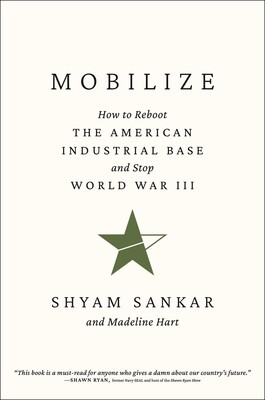
Mobilize: How to Reboot the American Industrial Base & Stop World War III
New York: Bombardier Books, 2026

Sometime between the January 6, 2021 Capitol Hill protest and the point in 2021 where Biden’s cognitive decline was obvious to all but American liberals, America lost her ability to deter, and hard knocks have followed. The best way to prevent a war going forward is to be so militarily strong that no one dares to carry out an attack in the first place.

Shyam Sankar and Madeline Hart, who work for the software company Palantir, have pointed out that America’s industrial base is not robust enough to support a military that can prevent a future World War III. Sankar and Hart write:

The American industrial base’s mobilization for World War Il remains a singularly impressive feat. Given the parallels today, it is often referenced as something the United States did before and, therefore, could easily do again. It’s a comforting thought, but as we’ve seen [recently], wartime mobilization isn’t a switch that can be flipped on and off at will. It wasn’t back then, either. We primed the pump for defense production via Lend-Lease while building new factories and retooling existing ones. Yes, Ford built B-24s at Willow Run, but it required two painful years before production was in full swing. The United States didn’t hit peak production until 1944. Now, with 2027 fast approaching, Taiwan is waiting on a massive backlog of defense articles, including 66 F-16 fighters from the United States. The delivery is years behind schedule and is now slated for the end of 2026. If that date slips any further, it might be too late. Worse, by not aggressively ramping up production to support Ukraine, the United States missed the equivalent of Lend-Lease. Instead of priming the pump with new production, the United States mostly drew down stockpiles of weapons and equipment made decades ago. This is painful because, as historian Arthur Herman said, “it’s through making things that we learn what can be made better.” The alternative to learning in peacetime is learning in wartime, precisely when stakes are highest and the margin for error is smallest. (p. 10)

You can buy Greg Johnson’s Is America Doomed? here.

The industrial base in America has been damaged by neo-liberal policies which hollowed out the economy of large swaths of America and transferred factories to the Far East, making Communist China a rival that the Pentagon optimistically calls “near peer.” China isn’t “near peer,” however. China is a peer. China is also flexing its diplomatic muscle, influencing Canada, and until recently, Chinese agents were securely positioned in Venezuela. The Chinese manufacture more than half the new ships built anywhere. Industrially, China is ahead by all metrics.

The abandoned factories that litter the American Rust Belt indicate more than just a jobs desert; they represent a decreased ability to support the military — and that lessens deterrence. The Ukraine War, for example, has become a war of drones, and America has very little ability to manufacture or employ drones. Sankar and Hart write:

. . . [T]he story of the commercial drone industry so far is tragic: a single Chinese firm, DJI, has a chokehold on the industry, with more than 90 percent of the global consumer market. It wasn’t until 2019 that Congress banned the Pentagon from buying Chinese drones. It would take another five years before similar legislation extending to the rest of the federal government passed in the 2024 National Defense Authorization Act. (p. 78)

The decline of the industrial base is only part of the problem. The other piece is the military itself. Sankar and Hart don’t say anything about the Diversity, Equity, and Inclusion problems in the military. Although in an interview promoting the book, Sankar did say:

[America has some cultural advantages] — a profound cultural current of America . . . the popular narrative is something like . . . the Silicon Valley culture comes from the Gold Rush, this sort of frontier spirit of California. I don’t think that is right, actually. The modern Silicon Valley culture that’s led to all this creation, it came from Iowa. It came from Bob Noyce, the inventor of the transistor, co-founder of Intel. Noyce is literally the guy who came up with the term “open-door policy.” And it’s rooted in Midwestern values around playing positive-sum games, open communication, transparency, an ability to sustain those positive sum games over long periods of time. Noyce was the first employer in Silicon Valley who gave even his secretary equity . . . There’s a lot in that sort of ideal, that sort of value system . . . Isn’t it kind of weird that there are zero Indian or Chinese enterprise software companies that are competitive on the world stage? Those countries do software, but they don’t do software companies. And so that is not a technical skill, it is a cultural capability that . . . is uniquely resident in America.

Sankar and Hart point out that the American military is hobbled by a deep cultural hostility in America toward companies becoming wealthy by selling weapons to the government. This goes back to when Senator Gerald Nye of North Dakota formed the Special Committee on Investigation of the Munitions Industry in 1934, which sat until 1936. Nye was an isolationist — and in my view a great patriot — and his political career was destroyed when the Japanese attacked Pearl Harbor. Nonetheless, his ideas regarding the munitions industry have extended to President Eisenhower’s warning about a “military-industrial complex,” as well as President Clinton’s post-Cold War draw-down of the military. Nye’s committee and Clinton’s drawdown have directly led to the inability to deter today.

President Clinton wanted to cut costs and take advantage of the “peace dividend” we were said to have earned at the end of the Cold War. Just after he took office, William Perry, the new Deputy Secretary of Defense, held a meeting with the CEOs of the major defense firms that came to be called “The Last Supper.” Perry took advantage of the fact that the Department of Defense was the primary customer of the assembled CEOs, and he told them that they needed to consolidate to achieve efficiency and lower prices.

This one-sided relationship is a monopsony, and this has warped the American economy and weakened America’s ability to deter. William Perry’s Last Supper was the start of “the Great Schism” wherein the industrial base that produces new things for the civilian economy became completely separate from the products of the defense industry.

This schism means that the defense industry is missing out on new innovations, such as Kevin Czinger’s desire to undertake digital manufacturing using 3-D printers and AI-powered software. Additionally, it is nearly impossible for a company in the industrial base to pass through the security checks that would allow it to handle classified information, which is essential for work in the defense industry. As a result, the firms that merged after the “Last Supper” continue to dominate, and that is a big risk for America. The defense industry is operating like Walmart: squeezing suppliers, underpaying employees, and being resistant to change. It has also left itself susceptible to losing market share to rivals, except that instead of merely losing market share, soldiers will end up dying in battle against a more innovative rival. Sankar and Hart write:

While cash [from the defense industry] paid to shareholders in dividends and share buybacks increased by a massive 73 percent from 2010 to 2019 versus the previous decade, the amount that defense contractors spent on R&D declined from a paltry 3.6 percent of revenue to an even worse 3.1 percent (for comparison, Palantir spent 18 percent of revenue on R&D in 2024, which is par for the course for publicly traded technology companies) . . . even the small amount that defense contractors spend on R&D isn’t comparable to what the traditional private sector spends because of perks and quirks specific to the defense industry. Decreased spending on R&D is the exact opposite of what you’d expect from a healthy sector, which should be plowing profits into new products. Lockheed Martin, for example, paid $3.1 billion in dividends in 2024, while spending just $1.6 billion on R&D. In short, despite improved financial performance from the lean times of the ’90s, we’ve seen an aggressive continuation of the financialization of defense, incentivized by a monopsonistic Department of War. (p. 149)

America’s ability to deter is likewise hindered by the Pentagon’s vast bureaucracy. Secretary of Defense Robert McNamara enacted an “efficiency culture” that has persisted to this day, and which has stymied development. Of this, Sankar and Hart write:

In some ways, McNamara’s failures in Vietnam and defense acquisition were two sides of the same coin — they were attempts to reduce the complexity of the universe through stovepiped analysis that could produce a magic-bullet solution to every problem. In Vietnam, the “McNamara Fallacy” as this mindset became known, led notoriously to the use of body counts as a proxy for success. Meanwhile, in the Department of Defense, “efficiency” was the watchword, and it became an end in itself-at the expense of flexibility and optionality.
You can buy Tito Perdue’s novel Reuben here.

Under the Pentagon’s current processes, which were inspired by McNamara’s vision, a new weapon, system, or program must go through a lengthy process before it can be deployed in the field. Once funded and fielded, these tools become difficult to swap out even when a new technology comes along that renders the old one obsolete.

Apart from this, McNamara’s focus on a single weapon, system, or program to be used by multiple services means that dysfunctional tools continue to be used because there are no alternatives. This policy likewise inadvertently ended up hampering innovation. It turns out that a development in one area — say, in missiles — can lead to technological innovations that can also be utilized in an entirely different system.

Some of the most important military innovations of the past were invented by mavericks who were able to operate outside the confines of the military’s bureaucracy. These mavericks need to be found again and given the freedom to innovate. The sidewinder heat-seeking missile was one such case. On the other hand, the “big five” — the Patriot missile, Bradley Fighting Vehicle, M1 tank, Apache attack helicopter, and Blackhawk utility helicopter — have all been successful, and they were developed via the processes put in place by McNamara.

This book is partially a promotion of Palantir’s software products related to intelligence-gathering. Palantir’s software replaced a clunky program that had been put in place after a long and bitter fight between the military brass and a rival company. Palantir’s programs have greatly speeded up targeting and been used by Israel in Gaza. Palantir’s products, like all weapons, can be used in all sorts of unpleasant ways. Should these products fall into the hands of an antifa-inspired administration, things could go very badly for Heritage Americans.

Sankar and Hart have nevertheless written an outstanding book on the problems of deindustrialization and its related pathologies. Like it or not, Heritage Americans are facing a foreign bloc — BRICS — led by Russia and China that is entirely hostile. Dealing with this hostile force means thinking hard about what changes need to be made in agricultural policy, banking, and industry.

Restoring American Deterrence through Innovation & Industry

Restoring%20American%20Deterrence%20through%20Innovation%20andamp%3B%20Industry%0A

Share

  • Gab

Enjoyed this article?

Be the first to leave a tip in the jar!

Instant Echeck GreenPay™

*  *  *

Counter-Currents has extended special privileges to those who donate at least $10/month or $120/year.

  1. Donors will have immediate access to all Counter-Currents posts. Everyone else will find that one post a day, five posts a week will be behind a “paywall” and will be available to the general public after 30 days. Naturally, we do not grant permission to other websites to repost paywall content before 30 days have passed.
  2. Paywall member comments will appear immediately instead of waiting in a moderation queue. (People who abuse this privilege will lose it.)
  3. Paywall members have the option of editing their comments.
  4. Paywall members get an Badge badge on their comments.
  5. Paywall members can “like” comments.
  6. Paywall members can “commission” a yearly article from Counter-Currents. Just send a question that you’d like to have discussed to [email protected]. (Obviously, the topics must be suitable to Counter-Currents and its broader project, as well as the interests and expertise of our writers.)

To get full access to all content behind the paywall, please visit our redesigned Paywall page. 

Related

  • The Robot Hotdog Stand

  • Counter-Currents Radio Podcast No. 689

  • How Cold War Two Came About

  • The Cruelty of Kindness

  • Lewis Strauss Did Nothing Wrong:

  • The 1970s: The Golden Age of Hijacking

  • BRICS War One:

  • How to Train Your Demon

Tags

artificial intelligencebook reviewsdefensedeindustrializationdeterrenceGerald NyeinnovationisolationismMadeline HartMorris van de CampPalantirRobert McNamaraShyam Sankartechnologythe defense industrythe PentagonUS Department of DefenseUS militaryweaponsWilliam PerryWorld War III

Previous

« Learning from CasaPound

Next

» Counter-Currents Radio Podcast No. 684

9 comments

  1. Peter Quint says:
    April 21, 2026 at 8:25 pm

    Sometime between the January 6, 2021 Capitol Hill protest and the point in 2021 where Biden’s cognitive decline was obvious to all but American liberals…

    Great article! Shouldn’t the quote above say “the point in 2024,” or some other later date? 🙃


    1
    1
    • Scott
    Reply
  2. Scott says:
    April 22, 2026 at 4:02 am

    Great article. I would question, however, that President Clinton’s “peace dividend” negatively affected U.S. Deterrence. Clinton was the first President since Carter who even tried to balance the budget.

    The 9/11 security failure was caused by not scrutinizing Jihadis and other foreigners traveling in and out of the country.

    But little was learned from this failure because they created a new agency called the TSA to do airport security on the premise that the rag-head with a bomb in his briefs might as well look like the Grandma next door.

    Clinton’s Jewish Secretary of Defense, William Cohen, a Republican from Maine, proposed the creation of a Cold War Victory Medal, and a consideration for this was signed into law by President Junior Bush in late 2001.

    But there was so much resistance to the idea of the “end of the Cold War” ─ or the “End of History,” oh Gawd! ─ that Secretary of Defense Donald Rumsfeld squashed it.

    Apparently you can still get a “commemoration” letter if you served honorably in the U.S. armed forces between September 1945 and December 1991, but no Victory Medal.

    A few states like Texas have recognized the Cold War Victory Medal but you are still not allowed to wear it on a uniform.

    🙂

    0
    0
    Reply
  3. Hugo Raven says:
    April 22, 2026 at 10:12 am

    Why should I be worried that the US, the Jewish attack dog, gets weaker? Especially as this attack dog also wants to destroy white populations everywhere? I laugh every time the arrogant US gets a humiliating blow on the head.

    1
    1
    • Uncle Semantic
    Reply
  4. Scott says:
    April 22, 2026 at 10:29 am

    From the article …

    ” Although in an interview promoting the book, Sankar did say:

    ” [America has some cultural advantages] — a profound cultural current of America . . . the popular narrative is something like . . . the Silicon Valley culture comes from the Gold Rush, this sort of frontier spirit of California. I don’t think that is right, actually. The modern Silicon Valley culture that’s led to all this creation, it came from Iowa. It came from Bob Noyce, the inventor of the transistor, co-founder of Intel. Noyce is literally the guy who came up with the term “open-door policy.” And it’s rooted in Midwestern values around playing positive-sum games, open communication, transparency, an ability to sustain those positive sum games over long periods of time. Noyce was the first employer in Silicon Valley who gave even his secretary equity . . . There’s a lot in that sort of ideal, that sort of value system . . . Isn’t it kind of weird that there are zero Indian or Chinese enterprise software companies that are competitive on the world stage? Those countries do software, but they don’t do software companies. And so that is not a technical skill, it is a cultural capability that … is uniquely resident in America. ” [Emphasis added.]

    Robert Noyce did not invent the transistor.

    That was William Shockley at Bell Labs in 1947, along with John Bardeen and Walter Brattain, all three of whom won the Nobel Prize.

    This first try was improved and patented a year later (1948) and today is called the germanium Bipolar Junction Transistor (BJT).  The more robust and cheaper silicon BJTs were also under development (1954).

    William Shockley, got his undergraduate degree at Caltech in Pasadena and his PhD in Physics at MIT. He bailed from Bell Labs in 1955 and founded Shockley Semiconductor Laboratory with some funding from the Caltech professor and instrument manufacturer Arnold Beckman, who was an Iowa farmboy. (Beckman made a very nice digital multi-meter in the 1980s.)

    Shockley setup shop at Mountain View, California in the Santa Clara Valley near Palo Alto because he wanted to be closer to his mother who was ill.

    Shockley recruited talent from Bell Labs, Raytheon, and new Berkeley graduates, but he had an abrasive management style and his Shockley Diode product was not commercially successful.

    Eight of Shockley’s best engineers soon bailed on him, including Robert Noyce, called the Traitorous Eight, who founded Fairchild Semiconductors in 1957, and Noyce also co-founded Intel Corporation in 1968.

    What Robert Noyce did invent was not the transistor but the first monolithic silicon Integrated Circuit (1959). Unlike a slightly-earlier IC iteration from Jack Kilby (2000 Nobel Laureate) at Texas Instruments, the monolithic silicon IC could be mass-produced cheaply. Noyce died in 1990 so does not share the Nobel with Kirby since they are not awarded posthumously.

    Some other types of transistors which are of crucial importance here that I won’t get into are Field Effect Transistors, which combine many electronic signalling properties of vacuum tubes but with higher frequency responses and higher power handing capabilities. Some of these like MOSFETs or insulated-gate FETs lend themselves well to extremely-compact chip designs but are extremely sensititve to static electricity.

    According to “Moore’s Law,” named after Intel co-founder Gordon Moore, transistor density on silicon chips tends to double every couple of years, so it seems that the sky is the limit ─ although with modern silicon chips with electrical traces that are only a few atoms wide, a physical limit must be reached at some time. Silicon chips are still increasingly doing more for less costs.

    My Dad was a statistician and reliability engineer who worked for Thiokol on the reliability modeling for the solid rocket engines on the 1961 Minuteman ICBM, and later the SRBs for the Space Shuttle after it exploded in 1986.

    The Minuteman (LGM-30) had a digital guidance computer that was built out of discreet transistors and other components. You can see this guidance computer displayed at various aerospace museums such as the one at Hill Air Force Base in Utah. It had 75 gold-plated circuit boards, weighed approximately 62 pounds (28 kg), contained 1,521 transistors, 6,282 diodes, 1,116 capacitors, and 5,094 resistors (LINK).

    Between 1961 and 1965, NASA’s Apollo program was the largest single consumer of integrated circuit chips.

    In 1971, Intel developed a silicon IC chip with a 4-bit digital computer etched onto it called a “microprocessor,” the Intel 4004. It was cheaply outsourced and could run things with simple dedicated programs like adding machines, traffic lights, and microwave ovens.

    In 1972, Intel released the 8008 and then the 8080 microprocessor, which was an 8-bit chip that made user-programmed “software” and Home Computers possible. In a couple of years (ca. 1977) Radio Shack and Apple were selling “home computers” like the TRS-80 and the Apple II.

    The 16-bit Intel 8086 was launched in 1978 and forms the basis for the x86 family of Microprocessors. The 1981 IBM PC (Personal Computer) used the 8088, a variant of this chip.

    International Business Machines Corporation (IBM) or “Big Blue” did not want to mess with the home recipe collection market and so hired Bill Gates, Paul Allen and Harvard dropout friends with an “astroturfed” software development company to write an “operating system” for the PC and basically handed them billions of dollars.

    Xerox Corporation made the same mistake in late 1979 when they showed Apple’s Steve Jobs how a “graphical user interface” GUI worked.

    Interestingly, the Iowan IC pioneer, Robert Noyce had a brother, Gaylord Noyce, who was a Congregationalist theology professor at Yale Divinity School who got arrested in Alabama while taking part in the 1960s “Freedom Rides,” the procession of Liberal and Jewish students who rode to the South trying to stir up the Negroes in revolt.

    Yale paid the bail for the good professor.

    🙂 

    1
    1
    • Malaparte
    Reply
    1. Director95 says:
      April 22, 2026 at 3:51 pm

      Scott, you wrote an excellent overview of the great modernization of American business. I lived it in the trenches in the oil business. We used to joke about it – “A computer on every desk, and we engineers all became typists and spreadsheet wizards. ”

      You might add the transition from slide rule to the hand held computer. There were 2 camps: the HP and TI . I could use either one, but preferred the TI.

      And then the cell phones showed up. Why are they giving us these fancy phones? We soon found out. We all had been put on an electronic leash.

      1
      1
      • Scott
      Reply
      1. Scott says:
        April 27, 2026 at 4:29 pm

        I used a cheap plastic slide rule very briefly in High School in the 1970s. Immediately thereafter, the school got some smoking deals on Casio and Texas Instruments scientific calculators for like twenty bucks or something like that.

        I got the Casio FX something since it had an LCD display and the keys were less clunky than the TI-30. I ditched the slide rule and today don’t even remember how to use it. One version of the Casio pocket-sized calculator would even do graphing for analytic geometry, but it was a little more pricey.

        In college electronics in the 1980s, I think I used a TI-55 II scientific calculator which had an LCD display, but it had clunky keys that you needed to be very careful with or it would botch your answers. I guess it taught me meticulousness in calculating things.

        Today I just use a cheap TI-30x scientific calculator just so that I don’t have to relearn the wheel. The keys are still somewhat clunky but I rarely need to replace the batteries. It is almost cheaper to buy a new one. I don’t like solar-powered calculators since I have had to calculate too many things in the dark.

        My Dad actually did have work experience with a slide rule. It was a high quality one that he probably bought at the BYU book store, but I don’t remember what brand exactly ─ maybe a Keuffel & Esser.

        He graduated in Mathematics & Statistics in 1960 and finished his Masters in 1964 after Thiokol laid him off. In those days, the Engineering students carried their slide rules in leather holsters strapped to their belts. You could either carry it on your right hip or on the left hip in a cross-draw, LOL.

        Dad gave his old slide rule to my nephew when he graduated in Mechanical Engineering and went to work for some rocket company in the People’s Republic of Colorado. Anyway, the last Keuffel & Esser slide rule was made in July of 1976.

        https://www.sliderulemuseum.com/Calculators.shtml

        In the 1960s, my Dad also used a mechanical computer on the job called a MonroMatic, sort of like a CSA-10.

        http://oldcomputers.it/parts/m/monroe/csa10/docs/john_wolff/Monroe6N-575-IMG_2438-5.jpg

        In the 1970s, he found a used one at a yard sale and brought it home, but it was clunky and I never really got it to work. In Amateur Radio we call things like these “boat anchors.”

        http://oldcomputers.it/parts/m/monroe/csa10/docs/john_wolff/Monroe.htm

        In late 1970, my Dad was working on the Supersonic Transport (SST) at Hill Air Force Base before the project was cancelled and he brought home a desktop electronic calculator called an “Electronic Slide Rule.” It was “Made in Japan” and I think it was a Dietzgen ESR-1, although Casio and Remington made branded versions of the exact same thing. This earlier one had a neon Nixie tube digital display.

        http://www.calcuseum.com/scrapbook/BONUS/14203/1.htm

        I was fascinated by this electronic “computer,” but was not allowed to use it for my math homework. Also, I was studying fractions then and it would only do those if you converted them into decimal format first. Later in the 1970s, Casio came out with a handheld calculator that would actually do common fractions as such.

        In the mid 1970s, my Dad’s work at Aerojet issued him a handheld HP calculator that cost several hundred dollars. That is when he dropped the slide rule for good. It might have been an HP-35 scientific calculator. I did not like it, however, because Hewlett Packard calculators did what I called “Inverse Polish Notation,” which I never got comfortable with. My Dad loved it, though, and won’t use anything else besides HPs.

        🙂

        0
        0
        Reply
  5. Viktor Schmidt says:
    April 22, 2026 at 1:32 pm

    The world does not need America as a world cop. And America itself does not want to be a world cop anymore. We will get another one world cop anyway, but maybe not so soon, for some times there will be many regional cops.

    The industry in the US is lost, because Chinese bribes were so lucrative.

    1
    1
    • Scott
    Reply
  6. Elear says:
    April 22, 2026 at 5:08 pm

    Restoring deterrence in the West is difficult due to sacrifices it would entail. Shattering the consumerist dream is the first major price to pay. Attempts to institute a substitute ethos of sacrifice already failed with green policies and related consumer luxury fads. Bringing back conscription and expanding military industry will cause the liberal electorate to sour on the establishment.

    1
    1
    • Scott
    Reply
  7. Francis XB says:
    April 22, 2026 at 8:06 pm

    Here is the dilemma:


    The proponents for the current US-Iranian war make their arguments in a seemingly rational, measured way:

    _ Iran has been at war with the United States since the Hostage Crisis of 1979.

    _ There has been low level warfare conducted by Iran against the US and its allies in the Persian Gulf for decades.

    _ The possession of nuclear weapons by the Ayatollahs would create future threats to US national security.

    _ And to get back to the first point, the US has to avenge that Hostage Crisis.


    But what is not being brought into the equation is this:  Does the United States have the combat power to gain its military goals against Iran?


    Instead, the proponents seem to assume that the current war can be resolved to victory by a series of airstrikes backed by rah-rah-Go-Team-America media rants. Have any of these people actually conducted an order of battle analysis for both sides, or mapped out contingencies to include the logistics of fighting a war in the Persian Gulf?


    Behind the combat power deployed into the Gulf there has to be an industrial base, supply chains, weapons systems research & development, and so forth. Yet there appears to be little in the way of consideration of these factors (aside from books like the one reviewed here).


    Vague pronouncements about winning that war against America which started back in 1979 is not a substitute for strategy. In a rational world all this would discredit the Neo-Conservatives but we are not necessarily living in a rational world.

    1
    1
    • Scott
    Reply

If you have a Subscriber access,
simply login first to see your comment auto-approved.

Post a comment Cancel reply

Note on comments privacy & moderation

Your email is never published nor shared.

Comments are moderated. If you don't see your comment, please be patient. If approved, it will appear here soon. Do not post your comment a second time.

    • The Remigration Movement Solidifies

      F. Roger Devlin

    • Casting Aspersions:
      The Fatal Consequences of Race-Swapped Casting, From Helen of Troy to Henry of Southampton

      Steven Tucker

      4

    • The Murder of Henry Nowack

      Millennial Woes

      9

    • Don’t Forget to Vote in Our Writer & Article of the Month Poll

      Greg Johnson

    • The Robot Hotdog Stand

      Greg Johnson

      23

    • Laughing Our Way to Victory

      Dave Chambers

      2

    • The Zodiac Killer

      Mark Gullick

      8

    • Jared Taylor: What Rome Means to Me

      Jared Taylor

    • An Interview with Endeavour:
      My Way of Life Is an Adventure!

      Ondrej Mann

      6

    • José Pedro Zúquete’s The Identitarians

      Greg Johnson

      3

    • Editor’s Update
      Fundraiser Update & How to Watch the Remigration Summit

      Greg Johnson

      5

    • The Bitter End of Western Metaphysics:
      Heidegger on Nietzsche, Part One

      Collin Cleary

      10

    • Berlin: City of Stones

      Spencer J. Quinn

      6

    • True Folk-Horror Is Horror of Your Own Folk:
      Mark Gatiss vs the Brexit Blind Dead  

      Steven Tucker

      4

    • Counter-Currents Radio Podcast No. 689
      Thomas Massie, the America 2050 Bust, the Need for Whites to Divest from America, the AI Economic Apocalypse, & Pro-White Project Pitches to Billionaires

      Counter-Currents Radio

      7

    • Nationalism This Week
      Remigration is Inevitable, Part 3

      Greg Johnson

      25

    • Why Billionaires Should Fund White Identity Politics

      Lipton Matthews

      8

    • How Cold War Two Came About

      Morris van de Camp

      5

    • Now Available for Pre-Order at a Special Price!
      Greg Johnson’s The Philosopher Is In

      Greg Johnson

    • David Zsutty’s Elevator Pitch to a Billionaire

      David M. Zsutty

      1

    • Headbanging Lite

      Mark Gullick

      5

    • White Advocacy Past and Present

      Peter Bradley

      13

    • The Lunch Wars

      David M. Zsutty

      46

    • The Russians are Coming/The Russians are Coming

      Steven Clark

      1

    • Peak Fatigue in Fort Wayne

      Gabriel Anderson

      24

    • Keith Woods’ Elevator Pitch to a Billionaire

      Keith Woods

    • The Cruelty of Kindness

      Morris van de Camp

      9

    • Predation Wearing the Mask of Civilization

      Jayant Bhandari

      13

    • The Mandalorian & Grogu

      Trevor Lynch

      24

    • Editor’s Update
      Fundraiser Update & a New $20,000 Matching Grant
      Greg Johnson & David Zsutty Discuss Thomas Massie on Counter-Currents Radio

      Greg Johnson

      2

    • How the Jews Defeated Thomas Massie—& Themselves

      David M. Zsutty

      24

    • Jared Taylor’s Elevator Pitch to a Billionaire

      Jared Taylor

      15

    • Nationalism This Week
      Remigration Is Inevitable, Part 2

      Greg Johnson

      8

    • Could Fascism Work?

      Mark Gullick

      40

    • Jonathan Bowden’s Deliverance
      Part 7

      Jonathan Bowden

    • China’s Quiet Hand:
      Influence, Infiltration, & the Western Blind Spot

      Lipton Matthews

      9

    • Counter-Currents Radio Podcast No. 688
      Tyler Dykes on Running for US Congress in South Carolina

      Counter-Currents Radio

      3

    • Lothrop Stoddard’s The Revolt Against Civilization

      Spencer J. Quinn

      14

    • Lewis Strauss Did Nothing Wrong:
      How the politics of the Atom Bomb during the early Cold War Apply to Artificial Intelligence Today

      Morris van de Camp

      14

    • The Ghost of the Confederacy

      Dave Chambers

      12

    • America’s Century of Humiliation has Begun

      Greg Johnson

      27

    • Prepare for Africans & Schizophrenics!
      Welcome to the New Canadian Military

      Gunnar Alfredsson

      6

    • Remembering Julius Evola:
      May 19, 1898–June 11, 1974

      Greg Johnson

    • About Film “From the Right”

      Karel Veliky

    • Nostalgia Ain’t What It Used To Be. . . Now It’s Racist

      Steven Tucker

      8

    • To Depose The King

      Mark Gullick

      7

    • Editor’s Update
      Tyler Dykes on Counter-Currents Radio & The Best of Trevor Lynch Now in French

      Greg Johnson

    • Nationalism This Week
      Remigration Is Inevitable

      Greg Johnson

      21

    • You’re Nicked! The Story of The Sweeney

      Mark Gullick

      12

    • The Counter-Currents Fundraiser 2026:
      Help Us Provide You With All the News That’s Unfit To Print—Because It’s Actually Worth Reading!

      Steven Tucker

      3

    • Will Williams

      The Zodiac Killer

      Derek Stark: June 2, 2026 …[T]here are more black serial killers per capita than white ones in the...

    • Vagrant Rightist

      The Murder of Henry Nowak

      Weren't Sikhs supposed to be the 'good ones' ? So much for that lie. Thanks MW, for the detailed...

    • Peter Quint

      The Murder of Henry Nowak

      Carry a Para-Ordnance 45 cal. sidearm everywhere like I do. 🙃

    • Peter Quint

      The Murder of Henry Nowak

      That is the same message White people in America have been getting for decades. 🙃

    • Thomas Johnson

      The Murder of Henry Nowak

      The message to white people in the UK is clear: if the nonwhite criminals don't get you, the coppers...

    • Glide Ratio 0:1

      Casting Aspersions

      Surprised you called Nyongongo Mgolo "average". As far as my eyes can see she's a black 2. Well...

    • Vagrant Rightist

      Casting Aspersions

      I'd be very surprised if Nolan himself believes in this stuff, but he knows full well his overlords...

    • Beau Albrecht

      The Robot Hotdog Stand

      Anyone remember this quote? "The simple statement that the People are not there for the sake of...

    • Greg Johnson

      The Robot Hotdog Stand

      You're arguing that a huge wave of post-AI business investment will employ the millions of people...

    • Peter Quint

      Casting Aspersions

      Great article! Margot Robbie would have been the best choice for Helen of Troy. Gerard Butler would...

    • YT

      The Murder of Henry Nowak

      People in UK (and everywhere) need to start saying online, in graffiti, in rough encounters in...

    • BigJimSportCamper

      The Murder of Henry Nowak

      Can I get a religious exemption to open carry my AR15 everywhere? That's what I thought...

    • Peter Quint

      The Murder of Henry Nowak

      We simply shouldn’t be living like this. Great article! You’ll get used to it, the constant...

    • YT

      The Robot Hotdog Stand

      Every time in economic history that there’s been a major technological improvement resulting in mass...

    • DarkPlato

      The Murder of Henry Nowak

      I hardly think the stabber could have gone into a “fight or flight” state of mind because of an...

    • Beau Albrecht

      Casting Aspersions

      I also hear that in the movie, they're casting a girlie for Achilles.  At that rate, they might as...

    • DM

      The Murder of Henry Nowak

      Lt. Col. Dave Grossman in his book, _On Combat: The Psychology and Physiology of Deadly Conflict in...

    • Greg Johnson

      The Robot Hotdog Stand

      Yes, and if AI makes us replaceable, it makes them replaceable too.

    • Ondrej Mann

      The Robot Hotdog Stand

      Has there ever been a time when civil service positions disappeared? Yes, after the fall of the...

    • Chad Malkinson

      The Robot Hotdog Stand

      is there an “AI bubble”? Was there not also Internet or.com bubble? if you take a look at some of...

    • Earth Day Special

      John Morgan

      12

    • A Robertson Roundup
      Remembering Wilmot Robertson
      (April 16, 1915 – July 8, 2005)

      Margot Metroland

      13

    • The Paranoid Style in White Nationalism

      Greg Johnson

      30

    • Join the Dance!

      Andrew Hamilton

      1

    • We Can’t Save the Earth Without Reducing African Birth Rates

      James Dunphy

      36

    • “I’m Not a Conspiracy Theorist, but . . .”:
      Jeffrey Epstein’s Death Gives New Life to “Conspiracy Theories”

      Greg Johnson

      22

    • Sylvia Plath: Stasis in Darkness

      Vic Olvir

      17

    • Vanguardism, Vantardism, & Mainstreaming

      Greg Johnson

      80

    • Aviation, Geography, & Race

      Charles Lindbergh

      3

    • Some Thoughts on Yule

      Collin Cleary

      4

    • Living in Truth:
      A Yuletide Homily

      Jef Costello

      7

    • John Kennedy Toole’s A Confederacy of Dunces

      Greg Johnson

      20

    • On Aleksandr Solzhenitsyn’s Warning to the West

      Spencer J. Quinn

      7

    • Elitism, British Modernism, & Wyndham Lewis

      Jonathan Bowden

      6

    • Philip K. Dick’s Do Androids Dream of Electric Sheep? as Anti-Semitic/Christian-Gnostic Allegory

      Greg Johnson

      20

    • “Conspiracy Theory” or Conspiracy?

      Andrew Hamilton

      21

    • Remembering H. P. Lovecraft
      (August 20, 1890–March 15, 1937)

      Greg Johnson

      3

    • Who Are We?
      Nordics, Aryans, & Whites

      Greg Johnson

      71

    • Remembering William Gayley Simpson
      (July 23, 1892–December 31, 1990)
      A Pleasant Afternoon with Harriet & Bill Simpson

      Margot Metroland

      18

    • Here are the Young Men
      Remembering Ian Curtis
      (July 15, 1956–May 18, 1980)

      Mark Gullick

      18

    • Percy Grainger
      Artist of the Right

      Alex Graham

      7

    • Remembering Revilo Oliver
      (July 7, 1908–August 20, 1994)

      Greg Johnson

      18

    • The Meaning of July 4th for the White Man

      Gregory Hood

      13

    • The Front National’s Evolution

      Bruno Mégret

    • Merwin K. Hart
      Forgotten American Hero & Man of the Right

      Morris van de Camp

      10

    • George Orwell’s Nineteen Eighty-Four

      Jonathan Bowden

      8

    • Carleton S. Coon
      Scientist & Reluctant White Advocate

      Morris van de Camp

      3

    • The Kwanzaa Absurdity Will Be Dwarfed by Juneteenth

      Robert Hampton

      10

    • Stravinsky

      Alex Graham

      7

    • Like the Roman:
      Remembering Enoch Powell (1912-1998)

      Mark Gullick

      23

    • Crosstown Traffic:
      Jimi Hendrix & The Post-War Rock ‘N’ Roll Revolution

      Mark Gullick

    • Slaves from the North:
      Finns & Karelians in the East European Slave Trade, 900–1600

      Lipton Matthews

      14

    • Neo-Fascism in Film
      Part 4

      Karel Veliky

      2

    • David Lean’s A Passage to India

      Spencer J. Quinn

      1

    • Elites are Essential to Development

      Lipton Matthews

      7

    • Jonathan Bowden’s Deliverance
      Part 4

      Jonathan Bowden

    • Neo-Fascism in Film
      Part 3

      Karel Veliky

      6

    • E. M. Forster’s A Passage to India & the Indian Mentality

      Spencer J. Quinn

      25

    • Jonathan Bowden’s Deliverance
      Part 3

      Jonathan Bowden

    • The Rest Is Silence
      Heidegger’s Quietism

      Mark Gullick

      2

    • Dispelling the Historical Fallacy of Indian Nationalism

      Lipton Matthews

      8

    • Neo-Fascism in Film
      Part 2

      Karel Veliky

      8

    • Jonathan Bowden’s Deliverance
      Part 2

      Jonathan Bowden

    • Life of a Klansman

      Mark Gullick

      8

    • Jonathan Bowden’s Deliverance, Part 1

      Jonathan Bowden

    • Decolonial Ideas are Holding Back Developing Countries

      Lipton Matthews

      8

    • Neo-fascism in Film, Part 1

      Karel Veliky

      21

    • Jonathan Bowden’s Onslaught, Part 8
      Divigations on Decadence

      Jonathan Bowden

    • Jonathan Bowden’s Onslaught, Part 7
      Intrigues in the National Front

      Jonathan Bowden

      1

    • Rotten to the Core

      Mark Gullick

      8

    • Strauss on Husserl’s “Philosophy as Rigorous Science”

      Greg Johnson

    • Jonathan Bowden’s Onslaught, Part 6
      Francis Bacon & Right-Wing Nihilism

      Jonathan Bowden

    • London After (& Before) Midnight:
      Aleister Crowley, The Landlord’s Worst Nightmare

      James J. O'Meara

      2

    • Jonathan Bowden’s Onslaught, Part 5
      The Post-War British Far Right

      Jonathan Bowden

    • No Rules: Rollerball

      Mark Gullick

      4

    • Jonathan Bowden’s Onslaught, Part 3
      Brett Easton Ellis’ American Psycho

      Jonathan Bowden

    • An Alternate History of the Harris Presidency

      Beau Albrecht

      5

    • The Origins of Mass Education:
      Augustina S. Paglayan’s Raised to Obey

      Francis Rockwell

      4

    • Jonathan Bowden’s Onslaught, Part 2
      Louis-Ferdinand Céline

      Jonathan Bowden

      1

    • The Four Philosophers of the Apocalypse

      Mark Gullick

      4

    • András László
    • Derek Hawthorne
    • Beau Albrecht
    • Alain de Benoist
    • Kerry Bolton
    • Jonathan Bowden
    • Collin Cleary
    • Jef Costello
    • Savitri Devi
    • Julius Evola
    • Jim Goad
    • Gregory Hood
    • Juleigh Howard-Hobson
    • Greg Johnson
    • Charles Krafft
    • Anthony M. Ludovici
    • Trevor Lynch
    • H. L. Mencken
    • J. A. Nicholl
    • James J. O’Meara
    • Christopher Pankhurst
    • Tito Perdue
    • Michael Polignano
    • Spencer J. Quinn
    • Fenek Solère
    • Irmin Vinson
    • Leo Yankevich
    • Francis Parker Yockey
    • Multiple authors
  • Editor-in-Chief

    • Greg Johnson, Ph.D.

    Featured Writers

    • Beau Albrecht
    • Gunnar Alfredsson
    • Collin Cleary, Ph.D.
    • Jef Costello
    • Morris V. de Camp
    • F. Roger Devlin, Ph.D.
    • Stephen Paul Foster, Ph.D.
    • Jim Goad
    • Alex Graham
    • Mark Gullick, Ph.D.
    • Greg Johnson, Ph.D.
    • Travis LeBlanc
    • Trevor Lynch
    • Margot Metroland
    • James J. O’Meara
    • Angelo Plume
    • Spencer J. Quinn
    • Fred Reed
    • Clarissa Schnabel
    • Michael Walker
    • David M. Zsutty

    Frequent Writers

    • Asier Abadroa
    • Aquilonius
    • Alain de Benoist
    • Kerry Bolton, Ph.D.
    • Dave Chambers
    • Steven Clark
    • James Dunphy
    • Endeavour
    • Richard Houck
    • Jason Kessler
    • Titus Livius
    • Ondrej Mann
    • Lipton Matthews
    • Mark Mazari
    • John Morgan
    • Jaroslav Ostrogniew
    • Kathryn S.
    • Christian Secor
    • Anne Wilson Smith
    • Thomas Steuben
    • William De Vere
    • Kenneth Vinther
    • Max West

    Classic Authors

    • Maurice Bardèche
    • Jonathan Bowden
    • Julius Evola
    • Guillaume Faye
    • Ernst Jünger
    • Kevin MacDonald, Ph.D.
    • D. H. Lawrence
    • Charles Lindbergh
    • Jack London
    • H. P. Lovecraft
    • Anthony M. Ludovici
    • Sir Oswald Mosley
    • National Vanguard
    • Friedrich Nietzsche
    • Revilo Oliver
    • William Pierce
    • Ezra Pound
    • Saint-Loup
    • Savitri Devi
    • Carl Schmitt
    • Miguel Serrano
    • Oswald Spengler
    • P. R. Stephensen
    • Jean Thiriart
    • John Tyndall
    • Dominique Venner
    • Leo Yankevich
    • Francis Parker Yockey

    Other Authors

    • Howe Abbott-Hiss
    • Michael Bell
    • Giles Corey
    • Jack Donovan
    • Richardo Duchesne, Ph.D.
    • Emile Durand
    • Guillaume Durocher
    • Mark Dyal
    • Tom Goodroch
    • Andrew Hamilton
    • Robert Hampton
    • Huntley Haverstock
    • Derek Hawthorne
    • Gregory Hood
    • Juleigh Howard-Hobson
    • Alexander Jacob
    • Ruuben Kaalep
    • Tobias Langdon
    • Julian Langness
    • Patrick Le Brun
    • G A Malvicini
    • John Michael McCloughlin
    • Millennial Woes
    • Michael O’Meara
    • Christopher Pankhurst
    • Michael Polignano
    • J. J. Przybylski
    • Quintilian
    • Edouard Rix
    • C. B. Robertson
    • C. F. Robinson
    • Herve Ryssen
    • Alan Smithee
    • Fenek Solere
    • Ann Sterzinger
    • Robert Steuckers
    • Tomislav Sunic
    • Donald Thoresen
    • Marian Van Court
    • Irmin Vinson
    • Book Reviews
    • Movie Reviews
    • TV Reviews
    • Music Reviews
    • Art Criticism
    • Graphic Novels & Comics
    • Video Game Reviews
    • Fiction
    • Poems
    • Interviews
    • Videos
    • English Translations
    • Other Languages
      • Arabic
      • Bulgarian
      • Croatian
      • Czech
      • Danish
      • Dutch
      • Estonian
      • Finnish
      • French
      • German
      • Greek
      • Hungarian
      • Italian
      • Lithuanian
      • Norwegian
      • Polish
      • Portuguese
      • Romanian
      • Russian
      • Slovak
      • Spanish
      • Swedish
      • Ukrainian
    • Commemorations
    • Why We Write
  • Archives
  • Top 100 Commenters
  • The Looney Bin
Sponsored Links
Europa.com Above Time Coffee Antelope Hill Publishing Paul Waggener IHR-Store Spencer J. Quinn American Renaissance Jim Goad The Occidental Observer
Donate Now Mailing list
Books for sale
  • The Philosopher Is In
  • Sexual Utopia in Power (Expanded Edition)
  • In Defense of Prejudice
  • Loving Our Own
  • Tyranny & Wisdom
  • The Populist Moment
  • Is America Doomed?
  • To all books
Copyright © 2026 Counter-Currents Publishing, Ltd.

Paywall Access


Please enter your email address.

Lost your password?

Edit your comment

Writer & Article of the Month May 2026

Select a writer and one of their articles.

1 vote
2 votes
1 vote
2 votes
1 vote
2 votes
1 vote
1 vote
1 vote
2 votes
1 vote
1 vote

Insert/edit link

Enter the destination URL

Or link to existing content

    No search term specified. Showing recent items. Search or use up and down arrow keys to select an item.