 1,578 words
Part 1 of 7 (Part 2)
Translated by Ondrej Mann
Original in Czech: https://deliandiver.org/neofasismus-ve-filmu-cast-1/
“Decadence is a necessary condition for renaissance. That is why I am very happy to live in a society where everything is collapsing. I think this process of decay is completely natural. It is the end of a certain phase of humanity. However, this process of decay needs to be accelerated; it is still too slow. We need to hasten the death of what is rotting. It is necessary to start all over again. To wipe the slate clean, to sweep everything away. There is no solution in continuity.”
—Federico Fellini
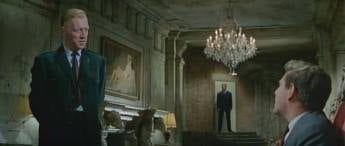
The first film dealing with the theme of neo-fascism or neo-Nazism is often considered to be the “spy drama” The Quiller Memorandum (1966, dir. Michael Anderson). However, there are not many neo-Nazis to be seen in it, and when they do appear, they stand respectfully in the background and listen to the old guard.The plot, with its suspense and logic, can be compared to the first Bond films (screenplay: Harold Pinter!), but the main character, British agent Quiller, played by George Segal, lacks Connery’s charisma (which is also less recognizable today)—he is just a “handsome guy of his time.” However, Max von Sydow certainly does not lack charisma in the role of Colonel October, Quiller’s adversary, who embodies one of the early—and therefore more decent—incarnations of an elegant, outwardly correct, but inwardly perverted SS officer according to the Freudian-Reichian interpretation. He has a doctor at his side who refreshes the memory of the exposed and captured Quiller during interrogations with large injections of “mood enhancers.” Another actor with a name that still resonates today, Alec Guinness, plays the role of a slick and unsympathetic British secret service agent in Berlin. In the opening scene, he briefs Quiller on the situation in the empty Olympic Stadium:
Things got a little out of hand in Berlin. A tough bunch. Nazis from top to bottom in classic form. It’s not just the remnants of the old group, oh no, there’s a lot of new blood, young, firmly convinced, very dangerous, not to be underestimated, very diverse, overall difficult to identify, none of them wear brown shirts anymore, no flags, so they’re hard to recognize, they look like everyone else. They work in various professions, but they are cautious and quite clever. Our task is to penetrate the hard core of extremists.
Why watch it again? Apart from Von Sydow’s performance, it’s mainly the realism: we will never again see such a clean, white, at first glance still un-Americanized Berlin of the “economic miracle” (shots from and around the school!). The only thing that is abandoned and slightly dilapidated is the aforementioned Olympic Stadium from 1936. The underground “headquarters” of the neo-Nazis on Kurfürstendamm, on the other hand, has the “Gothic” charm of a modern The Castle of Otranto. John Barry’s powerful musical theme, Senta Berger as the long-legged teacher, some of the dialogue, and the ambiguous ending are also enjoyable.

You can order The Best of Trevor Lynch here
More interesting is the French film Le combat dans l’île (Duel on the Island, 1962, dir. Alain Cavalier), which is often overlooked by Anglo-American critics. It is essentially a romantic drama between Jean-Louis Trintignant and Romy Schneider with a tragic ending, but set against the backdrop of current events surrounding the OAS, an illegal resistance organization formed to defend French Algeria. [1] Trintignant’s character Clément, a member of an “underground paramilitary cell,” is tasked with assassinating a Left-wing intellectual. He carries out the plan by using a bazooka to shoot into the victim’s office, only to discover that he himself has become a pawn in a larger game: there was no one in the office, only a mannequin behind the desk and its shadow. After the deed, he and his wife Anne hide in the country house of a childhood friend and set out to avenge the betrayal committed against him by his mentor and instructor, who has fled to South America. Meanwhile, his beautiful but somewhat capricious wife, an actress by profession, becomes closer to their host than is appropriate. Upon his return, Clément challenges him to a duel on a nearby island. . .
The best scenes? Apart from the assassination and combat training on private land somewhere outside the city, the most memorable scene is the one in which Clément “pacifies” an intrusive black man (in 1962!) in a nightclub where he went with his wife against his will. The “Duel on the Island” itself is filmed in a restrained, non-pathetic manner, so as to highlight the absurdity of the institution of dueling in the modern world.
As a whole, Cavalier’s film is captivating thanks to its atmosphere: impressive black-and-white cinematography, the use of jazz music for urban settings and classical music (Mozart) for rural ones, Normandy exteriors, and the personalities of the main characters. French speakers can also enjoy the dialogues by Jean-Paul Rappeneau. [2] Above all this stands the character and resulting actions of Trintignant’s protagonist: although his “fascist” idealism, according to the Marxist scheme, dulls his upper-class origins (son of a factory owner) and his strong sense of loyalty and honor is meant to come across as childish/infantile. . .
Another contemporary film on the subject of the OAS The Little Soldier (1960, dir. Jean-Luc Godard).
It is the story of Bruno Forestier, a young man who joins a “secret army” not so much out of firm conviction as out of a sudden impulse, a sudden existential revolt—just as Mersault in Camus’s The Stranger (1942, film adaptation Lo straniero 1967, dir. Luchino Visconti) kills an Arab. He is a recruit, a “pawn” in a political conflict, whose motivations for his actions remain largely opaque.
As the director’s name suggests, the film is shot in the “new wave” style. This has its advantages: we witness several realistic armed actions (or attempts) with clearly absurd features (“like when Gabčík’s submachine gun fails at the decisive moment of the assassination attempt on Reinhard Heydrich”), we watch almost documentary-like shots from Geneva—”cinema vérité” (Cinéma-vérité) in its purest form; and disadvantages: the biggest weakness is the endless space that Godard gives to Anna Karina, his then 20-year-old lover in the role of Bruno’s girlfriend from the opposite political camp.
It is not primarily their provocative political conversations that led the communist section of French critics to suspect Godard of sympathizing with the “far Right,” but rather the relatively long scenes of Bruno’s torture after he falls into the hands of a Left-wing group. While the group’s members prepare their political statements in the living room of their conspiratorial apartment, discussing, listening to the radio, and entertaining themselves, Bruno is chained to a faucet in the bathroom and repeatedly interrogated (using heat and burns) in the bathtub—indifferently, without emotion, routinely. Until then, such images had been reserved only for Gestapo offices. The government did not like the film either, and so it took two years before it was allowed to be released in cinemas. [3]
Notes
- The OAS, or Secret Army Organization (Organisation armée secrète), brought together all men capable of “action”: former non-communist resistance fighters against the German occupation, Pétainists and militiamen, members of the SS Charlemagne Division, and veterans from the First Indochina War. The armed campaign led by the OAS in Algeria, Paris, and other French cities culminated in 1962 with “attacks against the state” (including a series of bank robberies to obtain funds). The “black” element quickly gained the upper hand: the OAS was supported, and not just verbally, by most neo-fascist groups and parties across Europe, including emigrants from Romania (the Iron Guard), Hungary (the Arrow Cross Party), and Croatia (the Ustasha), who had found refuge in Franco’s Spain. The OAS’s activities gave rise not only to the cult of the “paras” (paratroopers as “supermen”) and a surge in popularity of the Celtic cross among “Right-wing extremist” youth in the 1960s, but also to the so-called “metropolitan OAS” (OAS Métro) also gave rise to the embryo of the later “New Right”—Dominique Venner’s Europe Action initiative, in which Alain de Benoist was also active.
- Rappeneau is, among other things, the screenwriter of well-known comedies starring Belmondo (That Man from Rio, That Man from Acapulco), but also the director of highly successful films from three important periods in French history: The Scoundrel (again with Belmondo), The Horseman on the Roof (based on the novella by Jean Giono!), Bon Voyage (from defeated France in 1940).
- There are several other films that refer to the OAS: the best known are certainly The Day of the Jackal (1973, dir. Fred Zinneman) based on Forsyth’s novel (the opening scene depicts a reconstruction of the OAS attack of De Gaulle) and the recent war drama Intimate Enemies (2007, dir. Florent Emilio Siri), in which Aurélien Recoing, in the role of commander Vesoul, wears a black shirt “just in case.” Delon’s hero in the melodrama The Unvanquished (1964, again by Alain Cavalier!) also joins the OAS as a former legionnaire, but soon betrays it when he falls in love with a woman he helped kidnap (the film was censored). In the film Lost Command (1966, dir. Mark Robson), Delon plays a paratrooper who, after Dien Bien Phu, voluntarily finds himself in Algeria, where a new anti-guerrilla war is beginning. Even better is R.A.S. (1973, dir. Yves Boisset). However, by far the most impressive depiction of these battles remains The Battle of Algiers (1966, dir. Gillo Pontercorvo), intended by its creator as a defense of “national liberation terror” (distribution banned until 1970!).
21 comments
IMO the French, White Pied Noir French Algerians is one of the most important clashes of civilizations, let’s not mince words -it was a pretty open race war, where our minority White Europeans, French and others decided they would not “Submit” to turning over French Algeria, then a part of France, not a colony , same as White Rhodesians decided not to just submit to Black Majority misrule and all the predictable horrors that always follow.
IMO the average White American SEC college (in name only) tackle football fan, NFL Negro Felon League TV addict or pretty much all of Conservative Inc, Regan Bush 1980s, Amurikuh Red Dawn, We must fight Saddam Hussein – he’s another Hitler, leading another Axis of Evil – our American Whites IMO have absolutely no idea that France actually fought an all out race war in French Algeria in the 1950s and directly contracting the mainstream dumb ass Amurkun World War II view “The French Never Fight, they’d be speaking German if we hadn’t saved their cowardly French as*se in two world wars” these dumb as* Americans didn’t know that French Military fought and basically won the war Battle of Algiers using the most effective, most brutal forms of counter terrorism including yes “Torture”.
The movie “The Battle of Algiers” long banned in France for being pro Arab terrorists, is IMO surprisingly fair to the French military – who fought to win. As the French counter terrorism military officer told the French press “This is a terrorist, guerrilla war – the Arab terrorists FLN wants all of us French to up and leave French Algeria – all the major parties in France including the Communist party have said Algeria must remain French. If you still believe that, you must accept the consequences and give us free hand to deal with these Arab/Muslim terrorists who plant bombs in French European cafes and who torture and murder Arabs that co-operate with us”.
Here’s that great scene from the Battle of Algiers.
https://www.youtube.com/watch?v=eSi8ie8n-6E
That’s right. Thanks for the additional information. You know a lot about this topic. The Battle of Algiers is a really good movie. I recommend checking it out. Stay tuned for the next installments in this film series. It’s going to be a wild ride!
Thank you Ondrej Mann for the kind words.
Yes, I do know a lot about this subject the race war, clash of civilizations in the French Algerian war ~ 1955-62.
In addition to the IMO GOAT war movie – “the Battle of Algiers”, I highly recommend Paul Johnson’s “Modern Times” – his chapter on decolonization, the French Algerian race war “the Bandung Generation” and the horrors that entailed for our people, but also for the natives that went from Western Civilization in places like Viet Nam, Kenya, Uganda, Lebanon, Rhodesia, Algeria to…
Idi Amin, Robert Mugabe, complete rape, murder of all White Europeans in the Belgian Congo and “The Coffin or the Suitcase” for White Pied Noir French and other White Europeans in French Algeria.
Here’s the link to Paul Johnson’s “Modern Times”.
https://www.amazon.in/Modern-Times-Revised-Twenties-Perennial/dp/0060935502/ref=sr_1_1?crid=220JDZH0LFYCW&dib=eyJ2IjoiMSJ9.dGvYpsH1HG9qN1B061CxflcxWnaOZA898qlCMSgGtqxAeV90FeE2hJrM41mIuiGNhSQYgjH2GxvMtq3Pld995E54SHvd-jPdKewLJPfPwYCMQaBHs2HqdID02pCaltXP.nBYP0WtiFVERGBS4Z2Iv2U3ewnxOkn7BnJRN–8dugE&dib_tag=se&keywords=paul+johnson+modern+times&qid=1775672329&sprefix=paul+johnson+modern+time%2Caps%2C322&sr=8-1
But, let me add a word of warning. If and When your friend, relatives and other normie Whites find out you are studying historical movies such as “The Battle of Algiers” and studying and understanding real history such as Paul Johnson’s “Modern Times” – they are not going to like that or like you, as it puts them down that they are not doing anything remotely similar. They are almost all happy being what they are, accepted the narrative that:
“The French never fight. They’d be speaking German now if we hadn’t saved their as*ses in two world wars” . These dumb as8es went along to go along with Reagan Bush Sr 1980s , “Red Dawn”, “Rambo III”, they see a dumb as* guy George Dubya Bush – in my opinion a virtual twin of “Jethro” on “the Beverly Hillbillies ” TV show and they think:
“That guys like me. FU*** those intellectuals that won’t fight”.
The Neo Con J men know this and they produce and Taylor their Neo Con, Zionist, Christian Zionist war propaganda with simple, time tested propaganda techniques to reach the hearts, minds and souls of these dumb as**es.
Thanks again for the kind words.
JR
Yes. I know a great deal about the clash of civilizations, racial war, and what it looks like when black people take over white society. In my native language, I contributed to a magazine Radix that published an issue on the real history of Rhodesia, apartheid, South Africa, Orania, and so on. In that magazine, I published an extensive interview with the writer Arthur Kemp. This man experienced the collapse of that civilization firsthand. For me, his life story is one of the most fascinating stories of the entire second half of the 20th century. Regarding the demise of Rhodesia, I highly recommend the Italian documentary film Africa Addio (1966).
Great article! I assume that The Boys From Brazil (1978) will be mentioned in a future article. 🙃
Absolutely! Get ready for a wild ride! Not only will this movie be discussed, but we’ll also break down many other films in this genre.
“ the Boys from Brazil”?
why promote that typical J Hollywood movie?
is Gregory Peck the lead actor as the evil NAZI that wants to kill 6 million more innocent Js ? Why ?
Because he s an evil NAZI that patriotic White American /British must stop to save the world again .
Nope
The theme is neo-fascism in film, so this series will include all films that fall under this theme. More iconic and “artistically” valuable films will be given more space, while trashy films will be given less. However, this is a very comprehensive film series, so all films should be included here—both the good ones and the bad ones.
Thanks for the recommendation. I watched Quiller and was highly impressed with the cast and the setting. Never a George Segal fan but he was good. Senta Berger looked amazing and talented. The Germans in the background made it look almost like a movie shot as a documentary they were so natural.
I am still wondering why the British and Americans were interested in the internal growth of a new Nazi party? I mean they certainly knew the Russians were the problem for Europe and not Germany at that point. Regardless of the plot I thoroughly enjoyed it and Senta Berger stole my heart.
Germany underwent a thorough denazification process after World War II. The occupying powers sought to track down and gradually eliminate those who wanted to continue building a National Socialist regime. Be sure to check out the stories of the Wehrsportgruppe “Hoffmann” and the Hepp-Kexel-Gruppe. I may explore the topic of post-war Germany in more detail in future articles here on CC. If you’re familiar with all the films mentioned, stay tuned for the next installment of the series, where we’ll take a closer look at films about neo-fascism, particularly those from Italian and Spanish productions. I’m confident you’ll discover something new.
knew the Russians were the problem for Europe and not Germany at that point
The Russians (and later also die Stasi) have successfully infiltrated the Neo-Nazi in both Europe (not only in West Germany), but also in the South America, where many Germans have emigrated after the WW2. Yuri Drosdov, one of most prominent Russian intelligence officers, was very good at it. Later he became the Chief of Illegal Intelligence and General.
Senta Berger was also Sergeant Steiner’s nurse girlfriend in “Cross of Iron.”
Watched the Battle of Algiers. That’s more like a documentary than acting. Pretty raw exposition of the reasoning behind guerilla warfare. They could never outgun the French, but they could certainly make life more dangerous. I enjoyed the irony in Colonel Mathieu addressing the press and noting he fought for The Resistance and yet now is called a fascist. Which leads to my confusion with current events in Europe where they invite the same people displayed here, vividly, to come inside their formerly idyllic lands and spoil the land and its people with their presence. Islam has never cared about the well being or the existence of any other people. Is it fascist to want to preserve your land for your own people? If so, call me fascist. The French lost by deciding not to fight for their country. Pity.
Not only the Arab world, but also both superpowers, SU and US, supported Algerian separatists, so the French had not a chance to keep those lands, even if we consider, that Algiers was not a colony, but a part of metropoly, departement outre-mer.
That’s a really good movie. Check out the other movies mentioned in the article, too. You might find something interesting.
Another film to check out is The Great Riviera Bank Robbery (1979), based on an actual heist (alternatively titled the chthonian Sewers of Gold). A team of rightwing French Army veterans plan the robbery to get the funds needed to buy weapons for an expected showdown with a resurgent Left. Along the way they form an alliance with a criminal gang who provide some of the muscle.
It’s set in the aftermath of the OAS, the 1968 May Day riots, and the creeping anomie of post-Gaullist France. The movie is not unsympathetic to the perpetrators, though it could have shown more of the political climate of the time: the rise of the Red Army Faction in Germany, Italy’s Years of Lead, and the Weather Underground mayhem in the USA.
The movie does take a little too much time showing the technical details of the robbers tunneling into the bank’s inner vault and not enough in the aftermath. One delightful if over the top element is the perpetrators bringing along a chef to cook gourmet meals in the vault while they spend the weekend looting the safe deposit boxes.
The Great Riviera Bank Robbery needs to be seen alongside Day of the Jackal (1973) for a snapshot of the rear guard actions of the post-World War II European Right.
That sounds like a good movie recommendation. Margot Metroland wrote a good review of the movie Day of the Jackal (1973) here on the site. It’s her favorite movie. I like this movie, too. Have you seen all the OAS movies?
Lost Command (1966) is a film adaptation of Jean Larteguy’s novel, The Centurions. The novel follows a group of French paratrooper officers from Dien Bien Phu to the battle of Algiers. Anthony Quinn plays Lt Colonel Raspeguy, loosely based on para legend Marcel Bigeard.
The novel contains an exposition of Larteguy’s ideas on counterinsurgency, and goes into the political difficulties facing the French army in Algeria. But the movie turned into something of a conventional war yarn with the colonel apparently hunting for glory.
The Centurions has been required reading in the military. It’s worth reviewing for understanding today’s fourth and fifth generation conflicts with plenty of lessons learned.
Larteguy wrote a sequel, The Praetorians, where the paras get involved in the historical coup against the French government over its apparent sellout in Algeria. Larteguy shows much sympathy for soldiers having to fight both an unconventional enemy to the front and an equivocating government at home. Obvious parallels can be made to Vietnam, Rhodesia and South Africa.
The Praetorians was supposedly optioned but never made it to the screen. Perhaps someone was concerned that it would get too many people thinking.
US author and Vietnam veteran Colonel David Hackworth studied the French experience in Indo-China and found it essential to understand enemy tactics and strategy. I thoroughly recommend his book “About Face” for fans of military books.
Anglian: May 15, 2026 US author and Vietnam veteran Colonel David Hackworth… I thoroughly recommend his book “About Face” for fans of military books.
—
Thanks, Anglian. About Face is one of my two favorite books about Vietnam — a real eye-opener about our “new Army” from a soldier’s soldier. A portion of an Amazon review:
1971–While the war expands into Laos, Hackworth is promoted to full-Colonel… Shortly after his promotion, the disillusioned Hackworth begins an interview with ABC reporter Howard Tuckner, which goes live throughout Vietnam and the States about the truth behind the U.S. Army’s policies of war in Vietnam (fake body counts and the much-dismaying ticket-punchers, including casualty lists of friendly-fire). While Hackworth busily then puts in his papers for early-retirement, the Army retaliates by attempting to hold him in Vietnam, and upon his return to the States, tail him with Army agents wherever he goes. Finally manages to retire on Sept. 28 and moves to Spain in self-exile...
Our National Alliance bookstore carries Hack’s 1997 follow-up book, Hazardous Duty,
Hazardous Duty by David Hackworth – Cosmotheism — Hack goes on to tell of the “systematic betrayal of an increasingly wasteful and inept high command. It offers essential solutions to problems that must be addressed if our nation is to remain the foremost military power in a volatile and ever-changing world.”
The book “A savage war of peace” by Alistair Horne is very informative. I bought the audiobook when I realised I knew very little of the conflict, except what I had read in a British volunteer in the French Foreign Legion who fought there. “Legionnaire” by Simon Murray.
If you have a Subscriber access,
simply login first to see your comment auto-approved.
Note on comments privacy & moderation
Your email is never published nor shared.
Comments are moderated. If you don't see your comment, please be patient. If approved, it will appear here soon. Do not post your comment a second time.