 3,779 words
Robert O. Paxton
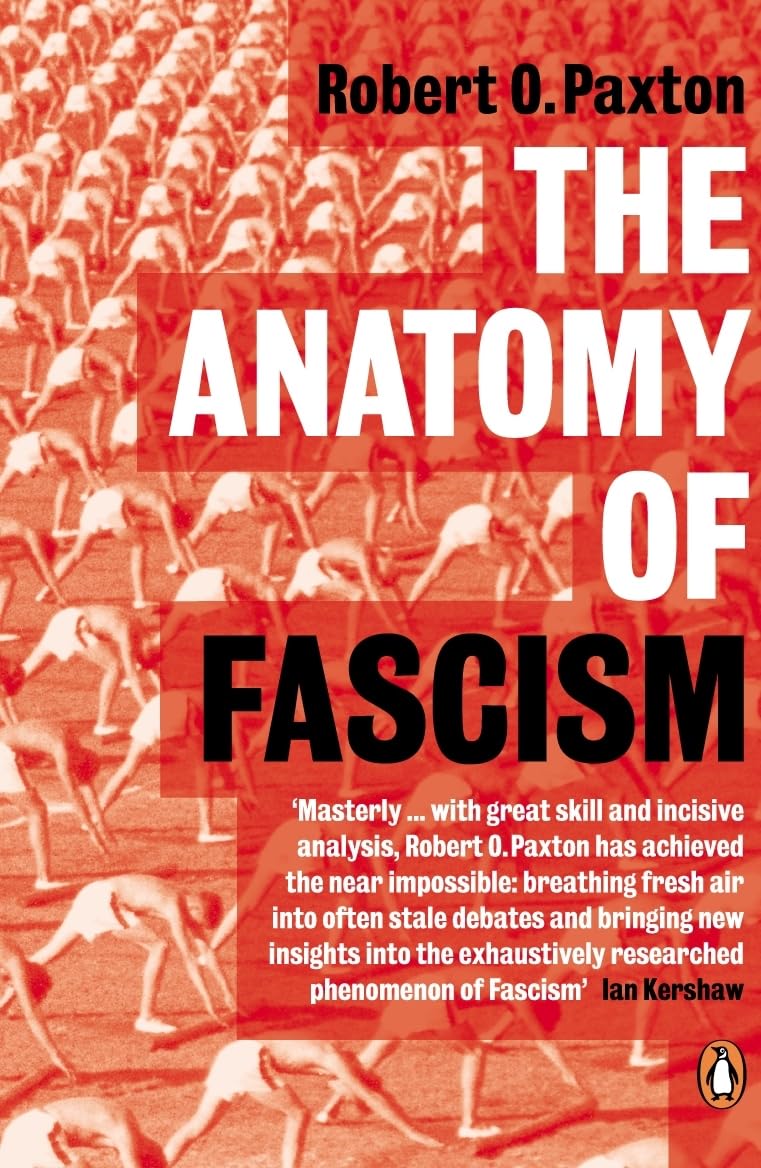
The Anatomy of Fascism
New York: Random House, 2003
When it is pointed out to someone on the political Left that socialism and communism have never worked anywhere ever, there is a standard reply; it wasn’t the right kind. Let’s give it one more try, they plead. This time it will work out. Why, then, should we not make the same claim about fascism? Hitler and Mussolini? Woefully incompetent poseurs, one a monomaniac, the other a narcissist. We can then echo our Leftist opponent’s riposte and apply it to fascism. Let’s give it one more try. This time it will work out.
Part of the problem of fascism is what we might call the toxicity of the brand. For the Left, Hitler means the Holocaust. Jew-led as it is, contemporary thought concerning fascism allows only one direction of travel. Any mention of the “other Holocaust,” for example, will enrage Jewish commentators on social media, despite a greater number of unfortunate gentiles being clinically expunged by the Nazis than Jews. The Roma gypsies the Nazis deleted are conveniently ignored, curious for a Left who can’t do enough for them today in Ireland, for example. The homosexuals who went to the gas are similarly overlooked, again, in a world which the new elites have attempted to homosexualize. Cripples are now lionized, and any criticism or omission of their minimal presence deemed “ableist,” but Hitler certainly culled Germany’s disabled community. Hitler also hated secret societies, and so had many Freemasons executed. (Well, Adolf, you got that one right). The problem is an obvious one. Although there were two Holocausts, you are only supposed to look at one. Nothing to see over there. As always, the main problem is that Hitler, the Nazis, and the Holocaust are viewed through the lens of morality, a seeing-glass so scratched and imperfect it would have been rejected by any competent lens-grinder as far back as Baruch de Spinoza. There was a good deal more to fascism than the Holocaust, and it will serve us well to announce that fact so that even those as intellectually obdurate as many on the Left are will be forced to look past the screen of the Holocaust and see what is behind it. When the grainy photographs of the death-camps are put away, what is fascism?
Robert O. Paxton is an American academic who specializes in the study of fascism. As he is an academic, one might expect his view of fascism to be appropriately liberal, but that’s of no importance. What we need is simply a serviceable history of the personalities, ideologies, and circumstances which brought it about, and Paxton’s book, The Anatomy of Fascism (Random House, 2003) does just that. Although often linked with the classical world, fascism is a relatively modern political innovation. “Fascism was unimagined as late as the 1890s,” the author writes, and was “a new invention created afresh for the era of mass politics.”
We are familiar with the root of the word “fascism,” coming as it does from the Italian fascio, a bundle or sheaf, usually of corn, and harking back to the Latin, fasces, which was an axe encased in a bundle of rods and carried ceremonially in Roman public processions to symbolize authority. It was Benito Mussolini who coined the Italian word fascismo, and the movement even has a date of birth; March 23, 1919, when Mussolini made an address to a crowd seeking political change. This was a meeting in Milan involving a disparate group wishing to “oppose socialism. . . because it has opposed nationalism.” The answer, claimed Il Duce, was fascismo.
“Everyone is sure they know what fascism is” Paxton writes, and this assured knowledge is primarily based on symbolic tropes that have passed into consciousness:
A chauvinistic demagogue haranguing an ecstatic crowd; disciplined ranks of marching youths; colored-shirted militants beating up members of some demonized minority; surprise invasions at dawn. . .
This caricature sounds uncannily like modern Britain, but coming from the direction of socialism rather than those associated with the “far-Right.”
We are aware that fascism revolves around the cult of personality:
The fascist leader wanted to bring his people into a higher realm of politics that they would experience sensually: the warmth of belonging to a race now fully aware of its identity, historic destiny, and power; the excitement of participating in a vast collective enterprise; the gratification of submerging oneself in a wave of shared feelings, and of sacrificing one’s petty concerns for the group’s good; and the thrill of domination.
We tend to see fascism as peculiar to Germany and Italy between the wars, but the author writes that “Movements that called themselves fascist or that deliberately modeled themselves on Mussolini existed in every Western country after World War I, and in some cases outside the Western world.”
Fascism was also a reaction against the dominant strains of European politics:
Deeper preconditions of fascism lay in the late nineteenth-century revolt against the dominant liberal faith in individual liberty, reason, natural human harmony, and progress.
Fascism required the active participation of the masses in politics, and so was on the side of suffrage. Paxton locates Emperor Napoleon III, who “pioneered the skillful use of simple slogans to appeal to the poor and little educated” as a precursor to fascism. It also required socialism to have reached at least a degree of power and shared governance. It was also pragmatic, and it was “not the particular themes of Nazism or Italian fascism that define the nature of the fascist phenomenon, but their function.” This was Realpolitik at the national level. Fascism required the political mobilization of the citizenry, and a crisis brought on by socialism and its attendant problems.
The equation of the new war against international capitalism was also inextricably linked with the “anti-Semitism” for which fascism is notorious. The invention of the steamship, for example, made it possible for European countries to import massive amounts of grain and other essential foodstuffs, which sounds like progress to everyone except the farmers and merchants it put out of business in the nations doing the importing. Fascism in its early stages appealed to all classes, although mostly the lower classes disenchanted by their economic circumstances, and it had the advantage of attracting the youth.
You can order the Centennial Edition of Francis Parker Yockey’s Imperium here.
Paxton believes that his fellow historians have concentrated too much on the roots of fascism, and insufficiently on the machinations of its rise to power. Many of the proto-fascist organizations, in France for example, never got further than “founding a newspaper.” And fascism was not the intellectual enterprise it is sometimes portrayed as, but rather brought about by men of action.
The anti-capitalism of early fascism was selective, and part of the organizational phase of early fascism was the differentiation between international capitalism and local, domestic producers, whom fascism “cherished.” This was certainly true of Hitler, who championed the small German farmer. Compare and contrast with how farmers are treated by the European Union and Britain today. Mussolini’s Blackshirts had their first real success among the landowners of the Po Valley. Establishing a monopoly over the farm labor market, the fascists allotted small plots of land to the small agricultural producers, and so “persuaded large numbers of landless peasants to abandon the socialist unions.”
Mussolini’s squadristi, militant groups backed by force, also appealed to the local police and army, who lent them trucks and arms. Although “the first Fascists had been recruited among radical veterans, national syndicalists, and Futurist intellectuals,” Mussolini knew how to appeal to the stewards of the land, and therefore those social players—and voters—responsible for food production.
The Nazis may have come to power at a time when the masses were far more fully a part of the electoral process, but they also knew how to select their target constituencies, which began with the cattle-farmers of Schleswig-Holstein:
The growth of the Nazi vote from the ninth party in 1928 to the first in 1932 showed how successfully Hitler and his strategists profited from the discredit of the traditional parties by devising new electoral techniques and directing appeals to specific constituencies.
While fascism gained traction in Germany and Italy, it had a less auspicious time in France. Despite similarities to the collapses in the Po Valley and Schleswig-Holstein brought about by the worldwide economic collapse of 1929, “French conservative farm organizations held their own much better” than was the case in Italy and Germany, and so had less need to call on the fascists for help. There were other “failed fascisms.” Despite strong electoral support, fascism never found a foothold in Hungary and Belgium, and failed utterly in Holland. The author is most surprised by the failure of Sir Oswald Mosley’s British Union of Fascists, not least because Mosley had the greatest intellectual gifts and strongest social connections of all the fascist chiefs. Perhaps George Orwell’s later diagnosis of Britain was correct, that the British had an ingrained antipathy to fascism, or perhaps Mosley was just too much the showman, and could not resist combative marches through areas he knew would ignite trouble, such as the march that led to the Battle of Cable Street in east London in 1936, when Mosley’s swaggering blackshirts fought with antifascists. Ireland’s Blueshirts also failed to gain any traction, leading Paxton to conclude that “it was not enough to don a colored shirt, march about, and beat up some local minority to conjure up the success of a Hitler or a Mussolini.” Fascism has had a tendency to appeal to those who just want to indulge in some political LARPing. The failed fascist organizations across Europe seem to indicate that anti-Semitism was not an initial driving force behind fascism. Germany’s anti-Semitism had died down by the time of World War I, and Mussolini would not turn to the issue of the Jews until later in his career. There was far more anti-Semitism at the turn of the century in Britain and France, a nation still agitated by the Dreyfus case in 1896.
Rather than fascism being a simple result of liberal governance across Europe, the author stresses that fascism “grew into” the economic and social space opened up by failed liberal regimes. Germany had the added impetus of what it saw as the outrageous demands of the Treaty of Versailles, and it was easier for Hitler to mobilize youth and shaped its identity by staking a claim to the street, to “fight with Communist gangs for control of working-class neighborhoods of Berlin.” Hitler and Mussolini also saw that “while Marxism now appealed mainly to blue-collar workers… fascism was able to appeal more broadly across class lines.” And fascism was indeed mobilizing, with the traditional main players being Germany and Italy, the two figureheads Hitler and Mussolini. The author moves to the factors that allowed them to gain power.
The “March on Rome” by Mussolini’s squadristi needs to be stripped of its mythology, writes Paxton, who sees it as “a gigantic bluff that worked” because “Mussolini had correctly surmised that the king and the army would not make the hard choice to resist his Blackshirts by force.” Might was beginning to make right.
By comparison, Hitler’s “Beer Hall Putsch” of 1923 was a comedy of errors. Attempting to kidnap the Bavarian government to gain political leverage, Hitler underestimated the efficiency of the government’s chain of command, and ended up in prison. After the collapse of 1929, however, with millions losing their jobs and a series of failed coalition governments, the Nazis suddenly began to get a firm grasp on power. The Hitler/Von Papen government came to power on January 30, 1933, “Hoist” into office by “a backstairs conspiracy” after much political skullduggery and horse-trading. Neither Mussolini nor Hitler came to power via coups, and neither led majority parties in their respective governments. The Nazis never got more than 37% of the popular vote, and Mussolini didn’t achieve even that. Fascism had not “swept to power,” but rather negotiated and finagled their way to their positions. Their status as dictators would not come until later:
Since the fascist route to power has always passed through cooperation with conservative elites, at least in the cases so far known. The strength of a fascist movement in itself is only one of the determining variables in the achievement (or not) of power, though it is surely a vital one.
Both leaders had trouble with their Conservative coalitionists, but it was still the case that “Hitler and Mussolini were the first lower-class adventurers to reach power in major European countries.” The Reichstag fire and the “Night of the Long Knives” cemented Hitler as a dictator despite technically being in a coalition, while Mussolini’s assumption of leadership was more gradual. Both were steeped in violence, which does seem to be a hallmark of fascism. This certainly does not rule out its resurgence today, as violence is inevitable in Europe, and someone on the Right had better be prepared for it. It’s just a question of how much violence, and when. The likely economic collapse which also seems imminent may create conditions similar to those which brought Hitler and Mussolini to power.
Chapter five of Paxton’s book deals with the nature of fascism once in situ. Given that both leaders were in coalition with Conservative parties who shared their desire to keep socialism from power (another argument for fascism today), the author profiles both sides of the sometimes uneasy union:
Conservatives tend to pull back toward a more cautious traditional authoritarianism, respectful of property and social hierarchy; fascists pull forward toward dynamic, leveling, populist dictatorship, prepared to subordinate every private interest to the imperatives of national aggrandizement and purification.
This led to inevitable struggle, and “a prevailing climate of social Darwinism.” Hitler has used the Reichstag fire and his purge of his inner circle to abrogate powers he would not otherwise have had, but he could not alienate his coalitionists with excessive force. Mussolini “subordinated his party to the state [because] he had less leeway, less drive and less luck” than his Nazi counterpart. Though both men had the charisma necessary in a fascist leader, their styles were very different, Mussolini working long hours at his desk, while Hitler preferred to “indulge in the lazy bohemian dilettantism of his art-student days.” But Hitler’s direct style of decision-making was genuinely beginning to mold Germany into a new country based on old values.
Hitler was changing the relationship between the individual and the state, and “fascism redrew the frontiers between private and public.” The Nazis encouraged, even forced, young people to be wards of the Reich rather than their parents or school, and students were particularly drawn to Nazism, as were women. How very different from today, when both blocs have unquestioningly adopted the non-values of the deleterious new socialism. In Nazi Germany, however, “the difference between the public and the private almost disappeared.” This is the essence of National Socialism:
There was no room in this vision of obligatory national unity for either free-thinking persons or for independent, autonomous sub-committees. Churches, Freemasonry, class-based unions or syndicates, political parties – all were suspect as subtracting something from the national will.
Both leaders saw their fascist regimes’ ultimate aim as war and, although “Hitler did not want the long war of attrition he got” and would rather have had a successful show of force in simply occupying Poland, both the Nazis and the Fascisti required new territories:
Fascist regimes could not survive without the active acquisition of new territory for their ‘race’ – Lebensraum, spazio vitale – and they deliberately chose aggressive war to achieve it, clearly intending to wind the spring of their people to still higher tension.
It was also war that brought out the greatest excesses of Hitler in particular, and Paxton deals with the Holocaust in a separate chapter. We are all aware that Hitler killed far fewer of his own people than did the Communist regimes of the 20th century. But it is still the case that, if you walked into a bar with Stalin on your T-shirt, or perhaps Andy Warhol’s Mao II, no one would raise an eyebrow. Try that in a Hitler T-shirt, however, and you would probably wind up in jail. As noted, Hitler erased more gentiles than Jews, but they are worth less to the modern socialist sensibility. The Holocaust is the symbol of fascism for the modern Left, and this is why it is almost impossible to make its case in the modern West. Hitler’s persecution of the Jews was not a sudden policy, but incremental. It received an accelerant after Kristallnacht, in November, 1938, when synagogues and Jewish businesses were attacked. Goering complained about the attacks, claiming that it did not really harm the Jew because insurance companies would pay for the damage. Something more programmatic was needed, and from 1939 in Poland, and 1941 in the Reich, Jews were forced to wear the infamous yellow star in order to mark them out. Expulsion, the next phase, proved difficult, and the Final Solution began to take shape. Quite why Hitler did not simply imprison the Jews and force them to work towards the war effort remains a mystery, unless Hitler’s monomaniacal hatred of Jewry is credited for the use of the camps, which had actually been in existence since 1933 as prisons for dissidents. With the Nazi taste for eugenics—a word invented by Darwin’s cousin, Francis Galton—it is understandable why the Nazis wished to exterminate cripples and the mentally handicapped, but the Holocaust was not only excessive and wasteful of human materiel which could have been put to better use, it also unwittingly gave the Jews of the future the biggest victimhood card in history. The test-run for the Holocaust was the use of the commercial insecticide, Zyklon-B, on 600 Soviet prisoners of war at Auschwitz on September 3, 1941. As noted, the German people were not party to the existence of the camps:
We can dismiss any notion that the Nazi regime murdered Jews in order to gratify German public opinion. It took elaborate precautions to hide these actions from the German people and from foreign observers.
Italy had no real strain of anti-Semitism, and Mussolini had long been funded and befriended by “Jewish backers and even close associates.” The author suggests that this relative indifference to Jewry was because “the Catholic tradition was hostile to biological racism.” Mussolini’s campaign in Ethiopia also diverted attention from any racial animus at home. But the programmatic outburst of genocidal violence is, as noted, what is most associated with fascism:
The radicalization stage shows us fascism at its most distinctive. While any regime can radicalize, the depth and force of the fascist impulse to unleash destructive violence, even to the point of self-destruction, sets it apart.
The penultimate chapter is an inventory of post-war Right-wing parties and, as expected, this shows the writer to be a product of liberal modernity. This is hardly surprising, as a book published by Random House is unlikely to be favorable of the fascists. European politicians such as Jean-Marie Le Pen, Haider, Berlusconi and Fortuyn are all seen as threatening to summon the specter of fascism redux, but the final chapter returns to the central question; What is fascism? And it is an elusive problem. Robert Griffin is a recognized expert on fascism, and gives one of many definitions:
Fascism is a genus of political ideology whose mythic core in its various permutations is a palingenetic form of populist ultranationalism.
Any definition of fascism is going to have to choose from a constellation of sub-definitions, although none of the Leftists who throw the word around like confetti will know any of them. But they have debased the word, as they tend to do with language. There is little to add to Orwell’s curt appraisal of the use of the word “fascism” in The Lion and the Unicorn:
The word Fascism has now no meaning except in so far as it signifies “something not desirable.”
Fascism itself, even with this denuded meaning in which the word has almost become a performative, is certainly not desirable to our enemies, which is precisely why it is time to revive it again. It doesn’t need swastikas, and death camps, and Kristallnacht, but it will require violence, which is coming anyway.
There are a number of reasons why fascism ought to appeal to us on the Right, and not least is that it was a reaction to extreme Left-wing politics. In this sense, it was properly reactionary, a term which has been falsely labelled a pejorative. If fascism was a critical reaction to Left-wing politics and culture, then it had me at hello. Exterminating up to 14 million people in death camps is excessive, and ultimately unnecessary, but since violence is coming to Europe anyway, it could certainly be condoned in any future fascist government. As Hitler never had much of a mandate, it is unclear how he expected to explain away the piles of corpses to those who did not vote for him after a war in which he had been victorious.
Paxton’s book is an excellent introduction to fascism, despite its liberal pearl-clutching. Paxton points out the difficulty of a reductive definition of such a complex concept, and the ultimate futility of searching for the “fascist minimum.” He offers two rather clunky (but necessarily so) definitions:
Fascism in power is a compound, a powerful amalgam of different but marriageable conservative, national-socialist and radical Right ingredients, bonded together by common enemies and common passions for a regenerated, energized, and purified nation at whatever cost to free institutions and the rule of law.
He refines this at the very end of the book, and somewhere in his definition there are clues as to what a modern European fascism might look like:
Fascism may be defined as a form of political behavior marked by obsessive preoccupation with community decline, humiliation, or victimhood and by compensatory cults of unity, energy, and purity, in which a mass-based party of committed nationalist militants, working in uneasy collaboration with traditional elites, abandons democratic liberties and pursues with redemptive violence and without ethical or legal restraints goals of internal cleansing and external expansion.
It may already be too late to save Europe, but if any salvage operation is possible, then fascism must be at the forefront rather than hidden in embarrassment. “Our ideology,” said a militant fascist of the 1920s, “is that of the fist.” We are sick of the BLM fist, the Communist fist, the “Black Power” salute. It is now time to use our own. Next time you go through your wardrobe, don’t throw away that old black shirt. You never know when you might need it.
40 comments
We need a Hugo Boss on our side.
The thing is, there was never a unified fascist movement. There was no “Fascist International” to counter the Communists. Italian Fascism was not like German National Socialism, and neither of them was like Belgian Rexism, the Hungarian Arrow Cross, the Romanian Iron Guard, or Spain’s Falange movement.
Post-war fascists were pan-European in outlook. See Bolton’s biography of Yockey.
Does the Anti-Comintern Pact count? Anyway, every time and place has its own needs, sensibilities, and unique political situation, so it makes sense that different countries will have their own particular variation.
Time is cyclical. What was, will come again.
Dude with the way that AI technology is accelerating right now. I’m not so sure if we can entirely rely on these cycles. it could be entirely possible within our lifetimes that we really hit enough of a technological milestone to be post scarcity. I predict a lot of people losing their jobs in the next 20 years
Post-scarcity? Buddy, you’re not ready for the scarcity that’s coming. The EU is pursuing net zero policies that require for just one generation (15y) hundreds of times more precious metals than are in existence.
The Levelized Cost of Energy (LCOE) is rising along with demand. Energy use will have to be scaled back significantly when two generations of “renewables” are used up and newly mined materials can’t keep up.
The Italian Giovanni Gentile – dubbed by Mussolini the “philosopher of fascism” – was assassinated by Communists in the final months of the Republic of Salò. A worthy subject for a Counter-Currents’ retrospective?
Gentile called his philosophy “actualism”; an extreme form of idealism that might have given Bishop Berkeley a touch of the vapours. Gentile thought that idealism and fascism were natural bedfellows. Why so? One reason might be that fascist economic thinking wasn’t as rigidly ideological as Communism or socialism (or American-style let-it-rip capitalism!). Italian fascists were prepared to try one solution to a problem; if it wasn’t working they would happily give something else a go. That adaptability would appeal to an idealist who was suspicious of our penchant for taking refuge in rigid concepts.
Real communism has been tried many times, always with the same result – millions of murdered innocents, with mass famine and economic failure. But commies don’t care. They always want to do it again. Liberals too, because liberals suffer from the same death-wish as commies. The only cases where nominally communist regimes work well, is when they combine nationalism with socialism, as in Tito’s Yugoslavia, Castro’s Cuba, and China today.
OTOH, fascism has been tried too, usually with great success, as in Franco’s Spain, Salazar’s Portugal, and Pinochet’s Chile.
Hitler was not a fascist, but a war-monger, like Netanyahu in Israel today. Mussolini was the original fascist, before he made the mistake of joining with Hitler. However, by allying with Germany, Italy undermined Germany’s war effort, and caused its defeat in WW2. Better for Germany if Italy had remained neutral and fascist. In that sense, we should credit Italy with helping to defeat Germany.
Of all the governance and systems you mentioned being crazy I noticed you forgot to condemn ‘Democracy’. Democratic governments being the biggest war mongers in the last century, always with the same result, millions murdered by democratic aggression in the aims of “spreading democracy”.
Communism, liberalism, democracy all siblings, all universalist extremist ideologies, all offspring off Christianity, all essentially a death cults in some manner.
Interesting you see the defeat of Germany as a good thing. One thing we can be sure of is had Germany won, White Europeans would not be being blood sacrificed or sexually enslaved in their homelands by browns and blacks with the blessing of the extremist liberal democratic death cults.
Italy deserves credit for helping loose the war, so that the Marxist Huns and liberal capitalists could carve up and debauch Europe? This is easily one of the most bizarre things I have read on this forum. And oh yeah, little Greece humiliated Italy when nut-case Mussolini (who started in politics as a red socialist) picked a fight with Greece for no good reason, other than to bully a European neighbor and raise the Italian national pride. At the end, at least Adolph had the balls to fall on his sword, While Benito did not and died a humiliating death at the hands of his enemies.
Franco in Spain seemed to be the only partially Fascist regime to work over 34 years, due to his non entry into the Axis group in WW2.
kolokol | May 21, 2026 at 10:00 pm
“Hitler was not a fascist, but a war-monger, like Netanyahu in Israel today. Mussolini was the original fascist, before he made the mistake of joining with Hitler. However, by allying with Germany, Italy undermined Germany’s war effort, and caused its defeat in WW2. Better for Germany if Italy had remained neutral and fascist. In that sense, we should credit Italy with helping to defeat Germany.”
I’m going to have to strongly disagree with the warmonger thesis.
Hitler would have infinitely preferred diplomacy over going to war ─ and he strongly resisted actually doing so. In fact, as he admitted to Finnish Marshal Mannerheim on the occasion of his 75th birthday in 1942, German intelligence had grossly UNDER-estimated the imminent Soviet threat in 1941, and the strategic situation was never going to get better as long as the Entente had remained the enemy. Hitler said that he appreciated Finnish help against the Soviets but did not ask for anything specific.
For their part, Churchill understood from his own intelligence that German naval power was simply not strong enough to support an Axis invasion of the Albion isles, so they would never be interested in making peace with Hitler under ANY terms, and the Americans (or the Jews) would always be a blank check behind London’s machinations anyway. Roosevelt, for his own part, wanted to inherit the British Empire, and they would owe the bloody Yanks a very great debt even if they ultimately defeated Germany/Japan.
Hitler understood how “Parliamentary Democracy” actually worked, which is to say that its job is to create perpetual gridlock by paralyzing the political factions into inaction and status quo stagnation. Then the Plutocracy (or the Bolsheviks) could come in with their own agenda, and either grease the skids of progress with foreign cash or with actual German blood.
When the Wall Street Depression of 1929 sabotaged the last hope of a Versailles War-Debt refinancing (Dawes Plan/Young Plan) for Germany, the Bourgeois German Zentrum (Center) Party was discredited and the NSDAP became the plurality-seated party in the Reichstag, with Blue Max-bearer and former WW1 aviator, Hermann Wilhelm Göring elected as Reichstag President (similar to House Speaker).
Still, the legislative and bourgeois factions desperately tried for as long as possible to keep Hitler from being appointed Chancellor by President Hindenburg (per custom as the leader of the primary legislative party). After various 1933 enabling acts in the Reichstag and upon President Hindenburg’s 1934 death, Hitler assumed the office of both Head of State and the Head of Government.
This story is not hard to understand but it is seldom told with any semblance of the truth.
Apparently getting things done is “Dictatorship.” When Trump gets things done, it is an abuse by “Kings.” This is how the Left thinks. Lots of “Reichstag Fire” claims in the book reviewed above by our excellent Counter-Currents writer, Mr. Gullick. That right there reeks of cant, and I therefore thank him for sparing me the need to read this flawed pulp on Fascism.
The Parliamentary Democracy way of dealing with problems ─ especially systemic ones ─ is to imagine that an oxcart is stuck in a bog and you tie horses to the cart from as many “diverse” angles as possible, and then let them all tug it out against each other. Sounds almost Darwinian.
So wherever the hapless oxcart ends up, that is where the will of the Democracy gods have shined. Sometimes the Plutocracy actually shovels a little cash in this direction or that direction and largely picks the winners too.
That is what we call the Free Market. And it is the closest thing to the “public interest” in a Democracy.
The American Founding Fathers did not try to create a Democracy, however; they created a Republic, “if you can keep it,” and the Federal Fasces was an often-used symbol of what they tried to do. The Many are One: e pluribus unum.
https://en.wikipedia.org/wiki/Fasces
The Fasces easily symbolizes how many smaller sovereignties were all bound together and facing in like directions, and the movement of my proverbial “oxcart” or ship-of-state was meant to be for the organic benefit of the whole ─ i.e., the collective interest of the nation, state, community, folk, people, race.
Hitler understood this. But who understands Hitler?
Hitler’s political life was geared around eradicating the Versailles Treaty and the encirclement that was created by the Entente at the end of the First World War in order to exploit Germany, which was not and never would have been an equal player before that world bar.
This was an abominable international system that the Plutocratic powers had fashioned for the world which they equated with International Law and with World Peace. It was a tissue of lies.
Hitler understood that at some point it would not be possible to negotiate with the “Democracies,” and sure enough they ultimately declared war on Germany but not upon the Soviet Union.
All Germany asked for over the Danzig crisis was a rail and road right-of-way through the “Polish Corridor” to connect East Prussia and Eastern Germany for goodness sake. The Entente powers had actually encouraged the Poles to blockade Danzig. In 1939, probably no Germans were more National Socialist than the “free city” of Danzig.
Hitler miscalculated that the Entente would actually declare war over Danzig. But even if he had been more patient and not defused Poland with Stukas over Warsaw, then the Führer knew that they would inevitably be fighting the Allies for keeps at some point. And Moscow would be there to mop up their fair share with the blessings of London and Washington.
And, they ─ the Allies ─ were always willing to cajole, bribe, or take advantage of the situation with Bolshevism right on the bleeding borders of central Europe, which was a unique German problem that the Entente and their American-Jewish friends would and did exploit.
If German sovereignty was to be preserved, no compromise could be made with Bolshevism. Hitler was never fooled about that. Was this overly pessimistic? Perhaps.
Hitler ultimately lost, after all.
Once Hitler put on the Army uniform in 1939, he vowed never to take it off until the war was over or he was dead. The Kriegsherr did little else, working late into the night until his health was shot and he was left a shattered man who went down with the beloved ship.
People pretend that Hitler had a choice about going to war and just rolled the dice for some reason. Utter Nonsense.
As far as Italy’s participation in the war, Hitler admired Mussolini and the Fascists, and wanted their moral and material help. But he absolutely did not need another greedy ally of extremely-limited military prowess. Italy backed the German annexation of Austria in 1938, and resolving the Sudetenland Crisis, but far less welcome was joining the Second World War by Mussolini launching into Southern France in 1940 after Paris was already defeated.
Italian military help, especially in the Mediterranean, was quite simply a complication that the German Oberbefehlshaber did not need. Thank goodness that Franco never joined the war too. Spain would have been blockaded by the Anglo-American navies, and Germany would not have been able to feed them.
Erwin “the Desert Fox” Rommel, who had fought and defeated the Italians in WW1, was never happy being saddled by default commanding Italian imperial troops in Northern Africa ─ these including Levantines, sometimes even including Negroes ─ who were fighting for old colonial territories in French or Italian North Africa after having been bested by the British.
The Desert Fox’s boss, Luftwaffe Field Marshal Albert Kesselring, who spoke passable Italian and was a superb diplomat and strategist, and who probably should have sacked the irascible propaganda prima donna, was quite measured and fair about evaluating Italian wartime performance in his postwar memoirs, which I would highly recommend.
Field Marshal Rommel, who in peacetime never would have made it past Colonel, was a dedicated solider, one-time Hitler admirer, and a brilliant armored warfare innovator. But he lost the faith.
Unusual for a German soldier if not an outright Nazi today, the man is revered for two reasons:
1) Rommel turned traitor and passively took no action against the Generals’ July 1944 bomb plot that killed many brother officers and nearly killed Hitler himself, and 2) because Albion and the Yanks ultimately did defeat the Desert Fox in the desert. Jolly Good.
Those are the kinds of stories that the Victors in Good Wars like to tell.
🙂
Literally zero of those were fascist regimes, all very traditional Latin & Latin American military juntas.
Even Iran had its own fascist party, known as SUMKA.
Being a nation of universalist, fanatical, extremists of a jew religion, fascism will never actually jive with them. Muslims prefer anti nature communism not Natural Order. Communism seems to appeal to inferior groups and people. The Arabs almost got race first governance to work which required elements of fascism but if you look at all the upper echelons of Ba’athists they were all mostly of a higher class genetically.
You mentioned Natural Order, I cannot speak for other Islamic countries, but hierarchy is more evident in Iran than in the egalitarian West.
Well done for pointing out why we’re all assembled here at CC. Liberalism has destroyed the West and the good guys lost the fight for White dignity in 1945. Yes the West today is an extremist, universalist, egalitarian dystopia and the sky is blue.
Agreed that (stone age) hierarchy is more evident in Iran than the West. We want Natural Order here not treating women like…. the browns do. That is not Natural Order.
There is no point in arguing with you since you are ignorant about the basics.
it wasn’t the right kind. Let’s give it one more try, they plead. This time it will work out.
Great article! Isn’t that what the Christians are always saying about their religion. 🙃
I seem to recall the academic definition of fascism having to do with more of a partnership between the federal government and industry. I see a bit of this mentioned in the article too. The point about this being a successful system more than the deadly socialism, was it successful for all of the society? Did the leaders still disappear citizens? It’s an easy word to misuse and works for the left to describe literally anyone they dislike. I’d venture to guess they would say they can’t define it, but they know it when they see it.
Flel | May 21, 2026 at 11:09 pm
“I seem to recall the academic definition of fascism having to do with more of a partnership between the federal government and industry. I see a bit of this mentioned in the article too. The point about this being a successful system more than the deadly socialism, was it successful for all of the society?”
This is an excellent point.
In the early time of FDR’s New Deal, before he decided to end the Depression and unemployment by going to war against Germany/Japan, the Hyde Park plutocrat who was best buds with Hank Morgenthau, Jr., saw himself as bearing an election mandate to find an innovative solution.
Frank Roosevelt was willing to try different “third position” or Fascist approaches like the National Industrial Recovery Act (1933) which setup the National Recovery Administration (NRA) which did various things like require minimum wages and suspend anti-trust laws to let businesses, labor, and government collaborate on industry-wide “codes of fair competition.”
These “codes” were somewhat less beneficial for small businesses than for larger firms, and were harder for them to adhere to, and the NIRA was then ruled Unconstitutional by the U.S. Supreme Court in 1935.
By 1937, most of Roosevelt’s New Deal was dead in the water.
However, the 1935 National Labor Relations (Wagner) Act, which formally allowed Collective Bargaining, was never ruled Unconstitutional. It is still the U.S. law today.
The Wagner Act created a government National Labor Relations Board which could arbitrate contracts between Labor and Management in the public interest.
The NLRB could also investigate “unfair labor practices” on behalf of either party, again in the interest not for class but for the organic whole. This is a good example of third-position or “Fascist” politics, and it helped in the 1930s and later United States to keep Marxism and class-warfare out of Labor organizations.
The Wagner Act allowed occasional NLRB elections to be held that would determine whether a Union could negotiate on behalf of a particular economic “bargaining unit.”
The Wagner Act was severely weakened in 1947 with the Taft-Hartley Act, which allowed states to ban the closed Union shop, which means that a bargaining unit must appeal to its local membership and beg for all its membership dues even though the Union is already negotiating with manangement or the ownership of the means of production for the wages and benefits of all the employees as a whole, and not just for the particular dues-paying Union members.
Right-to-Work is a very powerful means of dividing Labor at the picket line, whereas Management already essentially operates as a bloc, and sometimes as a class unto itself. Management often (illegally) reserves the right to reward individual employees who are NOT supporting the Union, and its efforts to organize a Local shop and to negotiate collectively for the unit.
Currently, in the United States, there are 26 Right-to-Work states where Union membership in a particular bargaining unit is not mandatory for all the employees in that unit. A Labor Union’s ability to negotiate and to promote favorable worker legislation is highly dependent upon the income that it can collect from dues. It is no surprise, therefore, that RtW states are places where the wages tend to be the lowest.
Like the German Labor Front of Nazi Germany, collective bargaining is almost a dead model entirely in the United States now as well, because if a multinational corporation does not want to pay higher wages or benefits, they need not negotiate with anyone at all ─ they are encouraged to just to close down the Unionized shop altogether, and outsource the means of production overseas where Labor costs are already lower.
I used to be a Union shop steward in the Broadcasting industry for the International Brotherhood of Electrical Workers (IBEW). We had television engineers, TV presenters, news editors, reporters, weather nerds, production technicians, radio announcers, etc., and even atomic workers in our Local.
It ultimately became clear to me why organized Labor nowadays does not fight so much for bread and butter issues like better wages, better benefits, and better working conditions. These are hard fights to win and they often require additional legislation that is contrary to what the commercial lobbies are fighting for.
Therefore, it is no surprise that the RINOs of the Chamber of Commerce want as much illegal immigration as possible. Keeping wages down will benefit the “free market,” don’t ya know.
Modern Unions are not really up for tough fights. Instead they want to organize on cultural-Marxist lines like Gender, Transexual toilets, Race, and whether Black Lives Mattuh.
You don’t have to deliver anything financially concrete to organize in favor of cultural-Marxism now. Modern corporate management often doesn’t even really care whether “Woke” men with green hair can wear dresses on the assembly line floor, let alone do their dangly business inside the Ladies’ room.
The pusillanimous corporate firms see Adam & Steve or Saint George Floyd kinds of issues as not really affecting their ultimate financial prospects ─ whereas a better employee Health plan they will probably fight against with teeth and claws because that will actually cost them a liitle more right from their profit margins.
🙂
Claims that “communism” or “fascism” don’t work and never have—citing the number of people killed—are a typical manifestation of American thinking. What if violence is precisely the key element of such a political regime’s appeal? Liberal capitalism is terrifying in its immobility and social rigidity (amid apparent frenetic activity), where the same type of people from the merchant class always rise to the top. Totalitarian regimes, especially in their initial violent phase, are attractive precisely because they enable violent catharsis and a different type of governance with a different type of elite (charismatic rule).
The fundamental question is whether an alternative system is still possible today, when society is so fragmented. To what extent was the world of so-called industrial modernity—with its masses of factory workers and soldiers—a prerequisite for fascism and communism?
“Fascism is a genus of political ideology whose mythic core in its various permutations is a palingenetic form of populist ultranationalism.”
No need for palingenetic populist ultranationalism as a mythic core when you’ve got the Holocaust myth (and do we ever!), with the evidentially threadbare Gypsocaust and Homocaust tagging forlornly along.
Fascism will never work in the U.S. I’m skeptical it would work in at least half of the world’s White countries. It might be one of those things that just doesn’t mesh with the constitution of most Whites.
Mostly agree with this. Even when faced with the knowledge of mass media being wicked and mendacious, foreign and actively subverting and destroying White societies the people will still side with nonsense like “freedom of the press”. This has to be a combination of (as you say) the constitution of White people, and Pavlovian conditioning to feel squeamish about an authority shutting the media’s lying mouths even when said authority is benevolent towards them. “Oh, it sounds like Nazi Germany”.
We have a problem.
Morality Squad: 22, 2026 Fascism will never work in the U.S….
—
Scott defined fascism and a history of how it actually did work in the U.S., to some degree, or there wouldn’t be, to this day, 8-foot-tall fasces symbols flanking the Speaker’s rostrum in the House of Representatives.
It’s an ancient symbol of our people, “consisting of a bundle of rods tied together with a single axe, representing magisterial and priestly authority in ancient Rome. Originating from the Etruscan civilization, it signified a magistrate’s power to punish and maintain order… This symbol embodies authority, strength, and unity throughout Roman history.”
since violence is coming to Europe anyway, it could certainly be condoned in any future fascist government.
It may already be too late to save Europe, but if any salvage operation is possible, then fascism must be at the forefront rather than hidden in embarrassment.
We are sick of the BLM fist, the Communist fist, the “Black Power” salute. It is now time to use our own.
Absolutely! Politics will not save us. Praxis informed by metapolitics will, and focused violence is a necessary part of that praxis.
A spectre is haunting Europe — the spectre of White nationalism. All the powers of old Europe have entered into a holy alliance to exorcise this spectre: Pope and Eurocrat, Premier and Prime Minister, French Antifa and German police-spies.
Where is the party in opposition that has not been decried as “racist” by its opponents in power? Where is the opposition that has not hurled back the branding reproach of “racism,” against the more advanced opposition parties, as well as against its reactionary adversaries?
Two things result from this fact:
I. White nationalism is already acknowledged by all European powers to be itself a power.
II. It is high time that White nationalists should openly, in the face of the whole world, publish their views, their aims, their tendencies, and meet this nursery tale of the Spectre of White nationalism with a manifesto of the movement itself.
[Cue an ad for Greg Johnson’s White Nationalist Manifesto.]
Whites of the world unite; you have nothing to lose but your place as victims in the plan of White genocide.
Fascism never “not worked”… it was simply defeated militarily.
If the war had gone the other way, we’d be colonizing other solar systems by now.
I consider myself more of an expert on Hitler and National Socialism than strictly Fascism.
American Fascism and the “Federal” Fasces symbol is nevertheless a very interesting story.
https://en.wikipedia.org/wiki/Statue_of_George_Washington_(Houdon)
However, I am not so sure that Abraham Lincoln really deserves the honor of resting his hands on two Fasces at his Washington, DC memorial (LINK).
Mr. Lincoln believed that Southern states “in Rebellion” had lost their right to a measure of sovereignty guaranteed by the Constitution for having voted to secede from the Union ─ even though those same states had the right apparently to voluntarily form a Union in the first place. Mr. Lincoln started “the War Between the States,” but declared the opposite. That is a familiar story.
Mr. Lincoln probably would have been willing to kill millions more people to break the Solid South over a handful of states leaving the Union, which today is interpreted as forcing poor White bigots to accept Negroes as not just freed slaves but their equals.
The fact is that most Southern men never owned slaves, and their wages were in fact harmed by that peculiar institution.
I had a Tennessee-born Confederate ancestor (never a slave owner) who died of starvation and disease in a Union PoW camp at Alton, Illinois on the Mississippi River a few weeks before Mr. Lincoln was shot. He was a prisoner-of-war there because he and his two brothers had before the war left Illinois and bought a tract of land in Arkansas and were peacefully blacksmithing and homesteading when Mr. Lincoln’s troops invaded the South, and Arkansas conscripted a skilled gunsmith.
There is now an engineering college in the Cato Springs area of Fayetteville, Arkansas. Their eponymous homestead is now long gone. And people wonder why “Confederates” fought for slavery.
Well, they didn’t. They fought because Federal armies invaded their homes.
Anyway, some of the best theoretical analysis of Fascism can be found from the books by Lawrence Dennis (1893-1977). Willis Carto’s Noontide Press published some of them. If you can find any of these, read them.
https://en.wikipedia.org/wiki/Lawrence_Dennis
Yes, I know, Lawrence Dennis was an Atlanta-born mulatto, who was apparently light-skinned enough to cross the “color line” to some extent. Mr. Dennis was also an Isolationist during World War 2, and he was one of those few charged with Sedition under the Smith Act in 1944, which led to a mistrial when the judge died of a heart attack.
🙂
Scott: May 23, 2026 I consider myself more of an expert on Hitler and National Socialism than strictly Fascism….
—
Scott, you’re an expert in multiple subjects and are an excellent researcher.
A bona fide expert on National Socialism, James Harting (Martin Kerr), current leader of the successor group to Lincoln Rockwell’s National Socialist White People’s Party (NSWPP), NEW ORDER, published this from another bona fide NS expert from 56 years ago that you may find interesting: “Dr. William Pierce on the Difference between National Socialism and Fascism” at nationalvanguard.org
THE NOTION that the National-Socialism of Adolf Hitler is a type or variant of a more generally defined “fascism” is a staple of Marxist propaganda and analysis. Indeed, the Marxists have been so persistent and strident in making this false claim that it has infected the thinking even of some of those who claim to be NS themselves. (ILLUSTRATION: Benito Mussolini and Adolf Hitler in 1941)
Back in 1970, Dr. William L. Pierce addressed this issue in his column “Questions & Answers for National Socialists,” that appeared in WHITE POWER: The Newspaper of White Revolution, which was a mass distribution tabloid of the National Socialist White People’s Party. (Dr. Pierce is listed as the “Associate Editor” for the issue in which this particular column was printed.)
Q: Liberals often refer to National Socialists as “fascists.” Are they correct in this practice?
A: Liberals apply the label “fascist” to anyone whose ideas they find abhorrent or dangerous — even conservatives. They tend to use this term as a smear word, not restricting it to the adherents of any specific ideology. Thus, they probably feel as justified in trying to smear us with the label “fascist” as any other of their opponents.
Q: Well, is it proper for National Socialists to refer to themselves as “fascists?”
A: Certainly not. When we use the term we are virtually always referring to the adherents of the specific social-political doctrine on which Benito Mussolini founded his governmental system in Italy — that is Fascist with a capital “F.” Although it may not seem important to the liberal, there is a profound difference between National Socialism and Fascism.
Q: But I thought that both Fascism and National Socialism were highly centralized, authoritarian and strongly nationalistic forms of government, with only slight differences between the ways they operated.
A: You have been reading too many textbooks written by liberals. Certainly the Fascist state and the National Socialist movement are authoritarian, and they both have a strong social basis. Furthermore, both Adolf Hitler’s National Socialist government and Mussolini’s Fascist government administered most of their programs for national and social renewal on a centralized, nationwide basis. Both governments brought forth immense popular enthusiasm, which was manifested in numerous public demonstrations and celebrations. All these things contributed to a seeming similarity. But the differences betwen the two systems are by no means slight!
Q: What are some of these differences?
Read Dr. Pierce’s answer to that and other questions at the remainder of this historical Q&A at the link.
Both you and Scott are genuine gems on this forum, Will. The information you both present is accurate, well referenced, and motivated by all the right reasons. I hope you both keep firing away for many years to come.
Prototype 3: May 24, 2026 Both you and Scott are genuine gems on this forum, Will. The information you both present is accurate, well referenced, and motivated by all the right reasons. I hope you both keep firing away for many years to come.
—
Thanks, P3. I’ll comment as long as I’m permitted and am able. I have a reputation for being anti-Christianity, but I’m actually more pro-Cosmotheism.
I’m not an original thinker. I mostly cite others who are. Martin Kerr sent me this gem by Josef Goebbels, saying he thought of me as he transcribed it. What an honor:
Commentary by Joseph Goebbels on
Adolf Hitler and the Christian Question
“[Conversation] with the Führer. He also admires the courage of the Greeks in
particular. Perhaps there is still a touch of the old Hellenic strain in them. The
Serbs are fighting desperately. But once the first resistance has been broken, then
the great retreat will begin. More detailed information on the progress of the
operations is not yet available. Things must be given time to develop. Piraeus has
been mined. The Führer forbids the bombing of Athens. This is right and noble of
him. Rome and Athens are his Meccas. He greatly regrets having to fight the
Greeks. If the English had not established themselves there, he never would have
gone to the Italians’ aid. It was their affair, and they should have been able to settle
it alone.
“The Führer is man totally attuned to antiquity. He hates Christianity, because it
has crippled all that is noble in humanity. According to Schopenhauer, Christianity
and syphilis have made humanity unhappy and unfree. What a difference between
the benevolent, smiling Zeus and the pain-wracked, crucified Christ. The ancient
peoples’ view of God was also more noble and more humane than the Christians’.
What a difference between a gloomy cathedral and a light, airy ancient temple. He
describes life in ancient Rome: clarity, greatness, monumentality. The most
wonderful republic in history. We would feel no disappointment, he believes, if we
were now suddenly to be transported to this old, eternal city.
“The Führer cannot relate to the Gothic mind. He hates gloom and brooding
mysticism. He wants clarity, light, beauty, And these are the ideals of life in our
time. In this respect, the Führer is a totally modern man.
“To him, the Augustinian period is the high point of history.”
_______
Source: The Goebbels Diaires: 1939-1941. Translated and edited by Fred Taylor,
Penguin Books, NY, 1982. Entry for April 8, 1941, pp. 304-305.
Only a few of our people are ready to accept such truth. Those who claim Nationalism does not need National Socialism are ignorant, but, unfortunately, they have a larger following of Whites on social media than do modern National Socialists.
In this dreadful book reviewed by our Mark Gullick, I would like to point out the number of references to piles of emaciated corpses in stinky heaps wearing striped prisoner uniforms ─ or sometimes going more “commando,” as they would say on the old Jewish sitcom Seinfeld.
Belsen was a gas.
How does this happen ─ not punk rock, I mean, but how aside from Fascism, does mass-murder happen?
Well, imposing wartime starvation blockades and engaging in economic warfare is nothing new.
The Good Guys of the Greatest Generation were not strafing German locomotives, vehicles on roads, and bombing power plants and fuel refineries to make it easier to conduct hygiene and to move food, medicine and other supplies around more easily, after all. High camp mortality was not really a thing until almost the end of the war anyways.
Sure, it might not be easy to understand piles of emaciated corpses in a country that lost only six people from a Japanese balloon bombing attack in Oregon, literally three days before the end of the war in Europe, and at a time just weeks before the infliction on the Japanese homeland of hundreds of thousands to be killed in incendiary and atomic attacks.
But Belsen was a gas.
We saw the newsreel films in Junior High School. It was supposed to be a “teaching moment” as the Jews say.
Except that homicidal gas was a lie.
Yes, after the war, there were piles of unburied bodies in various camps; there is lots of stark celluloid evidence of it too, sometimes filmed by Director Billy Wilder, sometimes by Director Alfred Hitchcock. Even General Patton reportedly puked from the stench at Ohrdruf.
But Hitler. Fascism. Holocaust. Blah.
Democracies, they don’t brutalize the innocent in wartime, do they? Maybe ask the Japs whose shadows got scorched into the concrete at Hiroshima and Nagasaki. Or the German children who starved after the 1918 Armistice but before the 1919 Versailles Dictate was yet signed.
I recently watched the 2023 movie The Zone of Interest. It is about the (somewhat boring) family life of Auschwitz commandant Rudolf Franz Ferdinand Höß (1901-1947), who was hanged by the Poles after the war at the site of the old crematorium in the Auschwitz StaLag or main camp.
SS-Obersturmbannführer Höß did not try to deny the horror show claims ─ after his capture, and after sufficient brutal British beatings ─ and he was therefore allowed to write an excellent autobiography shortly before his 1947 execution by the Poles at the site of his important wartime work. But the Commandant’s memoirs do not actually say very much about the supposed Death Camp in Oswiecim Poland. Hmmm.
I have always found it remarkable that the Hoess family lived 100 meters from the old Stammlager crematoria/gas-chamber ─ which shortly after the war the Soviets converted from a bombshelter into what they thought a mass-murder weapon would look like.
And while the Hoess film rarely shows any doomed Jews, one hears occasional gunshots and weeping and wailing and gnashing of teeth. One scene does have the Commandant thoughtfully smoking a cigar in his wife’s garden while just over the camp wall, fifty-foot flames belch the thick smoke of dead Jews out of the chimney.
Movie Trailer
SS-Lt. Col. Rudolf Hoess is credited in the official lore with finding the Zyklon-B insecticide and fumigant kicking about the camp with which he came to the grand idea to kill the Jews, which is ludicrous.
But atrocity propaganda does not need to be sophisticated.
The chimneys belching their dark flames is an especially obsolete story, and about as believable as the night soil of Holocaust Survivor Irene Zisblatt and her famous diamond stash.
Hollywood Super-Jew Steven Spielberg says that this film is the best Big-H story besides any of his own.
Well, History is ether real or it’s Indiana Jones popcorn. It can’t be both.
What does this say about Fascism? What does it say about Democracy-Capitalism?
🙂
TL;DR
It’s always the branding that’s the issue, as if selling it to people is why it fails. Nothing structural is ever brought up, as if building a bubble economy predicated on war & looting & the importation/outsourcing of productive labor to a foreign slave/serf case is the One Neat Trick that will make the internal contradictions of your society go away. Commies will at least criticize Stalin’s policies, fascists are incapable fundamentally of criticizing anything about fascist socio/economic policies because it’s all mythologized & set in historical epoxy.
I’m not sure that I understood your point correctly but Hitler did NOT restore the German economic by going to war.
Adolf Hitler also made this economic miracle without anything resembling the amount of resources available to his country compared to the boundless labor and material resources of the American continent during the Great Depression.
President Roosevelt did indeed restore the crashed American economy by going to war and by becoming the “Arsenal of Democracy,” but that was only necessary because he was unwilling to fully make some basic structural changes after the global stock market crash, especially some taxation reforms that his own Plutocratic class would never have approved of. Teh American President was only willing to dabble with some “Fascist ideas” to a point, as I mentioned earlier.
Going to a World War economy, which was a decision made by Roosevelt and Secretary Morgenthau before the 1941 Pearl Harbor sneak attack, expanded the underutilized U.S. economy and made de facto structural changes that essentially “floated all boats” and provided the needed employment that the New Deal had failed to do, even if this was now sometimes met via membership in the armed forces.
Germany was instead already at full-employment BEFORE the war, and in fact there was a slight labor shortage with wages slowly but steadily rising.
During the war, with so many men now in the Wehrmacht, there was an especially acute labor shortage ─ which the enemy understood very well and hoped to capitalize upon for their great victory. But rather than surrender to the Entente, to the Bolsheviks, and to the Roosevelt-Jewish “Brain Trust,” Hitler chose to fight anyway.
Yes, to fight the war, the Germans were ultimately forced to utilize prisoner labor in the war economy, and to conscript European labor. But National Socialism was not a “slave labor economy.” That is nothing more than Marxist propaganda.
Prior to the war, Germany took steps to make sure that mandatory penal labor was not renumerative in any way so that it did not compete with free German labor.
Transitioning to a “war economy” was difficult for Germany in the first place, and never fully completed until very late in the war. Also, making a transition with the increased use of prisoner or conscripted labor to help the war-effort was also a difficult process.
For example, a factoid that Democracy-Capitalist apologists and jingoists like the late Prof. Stephen E. Ambrose and other historians with better economic chops, like to point out is that “more slave laborers died building the V1, V2 wonder weapons (about 12-20 thousand) than were killed by the V-weapons in combat (about 18 thousand).”
Actually that is false. Building the rockets required reasonably-skilled labor and the mortality was not high.
But many unskilled prisoners did die at breakeck pace with insufficent housing to build the bomb-proof tunnels necessarily to build the rockets in a matter of months under relentless Allied bombing. That is why the emergency V-weapons were made in the first place.
And nobody expects prisoner labor to win any efficiency prizes either ─ the Soviets certainly did not. Marxism never cared how many prisoners died building a canal or mining ore in Siberia, or even if they were lucky enough to be issued shovels.
Unlike the Communists, the Germans were not being subsidized by the Western powers, so they were forced during the war to use unskilled prisoner and security-risk labor if they could. This freed up skilled labor for other things, which was always in short supply. As Prof. Ambrose used to say in his smoker’s voice, “Hitler loved pourin’ concrete.”
Furthermore, the prewar German incarceration rate, including political prisoners and Communists, was on par with the criminal incarceration rate in countries like the United States. In those days, both countries also made judicious use of the Death Penalty to deal with serious crimes.
Contrary to popular belief, the number of political prisoners in Germany before the war was VERY low.
A fairly conventional book about what Marxist and Liberal historians call the “Nazi Slave State,” but in this case a more sober analysis from a formerly-tenured History professor turned practicing American attorney is the following:
The Business of Genocide: The SS, Slave Labor, and the Concentration Camps by Michael Thad Allen (2002).
https://en.wikipedia.org/wiki/The_Business_of_Genocide
I briefly reviewed Prof. Allen’s book at the time of publication for The Revisionist history journal, published by Germar Rudolf with Ted O’Keefe as editor. Mr. Rudolf was forced to ceased publication of this academic journal in 2005 due to his imprisonment in Germany for Thoughtcrime, but the archive is still alive and the link to my 2003 review is below.
https://codoh.com/library/document/genocide-by-shovel-and-sewing-machine/
Anyway, most Liberal and Marxist propagandists, and especially Hollywood filmmakers like Spielberg, understand the NS system, economically or otherwise, about as well as a pig knows about Sunday.
🙂
The problem with this article is threefold:
First, it does not try to give any genuine own evaluation of fascism, but largely relies on the book’s assessments.
Second, Mr. Gullik remains prisoner of his distorted mainstream visions, which would need a separate comment:
The Roma gypsies the Nazis deleted … The homosexuals who went to the gas … Hitler also hated secret societies, and so had many Freemasons executed. (Well, Adolf, you got that one right).
Third, when he finally gets independent of the book review, his fascism is reduced to violence:\
violence, which does seem to be a hallmark of fascism … if any salvage operation is possible, then fascism must be at the forefront
Honestly, NS/Fascism has more lessons to offer than that.
“Second, Mr. Gullik remains prisoner of his distorted mainstream visions”. Alas, ’twas ever thus.
Scott: May 25, 2026 … Anyway, most Liberal and Marxist propagandists, and especially Hollywood filmmakers like Spielberg, understand the NS system, economically or otherwise, about as well as a pig knows about Sunday.
—
“Liberal-Marxist-Hollywood-Spielberg propaganda” could be a euphemism for Jewish control of the American news and entertainment industry, Scott — by roughly 2.5% of the population.
Don’t believe me? Though it needs revising and updating, here are the facts: Who Rules America 2010 . Racially responsible White Americans must withdraw their consent to be influenced by Jews and other non-Whites, separate geographically and build their own multi-media to circumvent existing alien ones.
We can continue complaining about Jewish control of our people, or become determined to cut loose from it and be a separate people.
If you have a Subscriber access,
simply login first to see your comment auto-approved.
Note on comments privacy & moderation
Your email is never published nor shared.
Comments are moderated. If you don't see your comment, please be patient. If approved, it will appear here soon. Do not post your comment a second time.