 2,970 words
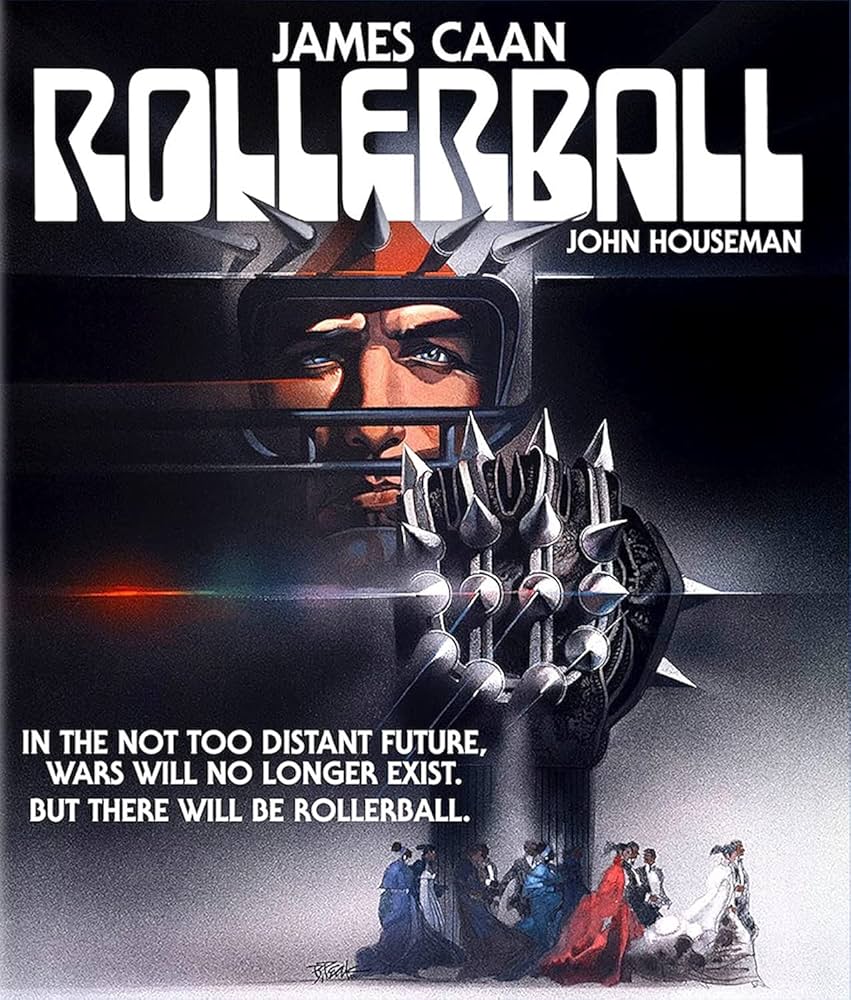
What if one of the greatest sporting movies ever made was about a sport that doesn’t exist? Director Norman Jewison’s Rollerball has just passed its half-century, coming out as it did in 1975. It was based on a 1973 short story, Roller Ball Murder, written by William Harrison for Esquire magazine. Harrison also wrote the film’s screenplay. The movie was quite a departure from Jewison’s previous film, Jesus Christ Superstar, but the basic plot is straightforward. In a not-too-distant future, war does not exist, and has been replaced by Rollerball, an incredibly violent sport involving motorcyclists and speed-skaters trying to propel a deadly steel ball into magnetic goals. Funded and sponsored by giant corporations, each of whom have their own teams, this savage, high-tech sport is under the control of a corporate elite eerily similar to those who rule us today. The plot of the movie revolves around a player who has become too big for the game, Jonathan E, captain of the world’s top team, Houston. Jonathan is beginning to become a hero of the people, and therefore a target for their corporate overseers, who fear being outshone by one man.
The game itself is a strange amalgam of other, actual sports. The steeply banked, circular track resembles the velodromes used in indoor cycling events. The players not on motorcycles are on roller-skates, reminiscent of Roller Derby, a popular sport in 1950s America. The goal is the equivalent of the hoop in basketball, and the motorcycles add an element taken from the incredible sport of motorcycle speedway. Rollerball is a full-contact sport, and the players wear leather gloves studded with metal spikes, the sort of thing you would expect to see Alice Cooper wearing rather than a sportsman. One player is given a three-minute penalty for kicking another in the face, kung fu-style but, other than that, anything goes. All the players wear American football-style helmets with mouth-guards, but much of the face is vulnerable. The heavy ball which must always be visible is made of steel, and is like a giant pinball or small cannonball. It is fired around a steel gutter at the top of the circular track, and falls down into play as its speed decreases. Then it’s game on.
The movie opens with J. S. Bach’s famous and ominous piece for church organ, the Toccata and Fugue in D Minor, and the movie is largely scored classically. The Seventies were a decade in which classical music was first being used to full effect in Hollywood soundtracks, and Albinoni’s beautiful and mournful Adagio appears in several scenes. Then we are thrown into the action, as the camera pans over the Rollerball track in preparation for the first game, Houston v Madrid. We watch the track being inspected before we see stretchers being wheeled in, a clue as to the carnage to come. The camera alternates between the ground staff and the players preparing in the tunnel before the entry of the gladiators, and the film’s protagonist and Houston skipper, Jonathan E. Jonathan is played by James Caan, probably best known for his Oscar-nominated performance as Sonny Corleone in The Godfather. This movie could not be more different, but it is equally violent. Jewison actually cast Caan for his performance in another sports movie, 1971’s Brian’s Song, about a football player with terminal cancer.

You can order The Best of Trevor Lynch here
The first game lasts a full 15 minutes of screen time, and there is no dialogue as such in the movie until the Houston players are in the showers celebrating their 3-1 victory over the beaten and bloodied Madrid team. The scoreline is significant not just for Houston, but for its similarity to a football (or soccer) score. Americans prefer a high points tally in their sports, whereas the British football fan will happily sit through a 0-0 draw. This seems like a cultural difference, and is reminiscent of the story of Space Invaders. When this famous video game was introduced across Europe a couple of years after Rollerball came out, it was a smash hit in every country but Italy. The designers couldn’t understand it, until some bright spark pointed out the difference between Italian currency, then the pre-euro lira, and that of other nations. The lira came in thousands rather than tens, and being a lira millionaire didn’t amount to all that much. It transpired that the Italians were unimpressed with, for example, a mere 500 points for shooting the big space invader who occasionally scuttled across the top of the screen. The designers simply increased the points won in the game by a factor of 100, and 50,000 points were far more acceptable to the Italians. The game promptly took off in the country which invented cheating in soccer. In the video-gaming world, early games such as Rocketball and Killerball were clearly influenced by Rollerball.
In the dressing-room after Houston’s victory, we see Corporation executives for the first time, led by the sinister Bartholomew. Actor John Houseman’s plummy English accent was an early example of the bad guys being English in American movies (see also the James Bond and Die Hard franchises). This, says Bartholomew, is Jonathan E’s season, and to celebrate there is to be a “multivision” TV special dedicated to Houston’s star player. It transpires that what Bartholomew actually means is that it will be Jonathan’s last season, and this ignored ultimatum will provide the dynamic for the movie. Jonathan looks uneasy despite the praise lavished on him by this powerful man, and this is the first suggestion that something is amiss.
The first plot point of the movie—around 23 minutes, as is standard in Hollywood scripts—is Jonathan’s visit to Bartholomew. There, Rollerball’s biggest star is told that he must use the TV special to announce his retirement from the game. “It’s a stupid game, after all” says the man who is effectively the leader of the world. Of course, it has made Jonathan E famous, giving him access to the “privilege card” the elites use to pay for services, in much the same way as the Party Card of the old Soviet Union. But that isn’t why Jonathan plays Rollerball. As with many of the film’s scenes, the interview between the world’s most powerful man and its greatest sporting legend is tense and awkward. On entering Bartholomew’s inner sanctum, Jonathan cuts his finger on an ornament, and spends the interview nursing the flesh wound. Slightly clumsy symbolism, but it indicates that the Corporation can hurt Jonathan whenever they want to, potentially more so than any injuries he might suffer out on the Rollerball track. Despite being told that he is expected to use his TV special to announce retirement before Houston’s next game, a world semi-final against Tokyo, he defies the Corporation and turns out for the team. As the executives listen to the crowd chanting Jonathan’s name after the Corporate anthem, they look uneasy, and it is clear that if Jonathan won’t go, then he must be pushed.
The way the Corporation intends to finish Jonathan E is by changing the rules of Rollerball, and the Tokyo game is to feature limited substitutions and no penalties for foul play. Despite the players’ resemblance to American football players, with the helmets and body-armor, Rollerball makes football look like pickle-ball, and the Tokyo game, which Houston wins, is savage even by the usual standards. Houston plays just as dirty as the Japanese, however, one of whose players is dispatched by placing his head in the steel track to be demolished by the speeding ball. The rule changes enforced by the executives who control both the game and the world mean that Houston are basically fighting a gang of martial-arts experts with motorcycles and steel gloves. A Japanese coach who advises the Houston team warns them that Tokyo will use moves from Karate and Hapkido (which is actually Korean), and during the game Moonpie—Jonathan E’s best friend and another brilliant player—is brutally attacked by three Japanese. His helmet is torn off, and he is punched in the back of the head with a spiked glove. This puts him into intensive care in an irreversible coma but, when Jonathan is asked to sign a release form for Moonpie’s life-support system to be switched off, he refuses. “But you have to sign!” says a desperate Japanese doctor. “There are rules!” Jonathan’s reply sets the tone for the rest of the movie. “There aren’t any rules” he says. “There aren’t any rules at all.” Before the final game, Jonathan talks to his lifeless buddy, telling him everything he dare not tell anyone else about his suspicions concerning what the Corporation is doing.
The last game is an all-American final, or would be if nations still existed in the corporate-led world portrayed in Rollerball. But this finale has gone beyond sport, and is clearly a last corporate attempt to kill the rebel Jonathan E. Even the New York team are chanting, “Jonathan’s dead!” as they emerge from the tunnel. Bartholomew has told Jonathan that no player can be bigger than the game and, by extension, bigger than the Corporation. And so the final is not intended as a game but an execution. “This wasn’t mean to be a game!” the Houston coach yells at his assistant as the kill-count mounts on the track. The world record for deaths in a Rollerball game, we are informed, was during Rome v Pittsburgh, in which nine Rollerballers died. When a player dies during a game, we see an electronic scoreboard showing four lights against a player’s number gradually blinking out as the stricken man’s life ebbs. It is never suggested that there is such a thing as women’s Rollerball. When the movie was released in Japan, the posters emphasized Rollerball’s brutality and violence. To market the movie in America, Caan and Jewison did the media rounds not on the usual cinema slots, but on sporting channels.
The final is a fight to the death, no longer Rollerball but sheer gladiatorial combat. There are no substitutions, no penalties, and no time-limit to the game, and Jonathan E is the last man standing. Bloodied and barely alive, the Houston skipper painfully mounts the slope and slams the ball into the goal. The crowd is utterly silent, until a low murmur turns into a chant, and the entire stadium—even the Corporation executives—take up the mantra: “Jonathan. Jonathan. JONATHAN!”. The world’s greatest Rollerball player skates straight at the camera, and the film ends with the freeze-frame technique so many directors stole from Truffaut’s 400 Blows. Jonathan has won.
The non-sporting scenes are sometimes almost painfully slow, and Caan’s performance is strangely subdued. But this shows his confusion, a man at the top of his game who is beginning to distrust the system that put him there. Visiting a library for books to explain the past before the “Corporate wars” he is told that the books he wants are classified, and have been “transcribed and summarized” by a worldwide computer system which foreshadows the internet. ARPANET (later DARPANET) had been in existence for five years prior to Rollerball, so perhaps the original story’s writer, Harrison, knew something of it. DARPANET was America’s online defense system, and would later become our familiar worldwide web. There is another prognostication in Rollerball, when Jonathan E visits a huge computing center in Geneva to look for answers to his subversive questions.
The curator of this huge data-bank is, as a pleasant surprise, played by the great English Shakespearean actor, Sir Ralph Richardson. More commonly seen as Hamlet, Macbeth, or King Lear, Sir Ralph plays a bumbling head librarian whose main concern is that his vast computer system, Zero, has just lost the entire 13th century. “Oh well” he sighs. “I suppose it’s just Dante and some corrupt Popes.” In our times of the deliberate erasure of past white culture, this has an icy ring to it. When Jonathan E tries to ask questions about how corporate decisions are made, Zero has a meltdown leading to Sir Ralph kicking it as though it were a stubborn dog.
Rollerball was released in the US in June of 1975, and in the UK in September. I was not easily impressed by spectacle at the time. In May of that year, aged 14, I had seen my first-ever live rock band, Led Zeppelin, and I wasn’t expecting a mere movie to thrill me all that much after such a rock baptism. I was wrong. I went with a very tall Irish girl and she commandeered a back-row seat with, I suspect, plans for a bit of canoodling. No chance. I couldn’t take my eyes off the screen for the movie’s entire two hours, and simply forgot she was there. There was no second date.
Watching it again, half a century later, it is obvious that my 14-year-old self was entranced by the visual impact this cult movie makes, but unable to process the deeper theme of corporate control. This cabal, of course, we are now learning all about, and to our cost. Although there are nominal political leaders across the West, they are in reality little more than corporate shills, doing the bidding of BlackRock and other vast conglomerates under the malevolent guidance of the usual globalist suspects. Sport is still used to distract the masses, although nothing as visceral as Rollerball exists. Perhaps it wouldn’t be a bad idea.
Jewison could have made a lot more money out of Rollerball than he did, as several sporting and gaming concerns tried to buy the rights for the game from him. Most backed off because of insurance, licensing, and legality concerns, but the director was appalled. He had tried to make a movie about corporate greed and the use of sport as a modern-day version of Juvenal’s panem et circenses used to distract and subdue an already-docile public herd. And all he got was the same system trying to use his film to create exactly what he was against in the movie. In short, he had made a movie intended to condemn violence, only to be surrounded by sharks who wanted to glorify it.
I couldn’t find the 2002 remake of Rollerball for free online, so it wouldn’t be fair to comment on it. The trailer, which is supposed to entice the viewer to watch a movie, looks appalling, and I note that it contains no hint that the anti-corporate sub-text has travelled from Jewison’s movie to this reboot. Perhaps that says something about what Hollywood is and is not allowed to criticize this millennium. Cinema audiences certainly had no time for it, and it bombed, taking in just $25 million against a budget almost three times that. As an indicator, however, I am prepared to be guided by my brother, a sci-fi/comic-movie buff who has seen 2002’s Rollerball. Despite being an articulate man, his review was succinct; “It’s shit.” I would be interested to see any comparisons in the comments from anyone who has seen both movies.
The social structure of the movie also prefigures our own. There is an executive class, a sort of intermediate jet-set, and the plebs. Although the Rollerball elite enjoy corporate privileges, the corporates themselves are just as destructive as the anarchic game itself. One striking scene has a group of drugged-out party-goers on a heath in the early-morning mist, amusing themselves by using a flame-thrower to incinerate a line of beautiful pine-trees. Drugs play a significant part in both entertaining the elites, and subduing the masses.
The non-sporting scenes are occasionally clunky and overlong, the slow pacing doubtless intended to juxtapose with the in-your-face viscerality of the Rollerball scenes themselves. These are what give Rollerball its well-deserved status as a cult movie, and although it did modestly at the box-office when released, its enduring popularity must surely have paid off its relatively small $6 million budget. The action scenes are superbly choreographed, and Rollerball was one of the first movies to give a screen credit to its stuntmen. The cinematographer was Ralph Slocombe, who served his apprenticeship in the 1950s at London’s famous Ealing Studios, and went on to shoot the first three films in the Indiana Jones franchise, as well as the visually sumptuous The Great Gatsby. Although set in Houston, much of the movie was filmed in Munich, and includes the vast head offices of BMW. Jewison’s interior design was, he said, strongly influenced by Kubrick’s 2001, and it shows. Jewison also gave a nod to Kubrick’s A Clockwork Orange as a strong influence on Rollerball.
In these days of vast corporate sponsorship of sport, interactions between executives and rugged sportsmen are doubtless replayed across the globe every weekend, but it is unlikely that the financial big-shots give their players MDMA, or something similar. When Bartholomew first visits the Houston team in the dressing-room, he gives Moonpie a pill and wishes him sweet dreams. All the elites in the movie take drugs reminiscent of soma in Aldous Huxley’s Brave New World, and when Bartholomew asks Moonpie what he will dream of under the influence, he tells him that while Rollerball players may dream of being in the executive class, executives on the same drug always dream of being Rollerball players. Executives may have power over the people, but the people’s heroes are men such as Jonathan E.
We may all of us have dreamt as kids of being a famous sports star, for the adulation and fame as much as the joy of playing our favorite sport at the highest level. But when what is at issue is not just sporting prowess, but standing up against the system, saying no to the corporations, seeking to defend our past and its traditions, staying with our principles, and meting out violence to our enemies, perhaps we might now dream of being Jonathan E.
4 comments
Great article! First, don’t waste your time watching the (2002) version of Rollerball, if I remember correctly, it is about a traveling team of cross country motorcyclists fighting an evil warlord in Africa. Second, in the (1975) Rollerball, there is a scene in which Bartholomew is consulting regional directors (there are no countries) on monitors; this scene is recreated in World War Z (2013). The scene wherein the partygoers destroy the landscape with a weapon they have found symbolizes the unhappiness the masses are experiencing, all it needs is a spark to ignite it (Jonathan E.). Last, Jonathan realizes that he is being phased out, when he chooses to fly with the team, and not by himself. 🙃
“his vast computer system, Zero, has just lost the entire 13th century”
As someone who has been very familiar with libraries and librarians, I can assure you that many of today’s librarians would not feel any sorrow if all written works from before 1990 were lost forever. Except for maybe the collected works of Marcuse and Margaret Atwood. There might still be a few dissidents in the field, but overall the library profession has been ruined, and I don’t mean by AI. It has been on the path of extreme politicization for a long time, and you can see this even in smaller-city libraries. Maybe if AI can be controlled so that it’s not contaminated by Woke, then there will be hope for future researchers.
James Caan was one of the Chosen ones, but he considered himself an “ultra-conservative” and was a Trump supporter, before Trump betrayed us. Caan deserved credit for going against the flow so much. As I recall, “Brian’s Song” made him a big star, but I wasn’t a huge fan of that TV movie–lots of sentimental manipulation, as I recall. He impressed me in some later movies, though.
Thanks for this interesting, enjoyable review, Mark. Back when the movie came out, I thought, oh, here’s just one more movie that self-righteously bashes capitalism. But as I learned later, we’ve had plenty of reasons to suspect the big corporations.
Marcuse and Margaret Atwood. Well, to misquote another 70s movie, you’re gonna need a smaller library. I’m glad you enjoyed the piece, thanks for taking the time to comment.
This film influenced the aesthetic of M8l8th’s mini-album Coup de Grace, as I mentioned in my review of M8l8th’s Reconquista. So it’s probably a pretty rare example of a far-right film, just like Starship Troopers. I’d love to watch this film. Thanks for the great review.
If you have a Subscriber access,
simply login first to see your comment auto-approved.
Note on comments privacy & moderation
Your email is never published nor shared.
Comments are moderated. If you don't see your comment, please be patient. If approved, it will appear here soon. Do not post your comment a second time.