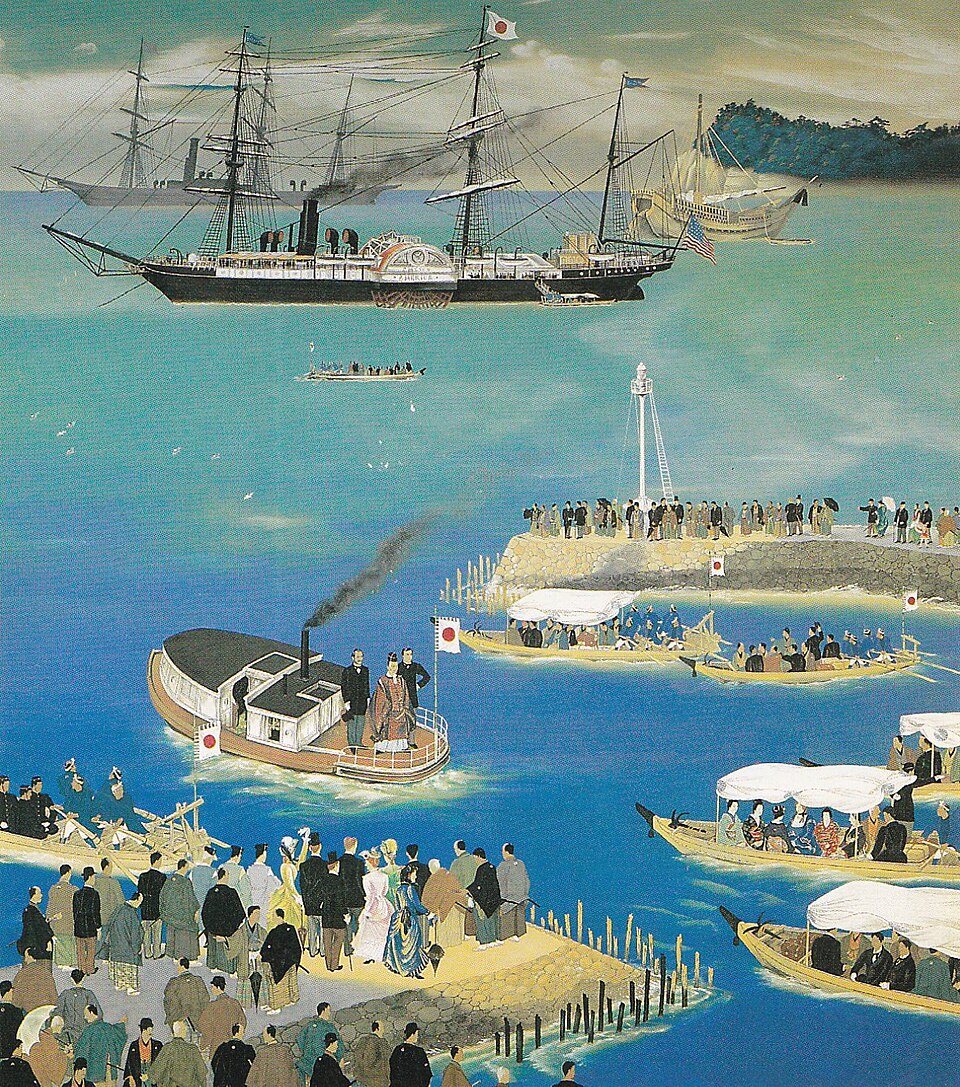
Departure of Japan’s Iwakura Mission to the West. Courtesy of Wikimedia Commons.
1,419 words
Decolonization has become one of the most resonant and politically charged themes across the developing world. From the Caribbean to Africa, it is invoked as a moral imperative, a necessary process of reclaiming identity, sovereignty, and dignity after centuries of foreign domination. Yet in practice, the modern interpretation of decolonization has drifted far from its original purpose. Rather than serving as a pathway to institutional maturity and global competitiveness, it has increasingly become an intellectual barrier to progress.
At the heart of the problem lies a fundamental misinterpretation. Decolonization is often framed as a wholesale rejection of Western culture, institutions, and knowledge systems. This framing is emotionally compelling but empirically flawed. Western societies, despite their imperfections, remain the primary engines of technological innovation, scientific advancement, and institutional development. Even today, they dominate global rankings in research output, higher education quality, financial systems, and technological ecosystems. While East Asian economies have made extraordinary gains, their success has not come from rejecting Western models outright, but from selectively adopting, adapting, and refining them.
Culture is not static. It evolves. Throughout history, the societies that have advanced most rapidly are those that have been willing to learn from others, especially from those who are more successful in specific domains. Sometimes this evolution requires retiring traditions, norms, or belief systems that no longer serve a productive function. Progress is not an act of preservation alone. It is also an act of selection.
The experience of Japan during the Meiji Restoration illustrates this principle with striking clarity. Faced with the existential threat of Western imperial dominance, Japanese leaders did not retreat into cultural defensiveness. Instead, they embarked on a deliberate and systematic effort to study the West. Intellectuals, bureaucrats, and entrepreneurs traveled abroad to learn about legal systems, political institutions, military organization, and industrial technology. They were not interested in superficial imitation. They sought deep understanding.
One of the most influential figures of this period was Fukuzawa Yukichi, whose ideas captured the intellectual spirit of Japan’s transformation. He advocated for constitutional governance that would limit arbitrary political power, emphasized individualism and free inquiry, and openly criticized aspects of Confucian thought that he believed encouraged passivity and hierarchy at the expense of innovation and scientific thinking. His message was not that Japan should become Western, but that it should become strong, and that strength required learning from those who had already achieved it.

You can buy Greg Johnson’s The Trial of Socrates here.
Japan’s modernization was therefore not an exercise in cultural surrender. It was a strategic adaptation. The Japanese adopted Western naval technology, educational frameworks, and industrial practices, but they did so while maintaining a distinctly Japanese identity. Their goal was not validation from the West, but parity with it. They understood that failing to modernize would relegate them to the status of a subordinate state in the international system.
This historical lesson is especially relevant today, when access to information is no longer a constraint. In the twenty-first century, knowledge is ubiquitous. The institutional blueprints of successful societies, whether in North America, Europe, or East Asia, are readily available to any country willing to study them seriously. Yet paradoxically, what often permeates discourse in developing countries is not a desire to learn, but a desire to differentiate. From the West Indies to parts of Africa, there is a growing emphasis on constructing alternatives to Western models, even when viable alternatives have not been clearly articulated.
Consider the political developments in the Caribbean. Barbados has transitioned to a republic, and Jamaica has expressed similar ambitions. While such moves are often framed as milestones of decolonization, they reveal a deeper contradiction. The republican form of government itself is a Western innovation, and the most successful republics are overwhelmingly located in the West. The act of adopting a republic is therefore not inherently decolonial. It is another instance of borrowing from Western political thought. The inconsistency lies in celebrating the symbolism of departure while continuing to rely on the intellectual foundations of the very systems being rejected.
This pattern extends beyond politics into economics and technology. In many developing countries, there is enthusiastic rhetoric about free markets, liberalism, and entrepreneurship. Leaders and commentators speak of building companies that rival global technology giants, yet there is little engagement with the underlying management techniques that made such firms possible. Equally, there is limited discussion of the philosophical foundations laid by thinkers such as Adam Smith and John Locke, whose ideas on markets, property rights, and governance underpin modern economic systems. The language of innovation is adopted, but the intellectual substance is often neglected.
The result is a superficial engagement with modernity. Developing countries often seek the visible outputs of Western success, the hardware, without investing in the underlying processes, the software. They want thriving private sectors without cultivating the rule of law, competitive markets, and intellectual traditions that sustain them. They advocate for civil society without recognizing that it depends on norms of free inquiry, institutional independence, and a clear separation between state and non-state actors.
Historically, the very concept of civil society emerged in the West alongside the development of universities, scientific journals, and professional associations. These institutions created an ecosystem in which ideas could be debated, tested, and refined independently of political authority. In many developing countries, however, what is labeled as civil society often lacks this independence. Civil society advocates are frequently politically aligned, embedded within party structures, or indirectly tied to state interests, which undermines their ability to function as genuinely independent actors.
In some cases, this problem becomes even more pronounced through the emergence of government organized non-governmental organizations, particularly evident in countries such as Nigeria, where state affiliated NGOs blur the line between civic engagement and political control. This phenomenon erodes the credibility of civil society, weakens accountability mechanisms, and replaces independent inquiry with managed narratives. Without real separation between government and civil society, there is little room for free inquiry, and the institutional environment becomes one of advocacy rather than analysis. Without these foundational elements, the language of civil society becomes hollow.
A similar disconnect exists in attitudes toward science and technology. Physics underpins vast areas of modern industry, from engineering to telecommunications. Yet in many parts of the developing world, there is little appreciation for the relationship between theoretical science and commercial application. The pipeline from abstract knowledge to practical innovation is poorly understood, which in turn limits the capacity to build high value industries.
The core issue is not a lack of ambition, but a misalignment of priorities. Decolonization, as currently interpreted, often emphasizes symbolic gestures and rhetorical positioning at the expense of substantive learning and institutional development. It encourages a posture of resistance rather than one of engagement.
What is needed instead is a recalibration. Developing countries should move away from a revolutionary ethos that prioritizes ideological purity over practical outcomes. They should adopt a mindset similar to that of Meiji era Japan, pragmatic, curious, and unapologetically focused on results. This means actively studying successful societies, not to replicate them wholesale, but to understand the principles that underpin their success.
There is immense value in examining what the United States can teach about technological ecosystems, what Switzerland can teach about precision engineering and innovation, and what Scandinavian countries can teach about social policy design and pension systems. These are not acts of imitation for their own sake. They are investments in knowledge acquisition.
In this context, the idea of modern Iwakura Missions becomes particularly compelling. Just as Japanese delegations once traveled abroad to absorb the best ideas from the West, developing countries today should systematically expose their brightest minds, students, policymakers, and entrepreneurs to the institutional environments of high performing societies. The objective should be deep engagement with these systems so that knowledge can be internalized, adapted, and effectively applied at home.
Ultimately, the path to progress does not lie in rejecting the West, but in understanding it. It lies in recognizing that the institutions, ideas, and technologies that drive global prosperity are not bound by geography or ethnicity. They are the product of human ingenuity, and they are available to any society willing to engage with them seriously.
Decolonization, properly understood, should not be about distancing oneself from sources of knowledge. It should be about expanding one’s capacity to learn, adapt, and compete. Until this shift in perspective occurs, the rhetoric of decolonization will continue to obscure the very pathways that lead to development.
8 comments
How is the development of “pest-hole” countries the concern of white identitarians? Other than their natives staying the heck out of our countries?
Mainstream economists and other short-bus passengers love to wax eloquently about how incomes have risen world-wide in the unbridled capitalism of the post-WW II period. They even dismiss the fact that developed (white) countries have had their manufacturing economies hollowed out and seen massive importation of cheap, non-white labor as acceptable by-products of the globalized economy.
that developed (white) countries have had their manufacturing economies hollowed out
Chinese bribes were and are very lucrative for Western politicians.
Lip Man declares: [D]eveloping [read: Black] countries today should systematically expose their brightest minds, students, policymakers, and entrepreneurs to the institutional environments of high performing societies. The objective should be deep engagement with these systems so that knowledge can be internalized, adapted, and effectively applied at home…
Bullshit, Lip. How’s that been working out for White American “identitarians” with, say, Somalians, and other Darkie ilk, bringing their Black Magic Voodoo, or Islam, or dog-eating culture into our living space?
—
Derek Stark: April 8, 2026 How is the development of “pest-hole” [read: Black] countries the concern of white [sic] identitarians? Other than their natives staying the heck out of our countries?
—
I couldn’t find this old piece from Lip Man here at C-C, but, oddly enough, it’s here: “Voodoo and Superstition Rife in Africa” at nationalvanguard.org Does this excerpt from The Lip back then make his case that superstitious kinsmen from his tribe’s pest-hole countries should come to America to learn from our high-performing White society?
I say no; he actually makes a good case against it. Not to say there are plenty of gullible, superstitious Whites, but they are our people, can be redirected and can make White babies. Stay in your pest-holes, Darkies!
He wrote five years ago:
… [B]elief in supernatural forces was prevalent even among educated Nigerians. Surveys of African university students have reached similar findings. In a sample of Nigerian students, many argued that Western countries are more technologically advanced because they possess magical powers that they refuse to share with Africans…
How’s that been working out for White American “identitarians” with, say, Somalians, and other Darkie ilk, bringing their Black Magic Voodoo, or Islam, or dog-eating culture into our living space?
Bringing large numbers of African students to our countries would also increase race-mixing, which is obviously not in our best interests. IMO, one of the most important issues that our movement needs to address is that even a small amount of Black admixture has severely negative genetic effects. This is likely due to a phenomenon called Outbreeding Depression.
I stumbled across an example of this while browsing Reddit’s AncestryDNA and 23andMe subs. I looked at dozens of posts by Americans who were overwhelmingly White yet who also had a bit of Black ancestry (often from Melungeon ancestors). What I found was that an extremely disproportionate number of the “2% Negro” types had bizarre psychological and physical issues. Many had gender identity problems, autism, and strange proportions. The degree of mental degeneration was noticeably worse among women whereas men were more prone to show signs of physical decline. I made this pic as a way to briefly summarize my findings:
https://imgur.com/a/123-aa-wa-results-wFQDOtq
While there are people of good blood who develop these issues due to trauma, our movement needs to be honest about what multi-generational race-mixing leads to. Some forms of mental illness are likely more common these days due to genetic degeneration stemming from Black x White mixing. My personal theory is that, in higher mammals, outbreeding depression can damage genetic repair mechanisms which means that (over the span of several generations) partially Negrified populations undergo a process of physical, psychological, and moral decay. It isn’t like a White American in Wyoming being 1% American Indian or some Slavs being part Siberian. It is much, much more severe.
This isn’t about being “hateful” – it’s just accepting reality for what it is. Importing Black students, policymakers, and entrepreneurs to our country is the opposite of what we’re trying to achieve. We know that Blacks are (on average) extroverted, aggressive, pushy, entitled, and hypersexual. Bringing them into our societies and movements never ends well. A lot of Manosphere types embraced the quadroon Andrew Tate because he repeated their anti-Feminist rhetoric and then he got busted for pimping out women in Eastern Europe.
I don’t see how bringing large numbers of Blacks into the West (which is what would be required in order to turn Lipton’s plan of exposing African students, policymakers, and entrepreneurs to Western institutions into a reality) could possible end well for us.
[And sorry for hitting you with such a long response, I’m simply passionate about this because I think it is one of the most important issues facing us in the long term].
Dani Vypont: April 21, 2026 …Bringing large numbers of African students to our countries would also increase race-mixing, which is obviously not in our best interests. IMO, one of the most important issues that our movement needs to address is that even a small amount of Black admixture has severely negative genetic effects…
—
Thanks, Dani. Even bringing small numbers of unsterilized Negroids into our breeding pool is unacceptable. Let’s call it “the small turd in the punchbowl” syndrome. Who will drink of that? Miscegenation will be forbidden, illegal, as in healthier times.
—
I stumbled across an example of this while browsing Reddit’s AncestryDNA and 23andMe subs. I looked at dozens of posts by Americans who were overwhelmingly White yet who also had a bit of Black ancestry (often from Melungeon** ancestors). What I found was that an extremely disproportionate number of the “2% Negro” types had bizarre psychological and physical issues….
—
Don’t be put off by Jew-owned 23andMe or anti-White social media propaganda, Dani. I looked up Melungeon to find this:
**The Melungeon’s: Unveiling the Mystery of Appalachia’s Mixed Ancestry – Echoes of Appalachia
There may be an occasional “Nubian in the fuel supply” in our southern Appalachian gene pool, as W.C. Fields would quip. but we hillbillies are of good European racial stock and want to keep it that way. If Elvis and Dolly are Melungeon, as they claim, we can live with that and work around it as we strive to separate racially to preserve our unique subspecies.
Thanks, Dani. Even bringing small numbers of unsterilized Negroids into our breeding pool is unacceptable.
Agreed, but that would be radically different than what Lipton appears to be envisioning. It sounds like he wants Western nations to be vaguely “sort of pro-Whiteish” whereas I think we need policies which specifically take into account our own race’s demographic and psychological interests (and the nature of other races).
Importing African students wouldn’t be like having a few Japanese professors teaching at a university. We all know how it would go.
Don’t be put off by Jew-owned 23andMe or anti-White social media propaganda, Dani.
I tried to verify that these were real people & also looked up “melungeon meetings” in parts of the South. Based off what I saw, I think there is something to the idea that small amounts of African blood can often have negative effects.
There may be an occasional “Nubian in the fuel supply” in our southern Appalachian gene pool, as W.C. Fields would quip. but we hillbillies are of good European racial stock and want to keep it that way.
Genetic studies show most Appalachians don’t have detectable African blood (and that type of mixing isn’t limited to Appalachia, there were mixed types who moved to places like Boston too).
I’ve been to Appalachia & know a high quality pro-White couple who moved to Tennessee and they like living there. My goal wasn’t to put down the South, just point out a legitimate issue.
If Elvis and Dolly are Melungeon, as they claim, we can live with that and work around it as we strive to separate racially to preserve our unique subspecies.
I looked up Elvis and Dolly’s ancestry & there’s no evidence they had Melungeons in their family trees. I think that some people are falsely claiming famous Southerners do for propaganda reasons / to have a “story to tell.”
“It lies in recognizing that the institutions, ideas, and technologies that drive global prosperity are not bound by geography or ethnicity.”
Oh, really?
Because it appears these things are indeed bound by ethnicity, by genetics, as Japan is a high IQ people and thus were capable of adapting and building sophisticated technology. If these other peoples were capable of something similar they’ve had a century to demonstrate this. Arguing it’s just a chip on their shoulder that got in the way is unjustifiably optimistic.
The core issue is not a lack of ambition, but a misalignment of priorities.
The core issue is the majority of non-whites (blacks, browns, etc.) are not smart enough to create a first world nation, and never will be. 🙃
If you have a Subscriber access,
simply login first to see your comment auto-approved.
Note on comments privacy & moderation
Your email is never published nor shared.
Comments are moderated. If you don't see your comment, please be patient. If approved, it will appear here soon. Do not post your comment a second time.