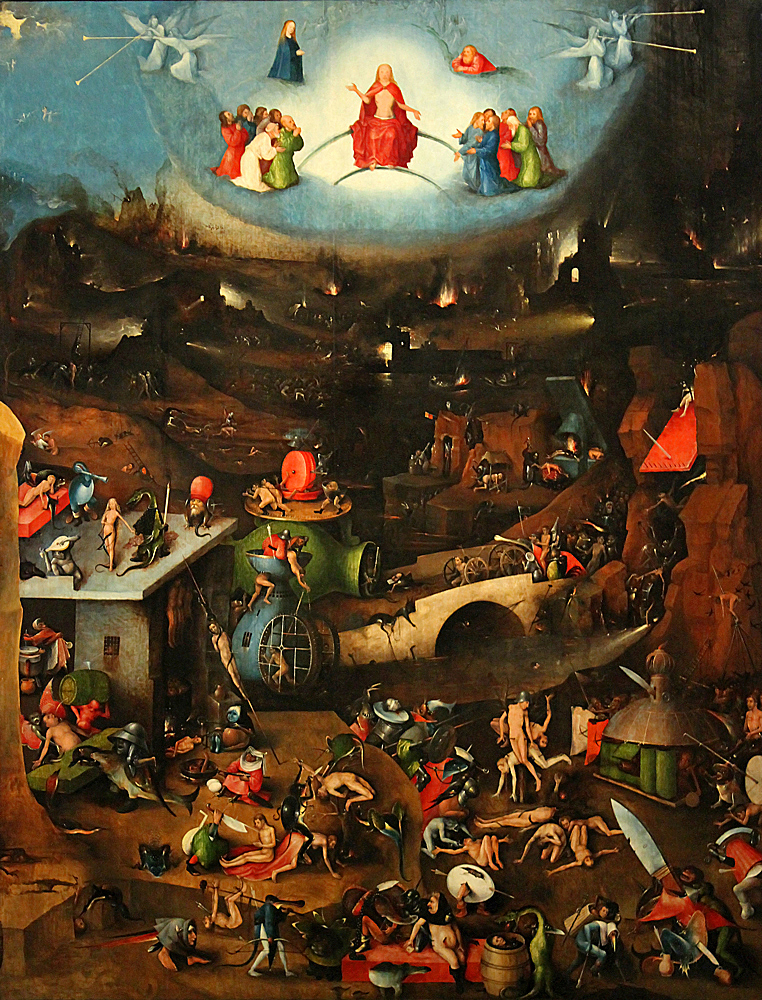
Hieronymus Bosch, The Last Judgement (ca. 1482)
2,049 words
Part 3 of 7 (Full series here.)
To return to Bosch & his tableaux of the end of the world — namely, The Last Judgement — one sees the guitar playing ape — the mammalian sentinel in the foreground — ahead of the picture — abreast of these developments — abandoned of an arrested fate: shirking his duty: not to be foretold — an unhallowed promontory of Hell-cat witches — the Christian Agape reversed and stood upon its head — with a fellow mammalian excrescence — not a lion or a sheep — a beast of God — staring at the ground — the sub-text of the picture — its border and foreground — tucked away in the corner. It was an anthropoid: neither Beast or Man: this is what he sees: a sub-Moreau fetish: a half-way house between Heaven & Hell — which tugged at the recognition of an animalian contract — of the flesh and the devil beneath the skin: a moral limbo; betwixt one and the other — this is what is represented here. [Interestingly enough, this builds up to or alternatively relates to another notion of external ideology; of outside-in rational intellection; applied to the essentially irrational and emotional character of the mind! Namely the fact that various post-modernist fads, circulating in and around the Faculty of the Humanities and belles lettres at Sussex University — the dialectical chit-chat of Harvester Press — believe that fantasy is ennobling — a refined calling of the redundancy of the spirit — a form of “leftwing” rebellion within the mind (these ideas nearly always eventuate from the New Left or the post-New Left — the exhilarated and somewhat socially depressive meandering of Jean Baudrillard et al . . .). When this is the notion which says that the closed, hazily inaccessible and saturnalian undercurrents of the mind — to whit: its unconscious (to make use of crude, reductive and unduly restrictive Freudian coinage) — is a temple of rebellion; an ecstatic field of force; a way of going beyond the trivialities and all too frequently assessed short-comings of Thatcherite Britain etc . . . a template of wonder; semi-Utopian expectancy and pseudo-erotic grandeur. The repository of forgotten dreams — this is what the theory of the radicality of deconstructive fantasy enjoins! Certainly it is the type of uncreative and self-fulfilling rhetoric — the thesis-digested patois of Dollimore, Belsey, Eagleton, Hawkes, Evans and other even lesser fry . . . — reflected back upon itself. It is the belief that somehow even escapist “bourgeois recreational” and downright reactionary phantasy — W. E. Johns — the screaming cars, jazz in the background, and cut-glass accents of Dornford Yates — the heroic exertion of Robert E. Howard, the racist bludgeoning of H. C. McNeile’s Sapper, the faery kingdom of Romance (as A. Conan Doyle once described it) — all tend in the direction of the Left: in the direction of an upending of received structures of opinion. When, in actual fact, this is not true at all! For active fantasy exists independently of political consciousness — as well as a corollary to it.
You can buy Jonathan Bowden’s Extremists: Studies in Metapolitics here.
It is twofold: the one pessimistic — the dungeons and Belt & Braces of the mind — the pitiless extremities of arrested force — whereas the other is heedless, banners and crowds in the streets; Eisensteinian flashbacks, the waving of clenched proletarian fists in bourgeois faces, the Anarchist banner unfurled before a posh banquet in the 1880s in Chicago: behold your executioners etc . . . — what both George Orwell and Noam Chomsky (from their different perspectives) called the “masturbation phantasies of the Left”. When — as the rationalist historian Norman Cohn has pointed out — in his twin alternating texts of the Middle Ages: Europe’s Inner Demons (negative) and The Pursuit of the Millennium: Revolutionary Millenarians and Mystical Anarchists of the Middle Ages (positive) — although it depends what you mean by positive and negative, of course — the real point at issue is whether fantasy can be construed in an optimistic as well as a pessimistic light — in a manner which is leftwing, in other words, as against a manner which is rightwing. When post-structuralism, by allowing Whiggish or liberal fact to be challenged, has given a justification to the questioning of received wisdom in other areas, such as the Holocaust — all of which leads to the deconstructive, ahistorical, impressionistic and counter-factual semantics of Paul de Man, Faurrison, and beyond them the complete gainsayer, Butz. This is a horriffic (sic) liberal outcome — all of which has caused a certain retreat, retrenchment, sense of deja vu, defeat and marginalization of academic deconstructionists, because there are some events, some palimpsests of the past, some transparent facts and inconsistent consistencies — in short, some sacred facts — which liberals themselves cannot live without].
But to return to Bosch: next to the lyre-wielding ape (or junior league monkey — simian excrescence) — one sees a woman — a miniature figurine; an idealization of a form of feminine beauty — attacked (?) by a reptilian creature; a malevolent and highly sexed stick-insect; a reptilian insecticide; Fool’s Gold; lodged around the vagina, its muzzle or snout nestling in the woman’s hand: the outcome of a refulgent sensuality — the expectation of orgiastic abandonment — the thrust and ardour of sex — here and now: naked as the others: in this way before the others — the heresy of the Adamites writ large in this tableaux of reptilian wantonness. While to one side there stands a large reptile; a dinosaur in a jerkin — a pair of mediaeval cast-offs — with its tail back to front {or could it be a sacred organ of the flesh — a cold-bloodied penis} and a Baconesque movement and swirl of cloth, possibly a daubing of the canvas with a sponge or alternatively the fierce rubbing of the surface of the picture with a stiff-bristled brush. The sole purpose of which was to mystify the slight movement of the paint: to transpose it onto something else: to aid and effect such a transposition: a surrogate garden of delights — whereby what was transparent took on the lineaments of the flesh (the recognition of a flawed solidity) — whereas what was solid (and relatively well-endowed) began to make more ethereal gestures. Here one notices the shadows around the characters, the penumbra cast by the prospect of damnation — here it comes: in the lamp-light of the fore-noon — the darker splodges of brown upon the lighter, paler and more virginal conspectus — the ground which remains basic, even sandy, and is certainly not a transposition of Vincent Van Gogh — the rhapsody of painted colour — a rainbow on the ground — as the artist goes out to ply his trade in the morning. To one side of this straight or lateral plateau — across this sub-section of the picture — we see a raised dais, the colour of red if not scarlet, the colour of blood / red meat / exoticism / eroticism. Upon which lies a reclining female figure — another naked figurine — a recognition of the flesh — with a flat and homily looking reptile peeping out beneath the bed — while on it nestles a swarthy toad-like being; a reptilian after-echo: with pink and unblinking eyes: behind which is seen to exist a mask and bewigged creature: girded about the head with a metal contraption; a lady’s brace; the sunken and inverted promontory of a halberd — this time pointed at one’s own stomach: but also encasing the visage — mask-like — in the sterility of its choice. For the symmetry of these variously inconstant (and yet nevertheless repeated) images in the work of Bosch is plain for all to see — it has to do with a particular type of High Mediaeval rhetoric and usage — at a time when the use of visual or symbolic metaphor and simile is all important in a society which remains massively illiterate and yet alive to the prospect of visual concretization: the degree to which one thing could be objectively correlativized in another. For instance, the use of fruit, metal, reptilian visages, beasts, herbivores of the earth (in one form or another), naked bodies (whether male or female), the lexicon of the nether Bestiary, the uncharted foliage, fauna and life-forms — vertebrate anthropoids, insects and other mammals — of the uncharted continents of the world — for which there was no accurate map in sight — was quite clearly (to the mediaeval eye and mind) a signification of the flesh, sexuality, sensuality, death and deliverance into Hades — the recognition of the underworld — the onset of Hell & torment in the fire by demons. Yet there was also a certain ambiguity; a type of redundancy — not really of the flesh (that is far too modern a conceit) — but about the whole process of arrested deliverance: the fact that the torments of the damned, the forgotten, the disacknowledged, the erotically enjoined; the dispossessed — certainly of the grace of a Christian God’s love — were also writhing in ecstasy in the diabolism of their fate; untrammelled in lust; breaking forth in song; howling with delight — rather like the disacknowledged heroine of Justine (who suffers ecstasies of torment) — this alone is the fire of their range. For example, in another transubstantiation of delirium, a mere snippet from out of a larger canvas on the same theme, The Fragment of a ’Last Judgement’, [a detail, oil on a panel, Alte Pinakotek,[1] Munich, 1504 (according to R. Delevoy), allegedly commissioned by Philip the Handsome], the writhing of the damned has been rendered decorative — equivalent to (without blasphemy) the psychic wall-paper of the damned. Yet any modern and admittedly retrospective understanding — any wish on behalf of critics in a secular age to interpret this solely as apostasy — as the clever (even diabolic) cloaking of religious dissent by pictorial device and formal allegiance to Christian writ — is wide of the mark. Since the whole point

You can buy Jonathan Bowden’s Reactionary Modernism here.
of art qua art (i.e. religious art) in a solely religious period is that it is a total form of communication — almost a willed and morally totalitarian form of art (in a manner the modern liberal world cannot easily understand) — because it communicates the faith dialectically: it includes oppositional undercurrents to the established reason of the Faith itself in order to show the depth of its allegiance. In short, it gives the Devil his due (to wax colloquial for a moment). It makes even the demonic undercurrent of the faith — its sheer opposite — powerful and attractive — in order to countermand or interdict this (dialectically) with its adoration of a beneficent God. It makes even Hellish absence of delirium seem attractive — because in the inversion of divine lore — mug-wumps and delirious Octopi (with purple limbs) strangling grannies and making their teeth rattle — it can trace an echo, no matter how hesitant, of the divine word. All of which is used in a total system of word, image and ideology (theology in this case) in order to show the strength and totality of the faith professed — as well as to fight against the errors of heresy — the delirious visions and “false” expectancies of the Adamites, for instance — by revealing to the whole word, even the adherents of these deviations, that they are wrong by virtue of the very attractiveness — the luminescent hideousness — of their own stubborn deviations. So, a total faith, an expectancy of death, hellfire and torment, a misjudgement of the fates, a soured excellence of passion, even gives enemies from within their own ideology its due. It understands what makes people rebellious apostates in relation to the nature of divine love! It defeats heresy from within as well as without — in a world where ideological truth is the bounty of all things — and it encourages apostasy through a recognition of the different forms it can take within the consciousness of an individual. This is the difference — the salient moment which declares the presence of the absence of passion. For its thinking is not lateral or linear — Edward de Bono be praised — it is dialectical: the insistence on the recognition of the opposite within oneself: the importance of self-criticism to classical communism, for instance: the recognition of the concept of the divided race-soul by the Schutzstaffel, for example. Here lies the true face of religious belief and devotion — real religiosity, in other words, not the flabby approximate to it which prevails today. It is an expression of the religiously based understanding that says: a soul in mock-heretical torment — wrestling with the reality of its future damnation — is more valuable than one who comes meekly to deliverance, as a horse is drawn to water. In a situation where heresy and unbelief — falling out of favour with the prospect of belief — are virtually synonymous.
Note
[1] Pinakothek.
If you have a Subscriber access,
simply login first to see your comment auto-approved.
Note on comments privacy & moderation
Your email is never published nor shared.
Comments are moderated. If you don't see your comment, please be patient. If approved, it will appear here soon. Do not post your comment a second time.