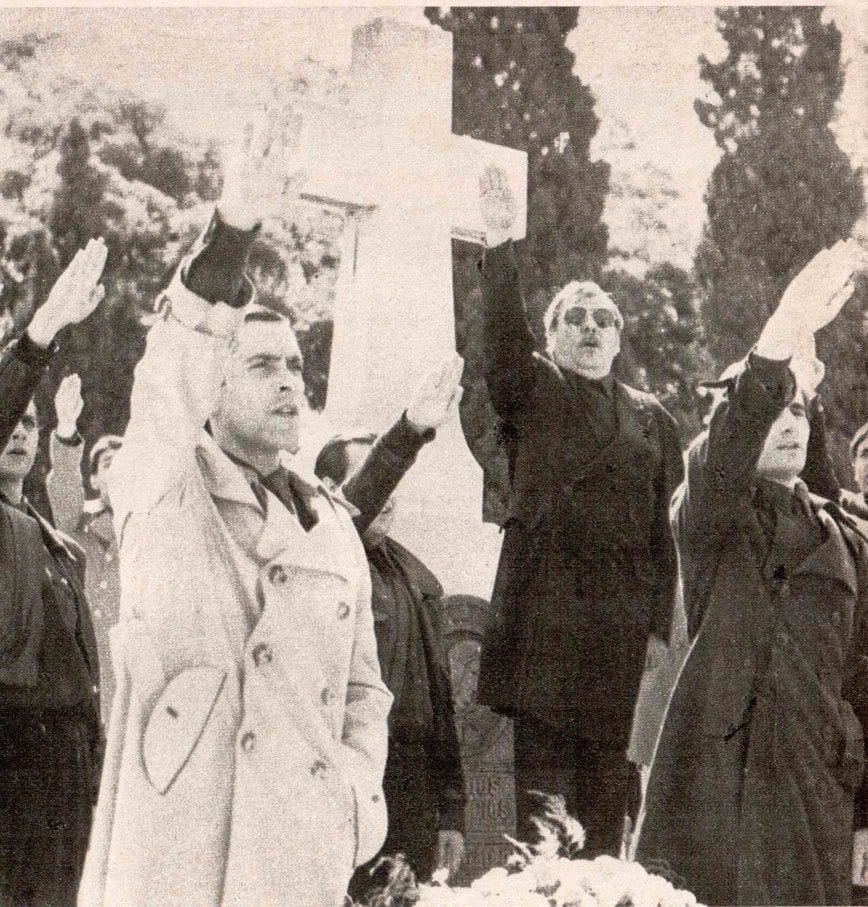
From Seven Days in January.
2,335 words
Translated by Ondrej Mann
We can conclude that peace with the world itself is still impossible, even though the number of those who oppose it has decreased significantly. — Jean Cocteau
Spain, 1976, a few months after the death of Generalissimo Franco: 15-year-old Tatin joins a small community living in an abandoned research institute, where they have established a kind of neo-fascist utopia: communal meals, choral singing, martial arts training, and activism — from the demolition of a Left-wing bookstore at the beginning to the spraying of “reds” with automatic fire from a moving car at the end.
This is the plot of the film Black Litter (1977, directed by Manuel Gutiérrez Aragón), which depicts the resistance of those who refuse to accept the rise of “progressive forces” in the country.[1] This community of about a dozen men, most of whom embody the “macho” type, is led by an elderly, authoritative woman! The director likes to play with contrasts: detailed shots of cutting up bloody meat for dogs, which the group keeps along with other animals (from poultry to horses), alternate with sharp cuts to a choir singing against the backdrop of a cold blue stained-glass window in a church. We see blood, knives, concealing weapons, the cult of fighting and violence, empowerment, a young man‘s initiation ritual — alongside Tatin’s first love for a similarly young and beautiful girl. The erotic scenes involving two “minors” were very daring for Spain at the time and attracted the most attention and controversy, as did the brutal murder of his partner that Tatin ultimately commits, which is precisely in line with Freudo-Marxist interpretations of the environment‘s inevitable influence.
At the beginning of 1977, mass union strikes by the workers and Communist demonstrations for the release of all political prisoners took place across Spain. Neo-fascist “militias” intervened against them. On Sunday, January 23, one of the protesting students was killed by an unknown gunman during street clashes, and a day later, a 21-year-old girl lost her life during a memorial service for him. Reports likewise appeared in the media describing the kidnapping of a prominent army representative.
In a desperate attempt to cripple and stop the “reds,” who nevertheless — or precisely because of this — have the initiative in their hands, the “blacks” decide to take direct action: on Monday, January 24, a three-member commando squad shoots a group of communist lawyers and journalists at their “headquarters” in an apartment building on Atocha Street.[2] The film Seven Days in January (1979, directed by Juan Antonio Bardem) is an attempt to reconstruct these events, and makes extensive use of documentary footage. It is set against the backdrop of the fates of several fictional characters: primarily the old Falangist Sebastian, a shooting range operator who has trained several “generations” of militants; his protégé Luis; and Don Tomas, a representative of the traditional Spanish elite who employs Luis (and whose daughter Luis is secretly dating). It is Don Tomas, played by French actor Jacques François, who gives the order to strike.

You can buy Trevor Lynch’s Classics of Right-Wing Cinema here.
Sebastian assembles the strike force, of which Luis is a member. The act that was supposed to signal a military coup succeeds in mobilizing not only “comrades with clenched fists,” however, but also tens of thousands of ordinary people who take to the streets, and 300,000 (!) people attend the victims‘ funeral, while the army remains “at home” in its barracks.
Luis, who is underground, waits in futility for the army to take action. Bardem accurately shows that the pragmatic “technicians of power” — the army and the police — were slowly “changing their coats” (as revealed in conversations between Sebastian and the police commissioner).[3] The assassins are arrested (including Sebastian and Luis), and from the survivors‘ statements, the director gradually pieces together his picture of the “massacre in Atocha Street” in all its detail. The epilogue is summarized in the final credits: on April 9, the Communist Party of Spain was legalized; on June 15, the first elections were held after 41 years; and on June 6, 1978, at the lawyers‘ request, the court summoned the Falange leadership. The investigation of the case was closed on July 20, 1979; the film premiered in November. (One should note the Celtic crosses that are shown drawn on the wall in the scenes showing the street fights, the singing at the Falangists’ meeting at the funeral ceremony, and behind the tables in the restaurant.)
You can buy Julius Evola’s East & West here.
The situation in Italy in the 1970s was even more heated and tense. It is reflected in several films, which often hint at or directly follow the trail of so-called “black conspiracies”: from serious political dramas such as Slap the Monster on Page One (1972, directed by Marco Bellocchio) or Illustrious Corpses (1976, Francesco Rosi), to more adventurous films such as The Salamander (1981, Peter Zinner), and even comedies We Want the Colonels (1973, Mario Monicelli) and those that seemingly have nothing to do with politics such as Conversation Piece (1974, Luchino Visconti).[4]
Our topic is most explicitly addressed in the film San Babila-8 PM (1976, directed by Carlo Lizzani), however. It depicts a day in the lives of four Milanese “Nazi-Fascists” — Fabrizio, Miki, Alfred, and Frank — who meet with some others at a bistro on San Babila Square.[5] The screenwriter crams as much as possible into those 20 hours: they attend the funeral of a veteran of the Italian Social Republic, smash some Left-wingers’ scooters in front of the university, paint swastikas on Jewish shops, shoot at passersby who are pro-Semitic with steel balls, train at a shooting range with embarrassingly perverse targets, have a brutal brawl with a “red,” unsuccessfully attempt to destroy a union center with an explosive, hold a peculiar protest against “sex shop filth” after which they are arrested by the police, and finally they hold a successful “night hunt”: this involves finding, attacking, and then stabbing a young female Communist activist and her boyfriend. The director does not neglect sexual perversion, either: when the youngest Franko fails as a man during intercourse with the well-developed yet stupid Lalla (could there be a greater shame in Italy?), he simply rapes her with his baton. We also see the conflicts of young people at school, at work, and with their parents.
Of the directors mentioned so far, it is Lizzani who depicts the type and social background of his antiheroes in the greatest detail.[6] He also gives them room to express their ideas and attitudes, however. At a university lecture, Miki describes the domesticated population of Milan as “living corpses.” Alfréd explains to his employer, the owner of an electrical goods store who spots his switchblade: “I am a patriot. Yes, that knife is mine. I need it to defend myself against the ‘reds’. I defend you against them, too . . .” Fabrizio, for his part, tells the simple-minded Lalla:
I am an idealist. Do you know what that means? It means I believe. Our society is too materialistic, and we must fight against that. We must all have the same ideal. The state must be like a church. Everyone must believe and obey, and that’s it. But to achieve that, violence is necessary. Hitler almost succeeded. But I wouldn’t kill the scum. Those are old, unproductive methods. I would remove them from society. The state would be like a fortress, a medieval castle, and all the scum would be outside the walls. . . . Those inside the castle, the chosen ones, would do it among themselves. The rest would all be sterilized. But absolute loyalty would have to prevail in the castle. Not outside. In the woods, in the mud, among the garbage, they can behave like animals. They would only produce more scum, anyway. In the castle, every woman would have only one man by law, and every man only one woman! . . . Better than the shit we’re living in now.[7]
Other memorable scenes include the arrest of a “fascist criminal” (in front of a bistro), and the march of the sanbabilanians arm-in-arm across the square while being accompanied by Ennio Morricone’s ominous music, intercut with shots of the surrounding architectural relics of Mussolini’s regime. At one point one of the characters shouts, “Only Nazism can rid us of all this shit [i.e., Leftists]!” Another replies, “What, Nazism? We need a bomb here!” There is also “You have all of Milan, but San Babila is ours!”
It is probably unnecessary to point out that all these films are intended as critiques from Left-wing, and even radical Left-wing, positions. Bardem and Lizzani in particular were good filmmakers, but also notorious Communists. This is reflected in the fact that these films completely ignore Left-wing violence, which in Italy alone led to the deaths — by beating, shooting, or burning — nearly 20 “far-Right” activists between 1970 and 1980.[8] Besides the Italian Red Brigades (Brigate Rosse) and Front Line (Prima Linea), there were also the German Red Army Faction (Rote Armee Fraktion, or RAF); the Spanish First of October Anti-Fascist Resistance Groups (Grupos de Resistencia Antifascista Primero de Octubre, or GRAPO); Ilich Ramírez Sánchez, also known as “Carlos the Jackal”; and the French Direct Action (Action Directe). Besides them there were many other Marxist-Leninist, Trotskyist, and Maoist organizations that were also operating in Europe — either illegally or semi-legally — at that time.[9]
Notes
[1] After Franco’s death, the regime’s elites split into three main factions. The largest wanted to govern along the lines of West Germany’s liberal-conservative Christian Democratic Union (Christlich Demokratische Union Deutschlands, CDU) and was represented by Adolfo Suárez, a supporter of King Juan Carlos I, who became prime minister; the middle faction, led by Blas Piñar and his New Force (Fuerza Nueva), unlike Suárez, sought to preserve the corporative system, but through parliamentary means; the smallest faction opted for armed resistance in secret organizations, such as the Los Guerrilleros de Cristo Rey (Warriors of Christ the King) led by Mariano Sánchez Covisa.
[2] The Anti-Communist Apostolic Alliance (Alianza Apostólica Anticomunista, or AAA) claimed responsibility for the assassination in order to “wash away the shame of democratization.” Another of its actions was, for example, an attack on the headquarters of the vulgar liberal humor magazine El Papus, in which one person was killed. The “Italian colony” in Madrid, who weremembers of the New Order (Ordine nero) and National Vanguard (Avanguardia nazionale) in forced exile, was also suspected of involvement in the wave of violent actions.
[3] In 1976 Suárez carried out a complete purge of the army and police force. A number of politically outspoken officers were dismissed or forced into early retirement. An attempted military coup in Spain did indeed take place, but not until 1981. King Juan Carlos then definitively confirmed his betrayal of the oath he had sworn to Franco (namely, that he would continue to lead the state in accordance with Francoist principles).
[4] All of these films contain themes and echoes based on a series of actual attempted coups which took place between 1970 and 1974, and which the Italian press dubbed the “ The Golpe Borghese” and the “Sogno conspiracy.” (In The Salamander, for example, there is “Prince Baldasare,” played by Christopher Lee, a character clearly inspired by Borghese. In Conversation Piece, the Marquis of Brumonti’s husband flees to Madrid after a failed coup, just like Prince Borghese. These are just two examples.) They were influenced by the successful coup of the Greek “Black Colonels” in 1967, and today it is considered an established fact that, as in Greece, these groups were all influenced and manipulated by the CIA as well as high government circles, who used them for their own political interests.
Another nightmare for the Communists was the coup in Chile in 1973. On this, see the films Night Over Chile (1977, directed by S. Alarcón) and The Centaurs (1978, V. Žalakevičius).
[5] “San Babila” was a real phenomenon in the 1970s. It consisted of about 60 militants, most of whom ideologically and politically identified with the New Order (Ordine Nuovo; one of its “leaders” is perhaps depicted in the scene on the shooting range, when he offers to transport a “package” for Alfred). The most famous sanbabilani were Gianni Nardi, Giancarlo Esposti, Maurizio Murelli, Nico Azzi, and Cesare Ferri. The Bar Motta in Lizzani’s film is now called Autogrill.
[6] Franko is a “goody-goody” or “spoiled weakling” from a broken bourgeois family whose mother bribes him with money. The intelligent but heartless Miki comes from a dysfunctional upper-class family with a despotic, superstitious father and a much younger mother who married him for his money (gender ideologues would certainly not praise the director for his portrayal of women). Both are students at a state university. Lizzani is clearly most interested in Alfred, who is a 19-year-old warehouse worker who moved to the city with his parents and many siblings from the countryside at the age of ten. He does not fit neatly into the Marxist category of the “lumpenproletariat,” and thus has the police officer quote extensively from Alfred’s slightly “Jekyll-like” curriculum vitae (which includes numerous arrests for fighting and “subversive activities,” but he also has a reputation for being an “exemplary father and worker”). Conversely, we learn nothing about the home environment of the dandyish Fabrizio, who is the group’s spiritual leader who “improves” his situation by cooperating with journalists and the police. Franko is at the bottom (“They’ve beaten us all up. They’ve locked us all up. You just don’t have the stomach for it. Physically and in terms of character, you should be one of them [i.e. a Leftist,]“ Fabrizio tells him). Then there is Alfréd, who, for example, argues that he would not like it if one of the ”bosses“ directly “managed“ him. Miki snaps at him, ”Because you’re a redneck and you don’t understand the importance of hierarchy!”
[7] A nationwide referendum on divorce was held in Italy in 1974, which the conservative forces, led by the ruling Christian Democrats, narrowly lost.
[8] A list of these fallen martyrs and their photographs can be seen, for example, in the video “Anni di piombo, angeli camerati” that was made for the song “Generazione ’78“ by Francesco Martinelli.
[9] Soviet propaganda claimed that most of these groups were in fact under the influence, or even led by, the “far Right.”
8 comments
It’s worth mentioning San Babila-8 PM‘s soundtrack was composed by no less a person than the venerable Ennio Morricone, composer of the soundtrack to The Good, the Bad, and the Ugly, as well as about a thousand others.
This may be apocryphal, but I was told by a knowledgeable source that San Babila-8 PM was shown in the Soviet Union in the late 1970s with the intention of frightening audiences with the horrors of fascism returning to capitalist Europe. I was told that it had the opposite effect on many of its younger viewers, however, who were impressed at the stylish clothes, hot girlfriends, and cool attitudes sported by the fascists in the film. Apparently this had a big influence on the aesthetics of the radical political circles that emerged in Russia in the 1980s and ’90s.
Yes, that’s right—the music for the film San Babila – 8 PM was indeed composed by Ennio Morricone. This is also mentioned in the article. The film was screened in Czechoslovakia and influenced a generation of Czech fascists in the 1980s and early 1990s, when these people modeled themselves after the Italian neo-fascists in the film. For example, in their appearance and by wearing brown leather jackets and sunglasses. This was confirmed to me by the author of this film series, who remembers that time very well. It’s possible that I’ll write a more in-depth article about the San Babila phenomenon for CC. Stay tuned for the next installments of the film series—it’s going to be quite a wild ride!
This may be apocryphal, but I was told by a knowledgeable source that San Babila-8 PM was shown in the Soviet Union in the late 1970s with the intention of frightening audiences with the horrors of fascism returning to capitalist Europe.
That’s true.
Have you seen any of the movies mentioned in this film series? Do you have any thoughts on these movies?
I cannot remember them. But I can remember some Soviet films about neonazi danger. One movie hit of 1979 was Hijacking of Savoya (Похищение Савойи), made in the SU together with the Poles, about a plane named Savoya, hijacked by terrorists and drug dealers in South America and landed in the “German colony” somewhere in South America, colony was founded by ex-Nazis, which use it for cocaine production. Soviet people, together with Poles and one Frenchman, ex-Resistance fighter, (played by the way by the great Russian Jewish actor Bronevoy, very popular in the SU as Gestapo-Mueller in TV-series Seventeen Moments of Spring) fought against bad Germans, and could escape. The colony was possible inspired by Dignidad in Chile.
There were more films like these; I explore this topic in the latest, fourth installment of Sadonacism in Film. Some films from the Soviet bloc and allied communist countries were truly brutal. For example, The Fall of Italy (1981), Occupation in 26 Pictures (1978), The Downfall of the Secluded Berhof (1983), and 30 Cases of Major Zeman (1956) S01E02.
Třicet případů majora Zemana I watched on the Soviet TV. But I cannot remember anything. I better remember DDR-Series like Archiv des Todes and Front ohne Gnade. But these German films were not about Neonazis, but about German Anti-Nazi resistance in the WW2.
Intelligence services of the Soviet block had always tried to remember the world about bad nazis. The STB in Operacija Neptun had secretly thrown the boxes with Nazi documents in the Teufelssee (Certovo Jezero) in 1964, to publicly take them out and make big noise.
If you have a Subscriber access,
simply login first to see your comment auto-approved.
Note on comments privacy & moderation
Your email is never published nor shared.
Comments are moderated. If you don't see your comment, please be patient. If approved, it will appear here soon. Do not post your comment a second time.