Counter-Currents
  • Advertise
  • Private Events
  • T&C
  • About
  • Contact
  • RSS
    • Main feed
    • Podcast feed
    • Videos feed
    • Comments feed
  • Welcome
  • Webzine
  • Books
  • Merch
  • Podcasts
  • Videos
  • Donate
  • Patrons
  • Subscribe
  • Crypto

LEVEL2

Donate Now Mailing list

Writers of May

(2 votes) Morris van de Camp David M. Zsutty Derek Stark Jayant Bhandari Greg Johnson

Articles of May

The Lunch Wars by David M. Zsutty Heidegger on Nietzsche, Part One by Collin Cleary 2 votes
  • Welcome
  • Webzine
  • Books
  • Merch
  • Podcasts
  • Videos
  • Donate
  • Patrons
  • Subscribe
  • Crypto
    • Small Is Beautiful:
      The Napoleon of Notting Hill and G. K. Chesterton Upon Defending One’s Homeland from Others—and Itself

      Steven Tucker

      2

    • The Psychology Behind MrBeast’s Moronic Thought Experiment

      Endeavour

      9

    • On the Roots of Anti-Immigrant Sentiment in Contemporary Britain

      Lipton Matthews

      6

    • Remembering Enoch Powell:
      June 16, 1912–February 8, 1998

      Greg Johnson

      16

    • Counter-Currents Radio Podcast No. 691
      Rob Rundo Returns

      Counter-Currents Radio

    • The Fragile Polity that is Syria

      Morris van de Camp

      2

    • Nigel Farage Calls Britain a Two-Tier State

      Mark Gullick

      4

    • Nationalism This Week
      Letter to J. D. Vance

      Greg Johnson

      32

    • Lost In Trans-Mission:
      How the Media Fails To Reveal the Inconvenient Truth About the Usual Suspects

      Steven Tucker

      10

    • Liar, Liar, Pants on Fire!

      Beau Albrecht

      7

    • Editor’s Update
      Rob Rundo on Counter-Currents Radio, Fundraiser Update, & a New $20,000 Matching Grant

      Greg Johnson

    • The Bitter End of Western Metaphysics:
      Heidegger on Nietzsche, Part Three

      Collin Cleary

      10

    • Uncivil War

      Mark Gullick

      50

    • Exclusive Interview with Karel Veliky:
      The Final Chapter in the Film Series! Part II

      Ondrej Mann

      2

    • Happy Birthday to Us!

      Greg Johnson

      6

    • Zsutty’s Maximum

      David M. Zsutty

      16

    • Exclusive Interview with Karel Veliky:
      The Final Chapter in the Film Series! Part I

      Ondrej Mann

      2

    • The Union Jackal, June 2026

      Mark Gullick

      23

    • The Inferiority Behind Immigrant Superiority

      Jayant Bhandari

      15

    • Counter-Currents Radio Podcast No. 690
      Greg Johnson & David Zsutty Discuss Current Things: AI, Henry Nowak, the Iran Crisis, & More

      Counter-Currents Radio

      7

    • Collin Cleary: What Rome Means to Me

      Collin Cleary

      4

    • Paul Krugman: Closet Bolshevik

      Spencer J. Quinn

      21

    • Fugue of Ideas:
      Ibram X. Kendi’s Chain of Ideas

      Greg Johnson

      19

    • Based Blacks

      Lipton Matthews

      24

    • Black Intellectual Fatigue

      Derek Stark

      41

    • Why White Advocates Should Avoid “Based Blacks”

      Dani Vypont

      32

    • Nietzsche & Race

      Mark Gullick

    • Editor’s Update
      Rob Rundo Rescheduled to Next Week on Counter-Currents Radio;
      Tonight Greg Johnson & David Zsutty Answer Your Questions;
      Fundraiser Update & a New $20,000 Matching Grant

      Greg Johnson

    • The Counter-Currents 2026 Fundraiser
      Lifetime Subscriber Welcome Packages Extended

      Greg Johnson

    • Nationalism This Week
      Who’s Looking Back?

      Greg Johnson

      29

    • China’s Threat to American Security:
      Food, Farmland, Foreign Control, & Energy Policy

      Lipton Matthews

      5

    • The Bitter End of Western Metaphysics:
      Heidegger on Nietzsche, Part Two

      Collin Cleary

      16

    • The Killing of Henry Nowak

      Mark Gullick

      38

    • The Crisis of Chinese Technology Thieves

      Morris van de Camp

      1

    • The Strange World of Gender Bender Fiction:
      & What This Genre Tells Us About Autosexuality

      Dani Vypont

      3

    • Watching the Watchers:
      The Dark Triad Question

      David M. Zsutty

      14

    • The Remigration Movement Solidifies

      F. Roger Devlin

      2

    • Casting Aspersions:
      The Fatal Consequences of Race-Swapped Casting, From Helen of Troy to Henry of Southampton

      Steven Tucker

      20

    • The Murder of Henry Nowak

      Millennial Woes

      23

    • Don’t Forget to Vote in Our Writer & Article of the Month Poll

      Greg Johnson

    • The Robot Hotdog Stand

      Greg Johnson

      37

    • Laughing Our Way to Victory

      Dave Chambers

      7

    • The Zodiac Killer

      Mark Gullick

      11

    • Jared Taylor: What Rome Means to Me

      Jared Taylor

      1

    • An Interview with Endeavour:
      My Way of Life Is an Adventure!

      Ondrej Mann

      6

    • José Pedro Zúquete’s The Identitarians

      Greg Johnson

      3

    • Editor’s Update
      Fundraiser Update & How to Watch the Remigration Summit

      Greg Johnson

      5

    • The Bitter End of Western Metaphysics:
      Heidegger on Nietzsche, Part One

      Collin Cleary

      12

    • Berlin: City of Stones

      Spencer J. Quinn

      6

    • True Folk-Horror Is Horror of Your Own Folk:
      Mark Gatiss vs the Brexit Blind Dead  

      Steven Tucker

      4

    • Beau Albrecht

      Remembering Enoch Powell:
      June 16, 1912–February 8, 1998

      At the time, Britain was still only experiencing the thin end of the wedge as far as migration goes...

    • Peter Quint

      Remembering Enoch Powell:
      June 16, 1912–February 8, 1998

      Okay, so he has two White Nationalist speeches to his credit. 🦈

    • Livla

      The Psychology Behind MrBeast’s Moronic Thought Experiment

      From a biological perspective, this thought experiment is the equivalent of a selection event that...

    • Adrian Roberts

      Remembering Enoch Powell:
      June 16, 1912–February 8, 1998

      In Mein Kampf, Hitler argued that the side which makes war inevitable is the side most responsible...

    • Adrian Roberts

      Remembering Enoch Powell:
      June 16, 1912–February 8, 1998

      So the English owe everybody reparations? Damn.

    • Wasili

      The Psychology Behind MrBeast’s Moronic Thought Experiment

      Great article!  Indeed, the following point can’t be emphasized enough: The [insert non-white...

    • Will Williams

      On the Roots of Anti-Immigrant Sentiment in Contemporary Britain

      Ecological experts call the replacement of one species by another as habitat succession. In my...

    • Douglas Mercer

      Remembering Enoch Powell:
      June 16, 1912–February 8, 1998

      In 1977 Powell gave a speech called The Road To National Suicide: “On the other hand there are at...

    • JayeRyanOD

      The Fragile Polity that is Syria

      I strongly support ex Syrian President Assad supported by my kinsmen the Russians . Before the...

    • Joe Gould

      The Psychology Behind MrBeast’s Moronic Thought Experiment

      I don’t see the decline of real, useful work as alarming or surprising, rather it is inevitable.We...

    • E_Perez

      On the Roots of Anti-Immigrant Sentiment in Contemporary Britain

      A little soft, the article, especially when its title promised to go to the roots. "The...

    • Elear

      Small Is Beautiful:
      The Napoleon of Notting Hill and G. K. Chesterton Upon Defending One’s Homeland from Others—and Itself

      A wonderful essay about things so small yet so precious. Fighting off the invaders is meaningless if...

    • Quu

      The Psychology Behind MrBeast’s Moronic Thought Experiment

      Thank you, yes, it's very interesting, revealing a predisposition that isn't globally normal, and...

    • The Laughing cavalier

      Remembering Enoch Powell:
      June 16, 1912–February 8, 1998

      It was England who declared war - both times - and neither time was England under any threat. It'...

    • TheLau ghin gCavalier

      The Psychology Behind MrBeast’s Moronic Thought Experiment

      A version of this scenario did the rounds on 4chan where red was "nothing happens" and blue was "50...

    • Peter Quint

      Small Is Beautiful:
      The Napoleon of Notting Hill and G. K. Chesterton Upon Defending One’s Homeland from Others—and Itself

      The Secret People G. K. ChestertonThey have given us into the hands of new unhappy lords,Lords...

    • Douglas Mercer

      Remembering Enoch Powell:
      June 16, 1912–February 8, 1998

      The UK now has 19 percent non-White which is more than double what it had in 2001 which was 8...

    • Lexi

      Nationalism This Week
      Letter to J. D. Vance

      They irrationally love Trump; their support for JDV is only an extension of this. Who loves JDV for...

    • Adrian Roberts

      The Psychology Behind MrBeast’s Moronic Thought Experiment

      I puzzled over the thought experiment for several minutes before reading the rest of the article....

    • Scott

      Remembering Enoch Powell:
      June 16, 1912–February 8, 1998

      I'm not an expert on postwar Albion, but I think the impressive colored invasion there is mostly a...

    • Earth Day Special

      John Morgan

      12

    • A Robertson Roundup
      Remembering Wilmot Robertson
      (April 16, 1915 – July 8, 2005)

      Margot Metroland

      13

    • The Paranoid Style in White Nationalism

      Greg Johnson

      30

    • Join the Dance!

      Andrew Hamilton

      1

    • We Can’t Save the Earth Without Reducing African Birth Rates

      James Dunphy

      36

    • “I’m Not a Conspiracy Theorist, but . . .”:
      Jeffrey Epstein’s Death Gives New Life to “Conspiracy Theories”

      Greg Johnson

      22

    • Sylvia Plath: Stasis in Darkness

      Vic Olvir

      17

    • Vanguardism, Vantardism, & Mainstreaming

      Greg Johnson

      80

    • Aviation, Geography, & Race

      Charles Lindbergh

      3

    • Some Thoughts on Yule

      Collin Cleary

      4

    • Living in Truth:
      A Yuletide Homily

      Jef Costello

      7

    • John Kennedy Toole’s A Confederacy of Dunces

      Greg Johnson

      20

    • On Aleksandr Solzhenitsyn’s Warning to the West

      Spencer J. Quinn

      7

    • Elitism, British Modernism, & Wyndham Lewis

      Jonathan Bowden

      6

    • Philip K. Dick’s Do Androids Dream of Electric Sheep? as Anti-Semitic/Christian-Gnostic Allegory

      Greg Johnson

      20

    • “Conspiracy Theory” or Conspiracy?

      Andrew Hamilton

      21

    • Remembering H. P. Lovecraft
      (August 20, 1890–March 15, 1937)

      Greg Johnson

      3

    • Who Are We?
      Nordics, Aryans, & Whites

      Greg Johnson

      71

    • Remembering William Gayley Simpson
      (July 23, 1892–December 31, 1990)
      A Pleasant Afternoon with Harriet & Bill Simpson

      Margot Metroland

      18

    • Here are the Young Men
      Remembering Ian Curtis
      (July 15, 1956–May 18, 1980)

      Mark Gullick

      18

    • Percy Grainger
      Artist of the Right

      Alex Graham

      7

    • Remembering Revilo Oliver
      (July 7, 1908–August 20, 1994)

      Greg Johnson

      18

    • The Meaning of July 4th for the White Man

      Gregory Hood

      13

    • The Front National’s Evolution

      Bruno Mégret

    • Merwin K. Hart
      Forgotten American Hero & Man of the Right

      Morris van de Camp

      10

    • George Orwell’s Nineteen Eighty-Four

      Jonathan Bowden

      8

    • Carleton S. Coon
      Scientist & Reluctant White Advocate

      Morris van de Camp

      3

    • The Kwanzaa Absurdity Will Be Dwarfed by Juneteenth

      Robert Hampton

      10

    • Stravinsky

      Alex Graham

      7

    • Like the Roman:
      Remembering Enoch Powell (1912-1998)

      Mark Gullick

      23

    • The 1970s: The Golden Age of Hijacking

      Morris van de Camp

      21

    • Jonathan Bowden’s Deliverance
      Part 6

      Jonathan Bowden

    • Do You Want to Play a Game?

      Mark Gullick

      1

    • Sexually Incontinent on the Indian Subcontinent:
      Who Rapes More Animals, Indians or Pakistanis? The Battle Continues!

      Steven Tucker

      3

    • Neo-Fascism in Film
      Part 5

      Karel Veliky

      15

    • The Game of Tarot

      Mark Gullick

      2

    • Institutions Cannot Be Transplanted

      Jayant Bhandari

      5

    • Jonathan Bowden’s Deliverance
      Part 5

      Jonathan Bowden

    • Crosstown Traffic:
      Jimi Hendrix & The Post-War Rock ‘N’ Roll Revolution

      Mark Gullick

      1

    • Slaves from the North:
      Finns & Karelians in the East European Slave Trade, 900–1600

      Lipton Matthews

      14

    • Neo-Fascism in Film
      Part 4

      Karel Veliky

      2

    • David Lean’s A Passage to India

      Spencer J. Quinn

      1

    • Elites are Essential to Development

      Lipton Matthews

      7

    • Jonathan Bowden’s Deliverance
      Part 4

      Jonathan Bowden

    • Neo-Fascism in Film
      Part 3

      Karel Veliky

      6

    • E. M. Forster’s A Passage to India & the Indian Mentality

      Spencer J. Quinn

      25

    • Jonathan Bowden’s Deliverance
      Part 3

      Jonathan Bowden

    • The Rest Is Silence
      Heidegger’s Quietism

      Mark Gullick

      2

    • Dispelling the Historical Fallacy of Indian Nationalism

      Lipton Matthews

      8

    • Neo-Fascism in Film
      Part 2

      Karel Veliky

      8

    • Jonathan Bowden’s Deliverance
      Part 2

      Jonathan Bowden

    • Life of a Klansman

      Mark Gullick

      8

    • Jonathan Bowden’s Deliverance, Part 1

      Jonathan Bowden

    • Decolonial Ideas are Holding Back Developing Countries

      Lipton Matthews

      8

    • Neo-fascism in Film, Part 1

      Karel Veliky

      21

    • Jonathan Bowden’s Onslaught, Part 8
      Divigations on Decadence

      Jonathan Bowden

    • Jonathan Bowden’s Onslaught, Part 7
      Intrigues in the National Front

      Jonathan Bowden

      1

    • Rotten to the Core

      Mark Gullick

      8

    • Strauss on Husserl’s “Philosophy as Rigorous Science”

      Greg Johnson

    • Jonathan Bowden’s Onslaught, Part 6
      Francis Bacon & Right-Wing Nihilism

      Jonathan Bowden

    • András László
    • Derek Hawthorne
    • Beau Albrecht
    • Alain de Benoist
    • Kerry Bolton
    • Jonathan Bowden
    • Collin Cleary
    • Jef Costello
    • Savitri Devi
    • Julius Evola
    • Jim Goad
    • Gregory Hood
    • Juleigh Howard-Hobson
    • Greg Johnson
    • Charles Krafft
    • Anthony M. Ludovici
    • Trevor Lynch
    • H. L. Mencken
    • J. A. Nicholl
    • James J. O’Meara
    • Christopher Pankhurst
    • Tito Perdue
    • Michael Polignano
    • Spencer J. Quinn
    • Fenek Solère
    • Irmin Vinson
    • Leo Yankevich
    • Francis Parker Yockey
    • Multiple authors
  • Editor-in-Chief

    • Greg Johnson, Ph.D.

    Featured Writers

    • Beau Albrecht
    • Gunnar Alfredsson
    • Collin Cleary, Ph.D.
    • Jef Costello
    • Morris V. de Camp
    • F. Roger Devlin, Ph.D.
    • Stephen Paul Foster, Ph.D.
    • Jim Goad
    • Alex Graham
    • Mark Gullick, Ph.D.
    • Greg Johnson, Ph.D.
    • Travis LeBlanc
    • Trevor Lynch
    • Margot Metroland
    • James J. O’Meara
    • Angelo Plume
    • Spencer J. Quinn
    • Fred Reed
    • Clarissa Schnabel
    • Michael Walker
    • David M. Zsutty

    Frequent Writers

    • Asier Abadroa
    • Aquilonius
    • Alain de Benoist
    • Kerry Bolton, Ph.D.
    • Dave Chambers
    • Steven Clark
    • James Dunphy
    • Endeavour
    • Richard Houck
    • Jason Kessler
    • Titus Livius
    • Ondrej Mann
    • Lipton Matthews
    • Mark Mazari
    • John Morgan
    • Jaroslav Ostrogniew
    • Kathryn S.
    • Christian Secor
    • Anne Wilson Smith
    • Thomas Steuben
    • William De Vere
    • Kenneth Vinther
    • Max West

    Classic Authors

    • Maurice Bardèche
    • Jonathan Bowden
    • Julius Evola
    • Guillaume Faye
    • Ernst Jünger
    • Kevin MacDonald, Ph.D.
    • D. H. Lawrence
    • Charles Lindbergh
    • Jack London
    • H. P. Lovecraft
    • Anthony M. Ludovici
    • Sir Oswald Mosley
    • National Vanguard
    • Friedrich Nietzsche
    • Revilo Oliver
    • William Pierce
    • Ezra Pound
    • Saint-Loup
    • Savitri Devi
    • Carl Schmitt
    • Miguel Serrano
    • Oswald Spengler
    • P. R. Stephensen
    • Jean Thiriart
    • John Tyndall
    • Dominique Venner
    • Leo Yankevich
    • Francis Parker Yockey

    Other Authors

    • Howe Abbott-Hiss
    • Michael Bell
    • Giles Corey
    • Jack Donovan
    • Richardo Duchesne, Ph.D.
    • Emile Durand
    • Guillaume Durocher
    • Mark Dyal
    • Tom Goodroch
    • Andrew Hamilton
    • Robert Hampton
    • Huntley Haverstock
    • Derek Hawthorne
    • Gregory Hood
    • Juleigh Howard-Hobson
    • Alexander Jacob
    • Ruuben Kaalep
    • Tobias Langdon
    • Julian Langness
    • Patrick Le Brun
    • G A Malvicini
    • John Michael McCloughlin
    • Millennial Woes
    • Michael O’Meara
    • Christopher Pankhurst
    • Michael Polignano
    • J. J. Przybylski
    • Quintilian
    • Edouard Rix
    • C. B. Robertson
    • C. F. Robinson
    • Herve Ryssen
    • Alan Smithee
    • Fenek Solere
    • Ann Sterzinger
    • Robert Steuckers
    • Tomislav Sunic
    • Donald Thoresen
    • Marian Van Court
    • Irmin Vinson
    • Book Reviews
    • Movie Reviews
    • TV Reviews
    • Music Reviews
    • Art Criticism
    • Graphic Novels & Comics
    • Video Game Reviews
    • Fiction
    • Poems
    • Interviews
    • Videos
    • English Translations
    • Other Languages
      • Arabic
      • Bulgarian
      • Croatian
      • Czech
      • Danish
      • Dutch
      • Estonian
      • Finnish
      • French
      • German
      • Greek
      • Hungarian
      • Italian
      • Lithuanian
      • Norwegian
      • Polish
      • Portuguese
      • Romanian
      • Russian
      • Slovak
      • Spanish
      • Swedish
      • Ukrainian
    • Commemorations
    • Why We Write
  • Archives
  • Top 100 Commenters
  • The Looney Bin
  • Advertise
  • Private Events
  • T&C
  • About
  • Contact
  • RSS
    • Main feed
    • Podcast feed
    • Videos feed
    • Comments feed
Sponsored Links
Europa.com Above Time Coffee Antelope Hill Publishing Paul Waggener IHR-Store Spencer J. Quinn American Renaissance Jim Goad The Occidental Observer
Print April 29, 2026 14 comments

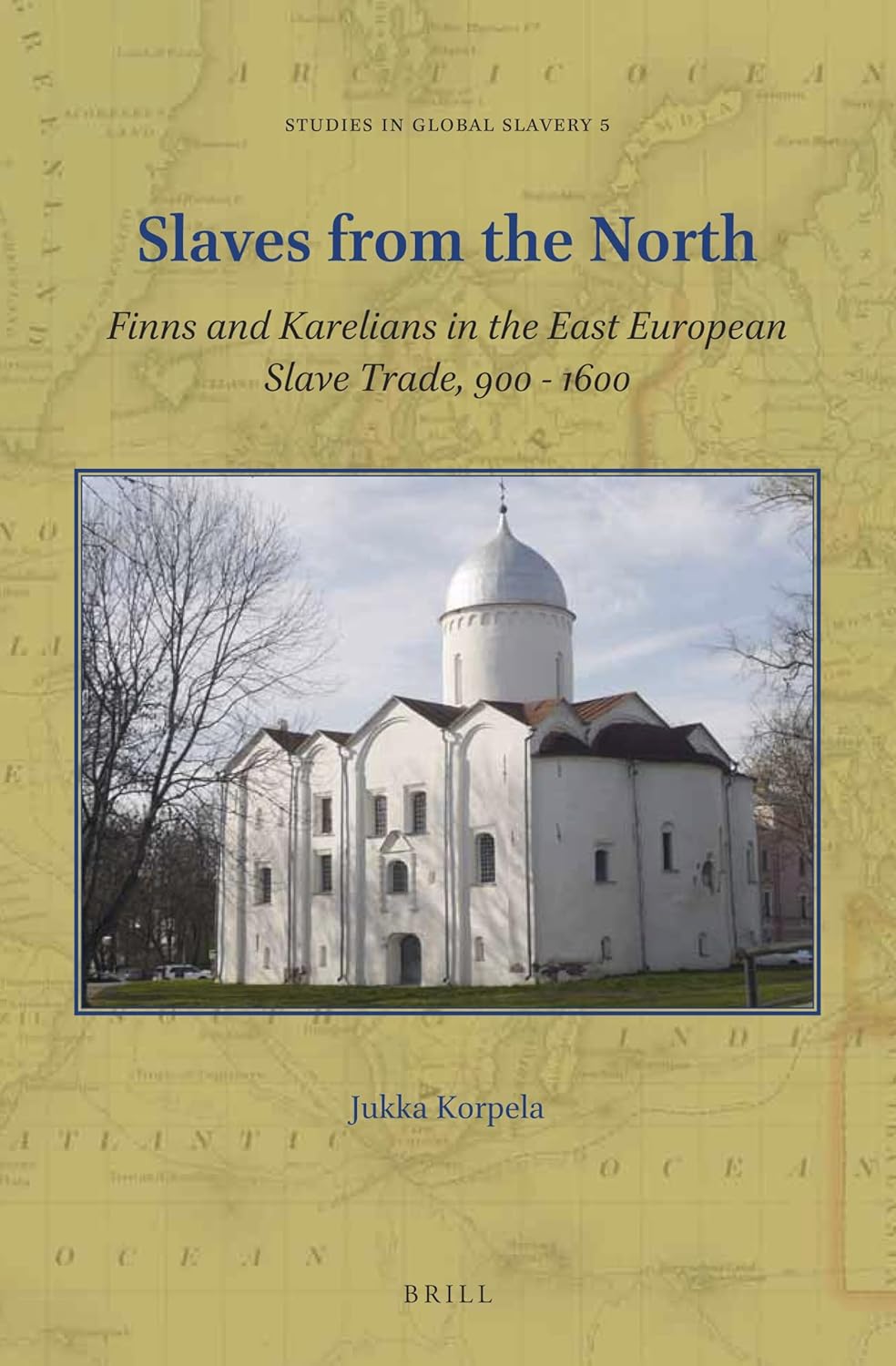
Slaves from the North:
Finns & Karelians in the East European Slave Trade, 900–1600

Lipton Matthews

3,251 words

Jukka Korpela
Slaves from the North: Finns and Karelians in the East European Slave Trade, 900–1600
Brill, Studies in Global Slavery, Volume 5, 2019

There is a history of human bondage in Europe that the textbooks rarely teach. While the transatlantic slave trade—with its millions of African captives, its plantation economies, and its enduring racial legacy—has commanded the attention of scholars and the public for generations, another vast machinery of enslavement operated across the eastern half of the continent for centuries, harvesting lives from the forests of Finland and Karelia to the steppes of Central Asia and the slave markets of Istanbul, Cairo, and Bukhara. Jukka Korpela’s Slaves from the North, published in 2019 as part of Brill’s Studies in Global Slavery series, is a landmark effort to recover that history. Scholarly in method, harrowing in detail, and unflinching in its conclusions, this book compels us to reckon with a brutal and largely forgotten chapter of European history.

Korpela, a Finnish historian at the University of Eastern Finland, draws on an extraordinary range of sources: Russian chronicles, Muscovite administrative registers, Tatar diplomatic documents, Italian commercial records, travel accounts by Arab geographers and Habsburg ambassadors, Norse sagas, and Finnish folklore. What he constructs from this mosaic is a sustained argument that the Finnic peoples—Finns, Karelians, Vepsians, Sámi, and related groups—were systematically preyed upon by Viking raiders, Novgorodian warlords, Muscovite troops, Teutonic Knights, and above all the fearsome cavalry armies of the Crimean Tatars, who funneled their captives into a trade network stretching from the Baltic to Persia.

The Vikings and the Origins of the Northern Slave Trade

The book opens with the Viking Age, and Korpela is careful to situate the enslavement of northern peoples within the broader context of early medieval slave economies. Slavery, he insists, was not a peripheral aberration but a core institution of medieval European life. As he observes, there were slaves in practically every Viking household, and they performed ordinary everyday work. Norse law treated the thrall—the Old Scandinavian term for a slave—like other property or domestic animals. Tore Iversen, on whose research Korpela extensively draws, has estimated that as much as a quarter of the population of Norway in the tenth and eleventh centuries may have consisted of slaves. The Domesday Book, compiled in 1086, records that slaves constituted roughly nine percent of the total population of England, and in some regions as much as a quarter.

The Vikings were not merely consumers of enslaved people; they were among the most active traffickers in human beings in the early medieval world. Records of Viking slave transactions are scattered as far apart as the Volga and the British Isles. Ibn Fadlan, the envoy of the Abbasid Caliph of Baghdad, reported on his visit to the court of the Prince of Volga-Bulgaria in 922. According to him, Vikings sold furs and slaves, especially slave girls along the Volga. The sexual poem “Moriuth,” composed by Warnerius of Rouen in the early eleventh century, describes how Danish Vikings kidnapped a man named Moriuth and put him up for sale at the market of Corbridge. Moriuth managed to escape from the nuns who purchased him, only to be kidnapped again and sold once more. Such vignettes illustrate how pervasive and routinised the trade had become.

Viking trading networks connected the forest peoples of the far North to the Islamic markets of the Middle East. The fur-rich territories of what would become Finland and Karelia were also slave-rich, and northern captives—prized for their fair skin and, crucially, for their non-Muslim status, which made them legally enslaveable in Islamic law were transported along the great river routes of the Volga and Dnepr to markets in Constantinople, Caffa, Baghdad, and beyond. Korpela notes that a castration center existed in Verdun in the mid-tenth century, described by Liutprand of Cremona, where merchants produced eunuch slaves for sale to elite households in Spain at extraordinary profit. The trade was industrialized, systematized, and deeply embedded in the political economy of the era.

Slavery declined in Western and Central Europe during the twelfth and thirteenth centuries, as royal power consolidated and the Church extended its prohibitions against the enslavement of Christians. In the Baltic and the East, however, it continued largely uninterrupted, adapting to new political configurations. The disappearance of slaves from Scandinavian law codes—Norway in 1274, and Sweden in 1350, did not mean the disappearance of slave hunting. It merely redirected the trade eastward.

The Novgorodians and the Raids on Finland and Karelia

Among the most persistent and systematic enslavers of Finnish and Karelian populations were the men of Novgorod, the great mercantile republic that dominated the forests and waterways of northwestern Russia from the tenth century through to its destruction by Ivan III of Moscow in the 1470s. Korpela has carefully catalogued the chronicle evidence, and the picture that emerges is one of relentless predation across the northern frontier.

According to the First Novgorodian Chronicle mentioned, Novgorodian raiders took countless prisoners from Southern Finland in 1226 and 1227. In total, the Russian chronicles record covers nearly a hundred raids to Southern Lapland, Central Finland, Southwest Finland (Häme), and Karelia over the medieval period, not including raids to the Karelian regions around Lake Onega. Prisoners appear in at least 38 percent of those accounts where enough detail survives.

The raids had an almost mechanical logic. When Novgorodians raided Southern Finland (Häme) in 1226, the chronicle records that the length of the return journey made it physically impossible to transport all the prisoners. So the raiders took some captives with them and simply slaughtered the rest. Killing was not cruelty for its own sake, but rather pragmatic economics. Transportation costs determined survival.

The chronicle entry for 1042 records the first raid unambiguously into the territory that became Finland and Karelia. Prince Aleksandr Nevsky himself attacked chud and yem in 1256, pushing so far north that, as the chronicle puts it, night was inseparable from day—and he too brought prisoners home. The raids were not merely military operations but a form of organized extraction, with prisoners as the primary resource. As Korpela notes, the Muscovite tax books for the Votian fifth region in 1499 and 1539 record repeated devastation: villages emptied, cattle seized, women and children beaten to death, settlements burned to ash. A typical entry from 1499 reads simply that foreigners (Swedes) “have robbed the village, taken the cattle and beaten women and children to death… and burned to ashes the villages of Kochelaksha, Il’mia and Ulyanila.”

The Swedish Chronicle of Eric, describing the wars in Karelia, captures the fate of the captured in a few bleak lines: “They imprisoned people there / and took them along to Viborg.” The chronicle claims the motivation was baptism, but as Korpela drily notes, we may well doubt this. In the last unambiguous medieval Swedish document about slavery, dated 27 February 1310, a wealthy man named Assmund Langh liberated his slave Karelus—likely a Finn from the Karelian region—and gave him a horse and a saddle as he went free. Karelus was probably not exceptional.

The Tatar Khanates and the Industrial Scale of Enslavement

If the Vikings and Novgorodians operated on a relatively modest scale in the North, the Crimean Tatars operated on an entirely different order of magnitude. Korpela devotes extensive sections of the book to the Crimean Khanate, the Tatar state that dominated the northern Black Sea coast from its establishment in the fifteenth century until the Russian conquest in 1783. The picture he paints is of an economy in which slave-raiding was not incidental but foundational.

The Tatar khan organized special troops dedicated to prisoner-hunting, and the system for distributing the spoils between the khan, military commanders, and ordinary soldiers was so sophisticated, as Martin Bronevsky observed, that ransom negotiations took place through diplomatic channels, and there were well-developed guarantee and debt instruments. To a considerable extent, as Korpela remarks, the business was regulated by the rules of international trade. Human beings were a commodity, managed with the same administrative seriousness as grain or timber.

The sheer numbers recorded in the sources are staggering. Sigismund Herberstein, the Habsburg ambassador who visited Moscow in the early sixteenth century, described the campaign of Muhammad Giray of Crimea and Said Giray of Kazan against Moscow in 1521. The Tatars took an almost unbelievable number of prisoners—the rumors put the figure at 80,000. Those prisoners who were too old or too weak to work were killed on the spot, since they could not be sold. Some captives, Herberstein reported, were handed to young Tatar soldiers specifically so that they could practice killing techniques: drowning, stoning, and other methods.

A 1592 entry in the Novyy letopisets describes a Tatar raid on the Ukrainian frontier with a kind of numbed horror: the raiders attacked Ryazan, Kashimir, and Tula, killed people and burned villages, and took such a multitude of Orthodox Christians prisoner—nobles, minor servants of the tsar, their wives and children—that “even old people did not remember that pagans had ever created such devastation.”

The 1408 devastation by Emir Edigu is recorded in the Chronicle of Vologda-Perm as sweeping across the whole of Rus from Ryazan to Galicia and Beloozero. In 1570 and 1571, the Tatar assault on Muscovy was described by Danish diplomat Jacob Uhlfeldt as burning 40,000 houses and killing 200,000 people.

Matthias de Mechow and the 1516 Raid

Among the most vivid eyewitness accounts in the book is the report of Matthias de Mechow, a Polish physician and scholar whose 1517 treatise Tractatus de duabus Sarmatiis constitutes one of the most important Western sources on the Tatar slave trade. Korpela returns to Mechow repeatedly throughout the book, drawing on both his geographical treatise and his chronicle of the Polish kingdom.

On the 1516 Tatar raid into Muscovy, Mechow provides a description of characteristic horror. The Tatars attacked Muscovy and devastated the land with weapons and fire. They burned castles and towns and inflicted horrible cruelties. Finally, they kidnapped people and cattle and transported more than 50,000 prisoners and livestock in chains, making it impossible for them to escape.

Elsewhere in the same work, Mechow specifically notes that the Tatars’ particular targets were women and girls of noble birth—matronas puellasque nobiles—and that their booty consisted of “wretched girls and innocent children” (miserae puellae et innocui infantes). This detail is important. Across the slave trades of the medieval and early modern East, women and children were consistently the most prized captives. Men of fighting age were often killed; the old and infirm were simply abandoned or slaughtered. It was the young—girls destined for harems, domestic service, or agricultural labor; boys who might become soldiers, servants, or eunuchs—who were worth the cost of transportation.

Mechow also provides testimony of a different, equally disturbing, kind of slavery—voluntary enslavement born of desperation. He records that it was an old tradition in Lithuania, Muscovy, and the Tatar lands to sell one’s own people into slavery in the same way as cattle. Free but destitute people sold their sons and daughters, and sometimes themselves, into bondage simply to get food to eat. The First Novgorodian Chronicle records a famine in 1230 so severe that people were driven to this extremity. A chronicle entry from 1445 describes people so desperate that they sold themselves and their children to Muslim and Jewish traders for bread.

The Muscovites as Slavers and Slave Consumers

Korpela is careful to avoid a narrative that casts Eastern Europeans purely as victims. Muscovites were not only targets of Tatar raids; they were themselves active participants in the slave trade, both as captors and as consumers. The Muscovite state maintained its own systems of bonded labour—the kholop institution—and the line between slavery, serfdom, and debt bondage was genuinely blurred throughout the period.

More striking is the evidence of Muscovite troops acting as slavers in the Baltic. The Livonian Chronicle of Balthasar Russow, which covers the devastating conflicts of the third quarter of the sixteenth century, records that on Ascension Day 1574, 10,000 Muscovites and Tatars raided Harjumaa in what is now Estonia, burning, robbing, and taking many prisoners. The following winter, the Muscovites imprisoned Brigittine nuns which Russow records as an extraordinary transgression even by the brutal standards of the day. Troops continued their devastation through Läänemaa, taking primarily people and horses, because they had no means to transport cattle and oxen. Korpela notes the economic logic embedded in this preference: human prisoners were more valuable than livestock.

When the Muscovites conquered Uuemõisa in 1573, they imprisoned soldiers and rural people along with their families. In Paide, the leaders were burnt at the stake while the rural people were smoked to death. When the castle of Põltsamaa surrendered in the summer of 1577, Muscovites and Tatars nearly came to blows arguing over the allocation of the prisoners—nobles, peasant women, and girls—before transporting them all to Muscovy and the Tatar lands. When the Tatars attacked Harjumaa again in 1579, they killed the elderly but imprisoned the young. Male soldiers were killed; women were taken to captivity.

Balthasar Russow’s summary is devastating in its bleakness: “An unknown number of them were killed in forests and countless people were sent all over the lands of Muscovy and Tatars. There they were executed by clubbing under water and burning by fire. Many died also of hunger and thirst.” This was not an aberration but a pattern, replicated across decades and across the entire eastern Baltic littoral.

The brutal partition of captives by age and sex reflected the logic of slave markets far to the south. Jacob Uhlfeldt records that one Tverian prince maintained his own harem of fifty Livonian girls. The ambassador Augerius Gislenius Busbequius, travelling home from Constantinople in the 1550s, encountered a convoy of boys and girls in chains on the road—the human cargo of the trade routes that connected the Baltic periphery to the Ottoman heartland.

Demographic Consequences: A Continent Bled

Perhaps the most arresting sections of Slaves from the North are those in which Korpela grapples with the demographic scale of what was happening. The numbers, where they can be reconstructed, are enormous.

Modern scholars estimate that the total number of slaves of Eastern European origin from the early fifteenth to the end of the seventeenth century was somewhere between 1 and 2.5 million people. Aleksei Novoselsky’s calculations of Muscovite-origin slaves in the Crimean trade during the first half of the seventeenth century, supported by Shmidt’s parallel research, suggest that between 100,000 and 150,000 Muscovite slaves passed through the Crimean trade during that period alone—meaning that the trade affected between 1,000 and 10,000 people annually.

The historian Dariusz Kołodziejczyk, cited extensively by Korpela, has calculated that nearly 10,000 Polish-Lithuanian and Russian captives were imported annually to Crimea during the period from 1500 to 1700. Guillaume Le Vasseur de Beauplan, a French officer in the service of the King of Poland from 1630 to 1648, reported that there were between 50,000 and 60,000 slaves for sale in Crimea in an average year and in the best year, 80,000. Modern historians have estimated that the realm of Poland lost one million people in total between 1474 and 1694 to this trade.

Kołodziejczyk’s conclusion, which Korpela endorses, is striking: the Black Sea slave trade was fully comparable in size with the Atlantic slave trade. The Franciscan friar Bartholomaeo de Jano, writing from Constantinople to a colleague in Venice in 1438, described himself as shocked by what he witnessed: thousands of young prisoners bought at low prices in the Black Sea ports of Moncastro, Tana, and Caffa, with more than thirty ships full of slaves arriving in Constantinople every year—and that was less than one percent of all the slaves for sale in the city. The scale of the trade appalled even a man of the fifteenth century.

For northern Finnic peoples, the numbers were necessarily smaller, given their remoteness from the main trade routes. Korpela estimates that Finns and Karelians were taken to Novgorod in the Middle Ages and from there funneled into the broader trading world. The demand for blonde, fair-skinned, non-Muslim slaves from the far North was real—they commanded premium prices—but the logistical challenges of transporting captives from the Finnish forests to the markets of the South meant that the volume was measured in dozens per year rather than thousands.

The Great Northern War (1700–1721) brought a sudden catastrophic expansion of this suffering for Finland. Between 20,000 and 30,000 Finns were imprisoned in Russia during the conflict. Furthermore, Russian troops, many of them Cossacks from the southern steppe who understood the market value of human cargo, specifically targeted children, who commanded the best prices in the slave markets. The clergy of the Diocese of Åbo complained in 1726 that, according to a priest recently returned from Russian captivity, approximately a thousand prisoners from Finland and Livonia had been sold onward to Isfahan in Persia. The majority of those transported were women and small children.

Maghreb, as Korpela notes, was not the center of the slave economy; its markets were small by comparison with Istanbul, Baghdad, Cairo, Bukhara, and Samarkand. Even so, Robert Davis has calculated that the renewal rate in the slave population of the Maghreb was about 25% annually meaning roughly 8,500 new slaves were needed each year to maintain a total enslaved population of only 35,000. The appetite of the larger markets was proportionally greater, and insatiable.

A Forgotten Atrocity in the Long Shadow of Atlantic Slavery

Slaves from the North is a work of genuine scholarly importance, and it is also, in the best sense, a work of moral urgency. Korpela is a careful and often cautious historian—he is the first to acknowledge when evidence is thin, when numbers are unreliable, when the chronicles are exaggerated. He does not seek to sensationalize. But the accumulation of evidence across his pages produces an effect that is difficult to shake: the Eastern European slave trade was not a minor footnote in the history of the continent. It was a centuries-long catastrophe for millions of people, conducted with bureaucratic efficiency and appalling brutality, and it has been allowed to slip almost entirely from the popular historical consciousness.

This amnesia has several causes. The victims were white Europeans rather than African peoples, which has made their suffering harder to fit into the dominant modern frameworks for thinking about slavery. The perpetrators were not Western colonial powers but a complex mosaic of actors—Vikings, Novgorodians, Muscovites, Tatars, Lithuanians, Teutonic Knights—none of whom maps neatly onto contemporary political narratives. The documentation, though extensive in aggregate, is scattered across languages and archives that few researchers command simultaneously. And the slave societies of the East left fewer of the visual records—the manifests, the plantation accounts, the abolitionist testimonies—that have made the Atlantic trade so legible to later generations.

None of these reasons is adequate justification for forgetting. Just as the emphasis on the transatlantic slave trade has been central to the historical consciousness of the modern West, we should never forget the slave trades of Europe. The men, women, and children marched in chains from Finnish villages to Novgorod markets, the mothers and daughters loaded onto ships at Caffa for sale in Constantinople, the Finnish prisoners sent to Isfahan—these people are as fully part of the history of slavery as the captives of the Middle Passage. Their suffering was not less real because it occurred in the wrong geography for easy memorialization.

Korpela’s book does not offer easy conclusions, and it does not pretend to have recovered more than fragments of lives that were systematically erased. But it is a serious, humane, and important act of historical retrieval, and it deserves a wide readership beyond the specialist community for which it was primarily written.

Slaves from the North: Finns & Karelians in the East European Slave Trade, 900–1600

Slaves%20from%20the%20North%3A%20%0AFinns%20andamp%3B%20Karelians%20in%20the%20East%20European%20Slave%20Trade%2C%20900%E2%80%931600%0A

Share

  • Gab

Enjoyed this article?

Be the first to leave a tip in the jar!

Instant Echeck GreenPay™

Related

  • On the Roots of Anti-Immigrant Sentiment in Contemporary Britain

  • The Fragile Polity that is Syria

  • Based Blacks

  • Why White Advocates Should Avoid “Based Blacks”

  • China’s Threat to American Security

  • Why Billionaires Should Fund White Identity Politics

  • China’s Quiet Hand:

  • The Selective Memory of Empire:

Tags

Byzantine EmpireEastern EuropeFinlandhistorical revisionismhuman traffickingJukka KorpelaKareliaLipton MatthewsLithuaniaMuscovitesMuslim slave tradeNorthern EuropeNovgorodOttoman EmpireSlavsTeutonic Knightsthe Balticsthe Tatarstransatlantic slave tradeVikingswhite slavery

Previous

« Crosstown Traffic

Next

» Le Debacle: Historical Echoes of Zola’s France

14 comments

  1. DarkPlato says:
    April 29, 2026 at 6:47 pm

    Wow, that was really interesting.  I would like to read something on the tartar empire.  I bet this book is replete with good references.  It’s hard to believe that Eastern Europe was so savage at so late a date!  I shudder to think what they wanted with all these children 🤢.  It reminds me of Conan the barbarian at the beginning.  That’s what went on.

    2
    2
    • kolokol
    • Traddles
    Reply
    1. Elear says:
      April 29, 2026 at 7:41 pm

      It’s hard to believe that Eastern Europe was so savage at so late a date!

      Proximity of the Eurasian steppe to the East European Plain might have had something to do with it. Slave raids were still feasible in the pre-modern era, especially before the mass-adoption of firearms and artillery. The Baltic areas on the other hand were late to Christianize, owing both to their remoteness and difficult, swampy lands, filled with dense forests.

      2
      2
      • DarkPlato
      • kolokol
      Reply
  2. Harry P. says:
    April 29, 2026 at 9:51 pm

    Russians took plenty of slaves from Finland during the occupation of the country in 1710-1721. However, this happened 300 years ago. Lots of water has flown in Baltic Sea after that. Russians have also suffered multitude of casualties in various conflicts. It is no use to be bitter about things long past. Peace.

    2
    2
    • Scott
    • Traddles
    Reply
    1. Viktor Schmidt says:
      April 30, 2026 at 2:21 pm

      Russians were under the foreign rule both in the 18th century and later.

      0
      0
      Reply
  3. Dominic Fox says:
    April 29, 2026 at 10:15 pm

    That was a topic as interesting as it is bleak.

    Is there a measurable genetic impact of this trade in the former Middle Eastern centers of the slave trade (e.g. Istanbul, Bukhara etc)?
    The data I’ve seen shows, for example, that modern Egyptians have ca. 5% Black heritage that Hellenistic and Roman era Egyptians lacked. I would expect a comparable impact of the Eastern European slave trade on, for example, western Turkish genetics.

    The irony is that imported slave populations usually leave at least some genetic trace – meaning that over time, the perpetual buyers’ nation is being partially “genetically colonized” by its slaves.

    1
    1
    • kolokol
    Reply
  4. Scott says:
    April 30, 2026 at 1:26 am

    In college History courses, the Slavicists and experts on Russia and Eastern Europe emphasized adamantly that the widely-held belief that the English word “Slav” is derived from “slave” is incorrect.

    I had never even heard this before, so I gave the idea little heed.

    Later, when studying more recent European history, one of the arguments used by the Slavophiles is apparently that in the West, they are always Slavophobes, who basically universally consider Slavs to be slaves.

    “Strong backs and dull minds,” as the fictional Sturmbannführer Erik Dorf ─ played by Michael Moriarty, later of Law & Order ─ put it in the 1978 blockbuster NBC TV miniseries, Holocaust.

    https://static.wikia.nocookie.net/nazipedia/images/2/29/Dorf.jpg/revision/latest?cb=20150813031406

    🙂


    0
    0
    Reply
    1. Harry P. says:
      April 30, 2026 at 3:15 am

      I would not say that Western Europeans are slavophobes. There is a certain Western European disdain toward Eastern Europe, but I don´t think it has anything to do with slavs per se; it is not ethnic, but more geographical and cultural phobia. Western Europeans sometimes think Eastern Europeans a bit barbaric, not quite so European. It also goes for Hungarians, Finns etc.

      2
      2
      • Scott
      • Dominic Fox
      Reply
      1. Viktor Schmidt says:
        April 30, 2026 at 5:37 pm

        Even if A.H. wrote sometimes something which could be could “anti-Slav”, you should not forget that the German Slavs (Wenden und Sorben) were not oppressed in Reich, and many Slav peoples of Europe were allies of Germans (Slovaks, Bulgarians, Croatians, Bosnians, West Ukrainians etc.) The repression of another Slav peoples (Poles, Czechs, Serbians) were of political, rather than racial nature, because of their Resistance activities.

        0
        0
        Reply
    2. Viktor Schmidt says:
      April 30, 2026 at 8:39 am

      the English word “Slav” is derived from “slave” is incorrect

      Yes, because it was vice versa. The word slave is derived from Slav, just like Sklawe, sklaaf, schiavo, etc. The Rahdonytes, Central Asian Jewisch slave traders, sold Slavs in the whole Europe and Mediterranean.

      0
      0
      Reply
      1. Scott says:
        April 30, 2026 at 12:04 pm

        Viktor Schmidt | April 30, 2026 at 8:39 am

        >> the English word “Slav” is derived from “slave” is incorrect

        >> Yes, because it was vice versa. The word slave is derived from Slav, just like Sklawe, sklaaf, schiavo, etc. The Rahdonytes, Central Asian Jewisch slave traders, sold Slavs in the whole Europe and Mediterranean. <<


        The Online etymological dictionary appears to agree:

        slave(n.)
        >> c. 1300, sclave, esclave, “person who is the chattel or property of another,” from Old French esclave (13c.) and directly from Medieval Latin Sclavus “slave” (source also of Italian schiavo, French esclave, Spanish esclavo), originally “Slav” (see Slav); so used in this secondary sense because of the many Slavs sold into slavery by conquering peoples.
        […]

        Slav(n.)

        […]
        >> The reduction of scl- to sl- is regular in English (compare slate). In late 18c. and early 19c. The spelling Slav is by 1866; in English it also was spelled Slave, influenced by French and German Slave. As an adjective, belonging to or characteristics of Slavs, from 1872. <<


        I’m a bit skeptical, however. The English had no original word for slave?

        The post-Soviet Eurasianists or Slavicists teaching or consulting as experts on the subject for upper division History did not accept the interpretation that there was really a connection between the two words. As far as I can remember, none of them were Russian Jews, but that might easily explain one possibility for a differing outlook, as nobody hates the Russians more than the Ashkenazim.

        I’m no expert, and I don’t remember the details about their contrary reasoning now. This was the first that I had ever come across the claim, which I notice quite often nowadays.

        Regarding the Big-H, it seems to me like another trendy play to “ecumenicize” the Good War atrocity monolith, but this is quite controversial. Before the eponymous 1978 NBC television miniseries, there wasn’t even a standard Shoah terminology. “Holocaust” is from the Greek, to make a sacrificial burnt offering in whole. And only Jews get to do that, as we are often reminded. Almost nobody remembers the Armenians.

        🙂


        0
        0
        Reply
  5. Peter Quint says:
    April 30, 2026 at 10:48 pm

    There is one “easy conclusion,” the hand of the jew in the role of White enslavement is vastly, and perhaps criminally understated. 🙃

    1
    1
    • Uncle Semantic
    Reply
    1. Uncle Semantic says:
      May 1, 2026 at 4:51 pm

      And one needing the Luke Skywalker treatment left unfixed. Slaver scum bastards. May they suffer eternal hell.

      1
      1
      • Peter Quint
      Reply
  6. Will Williams says:
    May 2, 2026 at 1:19 am

    Thanks, Lip Man, for this “African American” history of slavery.

    Lip Man: Slaves from the North, published in 2019 as part of Brill’s Studies in Global Slavery series,

    —


    The Center for the Study of Global Slavery (CSGS) is a research and outreach initiative at the National Museum of African American History and Culture (NMAAHC) in Washington, D.C., dedicated to exploring the history, impact, and legacies of slavery and its afterlives on a global scale National Museum of African American History and Culture.

    Mission and Focus
    The CSGS advances understanding of slavery through innovative research, scholarship, and public engagement, tracing its complex trajectories and enduring legacies across Africa, the Americas, Europe, and beyond. It emphasizes the resistance, resilience, and freedom-making activities of African-descended peoples throughout the diaspora...

    ============

    Fact is, Lip, slavery had ancient origins prior to the 17th -19th century transatlantic slave trade of your people from Africa to America.

    Slavery has existed since the earliest civilizations, with evidence dating back to 4000 BC in Mesopotamia. Initially, slavery was often a result of war, where captives were forced into servitude. The Code of Hammurabi (c. 1750 BC) recognized slavery as an established institution, outlining the rights and responsibilities of slave owners and slaves.

    0
    0
    Reply
    1. Will Williams says:
      May 2, 2026 at 1:56 am

      Our people need history from our people not from “African American” historians.. There are several interesting articles about slavery on National Vanguard by putting that word in it’s search block, like this one by the brilliant David Sims: “White Slavery: You Can’t Debunk the Truth” at nationalvanguard.org 

      THE WAY TO TELL honest historical scholarship from a deceptive leftist attack on history is as follows:

      Real scholarship is generally something that you have to take the trouble to find. Nobody sets it under headlines and under your nose. If a historical narrative pops up with the suddenness, the immediacy, and the ubiquity with which we are presently seeing in the “The Irish were not slaves” campaign, then it is probably an exercise in grand deception.

      If the media ever come bursting all over the web (Snopes, Slate, Wikipedia, NPR, New York Times, Associated Press, Salon, a dozen or so videos on YouTube, etc. etc.) about some sort of “fact checking” or “myth debunking,” as they are doing now with White slavery, it’s probably an orchestrated hoax.

      Real scholarship doesn’t start spouting from every possible venue like water from a thousand fire hoses. But, as to particulars:

      The Tudors of England tried to exterminate the Irish people during the 17th century. Their biggest success occurred during a massive genocide (1641-1652), when the population of Ireland fell from about 1,500,000 to about 600,000.

      The death toll from this genocide and that from the Great Famine that occurred two centuries later (1845-1852) were both in the rough neighborhood of one million people. The Irish émigrés from the famine were indentured servants in large part, and some of them were transported voluntarily, as they sought to make their way to a land where they wouldn’t starve to death.

      But the Irish transported after the 17th century military slaughters that occurred during the Tudor conquest of Ireland were mostly slaves. The enslavement of the Irish began about 1610. It is known that King James I, who began his reign in 1603 upon the death of Queen Elizabeth I (under whom the conquest of Ireland began), sold Irish slaves in South America in 1612.

      The first Black slaves arrived in 1617, though it was another 38 years before a Virginia judge gave judicial cognizance to the institution of slavery.

      In 1625, King James II (whose reign began that same year) decreed that all Irish political prisoners must be transported to the West Indies and sold (as slaves, not as indentured servants) to English farmers. Not long afterward, Irish slaves were the majority among slaves in the English colonies.

      The point, however, is that the circumstances of the Irish transportees to the Americas were generally dissimilar between the two events: (1) the transport of Irish prisoners following the Tudor genocide against the Irish in the mid-17th century and (2) the transport of Irish escaping the potato famine in the mid-19th century. The leftists are conflating the circumstances in the later event with those of the former event, and trusting to the Americans’ general ignorance of history to carry off a hoax in which they attempt to “debunk” the truth.

      I might have said this before, somewhere. But it bears repeating.

      The difference between a slave and an indentured servant isn’t the amount of time he spends in bondage. Nor is it the treatment he receives from his master. Nor does it depend on whether or not his children inherit his status.

      An indentured servant is a servant by contract, made either by agreement or imposed by legal force (a court). If a (contract of) indenture exists, the person to whom it applies is an indentured servant. If no such contract exists, then the bound person is a slave.

      There is no way that all of the tens of thousands of Irish deported and sold by King James I and King James II in South America, in the Caribbean, and in North America were contracted servants. They were mostly prisoners of war, sold not as indentured servants, but as slaves. Of course, there were, also, some number of White indentured servants who were bound under contract to a period of servitude in all of those same places and at about the same time.

      But let’s not pretend that the indentured servants were the most representative case. Most likely, they were the minority of bound White persons sold in the Americas. Making that pretense is what Liam Hogan is doing… I think…..

      Read more about slavery of Whites by other Whites from our Mr. Sims at the link.

      0
      0
      Reply

If you have a Subscriber access,
simply login first to see your comment auto-approved.

Post a comment Cancel reply

Note on comments privacy & moderation

Your email is never published nor shared.

Comments are moderated. If you don't see your comment, please be patient. If approved, it will appear here soon. Do not post your comment a second time.

Writers of May

(2 votes) Morris van de Camp David M. Zsutty Derek Stark Jayant Bhandari Greg Johnson

Articles of May

The Lunch Wars by David M. Zsutty Heidegger on Nietzsche, Part One by Collin Cleary 2 votes
    • Small Is Beautiful:
      The Napoleon of Notting Hill and G. K. Chesterton Upon Defending One’s Homeland from Others—and Itself

      Steven Tucker

      2

    • The Psychology Behind MrBeast’s Moronic Thought Experiment

      Endeavour

      9

    • On the Roots of Anti-Immigrant Sentiment in Contemporary Britain

      Lipton Matthews

      6

    • Remembering Enoch Powell:
      June 16, 1912–February 8, 1998

      Greg Johnson

      16

    • Counter-Currents Radio Podcast No. 691
      Rob Rundo Returns

      Counter-Currents Radio

    • The Fragile Polity that is Syria

      Morris van de Camp

      2

    • Nigel Farage Calls Britain a Two-Tier State

      Mark Gullick

      4

    • Nationalism This Week
      Letter to J. D. Vance

      Greg Johnson

      32

    • Lost In Trans-Mission:
      How the Media Fails To Reveal the Inconvenient Truth About the Usual Suspects

      Steven Tucker

      10

    • Liar, Liar, Pants on Fire!

      Beau Albrecht

      7

    • Editor’s Update
      Rob Rundo on Counter-Currents Radio, Fundraiser Update, & a New $20,000 Matching Grant

      Greg Johnson

    • The Bitter End of Western Metaphysics:
      Heidegger on Nietzsche, Part Three

      Collin Cleary

      10

    • Uncivil War

      Mark Gullick

      50

    • Exclusive Interview with Karel Veliky:
      The Final Chapter in the Film Series! Part II

      Ondrej Mann

      2

    • Happy Birthday to Us!

      Greg Johnson

      6

    • Zsutty’s Maximum

      David M. Zsutty

      16

    • Exclusive Interview with Karel Veliky:
      The Final Chapter in the Film Series! Part I

      Ondrej Mann

      2

    • The Union Jackal, June 2026

      Mark Gullick

      23

    • The Inferiority Behind Immigrant Superiority

      Jayant Bhandari

      15

    • Counter-Currents Radio Podcast No. 690
      Greg Johnson & David Zsutty Discuss Current Things: AI, Henry Nowak, the Iran Crisis, & More

      Counter-Currents Radio

      7

    • Collin Cleary: What Rome Means to Me

      Collin Cleary

      4

    • Paul Krugman: Closet Bolshevik

      Spencer J. Quinn

      21

    • Fugue of Ideas:
      Ibram X. Kendi’s Chain of Ideas

      Greg Johnson

      19

    • Based Blacks

      Lipton Matthews

      24

    • Black Intellectual Fatigue

      Derek Stark

      41

    • Why White Advocates Should Avoid “Based Blacks”

      Dani Vypont

      32

    • Nietzsche & Race

      Mark Gullick

    • Editor’s Update
      Rob Rundo Rescheduled to Next Week on Counter-Currents Radio;
      Tonight Greg Johnson & David Zsutty Answer Your Questions;
      Fundraiser Update & a New $20,000 Matching Grant

      Greg Johnson

    • The Counter-Currents 2026 Fundraiser
      Lifetime Subscriber Welcome Packages Extended

      Greg Johnson

    • Nationalism This Week
      Who’s Looking Back?

      Greg Johnson

      29

    • China’s Threat to American Security:
      Food, Farmland, Foreign Control, & Energy Policy

      Lipton Matthews

      5

    • The Bitter End of Western Metaphysics:
      Heidegger on Nietzsche, Part Two

      Collin Cleary

      16

    • The Killing of Henry Nowak

      Mark Gullick

      38

    • The Crisis of Chinese Technology Thieves

      Morris van de Camp

      1

    • The Strange World of Gender Bender Fiction:
      & What This Genre Tells Us About Autosexuality

      Dani Vypont

      3

    • Watching the Watchers:
      The Dark Triad Question

      David M. Zsutty

      14

    • The Remigration Movement Solidifies

      F. Roger Devlin

      2

    • Casting Aspersions:
      The Fatal Consequences of Race-Swapped Casting, From Helen of Troy to Henry of Southampton

      Steven Tucker

      20

    • The Murder of Henry Nowak

      Millennial Woes

      23

    • Don’t Forget to Vote in Our Writer & Article of the Month Poll

      Greg Johnson

    • The Robot Hotdog Stand

      Greg Johnson

      37

    • Laughing Our Way to Victory

      Dave Chambers

      7

    • The Zodiac Killer

      Mark Gullick

      11

    • Jared Taylor: What Rome Means to Me

      Jared Taylor

      1

    • An Interview with Endeavour:
      My Way of Life Is an Adventure!

      Ondrej Mann

      6

    • José Pedro Zúquete’s The Identitarians

      Greg Johnson

      3

    • Editor’s Update
      Fundraiser Update & How to Watch the Remigration Summit

      Greg Johnson

      5

    • The Bitter End of Western Metaphysics:
      Heidegger on Nietzsche, Part One

      Collin Cleary

      12

    • Berlin: City of Stones

      Spencer J. Quinn

      6

    • True Folk-Horror Is Horror of Your Own Folk:
      Mark Gatiss vs the Brexit Blind Dead  

      Steven Tucker

      4

    • Beau Albrecht

      Remembering Enoch Powell:
      June 16, 1912–February 8, 1998

      At the time, Britain was still only experiencing the thin end of the wedge as far as migration goes...

    • Peter Quint

      Remembering Enoch Powell:
      June 16, 1912–February 8, 1998

      Okay, so he has two White Nationalist speeches to his credit. 🦈

    • Livla

      The Psychology Behind MrBeast’s Moronic Thought Experiment

      From a biological perspective, this thought experiment is the equivalent of a selection event that...

    • Adrian Roberts

      Remembering Enoch Powell:
      June 16, 1912–February 8, 1998

      In Mein Kampf, Hitler argued that the side which makes war inevitable is the side most responsible...

    • Adrian Roberts

      Remembering Enoch Powell:
      June 16, 1912–February 8, 1998

      So the English owe everybody reparations? Damn.

    • Wasili

      The Psychology Behind MrBeast’s Moronic Thought Experiment

      Great article!  Indeed, the following point can’t be emphasized enough: The [insert non-white...

    • Will Williams

      On the Roots of Anti-Immigrant Sentiment in Contemporary Britain

      Ecological experts call the replacement of one species by another as habitat succession. In my...

    • Douglas Mercer

      Remembering Enoch Powell:
      June 16, 1912–February 8, 1998

      In 1977 Powell gave a speech called The Road To National Suicide: “On the other hand there are at...

    • JayeRyanOD

      The Fragile Polity that is Syria

      I strongly support ex Syrian President Assad supported by my kinsmen the Russians . Before the...

    • Joe Gould

      The Psychology Behind MrBeast’s Moronic Thought Experiment

      I don’t see the decline of real, useful work as alarming or surprising, rather it is inevitable.We...

    • E_Perez

      On the Roots of Anti-Immigrant Sentiment in Contemporary Britain

      A little soft, the article, especially when its title promised to go to the roots. "The...

    • Elear

      Small Is Beautiful:
      The Napoleon of Notting Hill and G. K. Chesterton Upon Defending One’s Homeland from Others—and Itself

      A wonderful essay about things so small yet so precious. Fighting off the invaders is meaningless if...

    • Quu

      The Psychology Behind MrBeast’s Moronic Thought Experiment

      Thank you, yes, it's very interesting, revealing a predisposition that isn't globally normal, and...

    • The Laughing cavalier

      Remembering Enoch Powell:
      June 16, 1912–February 8, 1998

      It was England who declared war - both times - and neither time was England under any threat. It'...

    • TheLau ghin gCavalier

      The Psychology Behind MrBeast’s Moronic Thought Experiment

      A version of this scenario did the rounds on 4chan where red was "nothing happens" and blue was "50...

    • Peter Quint

      Small Is Beautiful:
      The Napoleon of Notting Hill and G. K. Chesterton Upon Defending One’s Homeland from Others—and Itself

      The Secret People G. K. ChestertonThey have given us into the hands of new unhappy lords,Lords...

    • Douglas Mercer

      Remembering Enoch Powell:
      June 16, 1912–February 8, 1998

      The UK now has 19 percent non-White which is more than double what it had in 2001 which was 8...

    • Lexi

      Nationalism This Week
      Letter to J. D. Vance

      They irrationally love Trump; their support for JDV is only an extension of this. Who loves JDV for...

    • Adrian Roberts

      The Psychology Behind MrBeast’s Moronic Thought Experiment

      I puzzled over the thought experiment for several minutes before reading the rest of the article....

    • Scott

      Remembering Enoch Powell:
      June 16, 1912–February 8, 1998

      I'm not an expert on postwar Albion, but I think the impressive colored invasion there is mostly a...

    • Earth Day Special

      John Morgan

      12

    • A Robertson Roundup
      Remembering Wilmot Robertson
      (April 16, 1915 – July 8, 2005)

      Margot Metroland

      13

    • The Paranoid Style in White Nationalism

      Greg Johnson

      30

    • Join the Dance!

      Andrew Hamilton

      1

    • We Can’t Save the Earth Without Reducing African Birth Rates

      James Dunphy

      36

    • “I’m Not a Conspiracy Theorist, but . . .”:
      Jeffrey Epstein’s Death Gives New Life to “Conspiracy Theories”

      Greg Johnson

      22

    • Sylvia Plath: Stasis in Darkness

      Vic Olvir

      17

    • Vanguardism, Vantardism, & Mainstreaming

      Greg Johnson

      80

    • Aviation, Geography, & Race

      Charles Lindbergh

      3

    • Some Thoughts on Yule

      Collin Cleary

      4

    • Living in Truth:
      A Yuletide Homily

      Jef Costello

      7

    • John Kennedy Toole’s A Confederacy of Dunces

      Greg Johnson

      20

    • On Aleksandr Solzhenitsyn’s Warning to the West

      Spencer J. Quinn

      7

    • Elitism, British Modernism, & Wyndham Lewis

      Jonathan Bowden

      6

    • Philip K. Dick’s Do Androids Dream of Electric Sheep? as Anti-Semitic/Christian-Gnostic Allegory

      Greg Johnson

      20

    • “Conspiracy Theory” or Conspiracy?

      Andrew Hamilton

      21

    • Remembering H. P. Lovecraft
      (August 20, 1890–March 15, 1937)

      Greg Johnson

      3

    • Who Are We?
      Nordics, Aryans, & Whites

      Greg Johnson

      71

    • Remembering William Gayley Simpson
      (July 23, 1892–December 31, 1990)
      A Pleasant Afternoon with Harriet & Bill Simpson

      Margot Metroland

      18

    • Here are the Young Men
      Remembering Ian Curtis
      (July 15, 1956–May 18, 1980)

      Mark Gullick

      18

    • Percy Grainger
      Artist of the Right

      Alex Graham

      7

    • Remembering Revilo Oliver
      (July 7, 1908–August 20, 1994)

      Greg Johnson

      18

    • The Meaning of July 4th for the White Man

      Gregory Hood

      13

    • The Front National’s Evolution

      Bruno Mégret

    • Merwin K. Hart
      Forgotten American Hero & Man of the Right

      Morris van de Camp

      10

    • George Orwell’s Nineteen Eighty-Four

      Jonathan Bowden

      8

    • Carleton S. Coon
      Scientist & Reluctant White Advocate

      Morris van de Camp

      3

    • The Kwanzaa Absurdity Will Be Dwarfed by Juneteenth

      Robert Hampton

      10

    • Stravinsky

      Alex Graham

      7

    • Like the Roman:
      Remembering Enoch Powell (1912-1998)

      Mark Gullick

      23

    • The 1970s: The Golden Age of Hijacking

      Morris van de Camp

      21

    • Jonathan Bowden’s Deliverance
      Part 6

      Jonathan Bowden

    • Do You Want to Play a Game?

      Mark Gullick

      1

    • Sexually Incontinent on the Indian Subcontinent:
      Who Rapes More Animals, Indians or Pakistanis? The Battle Continues!

      Steven Tucker

      3

    • Neo-Fascism in Film
      Part 5

      Karel Veliky

      15

    • The Game of Tarot

      Mark Gullick

      2

    • Institutions Cannot Be Transplanted

      Jayant Bhandari

      5

    • Jonathan Bowden’s Deliverance
      Part 5

      Jonathan Bowden

    • Crosstown Traffic:
      Jimi Hendrix & The Post-War Rock ‘N’ Roll Revolution

      Mark Gullick

      1

    • Slaves from the North:
      Finns & Karelians in the East European Slave Trade, 900–1600

      Lipton Matthews

      14

    • Neo-Fascism in Film
      Part 4

      Karel Veliky

      2

    • David Lean’s A Passage to India

      Spencer J. Quinn

      1

    • Elites are Essential to Development

      Lipton Matthews

      7

    • Jonathan Bowden’s Deliverance
      Part 4

      Jonathan Bowden

    • Neo-Fascism in Film
      Part 3

      Karel Veliky

      6

    • E. M. Forster’s A Passage to India & the Indian Mentality

      Spencer J. Quinn

      25

    • Jonathan Bowden’s Deliverance
      Part 3

      Jonathan Bowden

    • The Rest Is Silence
      Heidegger’s Quietism

      Mark Gullick

      2

    • Dispelling the Historical Fallacy of Indian Nationalism

      Lipton Matthews

      8

    • Neo-Fascism in Film
      Part 2

      Karel Veliky

      8

    • Jonathan Bowden’s Deliverance
      Part 2

      Jonathan Bowden

    • Life of a Klansman

      Mark Gullick

      8

    • Jonathan Bowden’s Deliverance, Part 1

      Jonathan Bowden

    • Decolonial Ideas are Holding Back Developing Countries

      Lipton Matthews

      8

    • Neo-fascism in Film, Part 1

      Karel Veliky

      21

    • Jonathan Bowden’s Onslaught, Part 8
      Divigations on Decadence

      Jonathan Bowden

    • Jonathan Bowden’s Onslaught, Part 7
      Intrigues in the National Front

      Jonathan Bowden

      1

    • Rotten to the Core

      Mark Gullick

      8

    • Strauss on Husserl’s “Philosophy as Rigorous Science”

      Greg Johnson

    • Jonathan Bowden’s Onslaught, Part 6
      Francis Bacon & Right-Wing Nihilism

      Jonathan Bowden

    • András László
    • Derek Hawthorne
    • Beau Albrecht
    • Alain de Benoist
    • Kerry Bolton
    • Jonathan Bowden
    • Collin Cleary
    • Jef Costello
    • Savitri Devi
    • Julius Evola
    • Jim Goad
    • Gregory Hood
    • Juleigh Howard-Hobson
    • Greg Johnson
    • Charles Krafft
    • Anthony M. Ludovici
    • Trevor Lynch
    • H. L. Mencken
    • J. A. Nicholl
    • James J. O’Meara
    • Christopher Pankhurst
    • Tito Perdue
    • Michael Polignano
    • Spencer J. Quinn
    • Fenek Solère
    • Irmin Vinson
    • Leo Yankevich
    • Francis Parker Yockey
    • Multiple authors
  • Editor-in-Chief

    • Greg Johnson, Ph.D.

    Featured Writers

    • Beau Albrecht
    • Gunnar Alfredsson
    • Collin Cleary, Ph.D.
    • Jef Costello
    • Morris V. de Camp
    • F. Roger Devlin, Ph.D.
    • Stephen Paul Foster, Ph.D.
    • Jim Goad
    • Alex Graham
    • Mark Gullick, Ph.D.
    • Greg Johnson, Ph.D.
    • Travis LeBlanc
    • Trevor Lynch
    • Margot Metroland
    • James J. O’Meara
    • Angelo Plume
    • Spencer J. Quinn
    • Fred Reed
    • Clarissa Schnabel
    • Michael Walker
    • David M. Zsutty

    Frequent Writers

    • Asier Abadroa
    • Aquilonius
    • Alain de Benoist
    • Kerry Bolton, Ph.D.
    • Dave Chambers
    • Steven Clark
    • James Dunphy
    • Endeavour
    • Richard Houck
    • Jason Kessler
    • Titus Livius
    • Ondrej Mann
    • Lipton Matthews
    • Mark Mazari
    • John Morgan
    • Jaroslav Ostrogniew
    • Kathryn S.
    • Christian Secor
    • Anne Wilson Smith
    • Thomas Steuben
    • William De Vere
    • Kenneth Vinther
    • Max West

    Classic Authors

    • Maurice Bardèche
    • Jonathan Bowden
    • Julius Evola
    • Guillaume Faye
    • Ernst Jünger
    • Kevin MacDonald, Ph.D.
    • D. H. Lawrence
    • Charles Lindbergh
    • Jack London
    • H. P. Lovecraft
    • Anthony M. Ludovici
    • Sir Oswald Mosley
    • National Vanguard
    • Friedrich Nietzsche
    • Revilo Oliver
    • William Pierce
    • Ezra Pound
    • Saint-Loup
    • Savitri Devi
    • Carl Schmitt
    • Miguel Serrano
    • Oswald Spengler
    • P. R. Stephensen
    • Jean Thiriart
    • John Tyndall
    • Dominique Venner
    • Leo Yankevich
    • Francis Parker Yockey

    Other Authors

    • Howe Abbott-Hiss
    • Michael Bell
    • Giles Corey
    • Jack Donovan
    • Richardo Duchesne, Ph.D.
    • Emile Durand
    • Guillaume Durocher
    • Mark Dyal
    • Tom Goodroch
    • Andrew Hamilton
    • Robert Hampton
    • Huntley Haverstock
    • Derek Hawthorne
    • Gregory Hood
    • Juleigh Howard-Hobson
    • Alexander Jacob
    • Ruuben Kaalep
    • Tobias Langdon
    • Julian Langness
    • Patrick Le Brun
    • G A Malvicini
    • John Michael McCloughlin
    • Millennial Woes
    • Michael O’Meara
    • Christopher Pankhurst
    • Michael Polignano
    • J. J. Przybylski
    • Quintilian
    • Edouard Rix
    • C. B. Robertson
    • C. F. Robinson
    • Herve Ryssen
    • Alan Smithee
    • Fenek Solere
    • Ann Sterzinger
    • Robert Steuckers
    • Tomislav Sunic
    • Donald Thoresen
    • Marian Van Court
    • Irmin Vinson
    • Book Reviews
    • Movie Reviews
    • TV Reviews
    • Music Reviews
    • Art Criticism
    • Graphic Novels & Comics
    • Video Game Reviews
    • Fiction
    • Poems
    • Interviews
    • Videos
    • English Translations
    • Other Languages
      • Arabic
      • Bulgarian
      • Croatian
      • Czech
      • Danish
      • Dutch
      • Estonian
      • Finnish
      • French
      • German
      • Greek
      • Hungarian
      • Italian
      • Lithuanian
      • Norwegian
      • Polish
      • Portuguese
      • Romanian
      • Russian
      • Slovak
      • Spanish
      • Swedish
      • Ukrainian
    • Commemorations
    • Why We Write
  • Archives
  • Top 100 Commenters
  • The Looney Bin
Sponsored Links
Europa.com Above Time Coffee Antelope Hill Publishing Paul Waggener IHR-Store Spencer J. Quinn American Renaissance Jim Goad The Occidental Observer
Donate Now Mailing list
Books for sale
  • The Philosopher Is In
  • Sexual Utopia in Power (Expanded Edition)
  • In Defense of Prejudice
  • Loving Our Own
  • Tyranny & Wisdom
  • The Populist Moment
  • Is America Doomed?
  • To all books
Copyright © 2026 Counter-Currents Publishing, Ltd.

Paywall Access


Please enter your email address.

Lost your password?

Edit your comment

Writer & Article of the Month May 2026

Voting for this month has concluded. Here are the final results!

Top Writers

  • #1 Morris van de Camp 2 votes
  • #2 David M. Zsutty 2 votes
  • #3 Derek Stark 2 votes
  • #4 Jayant Bhandari 2 votes
  • #5 Greg Johnson 2 votes
  • #6 Jared Taylor 1 vote
  • #7 Collin Cleary 1 vote
  • #8 Spencer J. Quinn 1 vote
  • #9 Mark Gullick 1 vote
  • #10 Lipton Matthews 1 vote
  • #11 Keith Woods 1 vote
  • #12 Steven Tucker 1 vote

Top Articles

  • #1 The Lunch Wars 2 votes
  • #2 Heidegger on Nietzsche, Part One 2 votes
  • #3 Lothrop Stoddard’s The Revolt Against Civilization 1 vote
  • #4 Could Fascism Work? 1 vote
  • #5 Jared Taylor's Elevator Pitch to a Billionaire 1 vote
  • #6 Predation Wearing the Mask of Civilization 1 vote
  • #7 Peak Fatigue in Fort Wayne 1 vote
  • #8 Keith Wood's Elevator Pitch to a Billionaire 1 vote
  • #9 Do You Want to Play a Game? 1 vote
  • #10 Why Billionaires Should Fund White Identity Politics 1 vote
  • #11 The 1970s: The Golden Age of Hijacking 1 vote
  • #12 True Folk-Horror Is Horror of Your Own Folk 1 vote
  • #13 Finding Atlantis Part 4 1 vote
  • #14 Berlin: City of Stones 1 vote
  • #15 The Ghost of the Confederacy 1 vote

Total votes cast: 17

Insert/edit link

Enter the destination URL

Or link to existing content

    No search term specified. Showing recent items. Search or use up and down arrow keys to select an item.