 2,435 words
“The leading nations of the world are now engaged in a new kind of arms race. Our hesitation, perceived or otherwise, to move forward with military applications of artificial intelligence will be punished. The ability to develop the tools required to deploy force against an opponent, combined with a credible threat to use such force, is often the foundation of any effective negotiation with an adversary. The underlying cause of our cultural hesitation to openly pursue technical superiority may be our collective sense that we have already won. But the certainty with which many believed that history had come to an end, and that Western liberal democracy had emerged in permanent victory after the struggles of the twentieth century, is as dangerous as it is pervasive.”
—Alexander C. Karp and Nicholas W. Zamiska
“The Communists – in sharp contrast to our policy and our practice – refuse to divulge any information from their tests which might help other nations in protecting their people against the horrors of nuclear war. If they do this for their satellites, it is a program conducted in secret.”
“In particular, the Japanese have made strong headway in transistor radios. One large American concern has been quoted as saying it has lost 50 percent of its domestic market to Tokyo.”
—The New York Times – July 19, 1959
“We are determined that nothing shall stop us from sharing with [the USSR] all that we have…”
In The Wall Street Journal, Michael Doran and Zineb Riboua published an article calling for America to invest in an artificial intelligence (AI) data center put on a base somewhere in modern Israel’s western Negev Desert. They claim that,
The base would be home to research and development, large-scale server infrastructure, and energy systems to meet the enormous demands of AI training and deployment. Engineers would design chips, build models and run them on site inside a secure perimeter. The base would also house advanced chip fabrication, thus reducing dependence on semiconductor production in exposed regions like Taiwan.
It is highly questionable that such a center in such a place will be more secure than in Taiwan, which is completely surrounded by water and not engaged in a continual shooting war with its neighbors. A data center/production facility in the Negev would also shift American dependence on Taiwan for the production of semiconductors to Israel. Because this idea is being broached in The Wall Street Journal—the GOP Establishment’s semi-official ideas exchange bulletin board—the idea must be taken seriously. Additionally, my social media feed was recently flooded with memes decrying AI data centers in rural parts of the United States. According to these memes, AI data centers would despoil the environment and lead to ruin. Obviously, “someone” is out to generate fear of data centers in America while Israel is very deliberately seeking one.
Michael Doran and Zineb Riboua are establishment-approved influencers, and I am a white advocate who writes for a deliberately suppressed webzine. However, we all agree on the seriousness of the BRICS coalition threat although they are more focused on China rather than the entire BRICS alliance. Regardless, Heritage Americans should think hard about the wisdom of supporting the development of an AI data center in the Negev and vigorously support the construction of AI data centers in the United States.

You can buy Greg Johnson’s The Year America Died here.
How to manufacture microchips are institutionally known and such an operation can be done anywhere where there is a high-IQ population from which to hire a workforce. Microchip production is the first stage in cyber warfare. It is possible a microchip can be designed from the get-go so that it can be hacked by a government intelligence agency with the right key. It all depends on the integrity of the company making the product and the goals and abilities of the government of the nation in which the microchips are manufactured.
Regardless, microchip development is still manufacturing, and America needs to start to make things again. Meanwhile, artificial intelligence is the new frontier in technology, and its development and use are of enormous national importance. If Americans are engaged in a Second Cold War and AI is analogous to the atomic bomb, than we are in the stage where the debate over how to develop and share AI technology is like how to develop and share atomic technology was in the late 1940s and early 1950s.
Oppenheimer vs. Strauss
For the children growing up during the early Cold War, the years were filled with prosperity and a gentle awakening to adulthood unless the children were in the American South and in a school targeted for desegregation. For the adults however, the 1950s had all the potential for being a repeat of the series of calamities which had beset Western Civilization that started in Sarajevo in 1914 and ended in the ruins of Europe and Japan in 1945, except there were now bombs with enough power to destroy civilization over the course of a single afternoon. There was also still room for further growth in atomic bombs—bigger blasts using hydrogen. Fear of the dangerous new technology ran wild throughout the culture.
Atomic bombs were merely the leading edge of an entirely new technological sphere. There were non-military technologies and biproducts which could be used in all sorts of new and innovative ways. One of the biproducts was radiological isotopes, which had potential medical benefits. The question then arose, how should America share the non-military technology and biproducts? A second question was how far should atomic technology be developed for military purposes?
There were four potential ways to proceed divided into two separate categories:
Develop or Not
- Cease further development of atomic weapons.
- Continue to develop atomic weapons, especially the extremely powerful hydrogen-bombs.
Share or Not
- Share non-military atomic technology and biproducts.
- Do not share any type of atomic technology or biproducts.
One school of thought which developed during the early Cold War was to cease further development of weapons and share non-military atomic technology with allied nations. The second school of thought was to develop the hydrogen bomb and not share any technology. The clash between these opposing philosophies came to a head in a very ugly, very public row between two Jewish men. Cease and share was led by Robert J. Oppenheimer who had led the development of the atom bomb during World War II.
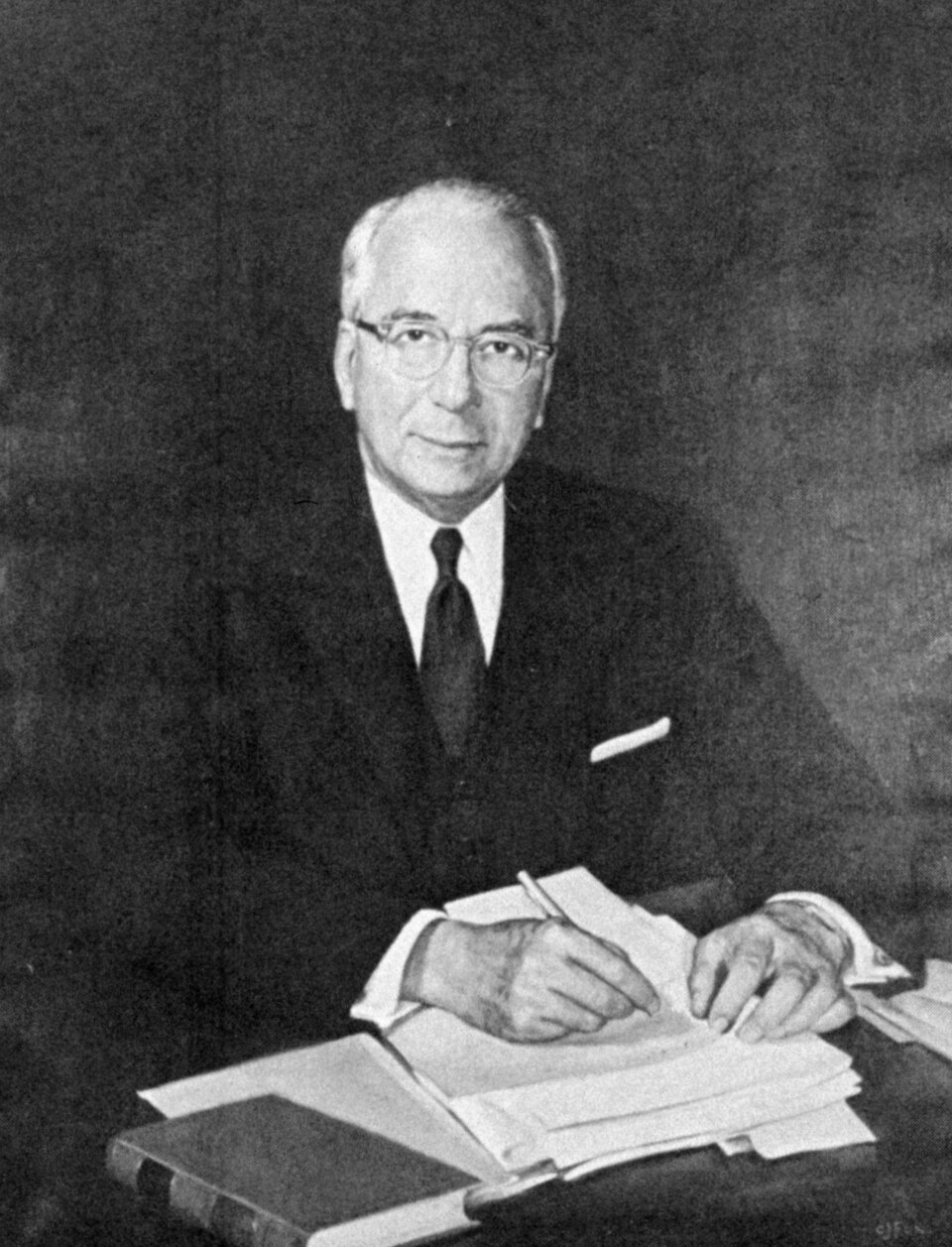
Oppenheimer’s rival was Lewis Strauss, a prominent businessman who sponsored early experiments on radiation and rose to prominence in the Bureau of Ordinance during World War II. Strauss insisted his name be pronounced like “Straws” in the Southern style. Strauss was an out-and-proud Virginian. Strauss served on the Atomic Energy Committee. He didn’t want to share any technology and continue to develop it, especially the hydrogen bomb.

You can buy Greg Johnson’s Is America Doomed? here.
To put it simply, Oppenheimer might have insulted Strauss at a public hearing over sharing radioisotopes with scientists from a friendly country and this started a feud between the two men. The feud is a minor plot in the movie Oppenheimer (2023) and the juicy details of it has been described in history books and podcasts. The Oppenheimer—Strauss feud is an event involving Jews that shows the limits of the Jewish Question. You can “name the Jew” in this case and it doesn’t matter at all. The insults and ugly attacks made by each man against the other are also trivial. The point is there was opposing schools of thought on how to manage a very dangerous, very new technology. We Americans living today can look back upon the affair with calm dispassion and apply what matters to the question of how to deploy a new technology of vital national importance.
Initially, how to proceed with the atomic bomb and its related technologies was merely an academic question, but in 1949, the Soviet Union became nuclear capable. This changed the balance of power in Asia, leading to the Korean War. It also raised the stakes of the Cold War. The Soviets were no longer just a conventional danger, but one with technological capabilities that matched the United States.
The Soviets Get the Bomb
The Soviet Union took advantage of America’s Lend Lease program to the fullest. One of the American officers involved in Lend Lease was Major Gorge Racey Jordan. He was suspicious of the Soviets and kept a careful record of his dealings with them. During an inspection of Soviet briefcases he found correspondence from Alger Hiss to the Soviets as well as maps of important American industrial facilities. His description of the shipment of heavy water—a key ingredient used in the manufacture of atomic bombs—to the Soviet Union has the ring of truth. Jordan wrote,
Records of evidence prove that on August 23, 1943, Hermann Rosenberg of Chematar received an application from the Soviet Purchasing Commission for 1,000 grams of deuterium oxide [i.e. heavy water]. The purpose stated was “research.” A supplier was found in the Stuart Oxygen Co. of San Francisco, which shipped the merchandise on October 30, by railway express, to Chematar’s New York office. Rosenberg forwarded the consignment to the Purchasing Commission in Washington, which dispatched it on November 29, by way of the Pipeline to Rasnoimport, USSR, Moscow U-1, Ruybjshova-22. The order was packed with as much tenderness as if it had been a casket of jewels. Forty Pyrex ampoules, each containing 25 grams, were enclosed in mailing tubes and wrapped in layers of cotton. The ampoules were divided in lots of 10 among four cartons, which were placed, with further precautions against damage, in a large wooden box.
After the fall of the Soviet Union in 1991, historians reviewed the Soviet archives and found that what Major Jordan claimed was in the Soviet Bolsheviks’ version of the Lend Lease records.
The Soviets were also aided by the top scientists working on the atomic bomb in the United States. These spies were led by Klaus Fuch, a Lutheran German immigrant. Most in the ring were Jews. While there was espionage, the spies were greatly aided by a vigorously maintained supply route which ran from the United States to the Soviet Union and operations were kept running smooth by Harry Hopkins, a Heritage American who was working directly for President Roosevelt. The secrets of AI that will be of vital national importance in the future have probably already walked out the door, aided by someone like Harry Hopkins. What is that secret and where did it go? Time to find out.
Atoms for Peace—America’s Most Idiotic Program
General Eisenhower was elected President in 1952 and Lewis Strauss, a Republican, was made the Chairman of the Atomic Energy Commission. In that capacity, he shifted from his develop and not share position to develop and share. The Eisenhower administration developed hydrogen bombs to the point that they were too destructive to be useful for anything but deterrence. Meanwhile, Eisenhower was motivated by his religious heritage—a Pennsylvania Dutch form of Quakerism called Pietism—to share atomic technology for peaceful ends. The thinking was that atomic energy would reduce scarcity which would reduce war.
Atoms for Peace turned out to be one of the Eisenhower administration’s biggest blunders. The technology to make atomic reactors went everywhere and that technology could be improved upon by those who got it without any American help. Israel got the bomb through Atoms for Peace. India and Pakistan both developed nuclear weapons from the initial Atoms for Peace technology transfers. Iraq’s nuclear program was a lie in 2003, but that nation did receive Atoms for Peace support from the United States and Iraq did build a reactor that was bombed by Israel in 1981. Iran got its nuclear program from Atoms for Peace and that is partially why we are at war with them as this article goes to print.
As far as AI technology is concerned, Lewis Strauss’s initial position was correct. Develop the technology to its furthest useful ends, but don’t share any of it. Any AI data center in Israel will be compromised from the get-go. The Israelis are known bad-faith actors, and they are but one of a raft of America’s “greatest allies” doing shifty things. Keeping AI technology entirely within the United States might not be possible, but it is worth a try.
AI & the Rust Belt
Atomic weapons contain ingredients—yellowcake, heavy water, powdered nickel—that can be tracked and intercepted. AI’s bottlenecks and ingredients are not fully understood and there might not be a study on AI’s requirements which can be grasped by a senior government official at the cabinet level at all. Nonetheless, it is known that there needs to be two things to make AI function: A data center containing the servers and the workers within, and a steady source of power.
A great deal of power. Artificial intelligence is a ravenous consumer of electricity.
This makes any place in the American Rust Belt with a pre-existing hydroelectric infrastructure a great spot for data center development. The ruined factories near the hydroelectric dams in Upstate New York are perfect spots for a collection of data centers. In such places, data centers can be built where there are pre-existing towns, roads, and schools. There are also decent spots in other parts of the Rust Belt as well as in the Prairie States.
All data centers are military targets. The Iran War has shown that a second-rate power can deliver precision rocket attacks on a stationary target with ease. A way to deter an attack is to develop easy-to-move riverine data centers. Put them on a riverboat that can travel along the inland waterways of the United States. The floating data centers can be connected to the network through a variety of communications channels, but primary through pre-built hookups at the various riverboat stops—Cairo, Illinois, New Boston, Ohio, and Huntington, West Virginia, for example. They can be powered by new modular nuclear reactors, none of which are like the ill-designed Chernobyl. If data centers can move, why bother to attack the stationary ones or their power sources?
America has had a run of letting her technological advantages slip away. In the 1950s, the Japanese took over the radio market by adopting and improving upon the transistor radio. The Japanese are but one of many nations that have done this action. The crisis of deindustrialization goes back to the early Cold War, when what do to with atomic technology was the primary issue of the day. Everything in this article is a simplified version of what happened, but it is accurate enough to provide guidance today.
14 comments
One of the chief criticisms of AI data centers is that they spike the cost of electricity and water for the surrounding community. Given that Big Tech are sophisticated actors, they know that they are effectively forcing the locals to subsidize their data center’s utility bill.
Resistance to new data centers should continue until Big Tech pays for the higher cost of utilities caused by pre-existing data centers, to include interest and tax consequences.
Interesting, but in the list of nice sites for AIDCs the author neglected the northwest. Many existing DCs were built along the Columbia River because of the abundant cheap power. Naught has changed other than the glowing red leftest slime trail of Washington State. But, Idaho calls! Further, the idea of handing the jews a prize as potentially valuable as that discussed is ludicrous in the glaring light of who was responsible, as an ethnic group, for the SovUn getting, or developing, the bomb. Whoever pushes on that rope should be hung with it!
Great article. I watched Oppenheimer, a somewhat, overly long, dull, but informative movie. 🙃
I noticed that in the (somewhat disappointing) movie Oppenheimer, that the one Soviet Atom Spy that they mentioned was the only Gentile, the German-British Communist Klaus Fuchs.
They did not even mention the Rosenbergs, who had been executed in the electric chair the year before Oppenheimer’s security hearing.
I was disappointed by Nolan’s Dunkirk movie too.
🙂
The new politically-correct and vibrant The Odyssey by Nolan should join your list of disappointments. Lupita Amondi Nyong’o as Helen of Troy?!? I can’t even…
I wouldn’t be surprised if C-C does a review of that film when it comes out in July. I and other commentators have mentioned it lately. It is obviously propaganda meant to obscure European mythology. Like I said recently, it would be good if that film flops.
I am planning to write an essay explaining why I will not be watching or reviewing. Basically: I know the story already. The only reason to see it is to appreciate how the story is treated. And this treatment is a desecration.
“Lupita Amondi Nyong’o as Helen of Troy?!? I can’t even…”
She has the face that sank a thousand ships.
The data centers are clearly coming regardless of what White Nationalists think about them, but I’m not so sure they will benefit us. Even if the environmental concerns are overblown, an AI surveillance state run by an alliance between Big Tech and the Military Industrial Complex does not sound promising for dissidents.
Dave Chambers: May 21, 2026 The data centers are clearly coming regardless of what White Nationalists think about them…
—
Jew-owned Big Tech tried to put one of their data centers on a 50-acre tract here in Mountain City in our rural Upper East Tennessee county. They’ve targeted relatively inexpensive rural land in Johnson and neighboring counties but, thankfully, have met with effective resistance.
I was proud to see the scheme defeated by our locals, not because it was a Jew-run AI/crypto mine op, but because of noise and high electricity and water usage. It helped when it was exposed that Big Tech Jews had secretly hired a City Council member to help make their case and he did not bother to disclose to his fellow council members or to his neighbors that he’d sold them out for a few dollars.
As long as IQ>threshold, clear technological advantage will be transient. You can get a leg up technologically for a while, but it’s not going to be forever. Information is hard to lock down for too long.
It’s an interesting question, about ‘squashing tech’. There’s tech I would squash, but not really with a view to maintaining some advantage, but because it’s garbage.
How much Atoms For Peace would matter in the long run, it’s hard to say, because ultimately the process doesn’t belong to Atoms For Peace, we’re just dealing with properties of the physics. It seemed to be more a factor for India rather than Pakistan. You can delay stuff, but not sure you can’t stop stuff.
If the idea is the new cold war is each side keeps building ever more powerful AIs to get some technological trajectory advantage for military or business while trying to maintain no data leaks it’s probably a waste of resources for all concerned, just like the US and the USSR building ever bigger bombs.
Out of curiosity I asked an AI this question, “How long could a major military advantage gleaned via AI be kept secret or before a competing AI discovered the same thing?”
It put it at 12-24 months, but if it was used in time it could be important. It also said a major advance in tech trajectory could be as short as months”.
What is the US going to do with a transient technological advantage gleaned through AI ? Attack China or Russia. Great. Make more AI diversity movies to export. Great.
If there was an implication there is a Chicom conspiracy to stop the US building data centers laundered through the left, I think that’s misunderstanding the issue. We’re at a point where there’s a genuine grassroots and also intellectual concern about runaway, unaccountable, opaque not-asked-for tech being rolled out as if it were the new normal. We got a small glimpse of this with 5G in European countries. But the implications with AI are far greater. Also the local energy costs mentioned by commenters. This is an elite top-down operation.
We’d be better off with a global consensus about AI, and a wind down from the hype and arms race type thinking. I suspect AI overall commercially is likely a bubble and as the novelty wears off, as we get a good idea about how many white collar jobs it displaces, as fatigue sets in, we’ll see a big correction of AI’s value.
Its real value in terms of quality of life for normal people is probably a fraction of its value on paper today, in fact it’s more likely a negative number. It’s a big positive number for elites and corporations, it’s negative for everyone else.
Excellent, well argued essay.
I wish I could simply agree with it. But unless we have a “Butlerian Jihad,” or totall civilizational reset, I believe our people are doomed.
Lawrence Douglas Fink is the Jew behind Blackrock, the largest money management fund in the world, with its $17,000,000,000,000-plus war chest (according to CBS 60 Minutes). That’s trillion with a “T”. What’s a puny $1 billion to a trillionaire Jew?
Over 1,000 signatures collected against Lowndes County
data center ahead of Tuesday commission meeting
Craig Monger 1819News| 05.26.26
The 800-acre project, called Project Red Clay, is spearheaded by the Houston, Texas-based developer Cloverleaf Infrastructure. The project is slated to carry a $1 billion price tag. The project is being painted as an economic boon for the area and its residents. However, like with many such communities across the nation, residents are expressing concern.
Though the project is in its infancy, residents have raised objections to potential environmental impacts, effects on the area’s infrastructure and rising energy costs.
A website called 45 Strong, which started in opposition to the project, claims that while Cloverleaf does not build, own or operate data centers, it will eventually hand them over to an unnamed hyperscaler. It acknowledges that Cloverleaf has not yet officially requested a tax abatement.
“Cloverleaf has not publicly identified the operator-tenant, and would not be the owner long-term in any case,” the site reads. “Their pattern in Port Washington, Wisconsin, was to assemble the land and then hand the project to Vantage Data Centers for an $8 billion campus build. Whatever Cloverleaf promises, Lowndes will be inherited — or not — by whichever hyperscaler eventually owns the asset.”
* * * * *
COPILOT gives the connection between Fink and Cloverleaf that 1819News.com doesn’t:
Cloverleaf Infrastructure is a Houston based company founded in February 2024 by three energy veterans. The company is focused on developing large-scale clean-powered data center sites and has secured significant funding to support its growth. While Larry Fink is not directly associated with Cloverleaf, he is a prominent figure in the energy sector as the co-founder and CEO of BlackRock, a major investment management firm.
—
Will Williams: May 21, 2026 Jew-owned Big Tech tried to put one of their data centers on a 50-acre tract here in Mountain City in our rural Upper East Tennessee county, but, thankfully, have met with effective resistance.
I was proud to see the scheme defeated by our locals, not because it was a Jew-run AI/crypto mine op, but because of noise and high electricity and water usage. It helped when it was exposed that Big Tech Jews had secretly hired a City Council member to help make their case and he did not bother to disclose to his fellow council members or to his neighbors that he’d sold them out for a few dollars.
Update on data center controversy in Alabama. Residents worry about all sorts of environmental impacts except the biggest one: which multi-billionaire Jews will control data centers once built.
A racially responsible researcher other than myself can investigate Big Tech Jew money behind these data centers, starting here with Vanguard: Vantage Data Centers: Hyperscale Campus Builder | Data Centre Magazine
The Texas project follows Vantage’s involvement in the Stargate expansion. In October 2025, OpenAI, Oracle and Vantage announced plans to develop a data centre campus outside Milwaukee in Port Washington, Wisconsin, with four data centres providing close to a gigawatt of AI capacity, scheduled for completion in 2028.
‘This is not a Democrat or a Republican issue’:
Dem lieutenant governor candidate Phillip
Ensler calls for data center moratorium
Craig Monger 1819News.com 06.01.26
State Rep. Philip Ensler (D-Montgomery), the current Democratic nominee for lieutenant governor, is proposing a moratorium on all data center construction in the state, citing concerns that special-interest influence is overwhelming citizens’ choices.
Data center construction has become a hot-button issue across the nation, and the controversy has reached Alabama. With the proliferation of AI-powered technologies, the infrastructure needed to house the hardware powering them has also skyrocketed.
Scheduled constructions for the centers have increased exponentially in recent months, with several planned in Alabama…
Ensler, who won the Democratic nomination for lieutenant governor in last month’s primary election, has now made placing a moratorium on data center construction part of his campaign.
“Alabamians should have a vote on whether they want to have a data center in their community, in their back yards,” Ensler continued, “I was in Lowndes County last night, and I hear from residents all over that are concerned about the impact of data centers on their utility rates and their electricity. They’re concerned about the impact on access to clean water. They worry about the impact on their land, and farming, and agriculture. And they’re worried about the impact on their overall quality of life, and what it means for their community.”
He continued, “This is not a Democrat or a Republican issue. This is about putting Alabamians first, and standing up to special, powerful interests.”
Will Williams: May 26, 2026
Lawrence Douglas Fink is the Jew behind Blackrock, the largest money management fund in the world, with its $17,000,000,000,000-plus war chest (according to CBS 60 Minutes)…
* * * * *
“Cloverleaf has not publicly identified the operator-tenant, and would not be the owner long-term in any case,” the site reads. “Their pattern in Port Washington, Wisconsin, was to assemble the land and then hand the project to Vantage Data Centers for an $8 billion campus build. Whatever Cloverleaf promises, Lowndes will be inherited — or not — by whichever hyperscaler eventually owns the asset.” …
Cloverleaf Infrastructure is a Houston based company founded in February 2024 by three energy veterans. The company is focused on developing large-scale clean-powered data center sites and has secured significant funding to support its growth. While Larry Fink is not directly associated with Cloverleaf, he is a prominent figure in the energy sector as the co-founder and CEO of BlackRock, a major investment management firm.
If you have a Subscriber access,
simply login first to see your comment auto-approved.
Note on comments privacy & moderation
Your email is never published nor shared.
Comments are moderated. If you don't see your comment, please be patient. If approved, it will appear here soon. Do not post your comment a second time.