 3,025 words
David E. Sanger
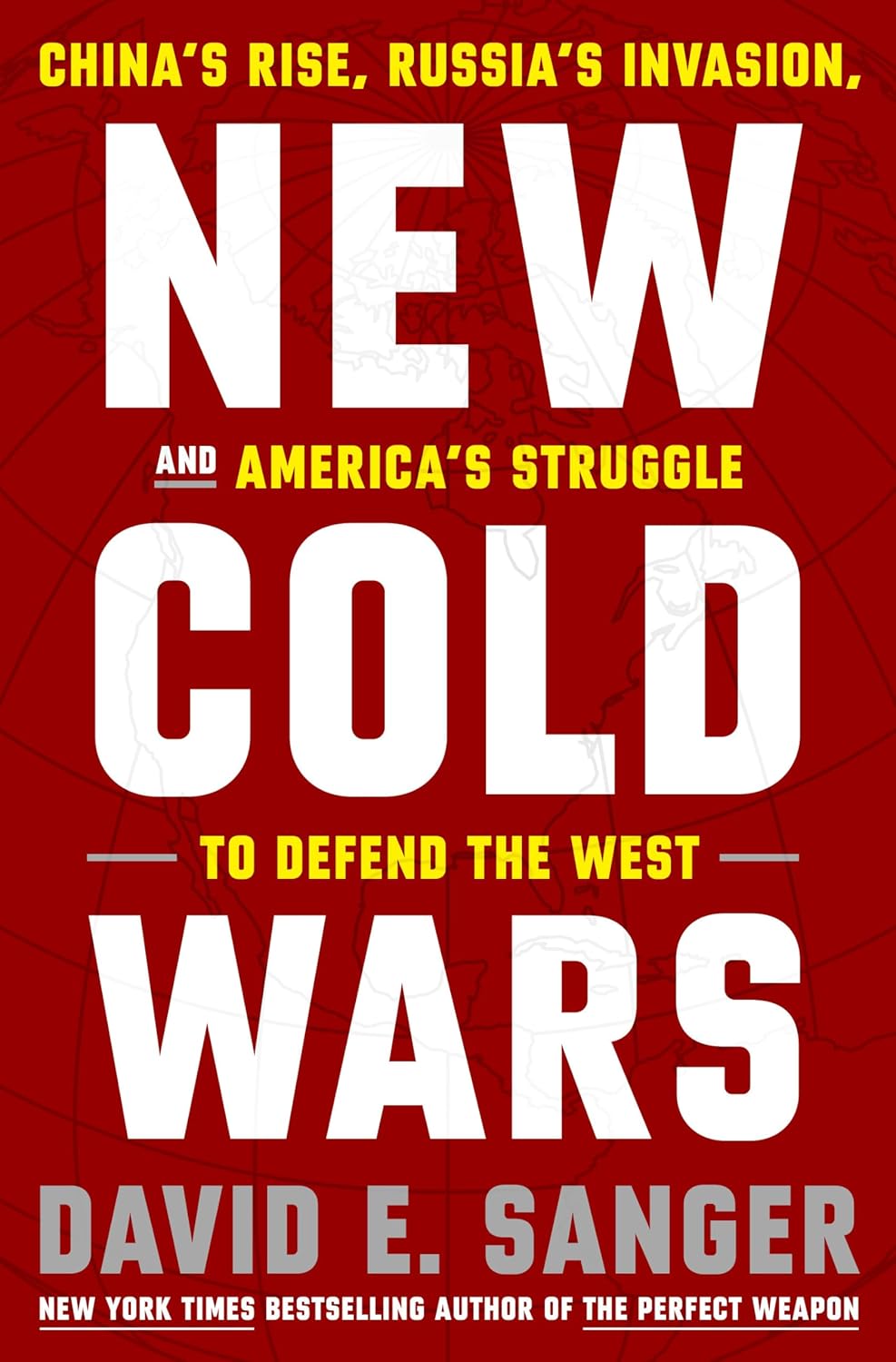
New Cold Wars: China’s Rise, Russia’s Invasion, and America’s Struggle to Defend the West
New York: Crown, 2024
The Second Cold War has started. This simmering conflict is one in which Russia and China are united against Western Civilization in general and America more specifically. This situation developed day by day underneath a sky of optimism that existed internationally in the 1990s. For three decades it has been unthinkable that any nation would deliberately seek to return international politics to a place where major warfare between blocs was a possibility, and yet, here we are. How did this occur? David L. Sanger explains,
Each president claimed he had achieved meaningful progress toward integrating America’s adversaries into a world order Washington had created and nurtured for seventy-five years. Clinton brought China into the World Trade Organization. Bush [43] made Beijing and Moscow uneasy partners in counterterrorism. Obama struck an arms control treaty with Putin and a climate change agreement with Xi. Obama boasted that Russia and China joined the West in negotiating the 2015 nuclear deal with Iran and were episodically helpful in reining in North Korea. Trump finally struck a modest trade deal with Xi in 2020. Each new bond was trumpeted as a major win, as a sign the world’s most powerful nations were rowing together. (pp. 19-20)
Unfortunately, the recent history of China and Russia have shown there was never any “rowing together.” It turned out that every assumption across the various post-Cold War administrations regarding Russia and China were wrong. One of Biden’s closest advisors told Sanger the members of Biden administration thought,
“The internet would bring political liberty. Trade would liberalize the regime” while creating high-skill jobs for Americans. The list went on. A lot of it was just wishful thinking. Much of the rest was oversold, part of what became known as the “Washington Consensus” that globalization was, on balance, the pathway to economic growth and political stability, despite the evidence that middle-class workers, not tech entrepreneurs, were its primary victims. Or that economic interdependence was no guarantee that countries would restrain their instincts to take power or land or disrespect human rights. “I was as guilty as anyone else,” the advisor concluded. Eventually, we reached the point at which the cognitive dissonance – between the future we expected and the reality we confronted was too big to ignore. (p. 20)
Throughout the 1990s, Russia, the United States, and NATO cooperated during the Yugoslav Wars, and in the aftermath of 9-11, Russia seemed to be a complete ally—to the point of sharing intelligence data regarding Afghanistan as the Americans invaded the country. Russian officials were invited to be partners in various NATO operations. When President Bush and Putin met on a boat on the Neva River in 2002, they were cordial. Those good feelings were due to the sense of a shared mission—a campaign against Islamic terrorists. “But,” writes Sanger,
as the years wore on, the bonhomie began to fade. The terrorism concept worked, but only if it wasn’t examined too carefully or for too long. Bush thought he was doing Putin a favor by cleaning up Afghanistan, a country the Soviet Union had invaded and then, in a humiliation that would portend others to come, retreated from. Putin thought he was entering into an equal partnership with the United States that would restore Russia to the global superpower status it had enjoyed before the collapse of the Soviet Union.
Yet it soon became clear that everyone had a different definition of who was a terrorist and what to do about them. Bush’s problem was al-Qaeda and its ilk, but for Putin, terrorism was about the Chechens – a Muslim ethnic group from the Caucasus Mountains. The Russians, like the Chinese, wanted to designate their most disfavored minorities as “terrorists,” thereby opening the door to dealing with them however harshly the regime desired. Then came the Iraq War. Putin had vehemently opposed the unilateral invasion and rejected outright the concept that by ousting Saddam Hussein the West would be ridding the world of a safe harbor for terrorists. (p. 34)
The Kosovo War’s Aftereffects
The problems started to appear during the Kosovo War of 1999. The Russians were enraged by the ease in which B-2 bombers taking off in Missouri struck targets in Serbia. Additionally, Russians across the steppes also felt sympathy towards the Eastern Orthodox Slavs under an attack made by “Germanic” Western Christians. Americans working with the Russians at the time also noticed that while the senior officials had reconciled themselves to the collapse of the USSR, the young Russian men in the Russian military or government were furious at the loss and looking to turn things around.
You can buy Greg Johnson’s Against Imperialism here.
As those young Russians moved into more senior ranks, Russian activity became more aggressive in Eastern Europe. Sanger is frank about the warnings made by Americans in the early 1990s about the dangers of expanding NATO eastwards. Many Russians were motivated to act aggressively due to the expansion of NATO. These Russians felt that they’d been lied to by the Americans, who they claim had promised to not expand the alliance during the reunification of Germany. The Russians were also disheartened by the ease in which the countries in their “near abroad,” Georgia and Ukraine, were flipped to the Western side by “color revolutions.”
The Russians did acquire Eastern Orthodox Russian-speaking populations in the Donbass and Crimea during the invasion of Ukraine in 2014, but the attack was based on envy rather than a desire to liberate people from one civilization within the frontier of another. This envy might have been the primary motivation for the full-fledged attack on Ukraine in 2022. Envy is an emotion that is so toxic that a person or society in its grip cannot be reasoned with.
Russian society is so corrupt that no one Russian bothers to be fully truthful to another. Fiona Hill points out that Putin aligns his government’s actions very closely to his personal financial interests. The rot extends to mid-level Russian government officials. The retired CIA Officer Sean M. Wiswesser ratifies this thesis in his book, Tradecraft, Tactics, and Dirty Tricks: Russian Intelligence and Putin’s Secret War (2026). He shows that Russian diplomats and intelligence officers stationed abroad spend a great deal of time dealing on the black market. There is also a culture of unnecessary humiliations dished out to low-ranking government officials—causing further churn. Many key defectors went to the West after suffering such insults.
The ethnic groups from the places to the west of modern Russia’s borders—Finns, Poles, Jews, Ukrainians, and Russian-Germans all have a burning hostility towards Russians that is difficult for those of a Western European background to fully grasp until the cruelty and corruption is explained, and even then, Americans and Western Europeans don’t really get it.
The Russians were fully hostile to America before the 2016 election. Putin personally hated Hillary Clinton and organized a disinformation campaign that was designed to damage her specifically. Hillary didn’t win in 2016, but the Russian disinformation campaign was ultimately able to hurt whoever won the 2016 election. Obviously, it worked. Sanger blames the furor surrounding the “Russian hacking of the election” during Trump’s first presidency on the Russian government but the liberal media where he works fed into the chaos throughout Trump’s first term. Putin also hates Victoria Nuland, a (now retired) Jewish US State Department official who is extremely anti-Russian. Putin’s intelligence officers bugged her telephone calls and released the recordings of her salty expressions and frank statements to embarrass her and the US State Department.
Russians had also launched a cyber-attack on the Colonial Pipeline. This shut down the flow of gas and caused the panic buying of gas in 2021. Commercial firms in America were not serious about cybersecurity and therefore an easy target. Officially, the hackers were “criminals” who “happened” to be located in Russia, but it is certain that this was a Putin-sponsored affair. The Russians also shaped the strategic environment with the Nord Stream 2 Pipeline that delivered Russian fuel directly to Germany. Trump had warned the German government in 2018 that the pipeline altered the balance of power in Europe to the point that war in Ukraine was possible, but he was laughed at by the German diplomats.
Trump’s warnings were unheeded, but so were Biden’s. The latter president had a “motherlode” of solid intelligence about the pending Russian attack but the European Union and the Ukrainians didn’t listen. The “motherlode” which Biden had was coming from a variety of intelligence gathering capabilities which had remained in place even after the Cold War ended. These systems picked up the Russian military build-up and American intelligence officers were able to recognize the Russians’ intent to invade in advance. Additionally, the Russian military deployed with every soldier using a cell phone which showed up on the Ukrainian telephone network. They also freely communicated plans with their cell phones. Even with so much warning the attack still took the Europe by surprise.
Free Trade Summons the Dragon
Trump was the first president to state very frankly that China was a threat. He had the freedom to do this because his political base was from the Rust Belt and the people there knew all about deindustrialization and fentanyl. The story of the latter scourge starts with Perdue Pharma selling Oxycontin—basically a form of opium—to middle America. Perdue Pharma was owned by a Jewish family and there was an ethnic hostility to it all. However, by Obama’s second term, Perdue Pharma had collapsed due to lawsuits and government pressure. Chinese firms then stepped into the void, selling fentanyl and other opiates as a form of vicious and excessive racial revenge. The Chinese opioid attack is worse than that of Perdue Pharma. The drugs are more powerful and transported across clandestine smuggling networks that must be puzzled out before they can be shut down.
The former problem, deindustrialization, started in the wake of the Tiananmen Square Massacre, wherein “pro-democracy” protestors were killed by the Chinese army. It is a question if the protesters would have created a genuine democracy or their if movement would have kicked off a generalized collapse and civil war in China. Regardless, immediately after the massacre, then President George H.W. Bush reached out to the Chinese government with a message of goodwill. The Bush (41) administration wished to engage with China economically despite the recent blood-spilling.
In 1989, China’s economy was flat, its people still reeling from the disorder and starvation of Maoist social theory taken to its fullest extent. The new Chinese leadership was seeking to make an economic change. They worked with the Clinton administration to increase trade between the two nations. One of the key Chinese visionary leaders was Zhu Rongji. Sanger writes,
Zhu was adept at playing American power games – sometimes to the shock of his interlocutors – and he wanted a quick deal. So when he realized in the spring of 1999 that President Clinton was slow-walking the negotiations because of opposition on Capitol Hill, Zhu took to the road. In a five-day tour, he visited Denver, Chicago, New York, and Boston to persuade American business leaders who wanted to enter the Chinese market to put the hard sell on their own president. It was a remarkable scene: a Communist Party leader in the den of American capitalism, whipping votes. It worked – the administration was flooded with angry emails and phone calls from top executives. (p. 59)
Charlene Barshefsky, the American trade negotiator finalized the deal with China in 1999. Sanger interviewed her and wrote afterwards that,
China would permanently normalize trade relations – and the United States would support China’s WTO bid. Barshefsky gave the credit to Zhu: “I don’t think I knew another leader like him,” she told [Sanger] in 2023, “because he took it upon himself to modernize the Chinese economy, even in the absence of strong political backing.”
In the years after, China grew at an unbelievable rate. By 2007, per capita GDP had nearly tripled to $2,694; by 2017, it had tripled again, to $8,817. But Zhu was hardly hailed as a hero when he retired in 2003 – the domestic financial and economic reforms he championed within China shocked the economy. Chinese families poured their savings into a booming stock market, then were wiped out by the predictable crash.
There were looming fears of a Japanese-style banking crisis. Millions were lifted out of poverty – while others lost their jobs as state-owned enterprises were gutted. The suddenly wealthy class of private entrepreneurs driving BMWs and Mercedes around the streets of Beijing and Shanghai underscored the wildly unequal distribution of gains. (p. 60)
The normalized trade deal freed capitalists, like Jack Welsh of General Electric, to increase the value of their respective companies’ shares on the stock market by closing factories in America and reopening them in China where labor rates were cheaper and health, environment, and safety regulations non-existent. Those who warned about the problem, like Pat Buchanan, were sidelined.
While American executives basked in the shortsighted glow of their free trade success, Chinese leaders thought very hard. Bush (43) was frustrated because,
…China pursued a strategy of pegging its currency to the dollar at a clearly undervalued level to make its exports cheaper. That helped cement its hold over critical supply chains – as Americans would discover in 2020, when they started looking for medical masks in bulk. While some Chinese markets opened, China’s trade surplus which the United States surged in the Bush years – far beyond the Japanese surpluses that were viewed as such a crisis in the 1980s. (p. 63)
By the end of the younger Bush’s dismal presidency, the Chinese warned the Secretary of the Treasury Hank Paulson that they “would not be deferential.”
China & Russia Together
Liberal Democrats warned about Russia. Only the American Far-Right warned about China. Both were right, however. Russia and China are arranged against the Americans. The situation has the potential to shift from bad to far, far worse overnight.
January 6 was not an unprecedented political protest, but both China and Russia were inspired by the disorder to act. Sanger writes,
The Global Times – China’s English-language propaganda sheet that can be counted on to turn any adverse event in the United States into an object lesson on the evils and inconsistencies of democracy compared the storming of the Capitol to the Hong Kong prodemocracy protests of 2019. It all played to the Russian and Chinese narrative that American democracy is not a viable governing system; it is chaos. Tellingly, though, American intelligence officials quickly noticed that the Russians and the Chinese exploited the moment differently. The Russians took the imagery of the mayhem and broadcast it around the world in an effort to undercut the American brand and heighten American embarrassment. In contrast, the Chinese broadcast the imagery mostly at home, in an effort to undercut the lectures from American presidents during visits to Beijing. The implication was clear: The American model would undo all the progress that China had made over decades to modernize its economy, elevate its populace from poverty; and unify its people ideologically. This opportunism was blatant. But clearly there was more than a kernel of truth in the accusations streamed by authoritarians around the world. (p. 126)
Restoring Deterrence
One of the key industries that allows Americans to deter both China and Russia, plus their wider BRICS network, is computing technology, which requires microchips. Currently, the manufacture of microchips involves two key areas: The first is a firm in the Netherlands which manufactures, to put it simply, the machine tools that carry out the fine etching required to make a microchip. The second is the manufacturing plants that are in Taiwan.
There is a Great Replacement aspect to Taiwan’s microchip industry. A Chinese immigrant to the United States who was educated at Harvard and MIT named Morris Chang, became frustrated with his job at Texas Instruments and went to Taiwan where he made a pitch to Taiwanese notables to set up shop locally. When he gave the estimated cost, although extraordinary, nobody flinched. Chang was in business.
As a result, Taiwan is an essential nation in the global economy. This nation is also bitterly divided internally between those who wish to rule both Taiwan and Mainland China and those who want independence. For their part, the Communists ruling Mainland China are willing to conquer Taiwan should the opportunity arise.
China has the ability to crush the global computing industry by disrupting Taiwan’s industry and supply routes with its enormous navy. The threat is not idle. Ordinary supply chain disruptions during the COVID pandemic led to a microchip shortage. Vehicles sat in factory lots awaiting chips. Humble dishwashers and washing machines also need microchips. In the event of a crisis, a deliberate microchip shortage could prove fatal. Reshoring this industry is therefore a key requirement to re-industrialize.
Turning this situation around means that Americans must address several related problems. The first is the immigration catastrophe—the 1965 Immigration Act must be replaced with a law that declares America settled and civilized territory. Then, the hard work must be done to reverse the Great Replacement. Americans must also eliminate the 1964 Civil Rights Act and its follow-on bits of laws and rules. The inability to “discriminate” against people is part of the reason why so many people of Chinese origins have access to top drawer government secrets or proprietary industrial blueprints. Those are the people getting the secrets to China.
The crisis is here. Now is not the time to blame the problems on the “Boomers”—they’re old and we will miss them when they are gone. Now is the time to seek out opportunities. To find work and work hard. To use one’s savings to invest at home. Build up one’s community.
This book has a weakness, however. It ignored Joe Biden’s declining mental acuity and poorly chosen staff. This situation mattered. The Chinese and Russians advanced because a large part of the Democratic Party is given over to ideologues who give tampons to teenaged boys in school and low IQ groups. One of the best ways to advance the goals of any enterprise is to staff it with good people. Which they did not.
5 comments
The whole thing reads like propaganda dressed up as objective analysis.
The notion that Russia and China will work together in any meaningful sense to advance some strategic foreign policy enterprise is laughable. The relations between the two countries are at best a marriage of convenience, formed by a mutual sense of defense against a United States that is hostile towards them. China has historical grievance against Russia that is still unaddressed on an emotional level but is kept in check by the Communist Party for domestic political purpose. Russia is increasingly uncomfortable of a China that has eclipsed it on almost every level. The organization that symbolizes the cooperation between the two countries, the Shanghai Cooperation Organization (SCO), is filled with maneuvers that belies the lack of trust between the two countries. As years passed, Russia pulled in India to dilute China’s influence. China countered by inviting Pakistan to cancel out India. China is trying to build a railway running through Tajikistan to Europe, bypassing Russia. Russia is trying to thwart China’s project by pressuring the relevant countries.
“Russia is increasingly uncomfortable of a China that has eclipsed it on almost every level‘: that statement applies to all nations in the whole world. If Russia is uncomfortable’, what are the feelings of US, Germany, UK, India, Japan, etc…?
The rational policy requires balancing, that is obvious, but Russia doesn’t seek to dominate China or China doesn’t seek to dominate Russia. They want to trade with benefits to both countries. US on the other hand, wants to dominate and control. Unfortunately or fortunately, depending on your point of view, US is too weak to stop that process, but if it pursues its objectives, it itself will be targeted for termination. The faster US reaches accommodation with China and Russia, the better for us all.
This David E. Sanger is a Jew and chief correspondent of the New York Times. So of course China and Russia are the bad guys and the US the good goys, who do what the Jews tell them to do. A defeat of the US is a defeat of the Jews and to be celebrated.
Ukraine is even more corrupt. Jews are upset because they were restricted to the pale tor good reason. Poland needs to develop an economy beyond low wage German industrial platform and free EU and wage transfers.
russia has bare minimum security concerns. The libertarian economic model forced on Russia just accelerated the rot. We will all be there someday.
incidentally, I am seeking a Russian wife because the free cash and emigration to the west is still too strong for Eastern Europeans. All the countries have been subsumed in a fait accompli to judeo Anglo west.
at least my wife will have some traditional values.
If you have a Subscriber access,
simply login first to see your comment auto-approved.
Note on comments privacy & moderation
Your email is never published nor shared.
Comments are moderated. If you don't see your comment, please be patient. If approved, it will appear here soon. Do not post your comment a second time.