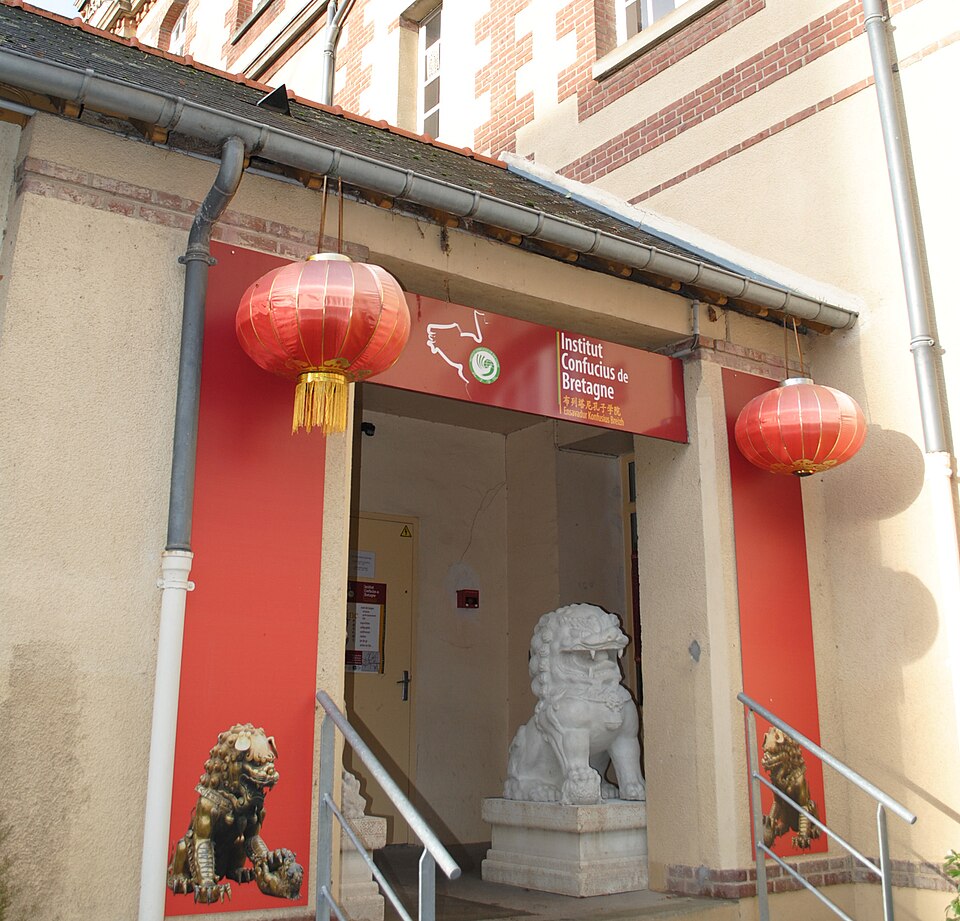
A Confucius Institute, courtesy of Wikimedia Commons.
2,278 words
Americans have grown increasingly alert to the machinations of foreign powers. Qatar’s funding of university campuses, the reach of the Israeli lobby, Saudi Arabia’s investments in media and sport: these are debated loudly in Congress and across cable news. The scrutiny is warranted. Yet one foreign power, arguably the most consequential geopolitical rival the United States has ever faced, has managed to embed itself far more deeply and systematically into Western economies, institutions, and political life than any of the others, with comparatively little public attention. That power is China. And unlike the influence operations of Gulf states or European lobbies, which tend to cluster around specific industries or policy questions, China’s approach is holistic, a coordinated, multi-front strategy that targets agriculture, education, political donations, media, and academic research simultaneously. Its ambition is not to win a particular argument. It is to shape the environment in which arguments take place.
Before one can grasp why China has invested so heavily in American agriculture, it is necessary to first understand the scale of China’s domestic food crisis. China holds somewhere between 7 and 9% of the world’s arable land while feeding nearly 20% of the global population. As of 2018, China had approximately 294 million acres of farmable land to sustain 1.4 billion people, while the United States, with less than a quarter of China’s population, has over 375 million acres. That disparity is worsening. Rapid industrialization has eaten into Chinese farmland for decades, and a joint government report from 2014 found that 19.4% of China’s agricultural land, around 64 million acres, had contaminated soil, with heavy metal pollution alone destroying approximately 10 million metric tons of grain every year. These are not minor inconveniences, but civilizational vulnerabilities.
Faced with a problem it cannot solve at home, China has gone abroad in pursuit of solutions. The most dramatic example of this strategy is the 2013 acquisition of Smithfield Foods, the largest pork producer in the United States, by Chinese company WH Group, backed by a $4 billion loan from the state-owned Bank of China. The deal gave a Chinese entity control of more than 146,000 acres of American land, spread across North Carolina, Missouri, Virginia, Utah, Colorado, and Oklahoma, along with hog farms, processing plants, and feed mills. Since then, WH Group has systematically expanded its American footprint, acquiring grain elevators in Ohio and cutting out American farmer-owned cooperatives that had supplied its feed mills for decades. Chinese holdings of American agricultural land surged from 13,720 acres in 2010 to 352,140 acres by 2020.
Troubling as the economic dimension is, the environmental consequences are equally serious and less reported. Raising hogs on an industrial scale produces vast quantities of waste, typically stored in open-air lagoons that emit toxic chemicals and leach into local water supplies. North Carolinians living near clusters of industrial swine operations, including those run by Smithfield, suffer higher rates of sepsis, kidney disease, tuberculosis, and infant mortality, and children attending nearby schools more frequently experience asthma. Smithfield’s own research identified more environmentally sound alternatives in 2013 but chose not to implement them, citing cost, while WH Group has deployed more advanced biogas digesters at its Chinese farms. American rural communities are, in effect, absorbing the environmental costs of Chinese pork production.
Beyond land and livestock, China has targeted another layer of American agricultural strength: the intellectual property embedded in genetically modified seeds. A single hybrid seed can cost up to $30 to $40 million to develop, and these technologies represent a strategic advantage, the precise tools China needs to address its food security crisis. In documented cases, Chinese actors have simply stolen them. For example, a Chinese scientist was convicted in 2016 of stealing genetically modified corn seeds from test fields in Iowa. Similarly, a former imaging scientist at Monsanto pleaded guilty in 2022 to economic espionage, admitting he transferred a proprietary algorithm to a memory card and attempted to carry it to China for the benefit of the Chinese government. These are not isolated incidents. Moreover, experts have warned that China’s accumulation of genetic data on American crops creates the theoretical possibility of engineering biological agents capable of targeting specific GM crop varieties and devastating entire harvests.
Furthermore, agricultural penetration, it turns out, has an instructive parallel in the domain of education. The surface-level comparison between China’s Confucius Classroom and Confucius Institute programs and Western equivalents, France’s Alliance Française and Germany’s Goethe-Institut, is deliberately misleading. Western programs constitute independent nonprofit organizations based within civil society. They reflect national interests without imposing ideological obligations on their hosts. China’s Confucius programs operated on an entirely different basis. American universities hosting Confucius Institutes were subject to contractual obligations requiring them to uphold and defend the reputation and image of the Institutes, under threat of legal action. Contracts empowered China’s Hanban bureau to sue directors or teachers who developed lessons without prior clearance. No equivalent arrangement has been documented for any Western-sponsored language programme.
Remarkably, Chinese officials described the political purpose of these programmes with little attempt at concealment. In 2009, Li Changchun, a member of the CCP’s Politburo Standing Committee, described Confucius Institutes as “an important part of China’s overseas propaganda set up.” The following year, China’s minister of propaganda wrote in the People’s Daily that language programmes must “actively carry out propaganda battles” on issues including Tibet, Xinjiang, Taiwan, human rights, and Falun Gong, and that it was necessary to “do well in establishing and operating overseas cultural centers and Confucius Institutes.” In 2020, Secretary of State Mike Pompeo designated the Confucius Institute US Center as a foreign mission of the People’s Republic of China for “advancing Beijing’s global propaganda and malign influence campaign on US campuses and K-12 classrooms.”
Internal documents reveal the true scope of what was being constructed. Minutes from a 2011 Confucius Classroom conference in San Francisco, attended by representatives of 150 operating Confucius Classrooms and 30 Confucius Institutes, recorded Beijing’s layered approach: first securing policy support from state governments and educational institutions, then cultivating parents and local communities, then integrating Chinese language and culture into the core curricula of K-12 schools, and finally building communication channels with teachers’ unions and education administrators. This was not a cultural exchange programme. It was a whole-of-society architecture for building influence across multiple layers of American civic and political life.
The political character of the programmes was, predictably, visible in the curriculum itself. Sensitive topics including Taiwan, Tibet, and Tiananmen Square were systematically muted, and portrayals of the CCP were whitewashed throughout. At Portland State University’s Confucius Institute, the director acknowledged that Tibet was taught with an emphasis on scenery and tourism, while content relating to the CCP’s treatment of minorities and dissidents was avoided. Even the College Board’s Advanced Placement Chinese curricula, developed in collaboration with Hanban, required students to learn the simplified Chinese script introduced by the CCP after 1949, a script that now limits its learners’ access to Chinese-language media produced outside the PRC.
Across the Atlantic, the patterns visible in American education and agriculture have close counterparts in the United Kingdom, where intelligence agencies have been issuing increasingly urgent warnings about the scale of Chinese state activity. MI5 Director General Ken McCallum warned in October 2025 of a 35% increase in individuals being investigated for state threat activity, encompassing espionage against Parliament, universities, and critical infrastructure. GCHQ Director Anne Keast-Butler confirmed in May 2024 that her agency now devotes more resources to China than any other single mission. Likewise, the 2023 Intelligence and Security Committee report concluded that China almost certainly maintains the largest state intelligence apparatus in the world, dwarfing the UK’s own intelligence community.
Patient and varied, the methods deployed against Britain operate across many simultaneous fronts. MI5 revealed that suspected Chinese agents had approached over 20,000 people in the UK via LinkedIn. One documented case involved a British aviation expert who was courted online, flown to China twice, and lavishly entertained before being asked to hand over technical information on military aircraft. In 2024, a major hack of the Electoral Commission’s voter registration system, giving attackers access to the personal data of 40 million people, was attributed to the Chinese state-affiliated group APT31. In November 2025, MI5 issued an alert to MPs, peers, and parliamentary staff after Chinese intelligence officers were found attempting to recruit individuals with access to sensitive information about the British state, using fake headhunter profiles on LinkedIn.
Higher education has been a significant and particularly vulnerable point of entry. Britain currently hosts 20 Confucius Institutes operating within formal higher education structures. Human Rights Watch has argued that hosting them is “fundamentally incompatible with a robust commitment to academic freedom.” The most striking illustration of Chinese pressure on British academia came in November 2025, when it emerged that Sheffield Hallam University had suppressed research on Uyghur forced labor conducted by Professor Laura Murphy. Internal documents revealed a campaign of harassment and intimidation by the Chinese state: three officers of China’s National Security Service visited the university’s China office and interrogated a member of staff for two hours, with the recorded message being unambiguous, namely that the research must stop. The pressure was reinforced economically as access to the university’s websites from China was blocked, directly threatening its ability to recruit the Chinese students on whom many UK universities are financially dependent. The university initially complied, halting publication of Professor Murphy’s findings. It is a precise mirror of the American Confucius Institute model, with financial dependencies weaponized to enforce political compliance.
If the United Kingdom represents a major strategic target for Chinese state activity, New Zealand illustrates something different: how a smaller country can be embedded into Beijing’s strategic architecture through what might appear to be perfectly ordinary commerce and community life. New Zealand controls the foreign affairs of three Pacific territories, sits inside the Five Eyes intelligence network, and has been publicly described by Beijing as a model it wishes to replicate in its relations with other Western nations. China has a particular interest in keeping it compliant.
Central to this effort is a technique with deep historical roots. The instrument of influence is the united front, a Leninist tactic of strategic alliances that the CCP has deployed since the 1930s, elevated by Xi Jinping personally as one of the Party’s “magic weapons.” It operates through community organizations, business networks, media partnerships, and political donations that appear entirely ordinary on the surface. In New Zealand, all four of its core strategies are visible: directing the overseas Chinese community as an instrument of foreign policy, co-opting politicians, academics, and businesspeople, running a multi-platform propaganda operation, and building economic dependency through the Belt and Road Initiative.
Of all these dimensions, the network’s penetration of New Zealand’s political class is perhaps the most serious. National MP Yang Jian spent fifteen years working in China’s military intelligence sector, a career he concealed on his permanent residency application and in his English-language public profile, before entering Parliament, where he sat on the Select Committee for Foreign Affairs, Defense and Trade and had access to New Zealand’s China policy briefing documents. Under normal circumstances, someone with his background would have been refused a security clearance. Elected MPs are not required to apply for one. Labour MP Raymond Huo described himself publicly as a “person from China” who would promote Beijing’s Tibet policies in Parliament, stated that advisers for the government’s Chinese Language Week initiative would be appointed in consultation with Chinese diplomats, and translated Labour’s 2017 campaign slogan using a catchphrase of Xi Jinping’s that functions as the politically mandated slogan for promoting Belt and Road.
Interwoven with this political penetration is the flow of money, which reinforces the network at every node. New Zealand’s donation disclosure rules contain significant gaps: anonymous donations have accounted for 83% of National’s recorded large donations and 80% of Labour’s. Within what can be documented, a clear pattern emerges of politically connected Chinese businesspeople donating to whichever party holds or is likely to win power. A fundraising dinner organized by Yang Jian in 2014 raised $200,000 for National’s election campaign from unnamed wealthy Chinese donors, with the Prime Minister in attendance. During Phil Goff’s successful 2016 Auckland mayoral campaign, a charity auction raised over $366,000, the headline item being a signed copy of Xi Jinping’s Selected Works, sold for $150,000.
Completing the picture, New Zealand’s Chinese-language media underwent a parallel transformation, moving from a collection of independent outlets into a network largely aligned with official CCP messaging, with content cooperation agreements with Xinhua News Agency and a leading digital platform visited in 2015 by the Deputy Head of the CCP Central Propaganda Department, who personally instructed it to “tell China’s story.” The pattern is identical to China’s domestic media model: ownership may be diverse, but the Party retains overall political control.
Taken together, what unites these four theatres, American agriculture, American education, British academia, and New Zealand politics, is neither accident nor opportunism. They are expressions of a single strategic logic. China’s approach to foreign influence is explicitly whole-of-society: state-owned companies, cultural organizations, academic institutions, media networks, and community associations are all understood as instruments of national strategy. Xi Jinping has not concealed this. His government’s own documents describe the goal of building bilateral ties with state and local leaders beyond the domain of education, using language programmes to access broader segments of society, maintaining the overseas Chinese community under “guidance,” and deploying the united front as a “magic weapon.”
Foreign powers do not always announce their intentions at the front door. Sometimes they walk quietly through a cornfield in Iowa, or embed an intelligence veteran inside a parliament’s foreign affairs committee, or visit a university’s China office with three security officers, or instruct a media platform to tell China’s story. The question is not whether this is happening. The documentation makes that clear. The question is whether the West is yet willing to recognize it as a coordinated challenge, and to respond accordingly.
9 comments
It’s not so much that we’re blind, but that our rulers are too weak and pathetic and misguided to stop them. I recall an anti-espionage law. After some years, 100% of the spies caught and prosecuted turned out to be Chinese. The response from our ‘betters’ was that the law should be repealed because the disparate impact proved that it was racist against the Chinese. And against a charge of racism our rulers quake in fear. Of course anyone with a functioning brain could see that the proper conclusion is that Chinese are often spies.
“Yet one foreign power, arguably the SECOND most consequential geopolitical rival the United States has ever faced,”
Fixed it for you.
“our rulers are too weak and pathetic and misguided to stop them”
Perhaps “owned by Jews” should have been included in that sequence. This week’s big election–with massive Jewish money ending Thomas Massie’s run in Congress–shows just how much they run the show. It is the Jewish concept of the “open society” that allows the Chinese to operate. They don’t have a problem with Chinese influence in the US and Britain, since it gives their own influence cover. It seems there’s plenty of meat for everybody to dine on this rotting corpse.
With that said, we certainly need to reduce Chinese influence (note how Xi took Trump’s lunch money last week). The Chinese are pragmatically extending their influence everywhere through peaceful and incremental methods, while we waste our national energy on fighting retarded Jew wars and on dysgenic egalitarian economic policies. The Chinese are a serious people, with serious national goals. Sadly, we are not.
There is another front China has open. Mass legal immigration and illegal immigration. The merchant empire thinks it only needs GDP to be the power. The biggest GDP means the biggest empire. Well, I live amongst a tidal wave of Chinese immigration. It isn’t poor huddled masses either. It is going into the wealthiest towns and buying the outright with cash and setting up total ethnic dominance in networking and resource allocation along with “Chinese Community” organizations.
I have seen them boarding tour buses at major train stops and also them meeting individual RE agents for shopping expeditions.
Trump doesn’t want RE prices dropping or Universities going under and student loan usury to learn and lower GDP. So, he wages trade war with China and knows full well that they are buying up the choicest suburban real estate and establishing political dominance.
Every few weeks the tidal wave is noticeable. Though where I am at the colonization is so near complete that the breathtaking changes will soon seem normal as they hop on the board the commuter trains and buy coffee and arepas amongst the hoard of abuelacitas muy gorditas that sit around the station all
Day while their spawn use the buses to disperse and perform helot labor for their new masters.
Hate to blackpill, but this is the reality I see every day.
Trump is a fraud and an obvious swindler. MAGA was just a con – he was never for MAGA. Trump always puts Israel first, himself second, and America dead last.
It’s not that anyone is really blind to this. Political reality prevents us from doing anything about it. China has too much manufacturing power and holds all the cards. The only card the US has to play is total global nuclear annihilation which is a card nobody wants to play and is therefore quite useless. Iran already has the US in a form of checkmate, let alone China. Saber rattling against China is posturing of the most hollow kind, especially when the most anti-Chinese elected official in recent history is now actively groveling before Xi while Xi openly declares the American century to be over. All China had to do to achieve this great victory was play the economic long game and watch carefully as the West succumbs to its Jewish problems, and simply step in once the time was right. However I don’t believe China truly understands the Jewish phenomenon and already is dealing with its own problems in that regard, with some actively supporting the Chinese against America at the highest level. Of course the tribe knows which way the wind is blowing and they will jump ship soon enough, and China will foolishly welcome them with open arms. It’ll be interesting to see if they too will fall victim, or if they will eventually have some pogroms. The forced labor camps are not just for Uyghurs.
The threats described in this article are really minor, except for immigration. China is an extremely peaceful country, compared to USrael. The Chinese want their people to be powerful and prosperous, and they are succeeding magnificently. Good for them. Instead of complaining about China’s rise we should get rid of the traitors who govern our own countries.
Confucius say, “The chinese, and the jews are of the same race, and must work together.” 🙃
Article states: “North Carolinians living near clusters of industrial swine operations, including those run by Smithfield, suffer higher rates of sepsis, kidney disease, tuberculosis…” Kyle Busch lived in North Carolina, northeast of Charlotte and was in North Carolina at the time of his death. His company released the statement: “The medical evaluation provided to the Busch Family concluded that severe pneumonia progressed into sepsis, resulting in rapid and overwhelming associated complications.” Coincidence? Probably, but…
Reading this article reminds me of Wolfgang Pauli, the famous physicist who once criticize the work of one of his colleagues as ‘Not even wrong’.
Lipton Matthews is out of his league when it comes to China. There is no Uyghur forced labor or Tibetan oppression or anything like that. There are hundreds of millions of tourists visit these areas each year, including many Westerners. You can see many of their travelogues on YouTube. In fact, I can categorically say that China, even during Mao’s times, has never did anything even remotely resembling ethnic oppression in all of China. Not that Mao was a saint. Mao was petty, vindictive, ruthless and a psychopath and was extremely wicked, and his policies causes tens of millions of people died in starvation during the Great Leap Forward and his lust for power causes millions of deaths as collateral damage during the Cultural Revolution. But Chinese politics is very different than Western politics. Each follows its own internal logic borne out of milieu old cultural foundation that is not applicable and is inscrutable to the other sides. This accusation of ethnic and religious oppression may sound plausible to a Western audience but is a very alien concept in a Chinese setting.
The West unfound smearing of China on the issue of ethnic and religious oppression actually has an unintended effect. And that is the Western media has totally lost its credibility among the Chinese people because it has proven to be a liar on certain issues. As a result, I noticed a lot of Chinese people, especially the younger generation, believe Mao was a great person just because the Western media says Mao was horrible.
If you have a Subscriber access,
simply login first to see your comment auto-approved.
Note on comments privacy & moderation
Your email is never published nor shared.
Comments are moderated. If you don't see your comment, please be patient. If approved, it will appear here soon. Do not post your comment a second time.