 8,121 words
Phil Baker
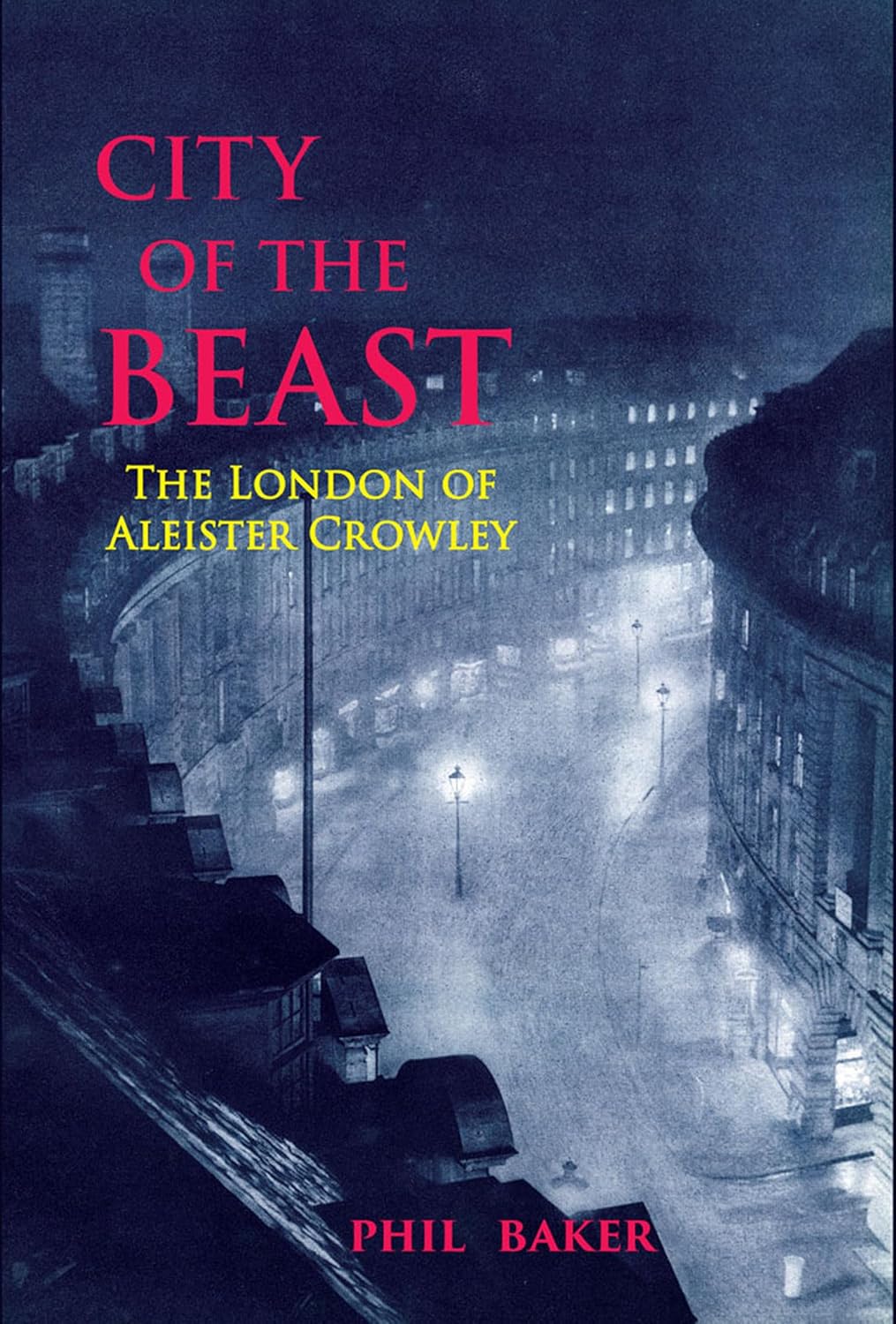
City of the Beast: The London of Aleister Crowley
Foreword by Timothy D’Arch Smith
Strange Attractor Press, 2022
“No news, no tobacco, no friends, no printer, no hope, no bloody nothing.”
—Aleister Crowley, London, Spring 1943
“This desolating war!”
—Aleister Crowley, London, 1943, after a lunch of game pie, grapes, 1858 cognac and a Cabanas cigar.
Constant Readers will recall my review of David J. Goodwin’s Midnight Rambles: H. P. Lovecraft In Gotham (Fordham University Press, 2023). Imagine then, my delight when this work by Phil Baker[1] crossed my path, described thus by the publisher:
Not a walking guide, although many routes could be pieced together from its pages, this is a biography by sites. A fusion of life-writing with psychogeography, steeped in London’s social history from Victoria to the Blitz, it draws extensively on unpublished material and offers an exceptionally intimate picture of the Great Beast. We follow Crowley as he searches for prostitutes in Hyde Park and Pimlico, drinks absinthe and eats Chinese food in Soho, and find himself down on his luck in Paddington Green—and never quite losing sight of the illumination that drove him: “the abiding rapture,” he wrote in his diary, “which makes a bus in the street sound like an angel choir!”
Other than they and their fans occupying the darker end of the spectrum, the two men could hardly seem more different. Crowley, whatever else one might say about him, was certainly an extrovert, travelling all over the world, founding various cults, a legendary epicure, acknowledged as an expert mountain climber, inheriting and wasting a great fortune, subsequently living on credit and stipends from disciples, a classic Victorian lady-killer (perhaps literally) and all-around cad, etc., while Lovecraft barely left his hometown or even his mother’s house, dressed and dined as cheaply as possible, and far from being a tabloid regular as “the wickedest man in the world,” was barely known outside of his admittedly large body of pen pals.
Above all, Lovecraft was an atheist and materialist, despising and satirizing religion and the occult; however, contempt and hatred for Christianity in particular was a shared hobby, nor has this prevented fans from claiming a secret knowledge and experience of the occult for Lovecraft, including prominent Crowleyites themselves, especially Kenneth Grant.[2]
The books, too, are rather different; while Goodwin concentrates on a brief and anomalous—though, as he shows, rather decisive—period in Lovecraft’s life and career, London was central to Crowley’s life and work; thus it operates as a rather inclusive and extensive account of both (although the reader of both book and review will benefit from some prior knowledge of same).[3]
Another difference—purely subjective—is that while Lovecraft’s fiction and non-fiction have always seemed to me to be, for the most part, works of a serious and talented chap, I’ve never been able to take Crowley, or at least his major work, entirely seriously. The robes, the swords, the incense, the magickal degrees, mostly self-bestowed and absurdly named; are just not my cup of tea.[4]
It was only when I read Colin Wilson’s account of Crowley[5] that I fully grokked his approach: the robes, etc. functioned as means to concentrate the mind and focus the attention on the task at hand: effecting changes in the world in accordance with the will of the mage.[6] As Phil Baker says here:
There has been a widely noted ‘psychologization’ of twentieth century magic, which Crowley spearheaded with ‘The Initiated Interpretation of Ceremonial Magic’ back in 1904. In it, he argues that when an old magical grimoire talks of evoking a demon who finds money, this really means stimulating the part of the brain that governs business ability. In line with this, much of his sex-magical activity (for his own health, or for a creative endeavour, or for giving a good talk) is within the realm of motivation, confidence, and inspiration, along with more nebulously causal but still partly self-determined areas such as ‘luck’ or ‘prosperity’ or success with another woman.
Later, Dion Fortune reformulated Crowley’s definition of magick (“the science and art of causing change to occur in conformity with the ill”) as “the art of causing changes in consciousness to occur in accordance with the will.” [Chapter 82: West Halkin Street]
As AI tells us:
Crowley’s vision, encapsulated in the motto “The Method of Science – the Aim of Religion”, aimed to bridge rational inquiry with spiritual transformation, making magick a disciplined, repeatable path to self-discovery and enlightenment. “Method of Science” refers to his approach of applying rigorous, empirical principles—observation, experimentation, documentation, and skeptical analysis—to spiritual and magical practice. Practitioners are encouraged to treat rituals as experiments, meticulously recording outcomes in a Magical Record to track progress and refine techniques.

You can buy James O’Meara’s book The Eldritch Evola here.
In short, behind the robes, swords, and smells, Crowley was actually in line with what we Americans had already been pioneering: New Thought.[7] Although the spirit of New Thought suggests doing whatever works for you, the essence of modern “Chaos Magick,” modern exponents of “Crowleyanity” or even “Satanism” are less in his spirit than are Oprah or Marianne Williamson.[8]
Baker’s book gives a further reason for taking an interest in Crowley: whether or not he was the “wickedest man in the world,” he may very well have been The Most Interesting Man in the World.
The publisher says that Baker “uses psychogeography to explore the life of the infamous occultist through 93 specific locations in London.” The publisher does not explain, though Baker will, the significance of “93”:
Within the murky prisms of numerology 93 is the number of Will (as in “Do what thou wilt shall be the whole of the Law”, the keynote of his new religion) and Love (as in “Love is the Law, Love Under Will”, its companion dictum). In later years he would sign off letters with “93/93.” [Chapter 33: 93 Regent Street]
Indeed, in addition to 93 Regent Street, headquarters of Crowley’s Ordo Templis Orientalis, our journey to the final chapter 93 will end up at 93 Jermyn Street, Crowley’s last London address.
The publisher, also unknowingly, goes on to locate the book in the same genre as Goodwin’s Midnight Rambles—psychogeography[9]—and as quoted above, hints at the interesting things within. Another Phil, Phil Hines, himself the author of various guides to Chaos Magic and Cthulhu Magic, fleshes out those hints:
Here are Crowley’s failed court cases, his tempestuous relationships with the various ‘scarlet women’; his constant quest for disciples with money, influence, or both. His casual cruelties to lovers, friends, and followers. As Baker points out, Crowley knowingly portrayed himself as “a reactionary Tory of the most bigoted type” – a man who felt it necessary to maintain the airs and graces of a gentleman – even whilst dodging his creditors.
So, in the spirit of Baker’s book, I propose to give you a brief tour of some of the delights within.
Even before we really start in, Baker gives us a passage from Crowley’s auto-hagiography that shows Crowley’s opinion of London was not unlike Lovecraft’s opinion of New York:
The very streets testify against the city. On the one hand we have pale stunted hurrying pygmies jostling each other in the bitter search for bread; an ant heap is a miracle of beauty and dignity in comparison. On the other, when it comes to excitement or amusement, we see perspiring brutes belching the fumes of beer; course, ugly parodies of apes. Nature affords no parallel to their degradation. There is no open air life, physical or mental, and there is the ever-abiding sense of sin and shame to obsess these slaves.
We find the same quasi-biological or zoological attitude, the hints of degeneration in the pygmies being a devolution of “stunted” English people, now merely “parodies” of apes, pale like the white ape that was Arthur Jermyn’s mother or the devolved Dutchmen of The Lurking Fear, along with the loathing of employment, slaving for bread.
Like Lovecraft, Crowley describes himself in a letter as “a reactionary Tory of the most bigoted type”—but more precisely, a type familiar to the paleo- or Dissident Right: Russell Kirk called them “Bohemian Tories.” Jere Real reviewed the work of Noel Coward back in 1976 and came to the same diagnosis, but with this useful caveat:
[A] conservative may desire simultaneously order in society and the toleration of personal non-conformity, he can doubt the existence of equality in the abstract but hope for the greatest variety in human experience. This combination—the orderly society combined with considerable expression of individual eccentricity—exists in our time, almost as nowhere else, in the England of a writer such as Noël Coward.… [10]
Both Crowley and Lovecraft imagined themselves as temporarily embarrassed aristocrats—Crowley with some justification, since he had had a substantial inheritance but quickly spent it all,[11] while Lovecraft and his family were downwardly mobile from his birth. Perhaps because he started off rich, Crowley simply continued to spend—or more usually, incur enormous debts—in that aristocratic way,[12] while Lovecraft endeavored to make a life of second-hand suits and tinned spaghetti seem a virtuous, gentlemanly shunning of plebian employment.[13]
Crowley was such a toff that when, writing for a pro-German propaganda paper in New York during the First World War, he asked the Germans to visit his aunt’s house, he carefully occluded the number of the address, since “there was a snobbery about houses in the suburbs and country ordinary enough to have numbers; it was the sort of thing that might get you ridiculed at boarding school.” (Lovecraft, who lived with his aunts for years, would not have approved).[14]
Nevertheless, and despite enjoying their company while in or visiting New York, Lovecraft was pretty much entirely a Tory and hardly a Bohemian, while Crowley, despite despising Victoria (he did a dance when hearing she had finally died), was very much a Victorian or rather Edwardian type: the Decadent. As Baker observes,
Crowley’s formative years were those of a Victorian anti-Victorian, a cultural revolt that was particularly associated with the 1890s. It is a decade remembered as the era of Wilde, Beardsley, absinthe, the Café Royal, and the decadent periodical The Yellow Book. Like the Swinging Sixties, a decade with which it has some affinity, the 1890s had its centre in London, and just as the Sixties[15] are often said to have lasted until 1974, so certain currents of the Nineties persisted well into the Edwardian period, and in Crowley’s case far longer; this “post-decadent” aspect was more obvious to his contemporaries.[16]
Lovecraft, on the other hand, had outgrown the Decadents, and even wrote “The Hound” as a parody of Decadent prose and obsessions, although our contemporaries may mistake it as an example of Lovecraft’s own overwritten style.[17]
So unlike Lovecraft, who insisted he was Providence, Crowley was inevitably drawn to London.
Crowley is virtually inseparable from his ‘English gentleman’ aspect. And London, is, par excellence, this particular gent’s terrain. Never quite as leisurely or disinterested as the Parisian-style flaneur, he traversed the city on a myriad personal missions,[18] ultimately in service of the long spiritual quest he always dated from one night in Covent Garden in 1898. And as he wrote later, apologizing for not setting an account of his magical adventures in remote exotic Asia, “there are just as many miracles in London as in Luang Prabang.”
That said, let’s tag along with Uncle Aleister as he visits his various haunts, which I hope will give you a taste of the psycho-geographical delights you will encounter in this volume.
Multi-Culti Crowley
As noted, Crowley was really a high-Victorian or Edwardian figure, a product of the Empire at its height, never more so than in his anti-Victorianism and Orientalism; he was also truly an example of that unique product, the English Eccentric.
In his later years Crowley would walk around Piccadilly raising his hat to courting couples and cursing priests with “Save us from every evil demon” in classical Greek. He only cursed Catholic priests because, as he explained, they are the only real priests. [34: Piccadilly]
Chatamasha seems to mean Alice Speller’s wonderful tea, from the Anglo-Indian “cha”. Cha plus tamasha may be Crowley’s own coinage, a tiny part of his larger “high-imperial, occult-exotic”cultural booty from the Empire, along with curry, yoga and yogic meditation, going on shikar,[19] practising quasi-tantric sex magic, and dreaming tamashas. [88: Hanover Square, Mayfair]
Crowley and Rose had a daughter born at Boleskine, Nuit Ma Ahathoor Hecate Sappho Jezebel Lilith Crowley (Lilith for short), and continued to travel, but while journeying back through China alone – he’d sent Rose home separately with the infant – Crowley felt he didn’t love them, and that they were a distraction from his destiny. Reaching Liverpool, he found that the baby had meanwhile died in Rangoon; Crowley’s friend and early bibliographer Louis Duncombe-Jewell said the unfortunate child must have succumbed to “acute nomenclature.” [16: St. Mary’s Terrace, Paddington]
Meanwhile Crowley was involved with several other women, including a Norah Knott (“She has a complex or fixation, but is as nymphomaniac as Peggy”) who did some secretarial work for him. This is almost certainly the Norah Knott who had been secretary to the Reverend Harold Davidson, disgraced for his relations with prostitutes, who ended up as a circus performer and met his end after being mauled by a lion. Like Crowley he was an extrovert public figure (in his performances he acted out being roasted on a spit by the devil) and he had recently died, in June 1937. [75: Hasker Street]
His pals were of course equally so:
Crowley sought Bennett out, and found him in south London at what he described as a squalid tenement (“a tiny tenement in Southwark or Lambeth – I forget which. It was a mean, grim horror”). The word tenement suggests slummy redbrick flats in several storeys, but it was a suburban house at 24 Barrow Road, Streatham, not so far from Crowley’s own childhood house at Polworth Road. Bennett was lodging there with Charles Rosher (Frater Aequi Animo) and his wife Lily. Rosher – not to be confused with Charles Rosher the cinematographer and cameraman, who was his son – had travelled the world as an adventurer, “invented a patent water-closet and been court painter to the Sultan of Morocco”, and he also wrote terrible poetry. “If his talents had been less varied,” says Crowley, “he might have made a success of almost anything.” [9: Barrow Road, Streatham: Lodging of Allan Bennett]
However rich with the loot of the Empire, the reader will notice that this is not, demographically, the London of today, which Baker notes with the expected regret; but this didn’t stop Crowley from enjoying himself in his accustomed ways:
It is noticeable how many of the women Crowley consorts with are black or other ethnic minority; and this is before large-scale Caribbean migration began with Windrush in 1948. Along with Phyllis and Beryl, the list includes a “coloured girl” in Windmill Street, “Marie Johnson 11 St. Peter’s Sq. Hammersmith. Mulatto”, and the slightly mysterious “black-bumbed Blowzabella”, at 5 Florence Court Maida Vale W9. [72: Chepstow Villas, Notting Hill]
What it did lack were the main “benefits” of mass immigration, ethnic restaurants; here, once more, Crowley is never more Edwardian, and more modern, than in his thirst for exotic dining.
Crowley had a strong taste for Asian food in general. Indian restaurants were still not common in Britain. Crowley went to Shafi’s at 18 Gerrard Street (one of the earliest, founded in 1920) and to Dilkush at 4 Windmill Street in Fitzrovia, opposite the Fitzroy Tavern. Veeraswamy’s was a high-class pioneer in the field (and still there on Regent Street). Churchill, Gandhi and Charlie Chaplin all ate there, but Crowley was not impressed. In 1941 he recorded that he had tried it again after a seven-year absence and found it “coarse and bad as ever”. The following year he accused them of serving rabbit as chicken.
Crowley may even have anticipated, or at least envisioned, the Harry Potter themed restaurant:
Crowley’s interest in food and drink inspired him to think of opening restaurants. In the Thirties he was floating the idea of a Black Magic Restaurant or Bar 666, with a “unique aesthetic”: there would be goats’ heads and skulls, and lights that would “come on automatically when certain objects are approached.” Another plan outlines atmospheric ideas including situation (“Obscure ill-famed quarter, but not too inaccessible. Narrow dark alley”) and furnishing (“Furniture. No chairs or tables, but mattresses, armchairs, bolsters… dyed to appear dirty.”)
In addition to these ideas of ghosttrain engineering and psychological decor, he also planned to open an “Exotic Restaurant”, and here he was probably more sincere about the food. In 1936 he even got as far as investigating a possible site for it at 16 Clay Street, Marylebone, a fairly bleak back street (more than an alley, but not a mews) between Crawford Street and Dorset Street. Now largely redeveloped, it had no real ‘walk-by’ for casual customers but it could have worked for a deliberate ‘destination’ restaurant, as it could for a brothel. [49: Shanghai, Soho, and other Restaurants]
Curry ala Crowley
And of course, there’s curry.
Although Crowley had real, down-to-earth experience of the FarEast, his taste for Asian food involved strong elements of exoticism and orientalism. This was true of his taste for curry, which was part of a more general taste for extremes (“I want blasphemy, murder, rape, revolution, anything, bad or good, but strong”). In a very British fashion this had elements of the comic ordeal (long part of the British attitude, with people boasting about eating “the Brick Lane ring stinger” and so on) and even of the practical joke: entertaining a friend in 1936 he writes “Bracewell put through Ordeal by Curry.”
“He explained that he had learnt about real curry in India, Burma and Ceylon, that its object was to produce sweating, hence a cooling process… He pointed out that this was only one of many cooling processes he was familiar with in these lands and that one of the great points of hospitality was to have one’s partes viriles lifted up by a maiden attendant, and fanned from below with an exquisitely painted fan… He assured me that I would soon get to enjoy such things, as well as curry, once I got out there, to say nothing of the delights of opium, hashish and heroin.”
Louis Umfreville Wilkinson, whom Crowley said was his best friend in later life, remembered Crowley curries as “astounding”, but “rather too moving for me” (possibly a euphemism) “though I ate them with joy for their very excessiveness.” [49: Shanghai, Soho, and other Restaurants]
Cooking with Crowley
In addition to his deadly chilies, Crowley loved inventing dishes, often dedicated to his acquaintances; Baker lists Cojones Mexicanos; Risotto Cheshire Cheese (named after the pub); Turbot d’Urberville; Turbot Porterfield (named after his dentist); Sambar of Turbot and Mushroom; Goldfish Toast; Flying Fish; Capretto St George (goat); Fisherman’s Daughter, a sole and lobster dish; Escalopes de Veau Desespoir (Veal Despair); Pimentos Katarina a la St.Bartoleme; Biftek Crapaudine; and others.
One dish in particular would have delighted one of the gourmets of the alt-Right:
Fondre Falconer (‘Falconer melt’). It was fried mushrooms, cut small, with powdered chili [of course], cooked in parmesan or preferably Cheshire cheese, then boiled up with the addition of cream, and eaten with fried French bread. [77: Blackfriars Road, Waterloo]
Hot stuff indeed! Certainly not something you can find in many different places, even today. Meanwhile, back at the Café Royal:
Crowley felt so at home in the Café Royal that he put adverts for it in his occult journal The Equinox – probably unpaid and unsolicited – announcing “EPICURES are invited to taste the special dishes invented by ALEISTER CROWLEY. This can be done at the CAFÉ ROYAL, REGENT STREET, W. Pivots d’Amour Cro-Cro, Pilaff de Moules a la Santa Chiara, Crowley Mixed Grill, Soufflé Aleister Crowley etc etc.” [15: Café Royal, Regent Street]
Breaking Baal?

You can buy James O’Meara’s book Green Nazis in Space! here.
But more than as a foodie, Crowley is remembered for his experiments with drugs. The Beast, bald and bad, is something of a forerunner, or Heisenberg-esque Doppelgänger, for Walter White. Both men aimed to use “the method of science” to perfect their areas of legally dubious expertise, producing a better product than earlier competitors. Both sought to become Übermenschen, beyond good and evil, destroying many lives in the process.
While Crowley experimented with a wide variety of drugs, on himself and others, Walter was devoted only to the scientific perfection of one drug, his beloved Baby Blue. Here, however, we find a clear link between the two:
Brooks introduced him to the spy-traitor Guy Burgess and his partner Peter Pollock: “one or two of the younger generation who wished to meet him”, as Brooks calls them. Crowley pulled out his new party trick of putting methylene blue dye in his drink, perhaps to give the impression it was some strange potion, from a little phial labelled ‘Lady Astor’. The humour of this is a mystery, but probably related to the fact that Lady Astor was famously teetotal.[20] [89: Dover Street, Picadilly]
[When “further “mysteries” for a paying audience of thrill-seekers were conducted at Fulham Road] there was a ludicrous write-up of this by the once-famous Bohemian Harry Kemp in the New York World magazine, entitled ‘Weird Rites of Devil Worshippers Revealed by an Eye Witness’. Kemp’s revelations involved “a large, high-ceilinged studio the atmosphere of which was coloured a deep blue by the reek of a peculiar smelling incense.” [35 Avenue Studios, Fulham Road]
Fear and Loathing in Mayfair
Bennett talked of wanting to find a Holy Grail of drugs, a drug that would “open the gates of the World behind the Veil of Matter,” and Crowley refers to them both “exploring the pharmacopoeia for the means of grace.” When they did this they followed what he later calls “The old Chancery Lane rule: begin with half the minimum dose of the Pharmacopeia, and if nothing happens within the expected time, double the dose. If you go on long enough, something is nearly sure to happen!”
In 1926 Crowley delegated his young disciple Tom Driberg to buy some items from Lowe’s only to find the shop had moved … Crowley wanted lignum aloes, the exquisitely scented agarwood, but unfortunately Driberg allowed himself to be fobbed off with the wrong thing, and wrote a grovelling letter of apology…. It is extraordinary to think he ended up as Chairman of the Labour Party. [21] [11: Stafford Street, Mayfair: Lowe’s Chemist]
Epstein Before Epstein
The Horos Affairs deserves quoting at some length, lest the reader persist in thinking such things are new, or that Crowley was indeed “the wickedest man in the world.”
There was a postscript to the final Golden Dawn debacle with a couple of chancers named Theo and Laura Horos, an American couple who ran a short-lived, shady cult at 99 Gower Street. They mixed a smattering of occultism, picked up from their Golden Dawn contacts, with a further emphasis on sexual magic. Mrs Horos was a woman of about sixty who also went by the names of Swami Vive Ananda and Marie of the Commune (the 1870 Paris Commune), but under a pile of aliases her earliest name seems to have been Ann or Editha Salomon. Mr Horos was about thirty years younger and may have been an unfrocked priest; his real name seems to have been Frank Dutton Jackson.
In September 1901 the Horoses were arrested and appeared in Marylebone Police Court as Frank and Edith Jackson, charged with fraud, theft, and procuring young women for immoral purposes. They had been running a cult called The Order of Theocratic Unity at 99 Gower Street, and victims Vera Croysdale, Olga Rowson and Daisy Adams, a sixteen-year-old whom Frank Jackson was accused of raping, had come forward. Vera Croysdale remembered Frank had told her he was Christ, and that any sin with him would be an act of piety. She had also undergone an impressive initiation ritual beginning “I, Vera Croysdale, in the presence of the Lord of the Universe and in the Hall of the Neophytes in the Order of the Golden Dawn…”
It transpired that girls were being hypnotised, drugged, and given whisky for breakfast. This was the first that the great newspaper reading public had heard of the already disintegrating Golden Dawn, and it did the Order’s reputation no favours. Suddenly it, or its Horos version, was even being celebrated in comic songs (“Way down upon the Swami River…”). The public galleries at the trial were packed, and the Horoses provided rich entertainment by conducting their own defence; at one stage Mr Horos turned to the gallery and shouted “Keep quiet, you reptiles!”. The trial moved to the Old Bailey, where Mrs Horos – the prime mover – received seven years and her unfortunate husband fifteen. [14: 99 Gowers Street]
It should be noted that Crowley, supposedly “the wickedest man in the world,” allows himself to gloat somewhat over their downfall in his Confessions, as Wilson recounts:
He states in the Confessions that Mrs Horos had “bolted with such property of [Mathers] as she could lay her hands on” (which was untrue), then goes on primly: “In the following year she was sentenced to seven years penal servitude for outrages on young girls. She had in some way used the rituals of the Order which she had stolen from Mathers to entice them to their doom.” And in due course Crowley was able to combine his distaste for the Horoses with his resentment of Mathers in his extraordinary tale about Mathers being ‘possessed’ by the spirit of Madame Horos.[22]
The Beast Speaks!
In October 1942, Crowley recorded the First and Second Enochian Calls (Enochian being the angelic language of Renaissance magicians Dr Dee and Sir Edward Kelley).[23] The 78s survive and can be heard here (English and then, after a pause, Enochian).[24]
The listener’s reaction is likely to mirror that of Viola Banks, who, on her long-anticipated meeting with Crowley, was rather disappointed to hear him: “His voice, which I had imagined would be sonorous, was light and rather high for a man.”[25]
William Burroughs was more direct:
Burroughs considered Crowley a bit of a figure of fun, referring to him as “The Greeeaaaaaat BEEEEAST!” in that behind-closed-doors, queeny comic delivery he used sometimes: his voice rising straight up in pitch, into an hysterical falsetto . . . [26]
Nevertheless, there’s more than a little connection between Uncle Aleister and Uncle Bill – perhaps that accounts for Burroughs’ performative disdain. AI says:
Burroughs’ literary techniques—like the “cut-up” method and the “playback” technique—can be seen as modern, mechanical versions of Crowley’s magical rituals. The playback technique, involving recording and subliminally replaying audio at a target location, was used by Burroughs to curse businesses, such as the Moka Coffee Bar in London, which closed after repeated playback operations. This act mirrors Crowley’s belief in the power of ritual to alter reality.
Burroughs lived in various parts of London in the early sixties, including Duke Street, as did Crowley [68: Duke Street], and like Crowley he was at best ambivalent about London and England in general.[27]
Already in the Introduction, Baker links the two, saying of Crowley that, “as a later generation would put it, that of Alexander Trocchi and William Burroughs in the early 1960s, he was ‘a cosmonaut of inner space’ (see Ted Morgan, Literary Outlaw, p.335),” and later he also invokes Burroughs’ notion of “transitional districts” to describe Paddington:
With the railway station, the proximity of Edgware Road, and Praed Street (with its dirty postcards and radio manuals) Paddington was one of those equivocal “ambiguous or transitional districts” that William Burroughs identifies in Junky: “Stores selling artificial limbs, wig makers, dental mechanics, loft manufacturers of perfumes, pomades, novelties, essential oils. A point where dubious business enterprises touches Skid Row.” [69: Manor Place, Paddington][28]
This would later, from Naked Lunch onward, become his “Interzone” motif, as it does here:
It was becoming a cosmopolitan interzone, where the remains of pie-and-mash working class culture met Jewish business and increasingly the Middle East (much of Edgware Road has now consolidated into London’s upmarket Arab quarter, good for Lebanese food and oud scent). This was underway in Crowley’s day, and in September 1937 he notes “Met Camille Comer. French-Arab from Alger.
Smithers, eh?
The Strand itself, now rather miscellaneous and characterless, was the great exciting thoroughfare of Victorian London (hence the title of the magazine The Strand, where Sherlock Holmes appeared…). At night it was also associated with public drunkenness, which shocked foreign visitors, and with other deviant behaviour: there were notices in several pub windows (not intended humorously) saying “Beware of Sods”, meaning sodomites. At number 417 was a decadent wateringhole, the oddly named Bun Shop, well-known to Smithers and the rest. Crowley was very familiar with the Strand … [6: Hotel Cecil and The Strand]
Speaking of Epstein…
Always with the penis, these people.
Crowley had been outraged by the French authorities putting a butterfly-shaped piece of metal over the genitals of Jacob Epstein’s new sculpture for Oscar Wilde’s grave in Père Lachaise cemetery, so after a guerrilla unveiling of the statue, pulling the tarpaulin off before a crowd of about twenty people recruited from the Left Bank, he hacked it off and then strode into the Café Royal one night wearing it like a codpiece. In Crowley’s own telling of the story, Epstein himself was in the Café and appreciated the gesture (Epstein’s own telling of the story is less enthusiastic, but confirms it really happened). [15: Café Royal, Regent Street] [29]
Defining the Dissident Right?
The Book of the Law became the foundation of Crowley’s new religion, and he considered it the greatest event of his life. It combines the style of fin-de-siècle decadence – “To worship me take wine and strange drugs whereof I will tell my prophet, & be drunk thereof!” – with a belief that might is right, and the joy of strength: “The kings of the earth shall be Kings forever: the slaves shall serve”; “We have nothing with the outcast and the unfit: let them die in their misery. For they feel not. Compassion is the vice of kings: stamp down the wretched and the weak: this is the law of the strong: this is our law and the joy of the world.” It embodies the essence that British writer Cyril Connolly crystallised when he wrote that Crowley “bridges the gap between Wilde and Hitler.” [16: St. Mary’s Terrace, Paddington]
Apartment Therapy: Feng Shui a la Crowley
Crowley had fitted this flat out with two temples, one for white magic and one for black: the white magic room was lined with eightfoot mirrors, and the one for black magic – in a sort of cupboard – had “an altar support by the figure of Negro [sic] standing on his hands… the presiding genius of this place was a human skeleton, which I fed from time to time with blood, small birds and the like. The idea was to give it life [creating a “material and living demon servant”], but I never got further than causing the bones to become covered with a viscous slime.” [10: Chancery Lane: Semi-Solid Shadows]
There is a fictionalised description of Victoria Street in Ethel Archer’s 1932 novel The Hieroglyph, based on Crowley as she’d known him around 1910: “A room, she reflected, betrays the character of its owner and occupant, and this was far from being a common one… the semi-ecclesiastical austerity side by side with evidences of strange perversity and barbarity.” The bare floor is painted black, with a leopard skin rug before the fireplace. A large stuffed crocodile grins from the corner of the room. From the ceiling hangs a “wonderful silver lamp or censer” and above the mantelpiece is a Byzantine crucifix, while on the mantelpiece itself are several images of Buddha, together with Chinese and Egyptian gods. On the wall is a scarlet silk hanging embroidered with gold letters, “the spoil of a Tibetan temple.” On the bookshelves are first editions of Verlaine, Baudelaire, Swinburne, and Wilde, with some Rodin busts on top of the bookcases, and on the wall beside the fireplace are “drawings by Beardsley and Osman Spare.” [18: Victoria Street: Crowley’s Flat, & Temple of the Astrum Argenteum]
I For One Welcome Our New Asian Overlords
Crowley also shared with Lovecraft the enjoyment of visions of Western civilization laid waste by time with only a few scraps of occult knowledge (provided by Crowley’s journal, The Equinox, of course) waiting to be uncovered.
“We could also see the Professor of Archaeology in the University of Lhasa excavating the ruins of the British Museum.” This future Tibetan seems to be particularly excavating the Library, where “He discovered a vast number of volumes of our period purporting to deal with the occult sciences, but there were few indeed of these which had not crumbled into dust. Of those that remained, the vast majority were evidently frivolous. He rejoiced exceedingly to discover one series of volumes, the dignity of whose appearance, the permanence of whose paper, the excellence of whose printing, and the evident care which had been bestowed on their production, showed him at first sight that the people responsible for their production had been at infinite pains to make these volumes testify against the tyranny of time… The first standard work of reference – the key to the wisdom of the buried past.” [24: British Museum]
Anarchist Evening Entertainment; For Madmen Only!
Crowley began setting up rituals for members of the A:.A:. that were more like “magical-theatrical” performances with music, dance and drugs (mostly peyote, which Crowley claimed to have introduced into Europe). When a member suggested “– perhaps half-joking – that the ritual was so good they should perform it for the public and charge admission,” Crowley replied: “You may be on to something.”
Crowley was excited enough to build the performance up into The Rites of Eleusis, performed at Caxton Hall, Westminster, close to Victoria Street. It was a respectable and moderately grand venue, then associated with suffragette meetings (and later to be the site of, among other things, Churchill’s election speech; the assassination of Sir Michael O’Dwyer, in revenge for the Amritsar Massacre; the founding of the National Front; and the wedding of Ringo Starr).
Most papers wrote them up as the work of a weird cult, but it is not far-fetched to see them as an avant-garde psychodrama, and even a forerunner of Sixties ‘Happenings’. [26: Caxton Hall: The Rites of Eleusis]
“Our revels now are ended”
It seems appropriate that Crowley should die in reduced circumstances in 1947, just like the Empire.
Crowley’s great achievement was not just that he popularized magic again, after the triumph of the Royal Society view of the world, but that he did so with his opponent’s weapon: “the method of science.”[30]
From today’s perspective, he seems to still be too old-fashioned, more of his time than ours, but perhaps we can lean into that and view him as one of the last great Victorian eccentrics, like his hero, Sir Richard Burton.[31]
Like Byron, he was mad, bad, and dangerous to know,[32] responsible for several deaths and more than a few wrecked lives; in this he was quite unlike Lovecraft, and more like Hunter S. Thompson or William Burroughs.
Still, compared to the death tolls racked up by the most banal of our politicians, it seems a minor flaw.
George Orwell, writing after the death of Gandhi (another Victorian-Edwardian eccentric, a bald guy in robes, whose occupied an almost parallel segment of time), gives perhaps the best perspective on such figures:
One may feel, as I do, a sort of aesthetic distaste for Gandhi, one may reject the claims of sainthood made on his behalf (he never made any such claim himself, by the way[33]), one may also reject sainthood as an ideal and therefore feel that Gandhi’s basic aims were anti-human and reactionary[34]: but regarded simply as a politician, and compared with the other leading political figures of our time, how clean a smell he has managed to leave behind![35]
Or as Louis Umfreville Wilkinson recalls,
Crowley always managed to give the impression of careless wealth, “Except once, when I found him living in Paddington Green in some frightful lodging.” And even there, says Wilkinson, he brought his own atmosphere with him: “There was incense burning… that may have helped.” [69: Manor Place, Paddington Green]
Anywho, I hope to have given you enough of the scent to follow in the footsteps of the Great Beast. As Chaos Magickian Phil Hine says,
With an introduction by Timothy d’Arch Smith, an afterword focusing exclusively on Crowley’s London of the 1890s; extensive notes, and bibliography; City of the Beast is an outstanding addition to the ever-growing biographical corpus which is the legacy of Aleister Crowley. Immensely readable, witty, and at times rather sad, but if you are at all interested in Crowley’s madcap career – simply a must-read!
Notes
[1] MIT Press says; “Phil Baker is a writer based in London. His books include The Devil Is a Gentleman: The Life and Times of Dennis Wheatley and Austin Osman Spare: The Life and Legend of London’s Lost Artist (Strange Attractor), called by Alan Moore ‘little short of marvelous’” and which I plan to review as well.
[2] “Kenneth Grant was a British occultist who profoundly reinterpreted the works of H.P. Lovecraft, integrating them into his Thelemic system of magic known as Typhonian Thelema. Grant believed Lovecraft’s fiction was not mere horror fiction but a form of psychic revelation—a channeling of ancient, extraterrestrial forces he referred to as the “Necronomicon Mythos.” He argued that Lovecraft, though unaware of it, was in contact with the same “praeter-human Intelligence” that inspired Aleister Crowley.
“Grant expanded on this idea in his book The Magical Revival (1972), where he proposed a deep, unconscious connection between Lovecraft and Crowley, both drawing from the same occult sources. He linked Lovecraftian entities like Yog-Sothoth to the Qliphoth in Kabbalah, particularly the sphere of Daäth, and associated the iridescent globes in Lovecraft’s descriptions with the hidden spheres behind the reversed pentagram in Crowley’s magical symbols.
“His later works, including Cults of the Shadow and Outer Gateways, further developed these ideas, positioning Lovecraft’s mythos as a legitimate spiritual and magical framework.” (AI)
[3] You don’t need to know much, if anything, about Crowley and you’ll learn much about him. If that inspires you to explore further, there’s a pretty good recent biography by Richard Kaczynski, Perdurabo (Berkeley, North Atlantic Books, 2010); “Perdurabo” (“I shall endure”) was Crowley’s magical name in the Golden Dawn. The standard biography has been by John Symonds, though Crowleyites despise it. It’s gone through several editions and titles, from The Great Beast (1951) to most recently The Beast 666 (Pindar Press, 1997).
Of course, there’s Crowley’s own account, which is amusing but must be taken with many grains of salt (or perhaps grains of heroin). Baker describes Crowley’s “extraordinarily prolix memoirs, his Confessions… which he liked to refer to as his autohagiography, the autobiography of a saint,” as having “flashes of great richness, insight and fascination amid a general tone of airy self-satisfaction, in which Crowley constantly insists on his innocence, purity of mind, and continual surprise at the shabbiness of the world.”
For the reasons given here, I would suggest Colin Wilson’s Aleister Crowley: The Nature of the Beast (1987) as well as the Crowley chapter in The Occult: A History (1971); for some reason, Baker doesn’t use or mention either.
[4] Frank Costello in The Departed: “Church wants you on your place. Kneel, stand, kneel, stand. If you go for that sort of thing, I don’t know what to do for you.” Ironically, he then proceeds to enunciate a very Crowleyite alternative: “A man makes his own way. No one gives it to you. You have to take it. ‘Non serviam.’” Costello may not have been “the wickedest man in the world” but he is described as “the rock star” of the Boston underworld, a fitting designation considering Crowley’s influence on rock music.
[5] I forget whether his chapter in The Occult: A History (1971) or his later little book Aleister Crowley: The Nature of the Beast (1982).
[6] See my remarks on Wilson in “‘The Name is Crowley . . . Aleister Crowley’: Reflections on Enlightenment & Espionage,” reprinted in Mysticism After Modernism: Crowley, Evola, Neville, Watts, Colin Wilson, & Other Populist Gurus (Melbourne, Australia: Manticore Press, 2020).
[7] Crowley’s colleague and private secretary, Israel Regardie, called Neville Goddard the “most magical” of the New Thought or Positive Thinkers. The relevant chapter of his 1947 book is reprinted as the “Introduction” to The Neville Goddard Treasury (New York: Tarcher/Penguin, 2015), and can be read online at the Penguin website (click on “read sample”).
[8] See Mysticism After Modernism, op. cit.
[9] For more on this, see “Walk a Mile in Cthulhu’s Shoes,” my review of David Haden’s
Walking With Cthulhu: H.P. Lovecraft as Psychogeographer, New York City 1924-26
[10] Jere Real, “The Playwright as Bohemian Tory,” Intercollegiate Review 11:2 Winter–Spring 1976. See my discussion of Noel Coward here.
[11] “The few years after the Blythe Road confrontation [with the leaders of the Golden Dawn] were the most extraordinary of Crowley’s life, spent largely abroad and burning through an inheritance.” (16: St. Mary’s Terrace, Paddington: Life with Rose) “He had been on and off Queer Street for a long time; effectively since his inheritance ran out. But from now on, and officially, to borrow a characteristically nice line from his later diaries, ‘I am what St. Francis of Assisi used to call “fucked on the financial front.’” (62: Carey Street: Bankruptcy Court) Baker adds this useful note: “Being ‘on Carey Street’ (bankrupt) came to merge in the public mind with another more popular expression, ‘on Queer Street’ (also bankrupt, before acquiring sexual associations; a corruption of Carey Street has often been given as the origin of the phrase, but it seems to pre-date the move of bankruptcy business to Carey Street in the 1840s).”
[12] “Crowley was financially hard-up for most of his life, but even when he was down on his luck he lived as a gentleman (in the sense of class, rather than good behaviour).”
[13] For a discussion of the distinction the gentleman and the slave, see Greg Johnson, The Philosopher Is In (Counter-Currents, 2026).
[14] 36: Outram Road, Croydon.
[15] When, of course, Crowley’s visage would grace the cover of the Beatles’ Sgt. Pepper’s.
[16] Crowley’s publisher in the 1930. P. R. Stephenson, “published his own book of Crowley’s outrageous and often ludicrous press coverage, The Legend of Aleister Crowley (Mandrake, 1930), in which he also notes the ‘ninetyish romantic bravado’ of the younger, Edwardian Crowley’s attitude.” Stephenson himself is an interesting character from the Rightist point of view: “he returned to Australia after the Mandrake Press venture. From being a Communist at Oxford he moved to the far-right, and in 1936 he was running a magazine called The Publicist, which advocated not only monarchy – not universally popular in Australia – but also fascism and anti-Semitism. He later founded the ‘Australia First’ political party, and in the Second World War he was interned for supporting Germany and Japan.” [43: Mandrake Press, Museum Street] For more on Stephensen, see Greg Johnson, here, and Kerry Bolton’s essay here : “Considering the furor around Crowley at the time, it is indicative of Stephensen’s disregard of conformity, which would re-emerge in his political activities when the Axis was widely perceived evil incarnate.”
[17] “While S.T. Joshi calls the story ‘roundly abused for being wildly overwritten,’ he sees it as a deliberate parody. Its ‘adjectivitis’ mocks the prose of Poe and other writers Lovecraft admired, including Ambrose Bierce and Joris-Karl Huysmans.” (Leslie S. Klinger, The New Annotated H.P. Lovecraft, Liveright, 2014, p 258). Fans may be more interested in it as the first mention of the dreaded Necronomicon.
[18] Mostly involving drink, drugs, fine dining, and prostitutes.
[19] Shikar is “an Anglo-Indian word, from Urdu, meaning to go on a hunt or a hunting expedition”; this was Crowley’s term for his unending search for suitable prostitutes, of which there were a plethora, especially in Piccadilly and Hyde Park. [79: Hyde Park].
[20] The blue color of Heisenberg’s pure meth was also fake, merely a plot device; see here.
[21] Later, we learn that Driberg gave Crowley the first line of a limerick about bookshop owner Michael Houghton: “A dwarf kike, who called himself Houghton”; Baker explains that “a kike is someone who is Jewish” and that the line “doesn’t reflect well on Driberg.” [44: Atlantis Bookshop, Bury Place and Museum Street]
[22] Wilson, in his account of the affair, knows nothing of hypnosis, drugs or whiskey, and calls this “undoubtedly a major miscarriage of justice; the Horoses were really being imprisoned for immorality.” He goes on to say that “Crowley, who might have been expected to be on their side, was totally unsympathetic. … It is another illustration of the ‘nasty, petty, vicious louse’ aspect of Crowley of which Regardie speaks.” One can’t help but hear echoes of the Epstein defenders of our time.
[23] 92: Levy’s Sound Studio, New Bond Street
[24] For more on Enoch, see here and here.
[25] 28: Ralston Street, Chelsea, Salon of Gwen Otter.
[26] James Grauerholz, quoted from The Magical Universe of William S. Burroughs by Matthew Levi Stevens; for a further discussion see my review, “Curses, Cut-Ups, & Contraptions: The ‘Disastrous Success’ of William Burroughs’ Magick,” reprinted in Mysticism After Modernism: Crowley, Evola, Neville, Watts, Colin Wilson, & Other Populist Gurus (Melbourne, Australia: Manticore Press, 2020).
[27] See “Burroughs in London” for an examination.
[28] Even Bloomsbury gets the treatment: “The idea of Bloomsbury now has a rather refined and genteel ring to it, largely due to Virginia Woolf and the Bloomsbury Group, but this was not always the case. It once had a more ambiguous character, where cheap lodgings and sometimes down-at-heel scholarship met the slumminess of St. Giles, where Centre Point is now… Writing to a friend from Marseilles in 1930, the artist Edward Burra says “I am surrounded by so many negroes and dwarfs that I can hardly believe I am not in the heart of old Bloomsbury.” Add the proximity of the British Museum and the bookishness of the area, and it adds up to the kind of richly marginal area that suits occult business ventures.” [44: Atlantis Bookshop, Bury Place and Museum Street]
[29] Is Trump hinting at something? “Trump even has that hideous totem of Churchill (created by a Jew named Jacob Epstein) to loom over him, bragging that Obama had rejected the ‘gift’ from the UK, but he had it put in the Oval Office.” American in Exile
[30] For more on this general theme, see Jason Ā. Josephson-Storm, The Myth of Disenchantment: Magic, Modernity, and the Birth of the Human Sciences (University of Chicago, 2017) and particularly Chapter Six, “The Revival of Magic.”
[31] Burton was one of three dedicatees of Crowley’s Confessions (Stephensen was another), and Baker starts off at his tomb in Mortlake. “Like Crowley, Burton was a great Victorian malcontent who incarnated the genius and stranger undercurrents of Victorian Britain even as he was transgressing against mainstream Victorian values.”
[32] “Betty May had recently married Raoul Loveday, a bright young man just down from Oxford, and she was a friend of Betty Bickers, who was another Harlequin regular. Learning of Raoul’s interest in Crowley, Bickers introduced them, and May was disturbed when Raoul came home after three days smelling of ether and talking about his travels on the astral plane. Crowley was a bad influence, and May attempted to keep them apart.” For his part, “Crowley was appalled when Loveday took him to the Harlequin, where he saw Betty May singing, ‘three parts drunk, on the knees of a dirty-faced loafer, pawed by a swarm of lewd hogs, breathless with lust… Her only idea of life was this wallowing in the hog trough nuzzled by the snouts of the swine of Soho.’” The couple followed Crowley to his Abbey of Thelema in Cefalu, where “Loveday caught typhoid and died, either from drinking the blood of a sacrificed cat or – more likely – drinking the local water, which Crowley had warned him not to do.” It was during the ensuing tabloid scandal that Crowley acquired his title of “Wickedest Man in the World.” [39: The Harlequin Club, Soho]
[33] Well, Crowley certainly did claim something like that for himself: “The 1904 revelations [of The Book of the Law] also involved a long-dead Egyptian priest, Ankh-f-n-Khonsu (whose stele – a painted plaque – was catalogued as item 666 in Cairo Museum), and whose reincarnation Crowley came to believe he was (‘in the 26th Dynasty… I was Ankhf-n-khonsu and brought about the Aeon of Osiris to replace that of Isis.’” By 1914, Crowley had granted himself “the magical grade of Magus, one step up from Magister Templi, now making him equal to Christ or Mohammed.” And at the Abbey in Cefalu in 1922, he achieved the unprecedented rank of Ipsissimus, “wholly free from all limitations soever… preeminently the Master of all modes of existence… [with] no relation as such with any Being… and no consciousness of any kind involving duality.” Must be nice.
[34] Ditto: “…I am a reactionary Tory…”
[35] George Orwell: “Reflections on Gandhi”; first published: Partisan Review, January 1949.
2 comments
“If you can’t be a good example, then you’ll just have to be a horrible warning”.
—Catherine Aird
That’s Crowley. Perhaps this is his redeeming quality.
At least the Sicilians had the good sense to kick him out.
I guess in his time he was something. Now he just seems norml. Without the A.
Thank you for this very interesting and enjoyable article, James.
I always considered Mr Crowley to be a bit of an ‘overgrown brat’, but whatever one’s opinion of him may be, he certainly was an interesting fellow.
Timothy D’Arch Smith? That name seems familiar to me from somewhere…
If you have a Subscriber access,
simply login first to see your comment auto-approved.
Note on comments privacy & moderation
Your email is never published nor shared.
Comments are moderated. If you don't see your comment, please be patient. If approved, it will appear here soon. Do not post your comment a second time.