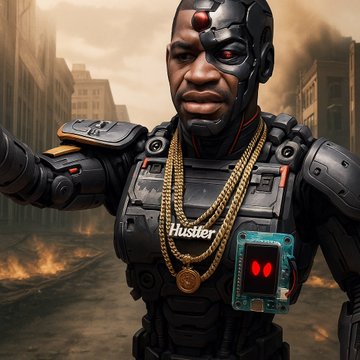
A variation of the “George Droyd/Droid” meme.
1,733 words
Tony Hinchcliffe is a white stand-up comedian known for making insult-based and inflammatory jokes. Last month, he was one of the participants in a “roast” of Kevin Hart. “Roasts” are televised specials where comedians take turns making fun of a specific celebrity guest of honor. Past subjects of roasts have included pop singer Justin Bieber, professional football star Tom Brady, and even Donald Trump (in 2011, before his political career took off). The typical joke told at a roast is intentionally insulting and shocking but is not meant to be taken seriously. This time Hart, a prominent black comedian and actor who is far more famous than Hinchcliffe, was the subject.
However, Hinchcliffe took aim not just at Hart—which was to be expected—but at George Floyd, when he told Hart that “The black community is so proud of you right now. George Floyd is looking up at us all, laughing so hard he can’t breathe.”
Not long ago, it would have been unthinkable for a white comedian to mock George Floyd while speaking directly to a black man, especially as part of an event organized by Netflix, a fully mainstream streaming platform. Back in June of 2020, Netflix climbed aboard the BLM bandwagon by offering subscribers a special “Black Lives Matter Collection” of black-centered content. But now, Netflix has no problem releasing and profiting from the Kevin Hart roast.
Additionally, although there has been some criticism of Hinchcliffe, Hart defended his fellow comedian, saying that while that particular joke was “distasteful,” Hinchcliffe “arguably had the best set or one of the best sets” of all of the participants in the roast. Joe Rogan, host of the world’s most popular podcast, vociferously denounced comedians who publicly took offense to Hinchcliffe’s performance and reminded them that it’s normal for roasts to feature that kind of humor.
We can conclude from this that the cultural standard in 2026 is that a joke about George Floyd, though “distasteful” is fundamentally no different than any other distasteful joke, and is evidently not distasteful enough to be barred from a Netflix comedy special. Americans, including blacks, are expected to tolerate this, and they can expect pushback if they refuse to do so.
But this was most certainly not the standard in 2020. Back then, George Floyd was the sacred symbol used to inspire feelings of guilt among whites and rage among blacks, and to argue for a massive transfer of resources from the former to the latter. The destruction of property, the defunding of the police, the removal of monuments, and reparations paid to blacks were all components of this so-called “National Reckoning on Race” and it was all supposedly justified by the death of one man in Minnesota.
Throughout basically every American institution, the initial response to these demands was either submission, or a terrified silence. The appropriate response would have been to reject the idea that a single death in Minnesota showed that whites owed blacks a damn thing, and to very forcefully put down the riots the very first night. The whole thing was ridiculous, and it should, therefore, have been ridiculed. It should have been repeatedly and publically laughed at.
You can buy Greg Johnson’s The White Nationalist Manifesto here.
Six years later, the agitators of 2020 have not received most of what they demanded. Relatedly, the name George Floyd does not carry the same emotional weight that it once did. Black activists and their allies tried desperately to enshrine Floyd as an American martyr whose name even self-proclaimed “conservative” whites would revere along the same lines as Martin Luther King. At first, it looked like there was a realistic possibility that we would end up with a George Floyd Boulevard or a George Floyd High School in every major city, and that the anniversary of his death might become a federal holiday. But the forces of Floyd-worship, at some imprecise point between the riots and today, were stopped in their tracks, and it’s hard to see how that lost momentum could be regained.
If a Democrat politician were to announce a presidential campaign based on fulfilling the demands of the 2020 protestors and, appealed to the memory of George Floyd in order to fire up the party base, such a candidate probably wouldn’t have much of a chance in the Democrat primary. That party’s multiracial coalition is, of course, still engaging in racial identity politics, but it is currently more focused on advocating for illegal aliens facing deportations and for Palestinians in Gaza than it is on black grievances. Police-related deaths and the pursuit of reparations for slavery are no longer what animates them the most.
George Floyd’s death has become just another historical event and is no longer a force that can motivate political action. It has as much political currency as a counterfeit twenty-dollar bill. This is not to say that a future police killing of a black man couldn’t breathe new life into the Black Lives Matter movement, but such a revival would require a brand-new martyr figure. A new round of protests and demands could not be based on the memory George Floyd. Most of America has moved on.
The failure of the Cult of Floyd to take root is an encouraging development and a significant victory for whites in the cultural arena. It is thus worth reflecting on why George Floyd has not become another Martin Luther King. I cannot point to a specific date where whites stopped allowing themselves to be emotionally blackmailed by the mention of Floyd’s death. It seems to have happened gradually, and the off-putting behavior of BLM activists combined with a post-Floyd rise in black crime was surely part of it. However, the combination of the post-Civil Rights crime wave, the Los Angeles riots, and black celebration following the O.J. Simpson verdict did not cause white Americans to stop admiring Martin Luther King. Instead, the avatar of integration only became more popular. It seems to me that something else must have put an end to America’s collective Floyd obsession.
A factor that I believe has played a role in tamping down the religious fervor over George Floyd’s death is the rise of Floyd-related online content, including memes and AI videos, which are usually intended for comedic purposes. Kevin DeAnna also made note of this on his show last week, as he referenced the spread of videos featuring both Floyd and Charlie Kirk. I first started to notice AI George Floyd videos a few years ago, and they have continued to proliferate. Not all of these videos portray Floyd negatively, although some do, but all of them inevitably send the message that it’s okay to laugh at jokes about Floyd. It stands to reason that individuals exposed to plenty of funny videos involving George Floyd—even if these videos are produced anonymously—will begin to feel comfortable making their own jokes about Floyd in conversation with friends who have also watched those kinds of videos. And people will not feel reverence toward someone they feel comfortable making jokes about.
Moreover, if jokes involving Floyd are normalized, individuals will be more open to questioning details about Floyd’s death. They will also be more open to questioning whether his death really proves the “systemic racism” thesis. Someone who in 2021 would have been afraid to entertain such thoughts because he judged them to be socially unacceptable might be more willing to consider them in 2026 after he has laughed at a few George Floyd memes. Last October, the Estate of Martin Luther King pressured OpenAI into banning users from creating Deepfake videos depicting King. NPR reported that “hyper-realistic deepfake videos of King saying crude, offensive or racist things have rocketed across social media, including fake videos of King stealing from a grocery store, speeding away from police and perpetuating racial stereotypes.” I think King’s family was wise to do whatever they could to stop those kinds of videos from spreading. If white people begin to laugh at King, they will no longer feel the need to honor his memory.
Like Floyd with his long criminal record, there is no shortage of unflattering things about Martin Luther King which could harm his reputation if they become widely known, with his adultery and his extensive plagiarism being two of the most damning. The memory of King’s “I Have a Dream” Speech, implanted early on in grade school, serves as a mental roadblock that prevents whites from questioning the wisdom of racial integration and convinces them that White Identity Politics is immoral. But if word got out that King was no more than an anti-white agitator with a shady personal life, another obstacle to the spread of our ideas would be removed.
Jewish power may also be under threat due to jokes. It is commonplace to see memes about Benjamin Netanyahu or the Rothschild Family, as well as jokes using terms like “goyim” and “Six Million.” Most of these jokes and memes do not make any historical or political claims. However, anyone who repeatedly comes across these kinds of posts will get the impression that Jewish power is a perfectly normal and legitimate thing to discuss and joke about even if they haven’t yet explored the topic themself. Such a person, having consciously or unconsciously accepted that talking about Jews and their influence is normal, and not just something that only crazy or evil people do, is less likely to be offended when they inevitably do encounter serious discussion of those issues.
The lesson from all of this is that the attempt to re-organize American society using George Floyd’s death as justification was brought to a halt in part because anonymous Americans would not stop telling and sharing jokes. It also suggests that older, more well-established taboos could potentially be smashed in the same way. Some people need to laugh at something before they will allow themself to think critically about it. In addition to well-reasoned books, essays, podcasts, and videos, we need to combat anti-white narratives with humor.
We may not have academia, Hollywood, churches, or financial institutions on our side, but we do have our jokes and our memes. The good news is that sometimes jokes and memes are enough to strike at the heart of an anti-white narrative and reveal an important truth. There are times when we really can laugh our way to victory.
2 comments
I miss the Dean Martin celebrity roasts. That was when America was America.
Great article! President Trump cussed out Netanyahu on the phone, over Israel’s renewed attacks on Lebanon, supposedly Israel has turned back. Perhaps the resiliency of King lies in the White, Marxist, Christian churches. 🙃
If you have a Subscriber access,
simply login first to see your comment auto-approved.
Note on comments privacy & moderation
Your email is never published nor shared.
Comments are moderated. If you don't see your comment, please be patient. If approved, it will appear here soon. Do not post your comment a second time.