 5,058 words
1. Nietzsche as Essential Thinker
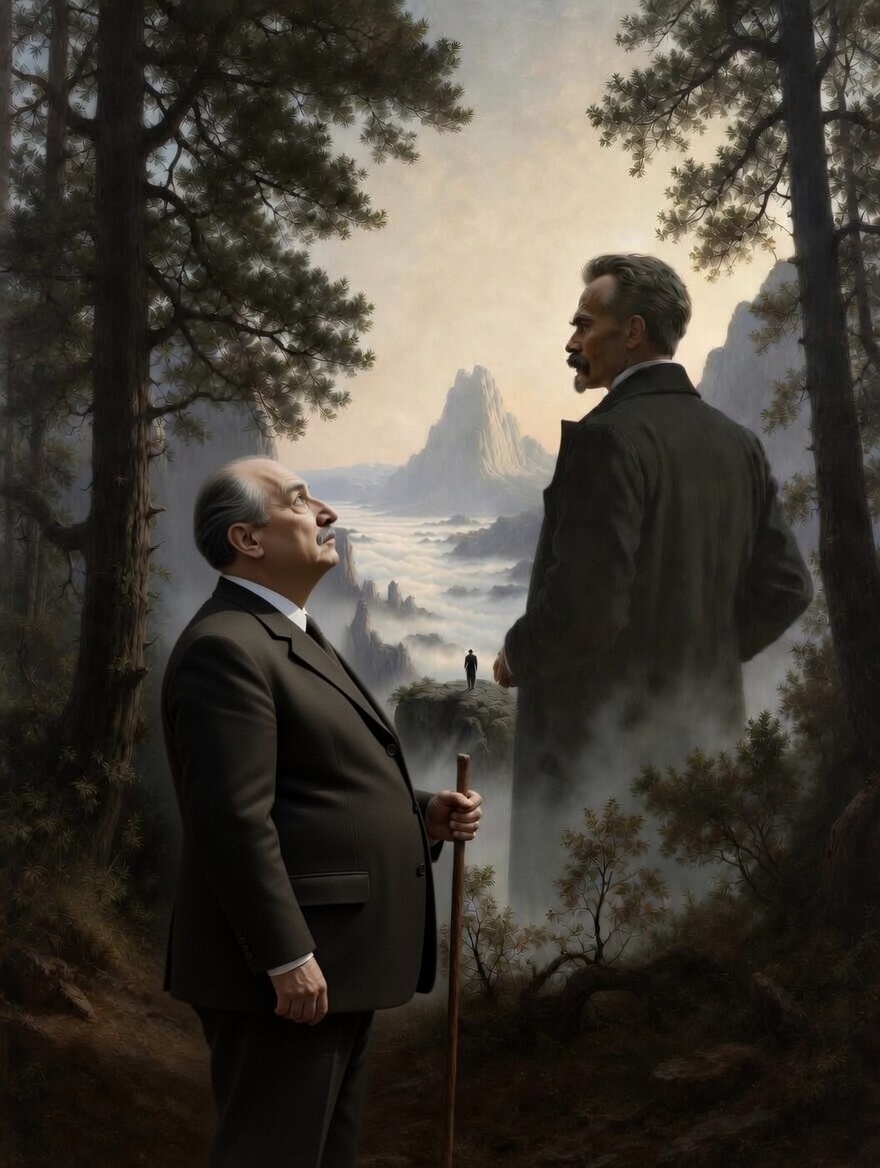
Friedrich Nietzsche is an extraordinarily significant thinker for the Right. His affirmation of hierarchy and natural inequality and his analysis of Leftism as moved by ressentiment are extremely important to us. Yet, viewed from the Right, there are also major problems with Nietzsche’s thought. His historicism and relativism (or “perspectivism”) are both highly problematic. Nietzsche’s affirmation of “the overman” involves a dangerous sort of voluntarism that seems of a piece with the worst excesses of the Left. The very idea that one can “create new values” smacks of a pernicious subjectivism. There is much that can inspire us in Nietzsche, but his thought often seems to herald some of the worst modern tendencies.
In assessing Nietzsche’s place in the history of philosophy, there is no better guide than Martin Heidegger. In Heidegger’s writings on Nietzsche, one great philosopher confronts another. Moreover, Heidegger is a thinker of the Right, and thus his confrontation with Nietzsche often speaks directly to our particular concerns. Heidegger’s Nietzsche Lectures span four large volumes—a total of almost a thousand pages in David Farrell Krell’s English translation.[1] From Heidegger, I have learned more about Nietzsche than from any other commentator. There are countless scholarly studies of Nietzsche and some of them are quite good. But few commentators on Nietzsche can also claim to be the most important philosopher of the twentieth century.
This essay on Heidegger and Nietzsche, the first of several, represents the conclusion of a series I have been writing since 2020. I originally called it “Heidegger’s History Metaphysics.” I dropped that title after a while, as I had the impression that readers were put off by an article with a title like “Heidegger’s History of Metaphysics: Part Eleven.” Even though the essays were all relatively self-contained, some readers thought that if they’d missed the first ten parts, the latest installment would be unintelligible.
These essays on Nietzsche represent the conclusion of that series because Heidegger claims that Western metaphysics ends with Nietzsche.[2] Actually, as we will discuss in a moment, he also sometimes speak as if metaphysics ends with Hegel (a matter I discussed in my series “Heidegger, Hegel, and the Completion of Western Metaphysics”). We could accurately describe Nietzsche, however, as the bitter end. Heidegger’s history of metaphysics is highly critical. He attempts to show that Western metaphysics is the expression of an anthropocentrism that culminates in the meaninglessness and inhumanity of modern technological civilization. Hence, the point of studying this history, as interpreted by Heidegger (and the point of my series), is to understand ourselves and the modern world.
It is in the Nietzsche Lectures that we see this account of the history of metaphysics truly coming together and revealing its explanatory power. Heidegger writes: “If in Nietzsche’s thinking the prior tradition of Western thought is gathered and completed in a decisive respect, then the confrontation with Nietzsche becomes one with all Western thought hitherto.”[3] Thus, if Heidegger’s interpretation of Nietzsche is correct, we see in Nietzsche the revelation of the concealed spirit of metaphysics. To understand the history of metaphysics we must understand it backwards, from Nietzsche.
Nietzsche completes something, but he also prepares the way for something else. Heidegger alludes to this when he writes,
The highest decision that can be made and that becomes the ground of all history is that between the predominance of beings and the rule of Being. . . . Nietzsche is an essential thinker because he thinks ahead in a decisive sense, not evading the decision. He prepares its arrival, without, however, measuring and mastering it in its concealed breadth.[4]
Nietzsche prepares the ground for the ultimate result of metaphysics, which is not actually a work of philosophy. It is modern technological civilization itself. But how can a philosopher do this? Does Heidegger think that philosophers somehow move the world? No. Instead, he believes that philosophers give expression to the spirit of the times. The anthropocentrism that moves through the history of metaphysics is a gathering or burgeoning anthropocentrism that besets Western man and gets expressed in purer and more extreme forms over the course of history.
What is the origin of this anthropocentric spirit? We will discuss this later, but for Heidegger it is deeply mysterious. A philosophy, like anything else, is an expression of the spirit of the times, and is thus moved by the same mysterious forces that move all else. Philosophers give voice to that spirit—but they are also capable of giving voice to a change in the Zeitgeist. Thus, philosophers sometimes function as prophets. Nietzsche is a perfect example of this. He looks back—in fact, all the way back to pre-Socratic philosophy—and his thought is the culmination of all that has come before. Yet, at the same time, he looks ahead, into an abyssal future.
The end of Western metaphysics does not mean the end of Western philosophy. For Heidegger, the death of metaphysics makes possible an “other beginning” (anderer Anfang) for Western thought. The “first beginning” (erste Anfang) was with the early Greek thinkers, and culminates in Nietzsche—or, we could say, with him it reaches a dead end. The “other beginning” is what Heidegger believes he inaugurates. Much later, we will discuss what that consists in.
2. Heidegger’s Reading of Nietzsche: Sources and Approach
Heidegger’s attitude toward Nietzsche is not entirely critical. He regards Nietzsche as one of the greatest philosophers and states that “Nietzsche belongs among the essential thinkers.”[5] I would also maintain (and I think few scholars would disagree with me) that Heidegger’s thought was positively influenced by Nietzsche’s. Even Heidegger’s critique of metaphysics owes something to him. Nietzsche saw the history of metaphysics from Socrates onward as the expression of a concealed will to power. As we shall discuss, Heidegger’s own conception of metaphysics is remarkably similar.
You can buy Collin Cleary’s Summoning the Gods here.
Our major sources for Heidegger’s treatment of Nietzsche are the aforementioned four volumes of the Nietzsche Lectures. Heidegger discusses Nietzsche throughout his writings, but my essays will draw primarily upon the Lectures. In addition, I will make some use of Heidegger’s lecture course What is Called Thinking? (1951-1952, published in 1954) which contains an extended discussion of Nietzsche. In discussing the Nietzsche Lectures, I will draw freely from all four volumes, giving Heidegger’s ideas a thematic order that is different from the original. The Lectures were delivered between 1936 and 1940 at the University of Freiburg. Thus, they are also interesting for the light they shed on Heidegger’s attitudes toward National Socialism (though one must read between the lines to see this). Heidegger published the lectures as a two-volume set in 1961. They were translated into English by David Farrell Krell and published in the period 1979-1982.
Heidegger’s interpretation of Nietzsche is highly controversial. One major bone of contention is that the Nietzschean text Heidegger focusses on is The Will to Power. However, Nietzsche never completed or authorized a book with this title, though he did plan one in the mid-1880s and left many notes on the theme. The volume titled The Will to Power was assembled from those notes by Nietzsche’s sister Elisabeth Förster-Nietzsche and Nietzsche’s friend Heinrich Köselitz (aka Peter Gast).
The result was published in 1901, the year after Nietzsche’s death, and then expanded in 1906. Heidegger discusses the history of the editions of the text and subsequent scholarly attempts to reorganize its contents. The major scholarly objections to treating The Will to Power as a source for Nietzsche’s thought are twofold. First, we cannot be sure that Nietzsche intended any of the notes contained therein for publication, and some may represent sketches of ideas that Nietzsche may have abandoned or rethought. Second, the editors have taken it upon themselves to give the notes a thematic organization of their own devising, which Nietzsche himself did not approve.
Heidegger does frequently allude to or quote from the texts Nietzsche himself prepared for publication, but he uses The Will to Power as his major source. Furthermore, he does so in full awareness of the problematic nature of the text. Heidegger defends his use of it as follows:
If our knowledge were limited to what Nietzsche himself published, we could never learn what Nietzsche knew perfectly well, what he carefully prepared and continually thought through, yet withheld. Only an investigation of the posthumously published notes in Nietzsche’s own hand will provide a clearer picture.[6]
Heidegger himself italicized the first sentence of this quote, and perhaps the key words of that sentence are “yet withheld.” Heidegger implies, whether or not this is true, that Nietzsche hesitated to publish these thoughts.
It is undeniable that Heidegger’s use of The Will to Power is open to the objections stated a moment ago. But perhaps too much has been made of this issue. In many other cases, scholars make use of a philosopher’s Nachlass (his unpublished literary remains) to illuminate his thought. Often major points of interpretation hinge on something found in the Nachlass. And it is the case that sometimes the Nachlass contains material that a thinker considered too shocking or controversial to publish during his lifetime (this is certainly true of Heidegger’s own Nachlass; see The Black Notebooks). So long as the Nachlass is interpreted in the light of a thinker’s published writings there is, in principle, no problem with making use of it. As noted, Heidegger draws on Nietzsche’s published work together with The Will to Power.
Having now given the reader an introduction to the topic of Heidegger’s treatment of Nietzsche, we must turn to a crucial question: what is metaphysics? The title, incidentally, of a 1929 lecture by Heidegger). If Heidegger’s central claim about Nietzsche is that he brings metaphysics to an end, we can hardly understand that claim unless we understand what Heidegger means by metaphysics. This topic has been covered in my earlier essays, but a brief summation is in order.
3. What is Metaphysics?
The most “general” definition we could give of metaphysics, fit for inclusion in a university course catalogue, would be that it is the study of the fundamental nature of reality. The term itself comes from the title given to some of Aristotle’s lecture notes. Meta ta physika means that which comes after or goes beyond the physical things (depending on how meta is interpreted). It may simply mean the subject matter to be studied after the subject matter covered in Aristotle’s Physics.

You can buy Collin Cleary’s What is a Rune? here
Christian Wolff (1679-1754) distinguished between “general metaphysics” and “special metaphysics.” The former deals with ontology, or the study of being-as-such; with what it means to be. The latter is subdivided into philosophical theology, rational psychology, and cosmology. These deal, respectively, with God, the soul, and the cosmos considered as a totality. This Wolffian categorization was adopted by Kant. General metaphysics deals with being, whereas special metaphysics deals with certain very special sorts of beings.
Heidegger understands metaphysics as a discipline that initially sought to answer the “general metaphysical” question “what is being?” Instead of doing so, however, it very quickly became side-tracked into talking about beings instead. The history of metaphysics is thus characterized almost from its very inception by forgetting about being-as-such. To understand what Heidegger means by this we must understand what he calls the “ontological difference.”
The ontological difference” (ontologische Differenz) is the difference between being and beings. We say that the book in front of me is a being, because it has being. Things, like a book or the keyboard next to it, are beings: things that have being, things that are. Ontology is concerned not with beings, but with the being that beings have. But what is this? That is the fundamental question of metaphysics: What is being?
In English things get confusing because we are forced to use the same word in two different ways: being vs. beings. Matters are less confusing in German, where the being that a being has (being-as-such) is das Sein, a noun constructed from the infinitive of the verb “to be” (sein). Beings, the things that have being, Heidegger calls das Seiende. This is actually a singular noun, and is probably best translated “what is” or “that which is,” but it is understood to refer to beings, the things that have being.[7]
To take the ontological difference seriously is to recognize that being cannot be a being. If being were a being (i.e., one of the beings) it wouldn’t be being: it would simply be yet another thing that has being. To draw an analogy, you could say that what my dogs have in common is that they both possess the characteristic of dogness. I’m not sure how to define dogness, but I do know that dogness can’t be a dog. If it were, it would be something that has dogness, not the characteristic of dogness as such. To understand this is to understand the ontological difference. To fail to understand it, to fail to distinguish being from beings, makes understanding Heidegger’s thought impossible. However, failure to distinguish being from beings is precisely what made the Western metaphysical tradition possible in the first place.
Heidegger claims that all previous philosophers have failed in the task of thinking being, because in one way or another they sidestepped the question “what is being?” and talked instead about some being or other, some thing that has being—usually a very special or exalted being, but a being nonetheless. For Heidegger, Aristotle presents a paradigm case of this. Near the beginning of the Metaphysics, he tells us that his subject matter is “being qua being” (being-as-such). He says that the science that studies this is not the same as any of the special sciences for they each “cut off” some part of being and study that, rather than studying being qua being.[8]
In other words, Aristotle is saying that each of the special sciences studies some being or other: astronomy studies the stars, biology studies living beings, geology studies the earth, etc. They study things that have being, things that are, but not being as such; not what it means to be in the broadest possible sense. It will be the task of what Aristotle calls “first philosophy” to study being qua being.
However, to make a very long story short, Aristotle winds up deciding that the best way to understand being is to investigate that which is the highest or most perfect of the beings, of the things that have being. This is how Aristotle transitions to talking about God. He reasons that everything else is said to “be” insofar as it approximates to being like God, which, as the most perfect of the beings, is also the one, true being of which all others are effectively pale imitations.
The resulting conception—Aristotle’s theory of the Unmoved Mover—is certainly awe-inspiring, but, as Heidegger points out, it fails in one crucial respect. Aristotle had set out to learn what “being qua being” is. The metaphysics he produces, however, completely fails to do that. Instead of exploring being-as-such, Aristotle effectively abandons ontology and turns to theology instead. In other words, instead of giving us an account of being-as-such, he changes the subject and discusses the highest or most exalted of the beings. Again: Aristotle discusses a being, not being qua being. Thus, for Heidegger, Aristotle leaves the question “what is being?” unanswered. Heidegger contends, further, that all subsequent metaphysics also “forgets” being or confuses the ontological difference.
If the reader has understood the foregoing, I must now throw him a curve: Heidegger is not always consistent about how he uses the term “being.” In his later philosophy, by “being” (Sein) he frequently means what he calls elsewhere die Lichtung, which we translate as “the clearing.”[9] Thus, the “forgottenness of being” comes to mean the forgottenness of the clearing. This position does not contradict Heidegger’s critique of metaphysics as confusing being and beings. It just approaches the problem from a more fundamental level.
As noted earlier, Heidegger also confuses us by sometimes asserting that Nietzsche ends Western metaphysics and sometimes crediting this achievement to Hegel. Sometimes he credits both. In the Nietzsche Lectures he refers to Hegel as the thinker “who together with Nietzsche brought about the fulfillment of metaphysics.”[10] He elaborates upon this elsewhere in the Lectures. Having stated that Descartes provides the foundation of metaphysics in the modern era because he grounds “the metaphysical ground of man’s liberation in the new freedom of self-assured self-legislation,” Heidegger states that Hegel’s philosophy seems to be a “fulfillment” of this modern metaphysical ground. But this is true only insofar as Hegel’s thought is
an anticipation of the areas in which the history of the nineteenth century moved. Thought in terms of metaphysics, the fact that this century took its stand against Hegel on a level beneath Hegelian metaphysics (that is, the level of positivism) is merely proof that it was thoroughly dependent on him and that this dependence was first transformed by Nietzsche into a new liberation.[11]
Here, Heidegger seems to suggest that Hegel prepares the way for Nietzsche; that Nietzsche radicalizes some element that is to be found in Hegel’s thought. We could also say that Nietzsche goes “further” than Hegel, in some respect. This is extremely vague and it will have to remain vague—but only for a while. All will be revealed later.
Let us now consider how Heidegger frames the issue of an “end” to metaphysics. What exactly does it mean for metaphysics to come to an end? Many professional philosophers today would balk at this. This would be especially true of Anglo-American philosophers, who tend to think in terms of what they believe are eternal, ahistorical “branches” of philosophy. For them, metaphysics is timeless in the way that astronomy is timeless. Men have always studied the stars, and men have always done metaphysics—or, at least, they have done so since Thales.
Heidegger, however, sees metaphysics not as a timeless discipline but as a specific, historically situated intellectual project with certain presuppositions built into it. Heidegger writes,
But then what does it mean, “the end of metaphysics”? It means the historical moment in which the essential possibilities of metaphysics are exhausted. The last of these possibilities must be that form of metaphysics in which its essence is reversed. Such a reversal is performed not only in actuality, but also consciously – although in different ways – in Hegel’s and in Nietzsche’s metaphysics. In the view of subjectivity, the conscious act of reversal is the only one that is real; that is, appropriate to subjectivity. Hegel himself says that to think in the manner of his system means to attempt to stand – and walk – on one’s head. And Nietzsche very early describes his philosophy as the reversal of “Platonism.”[12]
Elsewhere in the Lectures, Heidegger refers to Nietzsche as reverting “to the very commencement of Greek thought.” Nietzsche’s philosophy “closes the ring that is formed by the very course of inquiry into being as such and as a whole.” Nietzsche does not recover the fundamental positions of the “first beginning” and leave them unaltered. Rather, he presents them in a “transformed configuration.”[13]
Much later, we will discuss what Nietzsche’s “reversal” of Platonism means. In Nietzsche, Heidegger sees the history of metaphysics as reaching closure because with him it comes full circle. And the metaphor of the circle (note Heidegger’s use above of “the ring”) will, incidentally, turn out to be very important: for Nietzsche and for Heidegger. It is one clue to understanding how Nietzsche heralds the spirit of modern technological civilization, as we shall see.
Heidegger states that “Nietzsche anticipates the consummation of the modern age with his unique thought of the will to power.” He constitutes the transition from what Heidegger calls the “preparatory phase” of the modern age (the years 1600-1900) to its “consummation.”[14] We are now living in the period of that consummation. We are living, Heidegger says, “in the age of Nietzsche’s metaphysics.”[15]
4. The Forgottenness of the Clearing
So far, we have spoken rather vaguely about certain tendencies in Western metaphysics finally playing themselves or reaching “consummation” in Nietzsche. And we have spoken of a concealed anthropocentrism in metaphysics. It is now time to expand upon these claims. To do so, we must return to the topic of the “forgottenness of being.”
Earlier I explained Heidegger’s ontological difference and noted that his criticism of metaphysics is that it forgets being-as-such and occupies itself exclusively with certain sorts of beings. However, I also noted that sometimes by “being” Heidegger refers to what he calls the clearing. The clearing, as we shall see, is what “gives” being. Thus, to speak of the clearing is to speak of something even more fundamental than being. And this means that Heidegger’s most fundamental criticism of metaphysics is that it forgets the clearing.
Obviously, to understand this claim we must discuss what the clearing is, and how it was forgotten. I have discussed the clearing in quite a few essays, but here I will offer a brief account for the benefit of readers who have not followed the earlier essays. And I hope that faithful readers will forgive me for repeating myself.
As an introduction to the topic let us consider a statement Heidegger makes in the Nietzsche Lectures:
We today, and many generations before us, have long forgotten the realm of the unconcealment of beings, although we continually take it for granted. We actually think that a being becomes accessible when an “I” as subject represents an object. As if the open region within whose openness something is made accessible as object for a subject, and accessibility itself, which can be penetrated and experienced, did not already have to reign here as well![16]
What Heidegger means here by “the unconcealment of beings” and by the “open region” is the clearing. He rejects as naïve the notion that beings become accessible to us when a “subject” “represents” an “object” (as in the representationalist model; I have placed all these terms in square quotes because, from Heidegger’s point of view, all are problematic). This assumes that beings become accessible to us as a result of an “act” of the subject. The problem with this way of looking at things is that something only becomes an object for a subject in virtue of a prior “openness.” In other words, the open region has to “reign.” For the being of a being to be given to us, this open region—the clearing—must, in a sense, already be operative.

You can buy Collin Cleary’s Wagner’s Ring & the Germanic Tradition here.
Now, the foregoing is likely to be utterly baffling to the uninitiated, so we have to go into more detail. First of all, it is crucial to keep in mind that Heidegger’s approach is phenomenological. His aim is to give a pure description of our experience of being and beings. As a phenomenologist, Heidegger does not make metaphysical claims about what exists and what does not. We have an experience of being, but it is not like our experience of an object in the world. We must not make the mistake of reifying being or the clearing – i.e., thinking of them, respectively, as a “thing” or a literal “region” or “place.”
Heidegger arrives at his concept of the clearing by asking a fundamental question: in virtue of what is being given to us? Heidegger phrases the issue in very simple terms in the Nietzsche Lectures: “the question of what being in truth is must at the same time ask what the truth in which being is to be illumined itself is.”[17] Here, Heidegger is saying, in effect, that there is a deeper question than “what is being?”: what is it that illumines being, or in virtue of what does being present itself to us? His choice of words here is also very precise. He refers to the truth “in which” being is illumined, suggesting a kind of containment: there is something “in which” being presences itself. This something is the clearing.
The term itself is a metaphor and it refers to a clearing in a dense forest, which allows light to enter in and illuminate what appears within it. Heidegger writes in “The End of Philosophy and the Task of Thinking” (1964):
The forest clearing is experienced in contrast to dense forest, called Dickung in our older language. The substantive “opening” [Lichtung] goes back to the verb “open” [lichten]. The adjective licht “open” is the same word as “light.” To open something means: to make something light, free and open, e.g., to make the forest free of trees at one place. The openness thus originating is the clearing. . . . Light can stream into the clearing, into its openness, and let brightness play with darkness in it. But light never first creates openness. Rather, light presupposes openness. However, the clearing, the opening, is not only free for brightness and darkness, but also for resonance and echo, for sounding and the diminishing of sound. The clearing is the open region for everything that becomes present and absent. . . . What the word [opening] designates in the connection we are now thinking, free openness, is a “primal phenomenon” [Urphänomenon], to use a word of Goethe’s.[18]
Here, “light” stands in for being: when we experience things, their being “illuminates” them. Let’s illustrate this with a phenomenological description of just such an experience of being. Suppose I am walking through the Black Forest and I see an unfamiliar object some distance ahead. I do not recognize the object at first, but as I approach closer it is as if suddenly the being of the thing “comes forth” to meet me and to reveal what it is: Aha! It’s Heidegger’s hut. In the moment that I realize the object is Heidegger’s hut, what has occurred is that the being of the thing—what it is, what its meaning is—becomes present to me.
However, Heidegger says, “light never first creates openness. Rather, light presupposes openness.” In order for the being of the object to become present, there must exist for me a certain special sort of openness, within which the being of something makes itself known, or makes itself apparent. The clearing is a metaphorical “space.” In addition to the measurable, physical space I experience myself as inhabiting, it is as if I also inhabit a “space” of being or meaning.
But where is this openness, this “space”? Is it within me—is it “subjective”—or is it somehow in the world? We want to insist that this openness is “within me,” that it is “subjective,” because it does not show up as an “object” in the world (instead, all objects show up within it). But Heidegger wants to entirely avoid a “subjective” treatment of the clearing as some sort of “faculty” or a priori structure that I carry around “inside me.” The reason is that this treatment of the clearing is phenomenologically untrue. I do not, in fact, experience the clearing as something “in me” that is “mine.” Nor do I experience it as something over which I have any kind of influence or control.
I experience myself and everything else within the clearing, because it is only within the clearing that experience, the presencing of all that presences itself to me, is possible. As I have said many times on previous occasions, I do not “have” the clearing; it has me. There is thus no real basis for “subjectivizing” the clearing; for locating it “within the subject.” Indeed, Heidegger critiques the subject/object distinction prevalent in philosophy since Descartes, which locates certain “properties” as “within” a subject, as if this subject is a kind of cupboard in which we dwell, removed from an “external world.”[19]
The result of this is that, for Heidegger, we may speak of something deeper or more ultimate than being itself (hence, he calls it an Urphänomenon): that which allows our encounter with the being of beings in the first place; the open clearing. The history of metaphysics is the history of the forgottenness of the clearing. We have forgotten that in virtue of which being is given to us.
It is this history that culminates in Nietzsche—and in modern technological civilization. But how did the clearing get forgotten? Here, Nietzsche can provide us with a useful way of putting things—though one that we will have to explain at length in the next installment. What caused us to forget the clearing was will to power.
Notes
[1] The title of the book is actually Nietzsche, but scholars refer to the text as the Nietzsche Lectures. My page count excludes the “Analysis” by Krell that closes each of the four volumes. Krell’s translation is available in two large paperbacks. The first book contains Volumes One and Two, and the second Volumes Three and Four. Throughout this series, “volume” refers to one of the four volumes. It never refers to the two large books, each containing two volumes. The bibliographical information is as follows: Martin Heidegger, Nietzsche, Volumes One and Two, trans. David Farrell Krell (New York: HarperCollins, 1991); Martin Heidegger, Nietzsche, Volumes Three and Four, trans. David Farrell Krell (New York: HarperCollins, 1991). Again, reference is to volume number, so that a reference to “Vol. 4” refers to the latter half of the second text just cited. Each of the four volumes has its own pagination. The Nietzsche Lectures will be referred to as “NL” in all endnotes.
[2] See, for example, NL, Vol. 1, 10.
[3] NL, Vol. 1, 4.
[4] NL, Vol. 3, 5.
[5] NL, Vol. 4, 4.
[6] NL, Vol. 2, 15. Italics in original.
[7] In order to avoid confusion, many anglophone Heidegger commentators have adopted the convention of capitalizing the initial letter of Being, to indicate that what is referred to is Being-as-such, the Being that beings (small b) have. However, this practice is falling into disuse, for reasons we need not go into. I do not use it here, though it occurs in some of the translations I quote.
[8] Metaphysics Gamma, Chapter One, 1003a2-30.
[9] Heidegger sometimes uses the archaic spelling Seyn to indicate that he is speaking about the clearing.
[10] NL, Vol. 3, 107.
[11] NL, Vol. 4, 100-101.
[12] NL, Vol. 4, 148.
[13] NL, Vol. 2, 199-200.
[14] NL, Vol. 3, 6.
[15] NL, Vol. 4, 195.
[16] NL, Vol. 4, 93.
[17] NL, Vol. 1, 68.
[18] Martin Heidegger, Basic Writings, ed. David Farrell Krell (New York: Harper and Row, 1977), 384-385. This essay was translated by Joan Stambaugh; italics added.
[19] See Heidegger, Being and Time, trans. Joan Stambaugh, rev. Dennis J. Schmidt (Albany, NY: State University of New York Press, 2010), 60-61.
12 comments
So happy to see the beginning of the conclusion to this wonderfully rich and erudite series, one that single-handedly reinvigorated my interest in philosophy back when I originally ran into it in 2020. Are there any plans to publish your essays as a book? I would buy it in a heartbeat.
The clearing reminds me of two things: first, Plato’s khôra or “receptacle,” where things can appear except taken broadly to mean the very possibility of intelligibility simpliciter, before we split reality into subject and object. Second, it reminds me of the purpose of Kantian transcendental idealism, but instead of being the conditions that make experience intelligible to the mind, it is more like the opening that lets beings show up in their Being at all. In both cases, Heidegger radicalizes the analogous concept from philosophy to something deeper and more underlying.
Thank you for your very kind words. Yes, eventually these essays will be published in book form, though it will probably have to be more than one book, as there are just too many. The comparisons you make are very valid. The clearing can be understood as transcendental subjectivity de-subjectivized. Under the influence of representationalism, Kant insists on locating transcendental subjectivity “inside” the subject as a “faculty.” Heidegger argues that this is phenomenologically untrue. We do not encounter the clearing “inside” us. That in which beings become present to us is not something “subjective.” We are in it as well! Other comparisons are possible. There is also the zimzum of Lurianic kabbalah; this is actually a really interesting parallel, worth looking into. Also, the clearing is very Eckhartian. See the latter parts of my 15-part Schelling series. And let’s not forget kaos and ginnungagap. More to come! Thank you for being a faithful reader.
I can’t confidently say I understood a word of that, but thanks for writing it. Lately I’ve been occupied with the ontology of tom bombadil from Tolkien. It’s a very fraught question.
Thank you for reading nonetheless!
Anthony Ludovici wrote 3 books about Nietzsche. They are a good intro for those who want to start with a commentarist belonging to our side.
Thank you for your clear style and thorough explication; I believe I am begging to grasp Heidegger, however faintly. I wrestled with Being and Time unsuccessfully, and other summaries of his philosophy were hardly better.
Personally, I think looking at Heidegger through his critique of the history of metaphysics and the beginning of a “metaontology” (which is probably just ontology “done right”) makes it much easier to understand what he is trying to do. The degree to which he is engaged in existentialism, or even phenomenology, seems almost experimental and is largely subservient to that project of critique and is relatively much less interesting overall (while still profound).
If someone looks at Heidegger and takes away merely Being-towards-death or something along those lines, I can almost guarantee that they have not engaged with Heidegger meaningfully.
I’m interested to see what you have to say on Heidegger’s view of race and biology. I bought the Krell books to see what Heidegger has to say, but Krell says that he was “repelled by the racism and biologism of his Party” (the NSDAP); and apparently Heidegger referred to these Nietzsche lectures as proof of that. So, if true, while it’s all well and good for Heidegger to criticize Nietzsche’s nihilism and subjectivity, if he gets race wrong, then I’m skeptical as to how useful Heidegger can be philosophically.
I know, that’s kind of shallow of me, but I’m so tired of this philosophical denial of the race, of the real biology of things. I think of this passage from the Black Notebooks:
“The question of the role of world Jewry is not a racial question, but the metaphysical question about the kind of humanity that, without any restraints, can take over the uprooting of all beings from being as its world-historical “task.””
If it’s not a “racial question”, then what is the “Jew” (for instance) as opposed to anyone else? I’m probably just ignorant, but never understood how this kind of “metaphysical race” argument, or “cultural” argument is supposed to work. Because all our perceptions of these things, these words, have reference to real people, to biological reality. Why deny it or belittle it? If these groups have essence, then they must in part, largely reflect something in the world; even if not all members of this group can be said to have the same essence (exceptions do of course exist).
This comment is intended as a reply to Arthur, Comment #5, above: Heidegger is in good company in downplaying the importance of biological race. Evola, Yockey, and Spengler (himself partly Jewish) took similar views. In part, they saw biological race as an English, materialist concept. At the same time, Jews themselves are not strictly a biological race: they descend primarily patrilineally from the Levant, yet modern Judaism is transmitted through the mother, have roughly 50 to 60% European ancestry (among Ashkenazi), and have lived in Europe longer than many groups with Central Asian origins, though admittedly modern Bulgarians and Hungarians carry no more than 3% of such blood. Jewish perseverance illustrates how spiritual and cultural factors often matter more for group cohesion than blood ties alone.
Even so, from our 21st-century vantage point, Heidegger and his peers were mistaken to minimize biological race—an overreaction to 19th-century materialism. He was nonetheless correct on the deeper issues.
Heidegger may be in “good company”, but I still disagree with all those people on this issue as well, which is why I’m tired of this trend.
But I do agree with you that this view might be an over correction against materialism. Still, I think it’s a bit embarrassing for these people to make such a mistake. Obviously they didn’t live to see our times, and it is the experience of the current time that makes the issue of biological race particularly profound. it is profound for us how this clash between races has occurred in the last few decades.
And say what you want about the “crude materialism” of the biological “racists”, they’re the ones who have been consistently proven right in their predictions – and who had predictions in the first place.
Time and again, these “racists” have been confirmed in both the scientific sphere, and the politico-social one. This is thanks to their materialism, which is what, at the end of the day as our civilizations dwindle and are subsumed by foreign biomass, will make the difference in every sphere of life. Not least the intellectual.
Your point about the Jews is well taken; but for my part they were just an example since I was talking about Heidegger. The real danger in the purely metaphysical thinking about race is that it will lead to some kind of civnatism.
And also, it smacks of disingenuousness to me. Like when leftists claim “white supremacy” or “whiteness” doesn’t refer to white people/Europeans as a race. We all know it does. The reference people have in mind is of a group of people. The same with designating “racial spirits” or whatever – again I warn of my own ignorance as to these concepts – which just seem to me pointless unless the spirit corresponds, generally speaking, to a real group of people.
Collectivity is a great simplifier. Grouping people together, people of like mind, is easier to do if you can anchor them in some kind of trait that corresponds to something more or less immutable. Things like “blood ties alone”, as you say, I agree are not enough necessarily, but they’re one part of the puzzle. If you reduced these “spirits” down, you’d eventually come to something like individuality, or having to operate on an individual basis, which is just impossibly impractical. And people can lie to you. Which is why, even if it seems a bit nonsensical, or weird, to use things like blood-ties, culture, custom, or whatever as a proxy for belief and ideals, it works better than just taking some atomized individual at his/her word.
IMO Nietzsche and those that follow him would have been better off if he had spent less time thinking , writing trying to dissect everything important that has ever been written , said or thought and instead he should have played beach volleyball with some sexy German Brazilian women in bikinis .
i think Richard Wagner had his friend Nietzsche in mind when he scripted the Rhinemaidens teasing the Je& dwarf Alberich and also when Siegfried was getting metaphysical speaking bird languages to birds – the birds kind of flipped Siegfried …. Flipped him the bird .
🙂
jr
This is a joke, right?
If you have a Subscriber access,
simply login first to see your comment auto-approved.
Note on comments privacy & moderation
Your email is never published nor shared.
Comments are moderated. If you don't see your comment, please be patient. If approved, it will appear here soon. Do not post your comment a second time.