
You can buy Jonathan Bowden’s Reactionary Modernism here.
2,771 words
Part 4 of 7 (Full series here.)
Edited by Greg Johnson and Peter Jacobi
In 1995, Jonathan Bowden self-published his Collected Works in six volumes (London: Avant-Garde, 1995), edited by Jürgen Schwartz, one of Bowden’s pen names. These volumes comprise 27 distinct books, 12 of which had been previously published. Altogether, the Collected Works contain more than 2,600 pages of rare early Bowden.
Deliverance is the fifth book in the second volume. It had not been previously published. We will publish it online in seven installments.
Like many of the Collected Works volumes, Deliverance covers a wide range of political and cultural topics. But instead of interspersing these analyses with fictional narratives, Deliverance is fictional from beginning to end.
Eventually, a fully annotated version of Deliverance will appear at the Jonathan Bowden Archive. It will then be followed by similar editions of the rest of the Collected Works, plus a couple more early volumes that were not included. — Greg Johnson
But to return to Bosch: elsewhere in the aforementioned picture we see two undulating and asymmetrical planes—sloping away from one another in opposite directions—and traversed by hidden archers with bow and arrow at the ready (more accurately; cross-bows) to trap the unwary. The creatures who are wielding these fiercesome weapons are themselves dark and subdued (from a distance). They appear to be negroid—cast off the fat—look at the colour and texture of the skin—dark oracle of fate; viaduct of treacle—but on closer inspection they are strangely familiar creatures: anthropoid beasties, mild waifs of self, abandoned and fleetingly erotic moments, hunting their trajectory home. In this particular diagram, they are stealthily pursuing an angel with wings who is in the company of a naked man who appears to be beckoning her down below. To what fate—we know not! Yet the entire picture seems to infer a certain meaning: the possibility of erotic dissonance at the moment of the rupture of the self: the degree to which the Apocalyptical moment—the literal end of the world—always faced two ways at once: one way was towards the ecstatic bravura of arrested peace; the other was towards the fleshiness of the pit—the hint of erotic disembowelment. While on the other mock-horizontal surface—the transverse beam—the lost moment—an echo or forgotten promontary of self—we see a naked man (invisible from the torso up)—in the company of a vaguely human creature; a beast of man; a vivisected insect—something not to write home about—clad in armour; humanoid of lost fructification—as he leads by the hand his hapless namesake out of the field of force; the spectre of delirium (as orchestrated by the picture); into the sunny downlands beneath the frame—with a ladder slung over one shoulder—with the visor down: the template of the armoured God open for all to see—only to reveal the emptiness and avidity (the bug-eyed insouciance) of a human glare. Now we need to freeze the frame and yet move onward slightly towards a similar and yet dissimilar image—an image of frenzy and the absence of wrath—where we see a mottled human carcass about to be dismembered by a malignant beast: itself mottled, glaucous and yet green—yellow-green-grey (take your pick)—with a greyish and off-colour head in the form of a spitting stoat; howling in fury and hatred; scrotum-sack (grey beneath the yellowish green hue of the body) hanging down in shadow; as the creature takes a small sword to the head of the reclining figure. While directly in front of this tableaux of mayhem—the moral senses of Hell running amok—we see a lizard’s egg—possibly a mammalian distemper of the flesh—cracked into two broad pieces—broad-sword cadaver with an arrow through the lot (a recognition of the corpse-bred day)—nestling out of sight in the bottom right hand corner of the image. The egg is split lengthways (along its side): an armoured flank or mock-arm encased in bubbly steel sticking out of the side of the egg—while another stoat-like form glares anxiously from out of the broken egg-shell at an imaginary spectator several feet beyond. Atop the reclining form (just mentioned) we see two pairs of naked limbs, legs as bare as the day they were born, astride the tundra, with the merest hint of a snake, taper or worm—reptile of delirium, sex and terror—coiled around their lower extremities: a creature which is itself reminiscent of an adder or English grass snake seen curled at the bottom of a bucket in Peppard, South Oxfordshire, in childhood—an innocent enough movement of the lithe and trapped form which then struck fear into a childish and innocent heart. [As Brian, bored with the sound of the fresh blood pounding in his ears—the deliverance from the inner hollowness of being—moved his chair around to sit adjacent to the table, there to regale me: Now, look here, John!—with his plans, moves, dodges and dives—concerning the future of the Club—an organization which, in truth, had no future.] But above the reclining figure whose skull was being split open as we speak (or were speaking of: in the manner of Bosch): there ramped a scarlet charger: a strange, partly elephantine form: a horse which was not encased (after the French riders in the battle of Agincourt) in chain-mail or armour for protection: but that seemed to be enrapped—in the manner of those post-modern performance artists who wrap up buildings like the New York Trade Centre—in a scarlet sheath: a prophylactic of the unconscious mind (so-called) stimulated by amyl nitrate—out of which popped an amphibean glare; muscular and affronted—by means of a steed’s head, a mane and after-thought—the gloss of coat. This was an aggressive fish—the sadistic equivalent of Zippy in Rainbow (Mr. Fish in the Marvel Comic Power Man) waving a hatchet with a spike attached. The latter the image of a fish which seemed determined not to have to fillet itself! While beneath the flashing blade of the fish on the table one had to see what could best be described as a fowl—a streak of plummage across a halberd’s grimace—battle-axe foreplay—redundancy of fate—alternatively: the Baconian swish of paint, plastered on with a trowel, sponge or swab, the accidental and contingent variations of modern figurative art: a matter of fish and fowl alone on a table with a man and his knife. While various figures—mottled and transparent—were seen to writhe in torment just off stage—pinioned by the rafts of danger, tendrils of the flesh, the longitudinal spears (of Destiny?) carried aloft by the rider. This was a man (if so he can be called) holding up aloft a shield with a jagged tear within it—victim of a sabre or mace strike—lucky strike—the number of one’s fortune—murderous numerology—and he wore body armour leading up to a blackened face and a cockaded hat with a plume above it: out of which (most incongrously of all) there slipped, flipped and sloshed a fish. While behind this particular figure there was to be seen a decapitated knight: the face bandaged at the eyes and the neck surrounded with bloody gore beneath which was to be seen a whitened disk or diskette—itself streaked with pink and blue—the colours of the Hospital ward (even in the ever-so-inadequate NHS)—underneath which there appeared to be the upper part of a piece of armour—words inadequate to the picture here—either the helmet of a displaced knight in dulled armour who had misplaced his head—only to see it lie, decapitated and still, on a disk (or Herod’s divine plate) above his masked eyes: or the Boschian romance (so depicted) saw a knight riding into battle with sleek dark armour—atop which lay, in the mutilatory vision of a child’s fractured top, the head of a fallen foe: blind-folded in battle. This particular tableaux within a tableaux is reminiscent of the peeling scalp, the fractures of the head, held back in sheets, of Moreau’s vivisected puma. Yet it is also reminiscent of Captain Scarlet & the Mysterons—“once more into the breach!”—the reconfiguration of an aspect of horror into a motif which only sponsors adventure: as in the boy’s own stories of Gerry Anderson—Robert Vaughan sprawled on the grass with an automatic pistol in his hand and a leather jacket on his back: not to mention the enigmatic and mysterious smile of Nyree Dawn Porter—both from The Protectors. Truly, this is the moment when the pathos of war and hand-to-hand combat merges with decapitated puppet-heads—eraser-heads—in the boy’s room [to re-adapt Marilyn French]—at a time when Asterix the Gaul, mediaeval knights, the Templars, the Johannites of the Temple of Solomon (before their fall under papal persecution) and the gun-fire of Captain Blue (against a ricocheting target) merge (somewhat effortlessly) with the Waffen SS. When Marvel Comics merges with the Gulf War—a war which the French theorist Jean Baudrillard claimed did not take place!
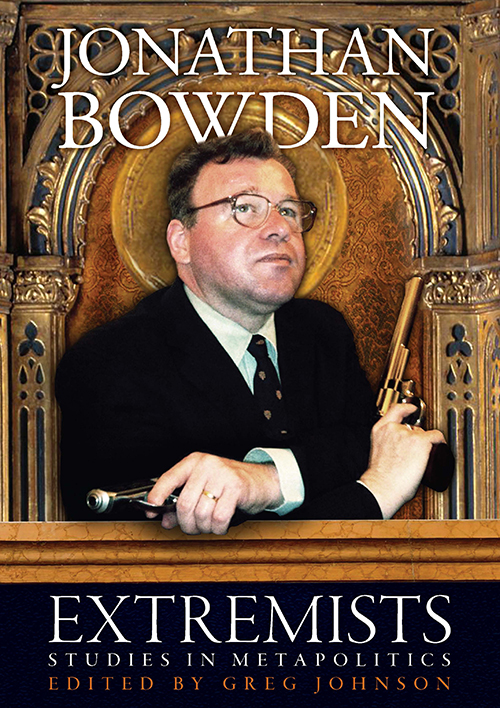
You can buy Jonathan Bowden’s Extremists: Studies in Metapolitics here.
Yet there is one interesting parallel here: not just between high and low art—but also between the reconfiguration of a pessimistic mantra—the dithyrambics of a genius maudit*—and a type of politics or meta-political intrigue which is ontologically pessimistic and metaphysically conservative. (*As John Calder, the card-carrying liberal and depressive British avant-garde publisher, referred to William Burroughs—primarily to salve the out-raged guilt, anti-white racism, “liberal” hatred and self-alienation of a member of the cultural glitterati—a despairing member of the chattering classes—who believes that we are living in a “Fascist” state. If only we were. Then Mr. Calder would have something to complain about from the perspective of the pessimistic and yet privileged libertarianism which he adopts (an anarchism of the middle-class bohemian “left”). The sort of viewpoint which one sees adopted by a polite and middle-class anarchist monthly like Freedom (founded by Prince Peter Kropotkin). Although if Mr. Calder was ever forced to live under a fascist regime he would doubtless collaborate—in the manner of Alistair Hamilton’s The Appeal of Fascism: Fascism and the Intellectuals (Blond)—probably by publishing the collected edition of Robert Brassillach’s poems Poesies. For when certain writers and artists, such as Sade, Burroughs, Mishima, Acker, Bosch, Bacon, Grunwald & Junger, adopt a purely pessimistic view of human society and its development, then they automatically begin to adopt a stylization, a sensibility or meta-political intrigue, which is actually of the “right” rather than the “left”. When one has to understand that the Right is ideologically pessimistic and the Left is ideologically optimistic! Even though the political thinkers so arraigned are of indeterminate view-point—at least in a logical, conscious or rationalist sense. Yet there is a common strand which runs through them, nonetheless. One of the many reasons why liberal, centrist or “rationalist” commentators (particularly those speaking out of a particular moral stance—whether Jewish, Christian, Enlightenment, humanist, feminist, what have you) find these individual talents so forbidding and difficult to deal with. It is the notion that they regard humanity as incorrigible and irredeemable—in the heart of their psychic recesses (from whence their art springs)—irrespective of what political position they consciously adopt. Politically, of course, the expression of ontological aesthetic pessimists is very wide: Burroughs is a minimum state libertarian; Acker a post-feminist sexual anarchist & “political” bi-sexual who subscribes to Class War; Sade was a moderate French revolutionary, a follower of Brissot or the Gironde, a conservative aristocratic liberal when he wasn’t a flaming communitarian pan-sexualist (as in the Section-published pamphlet One more effort, Frenchman, if you would become republicans)—the “communistic” element in his sexual propaganda attracted various communists to his explication, such as Geoffrey Gorer, while Bosch & Grunwald were pessimistic Christian millenarians in an era of sin and the bloody punishment of that sin (often burnt out by fire); Bacon was a homosexual Tory and a centre-right inegalitarian who advocated human inequality as a mainstay of artistic purpose; Beckett, for his part, was a pathological pessimist, minor Manichean and apolitical conservative, who was fascinated by a proto-fascist like T. E. Lawrence and the example of Dr. Johnson (a conservative pessimist); whereas Mishima & Junger were both fascists or revolutionary rightwingers of style; who advocated the mastery of the pain of human life through cathartic experience in order to give it meaning. But what is common to all of them (in their different ways) is the belief that life is about pain and death—and you can either accept that actively like Mishima and Junger (as Goethe once put it, in a line admired by Hitler, in the beginning there was action) or passively like Beckett, Bosch and Grunwald; or you can oppose it like Acker, Burroughs and Sade. Yet it is a type of opposition without illusions—in that it supports the validity of what it “morally” or politically opposes—because it ultimately believes that life is really like that and that is an end of it. Hence the fact that its opposition to authority {“fascism” (sic)} is nearly always non-leftist or libertarian or anarchistic in form—the revolutionary left, after all, merely wishes to replace one form of power with another! When anarchism & power politics is the inverse of the fascism or national socialism which it decries—the exact obverse—in that an anarchistic or communitarian society is impossible to achieve and has never been achieved in human history, throughout the whole course of human history, rather like the Utopias of mediaeval millennial sects, like the Dolcinians or Followers of the Angelic Pope, of which it is actually a secular example. For when something which cannot itself exist can only survive by hating something that does exist then it justifies itself at one remove. Hence the fascination which much of the far left has for the far right—something which is not reciprocated by the other side. (Insofar as anarchism can actually be seen to be an out-rider of the general far left—rather than explicitly a part of its constellation). For when the extreme left looks at its opposite it sees its own disacknowledged transposition—the hidden foot-falls or trace-elements of itself—it only rebels in order to confirm what it actually violently disagrees with and yet secretly agrees to disagree with (even agrees with in the dark recesses of the night and of consciousness). It sees the silent abstraction of itself—the recognition of its own folly—the fact that it follows the surrender of its own prospects to the future plenitude of pain—the reality of supporting that which otherwise exists. Something which is itself confirmed by the fact that most people go through a mild stage of adolescent rebellion, drift towards the Left, perhaps join a communist, Trotskysit (anti-establishment communist), left communist or anarchist group, fellow travel, read a few magazines like Class War, Anarchy, Socialist Worker, Militant, Newsline, The Next Step, Black Flag, Socialist Action, Red Action, Black Dwarf, The Leveller, International Times, The Leninist, The Morning Star, Worker’s Hammer, The Worker etc … before drifting on into social democracy and thence conservatism (when all of the latter stuff begins to appear either insane or irrelevant). [To re-cap: the above journals were the publications of the Class War Federation, Anarchy collective, the Socialist Workers Party, Real Militant Labour / Militant / the Revolutionary Socialist League, the Revolutionary Communist Party, the Anarchist Black Cross, the continuing International Marxist Group, i.e. Socialist Action, Red Action (sic), IMG / unaligned New Left, unaligned New Left / Leveller collective, politicised Hippy / Yippie / it collective, “the Leninist” faction {break-away CPGB grouplet}, Communist Party of Great Britain, Spartacist League, and the Communist Party of Britain (Marxist-Leninist), i.e. Maoist.] Perhaps in the end we could say that most people revert to the moderate “right” (at least) before death—when the naturally pessimistic reality of the human condition is confirmed. Whereas perhaps the best example of disacknowledged para-rightism in the cultural sphere is the anarchist Octave Mirabeau, who in the decadent novel Garden of the Supplicants (Jardin des Supplices), flirted with the ecstasy of pain, cruelty, adoration and death—in a manner which is decidedly religious. Something which is reminiscent of the intensity of the power of an untrammelled authority (despite the attempts of liberal revisionist scholars to prove that these thinkers really disapproved of the images—drawn from the recesses of their own despair and the pitiless metaphysical pessimism of their own psyches—which their work really celebrates.)
If you have a Subscriber access,
simply login first to see your comment auto-approved.
Note on comments privacy & moderation
Your email is never published nor shared.
Comments are moderated. If you don't see your comment, please be patient. If approved, it will appear here soon. Do not post your comment a second time.