 4,823 words
Scott Anderson
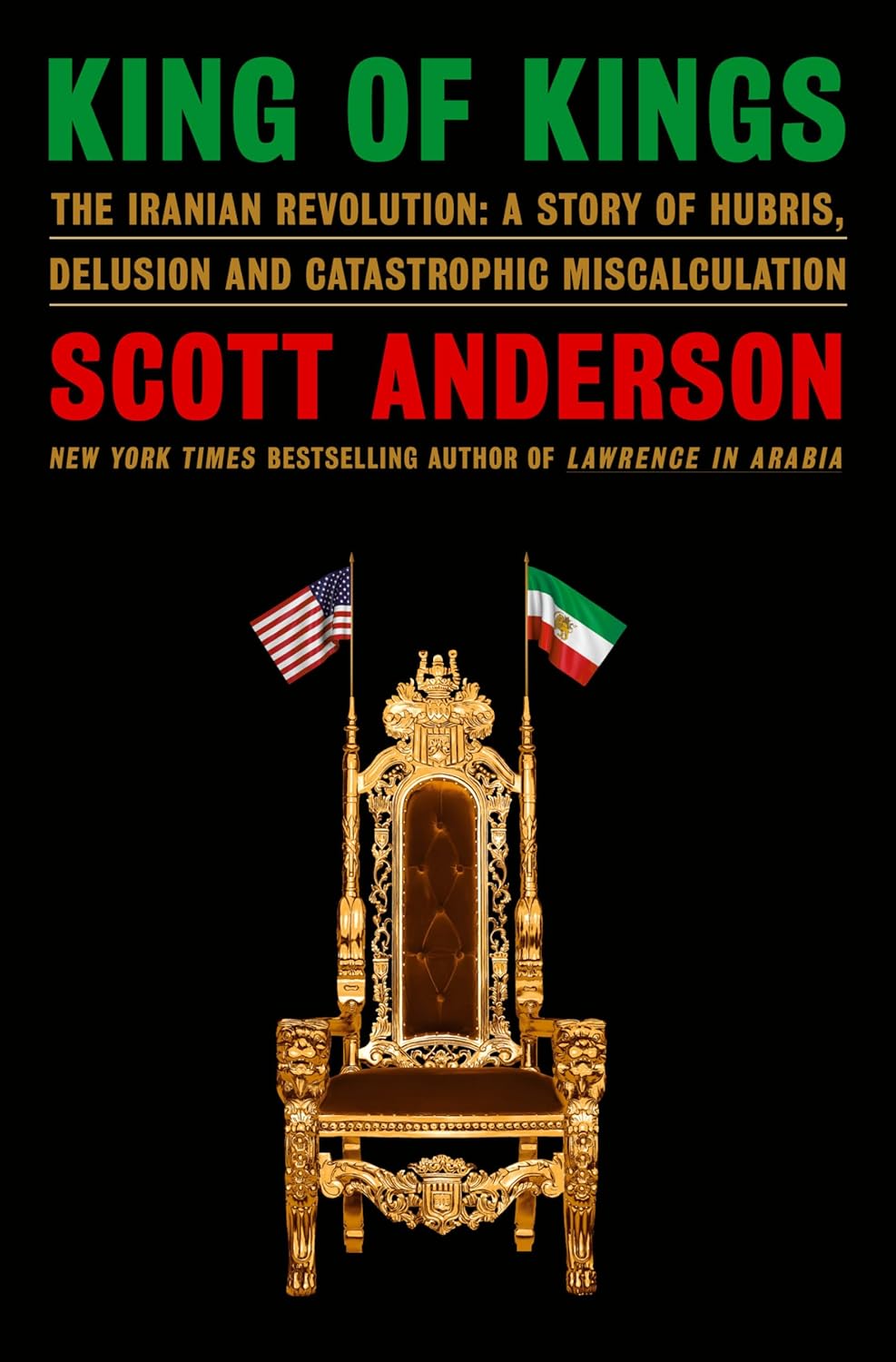
King of Kings—The Iranian Revolution: A Story of Hubris, Delusion and Catastrophic Miscalculation
New York: Doubleday, 2025
The Iran Hostage Crisis in which Iranian students imprisoned the Americans on the staff of the US Embassy for 444 days after its start date of November 4, 1979 was part of the Iranian Revolution—a political convulsion which overthrew Mohammad Reza Pahlavi, Iran’s leader within the Iranian monarchical political order. Pahlavi was the king of Iran and in Iran’s vernacular Persian language “king” is rendered as “shah,” therefore Pahlavi was referred to as “the Shah.” His other titles were King of Kings, Light of the Aryans, and Shadow of God.
The convulsion which ended the Shah’s reign has affected the lives of everyone living as this article goes to print. Scott Anderson, the author of the book under review, witnessed the 1977 anti-Shah riot on the grounds of the White House—an event which foreshadowed the start of the Iranian Revolution a few months later. He writes,
…[S]ince [the Iranian Revolution’s] success, the Western and Islamic worlds have engaged in what many on both sides regard as an existential confrontation, one marked by revanchist religious fundamentalism and state-sponsored terrorism on one side and by paranoia and ultranationalist bigotry on the other. It has colored almost every political and economic development in the Middle East…a gamut that spans everything from the Arab–Israeli conflict to the wars in Iraq and Afghanistan to international trade and energy policy. While the effects of the revolution have obviously been most profoundly felt within Iran itself, they have been only slightly less so in the United States. The collapse of the Iranian monarchy brought an abrupt end to one of the most important economic and military alliances the United States had established anywhere in the world. Its aftershocks led to the fall of an American president and the advent of a new administration intent on re-exerting American influence abroad through massive rearmament and the sponsorship of proxy wars. (p. xvii)
Decolonization Ideology & the Dualistic Worldview of the Magi
The nation of Iran was once called Persia. It was the father of the Shah who was deposed in the 1979 Revolution, Reza Shah Pahlavi, who ordered the name changed because he felt that “Persia” was a name given to the land by foreigners. Reza Shah “decolonized” the country’s moniker, so to speak. Iran is the core territory of the Persian Empire which is mentioned throughout the Bible, but otherwise appears in the narrative of Western Civilization as an alien, otherworldly menace that attacked ancient Athens and viciously battled Rome.
Samuel Huntington placed Iran within what he called Islamic Civilization. Arnold J. Toynbee placed Iran in what he named Syriac Civilization. Oswald Spengler placed Iran in a civilization he described as Near-Eastern/Magian. Spengler’s characterization of the deep civilizational theology of Iran best describes the mental moral template of those who made the Iranian Revolution, especially the Shi’ite Islamic Iranian cleric Ruhollah Khomeini—the central leading figure among the Shah’s revolutionary enemies. Khomeini would rule Iran after the Revolution. Arthur Chandler summarized Spengler’s views of Iran’s Magian-infused worldview in 1979 writing,
The Western/Faustian mind perceives the universe as infinite space…as well-ordered aggregates of bodily forms beneath a corporeal vault of the heavens…the Near-Eastern/Magian [Civilization] conceives of the universe as a cavern. Here, the primordial light-versus-dark struggle pervades the cavern dome of the heavens even as it dominates the eternal wars among the human race. The Magian world is thus a cosmos of opposing substances: God versus the devil, the righteous versus the infidel. “Even death, for the author of the John Gospel, as for the strict Moslem, is not the end of life, but a Something, a death force that contends with the life-force for the possession of man.” By setting the high cultural achievements of the Magian world alongside those of the Apollonian and Faustian [i.e. Western], we perceive the radical dissimilarity among them. The classical temple is an architectural body of ordered elements, optically graspable in a single glance, designed as a completely exterior experience for the eye. The Western cathedral is an expression of an inward yearning for the light from infinity. The Near-Eastern mosque is a cavern from which the symbolic duality of light and dark contend in the enclosing dome.
It is from Persia/Iran that the Manichean religion originated. This faith has vanished but its central doctrine that good and evil are two forces forever clashing lives on in Shi’ite Islam. While a clash between good and evil might sound familiar to Western Christians, it is unwise to presume that Shi’ite Islam and Christianity share a common theological doctrine regarding good versus evil. The Manichean/Magian view espoused by the Shi’ite Khomeini and his Iranian Revolutionary followers is different from the view of evil described by one of Western Christian Civilization’s seminal theological thinkers—Saint Augustine.
Augustine started his faith journey as a Manichean. However, he came to reject its view of evil as a distinct thing and he converted to Christianity. To put his theological logic on the nature of good and evil in simple terms—“evil” is not a thing that exists independently of God or “goodness.” Instead “evil” is the absence of “good” in some way. By the lights of Saint Augustine, that which seems a massive and evil adversarial force or thing can be reformed. For Magi-inspired Manichean thinkers, there cannot be reform of a thing that they view as an independent evil. That thing must be destroyed. This sort of thinking is what made Iranian Revolutionaries chant against a decent king, “Death to the Shah.” Which was then followed by “Death to America.” Which is then followed by “Death to…”, “Death to…” Death to…”, etc. In the worldview of the Manichean Magi, the apocalypse is always at hand.
The Road to Catastrophe
None of the experts saw the Iranian Revolution coming, although in retrospect it became obvious that the political situation in Iran had been on the cusp of a catastrophic meltdown for decades. The roots of the Iranian Revolution which started in 1978 and ended roughly a year later go back to the final years of Iran’s ruling Qajar dynasty. To put it simply, the Qajar dynasty made poor choices, the most significant of which was that it failed to fully capitalize on the British discovery of an ocean of oil within Iran just before World War I. The deal between the Qajars and the British made the oil the property of a company that is now called BP, so most of the profits went to London. The Qajar dynasty was replaced by force in 1925 by the last Shah’s father, Reza Shah, who was then a military officer.
Politically and ideologically, Reza Shah was similar to Kemal Atatürk. Like the Turkish military ruler, Iran’s Reza Shah thought the best way forward for his nation was through abandonment of traditional practices and adoption of Westernization. Reza Shah was acting on a pre-existing social trend, Anderson writes,
Going at least as far back as the Qajar shahs, successive generations of Iranians had been bombarded with the message that in almost all conceivable spheres the West was superior to the East and that embracing Western ways—in industry, in medicine, in education, even in dress—was the key to a better life. For at least as long, Iranians had also been inculcated with the belief that their nation was under the constant threat of subjugation by outsiders. History provided so many examples in support of this latter belief, examples ranging from the nineteenth-century Anglo-Russian Great Game to the multinationals’ long and parasitic control of Iran’s oil industry…the typical Iranian of almost any class or station in life was likely to harbor a very conflicted view of the West, a blend of awe and bitter resentment, an impulse toward emulation leavened by deepest suspicion. (p. 161)
The bitter resentment was noticed by the anthropologist Carlton Coon. In his autobiography, he described a curious misunderstanding between himself and an Iranian notable. The Iranian had believed Coon called him a disparaging word that is normally applied to sub-Sharan Africans. Coon was noticing the tension between Iranian culture’s deep theology of the Magi expressed through Islam and its Westernized ruling government.
During World War II, Iran was invaded by the British and the Soviets and the country became a transfer point for Lend Lease supplies headed to Russia from the United States. Cooperation between the three nations during the war was always conditional and as the conflict started to wind down, the Soviets aggressively sought to put Iran fully under their influence. The international geopolitical situation in Iran at the time marked out the contours of what would become the Cold War.
You can buy Greg Johnson’s Against Imperialism here.
Reza Shah was pro-German and was forced to abdicate in favor of his son in 1944. In 1953, the British and Americans staged a coup in Iran to keep the Prime Minister, Mohammad Mosaddegh, from nationalizing the oil fields. This coup was not as simple as described, however. Prime Minister Mosaddegh didn’t have the political mandate to make the full package of the sweeping changes he desired. Additionally, the British owned the oilfields because it was they who discovered the oil and had the engineering and technical know-how to develop the fields and use the product in engines and other items. The Iranians, for all their Persian poetry and culture, couldn’t exploit this resource and they had no hand in creating any industrial development that made oil valuable.
Regardless of the more complex truth behind the 1953 coup, it made the Shah America’s most critical ally in the region, but it marked him as “America’s Shah” by many of his countrymen. In 1963, there was a fundamentalist Islamic rebellion after the Shah ordered the arrest and exile of Ruhollah Khomeini, who’d preached an anti-Shah sermon. After the rebellion was suppressed, Khomeini went into exile in Najaf, a Shi’ite stronghold in Iraq. There he would develop his theories on governing along Islamic lines. His sermons were distributed by cassette tape into Iran through clandestine networks.
President Nixon and Secretary of State Kissinger were impressed by the Shah’s handling of the disorder caused by Khomeini. They were further impressed by the acumen of the Shah after he captured the Tunb Islands in 1971. The islands had been under British control through their rule of the colony that became the United Arab Emirates. The Shah seized the islands as the British were leaving thus adjusting the edges at a place and time where border changes were tolerated. Morrocco did the same thing with their Greenmarchers later in 1975. Nixon and Kissinger were desperate to recruit powerful allies in key places after so much had been burned up defending South Vietnam. Prosperous Iran with its dynamic king seemed the perfect ally.
Meanwhile, the Shah (mostly) played his cards right in maximizing his nation’s profits from the oil shocks of the early 1970s. The inflow of money warped Iran’s economy, however. Anderson writes,
So frenzied was Iran’s industrial development that both its transportation systems and its electrical grids had been quickly over-whelmed, resulting in massive bottlenecks of imported goods stacked up in warehouses and rolling power blackouts. All the new factories and public works projects under way in Iran’s cities had spurred such a severe housing shortage that a Tehrani professional might easily spend 75 percent of his or her income on rent. Simultaneously, a government program of subsidizing food imports for its urban populations was spurring the collapse of the nation’s agricultural base. By 1975, with rural income a shocking one-seventh that of urban dwellers, impoverished Iranians were flocking into city slums from the countryside as never before, there to face all the social ills of modern urban life: alcohol and drug addiction, unemployment, prostitution, petty crime. As a classic “one-city nation”—Tehran was seven times the size of Iran’s next-largest city —both the promise and the curse of frenetic development were most evident in the capital; as the historian James Buchan noted, “Everything and everybody converged on Tehran: migrants, traffic, sewage, factories, banks, hospitals, doctors, civil servants, heroin, divorcées.” (p.101)
Corruption flourished in Tehran as well as everywhere else in the country. This fraud ultimately undercut the Shah’s credibility, Meanwhile, upwardly mobile Iranian parents sent their children to universities abroad. While 50,000 Americans businessmen and soldiers were in Iran, 50,000 Iranian students were in universities across the United States. In the countryside, however, not much had changed. Women wore the black chador and villagers dried manure for fuel. Islamic clerics preached a fundamentalist, Manichean version of Twelver Shi’ite Islam.
The Shah’s investment in weapons brought American businessmen and American military advisors into the country where they resided in walled mini-American villages, especially around Tehran. The US soldiers in Iran were under the Status of Forces Agreement which held that American military personnel were under the jurisdiction of their respective commanding officers rather than local authorities. Which so much bitter resentment against “imperialists” woven into the culture, Khomeini’s criticism of this setup had an impact.
However, most Iranians would not have seen an American. For their part, few Americans met any Iranian other than those who were pro-Shah. The Iranians working at the US Embassy were pre-screened by the Shah’s secret police, SAVAK. Iranian workers were determined to be pro-Shah before setting foot in the building. The United States government had no espionage apparatus to monitor the Iranian domestic situation. Only the consular officer in Tabriz noticed anything off-kilter beforehand. He was struck by how many worried educated Iranians were requesting exit visas in the months leading up to the Revolution.
Conspiracies, Iranian Culture, & the Character of The Shah
There was a dysfunctional third-worldism to it all. The stability and class of the Shah’s government was a mirage. The political culture was one that allowed the ruling dynasty to come to power in a coup in 1925 and maintain power through a second coup in 1953. Violent extra-constitutional actions were baked into the Iranian political system.
There was also a widespread belief in conspiracies within Iran. This was partially due to the fact that Iran had been dominated by outsiders carrying out conspiracies. Americans enjoy conspiracies also, but most American conspiracy theories lean towards humor and entertainment. The Shah gave fuel to Iran’s genuine conspiratorial fire. He put forward the idea that he was the only man protecting Iran from conspiracies—usually said to be British-inspired plots.
The Shah’s support for conspiracy theories didn’t aid him in the long-term. Shah-controlled media outlets deplored American and British conspiracies while the Shah discussed important matters with American and British officials—a metapolitical narrative that was inherently contradictory. Iranian culture is also drawn to the supernatural. Midway through the Revolution, hundreds of thousands of Iranians claimed to have seen Khomeini’s face on the moon. There is another curious Iranian cultural trait. Many Iranians won’t cooperate until beaten by an authority figure. Michael Metrinko, who’d worked there as a teacher in the Peace Corps, found he had to beat up the largest of his students before he could get control of the classroom.
The Shah’s prime minister—more a chief of staff for the Shah than the PM in the British sense—was Asadollah Alam. Alam was from a wealthy aristocratic family which “owned” scores of villages in Birjand province in eastern Iran. It was Alam who forced the Shah to send the army in to suppress the 1963 riots that followed the arrest of Khomeini. Alam also worked to secure women to sleep with the Shah. Recruits for this job were often selected from the ranks of airline stewardesses. The time wasted on this endeavor as well as keeping it a secret must have been a factor in the on-rushing calamity. Sexually reckless behavior makes every endeavor a whispered conversation away from collapsing into rubble. Nonetheless, Alam was a competent lieutenant for the Shah, he died in April of 1978, had he lived things might have gone differently.
A tremor that was a harbinger for the Revolution was the Shah’s plan to have a massive gala at Persepolis, the ruined capital city of Cyrus the Great. The Shah called this event the 2,500-year Celebration of the Persian Empire. It was held in October of 1971. Third-worldism infused the event. Despite Persepolis being a site of enormous cultural significance nobody in Iran until that point had thought to make the site a national park with accommodations and easy access. The parallels to the Egyptians using the Rosetta Stone to patch a hole rather than recognize its value apply here.
There were other expenses. To make the area safe for guests, snakes and scorpions were killed with a fury so epic that a five-ton truck was needed to haul away the carcasses. A city was constructed with prefabricated tents made in Europe and trees, grass, and birds were brought in—they died shortly thereafter due to the climate. The pressure on the staff hosting the affair was intense. Heads of states showed up, but the two attendees most desired by the Shah, Queen Elizabeth II and US President Richard Nixon, did not attend.
The affair at Persepolis was marred by several small snags—the lag between the light show and the fireworks put the dignitaries in the dark for several uncomfortable minutes. Furthermore, the receiving line was a mess of awkward standing around and some participants showed up late fouling diplomatic protocol, but otherwise the event was flawless.
Unfortunately, the gala was not a domestic hit. Ordinary Iranians were hardly mentioned in the film about the party. The party also highlighted Iran’s ancient Persian culture but ignored the role of Islam in Iran. The Shah’s opposition united against the very symbol of the celebration.
Indeed, the party at Persepolis was part of the character flaws of the Shah. The desire to host this expensive and unnecessary event was rooted in the Shah’s deep personal insecurities, and underneath the glamor and glitz were the political prisoners who filled the nation’s dungeons.
These political prisoners were not dead, however. Elsewhere in the Middle East, the autocratic governments stacked bodies. After Islamist governments came to power the bodies piled even faster. After the Revolution, staff members in the Shah’s inner circle claimed the Shah was a soft man masquerading as a hard man. A case in point was when Iraq’s Saddam Hussein offered to liquidate the troublesome Khomeini preaching in Iraq, the Shah rejected the offer. The Shah also didn’t do well with spontaneous events. At a dinner with President Carter, he awkwardly flubbed congratulating musicians who’d moved everyone with their harmony.
Throughout the latter half of the 1970s, the Shah was dying of cancer, and he kept his condition secret. Had the Shah died of cancer in early 1978, he’d have been idealized as a visionary leader taken by death too soon. However, he didn’t die soon enough and the pressures in Iran continued to grow. Ironically, an unnecessary hit-piece against the ideology of fundamentalist Shi’ite Islam caused a surge in support for Khomeini, who had an enormous underground following.
Enter, the Revolution
On January 7, 1978, an article appeared in Ettela’at, a Shah-sponsored newspaper. The article was titled Iran and the Red and Black Colonization. It claimed that Communist (Reds) were colluding with Islamic fundamentalists (Blacks) to undermine the Shah’s accomplishments. (There is some truth to the claims far-Left and Islamist cooperation then and now. Anderson denies the connection in the book, however.)
The article backfired. The pressures on Iran were enormous, corruption was rampant, and the 1977 protest at the White House had convinced conspiracy-minded Iranians that the Americans had arranged the protest to indicate they wanted to overthrow the Shah. The idea that wild protests continuously swirl around Washington D.C. is not believable in a nation without free speech. Within weeks there were anti-Shah riots in Qom, forty days later there was a seriously effective anti-Shah rally in Tabriz commemorating the riots in Qom. Nonetheless, events didn’t travel on a clear course to catastrophe. Anderson writes,
While specifics obviously vary, revolutions tend to develop along a recognizable pattern of acceleration. Put simply, there is usually a steady tightening of tension or violence until either the state implodes and the revolution succeeds or the state co-opts or kills enough of the opposition to cause its collapse. Either way, there is a discernible intensification of events that, depending on one’s point of view, goes from bad to worse or from bad to better. In the Iranian Revolution, by contrast, there was none of this. In the days and weeks after the Tabriz rally, there came many moments when it seemed the fires of rebellion were spent, when none doubted that the Shah and his imperium would easily weather the tempest. Conversely, there were times when the regime appeared to be coming apart at the seams. (pp. 156/7)
The Revolution continued along its meandering path. The Queen, Farah Pahlavi, noticed shifts in public mood. She received a chilly reception at more than one event. More and more people joined the anti-Shah protests. Women and children would lead the protests so the Shah’s soldiers wouldn’t shoot at the mobs. Other changes followed. The maids on the palace staff started to wear veils. The Shah’s gardener or mechanic would be insolent for a moment and then work at a slow pace. The number of people at the anti-Shah rallies eventually spooked the military to the point it became ineffective. Mass protests mean that soldiers will likely be firing upon their own family members.
The point that marked the terminal decline of the Shah’s reign was a fire in a movie theater in Abadan on August 19, 1978. The fire was deliberately set, and it killed around 400 people. The exact number remains uncertain. The perpetrators of the blaze were certainly Shi’ite Islamic fundamentalists. Khomeini and other radicals had called for attacks on theaters and other forms of decadence. In the days following the fire, Khomeini suspiciously didn’t mention the event. Third-worldism also infused the story of the fire. The fire hydrants near the burning building didn’t work.
Theology matters. With a theological worldview based on Magi-influenced Manichean thought, “evil” movies cannot be reformed with production code ratings. Instead, the theater and its patrons must be burned through the actions of the zealous righteous. In a Manichean theological construct, problems with the unworking fire hydrants does not meaningfully compute. Since “evil” is an independent force that cannot be reformed, fire codes never get developed.
Khomeini’s followers should have been rounded up and imprisoned as accessories to the crime, but the blame for the blaze fell upon the Shah’s SAVAK secret police. After the Revolution, one of the Shah’s army captains was executed after being found guilty of the arson attack at Abadan in a kangaroo court. The pre-existing conspiratorial template regarding SAVAK greatly aided the Islamic Revolutionaries in that Islamist attacks on religious minorities such as the Baha’i were blamed on SAVAK, for example. The Iranian Revolution’s dangerous side was hidden behind a curtain of misunderstanding .
The Carter Administration
The Iranian Revolution was helped by a credulous, conspiracy believing public, and the flaws of the Shah also provided a boost. Another resource for the Revolution was the weakness of President Jimmy Carter, a progressive “Born Again” Christian who was deeply influenced by the theology of Reinhold Niebuhr. Theology matters. Niebuhr’s theology practically applied meant that Carter scolded America’s Cold War allies for human rights violations while ignoring the human rights violations of America’s enemies. In effect, Carter was a fully baptized congregant in the Pseudo-Religion of World War II.
While the above paragraph is hostile to Carter, it is completely true. Carter’s focus on human rights is part of the reason why the Shah went to visit Carter in 1977. The Shah wanted face-to-face assurances that Carter would not scold him. This was the visit which allowed for idealistic and naive Iranian students to violently protest against the Shah at the White House which caused ordinary Iranians to believe the US government had abandoned the Shah, which in turn gave vital energy to the anti-Shah protests, which ultimately toppled his regime.
President Carter also fervently believed in “civil rights.” All those who believe in speeches about integrated schools, mountain tops, and red clay soil misread data. Carter misread the data in Iran, but he didn’t get much data to read in the first place. The technology of the day hindered spreading the news. Information from the US Embassy in Tehran went through a narrow diplomatic channel and was disseminated to at most twenty people, most of whom were too busy to look at the paper the info was printed on. There were also the crushing events of the day that clouded the issues in Iran for Carter and his team. At all the significant turning points of the Iranian Revolution, the Carter administration was distracted with other events—development of the peace treaty between Egypt and Israel, for example.
Additionally, all international events were viewed through the prism of the Cold War. Nobody in the US Government understood the ideology of fundamentalist Shi’ite Islam and how that was a threat different from the communist one. Nobody in the State Department or the Central Intelligence Agency had listened to one of Khomeini’s sermons on tape. The warnings about Islam made by Hilaire Belloc and Lothrop Stoddard were forbidden scribblings of the past, hidden behind the moral smokescreen of “civil rights.”
The “civil rights” moral smokescreen also hid the problem of paperwork Americans, those of immigrant background from third-world countries like Iran who have no loyalty to the United States and a deep hostility towards Heritage Americans. One such paperwork Americans during the Iranian Revolution was Ebrahim Yazdi. He worked in the American academic system and had become a naturalized US Citizen in 1971. He helped Khomeini frame his message to credulous Western liberals especially after Khomeini took up residence in a Paris suburb called Neauphle-le-Château. Yazdi believed in the Revolution. Anderson writes,
As a younger man, Yazdi had voraciously read accounts of successful revolutionaries around the world, the tracts of everyone from Mao and Trotsky to Algeria’s Ahmed Ben Bella and Cuba’s Castro. As a result, and perhaps more than most of his colleagues in Neauphle-le-Château, he had become increasingly convinced that the Iranian Revolution wouldn’t be won on the barricades. Rather, the contest would primarily be decided by psychological warfare, and to achieve victory, the revolutionaries needed to win over or neutralize three distinct blocs of actors: the Iranian military, of course, but also the Shah’s foreign sponsors and that great mass of Iranian citizenry who, consistent with the masses in most any revolution, sat on the sidelines. What made this campaign tricky was that all three blocs needed to be dealt with simultaneously, and that failure with any one all but ensured failure with the other two. Conversely, success with one increased the odds of winning over the others. (p. 280)
Obviously, Yazdi’s strategy worked. The Shah’s military collapsed. Foreigners rushed to support or not block Khomeini. Michel Foucault, a prominent French Leftist who died of AIDS, was a supporter of Khomeini. When Khomeini flew to Iran in February 1979, no nation sent fighters to bring down his aircraft although his Revolution would come to drench the Middle East in blood. The Carter administration was likewise rudderless. The White House staff was paralyzed by in-fighting. When Carter asked if the embassy might get sacked, his staff had no response. By the end of the year, as the Shah’s cancer battle worsened, he was admitted into America to receive treatment.
The secrecy of the Shah and the belief in conspiracies by the Iranians meant that radicals in Iran thought the Americans were organizing the Shah’s return. In November, they swarmed the embassy and took the Americans working there hostage. The Hostage Crisis was the icing on the cake that was a very bad decade. A decade that saw defeat in Vietnam, Leftist violence, and quickening deindustrialization.
There were some bright spots, however. When looking over the photographs of Americans responding to the hostage crisis, there are signs calling for the deportation of all Iranians from the United States. The idea of deportation to achieve foreign policy goals started then. Events in Iran destroyed Carter’s chances for reelection, but it made Ross Perot, an excentric tech billionaire a national hero, when he hired a retired Special Forces colonel to lead a rescue operation to recover his employees held in Iran.
In interviews promoting King of Kings, Anderson states that Carter should have issued an ultimatum to Khomeini to release the hostages or there would be war. This would have ended the problem and possibly moderated the Iranian Islamic Republic.
One will never know. Khomeini certainly recognized that Carter was the type to back down. It is certain that the Shah’s Westernized Iran was a mirage. Through Khomeini, the priests in the birthplace of the Civilization of the Magi overcame the temporary occupation of a Westernized government.
16 comments
Reza Shah was pro-German…. that’s all I need to know.
The father of the last Shah was moderately pro-German.
You should understand why. Not that he liked Germans, or personally A.H. Germans were the enemies of the British, and the British (and also Russians) were seen in Iran as colonisers and exploiters. The same could be said about the first two presidents of modern Egypt, both great politicians, Nasser and Sadat. During the WW2 they were pro-German, and their motivation was just the same.
“It is from Persia/Iran that the Manichean religion originated. This faith has vanished but its central doctrine that good and evil are two forces forever clashing lives on in Shi’ite Islam.”
Islam is an Abrahamic faith which means it’s averse to syncreticism and a source of religious fanatism and “Manichaean” black-white thinking itself. I don’t think it’s correct to blame pre-Islamic Persian religions for something that developed for many centuries in a strictly Islamic context.
“For Magi-inspired Manichean thinkers, there cannot be reform of a thing that they view as an independent evil. That thing must be destroyed. This sort of thinking is what made Iranian Revolutionaries chant against a decent king, “Death to the Shah.” Which was then followed by “Death to America.” Which is then followed by “Death to…”, “Death to…” Death to…”, etc.”
I think that’s an unjustified inference. Moreover, Pagan Persian religion was more tolerant of other religions than Islam (or historic Christianity) were. It is precisely the Abrahamic spirit that says “That thing must be destroyed”. Abrahamism seeks to annihilate anything that is not itself, that’s the madness of the “One True Religion”. Pagan religions did not have this inbuilt hostility against other systems.
And the “Death to” phrase is, probably, not related to any philosophical principle but simply an example of the kind of flowery, emotional language common in Middle Eastern cultures:
“At Iranian demonstrations and even in parliament, it’s common to hear chants of “Death to Israel” and “Death to America,” the latter phrase originating during the 1979 revolution. These slogans are seized upon by anti-Iran hawks who say it would be foolish not to take Iranians at their word — meaning Iranians want all Israeli and American people to die. However, when you’re crossing cultural lines, discerning meaning isn’t always so simple.
Travel guru Rick Steves learned this firsthand as he was being driven to the Tehran airport at the end of a 12-day stay. When his car encountered heavy traffic, his driver spontaneously exclaimed, “Death to traffic!” A perplexed Steves said, “What? I thought it was ‘Death to America’.” His driver explained, “Here in Iran, when something frustrates us and is out of our control, we say ‘death’ to that.” Upon reflection, Steves likened it to an American saying “damn those teenagers,” without really wanting them to burn in eternal hellfire.”
[link: https://www.starkrealities.net/p/irans-jewish-population-belies-claims]
In fact, wishing damnation upon someone is worse than wishing death upon that person.
I don’t think it’s correct to blame pre-Islamic Persian religions for something that developed for many centuries in a strictly Islamic context.
I’m inclined to believe that Islam was so successful in the region because of their racial temperament which pre-dates Islam. Islam tells them exactly what they want to hear, the Manichean religion was only the first to post with similar content.
I agree, but would add that Abrahamic religions can turn white people into close-minded zealots as well. A religion that is at heart an ideology and indoctrinates the follower in a cult-like fashion is a force on its own.
When I read Herodotus and other ancient Greeks I didn’t get the impression that they saw a problem with the Persians’ religion or religious fanatism, just with their political power and ambition.
Furthermore, Persians are genetically different from the original Arabs that created and spread Islam. There’s actually not much a lot of overlap as the Arabian Peninsula and Iran had different population histories. The “Southwest Asian” genetic cluster makes up ca. 68% of the genome of modern Saudi Arabians, but only 14% of that of modern Iranians, and not all “Southwest Asian” is of actual Arabic origin.
One reason Carter didn’t threaten war was that the US armed forces were in a bad way at the time. They were still recovering from Vietnam, stocks of munitions were low (we’d abandoned a lot of materiel in Vietnam), racial trouble was endemic, and drug use was everywhere. Also, sending naval vessels into the Persian Gulf was not a good idea. It’s shallow and narrow and well within the range of a lot of weapons the Iranians had.
I’ve read accounts of what the military was like during that period. I’ve also talked to veterans who were in the military during that time as well. Both of them verify what you are saying. The military had problems recruiting quality people during the seventies.
Quality (or at least the appearance of it) was emphasized as soon as Reagan took over.
But some of it was pretty superficial ─ like, for example, you might see the National Guard with longer hair then except during Annual Training. Think of the 1981 movie Southern Comfort. However, some of the Regular Army units were full of themselves. At the Atlanta airport in 1982 or thereabouts, some colonel in civilian clothes thought that an Army Reserve unit passing through looked haggard, wearing worn boots and so on. Those wearing class A’s were still wearing the khaki poplin shirt underneath the blouse and not the new green one. Some might have still been wearing the khaki class B’s which I wish they had never phased out. I think the real complaint of the hot shot was that they were together but not uniformly in uniform, though most were travelling in uniform with what they had prior to arrival on post for haircuts and new stuff. I don’t think they really looked all that bad but maybe not a crack unit. They were older cooks and radio operators, many overweight, but knew their stuff. Anyway, the captain in charge of the Reserve unit told the busybody colonel to go to hell, and if he had a problem with that to discuss it the colonel in his own chain of command.
With respect to Iran during the hostage crisis, the Army obviously was not ready for some kind of Hollywood rescue mission, and the Delta Force was a joke. Unfortunately, the country was not too interested in doing much else after the long Vietnam imbroglio.
However, I think the military could have done a royal number on the Persian sand nïggers ─ and should have. For example, just a few years before, the Air Force had sent waves of B-52 fat cars into Hanoi, which was some of the most heavily-defended airspace in the world at the time, and while not lossless, it had a jolly effect. The Soviet SAM sites had to be attacked with fighter bombers right before the missions, but for diplomatic reasons the B-52 bombing raids were announced in advance with no element of surprise.
Also, in 1976 in Idaho I witnessed the Teton Dam collapse or at least the aftermath. I was at the airport that day in the Civil Air Patrol and my flying lesson got cancelled as a result. Within hours every National Guard and Reserve Huey helicopter from the nearby states and bases was operating within the regional airspace and it looked like the height of the Vietnam War. These were piloted by older veterans who knew their stuff.
Despite the misguided disaster of the long Democrat intervention in Indochina, I don’t think miltary Readiness in the 1970s was really all that bad considering that these were still mature days of the Cold War.
What the Paper Tiger lacked was morale and the will to stomp any Third World toilet regime who desperatly deserved it such as by attacking an embassy and taking hostages. I’m an Isolationist but efectively doing nothing set a very bad precedent.
The Delta Force crashing their equipment like Keystone Cops was actually worse than doing nothing. Jimmy Carter usually invoked the specter of nuclear war with the Soviets that supposedly tied his hands, but they could have been bought off easily and by not, for example, doing the future moralizing about Afghanistan, which was another huge mistake.
A thermonuclear ICBM tested somewhere (preferrably in the middle of the Iranian desert) would have been more to my liking. Time to release the hostages, Abdollah.
🙂
I was a young boy during “Desert One”, but I remember the effect that it had on moral in the country. Carter stated during an interview that many of his advisors urged him to launch an attack against Iran during the hostage situation, but that he advised against it.
From various things that I’ve read about “Desert One” there were numerous problems with it from the beginning. All four branches of the military wanted to get in on it and to get credit for it. The various branches of the service were not experienced with each other’s aircraft and equipment. Also, from what I’ve read of the mission, you get the impression that the operation was somewhat rushed without enough planning and practice.
There was definitely a Keystone Cops aspect during much of it. I’ve read some interviews with former members of Delta Force that are eye opening. Even though they were elite commandos, they had issues and some internal conflicts among themselves. Colonel Charles Beckwith, who was a type A personality, despised President Carter. He stated during an interview that Carter told him when they planned to storm the embassy in Tehran, to not shoot any Iranians unless it was absolutely necessary. Command Sargent Major Eric Haney was a young NCO Delta Force member. He stated in an interview that they had a contingency plan for the raid depending on the circumstances. It consisted of moving the hostages to the Soviet embassy. The reasoning was that, although they were our adversaries, they would guarantee the hostages and Delta members safe return to the U.S. to avoid bad public relations and diplomatic problems.
I’ve read Charlie Beckwith’s memoirs, and as I understood the situation, the plan to rescue hostages was unnecessary over-complicated, and all Services wanted to take part, the coordination was bad, so the failure was inevitable.
Later Reagan just ransomed the hostages for TOW ATMs and (Israeli) HAWK SAMs.
One important factor that led to the triumph of Khomeini is the fact that the lenient Shah, fearing Communist and other Leftist groups more, gave the Islamists space in the hope of them neutralising the armed Leftist groups (who were well-organised groups such as the MEK). But instead the two sides began working together to overthrow the regime. After which the Islamists eventually hijacked the revolution.
Great article! Now I have a better understanding of the differences between the Faustian, and Magian mindset. 🙃
I’ve been sorely lacking this also
“In 1953, the British and Americans staged a coup in Iran to keep the Prime Minister, Mohammad Mosaddegh, from nationalizing the oil fields. This coup was not as simple as described, however. Prime Minister Mosaddegh didn’t have the political mandate to make the full package of the sweeping changes he desired. Additionally, the British owned the oilfields because it was they who discovered the oil and had the engineering and technical know-how to develop the fields and use the product in engines and other items. The Iranians, for all their Persian poetry and culture, couldn’t exploit this resource and they had no hand in creating any industrial development that made oil valuable.”
Yet that does not justify what the US and UK did. A Third World nation deciding to nationalize the oil industry Western companies developed in their country is basically an economic risk. The correct solution would have been to reach an agreement whereby the Western oil firms sell their oil infrastructure to the Iranian government. But shareholders in New York and London expected to profit from Iranian oil until it ran out, so they lobbied their friends in government to prevent the nationalization by any means necessary. In other words, the West behaved more or less like Communist propaganda of the time period depicted it – preying on weaker Third World countries for oil/ressources.
And let’s not forget that 1953 was only 12 years after Britain and the Soviet Union had invaded neutral Iran to be able to supply the Soviets through its territory (and to prevent Iran from potentially cooperating with Germany should the Germans succeed in the south).
The genuine ancient religion of Iran was Zoroastrianism, not Manichaeism, which was founded by Mani, a Jew born into the Elkasaite Jewish-Christian sect in the Parthian Empire. Mani was imprisoned and probably executed by the Sassanids, and the religion was nearly wiped out in Persia soon after. The idea that it is the primary influence on modern Iranian thinking is silly. I find it very odd that Zoroastrianism isn’t even mentioned in this article. In any event, Islam doesn’t require any external influences to make it bloodthirsty and fanatical, it has always been like that.
I would advise to be someway cautious with both Anderson brothers. They always were Leftists.
If you have a Subscriber access,
simply login first to see your comment auto-approved.
Note on comments privacy & moderation
Your email is never published nor shared.
Comments are moderated. If you don't see your comment, please be patient. If approved, it will appear here soon. Do not post your comment a second time.