4,679 words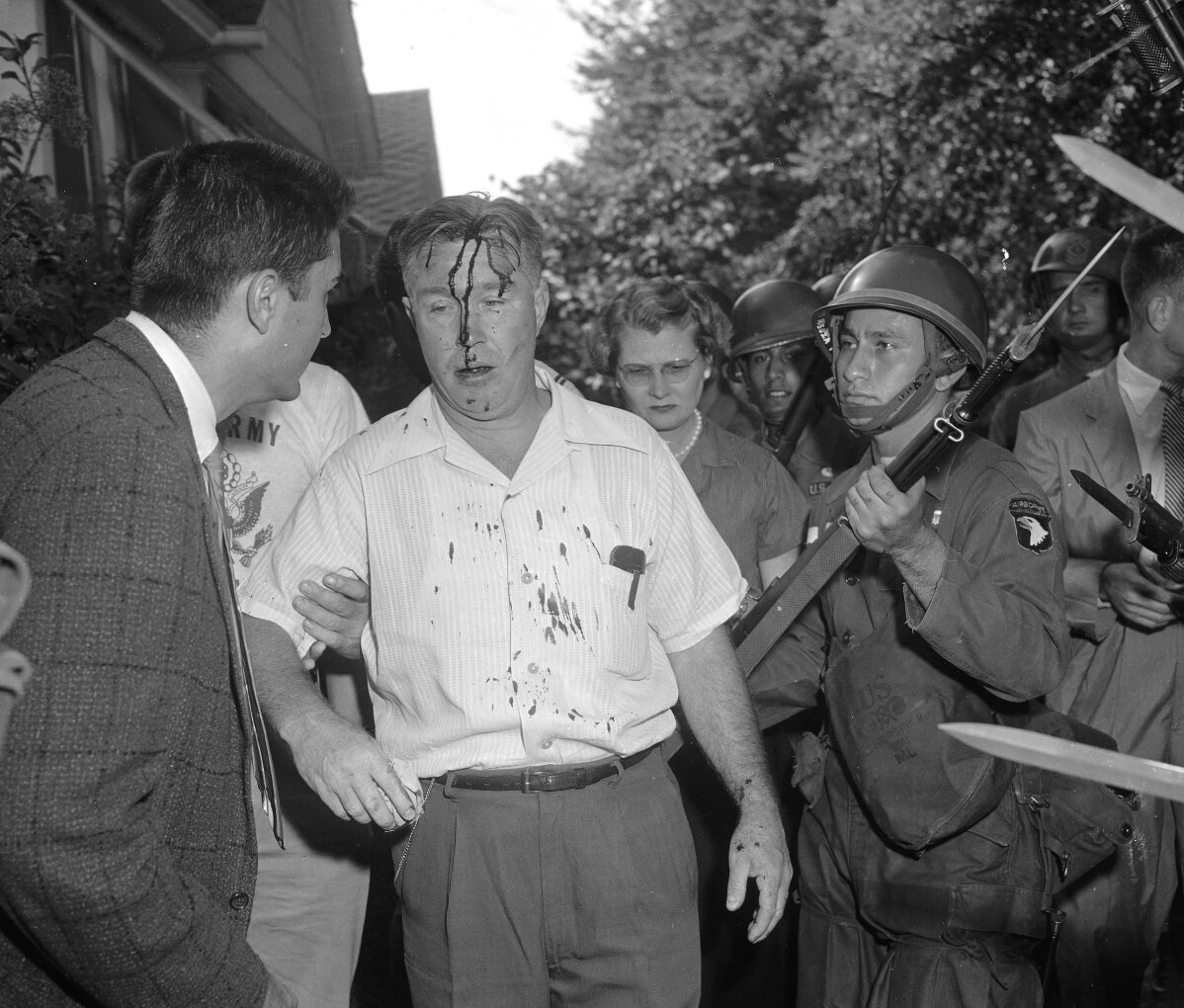
In modern American society, fictional works have become beacons of moral guidance. One such fictional moral beacon is the Richard Rodgers and Oscar Hammerstein musical, South Pacific, which was released on Broadway in 1949 and turned into a movie of the same name in 1959. Rodgers was Jewish, Hammerstein partially so and raised a Unitarian.
South Pacific’s setting in Polynesia during World War II was part of the tiki craze of the immediate post-war years. It also glorified the service of the manly men of the US Navy in that war – thus immediately winning over the many war veterans who were the bulk of the ‘50s-era ticket buyers. South Pacific contains several love stories, the most important being that of Nelly Forbush of Little Rock, Arkansas and Emile De Becque, a Frenchman who moved to Polynesia after “justly” murdering a man in France. The musical’s plot gives De Becque several half-Polynesian daughters.
Nelly wants to marry Emile, but she is concerned about the racial differences between her and her potential future stepdaughters. She is also worried about what her family in Little Rock would think about her becoming the mom of a racially integrated household. The more serious questions aren’t asked. Would the relationship continue if Nelly were transferred elsewhere by the Navy? Was the murder committed by De Becque really just? Would De Becque just be another criminal narcissist of the type that lost girls from Middle America stupidly fall for? Would Nelly become yet another dragon-lady stepmother after she weds Emile? How would her potential white children by Emile do in Polynesia? The downsides the audience might see regarding Nelly’s infatuation with the tall, dark, and handsome Frenchman are overwhelmed by the musical’s well-paced plot and the catchy songs. The songs are so good that one was recycled in the 1980s to sell hair products.
Forget the joyful jingles, South Pacific is subversive. It is establishment-pushed anti-white propaganda along the same lines as Twelve Angry Men and To Kill a Mockingbird. The play’s propaganda substitutes Polynesians for the integrationists’ true goal of putting sub-Saharans into white spaces. Due in part to South Pacific’s popularity, the nation was deceptively primed for a desegregationist push.
And the fictional Nelly Forbush was from Little Rock, Arkansas.
Woe Unto Little Rock….and America
In 1957, Little Rock, Arkansas became the target of a sanctimonious social experiment that was doomed to failure from the start – desegregation. This experiment came to be bitterly resisted by the city’s beleaguered whites. The Little Rock Desegregation Crisis, as the affair came to be known, became the most significant domestic political event of the Eisenhower administration. Eventually, the old general deployed paratroopers from the regular army and units from the Arkansas National Guard to ensure that nine blacks would become students at Central High School – an institution which had been built and paid for by whites.
The use of federal soldiers to enforce the desires of a militant Africanization movement broke the post-Reconstruction compact between North and South which had allowed the people of the South to handle their valid racial concerns in their own way. The soldiers backing integration were part of a crusader army following the theology of Negro Worship. The forces arrayed at Little Rock also set a precedent: that of using armed men, be they soldiers or federal marshals, to push for desegregation. Even the “civil rights” marchers to Selma in 1965 had supersonic jet fighters provided by the US Air Force for air support.
The desegregation battle in Little Rock was a fight that the good guys lost, and the negative ripples from the affair spread out as one would expect. The nine sub-Saharans who integrated the school became society-wide heroes, at least on the surface of public discourse. Liberals were also delighted that one of their pet projects was enforced by armed men empowered by the state to carry out lethal violence. The Little Rock desegregation narrative was used by American establishment liberals to create an expensive and inefficient legal and social structure which sought to uplift blacks in every way while excusing or hiding enormous black pathologies.
Because of the events at Little Rock in 1957, daily commutes to work are longer for whites, the choicest real estate in America is occupied, crime-ridden, and Africanized, the school system must educate a mass of students biologically unable to master abstract thinking, and crime in public places is rampant.
The Road to the Crisis
The white reaction to the desegregationist offensive at Little Rock was unexpected. The state governor, Orval Faubus, hadn’t mentioned segregation in his 1955 inaugural address. The governor also assured local school districts that his office would not get involved in their respective desegregation efforts. Arkansas had also already desegregated its university system with no court order and no trouble in 1948. One school administrator had integrated a local library to help blacks get the books he thought they wanted to read. Many of the school districts had officials on the various school boards who supported desegregation or were considered moderates. Most of the state of Arkansas was and is demographically white. This meant that full desegregation would not be much of a problem in that white supermajorities would continue to reign in most school districts. The places where blacks were a significant percentage of the population were in the state’s rural south and east. These regions were poor, sparsely populated, and out of the way. Little Rock, the capital, was in the white part of the state.
In the late 1950s, those in the City of Little Rock’s political elite wanted to attract industry from the deindustrializing North, and they feared that a segregated school system would imply “bad schools” and keep skilled people from wanting to move in. The integrationists were also backed by wealthy elites and “civil rights” activists at the national level who’d embarked upon a strategy of barratry which consists of setting precedent through legal decisions in various lawsuits where the plaintiff-activists knew in advance they’d get a favorable ruling. They’d also worked in the decades prior to 1957 to ensure judges were appointed who did not favor segregation. The NAACP, a “civil rights” organization led by ethnonationalist Jews, lobbied President Taft to withdraw the nomination of Judge William Cather Hook, for a job at the Supreme Court in 1912. Judge Hook had once made a ruling in favor of segregation.
A serious court victory which arose from the strategy of barratry and the appointment of pro-“civil rights” judges was Shelley v. Kraemer (1948) which stopped whites from retaining the value of their respective houses through restrictive covenants that wisely kept out value-reducing blacks. Then, in 1954, the Supreme Court ruled in Brown v. Board that segregation was illegal and followed up in 1955 with “Brown II” which ruled that the desegregation of schools should proceed as fast as possible.
Little Rock’s school system was headed by Virgil T. Blossom, who’d started his career as a football coach and rose in rank through his enormous leadership and administrative talents. Blossom was politically moderate, and he had a politically moderate plan for desegregation. Karen Anderson writes in her book Little Rock: Race and Resistance at Central High School (2010) that,
Blossom’s plan…followed national practices for the avoidance of social mixing in schools almost to the letter. In a 1947 article in The School Review, for example, Los Angeles County administrator Alexander Frazier offered advice to “schools under attack by minority or other militant groups” on “How to ‘Keep Them in Their Place.’” A reaction to “well-meaning ‘sentimentalists’ [who] advocate that … students be thrown together indiscriminately for the dubious benefits of interaction,” Frazier’s commentary suggests placing schools in minority neighborhoods at the center of their attendance areas, while locating those in Anglo neighborhoods at the peripheries when that served to distance them from racial ethnic populations. [1]
In other words, Blossom’s plan met the standards of the Brown decision, but it didn’t truly integrate anything. His plan, in effect was what the integrationists called “tokenism” where only a small, screened number of sub-Saharans would be integrated. Blossom also planned to integrate high schools first, allow students the ability to switch schools, and group students according to intellectual ability – which was a way to segregate within a school.
Meanwhile, segregationists started to organize against the integrators. Their center of gravity was in the counties of the Deep South where the percentages of blacks to whites were high. In Arkansas, serious pro-white resistance started in Pine Bluff – a small town with a large black population percentage. In Arkansas and other parts of the South whites, often accomplished men from prominent families, formed Citizens’ Councils which sought to keep schools segregated.
Why Resist?
No history of the so-called “civil rights” movement ever fully explains the motives of the segregationists. Historian Karen Anderson does hint in a small way at such motivations in her book about the crisis, however. There were several ongoing shifts in the late 1950s which helped bring about the affair. The rising economic tide meant that farmers – especially in the southeastern part of the state – started to part with their black agricultural labor force because they could afford to mechanize. This untethered mass of black former farm workers migrated to the cities of the South where they enrolled in school and became, according to a report, “disciplinary problems.” [2] The report blamed the disciplinary problems on non-nutritious lunches, inadequate clothing, and failure to be accepted by their peers. All literature about the “race problem” read by the American social and political elite at the time blamed sub-Saharan pathologies on environmental factors.
The good economy had another impact – affordable family formation without the need for intensive training or education after high school. As a result, ‘50s-era parents viewed high school as a place for their children to meet a spouse. In 1957, teen pregnancy rates were higher than any other year in the twentieth century. Part of this was the start of the sexual revolution, but the lion’s share of the pregnancies was due to early marriage. The idea that high school in the 1950s was a mating and courtship hot house is a theme in movies like Grease, Back to the Future, and other ‘50s-era coming of age films. Many parents feared that integrated schools would lead to interracial marriages.
This concern got traction. Most of the alarmist literature about desegregated schools were semi-pornographic essays against interracial sex. When this material got to Hoxie, a mostly white town in the northeastern part of the state which had integrated in 1955, concerned local individuals sought to reverse integration. They were led by a heroic soybean farmer named Herbert Brewer. These segregationists failed to re-segregate the school – the stakes in Hoxie were too low because the town was mostly white, but local activists had connected with other newly formed pro-white groups and segregationist ideas started to make a broader political impact.
The other reason whites in the state came out to support segregation was that Southerners had more experience with blacks than Americans in the mostly white areas of the country. Blacks, as a group, have a lower average intelligence level than whites, a higher propensity for crime, are fundamentally sympathetic to criminals, and more likely to engage in all-around reckless behavior.
Woe Unto the Class of 1958
The Reverend Robert Brown, Episcopal Bishop of the Diocese of Arkansas believed that,
It would seem to those who know the South, and its attitude towards these problems, that Little Rock, a moderate city in the Southwest, was chosen by design to be the ground for the battle” because its moderation made it a target for each side and its significance would be far “bigger than Little Rock.[3]
The battle would be significant, indeed. As word got out that Central High was set to be desegregated, Carol Thomason, a white working-class mother, called Superintendent Blossom several times in August of 1957 to request a transfer for her daughter. Blossom did not return her calls. Moderates like Blossom believed that by stonewalling the segregationists and avoiding any public comments they could ease the token blacks into the school and wrap up the project. However, the moderates’ middle-class disdain for the working-class segregationists was difficult to hide and it is unquestionable that their disdain increased white, working-class resistance.
The fiercest and most stalwart of the segregationists were working-class white women. After getting the brush-off, Thomason organized the Mothers’ League of Central High School. This organization became the structure upon which segregationist resistance in Little Rock was built. Events then moved quickly. There was a sense that the situation could become violent. On August 22, 1957, two weeks before school was set to start, one of the Citizens’ Council groups organized rallies and speakers and passions were high. Governor Faubus deployed the National Guard to keep the peace.
Throughout that waning summer, Faubus claimed to be a defender of segregation while attempting to steer a middle way. He invoked the memory of the Civil War, and called on Southerners to resist, all while being resigned to the idea that the Federal Government backed integrators would win in the end.
The day before school was due to start, Governor Faubus went on television to declare that he would order the National Guard to stop the desegregation of Central High School on the first day of classes. He used the talk of violence as justification for his action. The philosophy behind his decision centered upon his claim that white violence was too difficult for local authorities to contain, so the desegregation plan needed to be stopped by state forces. He did not say that blacks had a low propensity for learning and a high propensity for crime.
Faubus’s philosophical presuppositions about white violence colored the “civil rights” debate for decades to come. After Little Rock, “civil rights” agitators and white liberals wrapped themselves in a cloak of peaceful utopianism which would go unquestioned in the mainstream until the mask slipped (in a small way) during the OJ Simpson Trial of 1996.
Governor Faubus was also surrounded by enemies. His own father wrote editorials under a pen name criticizing his actions. The rest of his family was privately hostile to his support for segregation. The mainstream media piled on too. He was painted by the national press as a low-class hillbilly rube. There was no possibility for a counter narrative in the mainstream media then – the three networks were politically aligned, widely believed, and had the appearance of neutrality and honesty.
Faubus met with President Eisenhower to seek a way out of the crisis in mid-September. The meeting only lasted twenty minutes. Eisenhower’s position was that the court orders needed to be enforced, and the National Guard’s orders needed to be changed to keep the peace and protect the blacks seeking to enroll. The two men left the meeting smiling, but the crisis continued. Eisenhower, a career military man, came to see Faubus as something like a dishonest and insubordinate junior officer. Faubus refused to back down although his core of supporters at this point were segregationists who were mostly of working-class backgrounds. On September 23rd, Faubus withdrew the National Guard, and the Little Rock Police department assumed responsibility for the situation. The police sympathized with the segregationists. Chaos followed and rumors abounded that there was violence within the halls of Central High. Parents showed up to withdraw their children.
The black students who were chosen to racially integrate the school had been personally screened by Superintendent Virgil Blossom. None had hair that was too “nappy,” thick lips, nor spoke with a low-class negro accent. They all had clean records and good grades. While the Governor, Mothers’ League, and Citizens’ Council opposed the integrationists, Little Rock’s mayor, Woodrow Wilson Mann, and the city’s school board supported the desegregationist effort. The Eisenhower administration also supported the integrators. NAACP activists also arrived in Little Rock, the most prominent was a woman named Grace Loch, an educator and a “civil rights” true believer.
The integrators came to be called “The Little Rock Nine.” For a time, they were subjected to abuse from their fellow white students at Central High. One of the blacks, Elizabeth Eckford, was shown in nationally distributed picture walking in a dignified way while a young white girl named Hazel Bryan [4] followed behind her cursing. The cameraman caught Bryan’s face at the exact moment it was twisted with rage.
The Bryan–Eckford photo appears to show integrator Eckford up against formidable odds, but the truth was the opposite. Bryan was the working-class girl who had the entire American establishment lined up against her. Throughout her life, Bryan would be abused and pilloried for her youthful action while The Little Rock Nine would be given feel-good medals, visits from groveling politicians, and generalized underserved acclaim. In the 1990s, talk show host Oprah Winfrey featured the nine integrators prominently in several shows.
By the end of September, Eisenhower felt he was forced to act. He ordered federal troops from the 101st Airborne Division to intervene, citing a call for aid from Little Rock’s mayor for his choice. The President also called up the Arkansas National Guard to serve under federal authority. The general commanding the US Army troops during the affray was Edwin “Ted” Walker. The most vocal of the segregationists were women, often the schoolgirls themselves. As a result, pictures of paratroopers pointing bayonets at the backs of young women appeared in the national papers.
The furor died down as the weather turned colder, by December the nine desegregationist blacks were walking the integrated school’s halls which were patrolled by soldiers. They faced both hostility and support from whites. Minnijean Brown, one of the nine sub-Saharan integrators, turned out to be perpetually aggrieved, to the point of insulting the white students who supported desegregation. In one instance she threw soup on two white students who supported desegregation and had never done her any harm – Minnijean claimed she was aiming for someone else. Otherwise, the integrators had a lonely time. In his 1959 book about the events, Virgil Blossom observed that all the sub-Saharans except one, (presumably Minnijean Brown) behaved well.
The Shut Down and Reopening
In the summer of 1958, Governor Faubus won the Democratic Party’s primary. This was when the South still voted as a block for the Democrats so the primary result meant Faubus was certain to win the general election in November. His victories in both elections were overwhelming, giving him a mandate and ratifying his segregationist stance. There were a continued series of court cases related to the integration, but other than one local judge, the desegregation mandate continued to stand.
So, Faubus worked with segregationists in the legislature to shut down the public school system entirely. The decision to do this was in line with what was called the Virginia Plan, and it was part of the South’s “massive resistance” to the Brown decision. This policy was supported by working-class whites and opposed by middle- and upper-class whites. The working-class were content enough to safely learn the “Three Rs,” but those of a higher status wanted to graduate from accredited schools which would allow them to admittance into out-of-state universities. Private schools were quickly set up, but they couldn’t match the professional excellence of the public schools right away, so they were the subject of mainstream media calumny.
Middle- and upper-class white women led the effort to re-open the schools. They didn’t seem to realize that private schools could get accredited, or out-of-state universities should adjust their admittance programs to account for the situation in Arkansas and across the South. Eventually, the schools were reopened as desegregated, but the blacks admitted were screened tokens and the working-class white schools and middle- and upper-class schools both accepted blacks to avoid the appearance of class-based favoritism.
There was however, a bombing of several empty locations on Labor Day, September 7, 1959. The men arrested for the act were not unemployed losers, but had jobs, owned businesses, and families. One had even run – twice – for a spot on the City Manager Board but lost both times. The five men involved in the bombing did so in support of segregation and turned to violence as the nonviolent segregationist organizations collapsed in disarray during the schools shut down.
“Civil Rights” True Believers & Moving Away from “Civil Rights”
Negroes supported “civil rights” as a way to get access to the benefits of a civilization that they cannot create or maintain. That is easy to explain. But what about white support for the movement? Obviously, Jewish ethnic animus, lingering Yankee bitterness over the Civil War, the post-War rejection of “Nazi ideology,” and people who revel in cruelty were factors that made up white support for “civil rights.” There also were and are people who misread data, those simply seeking money through, for example, upheavals in real estate caused by black migration, and those who go along with the consensus.
“Civil rights” also advanced because of the success of segregation. Most Americans growing up between 1900 and 1948 had no first-hand experience with blacks. The blacks they saw were in films, like the character Buckwheat in The Little Rascals. They could be imagined as harmless, merely needing education and access to whiteness to meet white civilizational norms.
The true white believers of “civil rights” as well as the white moderates who ultimately sided with the true believers at Little Rock were born between 1900 and 1908. Grace Lorch, the white true believer and NAACP activist was born in 1903. Virgil Blossom was born in 1906. James A. Michener, who wrote the novel that became the musical South Pacific, was born in 1907. President Lyndon Baines Johnson, who signed the illicit second constitution, the 1964 Civil Rights Act into law was born in 1908. C. Vann Woodward was a “Southern Dissident” historian of bestselling books in the 1950s who rejected the pro-segregation Dunning School view of Reconstruction was also born in 1908. Something captured the minds of the most ambitious and well-connect cohort of that group in their formative years, and they labored on behalf of blacks for decades thereafter.
There were racially aware Southerners who knew the score and attempted to share the truth, but they had a difficult time articulating a message of race realism on the national level in 1957. Films of segregation supporting working-class whites in the audiences of rallies in the late 1950s show men with heavily greased hairdos which were already behind the fashions with cigarettes dangling from their respective mouths. They didn’t have the polish or the connections needed to do the job.
The mainstream narrative of the Little Rock Desegregation Crisis holds the affair was a desegregationist victory, but it was more like that of an army making an advance into foreign territory and then getting stuck in a stalemate. A perfect emblem of this situation was General Ted Walker. He led the desegregation effort in 1957 and then organized segregationist rallies in 1961. Walker looked at the situation in Little Rock and did not come away with the belief that desegregation was correct. When the schools re-opened, Little Rock’s school district only permitted the entry of token blacks to the various white schools. Meanwhile, whites across the South created new all-white suburbs and a string of private schools which increased in professionalism. Segregation involving tokens remains mostly intact today, at least as far as schools go.
“Civil rights” activists continued to press but their schemes for integration ran up against a non-Southern reality which the “civil rights” activists didn’t anticipate. In the North, there was no legal segregation. Sub-Saharan presence there was recent and confined to self-contained ghettos, so “civil rights” activists embarked upon a strategy of lawsuits to enact bussing students of one race to the school of another. The experiment was a disaster, judges in Boston desegregated working-class neighborhoods while keeping their neighborhoods secure, a fact that was widely noticed. The whites who were the victims of forced bussing as a child are the dedicated and articulate white advocates of today. Bussing became a political issue in the 1970s and every politician who ran against it won – to put it simply.
“Civil rights” did get normalized despite the continuation of segregated schools. The 1964 Civil Rights Act was passed, and its unjust tenants are carried out by bureaucratic supporters of the system. It has not gone well. There have only been glimmers of resistance to, what is in effect an alien occupation of American society, like the end of forced bussing. Some of the Boomer actions of the late 1960s, such as the rise in Christianity, was a reaction against “civil rights” without saying so directly. It is likely that the activists who shaped the judiciary in a more conservative direction were using abortion as a proxy for supporting racial separation.
“Civil rights” became grudgingly accepted on a society-wide scale after the desegregation and bussing battles ended albeit in a mostly fictional way. TV shows like Diff’rent Strokes and The Cosby Show offered an idealized version of integrated settings and professional black families. These shows were frauds, however. After Diff’rent Strokes ended, the child-stars struggled. The star of The Cosby Show, Bill Cosby, was a serial rapist—which wouldn’t have surprised any segregationist in Arkansas in 1957. Meanwhile crime, fueled by young black men exploded after 1964. Peak “civil rights” probably occurred between the passage of George H.W. Bush’s Civil Rights Act of 1991 (which expanded the 1964 Act) and the last episode of The Cosby Show which aired the day after the Rodney King Riots started in late April of 1992.
The “civil rights” experiment should have ended during Ronald Reagan’s presidency, but he ended up being completely focused on destroying the Soviet Union. “Civil rights” was extended when the Clinton administration passed a tough-on-crime bill which was written in such a way that many crime-causing young black men were sent to prison. With the pressure of the black crime wave temporarily lifted, white liberals and “civil rights” supporters could continue to claim desegregation worked while keeping the worst of the blacks segregated in penal colonies.
The problems from the Little Rock Desegregation Crisis remain, however. The integrators and “civil rights” supporters have never been called out for the evil of their operation. Of the black integrators, one in nine turned out to be a disciplinary problem, which is an alarming statistic given the enormous effort to screen the group beforehand. The “civil rights” supporting liberals also accepted a philosophical call for extreme violence when the paratroopers arrived to restore order. That is the worst aspect of the desegregation experiment at Little Rock in 1957. “Civil rights” supporters embraced a philosophy that excused, hid, and denied sub-Saharan crime, so no public space is free of the danger of a criminal black. Then, any group that can analogize to be like that of Negroes in the Deep South in the late 1950s – such as transsexual furries – can embrace the call to violence implied in the presence of the armed soldiers forcing integration at Little Rock and strike.
Notes
[1] Karen Anderson, Little Rock: Race and Resistance at Central High School, (Princeton, NJ: Princeton University Press, 2010) p. 36
[2] ibid. p. 28
[3] ibid. p. 6
[4] Much of the resistance to integration was the belief from parents that high school was a place to meet a spouse. I recall advice from a ‘50s Era high school graduate to buy a tuxedo to wear to all the weddings I was sure to attend following my own graduation. Marriage right out of high school was not uncommon then. Hazel Bryan, the white schoolgirl pictured cursing at one of blacks did just that – she dropped out of high school at age 17 to start her family two years after her photo “went viral.” Parents of the time were absolutely correct in seeking to avoid social interactions that could lead to an interracial sexual pairing. After interracial relationships – the most problematic of such being between blacks and whites – became accepted on the surface due to fad-like part of “civil rights” such pairings did occur. But the pairings were very rarely actual marriages. Instead, they often were and are crude sexual couplings with the black man absconding should the woman fall pregnant. These parings usually involve a sub-optimal or overweight white woman.
29 comments
Great stuff as always, Morris. Curiously, many of the “segregation academies” that sprang up in the South during the time of “mass resistance” (or was it “Massive Resistance”?) are still going strong. But thanks to Jimmy Carter’s Department of Education, the Federal government and state agencies have gradually eroded much of the independence of those schools, requiring at least a token presence of nonwhites, whenever local nonwhites are available. This is one of the key reasons, largely unspoken, for the drive to abolish the Department of Education.
That lead-in about South Pacific, and Nellie Forbush from Little Rock (!), suggests the core of a far-ranging pop-culture critique that needs to be assembled. Writing in the late 40s, Oscar Hammerstein II was quite consciously inserting race-amalgamation cant into his libretto. It was a fad of the era, like Dore Schary’s RKO social dramas, such as The Boy with Green Hair (orphan boy’s hair turns green, so he suffers from persecution), and Crossfire (where a screenplay adapted from a novel bizarrely transmutes the murder of a homosexual by an angry GI, into the killing of an inoffensive Jew, for no reason other than the GI’s presumptive Jew-hatred). Ironically, Nellie’s dubiousness about Emile’s children in South Pacific is not mainly about their Polynesian parentage, but rather their apparent bastardy, along with the general nimbus of immorality surrounding Emile’s expat “lifestyle.” But Hammerstein couldn’t leave it at that. He had to hammer the point home with a song, “You Have to Be Carefully Taught,” redefining Nellie’s religio-moral objection to one about racial sanitation (i.e., “prejudice”). In the lyrics of the song, we’re fed the tiresome Community Relations line that race prejudice isn’t natural, instinctual, and mentally healthy, rather it’s a sinister ideology that won’t take root unless you propagandize your children “before it’s too late.” And just in case you miss that political spin, we’re also given the Marine Lt. Joe Cable timorously shacking up with Bloody Mary’s unaccountably cute Tonkinese daughter.
And yet this obsession is unique to South Pacific among Rodgers & Hammerstein musicals, so can be fairly characterized as a brief postwar fad. In Carousel, Oklahoma! and most Hammerstein scripts and lyrics, there’s such homogeneity in the cast, there isn’t a flea’s breadth of room for nonwhite races. Closest we get to “diversity” is the social animosity in Oklahoma!, where freewheeling, expansive ranchers are up against conservative, parsimonious farmers. (Today, those two groups would seem to suggest rival parties in the WN movement.) In The King and I there’s certainly racial diversity, but no suggestion that prim British schoolteacher Anna Leonowens is destined to turn goodtime girl for the dancing despot of Bangkok. And the last Rodgers & Hammerstein musical, The Sound of Music, is so purely Aryan in source material, that R&H bent over backwards to inject a fictionalized anti-Nazi subplot, accounting for Captain von Trapp’s refusal to accept his commission in the Kriegsmarine, as well as the Trapp family’s need to escape over the mountains to Switzerland. In reality the Trapps merely took a train to Italy, and they left Salzburg mainly for financial reasons. Moreover, in the Broadway production (1959), R&H cast an unlikely young Austrian-Jewish folksinger, Theodor Bikel, as Captain von Trapp! Quite incredible, that. If you only know The Sound of Music from the film version with Christopher Plummer, you can’t imagine the difference he makes, compared with the original.
These segregation academies became common in the Mississippi Delta during desegregation and rightfully so. Most whites in that area send their children to a private school. A handful of guilt-ridden, whites have started a website called acadameystories.com. On this website are stories from white graduates who are ashamed that their parents sent them there and that they didn’t go to integrated schools. I mentioned the website a few years ago on CC when a similar topic was mentioned. This cultural rot runs deep.
A really sad and remarkable site. Had to look for the current url. Typical story: https://www.theacademystories.com/post/white-woman-s-tears-junior-high-edition
Now, I knew people in Georgia who went to such small private academies, but there was no reflection about that being odd or shameful, any more than going to the Westminster Schools would be. I guess the bite of self-consciousness in Mississippi went deeper.
They only represent a small, but vocal group of graduates.
I would love to share with those people some of my experiences attending public school in the south.
Your comment was almost as good as the article. I forgot all about The Boy With The Green Hair. In hindsight your assessment is spot on. It’s amazing what you see when you revisit old movies and television shows.
I just started watching Mr. Smith Goes to Washington. I do like Claude Rains and Jimmy Stewart (a natural), whose acting contrasts with the jewish daniel-day lewis’ unnatural ‘look at me’ overwrought style. I was blown away by just how White that world of 1939 was.
You should write a whole article about this, Margot! Your knowledge is impressive.
Thank you. Jotting down notes about two, even as we speak.
1) Postwar social-problem films and plays, with a special focus on the two RKO ones I mentioned, along with throwaways like Frank Sinatra’s The House That I Live In (1945), with special mention to South Pacific (stage and screen), a uniquely unctuous example of special pleading.
2) Socio-political agenda in Rodgers & Hammerstein. The Sound of Music, strangely enough, does not come up in the c-c Google search, though you can find Julie Andrews, Christopher Plummer, and of course Anschluß. I should tackle this one first, as it is timely.
This is the 50th anniversary of the film, which by chance I saw in its reserved-seat-only premiere at the Rivoli at 49th and Broadway. (I had nothing to do with this; my grandmother had ordered tickets months in advance.) It was notable for getting universally bad reviews in the better papers. “The Sound of Money,” it was called, by Variety and then by MAD. It was thought unbearably treacly by reviewers unaware of its earlier incarnations. There was the 1959 Broadway musical with Mary (“Peter Pan,” “Nellie Forbush”) Martin; itself based upon two mostly non-musical German films of a couple of years before, The Trapp Family Singers, and The Trapp Family in America, wherein they move to Mt. Vernon, NY. These were released as a single film in the USA in 1961. A British film magazine I have from that time describes the two Trapp films as the quintessence of everything wrong with German cinema: shoddily written and directed, hopelessly defensive and apologetic about the Austrian Painter Era. Those scripts had been cobbled together directly from Maria von Trapp’s own memoir, for which she sold the rights in perpetuity for the munificent sum of $3000. The fictionalized spin about why and how the Trapps left Salzburg seems to have been implanted in those German scripts, since Maria didn’t explain things that way. So when the 1965 Robert Wise film drapes itself in virtue as a mildly anti-Nazi work, it’s using fictional bits conjured up “of necessity” by the struggling, de-Nazified German film industry.
This article has so many great details.
Modern public libraries and public schools love to feature “pioneering” and “color-barrier-breaking” 1960s blacks as guest speakers.
I like asking the black female guest speakers what their own grown kids think today — whether they share their mom’s opinion, or whether they prefer the ability to voluntarily self-segregate. I ask them if they understand BLM to be an extension of MLK’s work.
They never have an answer prepared. You’d think they would have been coached on a pat answer to offer up, but they haven’t. They just keep pushing, without evidence: “More diversity is better!” Hopefully my questions spark some personal critical thinking within the older White hippies in attendance.
Great article, when are you going to gather-up all these articles into a book? 🙃
I’ll buy one!
Thanks for the support. I have thought about a book, but for now it is a no.
Something captured the minds of the most ambitious and well-connect cohort of that group in their formative years, and they labored on behalf of blacks for decades thereafter.
That something was the jew, with their posturing as “social uplifters,” and liberators of the oppressed. 🙃
I did mention Jewish influence in the article. I think there is more at work, however. I wonder if the people who were born between 1900 and 1908 saw the race/leftist riots of 1919 and thought they could handle the problem differently. They’d have been old enough to follow the events but too young to do anything about them. Just a hunch.
I believe that in the South, Jews were highly assimilationist, and tried to blend in with the wallpaper. They would avoid being identified with high-profile, disconcerting political causes. The NAACP Jews were in the North. You look around for integrationist journalists and politicians in the South during this specific era, or the 20th century in general, and Jews are few and far between.
That was no accident. If they could, they’d let you know their family had been in the CSA and even the original Klan (Bernard Baruch’s father), or that they were pillars of the merchant gentry (that would be Lillian Hellman’s family, which she fictionalized in two plays). You can decide for yourselves how guileful and crafty this was. Harry Golden of the Carolina Israelite wrote that Jews got along well in the South because they deflected prejudice toward other targets (Catholics, mainly) that they used as lightning rods.
When writing about the Buckley family and their involvement with the Citizens’ Councils and a segregationist newspaper in Camden, South Carolina, I found myself wondering whether old Will Buckley’s antipathy toward Jews (since he didn’t know many) mainly arose from his awareness of this sly strategem.
We always do the ‘if the races were reversed’ scenario but I just as much wonder at the ‘if our ancestors only knew’ topic and then pause: would they have just accepted this nightmare in hell as most spellbound normievision Whites do or radically altered course into a future unrecognizable from the current?
Very informative. Once again there seems to be a pattern of wealthy and middle-class Whites who care about appearing “moderate” and “respectable” turning their backs on other Whites who may be less articulate, financially successful, or intellectually gifted, but have greater sense of racial loyalty. This is a shameful betrayal on the part of the more fortunate Whites who ought to show genuine leadership.
I think Mr. Van de Camp, and many Counter-Currents would be interested in the 1974 controversy over school textbooks in Charleston, West Virginia. The heroine of that story is Alice Moore, a White mother and school board member who led the resistance against “multicultural” textbooks in WV’s capitol city. Many White coal miners joined her in the fight.
Here is a link to a 2013 documentary about the affair. I hope to write something about it at some point.
https://wvpublic.org/story/arts-culture/the-great-textbook-war-2/
That looks very interesting!
The women like this Alice, Savitri, Francoise Dior, and Kate Fanning have balls bigger than church bells that all White men should have in angrily addressing our plight and the curse of judaification and niggerdom. I can only imagine the trauma-turned-boiling rage when those poor European girls, English especially, grow up and confront the raceless cucked men who cared more about football and appeasing civilization destroyers than the mass rape of their own kin. Disgusting. May the palace burn and fall.
“The women like this Alice, Savitri, Francoise Dior, and Kate Fanning have *backbones*👌🏻 “…I can only imagine the trauma-turned-boiling rage when those poor European girls, English especially, grow up…”
I was very lucky to have all sons. (Maybe I’ll have some little granddaughters some day.) It is far easier to raise boys than girls, especially today. Any daughters of mine would have been chaperoned until receiving a marriage proposal! (I’m exaggerating, but not by much.) In our vast United States, we can more easily place some distance between ourselves & other groups thanks to our car culture, suburbs, semi-rural, & rural areas. But the idea that so many British ‘mums’ & dads, wont protect their own children is incredible. Parenting is a serious job. And we only have 18 years to make sure that we did our best. My 25yo was visiting, & he didn’t know he was a premature baby. His dad & I were describing to him what it took to keep him alive, he was getting very stressed-out just hearing about it!
I mentioned the website academystories.com in a previous post. The guilt-ridden whites that I refer to fit that profile. It’s a lot of upper-middle class professionals who are trying to distance themselves from other whites and gain more status with their colleagues.
One has to wonder how many of those guilt-ridden Whites live in majority-Black neighborhoods and school districts today? Probably not many.
I witnessed that bizarre and hypocritical race-pandering when I was growing up, though not in the South.
I had an aunt and uncle in New York who were real shitlibs. They lived in Gramercy Park and were the first critters of any species I ever knew to subscribe to EBONY magazine. That was quite a revelation back in the Sixties. It looked like LIFE, right down to the logo and the full-page cigarette and scotch ads, except there were no white folks at all; every advertisement and photospread was of negroes. It was like a great joke. And this was one way my relatives were learning to understand The Negro. They also volunteered to teach or help colored people in the “inner city” (more Bedford-Stuy than Harlem, as I recall) and were very up on colored cultural lore. They made a big point of going to Langston Hughes’s funeral. For entertainment they said they liked to go listen to jazz, by which they invariably meant negro jazz. Condescension? They did not know the meaning of the word.
They had two little boys, and as the tots neared school age, my aunt and uncle decided it was time to move out of the city. So in succession they moved to Cold Spring Harbor (Long Island), then New Canaan CT, two of the most upscale and simon-pure exurbs within commuting distance of Manhattan. Of course these were towns with “excellent schools” and no nonwhites. (As opposed to some “excellent school districts” you might find in some less-upscale New Jersey burbs nowadays, where those vaunted, top-rated schools turn out to be 45% Asiatic. Caveat emptor.) Only the best, only the most lily-white enclave, was good enough for Aunt A and Uncle B.
As an adult I would tactfully mention this paradox to them, how they were these self-described radic-libs on racial matters, but in middle age had taken themselves as far away as they could from their beloved colored folk. My uncle told me there was really no mystery at all here; no hypocrisy. It was just a matter of property values.
People like your aunt and uncle drive me off the cliff crazy with their bullshit. Gramercy Park in nyc is a private park that only people living in the surrounding townhouses have access to with a 400$/year fee just to have a somewhat peaceful place to sit without the narg harassing you with their paws, ooks, or smells. Property values, my ass.
The young Connie Coyne Marshner was lead researcher for the Heritage Foundation in that 1974 “textbook war.” Wackipedia informs me that it “inspired her to write Blackboard Tyranny, a book that instructed conservative parents on how to start their own schools.” Which sort of takes us back to the core subject of the above essay.
Margo Metroland you are our Revilo P. Oliver, you know that is a complement, don’t you? 🙃
Wish I’d known RPO better (better ‘n hardly at all)!
I am more of a Robert Benchley character who just always happens to be in the crowd, looking in the wrong direction, talking to the undersecretary of smith, at the very moment war breaks out.
I’m not surprised at all that the events in Kanawha County inspired other activists. Alice Moore and her allies were top-notch organizers and true believers in their cause. There is definitely a lot that can be learned from them.
Comments are closed.
If you have a Subscriber access,
simply login first to see your comment auto-approved.
Note on comments privacy & moderation
Your email is never published nor shared.
Comments are moderated. If you don't see your comment, please be patient. If approved, it will appear here soon. Do not post your comment a second time.