 5,504 words
The novelist Anthony Burgess (A Clockwork Orange) wrote that patriotism essentially means killing whomever your government tells you it is fashionable to kill.
Right now, killing Iranians is very much a la mode, but it’s a been simmering for a long time. Aside from the canards about Iran being the center of world terrorism, there is also an unforgiving feud from 1979.
A few days after the recent attack on Iran, my brother and I discussed the situation; I somewhat reluctantly, because I knew we’d be at loggerheads. I considered our undeclared attack criminal and illegal and, going by UN dictates, a war crime. He saw it differently.
“They’re a terrorist state,” he said in his dutiful common sense voice. Killing the Ayatollah Hamani? “He led terrorists. He’s a Muslim fanatic.” Killing over a hundred schoolgirls? “It was a mistake, we’d never do it on purpose, and in war, mistakes happen.” And, although not said, it was implied they’re terrorists. They started it.
My brother wasn’t angry or raised his voice; it was all rational and necessary.
Then he switched gears to the casus belli of the war. “They attacked our embassy in 1979, and we need to make them pay for it. That was an international violation of diplomacy, and we have to teach them a lesson.”
So, I asked, what about Israel? How they dragged us into war?
My brother was indifferent to that. Israel is an embattled state. Civilized, while Iran is full of…you guessed it…terrorists. He’s reasonable, well-read, at least he thinks he is, for he has the complete Time-Life collection of WWII and Vietnam books.
I won’t go into detail, but so many Americans are caught up in messy family lives and the social anarchy of our society that they can barely investigate anything outside their own lives. Forget about understanding anything international. The world of Epstein is more common to the polity than anything from Jefferson, Lincoln, or the frontier.
The nice folks at NBC, CBS, ABC and the others will tell us who and what to hate. A couple of years I listened to Glenn Beck, who summed up world affairs: Russia: Putin is a thug. China: The Chinese are communists who enslave people. Iran: The Iranians are just crazy!
Rush Limbaugh said much the same, but tempered it in the mode of being the mayor or Realville, an ordinary guy like us, and there was a lot of truth in this. But Realville, in terms of understanding what makes the world tick, can be Smallville.
A lot of Americans from our generation have very set memories, such as of the failed rescue in the Iranian Hostage Crisis. I think of what we’ve read and seen of Iran, and there is a good body of what encourages lasting enmity, if not a two minute’s hate. I’ve picked books and film, that make Iran glisten with dislike, dread, and enmity.
Not Without My Daughter, the 1990 film based on the book by Betty Mahmoody, is perhaps the classic film for the hate Iran crowd. It deals with Betty, who married Sayyed, an Iranian doctor in America and moved to Iran with him and their daughter. This was during the 1979 revolution, and a sea change comes to the couple. Betty experiences a massive culture shock coming to Iranian society, and Sayyed turns sterner and is influenced by the revolution they dropped into.
The film is described as an “overwrought drama,” but I found the film very faithful to the book. Betty goes into immediate culture shock as she is forced to wear the black chador and dealing with severe restrictions put upon women. Sayyed won’t let Betty return to America with their daughter, and her desperation leads mother and daughter to hazard a dangerous escape to the border.
The book and film drew mixed reviews. Popular among many, and while her cultural struggle was appreciated, others thought Betty was denigrating a traditional culture, and of course there was now a lobby demanding Betty retract her views because they were pro-Western and anti-Islamic. More than a few feminists joined this critique, which is noticeable because a lot of feminists, while forever denouncing white men and their “oppressive” culture, are mute when the excesses of a brown people’s culture come up.
There are two issues I have with Betty Mahmoody. First, she married a Muslim, a particularly devout one; did she not know what she was getting into? I’m puzzled by the ignorance of a lot of women who get into these cultural differences. It can always be steamrolled over in America or the West, but when you go to your husband’s country, that all changes.
I ask myself, why didn’t Betty just marry a white man and a Christian? It would solve a world of hurt, both in cultural and emotional stress. One understands the culture shock Betty faced, but again, she seems to be a typical American, ignorant of another country’s mores. She and her daughter were shocked when Sayyed’s family celebrate their arrival by slaying a sheep. It’s disturbing watching an animal’s throat slit and blooded, but in their culture, they’re closer to where dinner comes from, lacking our genteel wall of supermarkets and restaurants.
For that matter, slaughtering livestock was something we normally did a hundred years ago. People knew and saw this. Jews are very open about slaughtering animals for food and in rituals, but nothing is said of this. To us, it is barbaric forcing Betty and her daughter to wear the chador, but in the Islamic world, female modesty is the norm. Again, did not Betty know what she was getting into? Especially when she left Michigan for Iran?
In the book, there were other American women in Iran who married locals and adjusted. Betty is befriended by one. In the movie, the woman turns from her because her husband beats her to force her to break off seeing Betty. In the book, it is more ambiguous. The woman decides Betty needs to conform, urges her to respect her duties, and breaks off with her.
In the book, when Betty formed a group to protect women from spousal and cultural abuse, a group of German women married to Turks denounced her for insulting Islam. This was an example of the new politically correct thinking sweeping the West. Betty met with the women and convinced them she wasn’t attacking Islam. Peace was made, but it reminds us that not every woman can be brought into the feminist ideal.
I recall a local church where the Latin mass is said and women are asked to be veiled during mass. Women happily comply with this, especially younger ones, and the parish has seen a surge in new, younger families coming to mass, and its youth program is growing. A younger generation seems more amenable to older strictures than the baby-boomer women, who are wedded to the Vatican Two directives.
The film also impressed upon me American ignorance of the world. Betty and Sayyed popped into a revolutionary Iran, seething with hatred over the Shah’s rule and its American domination. Betty seemed totally ignorant of what the CIA and high finance had done to Iran. Revolutions are never neat. Had Betty been dropped into Portland or Seattle in 2020, she would have found an equally wacky social upheaval. Betty was also in Iran when the war with Iraq began, and had to hide from missile attacks. . . a war funded and encouraged by the American government. I appreciate the human element of book and movie, but there is no doubt that this image of a ruthless, fierce Iran ready to repress women anywhere and everywhere, is still the accepted model of what any Islamic comity is.
A different, more encompassing analysis is Moorhead Kennedy’s Ayatollahs in the Cathedral. Kennedy was an upper-class diplomat at the US embassy in Tehran, and became one of the hostages held for 447 days. His story of captivity is compelling, as is his analysis of events leading to the seizure of the embassy.
Kennedy, with several other diplomats, urged President Carter to close the embassy and immediately evacuate the staff. The situation in Iran was far too uncontrolled and poisoned for any government to deal with America. It was wiser to get out, let events play out, and then begin negotiations on re-entering, assuming the Americans would be welcome. President Carter and his advisors insisted a new beginning with the revolutionary government must be tried. But, Kennedy insisted that with the Mullahs, revolutionaries, and various student groups staking out territory on the streets of Tehran, no one was in charge. The army had dissolved. There was no one to keep order.
Anyone with a bullhorn and a shaking fist could rouse a mob. Get out.
When the Shah, suffering from cancer, insisted on coming to America for treatment, Kennedy saw what would happen. The Shah, aware of his unpopularity, told his banking friends in New York that if not admitted to America, he would pull all assets out of their banks. Carter went along with the financial advisors, the Shah was admitted, and a furious mob stormed the embassy. And there was a new president come November.
Despite America’s view of Ayatollah Khomeini being the sinister mastermind behind the attack, Khomeini was taken by surprise, but went along with it because the national mood was too intense to counter. The seizure and subsequent publication of documents from the embassy united Iran and allowed Khomeini to consolidate his power, and after the CIA and American involvement in Iran and their backing of the Shah, Khomeini and his followers were hardly in a forgiving mood.
When Kennedy was released, he went to work for peace and international understanding. In New York City, Kennedy’s patience in his peace work was challenged by activists who demanded unilateral disarmament, a complete withdrawal from Central America, then caught up in counterinsurgency and violent revolution. Kennedy compared their intransigence with the student radicals in Tehran who locked him up, hence the title of his book.
Kennedy offers a wider view of Iranian turbulence and the need for he and his fellow captives to deal with it, and the need for reform in Iran; reform that would incorporate the needs of Iran to participate civilly in the international community with the dignity and history of the ancient and treasured civilization of Persia.
Certainly a dignified, scholarly yet human view of this period in Iran’s history is the 1981 Among the Believers, written by the Indian-Trinidadian writer V.S. Naipaul. Naipaul took a tour of several Muslim countries, from Iran to Pakistan, then Malaysia and Indonesia to examine the revival of Islamic self-confidence. He found Iran was indeed radical and unstable, and considered the irony that Iranians seemed eager to dash back into Muslim traditions and resume a life of centuries past, but were certainly not giving up any Western technology. They were, while chanting death to America, rapidly exporting new stereo systems, computers, and telephones. After all, Khomeini, the prime leader of a return to a non-Western age of Islamic purity, created his revolution partly with tape cassettes he made in Paris and had sent into Iran.
Certainly, considering the recent war and the decisive effect Iranian missiles are having in holding back American and Israeli advances, one must appreciate Iranian respect and improvements on our technology. But Persia was always an advanced center of the ancient world. Naipaul offered a pessimistic view of Islamic hopes of purity in that time period, but he captured its frustrations and contradictions very well; an urbane traveler, catching the world Betty Mahmoody experienced at a lower level.
In a lighter vein is the 2012 film Argo, produced by Ben Affleck. The film recreated an incident in the hostage crisis when six Americans from the embassy escaped by hiding in the Canadian embassy by becoming part of filming Argo, a science fiction film. By use of subterfuge and Hollywood sleight of hand, the six were spirited out of Iran.
It was a thoughtful, entertaining, and clever film. A semi-animated prologue explained the causes of the anti-Americanism in Iran that begat the revolution. It was not sympathetic to the seizure of the embassy, but merely a historical background that most Americans were unaware of, as they are of most history. I’ve always maintained that for Americans, history begins with Elvis Presley.
Many on the American Right and especially talk show hosts, led by Rush Limbaugh, pounced on the prologue as anti-American and pro-Leftist. What can you expect from Hollywood? Rush and others thundered. Argo made $232 million and was best picture of 2012. While Iranians thought it kept many stereotypes of Iranians especially during the revolution, it offered a less bloodcurdling view of Iran.
A prime book dealing with Iran with rather ominous overtones to the present is Paul Erdman’s 1976 novel The Crash of ’79. Erdman, an economist, banker, and convict (he was jailed in Switzerland for fraudulent banking practices), wrote a compelling techno-thriller. His protagonist, Bill Hitchcock, an irascible but competent banker, becomes involved with Saudi Arabia as their sheiks hope to create an Arab lobby in America.
The book begins with Hitchcock at an international meeting where Italy has declared bankruptcy. He and his fellows decide that instead of carving Italian assets up like a pie and dishing them out, a more subtle and effective method might work. Italy will be bled, but out of sight, out of mind.
The Saudis admire Hitchcock’s deftness, not to mention his sangfroid with appropriating a debtor country’s funds, and happily employ him. He’s a willing agent. Any oppressive aspects of the Saudi regime can be swept under the table, for the financial gains of the lobby would be immense. Being irascible, Hitchcock is quite used to sweeping things under a table.
He gets the attention of two other people. One is Ursula Hartmann, a Swiss woman who asks Hitchcock to help her father, a scientist employed by a very demanding client. Hitchcock enjoys toying with Ursula’s excessive altruism. She is Jewish, and demands Hitchcock do something to help Soviet Jews escape the USSR, a very hot issue at the time. Hitchcock’s annoyance at Ursula’s browbeating him with do-gooder talk for being rich leads to him offering her a high price to have sex with him. . . on condition the money will free Soviet Jews. She is sniffy and repelled by this grossness, but swallows her pride and sermonizing to hop in the sack for the sake of freeing Jews.
Ursula is, Hitchcock asserts to the reader, a great lay. . . and he learns a lesson about Jews wanting something very badly.
That demanding client of Ursula’s father is the Shah of Iran, and Erdman makes no bones portraying Shah Reza Pahlavi as a cruel megalomaniac oozing with money and a strong military courtesy of American money, and agreeing to the CIA overthrow of the elected Iranian government in 1953. These define his power far more than his claims of being King of Kings, Light of the Aryans, and the next world ruler.
The Shah wants to get a nuclear bomb, and Professor Hartmann is his key. Interestingly, an Israeli agent meets with Hitchcock to inform him of this, then stays in the background. Hitchcock becomes involved in more intrigue while he cuts a deal with Congress to offer rich concessions to the Arab Sheiks. “And so,” Hitchcock writes, “the Arab lobby was born.”
Now that his plans to seize the world’s oil supply is frustrated, the Shah reacts. His military is unleashed on the oil nations. His army takes out Iraq and Kuwait, then move west. In Saudi Arabia, the Shah’s air force is punched out by the Saudis. . . which is to say, USAF pilots as mercenaries.
The Shah uses his most deadly card, courtesy of Dr. Waldmann. He fires a nuke. The Americans fire off one that vaporizes the Shah’s headquarters, snuffing out the Light of the Aryans. But the Shah fires off his arsenal, hitting the oil fields around the gulf. The Middle East oil supply is now radioactive and off the table. The Arabs are finished as a power. Hitchcock, now married to Ursula, enjoys lunch in a Swiss restaurant paid with gold coins, because all the world’s currencies have collapsed. Hitchcock has his bags packed, because the Swiss have ordered all foreign nationals out, and throughout Europe foreigners are being expelled because Europe must feed its own people.
An interesting fact is revealed to Hitchcock; that Israeli agents encouraged the Shah’s attack, expecting the oil fields would be destroyed, and now that the Arabs and everyone else is now politically negligent, Israel is safe. This is very subtly stated and very much between the lines, but Israel wanted mass destruction for their own benefit.
Erdman’s book is remarkable in that it almost predicts what a war for control of the Middle East would be like, although in his scenario, Iran initiates the war. Actually, Israel did, but it used the Shah to do its dirty work. Reality seems to have substituted America.
James Clavell’s Whirlwind clocks in at 1147 pages, and the author of Tai-pan deals with the 1979 Iranian Revolution from the point of view of British subjects caught up in the whirlwind. A British helicopter company tries to come to terms with the revolutionaries and the new government, or what passes for one, and finally decide the only course left is to flee, taking their stock with them.
It’s a rousing story of clever Brits outwitting fanatical, crooked Iranians, along with a colorful supporting cast of many ethnic groups and an array of characters dealing and surviving in a topsy-turvy society that was rock-solid in the Western camp until Khomeini came along.
Or it seems that way, for Clavell’s British pilots seem to ignore the repression they worked around. When writing his Asian novels, Clavell always offered a kaleidoscope of their society and mores that contrasted with British and Western values. Here there is obvious dislike for Iranian society and his narrative abounds in two-dimensional stereotypes. Clavell especially shows women degraded and abused by the new Islamic Republic, and displays very openly the western sense of women’s equality that so many have taken when they oppose Iran. Echoing Not Without My Daughter, Clavell makes his Iranians as mindless fanatics ready to plunge Iran back to the twelfth century. . . an argument that people still use today, especially many who argue Iran is seeking to impose their values on the world, and we’ve got to stop them.
Clavell is far more of an explainer when he deals with Chinese society. In an interview he did years ago, Clavell dismissed the notion of China being a communist society. He said the Chinese are far too interested in money-making to lose themselves in Marxist thought, which seems to have been borne out by the last few decades.
He also freely admitted that the Chinese have an innate sense of racial superiority. It goes back to the belief of China being the Middle Kingdom between heaven and the world. Clavell explained how the Chinese see themselves as a master race, but not in a belligerent way. They don’t have it against anyone not being Chinese, it’s just that you’re not one of them and don’t make the grade.
Clavell didn’t bring this open, cosmopolitan view into Whirlwind. His British characters see the Iranians as degraded and unable to fathom complex Western thought.
It was regrettable Clavell didn’t try to make a more balanced effort to portray Iranian society except through the eyes of a collection of British pilots and staff who seem to echo much of the wit and wisdom of Margaret Thatcher, but it was a troubled event in Iran, and dealing with the shifting emotions where the British became an outlet for the local’s frustrations would of course have hardened their minds. As it is, Whirlwind captures very adequately the emotions of the Western world, or at least its more conservative elements when faced with radical change in the world system, and certainly will speak for its older set.
If there are positive and hopeful examples of understanding Iran, especially after the revolutionary period, Rick Steves might be a god start. His series Rick Steves’ Europe was a popular tourism show on PBS, giving the viewer culture, cuisine, and local mores in a lighthearted yet thoughtful manner. In 2009, Steves threw a curveball and did Rick Steve’s Iran, going to the land of Crazy People- and found a society surprisingly normal, polite, full of people getting and spending among beautiful scenery, architecture, historic sites, and great food.
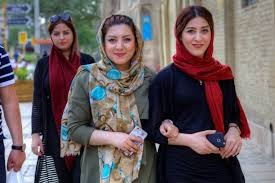
What was remarkable was Rick’s breaking the wall set up of fist-shaking fanatics and determined terrorists and meeting people who were hospitable and, in many respects, not unlike the West. He especially met a number of women and girls. Granted, they wore hijabs in public, but all the same were smiling, giggly, spontaneous, and you could see, here and there, wings of hair peeking out from their hijabs.
The people he met supported the revolution. They wanted to be friends with America. Steves was reminded Iran was a republic with a constitution and elections. The show wasn’t entirely an unquestioning jaunt. As Steves remarked, “this is a place that is not a democracy by our understanding, it is authoritarian, but it is changing. It isn’t shutting out the world.”
He felt many parents there don’t want their children corrupted by what is seen as decadent Western values from a people that look to be in decline. Islam, they argue, offers a better life. I liked this view of a people who have been walled up in the prejudices and propaganda of our leaders.
Perhaps a trip to Iranian media might help. I haven’t seen a lot of Iranian film, but I did enjoy the 1995 film The White Balloon, dealing not with The Great Satan (that’s us), but New Year’s Eve in Tehran. Razieh, a little girl, wants to buy a goldfish as a gift, but she doesn’t want to give the fish from her family’s pond. She wants a store-bought goldfish, since they’re top drawer. She has a series of misadventures where she is helped, hindered, frustrated, and loses her money, but a boy who sells balloons has a wad of chewing gum that saves the day and the Persian year 1374 comes in triumphantly.
Curiously enough, with much talk of Western rejuvenation through rediscovering our ancient values and mores, if Western society sinks into a gabble of self-indulgence and egocentric gratification, may a proportion of the West turn to Islam? Perhaps a more open, laissez faire version. Impossible? Believe me, if someone could make a pile of money creating a symbiosis of Western and Islamic merging, it will come. Jesus and Mary are revered in in Islam. In Judaism they aren’t. And if the Jews wear out their welcome, such truths may be the fulcrum ending the Zionist hold on American thought. If some think this is monstrous, then I counter that an Islamic appeal is only a final, exasperated reaction to decades of Jewish and corporate control of our culture and political system. It will only be an open reply to John F. Kennedy’s quote that those who make peaceful revolution impossible will make violent revolution inevitable.
Despite my list of anti-Iran literature and media, one book stands out as a thoughtful and wise, if sad, commentary on both our peoples, and that is Andre Dubus III’s 1999 novel House of Sand and Fog.
It’s a story that critics have said is almost Shakespearean in its tragic scope and the destruction of its characters. In it, Massoud Behrani, an Iranian air force colonel in the Shah’s air force, fled to America after the Shah’s fall, and struggles to build a lavish life as he was used to in Iran. He comes upon a house sold in an auction by the county for non-payment of taxes. He buys it for a song, and will flip it for a profit.
Kathy Nicolo, the owner, is a recovering alcoholic and addict who lost the house in one of her jags, and wants it back so she can rebuild her life. She sees Behrani as an interloper, as he also sees her when she keeps trespassing and demanding he do what’s right. Into this comes Lester Burdon, a deputy who becomes romantically involved with Kathy. A married man, Lester is obsessed with getting justice done for her, and begins a campaign of intimidation against Bahraini, who intimidates back. Kathy has an inner monologue where although the house “…Was just a little place in a low-rent beach town, I refused to be the one in the family who had let it slip away. Kathy claims “It is wrong; it’s so wrong to invade someone else’s home.”
But Behrani considers it his home that he will fight for to make a better life. Both capture the dislocation of modern America, a dislocation that Lester will play a horrible role in escalating by offering hope to Kathy and illegal intimidation to Behrani, especially to Behrani’s wife in a way that makes him look like a bully. . . but of course it’s for a good cause.
These three begin a circle of misunderstanding, defiance, and an inability to understand their different cultures and needs.
Lester is almost an echo of America’s military power: that we are a decent, good people, and our power will bring good. That people like Behrani must be stopped.
Behrani has a quiet contempt for Americans. He admired the American military officers he knew in Iran as advisors, but the Americans he sees are fat, soulless, weak and unmanly: “These people do not deserve what they have.” He judges Americans as:
These people have the eyes of very small children who are forever looking for their next source of distraction, entertainment, or a sweet taste in their mouth. And it is no longer to me a surprise that it is the recent immigrants who excel in this land, the Orientals, the Greeks, and yes, the Persians. We know rich opportunity when we see it.
As for Kathy, she is a mess but at her heart a decent woman, but sees the house as an extension of her soul, and falls for Lester because of his supposed ability to save her. That is, to get her father’s home back that, in her mental haze she let slip through her fingers.
Kathy’s substance abuse recalls my earlier description of how many Americans are distracted by messy family lives or are too wasted by addiction and consumerism to look outside their lives and the narrow picture they have of a world beyond America. As Lt. Colonel MacGregor said, “America isn’t just another world; it’s another planet.”
With Lester and his cold, simple determination to see justice done, he reminds me of America pushing its weight in the world. As C. J. Koch, the author of The Year of Living Dangerously wrote in his novel Highways to a War, “The Americans are deluded. They sit in the sky like gods, pressing buttons.”
My college had a large number of Iranian students, funded by the Shah. To me, they looked and seemed exotic, since my part of Missouri was almost all white, and even my college was pretty white in those days. The Iranians, both male and female, were colorful and noisy, and quite vivacious. They smoked in the cafeteria. It was against the rules, but they didn’t care. On the commons area near our major dorm, the Iranians played a lot of vigorous, no-holds-barred soccer. In 1973, Americans didn’t play soccer in my part of the Midwest.
They liked to party, but it was a party school, with 22 fraternities and sororities, so whooping it up was okay. The Iranians studied for degrees in engineering, physics, math, and banking. Most of my fellow white students centered on business, education (teachers), and the usual collection of useless liberal arts majors (guilty as charged).
I latter observed Iranians in the Army. At the Defense Information School (DINFOS) at Fort Benjamin Harrison, Indiana, where I took advanced training, Iranian officers were plentiful, as were the South Vietnamese, those two stalwart rooks on the Nixon Doctrine chessboard.
In the late 1970s, I noticed Iranian students at the University of Missouri-Columbia. They still studied the same subjects, but now placards on their dorm rooms proclaimed Down With the Shah. Despite him still funding their education, they detested him, and when you read of the political situation in Iran, there was a lot to detest.
Many of them were Marxists, devoted to the Tudeh (Communist), and expecting that a communist state would be proclaimed when the Shah was deposed. Khomeini was a great surprise to them, and when he began persecuting communists, they were caught up in a dilemma of seeing all their theories and plans go sour. A professor I had confided to me how many of them suffered from depression because their airtight theories didn’t work. Khomeini was never part of the equation.
I’ve been around Iranians, worked with some when I was in the anti-war movement in the 1980s, and I don’t see them as mindless fanatics. They’re a lot like us in basic needs, vices, and hopes, and they’re more than just the “rag heads” our media and the more martial of our public think they are. The activists among them were quite well-versed in Marx, political theory, and far better organized then our Leftists, who tended to be more emotional (“Nixon is an asshole”), somewhat altruistic or into PoliSci, and not much into deep theory; except for the women, who eventually siphoned their activism into radical feminism.
I don’t want to fight them. I don’t want to bomb them. I hate seeing a recent picture on Sonar 21, Larry Johnson’s website, of three smiling Iranian children who were just killed in one of our bombing raids. We and Iran could actually work together, except for the neocons who frankly, prefer Israel to America and keep maneuvering us into war after war. Now, we’ve got a big one. . . the big one. . . which many have wanted for decades. I hope the books and films I’ve discussed lead to some kind of understanding about this enemy, this people, this thing that has arisen in our psyches.
27 comments
“This is very subtly stated and very much between the lines, but Israel wanted mass destruction for their own benefit.”
Very true in the current war; it is not about Iran having nuclear weapons or any other pretext; it is about turning Iran into ruins, just like Gaza, so that Israel would be the only power in the region.
P.S. I recommend the Iranian movie A Separation, it should be available on the net with English subtitles.
“it is about turning Iran into ruins, just like Gaza…”
Your couldn’t be further form the truth, which is extremely suspicious. It’s about US christians that see the backlash from aware whites the world over, who now understand the extent jews lied to manipulate us into WWII and the massive subversion to Europeans ever since.
As a result, jews and christians are unleashing a last ditch effort to weaponize the nonsense in the bible, playing off end-times ideology as a way of escaping responsibility for the treason to their European stock, traditions, laws and constitutions. They know they are traitors engaging in mass murder and think that by fulfilling as much of that jewish psyops as possible, they can save themselves.
Evangelical Christian nonsense aside. Israel wants a weakened Iran. Netanyahu has been pushing for this for 40 odd years. They finally found an idiotic goy president who is willing to get involved in their dirty work.
I agree, also saw the movie ” A Seperation” years ago which showed how a non profit judicial system gave custody to the father when the mother wanted to leave and separate the family to be with the sister in the U.S., despite admitting that the father was good man and responsible to his family. Iran has a great history of civilization and became a religious autocracy only when threatened by the west starting with the removal of Mohammad Mosaddegh, and placement of the U.S. puppet government. This statecraft polity has been used on many equatorial nations, see General Smedley Butler.
That was really interesting. I agree—most of the Iranians I have known have been exemplary people, but they can show a kind of chauvinistic disdain similar to the House of Sand and Fog guy. I think of one chess player I knew in particular, but he sort of toned it down after I handed him his a*s a few times!
It’s impressive to have read so many books as the author has. I can’t imagine reading a book over a thousand pages, let alone writing one! The entire Iran affair is depressing and a complete concoction of the Zionists, I believe. His brother is a classic case of the authoritarian personality. Whatever authority or the mainstream consensus is has to be right in the minds of these people. They receive their status and approval from the system, hence the system has to be right or it’s a threat to their own self regard.
We on the other hand who are outcasts of the system create an inverse morality, where we tend to disagree with the system reflexively. Oh well!
Jews are very open about slaughtering animals for food and in rituals, but nothing is said of this.
Only the ritual slaughterer is “very open”. Jews in general are just as uncaring and willingly brain-dead as most non-Jews regarding the source of that slab of flesh on their plates.
Anyway, that is a most interesting article, so thanks.
https://english.almayadeen.net/news/politics/president-of-iran-addresses-americans-in-open-letter Short excerpt:
Within this same framework, the United States has concentrated the largest number of its forces, bases, and military capabilities around Iran—a country that, at least since the founding of the United States, has never initiated a war. Recent American aggressions launched from these very bases have demonstrated how threatening such a military presence truly is.
I don’t know about fiction on this, it’s interesting to read, but I’m sure there’s a far wider catch in movies, where the bad guy is just not called ‘Iran’, but is.
Iran’s great ‘crime’ towards the US specifically was rejecting and upending the British-US regime change op of 1953, in 79 which was because Iran outrageously wanted to control its own assets and not have them exploited and be ripped off. That’s the sole reason. How dare a country do this?
I don’t really give a damn about British Petroleum or past corporate iterations and their Iranian oil assets nor about the Shah and his medical treatments in New York, which prompted the Islamic storming of the U.S. embassy in 1979.
However, I did find it kind of odd that so many students at U.S. colleges were Iranians and incredibly anti-American.
What I don’t think any serious nation can tolerate is violating their embassy, which is an act of war, and which must be dealt with severely.
The United States response to the hostage crisis for 444 days was to wreck a few Army helicopters in the desert on a phony rescue mission and then call it good. That would be like doing nothing after Pearl Harbor with the argument that the Japanese were holding some hostages.
Fighting Iran is not in American national interests so I am opposed to it, and if anything, short work should be made of the Israel Lobby if they think otherwise. But arguing that Jihadi Muslims are smelling like roses here is absurd.
🙂
When I remember it correctly, in NOT WITHOUT MY DAUGHTER, the husband was a doctor, who worked in the US, and came in America already under Shah. So in the US he was more or less secular, but his relatives in Iran and also everybody aroung him there were deeply religious, so he came under their influence.
ARGO was a good film, just like a book, written by the CIA artist Mendes, on which the film was based.
Persepolis (2007) was an interesting, well-reviewed animated coming-of-age story, based on a graphic novel, of a young lady whose parents were left-of-center and who opposed the Shah. Imagine THEIR surprise when the fundamentalists took over. Her parents send her to Austria, where she encounters dysfunctional fellow students, and a romantic breakup, among other disappointments, and returns to Iran. Eventually, she leaves Iran yet again and finds exile in France. It was voiced by, among others, Chiara Mastroianni, Catherine Deneuve (her mom, with Marcello M.), and the venerable Danielle Darrieux. It was directed by Iranian expatriate Marjane Satrapi, whose protagonist is named, cleverly enough, Marjane. Not a profound political allegory, but a pretty good comedy-drama with a young person’s view of the seismic events from the late Seventies through our fin de siecle.
Yes, this was a good film.
That’s pity that the book TIME TO BETRAY, by Iranian Reza Kahlili, the CIA agent inside the Pasdaran, was not сinematized, it could be an interesting movie.
Apr 01, 2026
President Donald Trump’s address to the nation on the war against Iran
https://apnews.com/article/donald-trump-transcript-address-iran-war- b5970011fe934dde84d95d650bda56a9
Trump’s speech announced the end of global American empire.
Apr 01, 2026
Iran’s President Masoud Pezeshkian Publishes Letter to the American People
https://www.dawn.com/news/amp/1987606
“The Iranian people harbor no enmity toward other nations, including the people of America.”
Sep 15, 2001
Iraq’s President Saddam Hussein Publishes Letter to the American People
https://www.americanrhetoric.com/speeches/sadaamhusseinopenlettertous.htm
Lessons to learn ?
Great article! I don’t want to understand the Iranians, or any other non-whites, I just want all of them out of White countries. 🙃
Nice article. There is obviously a generational difference in views on Iran, with older Americans who remember 1979 and younger Americans who don’t really have any kind views on Iran.
Growing up in the 80’s and 90’s, I knew a handful of Iranian kids in school whose parents came here after the Ayatollah took over. It must have been rough for them living in such a different world.
Beyond that I know nothing of Iranians, and don’t really care about them one way or the other.
The loss of innocent life bothers me of course, but the main feeling I have is embarrassment that our government has shown the world yet again that we are Israel’s bitch.
Israel’s Orange Golem, at any rate–though this may be a case of the creator being more erratic than his product.
Orange Golem indeed. I hope you don’t mind if I borrow that one.
Thanks! Please do!
I’ve been suspicious for years about the 1979 hostage situation. I read a book, On Wings of Eagles, where Ross Perot told about how he was able to get some of his guys out of Iran when they were imprisoned there after the Shah fell. He explains how very easy it was to manipulate the mobs in the streets and get them to break open the prison where his men were.
Both the Soviets and Israelis had good reasons to make damned sure that the US never would be friends with Iran. Iran bordered the Soviet Union and its people were kin to many under the Soviet yoke. The Soviets may not have liked the mullahs, but at that time they didn’t see political Islam as a threat. And the Israelis wanted to be our only friend in the whole area; having us be pals with the Iranians might make people question why we must endlessly coddle Israel.
The KGB and Mossad both had networks in Iran and could have manipulated the mobs into storming the embassy and taking its personnel hostage, rather than just shipping them home. And if it was an intelligence coup, by either the Soviets or Israelis, I have to say it was a masterpiece of the genre.
Soviet intelligence officer and later defector Kuzichkin told in his book INSIDE THE KGB, that the Soviet spies were surprised by Khomeyni rise to power and did not like him at all. They would prefer the Shah to suppress the rebellion, because the Shah was a predictable politician, and, by the way, in 1970’s he cooperated not only with the West, but also with the SU, and was not an enemy of the Soviet Union.
That’s assuming that Kuzichkin was telling the truth. And that still leaves the Israelis, doesn’t it? False-flag operations are meat and drink to them—just ask the crew of the USS Liberty sometime.
I have read some of Khomeini’s writings. He disliked equally the liberal West and the communist USSR. These feelings are widespread among Iranians. For them the history of WW2 is very different of how it is perceived by western mainstream crowd. For Iranians the Allies were the enemies and occupiers, not liberators. In this regard Iran is our natural ally. Iranians are not poisoned by the false narrative of WW2. This fact in itself counts for much.
The Soviets may not have liked the mullahs, but at that time they didn’t see political Islam as a threat.
Not true, Afghanistan under Taraki was already boiling by that time.
Excellent article. So well read the author is. I can understand the frustration vis-a-vis ignorant family members.
Nice article, Steven. I have nothing against the Iranian people, as long as thy are in Iran. You express my feeling about them when you write:
… [T]hey’re more than just the “rag heads” our media and the more martial of our public think they are.
But your best sentence that had me laugh out loud was describing your brother as typical of most know-it-all Americans:
... well-read, at least he thinks he is, for he has the complete Time-Life collection of WWII and Vietnam books.
Anglo-Saxon chauvinism and jingoism manifest themselves fully in America, without the classic British, aristocratic constraints. They are fanned by people calling themselves “conservatives” and discreetly enabled even by the most “anti-racist” regimes. This way of perception manifested itself most absurdly during the Obama/Biden administrations when white American man was supposed to worship brown people and feel guilty for their plight while simultaneously blowing them up across the Globe for intersectional democracy. It’s no wonder “the Great Awokening” couldn’t last forever.
Most smart regimes provide safety valves around the official orthodoxy to allow people let off some steam from daily humiliations. Thus Britons are discreetly allowed to vent on Eastern European immigrants, Germans can quietly indulge their chauvinism towards Poles, Poles can express boundless hatred for Russians and, in limited degrees, for Germans (the “bad”, neo-nazi, AfD ones).
The Iranian is an another “brown” for the peon to safely hate, although as a “terrorist”, “fanatic” or at worst- a “rag-head”. Dissenters can be shamed as “third-worldist” or even “incels” as the pig-Right salivates at the prospect of flooding the Islamic world with smut and sluts.
[…]if Western society sinks into a gabble of self-indulgence and egocentric gratification, may a proportion of the West turn to Islam? Perhaps a more open, laissez faire version.
Average “Westerner” hates Islam as it denies him many forms of escapism the System provides. Genuine appreciation is found among the illiberal Right who contest the System so such conversion would require a localized revolution (moral/institutional). In the end the answer to that question will be provided by the discarded, young men who have no investment in the current order. Right now, European Islamic converts often come from troubled backgrounds and the new faith allows them to channel their past shame into neophyte zeal.
You got me rockin’ and a rollin’, rockin’ and a reelin’
Bomb Iran, bomb, bomb, bomb, Bomb Iran…
I cannot get this Beach Boys classic, sung to their tune, “Barbara Ann,” out of my head.
If you have a Subscriber access,
simply login first to see your comment auto-approved.
Note on comments privacy & moderation
Your email is never published nor shared.
Comments are moderated. If you don't see your comment, please be patient. If approved, it will appear here soon. Do not post your comment a second time.