Pixabay, CC0, via Wikimedia Commons
5,808 words
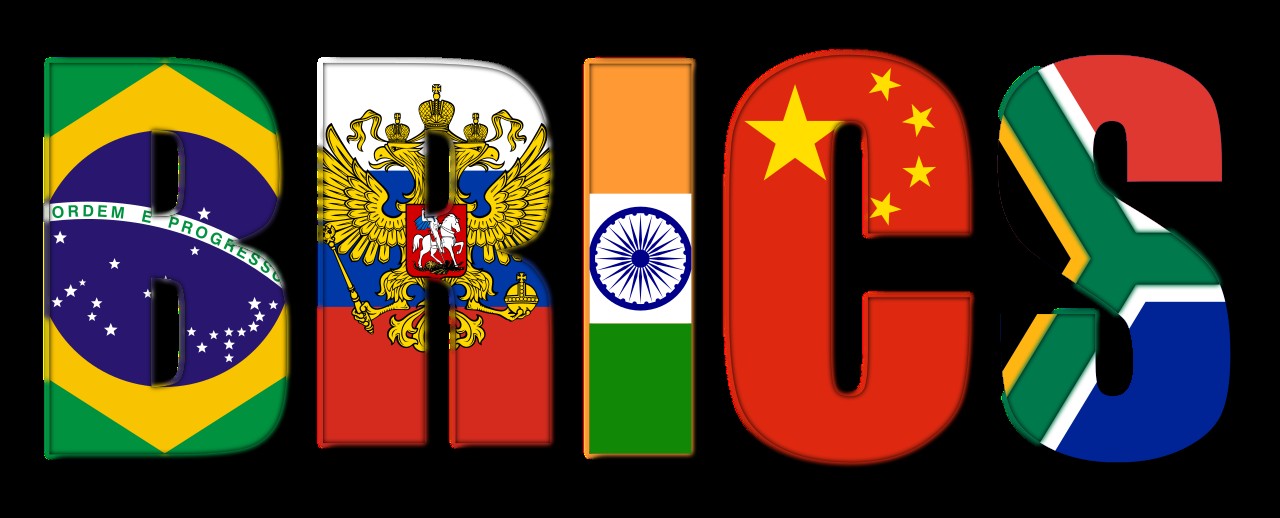
BRICS—named for the first five nations which entered the pact, Brazil, Russia, India, China, and South Africa, is a serious danger to America. The BRICS hazard comprises three separate threats. The first is an alternative banking and financial system which is opposed to the US dollar. The second consists of military threats which include aggressive Russian forces in Eastern Europe and the Arctic as well as Chinese military pressure in the Indo-Pacific. The BRICS bloc has already militarily cooperated. China has supported Russia’s war effort in Ukraine since 2022, and in 2026 South Africa hosted a BRICS naval exercise. The final threat is that of basic economic rivalry; Brazil’s agribusiness products are in direct competition to that of the USA, and China is likewise a direct industrial rival.
BRICS is a coalition which is strong where America is weak—in manufacturing. BRICS is also positioned to attack America at an extremely venerable point—finances. A rival financial system should be taken very seriously. A sort of rival financial system has caused America serious problems before—albeit by accident. A credit-fueled agribusiness deal with Russia (then the Soviet Union), agricultural investment opportunities in Brazil, and unwise domestic policy choices created a major internal problem within the United States during the 1980s. This was the Farm Crisis—a major economic disruption which morphed into a small but vicious civil war.
It is very possible that in the future the BRICS coalition could seek to deliberately bring about a repeat of the catastrophe to further their own respective national goals. Therefore, understanding the Farm Crisis is critical. The Farm Crisis was a disaster in whose shadow we still live. Parts of the Farm Crisis never really ended; it just moved from crisis to chronic.
Banks are Important
Military capability is flashy but banking and finance are important, too. It is financial institutions which make armies possible. For all the grumbling about bankers, getting “debanked” is a major inconvenience. Banks do several things that make life easier. The first is that they secure money. Then, they move money safely. Finally, banks are an institution which can harness unused capital for productive uses by means of making loans. To make the loan worth doing the borrower must pay the money back with interest.
Banking requires a society with a legal structure in place which allows the creditor to get the loaned money back should the borrower default. This is the critical factor that allowed the English-speaking world to economically advance far ahead of the rest of the world. Banks also require a society with a government that can produce currency that is accepted and stable. The totality of the currency must grow with the value of the economy so there are enough new coins (in whatever form) in circulation to allow a borrower to acquire the currency to pay off the loan provided the borrower is conducting business profitably. There is a balance to this that must be maintained. Fiscal policy must avoid inflation, and that is but one of the actions needed to keep a healthy pro-bank ecosystem.
There are some important cultural prerequisites for banking. The bankers must have an internalized ethos that prevents embezzling the deposits as well as an ideology which gives the creditor the moral force needed to collect from a borrower in arrears. Calvinism is a perfect example of a cultural prerequisite. Calvinists are expected to be honest and not embezzle. They also have a theological worldview which holds that wealth is a sign of God’s grace. Quakers also have the optimal cultural prerequisites for banking. They view that goods should be sold for a fixed price and they excommunicate members who go bankrupt. There is a sharp edge to the theology of economics on the part of both denominations, but societies with many Calvinists and Quakers are all economically advanced. Jews are also expert bankers, but they have a two-tiered morality with one set of behaviors for non-Jews and a different one for Jews, consequently there is a bit more of a predatory edge from that quarter.
Modern banking—at least the part where money could be safely stored and moved—was not created by Jews. It arose during the Crusades when Western Christians sought to liberate the Holy Land from the Turks. A monastic military order involved in the Crusades, the Knights Templar, pioneered money moving. The Templars established banks in both Europe and Palestine. A knight could deposit his money in London and withdraw it in Jerusalem. Eventually, the Templars came into conflict with the Pope (and the King of France) and were excommunicated. There is a legend that the Swiss banking industry was started by the excommunicated Templar knights.
The Farm Crisis
The book, Monsters of Babylon (2024) by Gregory Delaney, is an exploration of the history of Jews and banking from a highly hostile point of view. It’s almost too hostile. Nonetheless, the book has an anecdote about how banking operations can affect national security. In the distant past, when the Assyrians in Nineveh were in competition with the Babylonians, pro-Babylonian bankers in Nineveh (which Delaney held to be Jews) engineered a shortage of credit crisis by loaning silver to Babylon in advance of hostilities. When war came, the Assyrians couldn’t get the coinage to pay for their army and Nineveh was conquered. A shortage of capital in a critical part of American industry happened in America during the Farm Crisis.
The Farm Crisis originated when the US Secretary of Agriculture Earl Butz altered agricultural policies in the 1970s. Butz ended New Deal Era farm subsidies which paid farmers to not overproduce. Butz’s new policy increased farm subsidies provided the farmer increased production. Soon farmers planted fencepost to fencepost and took on more debt to buy more land. Land was available because many small farmers were selling out and moving on. Iowans from their farm-heavy state had been moving to southern California for decades.
The overall impulse for the expansion was that larger farms were more efficient. Historian Pamela Riney-Kehberg writes:
By 1969 the size of the average farm had jumped to 239 acres, and machines and chemicals did more of the work compared to farming families and their animals. Farmers realized economies of scale as farm size grew. In the early 1970s, a small farmer working 160 acres paid thirty-two dollars per acre for expenses such as machinery, power, and fuel. If a farm doubled in size, those expenses fell to twenty-five dollars an acre. At six hundred acres, the expense would only be nineteen dollars an acre. Successful Farming, one of the farm management magazines that Iowa’s farmers most trusted, counseled farmers to buy more land in order to use their machinery more efficiently, thus lowering their costs. [1]
The central financial challenge within the farming industry is that the more productive each farmer is, the less an individual farmer can get when selling his product. In the 1970s, the US Department of Agriculture realized that farmers could profitably off-load their overproduced products to the Communist Bloc, which badly needed food because their political and economic model didn’t work.
In 1973, a deal was reached between the United States and the Soviet Union whereby the communists could purchase grain on credit. The Soviets overran their initial credit outlay within a month but got more credit and continued to buy. As with the Lend-Lease program during World War II, the Soviets fully thought through their requisition strategy and got the better end of the deal. They acquired enough food to cause wheat prices to increase across the globe. The Soviet purchase of wheat came to be called “The Great Grain Robbery.”
Farm incomes increased, and throughout the 1970s banks loaned money to farmers with little inhibition. Lending to farmers seemed a sure way for the financial industry to make money since other American industries were increasingly distressed.
As a result, the price of farmland increased in Iowa by 500% or more. Farmers went in debt to buy land for their children to continue their respective family traditions. Meanwhile, the Arabs launched an oil embargo over modern Israel’s mistreatment of the Palestinian people. As a result, fuel costs increased. Then, due to overproduction, the market price for farm products decreased. The crisis had started, although it was still a cloud the size of a man’s hand.
There was no single moment that announced the coming of the Farm Crisis, but in 1977 a group of far-sighted farmers in Campo, Colorado realized that there was a problem and they launched the American Agriculture Movement (AAM) which sought to create a national-level policy called “parity.” Simply put, parity meant that the USDA would offer price supports for farm goods, so they were “in parity” with other products. If a tractor cost the value of 1000 bushels of wheat in 1910, then the total price of 1000 bushels of wheat in 1977 should cost the same as a tractor built that year.
The plan was radical and went against the increasingly powerful free market ideology, nonetheless farmers showed their support for the AAM by holding a demonstration in Des Moines, Iowa and President Carter’s hometown of Plains, Georgia. Thousands of farmers in their tractors formed convoys in both places on the same day. A bipartisan bill that partially met the AAM’s requirements was advanced by the Senate by Republican Bob Dole, but it perished in the House.
The Carter administration didn’t recognize the seriousness of the problem. The enormous output of food was quickly exported, helping to bring down the trade deficit. The USDA saw itself as representing the consumer to the farmers so that agency’s focus was on maintaining a cheap and safe supply of food—farmer profits were not a concern. Then the Iran Hostage Crisis broke out and Carter was overwhelmed. In 1980, in response to the Soviet Invasion of Afghanistan, Carter stopped Soviet grain purchases. Prices for farm goods plummeted further.
It is possible that agricultural loans could have been repacked into new financial vehicles in the 1970s, but the window of time to do that was small. Bankers were obligated to invest where the most money could be made which was in certificates of deposit or abroad—such as in Brazil. Additionally, the economy was in a place where there was both economic contraction and inflation—stagflation. The media called economic statistics of the time the “misery index.”
To fight inflation, President Carter appointed Paul Volcker to head the Federal Reserve Board. Volcker’s strategy was to end inflation by raising interest rates to an extremely high level. As a result, banks restricted lending to farmers, and land values declined. Soon a great many farmers were flipped in their mortgages and paying usurious interest rates with no way to get out of the hole of debt. For America’s farmers it was as though money had vanished. The silver coins had gone from Nineveh to Babylon without the dignity of a genuine pre-planned conspiracy behind it all.
Meanwhile, America’s strategy in the Cold War hinged upon the maintenance of a “Free World” economic zone that effectively ended the US government’s historical protections of American industry. Peter Zeihan writes:
[During the Cold War,] the United States guaranteed the safety of the imports, exports, and supply lines of everyone. Even countries it economically competes with […] As Detroit was hollowing out, German automotive exports were sacrosanct. As Midwest farmers were struggling with low grain prices, those pursuing Brazilian agricultural expansion found it easy to import American fertilizers and equipment. (My emphasis). [2]
The American Agricultural Movement endorsed Ronald Reagan for president in 1980, and he won in a landslide. The distressed farmers were not Reagan’s only voting bloc. Reagan had won office by appealing to the voters who were frustrated by “civil rights.” However, he couldn’t do all that much to overturn “civil rights” laws during his two terms. There were still too many white true believers around who insisted that an integrated utopia was just over the horizon. Additionally, the Communist World had expanded and there was communist inspired trouble in Central America. Reagan used the most revolutionary minded white advocates for operations in El Salvador and Nicaragua, which were then on the frontlines of the Cold War.
The Farm Crisis, De-Industrialization, and the Far Right
When it came to fighting communists, [3] the American Far right supported Reagan all the way, however a portion of the Far right recognized the problems of the Reagan administration’s embrace of the ideology of neo-liberalism which exacerbated the problems of the Farm Crisis. While neo-liberalism did dismantle the inefficient economic policies of the New Deal, it also allowed industrialists to offshore industry. In the early 1980s, Jack Welsh, the CEO of General Electric “streamlined” his company and increased the value of his shares by closing factories in the United States and rebuilding them in Asia, to put it simply.
The were no words to describe what was happening. It wasn’t until 1984 that Walter Mondale pointed out that Reagan’s economic policies were turning the Midwest into a “rust bowl.” Artists did react, however. The video to Lee Greenwood’s song, “God Bless the USA,” (1984) is an extended reference to the Farm Crisis. John Cougar Mellencamp (from Indiana) produced his classic album describing the situation, Scarecrow, in 1985. Willie Nelson organized Farm Aid in 1985, where musicians hosted a concert that raised awareness of the crisis. However, that was almost a decade after the crisis had started.
The Farm Crisis & the Midland’s Civil War
As the crisis deepened, industrial firms like John Deere laid off workers. Businesses that supplied fertilizer and other goods to farmers suffered. Small town banks sank along with the farms they foreclosed on. Midwestern farmers died by suicide, small towns in the hinterlands emptied of people, and the desperation increased. One shocking event was the rampage of 63-year-old Dale Burr. On December 9, 1985, he shot his wife, murdered a neighboring farmer and a small-town banker, and then took his own life.
Burr’s actions were part of a civil war caused by the Farm Crisis that raged within the American sub-nation that Colin Woodard calls “the Midlands.” The sub-nation that became the Midlands started when English Quakers moved to the Delaware River Valley in the seventeenth century. There the Anglo-Quakers intermixed with the settlers of the pre-existing Swedish and Dutch colony and expanded westwards aided by German immigrant allies.
Starting from the Delaware River Valley, the Midlands comprises northern and central Maryland, most of Pennsylvania, the central parts of Ohio, Indiana, and Illinois. After reaching western Illinois, the Midlands spreads through nearly all of Missouri, Iowa, Kansas, and Nebraska and then heads north through the center of the Dakotas into Manitoba where it curls back east into Ontario. The southern branch extends into much of Oklahoma, the northern panhandle of Texas, and northeastern New Mexico.
The Farm Crisis caused considerable violence in a region otherwise known for its peaceful inhabitants. This might sound hyperbolic, but SWAT teams and police phalanxes were involved in foreclosures. There were shootouts. Many of those involved in both sides of the gun battles that took place in Iowa, Nebraska, or North Dakota during the Farm Crisis had deep ancestral roots in the Midlands. Men whose resting fathers had stood shoulder to shoulder in the Union Army at Shiloh shot each other at police checkpoints, punched each other in courthouses, and threatened each other at farm auctions. Who stood where during the fights depended on what side of a bill of sale one was on. One of the central figures of the far Right at this time is Reverend William Potter Gale. Gale is a figure with a mixed legacy. On the one hand, his ideas helped win the Cold War and inspire whites in a very dark time. On the other hand, he was part of the tragedy.
Gale’s mother was from Minnesota, and her ancestry was mostly English. His father, Charles Gale, has a backstory that is shrouded in mystery because Charles wished it so. Charles was born in 1876 and was of Jewish heritage—although this is disputed. He and his parents left Russia for Scotland, but he decided to move to North Dakota with his aunt and uncle at a settlement called Painted Woods, North Dakota. [4] Charles later told the army and census takers he was born in North Dakota and his parents were Scottish. He enlisted in the military to fight in the Spanish-American War and served in the Philippines Insurrection. He got out in 1902, worked in several occupations in Minnesota, and then re-enlisted in 1920 in Battery F, 76th Field Artillery as a Stable Sergeant. He might have been in the National Guard or Reserves between 1902 and 1920. One researcher, Daniel Levitas, believes Charles was a soldier for close to thirty years and first enlisted in the 1st Wisconsin Volunteers in 1898.
William Potter Gale served in the Pacific during World War II. He was a commissioned officer and led a detachment of Filipino troops in California. After he was promoted to major, he was most likely involved in logistical operations. He claimed to have been involved in guerilla operations in the Philippines. If so, he would likely not have been involved in direct actions—he did stateside training with Filipinos and supply and support in the Pacific. There is probably no way to get to the exact truth because the military files of all soldiers who enlisted during and after 1917 burned in a fire in 1973.
William and his sister Ruth both became Christian Identity adherents, and both claim their parents held those beliefs. Ruth and Willam’s mother, Mary Agnes, was probably not Identity, but she was politically on the Right. She left the Episcopal Church because she was convinced that many of its leaders were communists.
What put Gale in the center of the tragedy of the Farm Crisis was when his ideas intersected with a libertarian tax protest movement and the ongoing economic desperation. Gale’s theological message is beyond the scope of this article, but his political message held that Anglo-Saxons and related peoples were under threat from Jews and other non-white groups who were maliciously supported by the US Federal Government. To counter the threat, he promoted a theory that held that Anglo-Americans should only hold the county as the highest level of government—this is putting it simply.
His ideas were amplified by a former Silver Shirt activist named Mike Beach. There was also an anti-tax movement which fit into Gale’s message. It was led by Arthur J. Porth of Kansas. The anti-tax ideology was mainstreamed by Irwin Schiff (Jewish). [5] Porth and Schiff inspired upwards of sixty thousand Americans to file bogus or blank tax forms. Other Christian Identity ministers were inspired by Gale’s success. Christian Identity minster Sheldon Emory wrote Billions for the Bankers Debts for the People in 1982. The cover of Billions. . . shows a farmer on a tractor.
The merger of the tax protest and Gale’s ideas on the sovereignty of the county became a movement that came to be called the Posse Comitatus. The most notable member was Gordon Kahl. He was from Medina, North Dakota (which is very close to Painted Woods), and had served in the Army Air Corps as a gunner during World War II. Kahl was not primarily a farmer, but as the farms collapsed, so too did the economy of the small towns. His tax protest eventually caused him to come into conflict with the US Marshalls and the police. In early 1983, Kahl and his son shot and killed their way through a police roadblock and went into hiding in Arkansas. Eventually he was found and died in a shootout. Law enforcement also burned the cabin he was hiding in. At Kahl’s funeral, the presiding minister Peter Dyck called Kayl a martyr, a patriot, and a peaceful man.
Economic problems don’t make people nicer. Desperation makes shoot-outs appear to be a good idea. One such violent white advocacy group—and it was unquestionably violent—was The Order, whose most storied member was its leader Robert Mathews. In his famous speech, A Call to Action (1983), Mathews specifically invoked the economic problems arising out of the Farm Crisis saying:
The regime in Washington, D.C. is extremely worried about the further radicalization of the American farmer. Fortunately, instead of implementing a program that will genuinely help the farmer, they’re responding with massive shows of force and repression. So much the better. Sixty miles south of Spokane, Washington, along the Idaho border is a farming area we refer to as the Palouse. It’s one of the richest farming areas in the world. […] Even so, comrades, many farmers in the Palouse are being foreclosed upon. I have met and talked with one of these unfortunate farmers, a kinsman by the name of Ray Smith. Mr. Smith is a large-framed, ruddy-faced man who likes to refer to himself as “a Snake River cowboy and damn proud of it!” […] Mr. Smith’s dreams have been shattered and he’s on the verge of losing his two-thousand-plus acres, his home, and his son’s future livelihood. Mr. Smith, to his credit, took a long good look at his problem and how he arrived at so sorry a state. […] And how did the system react? By sending a plane, a helicopter, a bulldozer, SWAT teams from all over the state of Washington, and sixty very heavily armed deputies to the foreclosure on Mr. Smith’s farm […] Radicalization of the American farm movement is also taking place in the Dakotas and Colorado.
The Order went on to commit a string of robberies and then shot to death a disgusting Jewish “shock jock” in Colorado in 1984. The FBI were alarmed by The Order and even more alarmed by the group’s coherent ideology. These actions gave a mandate to Federal Law Enforcement to roll up pro-whites. There was a “sedition” trial at Fort Smith, Arkansas in 1988 which was an act of lawfare against a number of white advocates—some of whom really had done highly reckless and imprudent things.
Two other people who were knocked loose by the Farm Crisis were Randy and Vicky Weaver. Both were from Iowa. Randy had been a Green Beret in the late 1960s but had not been sent to Vietnam. Vicky had been raised as both a Reformed LDS and a Congregationalist and shifted over time into Christian Identity-like beliefs. The economic desperation in Iowa during the Farm Crisis and Vicky’s increasing belief that her family needed to prepare for a final spiritual battle caused the family to leave Iowa and set up a homestead in Ruby Ridge, Idaho.
There, they came into conflict with the FBI. Federal law enforcement was keen on getting Weaver to be an informant on a nearby Christian Identity church. Weaver refused and this created another series of gun battles, to put it simply. The siege of Ruby Ridge was the first battle in the last campaign of the Midland’s civil war. The bloodshed continued in Waco and Oklahoma City although the Farm Crisis had been forgotten by then.
The Farm Crisis ended because the crisis burned itself out. The most serious of the distressed farms went under and those farmers that stayed in business pressed warily onwards. Prices eventually stabilized and inflation ended. Prairie towns that reporters expected to become abandoned in 1989 remain viable as this article goes to print and many have increased in population. Nonetheless, the entire region remains underpaid.
Ronald Reagan was not politically damaged by the Farm Crisis. Additionally, his neo-liberal economic policies were adopted by later administrations. The bill came due for Reagan’s successor during the 1992 election, when George H.W. Bush was defeated by a political far Right which had dropped gun battles for metapolitics and civic activism. Bush 41’s defeat had nothing to do with raising taxes and everything to do with race, deindustrialization, and the Farm Crisis.
It is too easy to look back at the men who took to violence during the Farm Crisis and point out how they were completely in the wrong and today’s far Right thinkers are so much wiser and smarter. Men like William Potter Gale and Gordon Kahl did recognize that their people were ill-ruled by an imperial government which embarked upon adventures for Israel or other favored constituencies while their people suffered. Their efforts to correct the problem were flawed and doomed to failure, but had the Midlands of 1980s America been the Spanish Netherlands in the 1580s, matters could have turned out differently and Gale, Mathews, and Kahl would be national heroes. Nonetheless the Farm Crisis was a vast national wound which has continued unacknowledged and unhealed.
The Farm Crisis and America’s Alliance System
The Farm Crisis also brought into focus the problems of America’s alliance system, whereby nations like South Korea and Israel are heavily subsidized and defended while heritage Americans in the heartland are taken for granted and scorned.
Pamela Riney-Kehberg points out that this issue arose in Iowa during the Farm Crisis:
[Children] heard what their parents and other adults were saying [about the situation] and responded. A farm woman from Cresco, [Iowa] writing to the governor, described the way in which the crisis was affecting her young son. She wrote, “This morning my son (7 yrs) asked why the President doesn’t love the farmers.” The youngster had listened to the news and heard that the president was asking Congress for military aid for American allies. This had president was not providing aid for farmers like his parents. Hence, the child had come to believe that President Reagan did not care about people like him. As the boy’s mother wrote, “I really don’t know what to tell him.” [6]
The famous military historian and raisin farmer Victor Davis Hanson was also deeply affected by the Farm Crisis. In 2023, he pointed out that the inconsistency of enormous support America gives its allies during times of severe American hardship in an interview with the Hoover Institute’s Peter Robinson. Hanson said:
[During the Farm Crisis] […] the market collapsed with raisins. It went from $1,400 to $440 [per ton] in one year. So, a year before we’d cleared $80,000. That year, we lost $250,000. So, they had a person from the Reagan administration and the Raisin Administrative Committee, [come to his area] because everyone was complaining. [Hanson, then 26 met him in a meeting and asked,] …why do we subsidize our NATO partners who are dumping Greek and Turkish raisins below the cost of production that you can buy in the United States?
The Reagan administration official didn’t have an answer, he only replied with the talking points of neo-liberal economic theory and ignored the fact that Greece and Turkey could subsidize their raisin producers forever provided the Americans paid for their respective militaries.
The Danger of BRICS
While America has freeloading allies, America has genuinely hostile rivals. They can be found in the BRICS coalition. The separate financial system promised by BRICS provides dangerous enemies the opportunity to create a deliberate shortage of capital in a critical part of American society at a key time. There could be a Farm Crisis II in the middle of a crisis in Cold War II. The Farm Crisis started with a Soviet Russian super purchase of grain aided by American creditors. During the Farm Crisis, Brazil modernized its agribusiness with loans from US-American banks.
BRICS was organized in Russia in 2009. Marina Larionova writes that:
The BRICS is committed to a strong, open, rules-based multilateral trade system with the WTO at its centre […] This commitment is reflected in the continuous support of the Doha round of trade negotiations and the Trade Facilitation Agreement, and in a cautious assessment of the “plurilateral initiatives that go against the fundamental principles of transparency, inclusiveness and multilateralism,” which “distract members from striving for a collective outcome…” [7]
There are eleven full members of the BRICS coalition. Grouped by cultural and geographical categories, they are:
- Americas—Brazil
- Asia—China, India, Indonesia
- The Middle East—Iran, Egypt, United Arab Emirates, Saudi Arabia
- Africa south of the Sahara—Ethiopia, South Africa
- Russia
The combined group consists of members from civilizational rivals of the West. South Africa represents extreme anti-whiteness combined with Anglo-Protestant Negro Worship. Eurasian Russia has a long history of causing military problems. The Middle Eastern countries have plenty of oil resources and have a history of sponsoring Islamic terror groups. BRICS is a scorpion.
There are a number of theories as to why these nations joined together. One is that Russia was maliciously seeking to expand its influence while President Obama was attempting to reset the US-Russian relationship back to a positive state. Another idea is that China is looking to expand its reach. Either way, we are now in a multipolar world where no single country is the strongest.
Elbridge A. Colby writes:
In the unipolar era, Americans could make decisions about strategic questions without too much fear of the consequences; America’s preponderance of power buffered it from the results of its decisions becoming too painful. This is no longer the case. Power is now more diffuse, and the places to which it is diffusing especially China – are not established US allies. Ten years ago, the United States spent more on defense than the next eighteen countries combined, and most of the immediately trailing countries were close allies. Today, that margin has shrunk; it spends as much as the next seven combined, and China, which has leapt into second place, has increased its defense spending by around 10 percent every year for the past twenty-five years. And the margin is likely to shrink further as China grows. [8]
BRICS is a new entity consisting of vastly different peoples. It might collapse on its own. China and Russia may very well be becoming hostile rivals again, but prudence dictates that Americans should take the threat seriously. Domestically, this means ensuring that America does not have an agricultural policy where consumers get a steady supply of cheap and safe food while the food producers fail to be paid for what they have rightly earned.
This also means encouraging Europe to re-arm against Russia. The Baltic states also have a large ethnically Russian population, and this population could be the excuse for Russia to occupy places like the Russian-speaking town of Narva, Estonia. The ethnic situation in the Baltics is a major potential problem. Hiiumaa island is also strategically valuable and within grasp of Russia’s navy. Demonstrating that Hiiumaa is defendable is a good objective for future NATO exercises.
China is especially dangerous. Its manufacturing industry is modern and enormous. The Chinese have replaced Jews in smuggling opiates into the United States. China has gained influence everywhere. There is no way to avoid future unpleasant dealings with Communist China. A 2026 report from the Rand Corporation has a good suggestion on how to move forward:
Rather than competing head-on with China’s incremental innovations, the strategy advocates for leapfrogging current-generation technologies to create entirely new paradigms in such areas as semiconductors, renewable energy, advanced manufacturing, and health care diagnostics. It emphasizes multilateral collaboration with other leading industrial democracies to pool resources, talent, and influence, fostering a shared ecosystem of innovation.
Another option is the “dark route.” China has risen to global prominence in no small part because America secures large swaths of Asia. Should Americans cease to secure mainland Asia—including South Korea—matters for China might change. Without continued American security engagements, the Orient will become a different place. Asia, including BRICS member India, can be “re-wilded.” Isolationism against Asia is a good idea. It is also time to consider breaking apart the present failed state that is South Africa. Recognize an independent Cape government and provide it with aid. Natal can also be separated from South Africa.
If there is a lesson from the Farm Crisis, it is to be cautious of getting too deep in debt. If “everyone” is borrowing money to buy the same sort of thing, there is a bubble and it will eventually pop. The story of the Farm Crisis is very similar to the Housing Collapse of 2008.
Notes
[1] Pamela Riney-Kehrberg, When a Dream Dies: Agriculture, Iowa, and the Farm Crisis of the 1980s, (University Press of Kansas, USA, 2022) (pp. 19 – 20)
[2] Peter Zeihan, Dis-United Nations: The Scramble for Power in an Ungoverned World, (Harper Business, New York, 2020) (p. 12)
[3] For the most part, these true Rightists didn’t fully recognize the deep cultural differences between Western Europeans and the people of “Russian World.” The idea of a “Clash of Civilizations” which held that the Russians and Russian-related peoples were completely different from Western Europeans was not fully understood. In the 1970s and 1980s, blame for the international friction was placed on the different communist governments or the Organized Jewish Community.
[4] Painted Woods, North Dakota and Campo, Colorado are both settlements on the western edge of the Midlands region as identified by Woodard. Both places are subject to the extremes of the western prairie climate (BSk). It is notable that the most eloquent of voices during the Farm Crisis had connections to the western border of the Midlands.
[5] Jews being involved in the most radical faction in an Anglo-Midlander civil war might not be as anomalous as one would think. Radical ideas that are propagated by Midlanders often have Jewish supporters. As the Farm Crisis deepened, Jewish clothing suppliers in Oregon who originally came from the Painted Woods settlement in North Dakota supplied paraphernalia to Posse Comitatus activists in the 1980s. The Ware Group of the 1930s and 40s consisted of communist spies. It consisted of Jews working with native white Americans of Midland origins, including Alger Hiss and Whittaker Chambers. The Race-IQ issue was first seriously popularized by Charles Murray (Quaker—from Iowa) and Richard Herrnstein (Jewish).
[6] Pamela Riney-Kehrberg, When a Dream Dies: Agriculture, Iowa, and the Farm Crisis of the 1980s, (University Press of Kansas, USA, 2022) (p. 75)
[7] Marina Larionova & John Kirton, BRICS and Global Governance, (Routledge, New York, 2018) (p. 12)
[8] Elbridge A. Colby, The Strategy of Denial: American Defense in an Age of Great Power Conflict, (Yale University Press, New York, 2021) (p. x)
Bibliography
Caldwell Christopher, The Age of Entitlement: American Since the Sixties, (Simon & Schuster, New York, 2020)
Elbridge A. Colby, The Strategy of Denial: American Defense in an Age of Great Power Conflict, (Yale University Press, New York, 2021)
Frank L. DeSilva, Bruider Schweigen or The Silent Brothers, (Self Published, USA, 2014)
David Hackett Fischer, Albion’s Seed: Four British Folkways in America (New York: Oxford University Press, 1989)
Marina Larionova & John Kirton, BRICS and Global Governance, (Routledge, New York, 2018)
Daniel Levitas, The Terrorist Next Door: The Militia Movement and the Radical Right, (Thomas Dunne Books, New York, 2002)
Carlo Masala, If Russia Wins: A Scenario, (Atlantic Monthly Press, New York, 2025)
Pamela Riney-Kehrberg, When a Dream Dies: Agriculture, Iowa, and the Farm Crisis of the 1980s, (University Press of Kansas, USA, 2022)
Colin Woodard, American Nations: A History of the Eleven Rival Regional Cultures of North America, (Viking, New York, 2011)
Peter Zeihan, Dis-United Nations: The Scramble for Power in an Ungoverned World, (Harper Business, New York, 2020)
1 comment
A fascinating description of the Farm Crisis and its long-lasting consequences. Perhaps the anti-European hatred spread by MAGA populists feeds off partially on the plebeian envy of the perceived “favored children” of Uncle Sam’s NATO. The regime now deflects by suddenly attacking the “freeloaders”, but this has been a price of the imperial upkeep in Asia Minor against the Soviet Union and then for the Pax Americana (which actively sought to disarm Europe post-Cold War).
European small farmers are in for their own dispossession in the EU-Mercosur deal. Like their overlords over the Potomac, the Eurocrat vassals are going to sell out their own peasants. More land for the wind turbine peddlers.
BRICS may found itself obsolete or in need for a new roadmap if the world trade based on sophisticated Western importing markets collapses. Chinese prosperity is still heavily tied to the post-Cold War imperial infrastructure and would need to diversify further with potentially more diminished returns from less developed markets
Comments are closed.
If you have a Subscriber access,
simply login first to see your comment auto-approved.
Note on comments privacy & moderation
Your email is never published nor shared.
Comments are moderated. If you don't see your comment, please be patient. If approved, it will appear here soon. Do not post your comment a second time.