 1,446 words
Peter Hammond
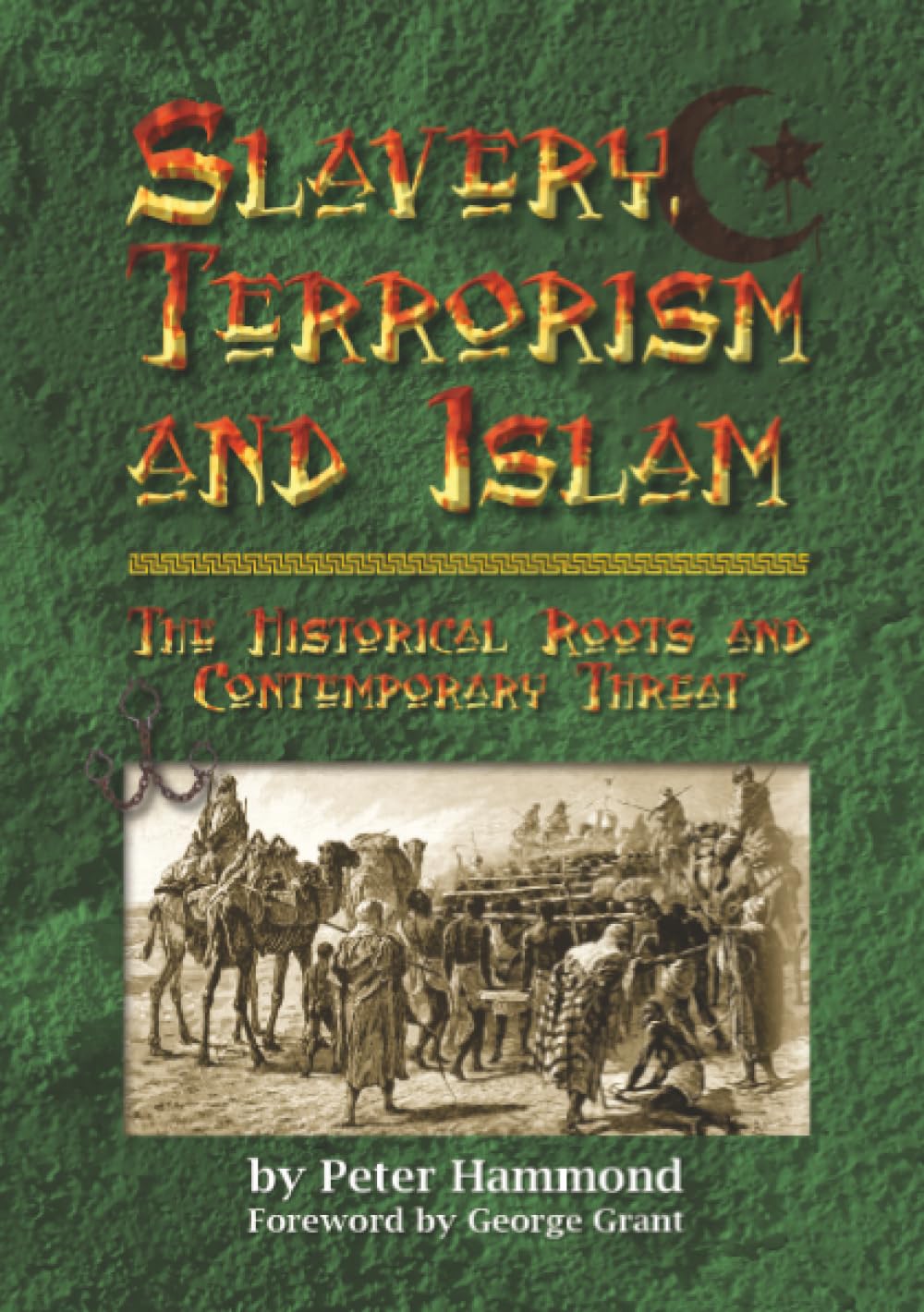
Slavery, Terrorism and Islam – The Historical Roots and Contemporary Threat
Cape Town: Christian Liberty Books, 2021
Peter Hammond’s Slavery, Terrorism and Islam is structured as a sweeping historical indictment. It is not written in the tone of comparative theology or neutral historiography. Hammond’s objective is to argue that the themes of slavery, expansionist warfare, religious supremacy, and coercion are not distortions of Islam but are embedded in its earliest precedents and carried forward through centuries of jurisprudence and empire. In his telling, modern Islamist terrorism represents continuity rather than corruption.
The foundation of Hammond’s argument lies in the life of Muhammad during the Medinan period. After the Hijra in 622 CE, Muhammad and his followers transitioned from a persecuted minority in Mecca to a politically organized community in Medina. Hammond emphasizes that this transition marked a decisive shift toward armed engagement. The early caravan raids against Meccan merchant routes are presented not merely as defensive responses but as organized expeditions intended to seize property and weaken rivals. The Battle of Badr in 624, frequently described in Islamic tradition as a miraculous victory, is framed by Hammond as an attempted caravan interception that escalated into open battle.
He catalogues the numerous expeditions recorded in early Islamic biographical literature, stressing that warfare became institutionalized. For Hammond, this has theological significance: Muhammad’s conduct forms the Sunnah, the normative example for Muslims. If the founder conducted raids and sanctioned warfare under religious authority, Hammond argues that such actions cannot be dismissed as historically contingent.
Hammond expands this discussion with detailed attention to the Jewish tribes of Medina. The Banu Nadir are described in early sources as having been expelled from Medina after accusations of plotting against Muhammad. Their lands and property were confiscated. Hammond interprets this episode as consolidation of political and economic power through expulsion and expropriation. He then turns to the Banu Qurayza, whose adult males were executed after the Battle of the Trench and whose women and children were enslaved. Hammond presents this as evidence of collective punishment carried out under prophetic authority.

You can order Greg Johnson’s Loving Our Own here
He also addresses the Banu al-Mustaliq. During the campaign against this tribe, Islamic sources record the capture of women and children as war booty. One of the captives, Juwayriya bint al-Harith, later married Muhammad, and her marriage reportedly led to the freeing of many captives from her tribe. Hammond does not interpret this as an act of clemency but rather as confirmation that enslavement of captives, including women, was embedded in early Islamic warfare. The episode of Banu al-Mustaliq is also associated in Hadith literature with discussions of sexual relations with captive women. Hammond uses these reports to reinforce his claim that slavery and concubinage were not peripheral but structurally integrated into Islamic law and practice.
Indeed, the scourge of sexual exploitation runs throughout the book. Hammond opines that the Quran permits the sexual abuse of women and slavery. Islam did not abolish slavery but regulated and normalized it. The Quran refers repeatedly to “those whom your right hands possess,” understood in classical jurisprudence as slaves. Sexual relations between masters and female captives were permitted without marriage. Manumission was encouraged but not mandated. Hammond stresses that Muhammad himself is recorded as owning slaves and concubines, making slavery part of the prophetic precedent rather than merely inherited culture.
He also highlights the traditional narration that Aisha was nine years old at consummation of marriage, citing historical collections. Hammond treats this age as historically binding because of its presence in widely accepted sources. For him, the issue is not cultural relativism but doctrinal permanence. If Muhammad’s life is exemplary for all time, then such precedents carry enduring moral weight.
From biography, Hammond shifts to textual foundations. He discusses early Quranic manuscripts discovered in Sana’a and the work of German scholar Gerd Puin. Puin examined palimpsests that revealed textual variants beneath later standardized readings. He noted that while the Quran presents itself as “mubeen,” or clear, a closer look shows that approximately every fifth sentence is incomprehensible. This inconsistency has long fueled concern about translation. If a fifth of the Quranic text is not understandable, even in Arabic, it is difficult to translate reliably, and the Quran’s repeated claims of clarity create a contradiction.
Some Muslim intellectuals, such as the Iranian Ali Dashti, have also observed that the Quran contains incomplete and unintelligible sentences, pronouns without clear referents, and over a hundred departures from Arabic grammatical norms. Hammond uses these observations to challenge the traditional notion of perfect textual preservation and further argues that the Quran reflects substantial influence from Jewish midrash, Christian apocrypha, and pre-Islamic Arabian religious culture. Parallels between Quranic narratives and extracanonical Christian texts, including stories about Jesus speaking in Mary’s womb, are cited as examples of literary dependence.
Hammond’s discussion of jihad builds on this foundation. He argues that classical jurisprudence elevated military jihad to such central importance that it effectively functions as a sixth pillar. He cites Quranic verses commanding fighting against unbelievers and describes the medieval division of the world into Dar al-Islam and Dar al-Harb. In Hammond’s presentation, this legal dichotomy institutionalized expansion until Islamic rule prevailed.
The rapid expansion of Islamic rule after Muhammad’s death forms a key part of his narrative. Within decades, Muslim armies conquered Syria, Egypt, North Africa, and Persia, regions that had been predominantly Christian or Zoroastrian. Hammond contends that this expansion was religiously motivated and structurally tied to the doctrine of jihad.
His treatment of the Crusades directly challenges modern popular portrayals. Hammond argues that the Crusades were a response to centuries of Islamic expansion into historically Christian territories. By 1096, much of the eastern Mediterranean had long been under Muslim control. He claims that Western narratives, especially those shaped by twentieth-century media, portray Crusaders as uniquely barbaric while ignoring prior Islamic conquests.
In this context, Hammond references Kingdom of Heaven as a Hollywood propaganda film that reinforced anti-Crusader stereotypes. Though he does not center his argument on cinema, he suggests that modern media depictions present Muslim leaders as noble and Crusaders as fanatical aggressors, reshaping historical memory in favor of Islamic narratives. This cultural framing, in his view, contributes to a distorted understanding of medieval conflict.
Hammond also highlights the historical devastation of Hindu and Buddhist communities under Islamic conquests in India. Before the invasions, medieval India was a culturally rich civilization with ornate architecture, intricate sculptures, and complex social order. Muslim invaders destroyed much of this heritage, leveling temples and replacing them with mosques, while many Hindus were killed or enslaved. At Somnath, approximately 50,000 Hindus were reportedly massacred under Mahmud’s orders. The North-Western region of India came to be called the Hindu Kush, reflecting the mass deaths of Hindu captives forced across the mountains to slave markets in Central Asia. Buddhists were also targeted: in 1193, Muhammad Khilji burned the famous library in Bihar, and the surviving monks and scholars retreated to Nepal, Tibet, or southern India. Hammond presents these campaigns as evidence of systematic religious conquest and cultural destruction, consistent with patterns of warfare and coercion evident in early Islam.
Hammond is equally lucid in his coverage of the brutalities unleashed by the frequently ignored Trans-Saharan and East African slave trades. He argues that the Islamic slave trade lasted approximately fourteen centuries and enslaved at least 28 million Africans. He presents mortality rates during capture and transport that he estimates at 80 to 90 percent in certain contexts. Including deaths from raids, forced marches, desert crossings, and castration, Hammond suggests cumulative deaths exceeding 112 million, possibly reaching 140 to 180 million. He emphasizes the routine castration of male slaves, often performed under brutal conditions with high mortality. Female captives, he writes, were frequently absorbed into households as domestic servants and concubines.
Finally, Hammond links these historical patterns to modern violence, especially in Nigeria. He notes that twelve northern states have proclaimed Shari’a law, resulting in the destruction of hundreds of churches and the murder of thousands of Christians in Kaduna, Gombe, Sokoto, Kano, and Bauchi. Central states, predominantly Christian, have also endured waves of Islamic jihad. Thousands of Christians have been killed in Jos and Gboko, although local communities have resisted and stood firm against the attacks. Hammond portrays these events as consistent with the historical patterns of religious warfare established in early Islam.
Throughout its chapters, Slavery, Terrorism and Islam maintains a consistent thesis: early Islamic practices, including raids, expulsions, enslavement, concubinage, military expansion, and the legal codification of jihad established patterns that shaped centuries of history. Hammond presents these developments not as aberrations but as structurally embedded features of Islamic doctrine and civilization, positing that understanding them is essential for interpreting both medieval conflicts and modern extremist movements.
6 comments
Islam is one horrible “religion”, as proven by this article and the book it reviews. Did Jesus own slaves and concubines? Did Bhudda? Nope, but Muhammad sure did.
War, genocide, slavery, rape and pedophilia are the central tenets of Islam. Muhammadites may claim to worship God, but they really worship Satan. It is a “religion” for bandits, perverts and war-mongers. No decent person should tolerate Islam.
Pure projection, coming from a member of an Epstein society.
What I said about Islam is all true, not projection. Islam is all about war, genocide, slavery, rape and pedophilia. They worship the devil.
The Jews are the same. Jeffrey Epstein was a Jew. Most of his clients were Jews. All of the girls were White. None were Jews. Israel is the pervert capital of the world. NYC is the pervert capital of America.
Trump’s war against Iran is a Jewish war. Trump acts for Israel, not for America.
Huge cope. Destroying ayatollah is in the interest of the white race. He was allied with South Africa and Kremlin. He was delivering drones to kill ukrainians. Stop crying
Islam has always fascinated me. A Boomer now, I wrote my first high school term paper on the five pillars of Islam. I read the Koran for the first time decades ago. (Tough going!) The contents of Hammond’s book have long been familiar to me. But what is clear from its 1400 year old history is that it is a totalizing imperialist territorial theocracy which essentializes the norms of 7th century Arabs. Its inborn drive for expansion and conquest has been further fueled by Third World resentment at the worldwide imperial success of our ancestors. It has no place in any Western land.
PS. Islam and Judaism are Semite cousins, despite their current hostile populations, and both hold Hellenistic Christianity in contempt and for the same reasons. The great 12th century Jewish sage Maimonides (the Aquinas of Judaism) permitted Jews to pray inside mosques. But he forbade Jews even to set food inside a church and told them even to avoid letting the building’s shadow fall on them. Worth noting.
Author’s biography, simply from Amazon:
About the author
The official government of Sudan, Ministry of Foreign Affairs website includes an article that declares that missionary Peter “Hammond should expect to be bombed when he comes to Sudan … he should expect to be shot on sight”!
Dr. Peter Hammond is a missionary who has pioneered evangelistic outreaches in the war zones of Mozambique, Angola and Sudan. Often travelling by off road motorbike, Peter has travelled hundreds of thousands of miles to deliver Bibles to persecuted Christians in Africa and Eastern Europe. In the course of his missionary activities Peter has been ambushed, come under aerial and artillery bombardments, been stabbed, shot at, beaten by mobs, arrested and imprisoned. On some mission trips he has flown far behind enemy lines to the beleaguered Nuba Mountains in Central Sudan with tonnes of Bibles, books and relief aid. He has then walked throughout the war devastated Nuba Mountains showing the Jesus film in Arabic, proclaiming the Gospel, training pastors and evading enemy patrols.
Rev. Peter Hammond is the Founder and Director of Frontline Fellowship, the Founder and Chairman of Africa Christian Action, the Director of the Christian Action Network and the Chairman of The Reformation Society. He is the author of The Greatest Century of Missions, Faith Under Fire in Sudan, Holocaust in Rwanda, the Great Commission Manual, Faith in Action, Putting Feet to Your Faith, In the Killing Fields of Mozambique, Biblical Principels for Africa, the Discipleship Handbook, Slavery, Terrorism and Islam – the Historical Roots and Contemporary Threat and The Greatest Century of Reformation and the Power of Prayer Handbook. In addition he has co-authored or contributed to: Fight for Life, Make a Difference, The Pink Agenda and South Africa – Renaissance or Reformation?, Character Assassins – dealing with Ecclesiastical Tyrants and Terrorists and Reforming Our Families. He is the Editor of both Frontline Fellowship News and Christian Action.
For over 26 years, Peter has been dedicated to assisting persecuted Christians and to working for Reformation and revival in Africa. Peter has developed the Biblical Worldview Seminar and Great Commission Course to mobilise Churches to comprehensively apply the Lordship of Christ to all areas of life and to fulfill the Great Commission.
Peter was born in Cape Town (in 1960) and brought up in Bulawayo (in what was then war torn Rhodesia – now Zimbabwe). He was converted to Christ in 1977, worked in Scripture Union and Hospital Christian Fellowship, served in the South African Defence Force and studied at Baptist Theological College, Cape Town. He also earned a Doctorate in Missiology and has an honourary Doctorate of Divinity. Peter is married to Lenora (whose missionary parents Rev. Bill and Harriett Bathman, have pioneered missionary work into Eastern Europe for over 55 years). Peter and Lenora have been blessed with four children: Andrea, Daniela, Christopher and Calvin, whom they homeschool.
***
So he is a Christian fanatic zealot, who dislikes Muslim fanatic zealots. Well, neither the Christianity is a native religion of Europeans, not the Islam is a native religion of oriental peoples (they have had their own beliefs, like Zoroastrism by Persians, Tenhrism by Turks, etc.)
If you have a Subscriber access,
simply login first to see your comment auto-approved.
Note on comments privacy & moderation
Your email is never published nor shared.
Comments are moderated. If you don't see your comment, please be patient. If approved, it will appear here soon. Do not post your comment a second time.