 2,059 words
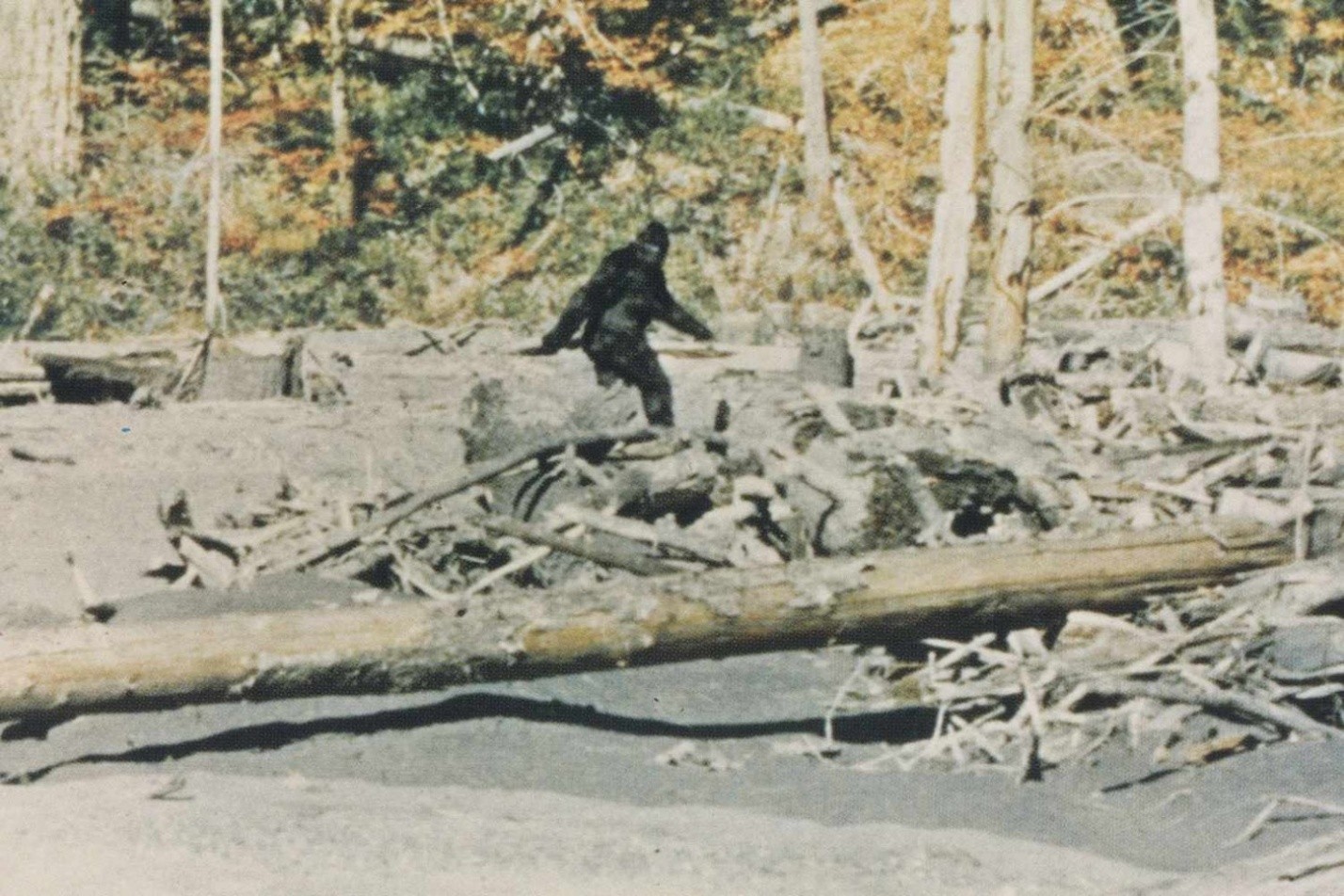
The recent South by Southwest Film Festival saw the debut of a documentary which has left the world of cryptozoology in shambles. Capturing Bigfoot has shown that the world’s most famous footage of Sasquatch, the Patterson-Gimlin Film (PGF), was a hoax.1 The now debunked video was first presented to the world in 1967. A pair of cowboys, Roger Patterson and Bob Gimlin, told astonished crowds that they’d been riding through a dry creek bed in northern California when they came across something unbelievable. Their video showed a massive “Bigfoot” casually looking back at the men before disappearing into the forest.
The “PGF” sparked decades of debate. Some anthropologists, such as Jeff Meldrum, spent years insisting that the clip must be genuine because a hoaxer would need an expert’s level of knowledge in primate morphology.2 A number of well-respected men in the special effects industry endorsed this view. John Chambers, who designed the masks for Planet of the Apes, described the PGF by saying, “I’m good – but I’m not that good.”3 Bill Munns, a makeup and special effects specialist, insisted that the creature shown in the clip couldn’t be faked using the techniques available in the 1960s.4
Others were more skeptical. Famed cryptozoologist Bernard Heuvelmans (who believed in Sasquatch) said that the PGF was an “obvious fake”5 which depicted a man in an ape suit. Many cynics pointed out that there were too many odd “coincidences” surrounding the PGF. Patterson was a talented artist, with a whimsical personality, who had produced Bigfoot artwork and wanted to make a “pseudo-documentary” about the creature. It certainly seemed odd that a man like that would be the only person to capture Sasquatch on tape. Yet definitive proof that the PGF was a forgery remained elusive.
Capturing Bigfoot has offered the latter in droves. The evidence includes:
1. Previously undisclosed test footage of Patterson and Gimlin with the ape suit.
2. Verification from Roger’s son that his father had orchestrated a hoax.
3. Confirmation that Gimlin’s friend Bob Hieronimus was the man who wore the ape suit.
4. Information on the role of Roger’s brother-in-law, Al DeAtley, in creating the PGF.
Yet perhaps the most interesting revelation has come from how Bigfoot believers reacted to the film. Explosive arguments and conspiracies immediately broke out in the cryptozoology community. Special effects expert Bill Munns, who endorsed the original clip, lurched into a state of denial. He’s spent the last few weeks insisting that the test footage featured in Capturing Bigfoot was an attempt by Roger Patterson’s brother-in-law to duplicate the real creature shown in the PGF.6 Some Bigfoot believers say they’ve been moved to tears. The drama far exceeds what one normally sees when a monster story is debunked. That doesn’t surprise me in the slightest. Bigfoot isn’t in the same category as regional North American cryptids like Lake Okanogan’s monster or Appalachia’s black panthers.
He’s an American icon.
Bigfoot Goes to Hollywood
Sasquatch’s rise to stardom took a bit of time. Supposed encounters with apemen made the news in the Pacific Northwest as early as 1924, but these tales were mostly unknown in the rest of the country. The first to achieve national attention was William Roe’s 1955 report. The similarities to the Patterson-Gimlin Film are obvious (I’ve kept Roe’s original spelling and grammar):
My first impression was of a huge man, about six feet tall, almost three feet wide and probably weighing somewhere near 300 pounds. It was covered from head to foot with dark brown, silver-tipped hair. But as it came closer I saw by its breasts that it was a female. And yet, its torso was not curved like a female’s. Its broad frame was straight from shoulder to hip. Its arms were much thicker than a man’s arms, and longer, reaching almost to its knees…
…
The thought came to me that if I shot it, I would possibly have a specimen of great Interest to scientists the world over. I had heard stories about the Sasquatch, the giant hairy Indians that live in the legends of British Columbia Indians, and also, many claim, are still in fact alive today. Maybe this was a Sasquatch, I told myself.
I levelled my rifle. The creature was still walking rapidly away, again turning its head to look in my direction. I lowered the rifle. Although I have called the creature “it,” I felt now that it was a human being and I knew I would never forgive myself if I killed it.7
Others soon came forward with their own tales. A prospector named Albert Ostman told the world in 1957 that he’d been abducted (several decades earlier) by a Sasquatch who brought him to meet the creature’s family. He said that he couldn’t shoot the creatures because they “clearly intended no harm.”8 While his story was more over-the-top than most, it fit into an overarching pattern. There was a tendency in early reports to describe Bigfoot as a gentle (but mischievous) creature that should be treated with respect.
This stands in stark contrast to early depictions of the Abominable Snowman. Sherpas were genuinely afraid of the beast and stories of “abduction by yeti” weren’t as lighthearted as Ostman’s alleged misadventure. Western art responded by portraying the Yeti as a menace lying in wait for mountaineers. The names used for these cryptids are equally telling: “Abominable Snowman” suggests a ferocious predator whereas “Bigfoot” sounds downright folksy. The differences in characterization likely stem from each figure’s origin. The Yeti was a character from Himalayan folklore that was transplanted into Western culture by British explorers—a strange monster from a foreign land—whereas Bigfoot was a uniquely American phenomenon.
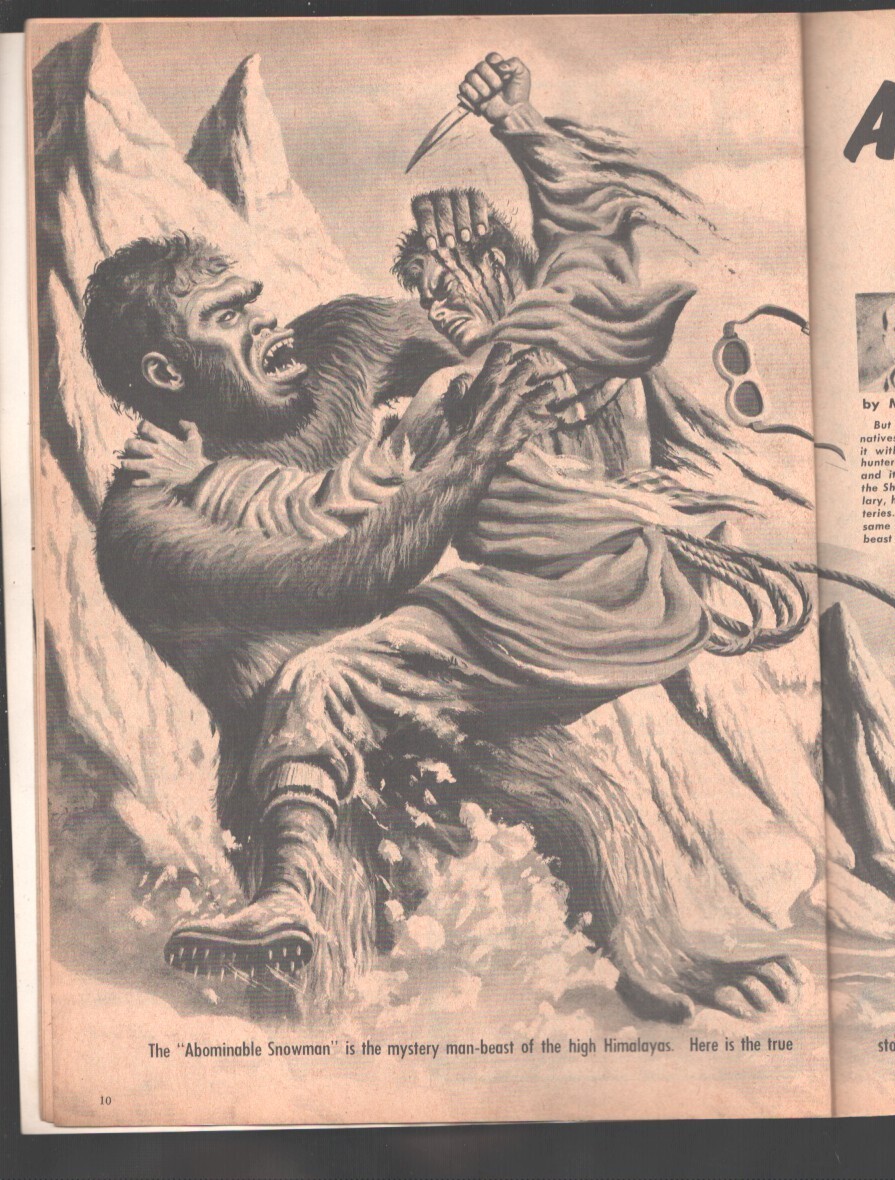
Pulp Fiction Often Depicted the Yeti and Explorers Battling High in the Mountains.
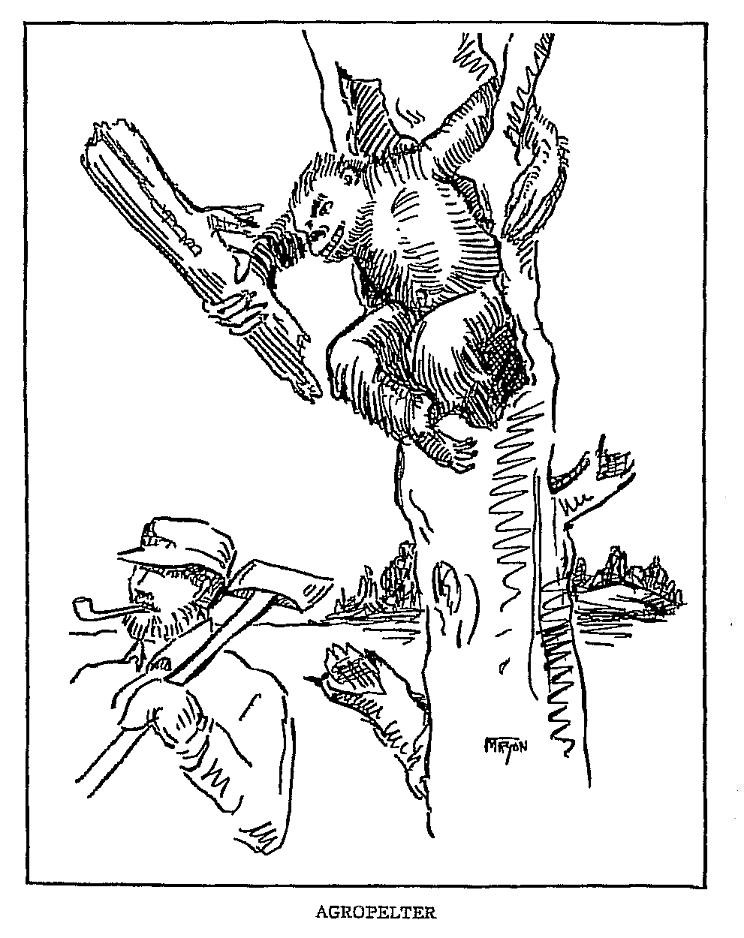
White Americans had spent the better part of two centuries wondering what might be living just a bit further west and inventing fabulous stories. Thomas Jefferson thought there could be gigantic lions in the interior of North America and warned Lewis and Clark to watch out for them.9 Lumberjacks in the Great Lakes region spent their days telling stories about chimp-like “agropelters” that would sit in the canopy and throw sticks at backwoodsmen.10 Even Teddy Roosevelt reported an apeman story. He claimed that a trapper told him about an encounter with a bipedal “goblin.”11, 12 As settlers moved into the Pacific Northwest, they encountered Indians who had legends of hairy giants.13 Settler folklore and Indian beliefs fused to produce a uniquely American character.
 It also likely wasn’t a coincidence that the original Bigfoot craze of the 1950s-1960s occurred when the pioneer days were fading from living memory. Roe’s alleged encounter was separated from 1890, the year the US Census Bureau announced the frontier was closed, by 65 years. That’s six years less than the gap between 2026 and 1955. Many Americans living in the 1950s had 80-year-old grandparents who were born in the 1870s and who saw the last stage of Western Expansion. Foreign observers were quick to note that 1950s America was obsessed with Western movies, books, and toys.14 The country felt a sense of nostalgia for bygone days and, in that cultural milieu, the archetype Bigfoot represented was incredibly appealing. Americans fell in love with the idea that a relic from the frontier days still existed.
Soon a Hollywood icon was born. The apeman appeared in films like the 1972 horror flick The Legend of Boggy Creek and TV series such as The Bionic Man. Books, toys, and roadside attractions all capitalized on the alleged monster. The 1960s and 1970s also saw the peak of Bigfoot’s respectability among scientists. Anthropologists investigated footprint casts while biologists argued about how many animals would be needed to maintain a breeding population. Even the FBI got involved and opened a case file to investigate alleged hair samples.15
Conclusive evidence of Bigfoot’s existence never materialized but the monster’s film career kept growing. Sasquatch starred in family-friendly movies like Harry and the Hendersons and A Goofy Movie. The 2000s and 2010s saw an explosion of Bigfoot related TV shows. Animal Planet’s tongue-in-cheek series Finding Bigfoot became one of the network’s most popular shows. It ran for 9 seasons and was then renewed for 3 seasons of special episodes. Comedy films, such as Sasq-Watch, parodied Bigfoot investigators. When the apeman was cast in a villainous role the results were equally over the top. Sasquatch even threatened to (unintentionally) destroy the world via a virus in the 2018 movie The Man Who Killed Hitler and Then the Bigfoot.
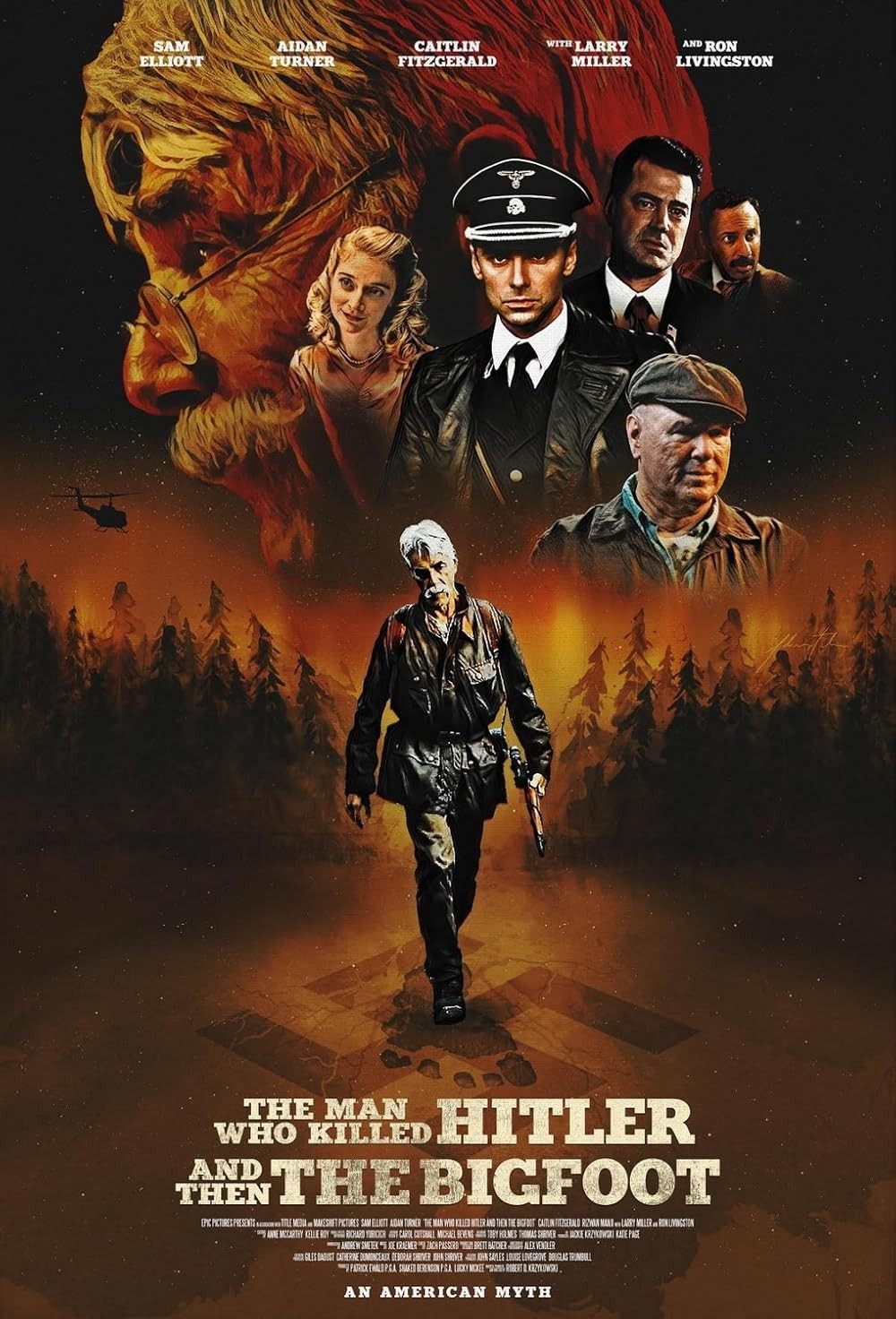
Probably Not the Path That Sam Elliot Expected His Career to Take…
Bigfoot’s Future
It’s a well-known fact that ambiguity breeds notoriety. Now that there’s no mystery to the world’s most famous piece of “Sasquatch evidence” it’s only natural to wonder if Bigfoot’s popularity will take a hit. As hoaxes have been exposed and technology has marched forward many cryptids have faded into subcultural irrelevancy. No one seems to care much these days about the Mongolian Death Worm or Mokele Mbembe. Even Nessie doesn’t spark interest like back in the old days.
I don’t think the same fate awaits North America’s apeman.
Bigfoot has shown a remarkable ability to evolve and adapt to new cultural and technological changes. The apeman is currently taking Instagram and TikTok by storm through viral AI edits. Many of these poke fun at political correctness. The legacy media has responded as one might expect. Wired Magazine felt the need to warn the public that “Bigfoot Baddie” videos are beyond the pale of acceptable comedy:
With “Bigfoot baddies,” online creators are taking what was a fairly innocuous trend on social media and repurposing it to dehumanize Black women. “There’s a historical precedent behind why this is offensive. In the early days of slavery, Black people were overexaggerated in illustrations to emphasize primal characteristics,” says Nicol Turner Lee, director of the Center for Technology Innovation at the Brookings Institution.
“It’s both disgusting and disturbing that these racial tropes and images are readily available to be designed and distributed on online platforms,” says Turner Lee.
…
“If I die here, I better get resurrected with a BBL,” says an AI-generated female Bigfoot on a different account, talking to the camera as she dodges bombs while vacationing in Israel. “One of the problems with generative AI is that the creators of AI tools cannot conceive of all of the ways that people can be horrible to each other,” says Meredith Broussard, a professor at New York University and author of More Than a Glitch, a book about biases in technology. “So, they can’t put up a sufficient number of guardrails. It’s exactly the same problem we’ve seen on social media platforms.”16
The fact that Bigfoot is being chased through the cyber world for politically incorrect humor is almost ironic. Many Bigfoot stories involve the creature playing pranks. Perhaps the cryptid was always destined to morph into an American version of the archetypical Jester Figure who points out things that need to be said but are best handled with a bit of humor. Julius Evola once observed that American culture is focused on “bigness”17 so perhaps it makes sense for America’s version of this character to be a 7-foot tall apeman. If this theory is true, it also means Bigfoot will be a part of American folklore and pop culture for decades to come.
References
- Hairy Man Road. (2026, March 16). I Saw The Footage…It’s A Hoax. YouTube. https://www.youtube.com/watch?v=WBuWLe1MC_A
- Rosman, J. (2017, December 20). Film Introducing Bigfoot To World Still Mysterious 50 Years Later. Www.opb.org. https://www.opb.org/news/article/bigfoot-patterson-gimlin-sasquatch/
- Davis, C. (2017, October 19). Memphis Bigfoot Festival at Memphis Made. Memphis Flyer. https://www.memphisflyer.com/memphis-bigfoot-festival-at-memphis-made/
- Munns, W. (2014). When Roger Met Patty. CreateSpace.
- Krantz, G. S. (1992). Big Foot-prints.
- Dave Wants to Know with David Wylie. (2026, March 16). Episode 7: Bigfoot: Costume or Creature with special effect expert Bill Munns. YouTube. https://www.youtube.com/watch?v=BUwrLSGNeoc
- BFRO Report 1083: William Roe account — Highway worker has lengthy sighting at close range & records much detail. (2025). Bfro.net. https://www.bfro.net/GDB/show_report.asp?id=1083
- Fanthorpe, L., & Fanthorpe, P. (2010). The Big Book of Mysteries. Dundurn.
- Ming, C. (2013, May 3). The Giant Lion that wasn’t. The Fossil Collector. https://fossilcollector.wordpress.com/2013/05/03/megalonyx/
- Cox, W. T. (1910). Fearsome Creatures of the Lumberwoods.
- Roosevelt, T. (1893). The Wilderness Hunter. Current Literature Pub. Co.
- Reddit – r/bigfoot. (2026). com. https://www.reddit.com/r/bigfoot/comments/vef7fm/theodore_roosevelt_bigfoot_story/
- The Native Bigfoot. (2024). www.youtube.com. https://www.youtube.com/watch?v=7zJhJsdoTYQ
- American Children Get “Cowboy Craze” – The Southern Cross News (WA : 1935 – 1957) – 15 Jun 1950. (2026). Trove. https://trove.nla.gov.au/newspaper/article/259197555
- Little, B. (2019, June 6). Bigfoot Was Investigated by the FBI. Here’s What They Found | HISTORY. https://www.history.com/articles/bigfoot-fbi-file-investigation-discovery
- Rogers, R. (2025, July). AI Videos of Black Women Depicted as “Bigfoot” Are Going Viral. https://www.wired.com/story/ai-videos-black-women-depicted-as-primates-viral/
- Evola, J. (1968). Negrified America. Counter-Currents. https://counter-currents.com/2015/10/negrified-america/
30 comments
As I’ve stated before in the C-C comments section, I chose to use the moniker Bigfoot because of my love of the outdoors, especially hunting. It wasn’t because I advocated a belief in an actual Bigfoot. Since the term” Bigfoot” may now be associated with lies, deception, and falsehood, I might have to start using another handle.
I doubt that the exposure of this hoax will be much of a loss to people that keep up with the paranormal. The topic of UFO’s alone should be enough to keep them busy.
Sam Elliot will now have two things to tarnish his reputation, a ridiculous B film from 2018 and his endorsement of Kamala Harris as president during the last presidential election.
The fast that PGF was a hoax, does not mean that big mysterious apes do not exist. Maybe they do not exist in America, but they surely existed and exist in Eurasia (and they could come from Asia to America, just as Homo Sapiens has come).
Is Mothman still a thing? He isn’t nearly as far fetched as Bigfoot or The Loch Ness Monster.
Mothman is just a West Virginian phenomen, but somebody like Bigfoot was and sometimes is even now seen in big parts of Eurasia (Western and Northern China, Mongolia, Siberia, the Great Steppe, Caucasus, Altai, North of Russia, etc.). Mothman is a Mythman, but big apes can and could be real.
This is a great article and a great topic. I love the atmosphere of The X-Files. One of the best parts of the series is when Mulder and Scully meet Bigfoot. There are plenty of urban legends throughout the entire X-Files series. I might cover this series in my detailed review.
I plan on writing a series on The X Files’ mythology and its influence from (and on) conspiracy culture. Maybe we could synchronize in some (loose) way?
Yes, that’s possible. What website do you write for? I write exclusively in English for the CC website. You can find all my articles and translations here. Right now, I’m finishing up a few great interviews for CC and a couple of movie reviews. And then I’ll have time to start working on a review of the X-Files TV series. If you have any ideas, email me at [email protected]. Thanks!
Thanks! I’ll send you an email after I finish my Alex Jones series. I don’t have a blog and I’ve only written articles for CC so far.
Ondrej, I’ll make a suggestion for you. Back in the seventies there weren’t that many channels on TV. There was a TV series called In Search Of during that decade. They did a couple of episodes devoted to Bigfoot. Both episodes are thirty minutes and are on YouTube. They treated the topic seriously. There was also a TV documentary from the seventies as well about Bigfoot. I can’t remember the name of it, but it’s hosted by Peter Graves. It’s on YouTube as well. The cinematography from these specials isn’t as good as modern cinematography, but it’s good enough. You might get a kick out of watching them, especially people’s various eyewitness accounts.
Thanks for the cultural tip. I’ll check it out as soon as I have a moment. I love those funny eyewitness accounts, whether they’re about the Holocaust or Bigfoot. There’s no evidence for either, but there are plenty of eyewitnesses who want to make money off of it.
Thanks Ondrej! I think an X files review would be fascinating to read.
Great article! I have mused a couple of times on what the director of The Man Who Killed Hitler and Then the Bigfoot was trying to tell us. Maybe he was trying to say that fascist demagogues who want to exterminate the jews, and cryptozoological creatures are myths spun out of the same whole cloth. 🙃
That’s a fascinating theory but the director doesn’t appear sympathetic to Hitler. Here’s what he said on the topic:
There’s also the theme of monsters. The Bigfoot is a monster, yet good. Hitler is a monster, and he’s a man, yet he’s evil. There’s also the notion of ideas being monsters—ideas living on like a disease. That’s happening today, even as we speak.
Source: https://www.cinema-crazed.com/blog/2018/11/13/an-interview-with-director-robert-d-krzykowski-part-1/
Sightings of “Bigfoot”-like creatures are fairly consistent across separate cultures. But the beings are consistently elusive as well.
This juxtaposition leads to two main interpretations:
a) “Bigfoot” is real and there’s a cover-up
b) “Bigfoot” is not real and there’s some smart-sounding psychoanalytic explanation why people worldwide seem to have the same hallucination
But there’s a third interpretation as well:
c) “Bigfoot”-like beings are real, just not in a physically-tangible, zoological way. Bigfoot is like the Little People found in folklore worldwide
Proponents of this third interpretation argue that “Bigfoot” sightings usually accomplany other “paranormal” phenomena, an association perhaps best exemplified by the (now famous) Skinwalker Ranch.
Sources I recommend in this context: David Paulides, Joshua Cutchin.
What’s when there is no ONE kind of Bigfoot – better to say, Relict Hominids, but many different? The desciptions are different. Some of descripted creatures are surely just big apes, not more than animals. Some are like humans, but not Homo sapiens (Denisovans?) Some are very big, some are about so tall as a normal Homo Sapiens, some are small. Some have some intelligence, some have simply instincts.
I think that “Bigfoot” is a paranormal phenomenon, or at least more than a normal flesh-and-blood creature. A normal creature of this size would have probably been found and confirmed by now.
An interesting author, Sol Schulman, Russian-Jewish scientific journalist, who emigrated from the SU to Australia, published ca. 40 year ago a book ALIENS OVER RUSSIA (Инопланетяне над Россией), and there he put forward a hypothesis, that at least some of “snowmen” could be biorobots of ET-aliens, used by them as “scouts” on the Earth, and, yes, he wrote, that some of “snowmen” had some paranormal abilities, which we could not find by “normal” humans and apes.
Utter bollocks. Many Forteans have long suspected that the Paterson-Gimlin film is a hoax. The Bob Hieronimous accusation has been known for many decades. This is not new information. The P-G film being discredited doesn’t “debunk” Bigfoot. Typical skeptic garbage. There are tons of videos taken of Bigfoot, some extremely convincing. There is a dashcam video from a police car of a giant 8 foot tall biped running across the road and leaping over a guardrail down a hill with incredible speed and agility. Not to mention probably hundreds of reliable witness reports. This article also doesn’t mention that similar creatures are seen in Siberia, the mountains of China(known as the Yeren or Chinese Wild Man), and Mongolia(the Almas). And of course there are the Yeti, who look pretty much exactly the same as Bigfoot. The reason it is so hard to find these creatures is that they are paranormal entities, not animals. There are many reports of them vanishing before an observer’s eyes, being associated with weird lights in the sky and other strange phenomena. There is an excellent book, Where the Footprints End, which covers this very well and is available on Amazon. Jerome Clarke also wrote about it in his book, Unexplained, under the entry Hairy Bipeds.
Some of folklore names of creatures, who could be relict hominids, are Leschyi, Chugaister, Rusalka, Lobasta, Alamas, Albasty/Almasly, Dev, Awbyunawy, Dikyi Chukcha, Yeren, etc. There was a good Russian book LESCHYI CALLED AN APE, where there are many examles from folklore of many peoples of the Old World, which could be explained with relict hominids.
“The reason it is so hard to find these creatures is that they are paranormal entities, not animals. There are many reports of them vanishing before an observer’s eyes, being associated with weird lights in the sky and other strange phenomena. There is an excellent book, Where the Footprints End …”
^
That’s the most convincing hypothesis. Where the Footprints End is one of Joshua Cutchin’s books. Cutchin’s research is focused and systematic. Highly recommended.
By the way, I think Yeren is not a Chinese word, but rather a Tuerkic word. It can origin from the word yer, which means earth in all Tuerkic languages, so Yeren is something like a creature of Earth, just as Slav Leshyi is a creature of woods.
Pulp Fiction Often Depicted the Yeti and Explorers Battling High in the Mountains.
Interesting, that there are TWO types of Yeti (which means something like “The Thing” or “That Thing”). Maybe only smaller Yeti is a primate, but bigger Yeti is simple a Himalayan bear. Anyway nothing like the creature on the picture, which looks rather as a big man of Homo Sapiens.
Fun stuff. Bit of trivia: I played pro-am basketball in the summer with the actor who played Harry in Harry and the Hendersons. He was about 6’11”. Probably about 1982 or 1983. Good times!
Kevin Peter Hall who played Predator alongside Arnold?
The actor / basketball player is Dawan Scott. Played at Seton Hall.
I wonder what the motives for ‘debunking’ PGF are? It seems an odd thing to care about. I’ve noticed there’s an entire culture of jews – like the Amazing Randi – who spend their time attacking White myths but never, ever, ever touch jewy nonsense and their freakish jewish practices.
As far as I am concerned, American Cryptidism is our – American – effort to recapture ‘the uncanny’ in North America, where we have no long history of the Fairy Faith and yet Whites still need to feel we live is a world of mystery.
‘Debunking’ Bigfoot is just another attack on the White American Soul and it should be treated with disdain.
I think you are on to something; the jews probably don’t want us to believe in anything outside of jewish mythology. 🙃
We’ve been trained to think of our beliefs as ‘myth’ and jew-approved beliefs as ‘spirituality’.
We’ve been trained to think of ‘myth’ in opposition to ‘truth’ when, in fact, ‘myth’ is ‘the truth of the folk’.
There is a t-shirt with the PGF ‘walking Bigfoot’ on it and the caption ‘All Time Hide-And-Seek Champion’. I think that’s a great sentiment and White kids who ever played ‘hide-and-seek’ can relate.
In the end, how is ‘hunting Bigfoot’ any more dysfunctional than climbing the career ladder in corporate America simply to enrich Blackrock jews?
Rather than asking ‘Is Bigfoot real?’ maybe we should as ‘Is ‘jew’ real?’
Loren Coleman’s and Jerome Clarke’s lexicon, Cryptozoology A to Z, listed scores of mysterious hominids in different parts of the world, more or less similiar to the Bigfoot. Even if the book is maybe a little strange structured: it has entries of both cryptids and of scientists, who studied them; I would strongly recommend it.
If you have a Subscriber access,
simply login first to see your comment auto-approved.
Note on comments privacy & moderation
Your email is never published nor shared.
Comments are moderated. If you don't see your comment, please be patient. If approved, it will appear here soon. Do not post your comment a second time.