 4,355 words
Agustina S. Paglaya
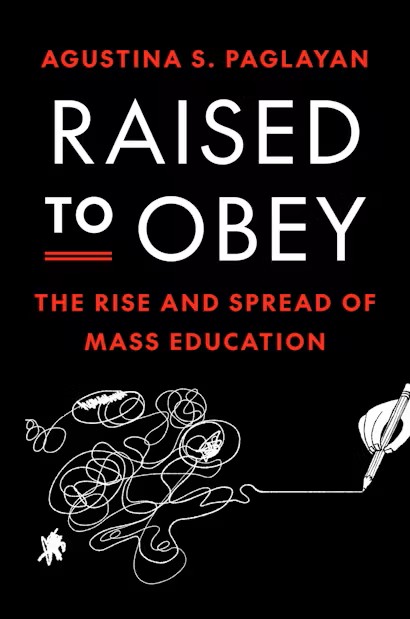
Raised to Obey: The Rise and Spread of Mass Education
Princeton: Princeton University Press, 2024
Why did societies establish mass education systems? Did democratic regimes produce schools to raise up informed and engaged citizens? Or perhaps, as libertarian writers like John Taylor Gatto propose, scheming businessmen endorsed compulsory education to craft a population of obedient, unthinking workers. How did we go from the system of tutors for the wealthy and basic education from the Church for the lucky commoners, to a system of government run schools for the entirety of the population? In Raised to Obey, UC San Diego professor Agustina S. Paglayan seeks to explain the origin of mass education in Europe and its American colonies.
Paglayan argues that governments created compulsory education systems to indoctrinate their citizens into moral behavior and obedience to the state. However, before spending the bulk of the book providing evidence for that claim, she dedicates the second chapter to dismantling alternative claims to the origins of mass education.
Many people view education as a democratic institution, established to teach citizens their rights and help them develop critical thinking skills to vote as informed citizens.[1] By that logic, one would expect to see a “large increase in primary schooling after transitions from autocracy to democracy” (pg. 47). However, one finds that, on average, governments started monitoring primary schooling sixty-five years before becoming democracies.[2] “[M]ost central governments around the world began to regulate and promote primary education well before democracy emerged” (pg. 48). She further notes that the rate at which children enrolled in primary schools displayed no noticeable increase after a country transitioned into a democracy (pg. 52).
If not democracy, perhaps nation-building, establishing a common tongue, promoting a national identity and shared culture, served as the catalyst for mass education. However, when most nations first implemented their compulsory schooling laws, only half specified in what language the education must be provided (pg. 201). For example, when the United States established state schools, they mirrored whatever language the local community spoke—German, Dutch, Swedish, French, Polish, Italian, or English. Prussian schools allowed teaching in either German or Polish and allowed religious teachings according to either Catholic or Protestant doctrines. The Prussian school system went forty-five years (until 1808) before efforts were made to have the schools imprint a national identity on the pupils. “In other words, neither linguistic nor religious homogeneity—two common markers of a shared national identity—were goals of primary schooling” (pg. 126).
You can buy Greg Johnson’s Graduate School with Heidegger here
Another explanation offered for the expansion of mass education was the need to train industrial workers. Libertarian authors, like John Taylor Gatto, complain that industrial capitalism needs “visible under classes and a large, rootless proletariat”[3] in order to work, and thus “it must be a production line where children as material are shaped and fashioned like nails.”[4] If that were the case, England, as the fount of the Industrial Revolution in the eighteenth century, should have led the charge in establishing a mass education system. Instead, England lagged behind continental Europe and only legislated mandatory school attendance in 1870. Prussia, as the industrialization argument goes, being a dominantly agrarian country in the 1700s, shouldn’t have required a mass education system; yet they were the first to establish one in Europe.
To ensure that Prussia and England aren’t simply outliers, Paglayan looked at the dates when several nations established their first education laws and compared those with the dates they adopted technological innovations—steam ships, trains, mule spindles, steel production—to see if a connection between them could be observed. She concluded that taking “the various measures of the timing of industrialization together, the main conclusion that emerges is the absence of a clear pattern linking industrialization and the emergence of a state-regulated primary education system” (pg. 65).
Moving from the democratic, nation-building, and industrial hypotheses, the fourth argument that Paglayan attacks is that the state-regulation and expansion of education occurred to train children into being good soldiers and to instill in them a sense of national pride and a common language. Proponents of this theory point to the establishment of the Prussian school system in 1763 at the conclusion of the Seven Years War and claim the latter caused the former. Another example they point to is the Jules Ferry Laws in France—which adjusted the curriculum to include physical education, military drills, and removing Catholic influences in the hope of instilling stronger nationalism—in the 1880s after France’s loss in the Franco-Prussian War a decade earlier.
The immediate counter argument is that Frederick the Great approved an education law in 1754, similar to the General Rural School Regulations of 1763, but was unable to implement it due to the outbreak of war. Thus, the Seven Years War couldn’t have instigated the Prussian school reforms as they started prior to the initiation of hostilities. In France, compulsory primary education laws were created in the 1830s under the July Monarchy, fifty years before the Jules Ferry Laws; while the laws in the 1880s modified the school system with clearly nationalistic and militaristic reasons in mind, they were not the initial laws establishing school regulation in France (pg. 72).
On a broader scale, rather than the specific examples of Prussia and France, Paglayan looked at the enrollment rates in Western countries before and after interstate wars in the nineteenth and twentieth centuries. If the military hypothesis was correct, one would expect to see an increase in enrollment in the period following a war. Instead, enrollment rates drop, as one would expect from a war, followed by a gradual rebound to prewar levels over the next twenty years; wars did not lead to increased enrollment (pg. 75).
With the main alternatives removed, Paglayan begins building her case that education for the masses was a:
strategy used to promote social order: indoctrination. … mass education systems emerged to convince the people that the status quo was actually okay, that there was no reason to rebel against it, and that accepting the status quo would elevate them more and earn them praise from others. These systems were designed to fulfill a task that churches had been fulfilling for centuries: to mold children’s hearts and minds to make them loyal subjects—but loyalty to God was replaced by loyalty to the state (pg. 4).
The two main sets of evidence she draws from to support her argument are the dates when governments adopted compulsory education laws and the curricula they established. Unlike the transition to democracy, dates of industrialization, and period after interstate wars, states did increase their rate of primary school enrollment after experiencing major internal social upheavals—revolts, civil wars, riots, etc. When looking at the twenty-three states in Europe and Latin America that experienced a civil war after 1800, Paglayan found that, on average, “primary enrollment grew more than twice faster after civil war compared to before” (pg. 79).
As the preeminent example, Prussia experienced a series of peasant revolts in the 1740s and 50s. To solve the immediate crisis, Frederick II sent troops to quell the rebellions when necessary and offered concessions to the peasants in the form of agrarian reforms limiting the labor obligations of the peasantry. However, the concessions failed to resolve the disagreements between the lords and their serfs, and attempts at physical repression encountered the challenge of soldiers siding with the peasantry rather than following their orders.
Since the seventeenth century, the Pietists (a subgroup of Lutherans) had advocated for the “education of the lower classes as a means to cultivate discipline, obedience, and respect for authority” (pg. 133). The peasants’ insubordination opened the ears of the Prussian elites to Pietist and Enlightenment ideas about education: men are shaped by their environments and the education they receive. Rather than relying upon hard power to control the lower classes, perhaps they could be taught to accept their role in society and accept the authority of those in power.
In 1750, at the suggestion of Pietist teacher Johann Hecker, Frederick II established the Supreme Consistory to oversee Lutheran churches and schools (Pietists had been establishing schools since the 1690s). In 1753, the king provided money for Hecker to establish a teacher training institution in Berlin and ordered schools to give the graduates preferential treatment in hiring. Hecker worked on school reform in Minden-Ravensberg which laid the groundwork for the 1763 education laws, marking the official establishment of the Prussian school system.
Another example supporting the post-internal conflict model for the expansion of compulsory schooling are the French Guizot Laws in 1833 following the July Revolution of 1830 and the establishment of the July Monarchy. The first two years of the new government were marked by widespread unrest and violence. Like Prussia decades earlier, the French struggled to use the military to counter the revolts: many members of the national guard joined the protests.
François Guizot, Minister of Public Instruction, concerned about the “barbaric,” “turbulent,” and “anarchic” behavior of the lower classes, pushed for the government to take control of and expand the public education system (pg. 139). Under his guidance, the enrollment rates in primary school increased from 32% of children in 1830 to 71% by 1848.
You can buy Greg Johnson’s From Plato to Postmodernism here
In addition to the timing of the education reforms, the content of those reforms and the discussion among the elites surrounding them inform us of their intended purpose. Prior to 1900, twenty-five countries in Europe and Latin America had established comprehensive national primary education laws. Pagalyan examined those initial education laws and found that “[n]ot only did the teaching of moral principles have a standalone subject in almost every country, but also it was often the first subject that appeared in national curriculums” (pg. 201). In addition to teaching morality as a separate subject, moral messages infused the instruction in reading and writing. In Prussia, students learned to read from the catechism; in France the curriculum emphasized that God rewarded good behavior and punished bad behavior. Though not mentioned by Paglayan, in the United States the McGuffey Reader series, written in the 1830s, emphasized piety and moral behavior and sold around 120 million copies by 1960.
In their first national primary education laws, almost every country in Europe and Latin America established that the goal of the curriculum was to provide “moral education” to the students (pg. 200). Frederick II wrote to his minister of education that “teachers in the countryside [must] instruct the young in religion and morals … and educate them far enough that they neither steal nor murder,” but he didn’t want them to learn too much, otherwise they might “rush off to the cities and want to become secretaries or clerks” (pg. 105).
Fearing that the moral curriculum would not be properly implemented by immoral people, many states required that teachers be of good moral standing and complete training at a government run normal school, colleges to train teachers in pedagogy and behavior. The normal schools often had strict regulations and tight schedules for the prospective teachers. The reasoning followed that “since the main goal of primary education was to shape children’s moral character, and because children learn above all by example … good moral qualities must first be ingrained in teachers” (pg. 188).
Why did countries vary so dramatically in the dates they established educational laws? Paglayan lays out four conditions that must be met for a government to establish compulsory education: first, politicians must believe that mass violence poses a serious threat to the state; second, elites must believe that schools can indoctrinate people; third, elites must expect to be in power long enough to benefit from educating future citizens; and fourth, there must be sufficient fiscal and administrative capacity to create the education system and enforce it.
The first point, elite fear of violence from the masses, was discussed earlier regarding Prussia and France. Other examples of note include: Chile passing education reform laws to increase enrollment, increase funding, and build more schools in 1860 following the 1859 Chilean Revolution; Argentina passed the 1884 Law of Common Education establishing compulsory education and government control of the curriculum after decades of military conflict between the government in Buenos Aires and the caudillos in the Interior; Finland established compulsory education after its civil war in 1918.
Shay’s Rebellion and the Whiskey Rebellion during the early days of the United States triggered a series of education laws in the Northeastern states organizing and funding common schools along with establishing some level of state supervision over the curriculum. These initial laws did not require attendance; that did not occur until Massachusetts established compulsory school attendance in 1852.
Regarding the second point—elite belief in the ability of school to indoctrinate people—Paglayan provides a brief history of the ideas surrounding mass education. While making brief reference to Plato, she links the Enlightenment philosophers, starting with Hobbes in the seventeenth century, to the growth of mass education. Hobbes believed that the sovereign power of a nation held the monopoly on truth, what was “right” or “wrong,” in order to maintain social stability. An education system, and state control of it, provided the mechanism by which the sovereign could imbue his desired teachings upon the people and ensure proper dogma (pg. 94).[5] “The people are to be taught,” Hobbes wrote, “first, that they ought not to be in love with any form of government they see in their neighbor nations, more than with their own, nor … to desire change. For the prosperity of a people … [comes from] the obedience and concord of the subjects.”[6] Additionally, they should be taught that it was a “great fault to speak evil of the sovereign representative (whether one man or an assembly of men), or to argue and dispute his power.”[7]
Building from Hobbes’ idea that humans are shaped by their environment and upbringing, Locke popularized the so-called Blank Slate Theory which posits that all humans are born mentally identical—identically empty and malleable—and then shaped by life experiences. From this, a strong emphasis on education swept through the intellectuals of the Enlightenment. Pagalayan points specifically to Voltaire, Kant, and Rousseau as advocates of children’s education designed to instill obedience and morality among the population.
Schooling provides three functions of indoctrination amenable to the state: first, schools instill a fear of misbehavior by punishing those who fail to follow the orders of school authorities. Early educational thinkers feared the use of corporal punishment would backfire by teaching students that the use of violence was acceptable (this mirrors many of the debates about spanking children today); they preferred the use of public scolding and humiliation or religious threats of eternal damnation. The second goal of schooling proposed by Enlightenment figures was that schooling could teach the masses to be content with what they had; if what they had was enough, there would be no reason to rebel. Finally, through repetition—schedules, procedures, routines—unconscious compliance could be instilled in the youth (pgs. 89-90).
As a counter-example, England developed a mass education system later than the rest of Europe because its elites rejected the idea that education would cause the commoners to more willingly comply with the government. They feared education would inspire social unrest among the common rabble by causing them to “’despise their lot in life,’ ‘render them factious and refractory,’ ‘enable them to read seditious pamphlets, vicious books, and publications against Christianity,’ [and] ‘render them insolent to their superiors’” (pg. 226). In the 1850s, England was the only European country with a primary school enrollment rate in the single digits.
England passed its first national primary education law in 1870, the Elementary Education Act, also known as the Forster Act, after decades of popular writers—namely Charles Dickens, Elizabeth Gaskell, Charles Kingsley, and Benjamin Disraeli—promoted the idea that education would help the poor make better choices and thus avoid radicalism and social instability (pg. 263). But even their calls for reform weren’t enough to inspire action until after the mass worker demonstrations of 1866 disquieted the elites.
Regarding the third condition for the establishment of compulsory education, that elites must expect to hold power long enough to reap the benefits of educational propaganda, Paglayan references a study by Barbara Geddes and Beatriz Magaloni regarding the time hegemonic-party regimes, military regimes, and personalist dictatorships retain power combined with the Varieties of Political Indoctrination in Education and Media Dataset (V-Indoc) of those regimes since 1950. The general trend is that longer lasting regimes (one-party systems) invest more in educational control than do shorter lived regimes (military dictatorships) (pg. 234). Regimes that feel the imminent threat of revolution will invest in short-term solutions to maintain control rather than the long-term investment of educational control.

You can buy Greg Johnson’s Toward a New Nationalism here.
And finally, for the fourth condition, that a compulsory education system is only established when the state holds sufficient fiscal and administrative capacity, she points to France and Sweden as examples of nations with well-established bureaucracies prior to mass education combined with transportation network (trains) allowing for the movement of teachers to rural areas and observation by administrators.
Mexico provides an example of a state that feared revolution by the masses, an elite who desired to control them via education, and the expectation of maintaining power, but lacked the capacity to implement educational reforms: the Mexican government established an agency to regulate, monitor, and promote public education in 1833. However, the results were lackluster. Porfirio Díaz, dictator of Mexico from 1876 to 1911, attempted to expand the reach of schooling, but failed due to “the resistance of local elites and parents to state intervention” and “the constraints imposed by limited fiscal and administrative capacity, poor roads infrastructure, and the absence of data about population size, enrollment, and the number of existing schools in remote areas” (pg. 242). From 1880 to 1910, the number of children enrolled in primary schools increased from 28% to only 33%.
The new regime established in 1920, after the Mexican Revolution overthrew Porfirio, led by Alvaro Obregón, reorganized the government structure, increased taxes, and established the Secretary of Public Education with expanded powers to regulate schools across the entirety of Mexico. With the increased funds and control, 3,300 federal schools were established in the 1920s and primary school enrollment increased from 30% in 1920 to 62% in 1925.
Paglayan’s four conditions for the development of mass education provide a basis for anyone interested in the history of education to analyze a nation’s policies toward schooling and help to explain why mass education did not develop in earlier civilizations.
An important thrust of her work, the focus of the seventh chapter, is that, because mass education is not limited to being a democratic institution and often originated before democratic government, the educational system in democratic nations also serves to propagandize the citizenry, though in a different manner than authoritarian regimes. In democratic regimes, students are taught that democracy is the best form of government, and they are supposed to accept this uncritically. Schools teach students to express their discontent non-violently (with the exception of a handful of radical teachers) via petitions and protests—thus fulfilling the goal of education to prevent danger to the prevailing regime. She concludes that:
most democracies today continue to provide limited opportunities for children to question the basic moral and civic values that governments want to inculcate. Critical thinking in democracies is allowed so long as children do not question, for example, the norm that discontent should always be expressed through peaceful means—including voting—and never through violence (pg. 281).
If the goal of state-controlled education is to promote social order, one must then determine whether those efforts bore fruit. Was there a lessening of social upheaval in nations with a mass education system, or were their efforts in vain? General trends indicate that increased schooling decreased crime, with the effects increasing over time (pg. 288). However, whether the schooling itself decreased crime by inculcating values like respect for the law, or the economic effects of the schooling decreased crime is unclear. Additionally, in the cases of France and Prussia, schooling successfully increased loyalty to the state.
On the other hand, Argentina, the second preferred destination of European immigrants in the 1800s (after the United States), experienced social upheaval and the overthrow of its government, likely because the new schooling system increased economic mobility, growing the middle class who then had the time and money to foment political change.
While the historical forces that led to the creation of mass education are intriguing, Paglayan does not limit Raised to Obey to the historical; she argues that perhaps the reason many education systems still struggle to teach students basic skills is because:
the very creation, initial design, and expansion of public primary education systems was not guided by a concern to improve basic skills of the population, much less their critical thinking skills. Instead, the key reason why central governments set up and invested in these systems was to teach ordinary people to be obedient and well-behaved. Again, mass education was conceived not as a poverty reduction tool or as a tool to empower the masses, but as an essential component of the repertoire of state-building policies used to promote social order and political stability (pg. 312).
In this final chapter, her roots in Foucault and other Left-wing thinkers begins to seep through (as opposed to the earlier chapters which rely on data and history rather than opinions). She complains about schools using “rote memorization and repetition instead of critical thinking” and how “the contents that students have to memorize and internalize typically serve the interests of dominant groups in society” (pg. 315). She falls into the typical Left-wing trap that Henry T. Edmondson III describes as trying to get “children [to] think, to the detriment of providing them something to think about.”[8]
While her historical analysis is thorough and interesting, and a worthwhile read for anyone interested in the history of education, her conclusion is lackluster. There are three areas that Paglayan fails to consider with her prescription: first, she fails to consider genetic and racial differences in the outcomes of schooling towards acquiring skills. The failure of certain portions of the population to achieve proficient literacy may fall on factors outside of schooling and economic background. Second, she ignores the plurality of pedagogical studies showing that the tried-and-true methods—ones that she would likely categorize as authoritarian—of direct-instruction, memorization, and practice produce students with better skills and knowledge than those taught via other methods.[9] Third, she ignores happens when people have tried to implement child-centered curricula, viewed as less authoritarian and more democratic, that promote “critical thinking” over set information: just check the results of any school in California or Oregon a few years after they roll out a new social justice curriculum (though this may tie back into the first point about demographics).
If Paglayan’s analysis, that mass education was created for, and is inseparable from, a propaganda apparatus to ensure obedience to the state, holds true, one must answer the question: what is to be done? That question can be further broken into two categories: what is to be done in an ideal setting where one has power over education, and what is to be done in the current circumstances?
All too often the Right draws no distinction between the two and falls into error; they see the state of education as it currently is and project that onto all education past, present, and future. From that viewpoint, they adopt the libertarian and anarchist viewpoint that the entire education system must be destroyed and never rebuilt. Unfortunately for them, their worldview lies on a plethora of false assumptions: these anti-statists prize freedom above all else, at the expense of all else. They imagine that society still exists in its pre-industrial, pre-mass-society state, and that simply removing schooling would return mankind to an Edenic state. But this is not the case. There is no returning to the old world as it was, and a new path forward must be forged which accounts for the advances in technology and the shifts in communication and culture.
A mental distinction must be drawn between mass schooling as-is and mass schooling as a concept. The current system lies under the thrall of anti-White administrators and activists. As-is, the best path for any White parent who doesn’t want their children to become ethnomasochists is homeschooling.
But what about a system in which the Right held political and cultural power? The majority of teachers are conformists and will either remain silent or enforce the prevailing cultural norms. Why give up the benefits of a mass education system? An authoritarian school system could instill a common culture, promote group identity, and promote virtues and obedience to reduce criminality. At a mass scale, homeschooling cannot provide those benefits and instead accelerates atomization and isolation. An authoritarian-Right education system would not suffer from the contradictions and half-measures of liberal and critical pedagogy; it would thrive where others failed.
Rather than taking Raised to Obey as a call to dismantle the mass education system, or rework it for libertine goals, we should take it as a challenge to control and shape mass education to our desires: a system that promotes and teaches our values, virtues, and culture.
Notes
[1] Critical pedagogue declares the importance of democracy and critical thinking on almost every page of his work On Critical Pedagogy. Neo-Traditionalist Daniel Buck in What is Wrong With Our Schools? states that his goal for education is to make sure students have enough information to read and understand a newspaper so they can make informed electoral decisions. Socialist E.D. Hirsch, best known for his book Cultural Literacy, dedicated entire books to the purpose of making citizens for democratic governments. Open any contemporary book about education theory or educational history, and the assumption is that education exists, or should exist, to support democratic government.
[2] Paglayan loosely defines a democracy as any country where at least fifty percent of males are enfranchised.
[3]John Taylor Gatto, Weapons of Mass Instruction (Gabriola Island, BC: New Society Publishers, 2009), 36.
[4] Ibid. 66.
[5] See Leviathan, chapter XXX.
[6] Quoted on Pg. 95. See Leviathan, XXX.7.
[7] Quoted on Pg. 96. See Leviathan, XXX.9.
[8]Henry T. Edmondson III, John Dewey & The Decline of American Education: How the Patron Saint of Schools Has Corrupted Teaching and Learning (Wilmington, DE: ISI Books, 2006), 50.
[9]Daniel Buck, What is Wrong With Our Schools? (Clearwater, FL: John Catt Educational Ltd, 2022).
4 comments
Great article! It’s all about propaganda, conditioning, and control—from the cradle to the grave. White people do not know who they are, our race was hijacked from its natural development over 2000 years ago. 🙃
I can affirm that this is indeed the correct take, being a professional in this system.
Some incel chud a long time ago pointed out that public education weirdly resembles an oriental polygamous harem in its structure. Not the sexual aspect of the harem, but the social dynamic. In harems the wives and concubines collectively rear the children, and separate them into different age groups, and an individual wife/concubine takes a set of an age group to manage for the day. That way the five year olds are all playing with others of their age, as are the ten year olds. Who is the distant father figure in this analogy, who is lounging around eating grapes and doesn’t have time for his hundreds of offspring? He’s the government. Isn’t it weird with how feminized the public school system is, that the school principal is just so often a man? More often than you’d expect anyway. I do think public school operates off those polygamous instincts as a base, and the superstructure is reliant on that dynamic. .
I get that public education is a good method of ensuring government control, but it seems like a volatile one that can backfire. People don’t really take moral messaging to heart in some kantian manner. It’s for most people a prosperity gospel, they follow the moral messaging because they’ve been conditioned that it’ll lead to good things. Which means unfathomable seethe if the opposite occurs and they’re penalized. People can’t handle being deceived like that, it hits the ego pretty hard. The Qing dynasty in China left many bagholders after their Imperial exam model became oversaturated, and many people that studied for such positions ended up poor and destitute. The Chinese education model leading to elite overproduction was a significant factor in the destabilization of the Qing dynasty. And you see it today with those ‘varsity types that loaded up on debt, so many desperate cries for others to pay it off for them. The government is literally in a position where they have to now bribe these people for future support, or they’ll turn to revolutionary politics. Resentment is a powerful emotion. It’s hard to argue that the government has ensured its population remains docile through these errors.
I wonder how close your conclusion comes to that of Giovanni Gentile in his work The Reform of Education.
If you have a Subscriber access,
simply login first to see your comment auto-approved.
Note on comments privacy & moderation
Your email is never published nor shared.
Comments are moderated. If you don't see your comment, please be patient. If approved, it will appear here soon. Do not post your comment a second time.