Counter-Currents
  • Advertise
  • Private Events
  • T&C
  • About
  • Contact
  • RSS
    • Main feed
    • Podcast feed
    • Videos feed
    • Comments feed
  • Welcome
  • Webzine
  • Books
  • Merch
  • Podcasts
  • Videos
  • Donate
  • Patrons
  • Subscribe
  • Crypto

LEVEL2

Donate Now Mailing list

Writers of May

(2 votes) Morris van de Camp David M. Zsutty Derek Stark Jayant Bhandari Greg Johnson

Articles of May

Heidegger on Nietzsche, Part One by Collin Cleary The Lunch Wars by David M. Zsutty 2 votes
  • Welcome
  • Webzine
  • Books
  • Merch
  • Podcasts
  • Videos
  • Donate
  • Patrons
  • Subscribe
  • Crypto
    • The Psychology Behind MrBeast’s Moronic Thought Experiment

      Endeavour

      1

    • On the Roots of Anti-Immigrant Sentiment in Contemporary Britain

      Lipton Matthews

      2

    • Remembering Enoch Powell:
      June 16, 1912–February 8, 1998

      Greg Johnson

      4

    • Counter-Currents Radio Podcast No. 691
      Rob Rundo Returns

      Counter-Currents Radio

    • The Fragile Polity that is Syria

      Morris van de Camp

      1

    • Nigel Farage Calls Britain a Two-Tier State

      Mark Gullick

      4

    • Nationalism This Week
      Letter to J. D. Vance

      Greg Johnson

      31

    • Lost In Trans-Mission:
      How the Media Fails To Reveal the Inconvenient Truth About the Usual Suspects

      Steven Tucker

      10

    • Liar, Liar, Pants on Fire!

      Beau Albrecht

      7

    • Editor’s Update
      Rob Rundo on Counter-Currents Radio, Fundraiser Update, & a New $20,000 Matching Grant

      Greg Johnson

    • The Bitter End of Western Metaphysics:
      Heidegger on Nietzsche, Part Three

      Collin Cleary

      10

    • Uncivil War

      Mark Gullick

      50

    • Exclusive Interview with Karel Veliky:
      The Final Chapter in the Film Series! Part II

      Ondrej Mann

      2

    • Happy Birthday to Us!

      Greg Johnson

      6

    • Zsutty’s Maximum

      David M. Zsutty

      16

    • Exclusive Interview with Karel Veliky:
      The Final Chapter in the Film Series! Part I

      Ondrej Mann

      2

    • The Union Jackal, June 2026

      Mark Gullick

      23

    • The Inferiority Behind Immigrant Superiority

      Jayant Bhandari

      15

    • Counter-Currents Radio Podcast No. 690
      Greg Johnson & David Zsutty Discuss Current Things: AI, Henry Nowak, the Iran Crisis, & More

      Counter-Currents Radio

      7

    • Collin Cleary: What Rome Means to Me

      Collin Cleary

      4

    • Paul Krugman: Closet Bolshevik

      Spencer J. Quinn

      21

    • Fugue of Ideas:
      Ibram X. Kendi’s Chain of Ideas

      Greg Johnson

      19

    • Based Blacks

      Lipton Matthews

      24

    • Black Intellectual Fatigue

      Derek Stark

      41

    • Why White Advocates Should Avoid “Based Blacks”

      Dani Vypont

      32

    • Nietzsche & Race

      Mark Gullick

    • Editor’s Update
      Rob Rundo Rescheduled to Next Week on Counter-Currents Radio;
      Tonight Greg Johnson & David Zsutty Answer Your Questions;
      Fundraiser Update & a New $20,000 Matching Grant

      Greg Johnson

    • The Counter-Currents 2026 Fundraiser
      Lifetime Subscriber Welcome Packages Extended

      Greg Johnson

    • Nationalism This Week
      Who’s Looking Back?

      Greg Johnson

      29

    • China’s Threat to American Security:
      Food, Farmland, Foreign Control, & Energy Policy

      Lipton Matthews

      5

    • The Bitter End of Western Metaphysics:
      Heidegger on Nietzsche, Part Two

      Collin Cleary

      16

    • The Killing of Henry Nowak

      Mark Gullick

      38

    • The Crisis of Chinese Technology Thieves

      Morris van de Camp

      1

    • The Strange World of Gender Bender Fiction:
      & What This Genre Tells Us About Autosexuality

      Dani Vypont

      3

    • Watching the Watchers:
      The Dark Triad Question

      David M. Zsutty

      14

    • The Remigration Movement Solidifies

      F. Roger Devlin

      2

    • Casting Aspersions:
      The Fatal Consequences of Race-Swapped Casting, From Helen of Troy to Henry of Southampton

      Steven Tucker

      20

    • The Murder of Henry Nowak

      Millennial Woes

      23

    • Don’t Forget to Vote in Our Writer & Article of the Month Poll

      Greg Johnson

    • The Robot Hotdog Stand

      Greg Johnson

      37

    • Laughing Our Way to Victory

      Dave Chambers

      7

    • The Zodiac Killer

      Mark Gullick

      11

    • Jared Taylor: What Rome Means to Me

      Jared Taylor

      1

    • An Interview with Endeavour:
      My Way of Life Is an Adventure!

      Ondrej Mann

      6

    • José Pedro Zúquete’s The Identitarians

      Greg Johnson

      3

    • Editor’s Update
      Fundraiser Update & How to Watch the Remigration Summit

      Greg Johnson

      5

    • The Bitter End of Western Metaphysics:
      Heidegger on Nietzsche, Part One

      Collin Cleary

      12

    • Berlin: City of Stones

      Spencer J. Quinn

      6

    • True Folk-Horror Is Horror of Your Own Folk:
      Mark Gatiss vs the Brexit Blind Dead  

      Steven Tucker

      4

    • Counter-Currents Radio Podcast No. 689
      Thomas Massie, the America 2050 Bust, the Need for Whites to Divest from America, the AI Economic Apocalypse, & Pro-White Project Pitches to Billionaires

      Counter-Currents Radio

      7

    • Will Williams

      On the Roots of Anti-Immigrant Sentiment in Contemporary Britain

      To answer the question posed in the title of this piece, the root of anti-immigrant sentiment in...

    • Ondrej Mann

      The Psychology Behind MrBeast’s Moronic Thought Experiment

      Good point. But what if it weren’t universal? For example, what if it only applied to writers on our...

    • Dr X

      Nationalism This Week
      Letter to J. D. Vance

      Speaking of  "wrecking the economy" - I lack a good understanding of how money was created in the...

    • Moss

      On the Roots of Anti-Immigrant Sentiment in Contemporary Britain

      The multicultural project hasn't failed, it's doing what it is supposed to do - destroy white people...

    • Moss

      Remembering Enoch Powell:
      June 16, 1912–February 8, 1998

      A titan of a man.

    • Joe Gould

      Nigel Farage Calls Britain a Two-Tier State

      We owe Nigel Farage nothing. Instead of thanking him we should congratulate ourselves on spreading...

    • Adrian Roberts

      Remembering Enoch Powell:
      June 16, 1912–February 8, 1998

      I don’t carry a torch for Britain’s involvement in WW2, but von Papen said something to the effect...

    • Greg Johnson

      Remembering Enoch Powell:
      June 16, 1912–February 8, 1998

      It was the British who chose to make a war between Germany and Poland into the Second World War.

    • Adrian Roberts

      Remembering Enoch Powell:
      June 16, 1912–February 8, 1998

      "When Britain started the Second World War" C'mon. We're not the NJP.

    • Scott

      Nationalism This Week
      Letter to J. D. Vance

      Yes, it [the 25th Amendment plan] would be a disaster ─ a shot in the foot to the GOP instead of the...

    • Scott

      Nationalism This Week
      Letter to J. D. Vance

      "I’d imagine millions of Iranians who were skeptical of the Iranian leadership prior to them being...

    • Scott

      Nationalism This Week
      Letter to J. D. Vance

      Unless Trump actually has a legitimate medical issue or becomes senile like Biden clearly was, there...

    • Glide Ratio 0:1

      Uncivil War

      That's funny, I can tell you I've known countless Ethno Nationalists open to the idea of working...

    • Beau Albrecht

      The Fragile Polity that is Syria

      It seems that they didn't learn the lesson that diversity is a country's greatest strength.  How...

    • YT

      Nationalism This Week
      Letter to J. D. Vance

      Not sure if you’re comment was meant to be directed to mine, but assuming so, my understand based on...

    • Will Williams

      I was interviewed by the NY Post Friday, mostly about Miss Heidi’s participation with the SPLC. The...

    • Will Williams

      Nigel Farage Calls Britain a Two-Tier State

      Farage may turn out to be the latest in a line of snake-oil salesmen posing as saviors…---He’s...

    • Joe Gould

      Nationalism This Week
      Letter to J. D. Vance

      "If Trump does not go quietly, Vance can withhold his pardon and let the dogs in Congress tear Trump...

    • Peter Quint

      Nationalism This Week
      Letter to J. D. Vance

      I can’t tell from this far off. I wouldn’t put it pass him; it is pretty common these days. 🙃

    • Adrian Roberts

      Nationalism This Week
      Letter to J. D. Vance

      Does he wear eye-liner?

    • Earth Day Special

      John Morgan

      12

    • A Robertson Roundup
      Remembering Wilmot Robertson
      (April 16, 1915 – July 8, 2005)

      Margot Metroland

      13

    • The Paranoid Style in White Nationalism

      Greg Johnson

      30

    • Join the Dance!

      Andrew Hamilton

      1

    • We Can’t Save the Earth Without Reducing African Birth Rates

      James Dunphy

      36

    • “I’m Not a Conspiracy Theorist, but . . .”:
      Jeffrey Epstein’s Death Gives New Life to “Conspiracy Theories”

      Greg Johnson

      22

    • Sylvia Plath: Stasis in Darkness

      Vic Olvir

      17

    • Vanguardism, Vantardism, & Mainstreaming

      Greg Johnson

      80

    • Aviation, Geography, & Race

      Charles Lindbergh

      3

    • Some Thoughts on Yule

      Collin Cleary

      4

    • Living in Truth:
      A Yuletide Homily

      Jef Costello

      7

    • John Kennedy Toole’s A Confederacy of Dunces

      Greg Johnson

      20

    • On Aleksandr Solzhenitsyn’s Warning to the West

      Spencer J. Quinn

      7

    • Elitism, British Modernism, & Wyndham Lewis

      Jonathan Bowden

      6

    • Philip K. Dick’s Do Androids Dream of Electric Sheep? as Anti-Semitic/Christian-Gnostic Allegory

      Greg Johnson

      20

    • “Conspiracy Theory” or Conspiracy?

      Andrew Hamilton

      21

    • Remembering H. P. Lovecraft
      (August 20, 1890–March 15, 1937)

      Greg Johnson

      3

    • Who Are We?
      Nordics, Aryans, & Whites

      Greg Johnson

      71

    • Remembering William Gayley Simpson
      (July 23, 1892–December 31, 1990)
      A Pleasant Afternoon with Harriet & Bill Simpson

      Margot Metroland

      18

    • Here are the Young Men
      Remembering Ian Curtis
      (July 15, 1956–May 18, 1980)

      Mark Gullick

      18

    • Percy Grainger
      Artist of the Right

      Alex Graham

      7

    • Remembering Revilo Oliver
      (July 7, 1908–August 20, 1994)

      Greg Johnson

      18

    • The Meaning of July 4th for the White Man

      Gregory Hood

      13

    • The Front National’s Evolution

      Bruno Mégret

    • Merwin K. Hart
      Forgotten American Hero & Man of the Right

      Morris van de Camp

      10

    • George Orwell’s Nineteen Eighty-Four

      Jonathan Bowden

      8

    • Carleton S. Coon
      Scientist & Reluctant White Advocate

      Morris van de Camp

      3

    • The Kwanzaa Absurdity Will Be Dwarfed by Juneteenth

      Robert Hampton

      10

    • Stravinsky

      Alex Graham

      7

    • Like the Roman:
      Remembering Enoch Powell (1912-1998)

      Mark Gullick

      23

    • The 1970s: The Golden Age of Hijacking

      Morris van de Camp

      21

    • Jonathan Bowden’s Deliverance
      Part 6

      Jonathan Bowden

    • Do You Want to Play a Game?

      Mark Gullick

      1

    • Sexually Incontinent on the Indian Subcontinent:
      Who Rapes More Animals, Indians or Pakistanis? The Battle Continues!

      Steven Tucker

      3

    • Neo-Fascism in Film
      Part 5

      Karel Veliky

      15

    • The Game of Tarot

      Mark Gullick

      2

    • Institutions Cannot Be Transplanted

      Jayant Bhandari

      5

    • Jonathan Bowden’s Deliverance
      Part 5

      Jonathan Bowden

    • Crosstown Traffic:
      Jimi Hendrix & The Post-War Rock ‘N’ Roll Revolution

      Mark Gullick

      1

    • Slaves from the North:
      Finns & Karelians in the East European Slave Trade, 900–1600

      Lipton Matthews

      14

    • Neo-Fascism in Film
      Part 4

      Karel Veliky

      2

    • David Lean’s A Passage to India

      Spencer J. Quinn

      1

    • Elites are Essential to Development

      Lipton Matthews

      7

    • Jonathan Bowden’s Deliverance
      Part 4

      Jonathan Bowden

    • Neo-Fascism in Film
      Part 3

      Karel Veliky

      6

    • E. M. Forster’s A Passage to India & the Indian Mentality

      Spencer J. Quinn

      25

    • Jonathan Bowden’s Deliverance
      Part 3

      Jonathan Bowden

    • The Rest Is Silence
      Heidegger’s Quietism

      Mark Gullick

      2

    • Dispelling the Historical Fallacy of Indian Nationalism

      Lipton Matthews

      8

    • Neo-Fascism in Film
      Part 2

      Karel Veliky

      8

    • Jonathan Bowden’s Deliverance
      Part 2

      Jonathan Bowden

    • Life of a Klansman

      Mark Gullick

      8

    • Jonathan Bowden’s Deliverance, Part 1

      Jonathan Bowden

    • Decolonial Ideas are Holding Back Developing Countries

      Lipton Matthews

      8

    • Neo-fascism in Film, Part 1

      Karel Veliky

      21

    • Jonathan Bowden’s Onslaught, Part 8
      Divigations on Decadence

      Jonathan Bowden

    • Jonathan Bowden’s Onslaught, Part 7
      Intrigues in the National Front

      Jonathan Bowden

      1

    • Rotten to the Core

      Mark Gullick

      8

    • Strauss on Husserl’s “Philosophy as Rigorous Science”

      Greg Johnson

    • Jonathan Bowden’s Onslaught, Part 6
      Francis Bacon & Right-Wing Nihilism

      Jonathan Bowden

    • András László
    • Derek Hawthorne
    • Beau Albrecht
    • Alain de Benoist
    • Kerry Bolton
    • Jonathan Bowden
    • Collin Cleary
    • Jef Costello
    • Savitri Devi
    • Julius Evola
    • Jim Goad
    • Gregory Hood
    • Juleigh Howard-Hobson
    • Greg Johnson
    • Charles Krafft
    • Anthony M. Ludovici
    • Trevor Lynch
    • H. L. Mencken
    • J. A. Nicholl
    • James J. O’Meara
    • Christopher Pankhurst
    • Tito Perdue
    • Michael Polignano
    • Spencer J. Quinn
    • Fenek Solère
    • Irmin Vinson
    • Leo Yankevich
    • Francis Parker Yockey
    • Multiple authors
  • Editor-in-Chief

    • Greg Johnson, Ph.D.

    Featured Writers

    • Beau Albrecht
    • Gunnar Alfredsson
    • Collin Cleary, Ph.D.
    • Jef Costello
    • Morris V. de Camp
    • F. Roger Devlin, Ph.D.
    • Stephen Paul Foster, Ph.D.
    • Jim Goad
    • Alex Graham
    • Mark Gullick, Ph.D.
    • Greg Johnson, Ph.D.
    • Travis LeBlanc
    • Trevor Lynch
    • Margot Metroland
    • James J. O’Meara
    • Angelo Plume
    • Spencer J. Quinn
    • Fred Reed
    • Clarissa Schnabel
    • Michael Walker
    • David M. Zsutty

    Frequent Writers

    • Asier Abadroa
    • Aquilonius
    • Alain de Benoist
    • Kerry Bolton, Ph.D.
    • Dave Chambers
    • Steven Clark
    • James Dunphy
    • Endeavour
    • Richard Houck
    • Jason Kessler
    • Titus Livius
    • Ondrej Mann
    • Lipton Matthews
    • Mark Mazari
    • John Morgan
    • Jaroslav Ostrogniew
    • Kathryn S.
    • Christian Secor
    • Anne Wilson Smith
    • Thomas Steuben
    • William De Vere
    • Kenneth Vinther
    • Max West

    Classic Authors

    • Maurice Bardèche
    • Jonathan Bowden
    • Julius Evola
    • Guillaume Faye
    • Ernst Jünger
    • Kevin MacDonald, Ph.D.
    • D. H. Lawrence
    • Charles Lindbergh
    • Jack London
    • H. P. Lovecraft
    • Anthony M. Ludovici
    • Sir Oswald Mosley
    • National Vanguard
    • Friedrich Nietzsche
    • Revilo Oliver
    • William Pierce
    • Ezra Pound
    • Saint-Loup
    • Savitri Devi
    • Carl Schmitt
    • Miguel Serrano
    • Oswald Spengler
    • P. R. Stephensen
    • Jean Thiriart
    • John Tyndall
    • Dominique Venner
    • Leo Yankevich
    • Francis Parker Yockey

    Other Authors

    • Howe Abbott-Hiss
    • Michael Bell
    • Giles Corey
    • Jack Donovan
    • Richardo Duchesne, Ph.D.
    • Emile Durand
    • Guillaume Durocher
    • Mark Dyal
    • Tom Goodroch
    • Andrew Hamilton
    • Robert Hampton
    • Huntley Haverstock
    • Derek Hawthorne
    • Gregory Hood
    • Juleigh Howard-Hobson
    • Alexander Jacob
    • Ruuben Kaalep
    • Tobias Langdon
    • Julian Langness
    • Patrick Le Brun
    • G A Malvicini
    • John Michael McCloughlin
    • Millennial Woes
    • Michael O’Meara
    • Christopher Pankhurst
    • Michael Polignano
    • J. J. Przybylski
    • Quintilian
    • Edouard Rix
    • C. B. Robertson
    • C. F. Robinson
    • Herve Ryssen
    • Alan Smithee
    • Fenek Solere
    • Ann Sterzinger
    • Robert Steuckers
    • Tomislav Sunic
    • Donald Thoresen
    • Marian Van Court
    • Irmin Vinson
    • Book Reviews
    • Movie Reviews
    • TV Reviews
    • Music Reviews
    • Art Criticism
    • Graphic Novels & Comics
    • Video Game Reviews
    • Fiction
    • Poems
    • Interviews
    • Videos
    • English Translations
    • Other Languages
      • Arabic
      • Bulgarian
      • Croatian
      • Czech
      • Danish
      • Dutch
      • Estonian
      • Finnish
      • French
      • German
      • Greek
      • Hungarian
      • Italian
      • Lithuanian
      • Norwegian
      • Polish
      • Portuguese
      • Romanian
      • Russian
      • Slovak
      • Spanish
      • Swedish
      • Ukrainian
    • Commemorations
    • Why We Write
  • Archives
  • Top 100 Commenters
  • The Looney Bin
  • Advertise
  • Private Events
  • T&C
  • About
  • Contact
  • RSS
    • Main feed
    • Podcast feed
    • Videos feed
    • Comments feed
Sponsored Links
Europa.com Above Time Coffee Antelope Hill Publishing Paul Waggener IHR-Store Spencer J. Quinn American Renaissance Jim Goad The Occidental Observer
Print May 1, 2026 2 comments

An Esoteric Commentary on the Volsung Saga, Part XXI:
Runelore of the Valkyrie

Collin Cleary

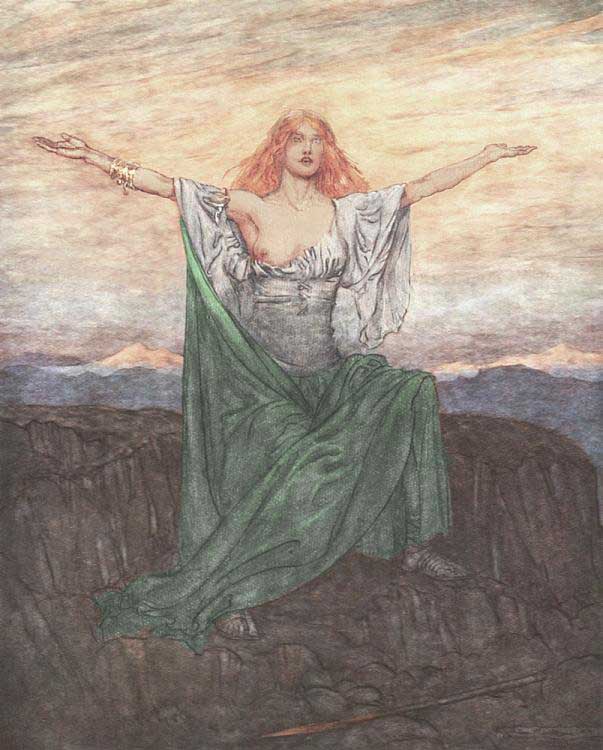
Hail to the Day by Arthur Rackham

3,876 words

1. Introduction: Wisdom Speaking

In our last installment, we discussed Sigurd’s meeting with the Valkyrie Brynhild, and how their encounter recapitulates, on a higher level, the dualities found in the story of the dragon slaying. When Sigurd rides through the fire to meet the Valkyrie he is going within his own solar, masculine being to reach the lunar feminine.

Brynhild is Sigurd’s fylgja—both a “higher” part of himself and a guardian spirit that can be passed on to later generations. We also made the case for the connection between the fylgjur and the Valkyries. Brynhild is both the fylgja of Sigurd and of the Volsung clan itself. Having achieved the supreme act of heroism in slaying the dragon, Sigurd now meets with the spirit of the Volsung clan, who is the keeper of occult secrets. What he will gain from her is wisdom—and magical power.

In this essay, we will explore the runelore Brynhild imparts to Sigurd. He says he has been told of her wisdom and wants to put it “to the test.”[1] By this he means that he will, in effect, challenge Brynhild to teach him what she knows. “Give me good advice on great things,” he says.[2] Her answer is curious. She says, “You are better able to do that,” but offers to teach him of runes or “of other matters pertaining to everything.”[3] In the following chapter, Sigurd tells Brynhild that there has never been a wiser woman than she. The Valkyrie responds, however, by telling him that he too possesses “wisdom” (vitrleikr).

Brynhild says these things to Sigurd not in order to flatter him, but because they are true. Sigurd has acquired wisdom and will acquire more through Brynhild. As we noted in part nineteen, Regin taught him runelore and other matters (possibly a runelore specific to the dwarfs). Sigurd learned the future from Gripir. From Odin he acquired battle knowledge. From Fafnir he learned of the Norns and of Ragnarok (of fate, and of what is fated to be). From Fafnir’s blood Sigurd gained knowledge of the language of birds, while the birds themselves taught him prudence. Brynhild will complete his education.
You can buy Collin Cleary’s Summoning the Gods here.

In Sigrdrifumal, after the Valkyrie awakens, she fills a horn with mead and then offers Sigurd a minnisveig. Literally, this means “memory drink.” We are not certain what this was. In Hyndluljóð (The Lay of Hyndla), preserved in Flateyjarbók, Freyja asks a giantess to provide her lover, Óttarr, with a “memory-ale” (minnisöl) to help him retain some crucial information. In Göngu-Hrólfs saga, a dwarf uses a minnisveig to restore a woman’s memory. One commentator believes that Sigerdrifa gives Sigurd the minnisveig to help him retain what she will teach him.[4] (The minnisveig is not mentioned in the Volsung Saga.)

It is possible, of course, that the drink is a “memory drink” just in the sense that it is to be drunk in memory of the gods—whom Brynhild will shortly invoke. However, the text seems to draw a clear distinction between the drink Brynhild pours for herself and the one she gives to Sigurd. The text literally says that “She took a hornful of mead and gave him a memory drink” (Hon tók þá horn fullt mjaðar ok gaf honum minnisveig). Indeed, while Brynhild’s drink is mead, Sigurd’s is beer, as we shall soon see. Only one is termed a minnisveig, therefore it seems unlikely that the purpose of the memory drink is simply to memorialize the gods. The minnisveig is specially prepared for Sigurd and has a special function.

In any case, after offering him the drink, in Sigrdrifumal the Valkyrie utters these justly celebrated lines:

She said: “Hail to the day!
Hail the sons of day!
Hail to night and her sister!
Look on the two of us here
with friendly eyes,
and give us victory.

“Hail the gods [æsir]!
Hail the goddesses [ásynjur]!
Hail the hospitable earth!
Give the two of us
eloquent speech, and wisdom –
and healing hands, while we live.”[5]

These words have been taken to be the record of an actual “prayer,” and have been adopted by contemporary neo-heathens, who often incorporate them into a morning ritual. We have no independent confirmation that this exact prayer was used in rituals. It may be entirely original to Sigrdrifumal. However, the poem makes clear that Sigerdrifa utters these words in a ritual context. After all, she takes up a hornful of mead before uttering them and offers Sigurd a drink as well so that they can hail the day together. It is highly plausible that prayers similar to this were in wide use, hailing the gods and goddesses, the night, the day and the earth, and calling for them to bestow good things on those invoking them. It is one of the few examples in the lore that seems to depict an actual religious ritual.

Let us look more closely at what the Valkyrie says. Both day (dagr) and night (nótt) are personified here and elsewhere in the lore. Vafthrusthnismal 12 mentions the horse Skinfaxi drawing the day over men below.[6] Vafthrusthnismal 25 tells us

Delling is the name
of the father of the day,
and the night is Norvi’s daughter.[7]

Snorri (in Gylfaginning) has this to say:

[High replies:] “Norfi or Narfi was the name of a giant who lived in Giantland. He had a daughter called Night. She was black and dark in accordance with her ancestry. She was married to a person called Naglfari. Their son was called Aud. Next she was married to someone called Annar. Their daughter was called Jörð [Earth]. Her last husband was Delling, he was of the race of the Æsir. Their son was Day. He was bright and beautiful in accordance with his father’s nature. Then All-father took Night and her son Day and gave them two horses and two chariots and set them up in the sky so that they have to ride around the earth every twenty-four hours. Night rides in front on the horse called Hrimfaxi, and every morning he bedews the earth with the drips from his bit. Day’s horse is called Skinfaxi [shining-mane], and light is shed over all the sky and sea from his mane.”[8]

So, Day is the child of Night. Day is also the sister of Jörð, but it is important to note that the “earth” referred to by the Valkyrie is fold (a poetic term meaning land or field) not Jörð. Little is known about the other figures mentioned by Snorri. Day, the sons of day (about whom we know nothing), Night and her sister (or daughter; ON nift or nipt could mean either) are asked to look on the Valkyrie and Sigurd favorably and to give them victory. Why victory? Probably because there is something that they must overcome; something that must be won. Is it wisdom?
You can buy Collin Cleary’s Wagner’s Ring & the Germanic Tradition here.

The gods, the goddesses (ásynjur, a female member of the Aesir), and hospitable earth (again, fold) are asked to give wisdom, and also eloquent speech and healing hands. These are closely tied together. In particular, there was a close association in the minds of the ancients between eloquence and wisdom. The early modern philosopher Giambattista Vico echoed this when he stated in On the Study Methods of Our Time (1708-09) that “eloquence is wisdom speaking” (la sapienza che parla). There is a belief here that genuine eloquence cannot be “faked” in order to express falsehoods; that in genuine eloquence wisdom shines through.

It is highly plausible that the Germanic peoples held a view similar to this, given their emphasis upon poetics. “Healing hands” are to the realm of action what eloquence is to the realm of speech: an expression of the ability to work the good in life. Hands that heal are informed by wisdom. Significantly, the Valkyrie teaches Sigurd no curses, but some of the spells (specifically, those concerning speech-runes and ale-runes) seem rather amoral in their intent.

The “Hail to the Day” does not appear in the Volsung Saga, but the sagaman quotes a number of other passages from Sigrdrifumal. Indeed, after Brynhild gives Sigurd beer, the entire rest of the chapter consists in quotations from Sigrdrifumal. However, the sagaman omits some passages from the poem and changes others, which may be significant. Unless indicated otherwise, all the passages quoted in this essay are from both the saga and Sigrdrifumal.

Brynhild says:

Beer [bjór] I bring you,
warrior,
blended with power
and fame.
Filled with spells
and healing staves [líknstafa],
with good magic [galdra],
with runes of joy.[9]

Blended is blandinn, the past participle of blanda, “to blend.” This term can also mean “to have sexual intercourse with.” “Runes of joy” is gamanruna. Gaman can also refer to sexual pleasure. There is thus a possible sexual subtext to the passage. While gamanruna appears in Sigrdrifumal, in the saga the word is gamanræðna, “joyful speeches.” Líknstafa, healing staves, certainly refers to rune staves. This is a cup full of runes and magic. Note that in Sigrdrifumal the Valkyrie literally refers to Sigurd as brynþings apaldr, “apple-tree of battle,” a kenning for warrior. This may have been a traditional kenning, but we cannot help but think here of the apple tree that stood at the center of Volsung’s hall, and of the magic apple through which Volsung himself was conceived.

Now begins Brynhild’s teaching of runelore. The following topics are discussed in the saga:

  1. Victory-runes (Sigrúnar)
  2. Wave-runes (Brimrúnar)
  3. Speech runes (Málrúnar)
  4. Ale-runes (Ölrúnar; or: beer-runes)
  5. Birth-runes (Bjargrúnar; or: life-saving runes, aid-runes)
  6. Limb-runes (Limrúnar; or: branch-runes)
  7. Mind-runes (Hugrúnar)

In Sigrdrifumal the same topics are discussed, but the order is different:

  1. Victory-runes
  2. Ale-runes
  3. Birth-runes
  4. Wave-runes
  5. Limb-runes
  6. Speech-runes
  7. Mind-runes

In both texts, victory-runes are first and mind-runes are last.

There are other “courses of runic instruction” mentioned in the lore. Earlier in the saga, of course, we are told that Regin teaches Sigurd runes, but no details of the instruction are mentioned. Given the clearly magical nature of Brynhild’s teaching, it may be that Regin merely taught Sigurd how to write in runes. In Rigsthula 34, Rig teaches runes to the boy named Lord, and the suggestion is that this is a magical instruction. The youngest son of Lord is called King, and we are told that he “learned runes, runes of fate and runes of destiny, he learned spells to save lives and dull blades, to calm storms” (Rigsthula, 41).[10]

We are also told that, like Sigurd, King learned “the language of birds.” And he learned further spells “to put out fires, to calm sorrows and induce sleep” (Rigsthula, 42). In Havamal, of course, Odin relates how he won the runes and then lists a number of spells. Comparing what is given in Havamal to the teaching of Brynhild, there is little crossover. Like Brynhild, Odin in Havamal speaks of spells concerned with healing, victory, and aiding ships at sea, but it is not clear that these are runic spells. In what follows I will take each of the Valkyrie’s seven spells in turn.

2. The Rune Spells

Here is Brynhild’s teaching concerning victory-runes:

Victory-runes you must know
if wise you would be.
On sword-guard carve [rísta] them,
on hilt-sockets,
on hilt’s iron grip,
and twice say Tyr’s name.[11]

From the term sigrúnar some might expect that what is being referred to here is the rune Sowilo which is often referred to today as the “sig rune.” But this designation is an innovation of Guido von List’s modern Armanen system. In fact, what is meant by “victory-runes” is probably the Tiwaz or Tyr rune, and, of course, the god’s name is mentioned in the passage. Snorri has this to say about Tyr:

There is also an As called Tyr. He is the bravest and most valiant, and he has great power over victory in battles. It is good for men of action to pray to him. There is a saying that a man is ty-valiant who surpasses other men and does not hesitate. He was so clever that a man who is clever is said to be ty-wise.[12]

It thus makes perfect sense that one would appeal to Tyr for victory. Brynhild advises Sigurd to carve these runes on several parts of the sword and, as the passage states, pronounce Tyr’s name twice.

Wave-runes are her next topic:

Wave-runes you must make [gera]
to watch over with care
your sailed steeds in swimming.
On prow carve them,
place them on steering oar,
and burn [leggja eld [13]] them also on oars.
No blue wave shall fall,
nor breaker steep,
but you’ll return safe from the sea.[14]

We can shed some light on this spell by comparing this passage to one in Havamal:

I know a ninth spell;
if the need arises
for me to save a ship upon the sea,
I can calm the wind
upon the waves
and soothe the sea to sleep.[15]

The idea in both cases is that the spell is intended to calm the sea. However, as in most of the Valkyrie’s teaching, the specific rune or runes are not mentioned. One might conjecture that it is Laguz. In Proto-Germanic, *laguz means water, liquid, wetness, or sea (derived forms include Old Norse lögr, meaning lake, sea, or water). In this context, “The Old English Rune Poem” is interesting in what it has to say about Lagu (Laguz):

[Water] is to people
seemingly unending
if they should venture out
on an unsteady ship
and the sea waves
frighten them very much,
and the brine-stallion
does not heed its bridle.[16]

However, it is pure conjecture that Brynhild is referring to the Laguz rune. She continues:

Speech-runes you must know,
to be spared, if you wish
repayment of grief rendered.
Wind [vindr] them about,
weave [vefr] them around,
set them all together,
there at the Thing
where throngs shall come,
all to full session faring.[17]

Speech-runes are intended to protect against the hateful speech of a man whom one has harmed. The Thing, as my readers may know, was a public assembly that functioned as a parliament and a court where disputes could be resolved. Since the spell instructs Sigurd to place the runes at the site of the Thing, it is likely that the intention is to protect one against defamation—or, more generally, harmful speech—spoken in the assembly of freemen. What is interesting is that it does not specifically protect one against lies, but against the ill-will of a man one has somehow wronged. As is typical of the Valkyrie’s speech, specific runes are not named, nor is it clear how they should be “wound” and “woven.” The general idea, however, is that they should be put all around the site of the Thing.

Next, Brynhild teaches Sigurd ale-runes, which turns out to be a rather complex matter:

Ale-runes you must know,
lest another’s wife
betray trust if you trust her.
On the horn you must carve them,
on hand’s back too,
and mark on nail Need [Nauð].[18]
You can buy Collin Cleary’s What is a Rune? here

Whereas ale-runes are the fourth topic discussed in the saga, in Sigrdrifumal ale-runes are the second, after victory-runes. This is the only place in the Valkyrie’s speech (either here or in Sigrdrifumal) where a rune is explicitly named. Here it is Nauð (Need), or in reconstructed Proto-Germanic, Nauðiz. The point of the spell may be to keep a woman with whom one has had an affair from revealing it—presumably to her husband. It is useful to know that while nauð meant “need” or “necessity,” it could also mean “compulsion” or “force.” Therefore, this looks like it could be a binding spell.

The same verb (rísta) is used here, as before, to indicate that the runes must be carved on a drinking horn. Perhaps a drink is to be offered to the woman who is the object of the spell. These runes are also to be carved on the back of the hand. Again, it is not clear what runes are meant, but the reference is clearly plural. As to the Nauð rune, we are told specifically that it is to be marked on the fingernail. Perhaps what is meant is on a fingernail of the same hand on which the runes are carved—and perhaps this is the same hand that proffers the drinking horn to the woman. We are not told that the N rune is to be carved on the nail. Rather, the text literally tells us to “mark” (merkja) the rune on the nail, whatever this may mean.

The passage about ale-runes is followed by this one:

The cup you must bless
against bane to guard,
cast leek into the drink.
Then this I promise,
that poisoned mead
will not fall to your fate.[19]

If this stanza is read as a continuation of the preceding, then a very different reading of the ale-rune spell is possible. It may be the case that the intention of the spell is to protect a man against poisoned ale (or mead) served to him by a treacherous woman whom he had trusted.[20] This was, after all, the manner of Sinfjotli’s death. The hero was served a poisoned drink by the treacherous Borghild.

Later in the saga, Queen Grimhild will serve Sigurd a cursed drink that causes him to forget Brynhild. This is not literally poisonous, but the spell Brynhild teaches Sigurd might have enabled him to avoid this trap (if he had suspected Grimhild’s intentions). Interestingly, the drink Grimhild serves him seems to be the diametrical opposite of the minnisveig or “memory drink” served him by Brynhild. As we discussed, the purpose of this drink may be to strengthen Sigurd’s memory.

We cannot leave the topic of ale-runes without saying something about ale itself and alu. *Alu is a reconstructed Proto-Germanic term from which our word “ale” (beer) derives. Old Norse öl (or ǫl) derives from it as well. Alu appears in many Elder Futhark inscriptions from Iron Age Scandinavia. It either appears alone or with other words or combinations of runes. The word is thought to have had a magical significance. Edgar Polomé connects alu to Hittite *alwanza– (alwanzatar: “witchcraft, magic, spell”; alwanza: “to bewitch”).[21] As Stephen Flowers (a student of Polomé) notes, “the common root meaning of the term would have been ecstasy [in the sense of magical or mystical ecstasy].”
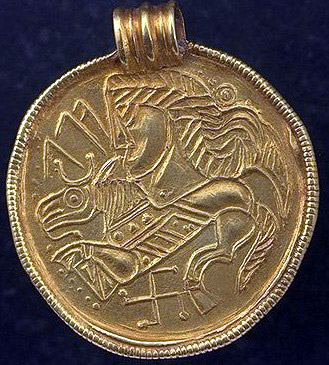
A bracteate bearing the inscription alu in upper left, read right to left.

The term came to be transferred “to the drink which brings ecstasy, the cultic drink”—i.e., ale, and probably also mead.[22] Certainly, Brynhild serves Sigurd a cup of ale filled with magic; a minnisveig no doubt intended to bring about an altered state of consciousness. We may also note that in the spell, we are told that “leek” is to be dropped into the drink. The Old Norse for “leek” is laukr, which can also refer to garlic, and is derived from Proto-Germanic *laukaz. Like alu, laukaz is also found in some inscriptions, including bracteates (where it sometimes accompanies alu), and is also thought to have a magical significance. We should also note the connection to the rune Laguz, as Laukaz has also been put forward as the Proto-Germanic name of the rune.

Brynhild next turns to birth-runes (which is the third topic in Sigrdrifumal):

Birth-runes you must learn
for those laboring with child,
to deliver babe safe and sound.
On palms you must carve them,
clasp them round limbs,
and bid the dísir give aid.[23]

As the text makes very clear, this spell is intended to aid women in childbirth. Once more, no specific runes are mentioned, but, as in the ale-runes spell, we are told that they must be carved on the hand. As to how one is to “clasp” them around limbs (the verb here is spenna), this is not made clear. It may mean that after carving the runes on one’s palms, one clasps the limbs of the woman in labor. The most interesting thing about this passage is that we are instructed to call upon the dísir for help.

The dísir, as many of my readers know, are semi-divine female spirits. Their function and properties are complex and mysterious, and they often seem hard to distinguish from the fylgjur and Norns. Earlier in the saga, we are told that Sigmund was protected in battle by his spádísir. This word consists of two components: spá, which means “prophecy,” and dísir, the plural of dís. The context suggests that these are family spirits, equivalent to kynfylgjur. It makes perfect sense that protective female spirits would be appealed to in seeking to aid women in childbirth.

Now here is a further spell regarding healing or giving aid:

Limb-runes you must know
for treating the sick,
to see wisely to wounds.
Cut them on bark,
on the leaves of a tree
whose limb bends to the east.[24]

There seems to be a play here on the limbs of the tree and the limbs of a wounded man. Limb runes is limrúnar, from limr which can have the sense of the limb of a human being, or the branch of a tree. The last line refers to the tree’s limar or “limb.” Though this is a genitive singular, translators often render the last line as referring to a tree whose “limbs bend to the east.” We are told here to cut (again, rísta) the runes on the bark of the tree and on the barri. Most translators render this as “needles,” but it is extremely hard to imagine how runes could be carved on pine needles! What might be meant instead by barr is a small leaf.

We now come to the final runic topic taught by the Valkyrie: mind-runes. This is the most mysterious of all her spells—and we will find that it is, in a very real sense, a key to the whole. However, we will have to save this topic for our next installment, coming soon. . .

Notes

[1] Vǫlsunga Saga – The Saga of the Volsungs, trans. R.G. Finch (London: Thomas Nelson, 1965), 35. Henceforth “Finch.” I have frequently altered this translation to make it more literal.

[2] Finch, 35.

[3] Finch, 35.

[4] https://scancan.net/index.php/scancan/article/download/204/407

[5] The Poetic Edda, trans. Jackson Crawford (Indianapolis: Hackett Publishing, 2015), 253. Henceforth “Crawford, PE.” I have frequently altered this translation to make it more literal.

[6] Crawford, PE, 50. Crawford translates dag as “sun.”

[7] Crawford, PE, 53.

[8] Snorri Sturluson, Edda, trans. Anthony Faulkes (London: Everyman’s Library, 1995), 13-14. Henceforth “Faulkes.”

[9] Finch, 35-36. For the corresponding passage in the Poetic Edda, see Crawford, 37. Note that the Finch and Crawford translations differ significantly, though the sense is generally the same.

[10] Crawford, PE, 154.

[11] Finch, 36. The Old Norse terms for the parts of the sword in this passage are obscure and translators disagree about their meaning.

[12] Faulkes, 24-25.

[13] Literally, “lay fire” or “put fire.”

[14] Finch, 36.

[15] Crawford, PE, 45.

[16] Edred Thorsson, Runelore (York Beach, ME: Samuel Weiser, 1987), 98.

[17] Finch, 36.

[18] Finch, 36-37.

[19] Finch, 37.

[20] This is suggested by Stephen Flowers, Runes and Magic (Smithville, TX: Runa-Raven, 2010; originally Ph.D. dissertation), 105-106.

[21] See Edgar Polomé, “Notes sur le vocabulaire du germanique 1. Runique alu,” La Nouvelle Clio 6 (1954): 49-55. This is discussed in Stephen Flowers, Runes and Magic, 38; see also Edred Thorsson, Alu (San Francisco, CA: Weiser Books, 2012), 9.

[22] Flowers, Runes and Magic, 38.

[23] Finch, 37.

[24] Finch, 37.

An Esoteric Commentary on the Volsung Saga, Part XXI: Runelore of the Valkyrie

An%20Esoteric%20Commentary%20on%20the%20Volsung%20Saga%2C%20Part%20XXI%3A%0ARunelore%20of%20the%20Valkyrie%0A

Share

  • Gab

Enjoyed this article?

Be the first to leave a tip in the jar!

Instant Echeck GreenPay™

Related

  • Heidegger on Nietzsche Part Three

  • Collin Cleary: What Rome Means to Me

  • Heidegger on Nietzsche, Part Two

  • Heidegger on Nietzsche, Part One

  • An Esoteric Commentary on the Volsung Saga – Part XXII

  • The West’s Forgotten Gift: Rediscovering Lost Civilizations

  • Counter-Currents in Rome

  • What Rome Means to Me

Tags

An Esoteric Commentary on the Volsung SagaByrnhildCollin Clearycomparative mythologyhistorical linguisticsNorse sagasphilologyrunesSigurdSnorri SturlusonStephen Flowers

Previous

« Editor’s Update

Next

» Biden and Trump: Twin Towers of Senility

2 comments

  1. JBP says:
    May 7, 2026 at 4:22 pm

    Thanks. I’ve mostly read through Vilhelm Gronbech’s culture of the Teutons, and this helps clarify some things. But grasping Teutonic culture is difficult to say the least. Another sad loss for white European culture.

    0
    0
    Reply
  2. SacredCow says:
    May 27, 2026 at 5:57 pm

    What is your opinion on the fly agaric as a central component of nordic mythology and shamanic practice?

    The Mead of Poetry in Norse mythology and Soma in Vedic tradition are functionally equivalent sacred beverages from a shared Indo-European heritage, both serving as elixirs of poetic inspiration, wisdom, and immortality.

    Origin and Composition: The Norse mead was created by mixing the blood of the wise being Kvasir with honey in three vessels (Óðrerir, Són, and Boðn).  Similarly, Vedic Soma was a ritual drink made by pressing the juice from a sacred plant, often identified with psychoactive properties.
    Theft and Transmission: In Norse myth, Odin stole the mead from the giant Suttungr by transforming into an eagle.  In Vedic myth, the god Indra or the bird Garuda (often linked to the goddess of speech, Vak) transported Soma to the gods.  Both narratives feature a deity bringing the drink from a hidden source to humanity.
    Effects: Consuming either beverage granted the drinker the ability to compose poetry, solve any question, and achieve a state of divine insight or ecstasy, bridging the mortal and divine realms.

    0
    0
    Reply

If you have a Subscriber access,
simply login first to see your comment auto-approved.

Post a comment Cancel reply

Note on comments privacy & moderation

Your email is never published nor shared.

Comments are moderated. If you don't see your comment, please be patient. If approved, it will appear here soon. Do not post your comment a second time.

Writers of May

(2 votes) Morris van de Camp David M. Zsutty Derek Stark Jayant Bhandari Greg Johnson

Articles of May

Heidegger on Nietzsche, Part One by Collin Cleary The Lunch Wars by David M. Zsutty 2 votes
    • The Psychology Behind MrBeast’s Moronic Thought Experiment

      Endeavour

      1

    • On the Roots of Anti-Immigrant Sentiment in Contemporary Britain

      Lipton Matthews

      2

    • Remembering Enoch Powell:
      June 16, 1912–February 8, 1998

      Greg Johnson

      4

    • Counter-Currents Radio Podcast No. 691
      Rob Rundo Returns

      Counter-Currents Radio

    • The Fragile Polity that is Syria

      Morris van de Camp

      1

    • Nigel Farage Calls Britain a Two-Tier State

      Mark Gullick

      4

    • Nationalism This Week
      Letter to J. D. Vance

      Greg Johnson

      31

    • Lost In Trans-Mission:
      How the Media Fails To Reveal the Inconvenient Truth About the Usual Suspects

      Steven Tucker

      10

    • Liar, Liar, Pants on Fire!

      Beau Albrecht

      7

    • Editor’s Update
      Rob Rundo on Counter-Currents Radio, Fundraiser Update, & a New $20,000 Matching Grant

      Greg Johnson

    • The Bitter End of Western Metaphysics:
      Heidegger on Nietzsche, Part Three

      Collin Cleary

      10

    • Uncivil War

      Mark Gullick

      50

    • Exclusive Interview with Karel Veliky:
      The Final Chapter in the Film Series! Part II

      Ondrej Mann

      2

    • Happy Birthday to Us!

      Greg Johnson

      6

    • Zsutty’s Maximum

      David M. Zsutty

      16

    • Exclusive Interview with Karel Veliky:
      The Final Chapter in the Film Series! Part I

      Ondrej Mann

      2

    • The Union Jackal, June 2026

      Mark Gullick

      23

    • The Inferiority Behind Immigrant Superiority

      Jayant Bhandari

      15

    • Counter-Currents Radio Podcast No. 690
      Greg Johnson & David Zsutty Discuss Current Things: AI, Henry Nowak, the Iran Crisis, & More

      Counter-Currents Radio

      7

    • Collin Cleary: What Rome Means to Me

      Collin Cleary

      4

    • Paul Krugman: Closet Bolshevik

      Spencer J. Quinn

      21

    • Fugue of Ideas:
      Ibram X. Kendi’s Chain of Ideas

      Greg Johnson

      19

    • Based Blacks

      Lipton Matthews

      24

    • Black Intellectual Fatigue

      Derek Stark

      41

    • Why White Advocates Should Avoid “Based Blacks”

      Dani Vypont

      32

    • Nietzsche & Race

      Mark Gullick

    • Editor’s Update
      Rob Rundo Rescheduled to Next Week on Counter-Currents Radio;
      Tonight Greg Johnson & David Zsutty Answer Your Questions;
      Fundraiser Update & a New $20,000 Matching Grant

      Greg Johnson

    • The Counter-Currents 2026 Fundraiser
      Lifetime Subscriber Welcome Packages Extended

      Greg Johnson

    • Nationalism This Week
      Who’s Looking Back?

      Greg Johnson

      29

    • China’s Threat to American Security:
      Food, Farmland, Foreign Control, & Energy Policy

      Lipton Matthews

      5

    • The Bitter End of Western Metaphysics:
      Heidegger on Nietzsche, Part Two

      Collin Cleary

      16

    • The Killing of Henry Nowak

      Mark Gullick

      38

    • The Crisis of Chinese Technology Thieves

      Morris van de Camp

      1

    • The Strange World of Gender Bender Fiction:
      & What This Genre Tells Us About Autosexuality

      Dani Vypont

      3

    • Watching the Watchers:
      The Dark Triad Question

      David M. Zsutty

      14

    • The Remigration Movement Solidifies

      F. Roger Devlin

      2

    • Casting Aspersions:
      The Fatal Consequences of Race-Swapped Casting, From Helen of Troy to Henry of Southampton

      Steven Tucker

      20

    • The Murder of Henry Nowak

      Millennial Woes

      23

    • Don’t Forget to Vote in Our Writer & Article of the Month Poll

      Greg Johnson

    • The Robot Hotdog Stand

      Greg Johnson

      37

    • Laughing Our Way to Victory

      Dave Chambers

      7

    • The Zodiac Killer

      Mark Gullick

      11

    • Jared Taylor: What Rome Means to Me

      Jared Taylor

      1

    • An Interview with Endeavour:
      My Way of Life Is an Adventure!

      Ondrej Mann

      6

    • José Pedro Zúquete’s The Identitarians

      Greg Johnson

      3

    • Editor’s Update
      Fundraiser Update & How to Watch the Remigration Summit

      Greg Johnson

      5

    • The Bitter End of Western Metaphysics:
      Heidegger on Nietzsche, Part One

      Collin Cleary

      12

    • Berlin: City of Stones

      Spencer J. Quinn

      6

    • True Folk-Horror Is Horror of Your Own Folk:
      Mark Gatiss vs the Brexit Blind Dead  

      Steven Tucker

      4

    • Counter-Currents Radio Podcast No. 689
      Thomas Massie, the America 2050 Bust, the Need for Whites to Divest from America, the AI Economic Apocalypse, & Pro-White Project Pitches to Billionaires

      Counter-Currents Radio

      7

    • Will Williams

      On the Roots of Anti-Immigrant Sentiment in Contemporary Britain

      To answer the question posed in the title of this piece, the root of anti-immigrant sentiment in...

    • Ondrej Mann

      The Psychology Behind MrBeast’s Moronic Thought Experiment

      Good point. But what if it weren’t universal? For example, what if it only applied to writers on our...

    • Dr X

      Nationalism This Week
      Letter to J. D. Vance

      Speaking of  "wrecking the economy" - I lack a good understanding of how money was created in the...

    • Moss

      On the Roots of Anti-Immigrant Sentiment in Contemporary Britain

      The multicultural project hasn't failed, it's doing what it is supposed to do - destroy white people...

    • Moss

      Remembering Enoch Powell:
      June 16, 1912–February 8, 1998

      A titan of a man.

    • Joe Gould

      Nigel Farage Calls Britain a Two-Tier State

      We owe Nigel Farage nothing. Instead of thanking him we should congratulate ourselves on spreading...

    • Adrian Roberts

      Remembering Enoch Powell:
      June 16, 1912–February 8, 1998

      I don’t carry a torch for Britain’s involvement in WW2, but von Papen said something to the effect...

    • Greg Johnson

      Remembering Enoch Powell:
      June 16, 1912–February 8, 1998

      It was the British who chose to make a war between Germany and Poland into the Second World War.

    • Adrian Roberts

      Remembering Enoch Powell:
      June 16, 1912–February 8, 1998

      "When Britain started the Second World War" C'mon. We're not the NJP.

    • Scott

      Nationalism This Week
      Letter to J. D. Vance

      Yes, it [the 25th Amendment plan] would be a disaster ─ a shot in the foot to the GOP instead of the...

    • Scott

      Nationalism This Week
      Letter to J. D. Vance

      "I’d imagine millions of Iranians who were skeptical of the Iranian leadership prior to them being...

    • Scott

      Nationalism This Week
      Letter to J. D. Vance

      Unless Trump actually has a legitimate medical issue or becomes senile like Biden clearly was, there...

    • Glide Ratio 0:1

      Uncivil War

      That's funny, I can tell you I've known countless Ethno Nationalists open to the idea of working...

    • Beau Albrecht

      The Fragile Polity that is Syria

      It seems that they didn't learn the lesson that diversity is a country's greatest strength.  How...

    • YT

      Nationalism This Week
      Letter to J. D. Vance

      Not sure if you’re comment was meant to be directed to mine, but assuming so, my understand based on...

    • Will Williams

      I was interviewed by the NY Post Friday, mostly about Miss Heidi’s participation with the SPLC. The...

    • Will Williams

      Nigel Farage Calls Britain a Two-Tier State

      Farage may turn out to be the latest in a line of snake-oil salesmen posing as saviors…---He’s...

    • Joe Gould

      Nationalism This Week
      Letter to J. D. Vance

      "If Trump does not go quietly, Vance can withhold his pardon and let the dogs in Congress tear Trump...

    • Peter Quint

      Nationalism This Week
      Letter to J. D. Vance

      I can’t tell from this far off. I wouldn’t put it pass him; it is pretty common these days. 🙃

    • Adrian Roberts

      Nationalism This Week
      Letter to J. D. Vance

      Does he wear eye-liner?

    • Earth Day Special

      John Morgan

      12

    • A Robertson Roundup
      Remembering Wilmot Robertson
      (April 16, 1915 – July 8, 2005)

      Margot Metroland

      13

    • The Paranoid Style in White Nationalism

      Greg Johnson

      30

    • Join the Dance!

      Andrew Hamilton

      1

    • We Can’t Save the Earth Without Reducing African Birth Rates

      James Dunphy

      36

    • “I’m Not a Conspiracy Theorist, but . . .”:
      Jeffrey Epstein’s Death Gives New Life to “Conspiracy Theories”

      Greg Johnson

      22

    • Sylvia Plath: Stasis in Darkness

      Vic Olvir

      17

    • Vanguardism, Vantardism, & Mainstreaming

      Greg Johnson

      80

    • Aviation, Geography, & Race

      Charles Lindbergh

      3

    • Some Thoughts on Yule

      Collin Cleary

      4

    • Living in Truth:
      A Yuletide Homily

      Jef Costello

      7

    • John Kennedy Toole’s A Confederacy of Dunces

      Greg Johnson

      20

    • On Aleksandr Solzhenitsyn’s Warning to the West

      Spencer J. Quinn

      7

    • Elitism, British Modernism, & Wyndham Lewis

      Jonathan Bowden

      6

    • Philip K. Dick’s Do Androids Dream of Electric Sheep? as Anti-Semitic/Christian-Gnostic Allegory

      Greg Johnson

      20

    • “Conspiracy Theory” or Conspiracy?

      Andrew Hamilton

      21

    • Remembering H. P. Lovecraft
      (August 20, 1890–March 15, 1937)

      Greg Johnson

      3

    • Who Are We?
      Nordics, Aryans, & Whites

      Greg Johnson

      71

    • Remembering William Gayley Simpson
      (July 23, 1892–December 31, 1990)
      A Pleasant Afternoon with Harriet & Bill Simpson

      Margot Metroland

      18

    • Here are the Young Men
      Remembering Ian Curtis
      (July 15, 1956–May 18, 1980)

      Mark Gullick

      18

    • Percy Grainger
      Artist of the Right

      Alex Graham

      7

    • Remembering Revilo Oliver
      (July 7, 1908–August 20, 1994)

      Greg Johnson

      18

    • The Meaning of July 4th for the White Man

      Gregory Hood

      13

    • The Front National’s Evolution

      Bruno Mégret

    • Merwin K. Hart
      Forgotten American Hero & Man of the Right

      Morris van de Camp

      10

    • George Orwell’s Nineteen Eighty-Four

      Jonathan Bowden

      8

    • Carleton S. Coon
      Scientist & Reluctant White Advocate

      Morris van de Camp

      3

    • The Kwanzaa Absurdity Will Be Dwarfed by Juneteenth

      Robert Hampton

      10

    • Stravinsky

      Alex Graham

      7

    • Like the Roman:
      Remembering Enoch Powell (1912-1998)

      Mark Gullick

      23

    • The 1970s: The Golden Age of Hijacking

      Morris van de Camp

      21

    • Jonathan Bowden’s Deliverance
      Part 6

      Jonathan Bowden

    • Do You Want to Play a Game?

      Mark Gullick

      1

    • Sexually Incontinent on the Indian Subcontinent:
      Who Rapes More Animals, Indians or Pakistanis? The Battle Continues!

      Steven Tucker

      3

    • Neo-Fascism in Film
      Part 5

      Karel Veliky

      15

    • The Game of Tarot

      Mark Gullick

      2

    • Institutions Cannot Be Transplanted

      Jayant Bhandari

      5

    • Jonathan Bowden’s Deliverance
      Part 5

      Jonathan Bowden

    • Crosstown Traffic:
      Jimi Hendrix & The Post-War Rock ‘N’ Roll Revolution

      Mark Gullick

      1

    • Slaves from the North:
      Finns & Karelians in the East European Slave Trade, 900–1600

      Lipton Matthews

      14

    • Neo-Fascism in Film
      Part 4

      Karel Veliky

      2

    • David Lean’s A Passage to India

      Spencer J. Quinn

      1

    • Elites are Essential to Development

      Lipton Matthews

      7

    • Jonathan Bowden’s Deliverance
      Part 4

      Jonathan Bowden

    • Neo-Fascism in Film
      Part 3

      Karel Veliky

      6

    • E. M. Forster’s A Passage to India & the Indian Mentality

      Spencer J. Quinn

      25

    • Jonathan Bowden’s Deliverance
      Part 3

      Jonathan Bowden

    • The Rest Is Silence
      Heidegger’s Quietism

      Mark Gullick

      2

    • Dispelling the Historical Fallacy of Indian Nationalism

      Lipton Matthews

      8

    • Neo-Fascism in Film
      Part 2

      Karel Veliky

      8

    • Jonathan Bowden’s Deliverance
      Part 2

      Jonathan Bowden

    • Life of a Klansman

      Mark Gullick

      8

    • Jonathan Bowden’s Deliverance, Part 1

      Jonathan Bowden

    • Decolonial Ideas are Holding Back Developing Countries

      Lipton Matthews

      8

    • Neo-fascism in Film, Part 1

      Karel Veliky

      21

    • Jonathan Bowden’s Onslaught, Part 8
      Divigations on Decadence

      Jonathan Bowden

    • Jonathan Bowden’s Onslaught, Part 7
      Intrigues in the National Front

      Jonathan Bowden

      1

    • Rotten to the Core

      Mark Gullick

      8

    • Strauss on Husserl’s “Philosophy as Rigorous Science”

      Greg Johnson

    • Jonathan Bowden’s Onslaught, Part 6
      Francis Bacon & Right-Wing Nihilism

      Jonathan Bowden

    • András László
    • Derek Hawthorne
    • Beau Albrecht
    • Alain de Benoist
    • Kerry Bolton
    • Jonathan Bowden
    • Collin Cleary
    • Jef Costello
    • Savitri Devi
    • Julius Evola
    • Jim Goad
    • Gregory Hood
    • Juleigh Howard-Hobson
    • Greg Johnson
    • Charles Krafft
    • Anthony M. Ludovici
    • Trevor Lynch
    • H. L. Mencken
    • J. A. Nicholl
    • James J. O’Meara
    • Christopher Pankhurst
    • Tito Perdue
    • Michael Polignano
    • Spencer J. Quinn
    • Fenek Solère
    • Irmin Vinson
    • Leo Yankevich
    • Francis Parker Yockey
    • Multiple authors
  • Editor-in-Chief

    • Greg Johnson, Ph.D.

    Featured Writers

    • Beau Albrecht
    • Gunnar Alfredsson
    • Collin Cleary, Ph.D.
    • Jef Costello
    • Morris V. de Camp
    • F. Roger Devlin, Ph.D.
    • Stephen Paul Foster, Ph.D.
    • Jim Goad
    • Alex Graham
    • Mark Gullick, Ph.D.
    • Greg Johnson, Ph.D.
    • Travis LeBlanc
    • Trevor Lynch
    • Margot Metroland
    • James J. O’Meara
    • Angelo Plume
    • Spencer J. Quinn
    • Fred Reed
    • Clarissa Schnabel
    • Michael Walker
    • David M. Zsutty

    Frequent Writers

    • Asier Abadroa
    • Aquilonius
    • Alain de Benoist
    • Kerry Bolton, Ph.D.
    • Dave Chambers
    • Steven Clark
    • James Dunphy
    • Endeavour
    • Richard Houck
    • Jason Kessler
    • Titus Livius
    • Ondrej Mann
    • Lipton Matthews
    • Mark Mazari
    • John Morgan
    • Jaroslav Ostrogniew
    • Kathryn S.
    • Christian Secor
    • Anne Wilson Smith
    • Thomas Steuben
    • William De Vere
    • Kenneth Vinther
    • Max West

    Classic Authors

    • Maurice Bardèche
    • Jonathan Bowden
    • Julius Evola
    • Guillaume Faye
    • Ernst Jünger
    • Kevin MacDonald, Ph.D.
    • D. H. Lawrence
    • Charles Lindbergh
    • Jack London
    • H. P. Lovecraft
    • Anthony M. Ludovici
    • Sir Oswald Mosley
    • National Vanguard
    • Friedrich Nietzsche
    • Revilo Oliver
    • William Pierce
    • Ezra Pound
    • Saint-Loup
    • Savitri Devi
    • Carl Schmitt
    • Miguel Serrano
    • Oswald Spengler
    • P. R. Stephensen
    • Jean Thiriart
    • John Tyndall
    • Dominique Venner
    • Leo Yankevich
    • Francis Parker Yockey

    Other Authors

    • Howe Abbott-Hiss
    • Michael Bell
    • Giles Corey
    • Jack Donovan
    • Richardo Duchesne, Ph.D.
    • Emile Durand
    • Guillaume Durocher
    • Mark Dyal
    • Tom Goodroch
    • Andrew Hamilton
    • Robert Hampton
    • Huntley Haverstock
    • Derek Hawthorne
    • Gregory Hood
    • Juleigh Howard-Hobson
    • Alexander Jacob
    • Ruuben Kaalep
    • Tobias Langdon
    • Julian Langness
    • Patrick Le Brun
    • G A Malvicini
    • John Michael McCloughlin
    • Millennial Woes
    • Michael O’Meara
    • Christopher Pankhurst
    • Michael Polignano
    • J. J. Przybylski
    • Quintilian
    • Edouard Rix
    • C. B. Robertson
    • C. F. Robinson
    • Herve Ryssen
    • Alan Smithee
    • Fenek Solere
    • Ann Sterzinger
    • Robert Steuckers
    • Tomislav Sunic
    • Donald Thoresen
    • Marian Van Court
    • Irmin Vinson
    • Book Reviews
    • Movie Reviews
    • TV Reviews
    • Music Reviews
    • Art Criticism
    • Graphic Novels & Comics
    • Video Game Reviews
    • Fiction
    • Poems
    • Interviews
    • Videos
    • English Translations
    • Other Languages
      • Arabic
      • Bulgarian
      • Croatian
      • Czech
      • Danish
      • Dutch
      • Estonian
      • Finnish
      • French
      • German
      • Greek
      • Hungarian
      • Italian
      • Lithuanian
      • Norwegian
      • Polish
      • Portuguese
      • Romanian
      • Russian
      • Slovak
      • Spanish
      • Swedish
      • Ukrainian
    • Commemorations
    • Why We Write
  • Archives
  • Top 100 Commenters
  • The Looney Bin
Sponsored Links
Europa.com Above Time Coffee Antelope Hill Publishing Paul Waggener IHR-Store Spencer J. Quinn American Renaissance Jim Goad The Occidental Observer
Donate Now Mailing list
Books for sale
  • The Philosopher Is In
  • Sexual Utopia in Power (Expanded Edition)
  • In Defense of Prejudice
  • Loving Our Own
  • Tyranny & Wisdom
  • The Populist Moment
  • Is America Doomed?
  • To all books
Copyright © 2026 Counter-Currents Publishing, Ltd.

Paywall Access


Please enter your email address.

Lost your password?

Edit your comment

Writer & Article of the Month May 2026

Voting for this month has concluded. Here are the final results!

Top Writers

  • #1 Morris van de Camp 2 votes
  • #2 David M. Zsutty 2 votes
  • #3 Derek Stark 2 votes
  • #4 Jayant Bhandari 2 votes
  • #5 Greg Johnson 2 votes
  • #6 Jared Taylor 1 vote
  • #7 Collin Cleary 1 vote
  • #8 Spencer J. Quinn 1 vote
  • #9 Mark Gullick 1 vote
  • #10 Lipton Matthews 1 vote
  • #11 Keith Woods 1 vote
  • #12 Steven Tucker 1 vote

Top Articles

  • #1 Heidegger on Nietzsche, Part One 2 votes
  • #2 The Lunch Wars 2 votes
  • #3 The 1970s: The Golden Age of Hijacking 1 vote
  • #4 True Folk-Horror Is Horror of Your Own Folk 1 vote
  • #5 Finding Atlantis Part 4 1 vote
  • #6 Berlin: City of Stones 1 vote
  • #7 The Ghost of the Confederacy 1 vote
  • #8 Lothrop Stoddard’s The Revolt Against Civilization 1 vote
  • #9 Could Fascism Work? 1 vote
  • #10 Jared Taylor's Elevator Pitch to a Billionaire 1 vote
  • #11 Predation Wearing the Mask of Civilization 1 vote
  • #12 Peak Fatigue in Fort Wayne 1 vote
  • #13 Keith Wood's Elevator Pitch to a Billionaire 1 vote
  • #14 Do You Want to Play a Game? 1 vote
  • #15 Why Billionaires Should Fund White Identity Politics 1 vote

Total votes cast: 17

Insert/edit link

Enter the destination URL

Or link to existing content

    No search term specified. Showing recent items. Search or use up and down arrow keys to select an item.