 2,080 words
The movement to “decolonize the curriculum” has become something of an orthodoxy in Western universities. Its proponents argue that the academy has been shaped by Eurocentric assumptions, and that non-Western knowledge traditions deserve greater prominence. Yet the movement’s loudest advocates display a curious blind spot: they appear wholly impervious to the remarkable, and largely unthanked, role that Western scholars played in recovering, preserving, and transmitting much of the very non-Western knowledge they now wish to celebrate. From the sands of Egypt to the temples of Ceylon, it was often European linguists, missionaries, and colonial officials who rescued ancient civilizations from oblivion, sometimes at considerable personal cost.
No episode illustrates this more vividly than the decipherment of Egyptian hieroglyphs. By the early nineteenth century, the language of the ancient Egyptians had been entirely lost for well over a millennium. The early Christian authorities had suppressed the old script, and subsequent centuries of Ottoman rule had done nothing to recover it. An entire civilization, comprising its theology, governance, and literature, had been sealed behind an impenetrable wall of unreadable symbols.
The chain of events that broke that wall open began, ironically, with a military invasion. When Napoléon launched his Egyptian campaign in 1798, he brought with him not merely soldiers but a “Commission of Arts and Science” consisting of 167 specialists, described as “astronomers, geographers, cartographers, architects, engineers, chemists, naturalists, physicians, orientalists, artists and historians.” Under the leadership of Napoleon, these men established the Egyptian Institute of Arts and Sciences in Cairo, conducted systematic surveys of the Nile, and produced the monumental Description de l’Egypte, published in installments between 1809 and 1828, a twenty-volume work containing 794 illustrated plates that placed the wonders of ancient Egypt before the eyes of the world. Europe’s fascination with what it saw was immediate and total.
You can buy Greg Johnson’s From Plato to Postmodernism here
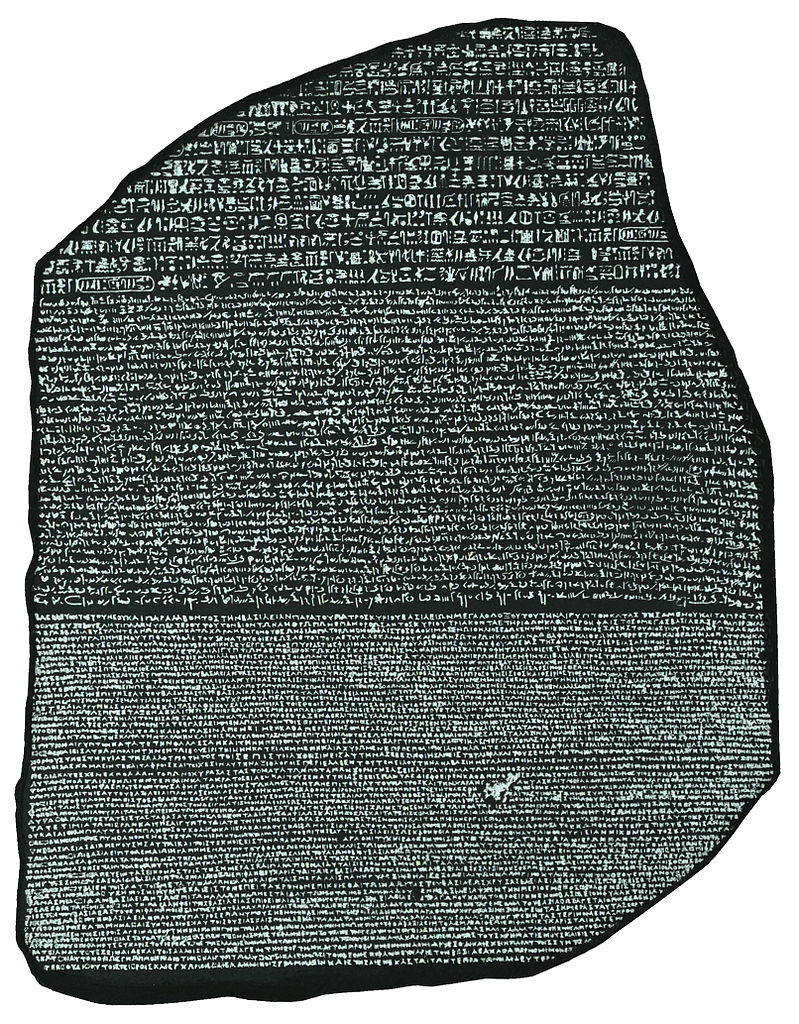
Yet even as this Egyptomania gripped the continent, the hieroglyphs themselves remained stubbornly silent. Their potential unlocking had begun almost by accident, with a French soldier stumbling upon an irregular black slab embedded in a decaying fortification near the town of Rosetta in 1799, a stone bearing parallel inscriptions in ancient hieroglyphs, Demotic script, and Greek. The Rosetta Stone, as it became known, offered tantalizing promise, but for over two decades it defeated the finest philological minds in Europe. Part of the difficulty lay in the fact that the three different writings of the same event were not identical word-for-word transliterations but phrases only roughly comparable in meaning, and the scarcity of hieroglyphic characters on the stone made a comprehensive study almost impossible.
It was against this formidable backdrop that Jean-François Champollion, born in the small French town of Figeac in 1790, devoted his entire intellectual life to mastering Coptic and oriental languages in preparation for this singular task. On the morning of September 14, 1822, poring over drawings of hieroglyphs from the temple of Abu Simbel in his attic room in Paris, Champollion finally saw the underlying principle. Recognizing the solar symbol Ra in a cartouche, and combining it with other signs to read “Rameses,” a name belonging to pharaohs who had lived millennia before the Greek and Roman period, he grasped in one electrifying moment that hieroglyphs were not pictographs but a sophisticated combination of phonetic and logographic elements.
He ran to find his brother at the nearby Institut de France, collapsed on the floor breathless, cried out “Je tiens mon affaire!” and fainted. His formal letter of announcement to the Académie des Inscriptions followed on September 22, 1822, in which he argued that phonetic writing had existed in Egypt at a far distant time, used to transcribe the proper names of peoples, countries, cities, rulers, and foreigners in monumental inscriptions.
The consequences of this single act of scholarship were staggering. Champollion’s decipherment opened access to a civilization dating back to 3300 BC, including its gods, pharaohs, cosmology, medicine, and law. His mastery of Coptic proved to be the decisive instrument, enabling him to deduce the phonetic values of many syllabic signs and to assign correct readings to many pictorial characters whose meanings the Greek text on the Stone helped confirm. What is more, Champollion’s contribution did not end with decipherment. When he traveled to Egypt in 1828, his moral authority was such that he successfully urged the governor Muhammad Ali to legislate against the looting and desecration of antiquities, a recommendation that was enacted into law in 1835. Without a French linguist laboring in a Parisian attic, ancient Egypt would in all likelihood remain mute to this day.
A parallel story unfolded on the Indian subcontinent, where a comparably decisive act of Western scholarship gave India access to dimensions of its own heritage that had been lost or ignored for centuries. The Asiatic Society of Bengal was founded on January 15, 1784 by Sir William Jones, a British judge serving on the Supreme Court in Calcutta, whose mastery of languages ranging from Sanskrit and Arabic to Persian made him without parallel among his contemporaries. Jones had come to recognize that the study of India’s classical languages was essential not only for the practical purposes of colonial administration but for the sake of human knowledge itself. Accordingly, he brought together thirty leading figures of the English community in Calcutta and established an institution whose declared object was to inquire into “everything that is performed by man and nature.”
The intellectual fruits of the Society were extraordinary and far-reaching. Jones himself identified the structural affinities between Sanskrit, Latin, and Greek, famously observing that Sanskrit was “of a wonderful structure; more perfect than the Greek, more copious than the Latin,” yet bearing to both a resemblance so strong that “no philologer could examine them all three without believing them to have sprung from some common source.” This observation did not merely illuminate Indian literary heritage. It founded the entire modern discipline of comparative and historical philology, reshaping European understanding of the deep history of human language.
Building on these foundations, Jones’s colleague Charles Wilkins, another founding member of the Society and the first Englishman to master Sanskrit, translated the Bhagavad Gita into English in 1785, placing one of Hinduism’s central texts before a global readership for the first time. Jones himself translated Kalidasa’s drama Sakuntala, comparing its author favorably to Shakespeare and in doing so placing Indian literary achievement on the world map. Through such publications, the Society brought the print revolution to India, with its learned tomes, including first editions in Bengali, representing an entirely new mode of preserving and disseminating knowledge on the subcontinent.
Nor did the Western contribution stop with Sanskrit literature. Among the most remarkable, and least celebrated, recoveries of ancient Indian civilization was the decipherment of the Brahmi script by James Prinsep, an official at the Benares mint, in 1837. Brahmi was the script in which the Emperor Ashoka, who ruled the Mauryan Empire in the third century BC and became one of the most consequential figures in the history of Buddhism, had inscribed his famous edicts on stone pillars across the subcontinent. By Prinsep’s era, not a single living scholar could read them. Working painstakingly on bilingual coin inscriptions, Prinsep cracked the code of Brahmi and in doing so effectively rediscovered Ashoka himself, a monarch who had all but vanished from historical memory. The edicts, which proclaimed Ashoka’s conversion to Buddhism and his philosophy of non-violence and compassionate governance, were now legible for the first time in over a thousand years. A vast chapter of South Asian religious and political history had been returned to humanity by a British numismatist in a colonial mint.
A third strand of this story runs through the island of Ceylon, now Sri Lanka, where a young Wesleyan Methodist missionary from Bradford did more than almost any other individual to inaugurate the Western academic study of Buddhism and its sacred language, Pali. Benjamin Clough (1791–1853) arrived at Galle on June 29, 1814, aged twenty-two, the youngest of the six founding members of the Wesleyan Methodist Mission. He had come, in the first instance, to save souls. In due course, however, he recognized that saving souls required understanding the tradition one hoped to convert, and this recognition drove him into a program of philological and anthropological research that would prove to have consequences far exceeding anything envisaged by his missionary brief.
You can buy Greg Johnson’s The Trial of Socrates here.
From the outset, Clough took an empirical approach, visiting temples, attending Buddhist festivals, and cultivating relationships with monks. Within months of his arrival he reported having “cultivated an acquaintance with several of the priests of Budhu” and having been present at “all their festivals of note.” He and his colleague William Harvard spent months in sustained conversation with the most learned Buddhist clergy they could find, attempting to understand the system of thought from the inside. In time, however, Clough recognized that oral inquiry had its limits. Monks, he found, were reluctant to speak directly and would “prevaricate and avoid a fair statement” when pressed. Accordingly, he turned to the texts themselves.
What followed was a sustained act of scholarly labor that should place Clough among the founding figures of modern Buddhist studies, though recognition has been long in coming. In 1824 he published the first Pali grammar in a Western language, a Compendious Pali Grammar based partly on a traditional monastic grammar, the Bālāvatāra. The work had been begun by William Tolfrey, a civil servant who had taken up the study of Sinhala and Pali texts before his unexpected death in 1817, after which Clough and his colleague William Harvard used Mission funds to purchase Tolfrey’s library and Clough completed the grammar himself.
This grammar remained the only Pali grammar published in a Western language until the late 1860s. George Turnour, whose own monumental work on the Pali chronicles followed in subsequent years, testified that Clough’s grammar had served as the basis for his own initial study of Pali. Max Müller, who would become the Victorian era’s most celebrated orientalist, was still citing Clough’s grammar alongside Turnour’s Mahāvanso as the twin pillars of available Pali scholarship in the 1840s.
In addition to the grammar, Clough’s two-volume Dictionary of the English and Singhalese and Singhalese and English Languages, the second volume of which incorporated extensive Pali and Sanskrit vocabulary, served as the principal lexical resource for students of Pali and Buddhist Sanskrit until Robert Childers published his Pali dictionary between 1872 and 1875. Burnouf himself, whom posterity has often credited, somewhat misleadingly, as the founder of Buddhist studies in the West, cited Clough’s dictionary some forty times in his Lotus de la bonne loi. Furthermore, in 1834, Clough published the first translation of a canonical Pali text into a Western language, a Kammavācā comprising monastic ritual texts, translated directly from the Pali rather than via an intermediary.
Beyond his own publications, Clough’s influence extended through the institution he helped shape. He established within the Wesleyan Mission what became, in effect, a school of Buddhist studies, with Daniel Gogerly and Robert Spence Hardy, two of the most important Buddhist scholars of the nineteenth century, both working closely under him and succeeding him in turn as leaders of the Colombo station. Moreover, the great Danish linguist Rasmus Rask, who visited Colombo between 1821 and 1822, worked closely with Clough, who arranged his lodgings, found him Pali tutors, lent him money, cared for him after a breakdown caused by overwork, and helped him acquire the famous collection of Pali manuscripts he brought back to Denmark. The dissemination of Pali scholarship across Europe was, in no small degree, a function of the networks that Clough had patiently built
The decolonization movement has conspicuously failed to absorb something fundamental: that the recovery of non-Western civilizational heritage has frequently been a Western achievement, pursued at personal sacrifice and driven by genuine intellectual passion. It is worth noting, furthermore, that no comparable movement exists elsewhere. There is no campaign to deafricanise Africa’s universities, no organized effort to expunge the intellectual history of Asia from Asian curricula, and no lobby demanding that scholars from other traditions account for the periods in which their own civilizations expanded, conquered, and absorbed others. The demand for decolonization is directed exclusively at the West, which suggests that what drives it is less a principled commitment to intellectual diversity than a selective animus towards Western culture. The deepest irony is this: the very knowledge that decolonization advocates wish to place at the center of the curriculum was, in enormous measure, recovered, systematized, translated, and transmitted to the world by the Western scholars they have chosen to cast as villains.
10 comments
If scholars seriously wished to decolonize the West, they should embark on a project to re-bury all of the artifacts that archaeologists have unearthed over the past few hundred years.
Very many found artifacts, which contradicted the “established” scholarship, were reburied.
This is already happening in Australia with ancient aboriginal remains being re-buried because science “disrespected” them by exhuming and examining.
Yes, I “dig” what you are saying, non-whites are too stupid to interpret, and protect their own history. 🙃
Another interesting example along those lines is the discovery of the Harapan culture in ancient Pakistan. It was an ancient culture on par with that of Mesopotamia and Egypt and roughly contemporaneous. There’re all these stone structures and temples in British India, and around the turn of the last century this British guy ,Masson, asked the local villagers how old they were. The villagers thought they were not very old maybe hundreds of years or a couple of generations. He examined them and determined that in fact they were thousands of years old! The Harapan script has yet to be translated; it is not well attested enough. There is some Chinese philology award for study of Chinese culture and ancient language and a high proportion of the winners are actually Europeans.
Other races are simply jealous and unable to acknowledge the contribution of Europeans. Notice how you don’t see any of the usual suspects listed among the great deciperers. I’ve been studying the history of paleontology lately, and they are conspicuously absent from that story as well. They seem to coagulate around fields that involve prizes.
A very well written piece, and an important point.
When I spent a week exploring the temples of Angkor Wat it was amazing how much work the French had put into rebuilding them from what was often just a pile of rubble. I bought The Angkor Guidebook, which contains black and white photos of the ruins before restoration. Here is an excerpt:
“The principal task of the newly-formed Ecole Francaise d’Extreme-Orient (EFEO) was to document, clear and restore temple remains at Angkor and beyond. It is easy, and these days rather fashionable, to dismiss the early work of the EFEO as a colonial exercise designed to justify French occupation, invent a narrative of a lost civilisation restored to its former grandeur, and reflect glory on France and its empire. Nonetheless, the fact remains that the colossal monuments were in urgent need of intervention after several centuries of neglect, and their restoration is a remarkable engineering achievement in its own right.
Meanwhile, a great deal of scholarly attention was given to translating and analysing the text of Khmer inscriptions, which currently numbers well over 1000 texts. The majority of these texts were translated by George Coedes of the EFEO and published in an eight volume series between 1937 and 1969. It is a towering achievement in Southeast Asian historiography, and provides the foundation for most of what we know about Khmer civilisation for a period of over one thousand years. Most of the standard textbooks and guidebooks about Angkor, as well as the historical narratives learned and related by tour guides, derive from this body of work.”
From what I have read, 20th Century American enthusiasts basically salvaged Chinese Buddhism from Communist destruction. The same applies to Chinese Martial Arts, as American Whites collected and preserved clannish techniques that would otherwise have have been lost.
Incidentally, like Chinese written language, both traditions have White origins. The semi-legendary figure, Bodhidharma, who was descibed as White, founded both Chan Buddhism and Shoalin Kung Fu, according to Chinese history.
I’ve read a version, that the famous book ART OF WAR, allegedly written by Sun Tzu, ancient Chinese, was in reality written by some Frenchmen in the 17th or 18th century. I do not know if this is true.
A perfect essay. I hope this gets published elsewhere, as it deserves a wide readership.
Good read and reality check on this..
If you have a Subscriber access,
simply login first to see your comment auto-approved.
Note on comments privacy & moderation
Your email is never published nor shared.
Comments are moderated. If you don't see your comment, please be patient. If approved, it will appear here soon. Do not post your comment a second time.