 4,010 words
Curtis Dozier
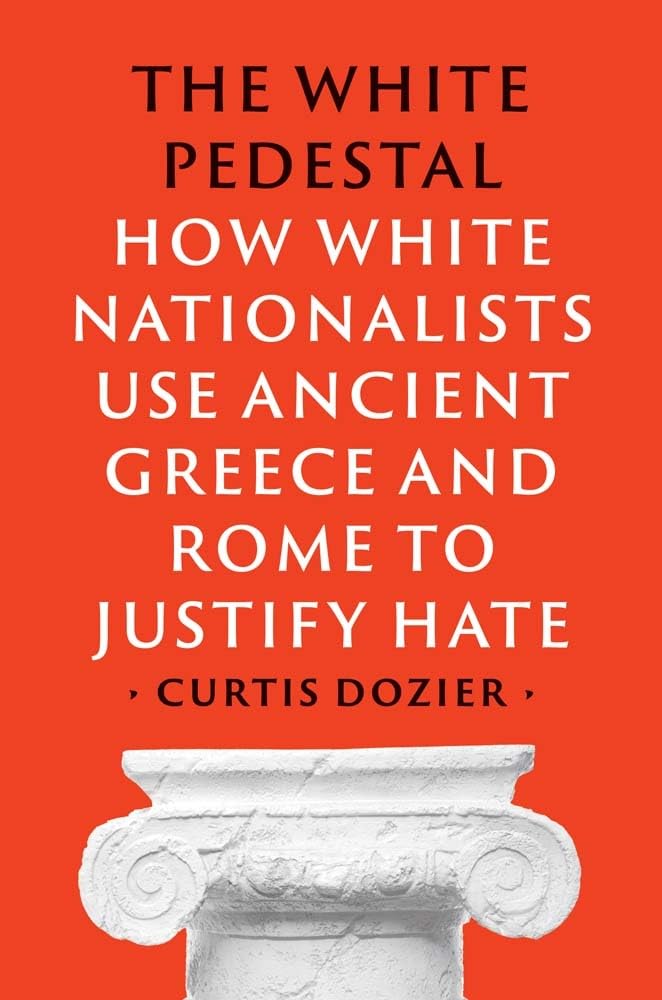
The White Pedestal: How White Nationalists Use Ancient Greece and Rome to Justify Hate
New Haven: Yale University Press, 2026
Curtis Dozier is one of my long-time academic stalkers. An associate professor of Greek and Roman Studies at Vassar College in New York, he is the director of Pharos: Doing Justice to the Classics, a website on which Leftist classics scholars bemoan “appropriations” of classical antiquity by “hate groups.” Naturally, my writers and I are all over Pharos and Dozier’s new book.
Pharos started strong in late 2017, but by 2021, it was clearly running out of steam. With the publication of The White Pedestal, now we learn why.
At first, Dozier’s mission was to indignantly repel “haters” as if the classics were a citadel of his own degenerate, anti-white egalitarian ideas:
When I announced the project, I promised to “detail the inaccuracies, omissions, and distortions” I found. I believed then that my job as an expert was to show that the historical reality of antiquity had to be distorted in order to support racism. (p. 13)
But eventually, it dawned on Dozier that the racists are right:
This is a book about just how suitable models from Greco-Roman antiquity are, in fact, for those who wish to promote abhorrently racist ideas. Greco-Roman antiquity’s reputation as a high point in European history has eclipsed the fact that some of the most widely admired figures in ancient literature and philosophy endorsed ideas that modern white supremacists share, and that the social and political realities of the ancient world provide models for political systems that contemporary white supremacists would like to establish in our communities. (p. 3)
It turns out that we aren’t just right, for Dozier finds a “disturbing depth and sophistication” in “a certain kind of white nationalist interpretation of Greco-Roman history” (p. 176). This came as some surprise, because like most liberals, Dozier thinks that people on the Right are uneducated:
The assumption that racists must be uneducated may lead us to expect to find distortion, misuse, and abuse of history in their writings. But what we actually find is much more disturbing. We find that they know much more about history than we give them credit for. They know, for example, that they do not need to distort or misrepresent the writings of many ancient philosophers and historians in order to find ideas in them quite similar to those that inform white nationalist politics. In this respect, white nationalist intellectuals often see the ancient world with clearer eyes than those who assume such interpretations depend on distortions or lies. (p. 25)
I may have played a role in Dozier’s change of focus. Take a look at his essay “The Fourth Year of Pharos: What is the Emotional Toll?” from December 17, 2021:
Greg Johnson, the editor-in-chief of Counter Currents, likes to quote Aristotle. . . .
One of the essays in which Johnson invokes Aristotle is called Truth, Justice, and a Nice White Country, . . . I haven’t been able to shake Johnson’s discussion of what he meant by “A Nice White Country.”
This, Johnson says, is what white nationalists want: “nice white schools, nice white suburbs, nice white churches, nice white restaurants and parks and playgrounds.” . . . it is these “revealed preferences” of white people that give Johnson hope for his white nationalist cause: “When whites finally wake up,” he writes, “to the fact that the system will no longer let us have a separate peace—that we can no longer run away to find nice white schools and nice white communities—then White Nationalism will be a political possibility.”
. . . Johnson’s essay about white people rising up against a more equitable society looks pretty prophetic. That realization—that Johnson might be right, and that his movement, which so many people continue to describe as “far right” or “extremist,” might actually have widespread support—takes a toll. But even more, as I look back over that same period from 2014 until today, I know I lived my life and I made choices, some of which subverted white supremacist ideology, but others of which fit the pattern that white nationalists like Johnson are depending on “normal” people making to fuel their movement’s continuing rise. Where to live. Where to go to school. Which park to play at. Where to eat. Where to go to church. How different, really, is the life I’ve made than that which people like Johnson expect me to make?
. . . working on Pharos affects me because it is painful to see myself reflected in Greg Johnson’s confidence that most white people like me—especially white liberals like me—lack the courage and conviction to give up some of our comfort, our wealth, our access to power, our confidence that we deserve what we have, our isolation from people and experiences that are different from ours, in order to create a more just world.
(I have quoted Dozier at length, but I recommend reading the whole article.)
Indeed, Dozier has gone from attacking White Nationalists for allegedly misusing the classics to attacking the classics because they are actually White Nationalist:
It was the patent racism of white nationalist treatments of Greco-Roman antiquity, combined with the learning and sophistication evident within them, that forced me to recognize the extent to which I had absorbed and maintained racist understandings not just of the ancient world but of my own. (p. 15)
Thus, The White Pedestal is “a book about the presence of white nationalist ideas in the Greco-Roman world, and the influence of such ideas on the way that history has been preserved, remembered, and interpreted” (p. 27).
So it turns out that White Nationalists have not “appropriated” classical civilization after all. Instead, it belongs to us by right. White Nationalists are the legitimate heirs of classical civilization.
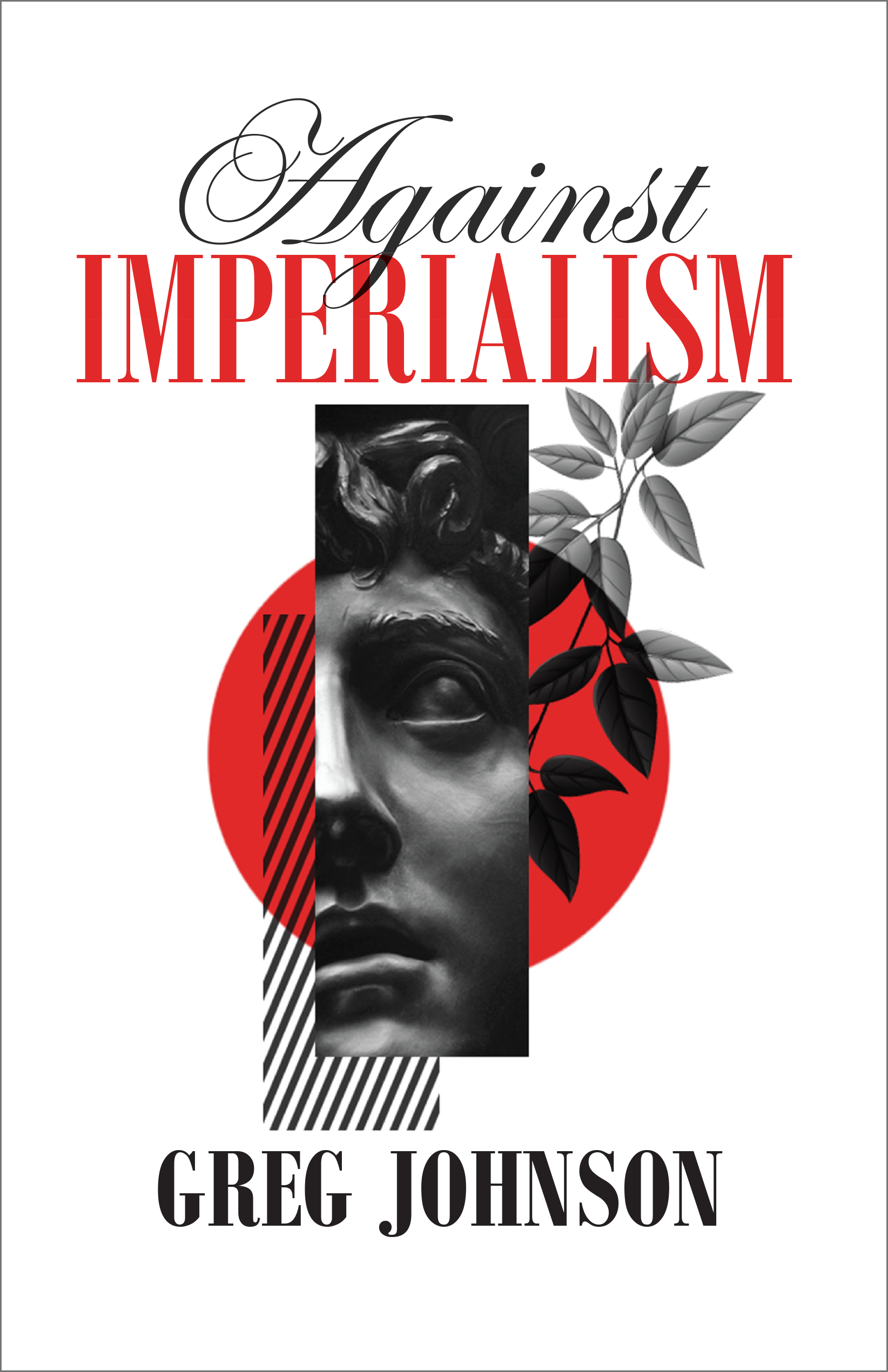
You can buy Greg Johnson’s Against Imperialism here.
But even I wouldn’t say that the Ancient Greeks and Romans were actually “White Nationalists.” Imagine what most of the Ancients would have made of my book Against Imperialism. You can construct a case for universal ethnonationalism from Ancient Greek philosophical and historical premises. I have done so. But such views were very much a minority viewpoint.
Or, as I prefer to think, they were ahead of their time. We can be critical of the Ancients, because in some ways we have advanced beyond them. The Ancients provide us with truths—as well as falsehoods. They offer us models of what to do—and what not to do. The one area in which the Ancients were not a mixed bag is aesthetics. But even there, we have improved upon the Greeks, particularly in music.
Of course, we can say that China and India provide us with food for thought as well. But there’s a difference: whether we love them or hate them, the Ancient Greeks and Romans are recognizably us. That cannot be said about China and India.
Personally, I regard Rome as more of a cautionary tale than a model for emulation. But the vices and follies and failings of Rome remain very much ours, whereas the excesses of Oriental civilization—the weird impersonalism, the hieratic petrification, the inhuman cruelty and chaos—remain alien and repulsive, not perennial temptations.
A Failure of Scholarship & Civility
The White Pedestal gets off to a very bad start:
A Note on White Nationalist Sources
White Nationalist Intellectuals Seek academic legitimacy by imitating the conventions of scholarly discourse in their publications. To cite these publications in the same manner that I would cite other scholarship would confer such legitimacy, as well as visibility. Therefore I do not cite publications from white nationalist websites in my notes. Interested researchers will be able to locate them from my descriptions.
There are three problems with this.
First, this is simply unprofessional. Scholars should cite their sources, otherwise, what is stopping them from simply making up quotes and facts? Yale University Press is a scholarly publisher. Presumably, they have standards of scholarly integrity. Thus they never should have allowed this. Vassar College is an institution of higher education. Presumably, they have standards of scholarship as well. Would Vassar allow a white male student to get away with not citing a liberal? If not, then why allow one of their faculty? Did this book contribute in any way to Dozier’s promotion or tenure? Frankly, Yale should pulp this book, and Vassar should censure Dozier for violating basic standards of scholarship and professional ethics.
A case in point: all told, I am mentioned 34 times in The White Pedestal, and Counter-Currents is mentioned 37 times. The latter number would be much higher if Dozier had deigned to actually cite the White Nationalist publications he quotes.
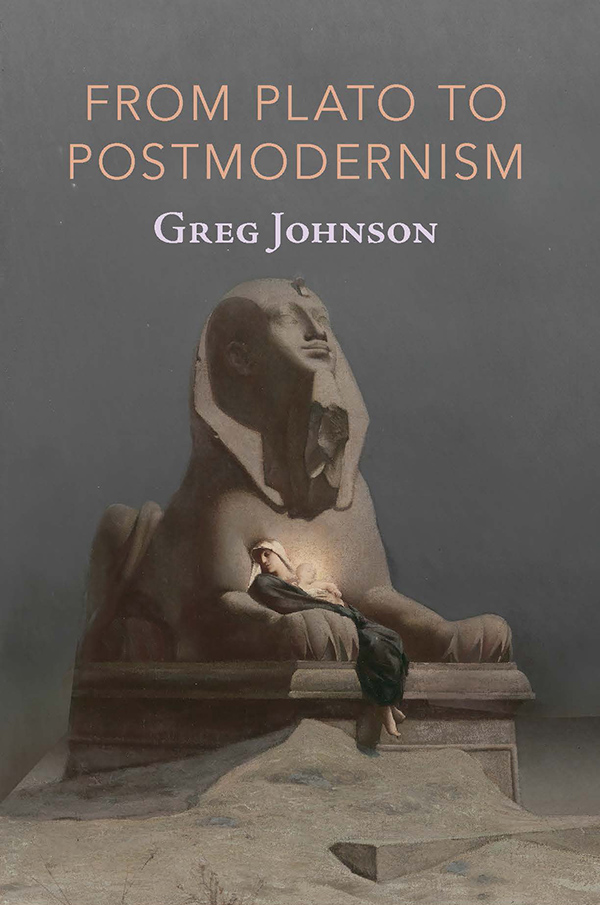
You can buy Greg Johnson’s From Plato to Postmodernism here
There is, moreover, something odd about the works Dozier chooses to cite by me: all of them were published before 2019. But in 2019, I published From Plato to Postmodernism. In 2023, I published The Trial of Socrates. In 2025, I published Tyranny and Wisdom: Plato’s Greater Alcibiades and Gorgias. All of these are certainly relevant to Dozier’s project. So why didn’t he cite them?
My hypothesis is simple: this book started as the Pharos blog, which Dozier lost interest in by the end of 2021. My strong impression is that this book is simply cobbled together from his blog research. If Dozier did essentially no additional research after 2021, then it would make sense for him not to cite my books on ancient philosophy.
It might also make sense for him not to cite White Nationalist sources, lest it become clear to his publisher, colleagues, and employers that he had stopped doing research years before his book was written. I seriously doubt that Yale or Vassar or the scholars who contributed promotional quotes would have looked favorably upon a book dealing with a current intellectual trend that doesn’t deal with the last five years of that trend.
In short, maybe Dozier is not citing his sources to cover up his own shoddy research. Frankly, every researcher who refuses to cite sources should immediately be suspected of fraud.
Second, Dozier’s gesture simply assumes that academia has an endless capital of “legitimacy,” a commodity that White Nationalists seek and that he can dispense or withhold. This is a very primitive, Leftist attitude: legitimacy is somehow just there, to be looted or hoarded. The question of how legitimacy is produced does not seem to have entered Dozier’s mind.
Academia only has legitimacy because it pursues and passes on the truth. One of the assurances of truth, however, is that scholarly works can be confirmed by outside reviewers. But this is only possible if scholars cite their sources. If Dozier doesn’t cite his sources, then he has no academic legitimacy to confer, and neither do Yale University Press or Vassar College or the people who have praised this book.
Third, Dozier’s gesture is deeply uncivil. Civility is how we deal with differences of opinion in the same political system. Of course, civility only makes sense if you envision continuing to live with people. Dozier evidently envisions a world in which White Nationalists do not exist. (See my essay, “Civility and its Discontents.”)
A Puzzling Mishmash
Dozier’s first chapter, “The Who and the Why of White Nationalist History” begins with . . . Tucker Carlson, being fired from Fox after promoting a “conspiracy theory” (p. 16) called the Great Replacement created by French writer Renaud Camus. Moreover, as Dozier solemnly reports, the Great Replacement was referred to by Brenton Tarrant, who slaughtered a bunch of Muslims in New Zealand.
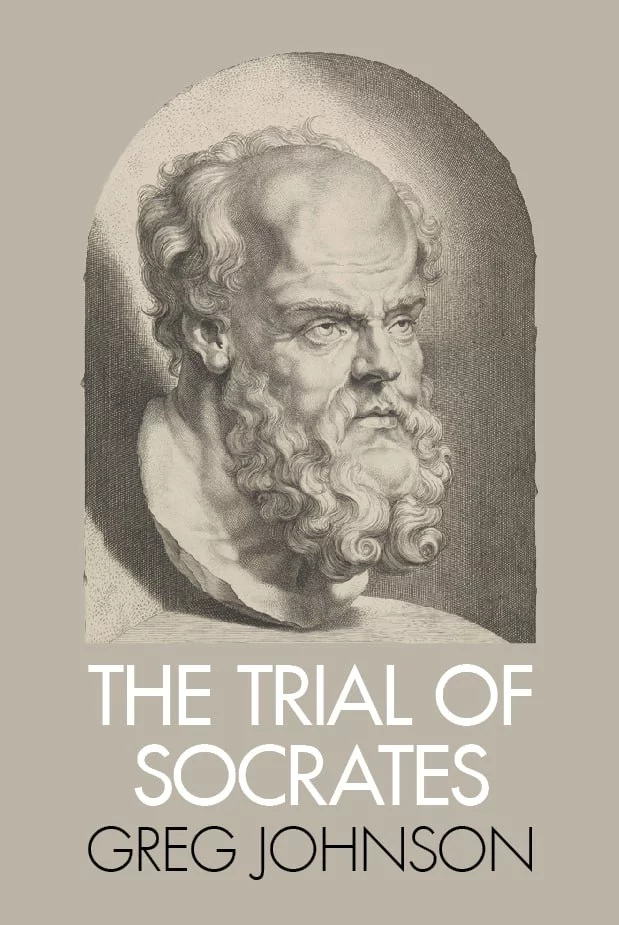
You can buy Greg Johnson’s The Trial of Socrates here.
Why mention any of this in a book on White Nationalism and the classics? Camus does refer to Plato, but it has no real connection to the Great Replacement as an idea, much less Tucker Carlson, much less Tarrant and his killing spree. The lurid opening is simply dictated by the nature of the book, which is a smear job.
The rest of the chapter surveys a number of White Nationalist and broadly New Right thinkers who deal with the classics, some quite tangentially: Dominique Venner, who was a great admirer of Homer; Alain de Benoist, who worked with Venner; Revilo Oliver, who was an actual classics professor, although it had precious little to do with his political work; George Lincoln Rockwell, who has nothing to do with the classics but created the American Nazi Party, which sounds scary; William Pierce, who had a Ph.D. in physics and opinions on the ancient world (of course Dozier also mentions the Oklahoma City Bombing); Kevin MacDonald, Editor of The Occidental Quarterly, which has published on topics related to classical antiquity; and Jared Taylor of American Renaissance, which uses an Ionic column in its logo. (Perhaps VDare would have received more attention if they had bought a neoclassical mansion rather than a medieval castle.) I am also mentioned in this chapter, as is Counter-Currents. Enoch Powell, Ricardo Duchesne, Costin Alamariu, and F. Roger Devlin all have Ph.D.s and have written about the classical world, but they are not mentioned until later chapters.
Dozier devotes a section to classical discussions of the Jewish Question, remarking that “White nationalists are able to muster such an impressive range of sources because they know how to do their research” (p. 30). Then he mentions Robert Bowers, the gunman who attacked the Tree of Life Synagogue outside of Pittsburgh. This is Dozier engaging in what Orwell called “crimestop.” The Bowers attack is tossed in lest Dozier—or his readers—start thinking seriously about what the ancient Greeks and Romans said about Jews.
The whole chapter is a lurid, hare-brained mishmash which gives the impression that it wasn’t so much written as simply dragged and dropped.
Chapter 2, “The Last Stand Against Modernity,” deals with classical warrior virtues. Naturally, it begins with the “insurrection” of January 6, 2021. Dozier devotes a few pages to my discussion of thumos (pp. 45–47). Perhaps I flatter myself, but I detect an undertone of grudging respect.
Chapter 3, “Predicting the New Dark Ages,” deals with White Nationalist discussions of the decline of Rome, which we of course use as a heuristic for understanding our own decadence. Dozier grants that “white nationalist intellectuals may not be far off base in granting Gibbon pride of place in their list of historians who provide legitimacy for their positions” (p. 74).
Chapter 4, “The Descendants of Achilles,” deals with claims about the whiteness of the Greeks and Romans and the continuity of white civilization from antiquity to the present. Dozier, like most Leftist academics, repeats the imbecilic mantra that race is “pseudoscientific” (p. 5), which makes possible such pronouncements as, “White nationalists know that the reality of genetics obliterates their claim to share a racial identity with the ancient Greeks” (p. 91). In truth, racial differences are obvious to prescientific experience, which remains valid even though scientific explanations of these experiences might come and go with time. (See my essay “Why Race Is Not a Social Construct.”)
Chapter 5, “The Prometheans,” is another strange mishmash: less a composition than a car crash, a forty-car freeway pileup in prose. The chapter begins with some inchoate hand-wringing about classical architecture. Basically, Dozier is struggling with the question, “How can I like classical architecture, given that Donald Trump likes it?” Indeed, classical architecture is “the preferred style of dictators such as Adolf Hitler and Benito Mussolini” (p. 111). Sure, but classical architecture was also the preferred style of people like Stalin as well. So what does this have to do with the aesthetic value of classical architecture? Dozier seems haunted by non-white anti-colonial voices who are neurotically triggered by classical architecture. He needs to just ignore them.
The chapter then leaps to F. Roger Devlin’s review essay on The Landmark Herodotus, which I commissioned back when I edited The Occidental Quarterly. Dozier, however, refuses to cite the original article’s source. He even refuses to use Devlin’s name, which is an uncivil touch. He does, however, grant that his “understanding of Herodotus has been the dominant one” (p. 119). Namely, Devlin emphasizes Herodotus’ contrasts between Greek and Oriental civilization and politics.
After that, the chapter jumps to Richardo Duchesne’s articles on the foundational importance of the Greeks for Western civilization. Dozier grants that Duchesne is also in harmony with most classical scholars.

You can order Greg Johnson’s Tyranny and Wisdom here.
Then Dozier discusses ranking civilizations, hopping around from Charles Murray to the Council of Conservative Citizens to Andrew Anglin to Francis Galton and eugenics, finally lighting on . . . Graham Hancock, who peddles genuinely pseudoscientific speculations about ancient civilizations and myths like Atlantis. Dozier solemnly declares that the vast literature on Atlantis “may seem to be nothing more than harmless quackery” but he detects that “the assumption of white supremacy lurks at its core” (p. 132).
Chapter 6, “The (Un)Natural Order,” deals with the idea of natural hierarchy in Greco-Roman thought. Naturally, the chapter begins with the Unite the Right rally in Charlottesville, Virginia, in August of 2017. After all, Unite the Right was about saving a Confederate monument, and antebellum Southerners loved classical columns and literature. Also, some of the protesters emblazoned themselves with SPQR and the fasces.
One of these young men was James Fields, Jr., who will die in jail for killing a protester in a car accident in the chaos following the Unite the Right rally. Dozier, however, pointedly does not mention his name. Nor does he mention the name of Dylan Storm Roof, who killed nine blacks in Charleston, South Carolina, in 2015. Roof also liked the Confederacy and thus, presumably, Greek columns as well.
These deaths are mentioned because, “The presence of classical symbolism at the Charlottesville rally illustrates how the work of white nationalist intellectuals such as that published by Counter-Currents informs the actions of violent white nationalist activists in the real world” (p. 138).
This is disgusting dishonesty. What, exactly, is he insinuating here with the weasel word “informs”? Dozier gives absolutely no basis for believing that Fields or Roof ever read Counter-Currents. Nor does he offer evidence that they were influenced by Counter-Currents. Moreover, if they had read Counter-Currents, Fields would have stayed away from Unite the Right, and Roof would not have shot a bunch of people, because I explicitly warned people away from Unite the Right, and I explicitly condemn terrorism.
But apparently to Dozier’s mind, what I actually said pales in probative value compared to the fact that I write about Socrates, and James Fields carried a shield with a fasces, and Dylan Roof liked the Confederacy, and those are all somehow linked together by Greek columns. Frankly, this smacks of paranoid schizophrenia . . . or pandering to it.
There is a tone of paranoia and near hysteria throughout The White Pedestal. Imagine Dana Carvey reading this in his Church Lady voice:
. . . if the investigation this book offers seems grim, joyless, and exhausting, and if you find yourself yearning for one of the countless books about how exciting, impressive, or inspiring the ancient world is, bear in mind that that’s what the white nationalist movement expects you to do. In fact, it’s what they need you to do, because they need the Greco-Roman world to retain the prestige they seek to harness in support of their hateful politics. (p. 12)
Dozier is unintentionally funny when he describes “Identity Evropa, the white nationalist organization that terrorized college campuses with posters featuring classical sculpture” (p. 139). Contrast this with Dozier’s reference to the “overwhelmingly peaceful Black Lives Matter movement” (p. 122).
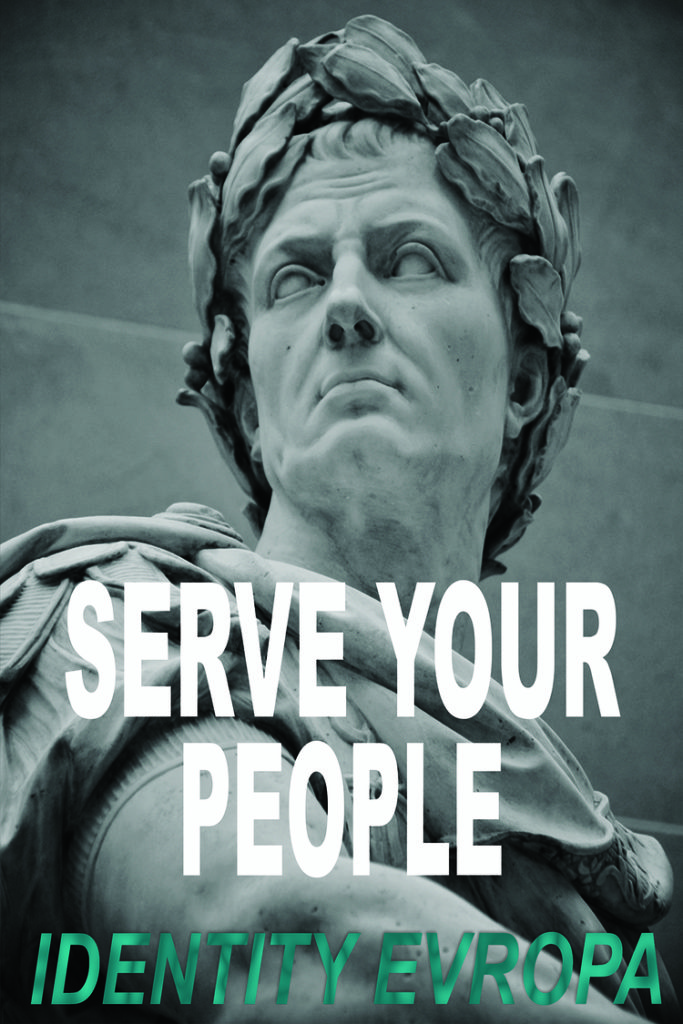
 Chapter 7, “The Dream of a White Homeland,” hovers vaguely and inconclusively around classical ideas connected to diversity and homogeneity.
Who Are the Guardians of Classical Civilization?
Dozier’s “Conclusion: Taking the Classics Forward” is a call to make academic classics programs even more politically correct, since the classical world and its legacy are so far out of step with the radical egalitarian ideology that grips today’s academy.
Dozier, of course, thinks that all people are basically equal. Thus all inequalities are merely socially contingent constructs that can be done away with by reeducation and social engineering. So nothing bad can really happen to classical studies by promoting more diversity: i.e., highlighting non-whites in classical history, trying to appeal to non-white readers and students, and promoting women and non-whites into the classics profession.
There are two problems with this.
First, all of these efforts at diversification are accompanied by lies. Leftists don’t just seek out “diversity” in our past. They simply fabricate it. Does Curtis Dozier have the guts to tell Afrocentrists that, no, Greek culture was not stolen from Egyptians and that, no, the Ancient Egyptians were not black? If so, then he is not a trustworthy guardian of our classical heritage.
Moreover, the promotion of women and non-whites in academia has thoroughly corrupted every discipline, for you can’t hire the best man for the job if you have a competing qualification, namely diversity. (See my essay “How Diversity Destroys.”)
Does Curtis Dozier have the guts to uphold professional standards when women and non-whites seek scholarships, jobs, and promotion? The answer is suggested simply by noting that he approvingly quotes the wisdom of Ibram X. Kendi (p. 15).
The second problem is much more fundamental. What if people really aren’t equal? What if different races and cultures really are different? What if we see ourselves in classical civilization because it really is ours? What if it fits us because we created it, and it created us? What if non-whites don’t see themselves in classical civilization because it isn’t the sort of civilization they would create for themselves?
What if “white privilege” just means that white people have created a civilization that we find comfortable for us, just as “Japanese privilege” means that Japanese society is an expression of the Japanese people? If so, that entails that other races inevitably find our civilization uncomfortable, just as non-Japanese will inevitably feel out of place in Japan. (See my essay “The Very Idea of White Privilege.”)
If races and civilizations really are different, then we cannot carry forward our classical heritage by trying to appeal to the sensibilities of non-white students. Nor are non-white faculty reliable guardians of our classical heritage, because on some deep level, it will inevitably feel alien to them, because it really isn’t theirs.
This is why I have long maintained that not only are White Nationalists the legitimate heirs of white civilization, but we are also the only people who can preserve it and carry it forward. Modern academia, by contrast, is anti-white and thus incompatible with the survival of our civilization. Many academics are actively anti-white, while others are merely too weak to oppose the destruction of our civilization. Thus for White Nationalists, true regime change requires more than just a new government. It requires a complete purge of anti-whites and their enablers from academia and all other institutions that shape the culture.
Along with its lapses of civility and taste, The White Pedestal contains a number of simple factual errors. For instance, F. Roger Devlin has a Ph.D. in philosophy, not political science (p. 117). William H. Regnery II is correctly referred to as the nephew of the founder of Regnery Publishing (p. 24) and incorrectly referred to as one of the heirs of the Regnery Publishing fortune on p. 87. The latter error is quite common in “anti-hate” literature, and the fact that it appears alongside the truth reinforces the idea that this book was hastily cobbled together from blog posts written at different times. Dozier also claims that Counter-Currents celebrates Enoch Powell’s birthday every year (p. 55). We don’t, but I will take it under advisement.
The White Pedestal is useful for White Nationalists simply for the grudging respect Dozier offers us. Dozier has weighed the evidence and declares, against his personal interest as an academic classics scholar, that Ancient Greece and Rome are more aligned with White Nationalism than the academic Left.
Of course, this only matters if we take Dozier, Yale University Press, Vassar College, and academia in general seriously as authorities. But Dozier himself makes that impossible by completely abandoning basic scholarly standards. Thus I cannot recommend The White Pedestal. It is a despicable intellectual performance and a miserable read.
54 comments
This is a good and witty review of a bad book. A good book cannot be written if the author approaches the work with malicious intent. If the author does not cite sources correctly and transparently, he is a coward and a fraud.
I believe that if a reader wants to read what white nationalists have to say about classical civilization and classical art, they would be better off reading original white nationalists like Greg Johnson and F. Roger Devlin on Counter-currents website rather than this politically correct, weak mishmash.
Thanks, I had fun with it.
Dozier appears to be a typical specimen of the leftist academic. Shallow and propped up by a corrupt academic establishment, he can only point and babble at his intellectual and moral superiors.
The same thing has been happening in medieval studies for many years. I remember an entire issue of a scholarly journal that was devoted to the topic of how to prevent the “far right” from exploiting medieval symbolism.
It is a way for scholars to feel relevant and virtuous and get points for political correctness. There are also much lower standards for such articles, because the are “for the cause,” and who would bother to check them much less demand fairness? There are now academics who make careers of essentially hate reacting to blogs and livestreams.
After many years writing about academia for Conservative Inc, I have increasingly developed a hope–and expectation–that the academic mainstream will suffocate from smelling their own farts and thinking they imbibed brilliance. The practice of not accurately citing sources or providing research results that can’t be replicated has become commonplace. People with degrees from elite schools just assume that their work will go unquestioned as long as they support the prevailing theories. The higher up in that world you go–the Ivy League, etc–the more common are such deceitful practices (although proper methodology is nonexistent at the bottom, such as at the HBCUs).
I think of Nathan Cofnas mocking Kevin MacDonald for teaching at a second- or third-tier public university–but such unheralded schools are where you are more likely to find scholars who conduct important social research today, since they are further away from the rigid control and grooming of the elites. Red state public universities are becoming superior to the elite schools, since they are answerable to the voting public and must maintain some standards. I also hope that new, small institutions will emerge from the right-wing blogosphere that truly support freedom of inquiry.
I think of Nathan Cofnas mocking Kevin MacDonald for teaching at a second- or third-tier public university–but such unheralded schools are where you are more likely to find scholars who conduct important social research today,
Right. Jews, even more ‘based’ Jews, or anti-Zionist Jews are obsessed by educational institutional rank and prestige. This is how they understand the world. Very flawed and they don’t know it.
Cofnas is now in a postdoctoral position in Ghent University. It is a long way down from Cambridge. Thus, his work has been discredited, and he is now a marginalized crank. See how that works?
Haha exactly Greg. Great article.
A recent example of this I noticed was an article published in Compact a few months ago titled The Return of the Jewish Question. The article is written by a Jewish college professor, and talks a lot about the work of Kevin MacDonald. The author writes:
“Kevin MacDonald, a former professor of psychology at a second-rate state school who wrote a dissertation on wolves, and low-level Hill staffers, it is true, have figured it all out. But the greatest minds of the West, including the greatest minds on the right, somehow missed it all. And they still refuse to see it.”
This argument would seem odd for a self-proclaimed conservative to make – after all, the most esteemed professors in the West are overwhelmingly liberal, so this appeal to authority actually calls into question the author’s own intelligence. Why is he a conservative when all the smart professors at Harvard are liberal? Is he just less intelligent than them?
That was indeed the aforementioned Nathan Cofnas who wrote that about MacDonald. As for the “greatest minds,” it is likely that:
1. They are so not great they couldn’t find a turd in a full septic tank.
2. They are cowed into silence by fear for their careers, and therefore not all that great.
MacDonald not only had the brilliance to see the importance of uncovering the truth about Jewish influence, but the courage to say it publicly. Can’t have somebody like him at Harvard–cow colleges only.
Cofnas’s conservatism was secondary to his Jewish nationalism. He accurately claims that low black IQ is hereditary, but then says that Jewish dominance is due solely to their high IQs and their tendency to move to centers of power. No nepotism or corruption–nothing to see there.
It might be interesting to write an article about what kind of ethos a far-right university for white nationalists should have. What principles would such a university follow, how should it operate, and so on? Plato founded the Academy of Athens, which was the first type of university. Perhaps Greg Johnson will found a new type of university for the Golden Age. Already on CC, we are better able to cite original sources accurately and truthfully, and we seek the truth more effectively than most Western universities. This is a major topic.
Interesting idea
Good essay, but I think any person who truly understands and loves the classics is already one or two clicks away from being a raving white nationalist, simply by virtue of the cognitive qualities involved.
I think so too. I want to read more about Plato, his teachings, and his life. And eventually, I’d like to explore his secret teachings as well. He was a true Master of philosophy.
What are the secret teachings?
These are advanced concepts in mathematics, existence, philosophy, and metaphysics that should remain hidden from ordinary people. Only those who study philosophy should be privy to them. That is why it is a secret teaching. I personally know only a few people who are familiar with this.
Are you talking about the “dark side,” and learning how to shoot lightning bolts out of your fingertips? If not, what is so important about keeping this knowledge secret? 🙃
do you mean by that some sort of esoteric reading of Plato? I know the esoteric language of the Jews, which I hope to impart to a disciple one day. It’s hidden in plain sight, but requires an IQ 160 to comprehend. No goy can comprehend it fully.
These matters are no laughing matter. You would have had to know Plato’s life story and the era in which he lived in great detail. If you possessed this secret knowledge, you would have come into conflict with the metaphysics, religious beliefs, and moral standards of the time. As a reminder, look up exactly what Socrates was sentenced to death for.
@Ondrej Mann
Are you a Sith Lord? 🙃
@DarkPlato
I know the esoteric language of the Jews, which I hope to impart to a disciple one day. It’s hidden in plain sight, but requires an IQ 160 to comprehend. No goy can comprehend it fully.
So, are you saying that you are a jew, and that you possess an IQ which exceeds 160? 🙃
At least he is an arrogant Jew who despises “goys”.
Great article, Dozier not only reeks of paranoia, but of jewishness, which is the same thing. 🙃
He isn’t Jewish, though.
Is he black? The only other Dozier I’m aware of is the very black Lamont Dozier.
He is white.
That is an interesting perspective. I put the name Dozier into a Google Image search and got a lot of Sportsball Negroes that I had never heard of.
However, Dozier is a German or French surname, and like Jefferson or Smith has been coopted by a lot of formerly-enslaved Sub-Saharan Africans.
If you search for “General Dozier” instead, you will get at least three possibilities, none of them Darkies.
The name “Dozier” specifically reminds me of U.S. Army Major General James Lee Dozier, a NATO official who in late 1981 was kidnapped from his apartment in Verona, Italy by the Red Brigades until rescued six-weeks later by an Italian special operations police unit.
“To date, he remains the only American flag officer ever taken prisoner by a violent non-state actor.”
https://en.wikipedia.org/wiki/James_L._Dozier
General Dozier was a West Point graduate with a Masters in Aerospace engineering from the University of Arizona. Dozier had gone to Armored school and Ranger school, and had been awarded a Silver Star and a Purple Heart in Vietnam as part of an armored cavalry regiment.
I don’t know if he loved the smell of napalm in the morning, but he wrote an inspirational memoir on the fortieth anniversary of his Anarcho-Communist abduction called Finding My Pole Star, although I have not yet read it.
https://frontedgepublishing.com/finding-my-pole-star/
General Dozier retired from the Army in 1985 after thirty-five years, and is still alive today at the age of 95.
🙂
This is in reply to Proteus below.
Clarence Thomas may be a Catholic now; and from that position somehow manages not only to be a legit Conservative — which is not the same as White advocacy, by the way — but to not sell out his own race at the same time. Avoiding race treason, however, is simply beyond the capacity of degenerate Whites such as Curtis Dozier. Consequently, we can feel free to embrace non-Whites like Thomas while being satisfied to leave Whites like Dozier to the wolves.
But I mentioned Thomas’s Catholicism. It is my view Whites are not an especially degraded race who betray our own with more enthusiasm and frequency than other races. What White people are is the longest-suffering victims of Christianity. We have been in sustained contact with the mind virus for millennia longer than any non-Whites. It is a deep and profound wounding in the European soul. Dozier even seems to have picked up on this fundamental aspect of our history in his outlook, by describing himself as Christian. We should be more diligent in recogning the effects of Christianization that endure unto the present day. Thomas is only aping White norms. And, black-on-black violence on any given weekend in Chicago furthermore completes the picture in regard to the capacity of blacks for destruction of their own.
Dozier is going to end up going crazy like a Lovecraft character who realizes he’s tainted by eldritch forces.
This puts me in mind of the phrase “settled science” that I’m pretty sure came into vogue during the peak of the climate change hysteria of the early 2000s. Journalists who cover the “science beat” and fancy themselves some kind of experts (because they spend their time interviewing leftist academics for their articles) coined that term to delegitimize any and all dissent or disagreement, no matter how nuanced.
Somehow, the “end of history” that we supposedly entered into was also the end of intellectual inquiry, where consensus, 50+1, was all it takes to establish a fact. In other worlds, the democratization of truth.
So with anything related to race, it’s a settled matter, put to rest by the Civil Rights bills that made water fountains and restaurants integrated spaces. 50+1 people said it’s so, so it’s so. We are all exactly the same, only a little more or less melanin. Settled Science baby!
Deliciously mean to Dozier. What a buffoon. I thoroughly enjoyed every word.
Thanks. Sometimes, this material just writes itself.
I once saw some Jewbag on X say “Lord, please send me better anti-semites to argue with”
When I read this I thought “Lord, please send us better anti-Whites”
Yes, sometimes I wish for more interesting enemies. But that would just postpone our victory. So, in the end, I rejoice at the low caliber of our opponents.
I don’t understand how somebody who knows we’re right can still not be a white nationalist. Does he fear losing his academic job? Is he just a coward? Most people either agree with us in their hearts, but can’t articulate why, and don’t have the knowledge to disprove liberals, or they lack knowledge and subsequently disagree because of that lack. But how can a man who understands that his very profession is aligned with our politics not take a moment to consider whether we’re right? Before i finished this article, i thought, “look at that! He’s just one bad experience with DEI away from being a white nationalist”, but by the end, i was dumbfounded by his inability to critically think. There are some people who just have to be told what to think, and they’re usually the smartest.
Along with its lapses of civility and taste, The White Pedestal contains a number of simple factual errors. For instance, F. Roger Devlin has a Ph.D. in philosophy, not political science (p. 117). William H. Regnery II is correctly referred to as the nephew of the founder of Regnery Publishing (p. 24) and incorrectly referred to as one of the heirs of the Regnery Publishing fortune on p. 87. The latter error is quite common in “anti-hate” literature, and the fact that it appears alongside the truth reinforces the idea that this book was hastily cobbled together from blog posts written at different times.
These stink of AI errors. When someone is known 95% for X it bleeds over to 100%, which is assume what it did with confusing Devlin’s politicized racial and gender writings for his entire output. The disproportionate association with one swamps out the other, these models operate off of probability. I wouldn’t be surprised if the author wasn’t just rehashing old blog posts, but he was using AI to build the frame and then manually filled in the gaps.
Liberals are correct that there were some people in the past that railed against the conception of ethnic particularism. But they were the minority and were, quite frankly, morally unscrupulous. These were always the ruling elites that wanted to entrench their own power. The corrupt feudal lords in medieval England often brought in German and French mercenary companies to suppress rebellions or fight feudal conflicts, specifically because these people had no local ties and hence no local loyalties, and would fight with brutality. The presence of jews in Europe at the time is explained by the same phenomenon. They were carried into England by the conquering Normans specifically because they’d be brutal with their taxation and administration, they were brought in right as the genocide occurred with the harrowing of the north. It’s not just that the conception of ethnic identity in the past was mainstream, felt and well understood, it’s that the people in the past who did their best to minimize it and blur distinctions almost universally had nefarious and self serving motivations. The struggle of ethnic nationalism and resisting homogenizing forces existed in the past, and we had the same sort of villains back then that we have today.
David Zsutty asked me if I think Dozier used AI. Honestly, I don’t think so. I think AI would have done a better job.
They were carried into England by the conquering Normans specifically because they’d be brutal with their taxation and administration, they were brought in right as the genocide occurred with the harrowing of the north.
Could we infer from that precedent that those Norman vices were carried through colonialism to the New World and influenced the elite’s choices regarding immigration?
You know, I’m always amazed. My exposure to philosophy at all, comes from the right, and in particular this website.
It’s funny to me, later on, when I come across some centrist liberal who talks about exactly the same material, but thinks it’s there to uphold centrist libtardism. lol
I think there must be a lot of silly thinking in this area in general.
But this guy sounds like a moron being dragged around by institutional incentives to me. As long he’s in line with incentives it must be ‘good’.
Man, what a thrashing. In the immortal words of David Brent, “I think there’s been a rape up there!”
It gives me pleasure to think that Dozier might be reading this, and see himself revealed. But he might not recognize himself in this article. These people seem incapable of self-knowledge.
There’s a good chance. I really hope his academic administrators, rivals, and worst enemies are reading it too, and opening a file. I hope the Trustees of Yale University Press and Vassar Collage are opening files too.
Greg, you mention Dozier’s reference to the “overwhelmingly peaceful black lives matter movement.” This is a sure sign that not only is he not a true academic, but in fact is incapable of original thought. Not because he supports BLM, but because he is reproducing verbatim the elite-suggested phrasing.
When I worked in academia, I was astonished by how often my liberal colleagues would all suddenly want to discuss the same thing. And it was not that they were sharing ideas, but that they were using the exact same words. And this happened not in group meetings alongside each other, where you would reasonably expect groupthink to occur, but in independent discussions. They would always share this stuff in a self-satisfied way, clearly thinking it was a novelty take.
It was uncanny to me, as if everyone was on an email blast giving them that week’s libtard talking points. “Overwhelmingly peaceful” is a classic example of this.
The Pharos site has land acknowledgements. These people are beyond parody. They all talk like they belong to a religious cult, or their children are being held hostage by terrorists. In a way, both are true.
“The Pharos site has land acknowledgements.”
True enough, he gives a shout out to the Munsee Lenape people who were there for thousands of years before the White Man arrived. They were doing nothing of importance but they were there, and now they finally get their due.
Nothing Vassar has done can compare to the kitchen middens and oyster shucking piles of the Munsee Lenape.
Emergent behavior. Even though they didn’t need to meet beforehand to synchronize their beliefs they still ended up producing the same output. All they needed was interacting with the same information ecosystem and belonging to the same social class which selects for similar types of people. Since brains always look for shortcuts, why bother re-phrasing the Narrative instead of repeating it verbatim? This is why the leftist consensus resembles a hive-mind. People instinctively tuned into the ideological frequency, the media serving as broadcast nodes, in-group status as regulator of the behavior. No need for a central unit that produces the propaganda. It emerges from elite interactions and is relayed to people who act as repeating stations without any self-awareness. Its hard to even call it copying because there is really no original to trace to as the media are a part of the same dynamic.
It’s mostly cynical opportunists who copy as they lack the ability to surrender their individuality to the consensus.
At first he laments that ethnonationalists were correct about their discourse regarding the classics but then says
“White Nationalist Intellectuals Seek academic legitimacy by imitating the conventions of scholarly discourse in their publications”
Apparently people like Greg are so good they can merely pretend to be scholarly and still end up with the correct conclusions. Curtis, you’ve already ceded your entire area of expertise that you’ve spent so much of your life on to the ethnonationalists – just give Greg the W already, as the kids would say.
I mean how petty…
It really is silly that these people have abused and debased academia with political correctness for decades but still think that it has an enormous, inexhaustible fund of credibility and prestige to confer.
I thoroughly enjoyed every word of this article and your trenchant takedown of this academic huckster, Greg. It disturbs me to the very depths of my soul that pusillanimous shysters like Crozier have the official imprimatur over classical studies rather than someone like yourself. The classics and classical civilization are ours, damn it, and merit pride of place in any White ethnostate. The only consolation I have at present is that the knowledge of the perfect compatibility of White identitarianism with the classical world and ethos must be eating Crozier alive. May it fester in his equality-besotted mind.
Just 20 years ago, there were still many “bubbles” and “loopholes” at universities where sensible and truly educated people could hold their ground. But paradoxically, opening universities to large numbers of students from the lower middle class led to a rapid shrinking of the space for the classic type of scholar. Today’s mainstream academia selects candidates based, first, on conformity and, second, on liberal narcissism. Another criterion is quantitative performance and bureaucratic management in a purely corporate style. As a result, university departments today are full of crude, half-educated careerists, midwit conformists and woke spiteful mutants. Meanwhile, a few normal people remain, though they constantly fear for their existence in a system whose very logic dictates their elimination. People from outiside -unfamiliar with that environment can hardly imagine how bad it is.
Very well said.
Very well put. I’ve had the same experience.
If you have a Subscriber access,
simply login first to see your comment auto-approved.
Note on comments privacy & moderation
Your email is never published nor shared.
Comments are moderated. If you don't see your comment, please be patient. If approved, it will appear here soon. Do not post your comment a second time.