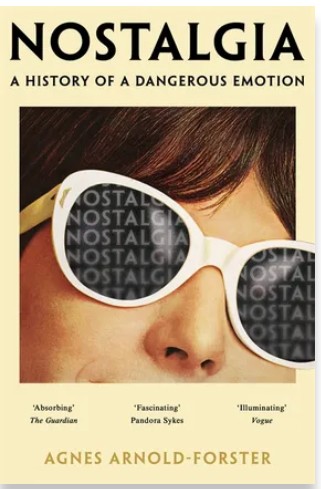
How appropriate she has black-tinted glasses rather than pink- or rose-tinted ones.
1,737 words
Proust had his madeleine. I had my blancmange.
Browsing online lately, I came across an infant joke-collection I had once owned as a child. Called The Pink and Wobbly Joke-Book, and sporting a cartoon image of a large strawberry blancmange with eyes and grinning mouth on the cover, every last joke within related invariably to the twin concepts of pinkness and/or wobbliness. Most were complete rubbish, along the lines of “What flies and wobbles? A jellycopter!!!”, but there was one which did actually make me laugh, at the time: “What’s pink and wobbly and belongs to granddad? Grandma!”
Recalling this joke suddenly made me feel profound regret, not merely for a lost childhood but, more substantially, for the lost world within which that childhood took place. Looking it up, I find the book was originally published in 1990, the United Kingdom having been deconstructed so completely in the 36 years since that even my favorite gag from it could no longer have been safely published anymore for a number of distinct separate reasons.
Heimat Is Where the Heart Is
Are such feelings racist? There are trends afoot right now to pathologize feelings of nostalgia for a vanished past—at least for white people. The very notion of nostalgia was originally conceived of as being a kind of disease in and of itself, as shown by contemporary Left-wing scholars like Agnes Arnold-Forster in her suggestively titled 2024 book Nostalgia: A History of a Dangerous Emotion. The term was first coined by Swiss physician Johannes Hofer in 1688 by combining the Greek roots nostos (homecoming) and algos (pain), and used as a diagnosis to be applied to those like soldiers, travelers, or migrant workers from the countryside to the big city, who, once away from home for long enough, began to suffer a pathological homesickness so severe it could lead not only to depression, but even death.
You can buy Greg Johnson’s Truth, Justice, & a Nice White Country here
However, by the twentieth century, the condition became pathologized in a different way by the new Mitteleuropean school of psychoanalysis. As the doctors who dominated this field were largely creatures of the big city themselves, they patronizingly questioned why anyone sane would ever wish to return back to what they saw as being the primitive toil and squalor of the countryside they were spawned in. Conclusion? The whole idea was quackery! Unlike Freudian psychoanalysis, of course. . .
Today, no reputable therapists consider nostalgia as being a full-blown medical disorder at all. Instead, explains Agnes Arnold-Forster, with immense condescension:
These views, while no longer held by therapists or psychologists, are still prevalent in political discussions about nostalgia … In 2016, for example, nostalgia was invoked as an explanation for two major electoral events: the presidential success of Donald Trump and the Brexit vote. But when journalists and critics used nostalgia to explain these cataclysmic [sic] geopolitical moments, they all too often deployed it as a kind of diagnosis – something to explain away seemingly wayward or irrational political decisions. As the historian Robert Saunders put it, in reference to Brexit, the debate marked out the Leave vote as ‘a psychological disorder: a pathology to be diagnosed, rather than an argument with which to engage.’
Funny, that’s how I feel about “progressivism,” the direct temporal-reverse political mental disorder, in my opinion.
Stranger Things Have Happened
Anything white people have a fondness for from the past is now automatically labelled as “racist,” no matter how innocent it may be. Being a child of the 1980s, I have great affection for the 1984 sci-fi comedy Ghostbusters, my favorite movie as a kid. Until recently, I thought that what I liked most about this film was all the ghosts in it, and the way they got busted. Now I am informed by better-knowing non-white nostalgia critics that what I really liked about it was the way the sole tokenistic non-white Ghostbuster, [1] Winston Zeddemore, was only incidentally black, and submissively conformed to white social and behavioral norms throughout the storyline.
For today’s Leftists, nostalgia for Ghostbusters is not the sole preserve of conservatives, but also of liberals. The manner in which Zeddemore unthinkingly goes about his business conforming to the ways of whiteness by holding down gainful employment shooting magic beams at Slimer and the Stay-Puft Marshmallow Man rather than engaging in constant acts of 2020s-style race-Marxism supposedly makes him an emblem of the old-style liberal notion of race-blindness too.
This is also what accounts for the contemporary popularity of the 1980s-set supernatural-themed TV serial Stranger Things, whose childhood heroes dress up as the Ghostbusters in certain episodes: it is nostalgia for the outmoded racial settlements of the past, allegedly.
A more sensible way of explaining the current popularity of nostalgic 1980s-set TV shows like Stranger Things may be that many real-life 1980s kids are now in their forties and settled down in life, with enough disposable income to make them an audience worth targeting. The whole trend is a simple money-making exercise, not a subliminal expression of mass social desire to return to the days when Winston Zeddemore, not George Floyd, was a role-model for black youth and whiteness the unquestioned American and European norm.
Make America White Again!
During the 2024 US presidential election campaign, some academics began to see disgraceful significance in Donald Trump’s “Make America Great Again” slogan, in particular that final terrible word “Again.” This was evidently a coded “dog-whistle” for those voters who were nostalgic for the days of their youth, when America was seen as safer, more orderly, and more prosperous—because it was whiter.
An academic paper published in the wake of Trump’s victory by political scientists Spencer Goidel, Kirby Goidel and Bradley Madsen, found that, when surveyed, independent voters who possessed little nostalgia had a 57% probability of voting for the “progressive” Democrats, and only 40% probability of voting for the “regressive” Republicans. Independent voters with high nostalgia levels, by contrast, had only a 25% chance of voting Democrat, and 74% of voting Republican.
The paper was called “Longing For the ‘Good Old Days’, Or Longing For a Racist and Sexist Past?” which makes it sound as if its desired conclusions were arrived at in advance. Accordingly, its authors wrote that “our findings reveal a standard deviation increase in nostalgia is associated with a 7-13% increase in the probability of expressing racist attitudes” and that therefore “nostalgic sentiments can exacerbate prejudice and discrimination by perpetuating the belief that things were better when America was more unjust,” by which they really mean “when America was more white.”
What did the study’s authors define as being “racist attitudes,” though? Things like believing that, today, “white people are discriminated against in America,” which they clearly are. Also, when given a series of statements and asked to decide which one survey-takers most agreed with, nostalgic “bigots” were 23% more likely to agree with the following “racist” option, than to disagree with it:
Irish, Italians, Jewish and many other minorities overcame prejudice and worked their way up. Blacks should do the same without any special favors.
Another good example of what the academics consider to be “racism” came in the following response they recorded from a white questionnaire-taker to the question “When you hear the phrase ‘Good Old Days’, what is the first thing that comes to mind?”
When people had more respect for each other, were proud of their country, had less government interference in their lives and how children were raised. Leftist liberals like BLM, Antifa and others weren’t allowed to loot, burn cities, assault police and citizens, with no accountability!
That just sounds like admirable moral and civilizational normality to me, not pathologically racist nostalgia. If the academics think that a society based upon order, liberty, safety, independence and respect is conceived as being an innately white one, then all that means is that the mass presence of too many non-white persons there will tend to undermine and destroy such values with chaos, disorder and violence. If that’s so, then it is perfectly rational to possess nostalgia for a whiter past, isn’t it? So rational is such a desire, in fact, that even many black people feel it: so dire is life in present-day post-apartheid South Africa that one post-1994 survey showed that 20% of black people, or one in five, thought existence was better for them there under vanished white-minority rule. What a bunch of big white racists these awful black people are.
The Past Is a Foreign Country
As the authors say, “It stands to reason that nostalgic individuals would desire to reclaim a past where hierarchies and discriminatory norms benefited … their in-group.” They mean this in a condemnatory sense, but to me this desire just sounds rational. And it’s only ever white people who are pathologized for possessing such “sick” emotions, never non-whites. When colonial-era Indians, Africans, Arabs, and Asians wanted their countries back from the white man, their nostalgia was thought of by anti-colonial Left-wingers as being perfectly logical.
I notice it is “Nakba Week” during May, where Palestinians mourn the loss of the region they once dominated prior to being exiled from by Israel in 1948. All across the West, keffiyeh-clad Leftists march in solidarity with the displaced Arabs to bemoan this catastrophe; shouldn’t they be telling them they are mentally and morally ill?
White Leftists should be telling the same thing to Australia’s Aborigines, and the Native Indians of the US and Canada too, but they aren’t. Instead, they are actively encouraging such races’ feelings of nostalgia for a vanished racial world, by virtue of opening meetings with cringing “land acknowledgements” that, for example, “This university/city/school/brothel is built on stolen land.” So these days, are Paris, Brussels, London and central Birmingham.
And academics wonder why white people all across the West are nostalgic for the nice white countries they used to have? What’s wrong with wanting safety, stability, prosperity, Ghostbusters, and harmless pink childhood joke-books back, precisely? Instead, all we have left is a jelly-spined and professionally racially subservient white political class whose only aim in life seems to be to give away their own countries to hordes of ungrateful others who possess zero nostalgia for our own precious civilizational heritage, and so wish to destroy it wholesale.
What’s pink and wobbly and belongs to Africa, India, China, and Islam now? The Western governing class, sadly.
Notes
[1] Ghostbusters fans generally believe that the character Egon Spengler is Jewish.
8 comments
At the ripe old age of nine or ten I had a collection of ethnic joke books. They spared nobody. Poles, Irish, Jews, Italians, Blacks and my friends and I thought they were hilarious.
Even the eggheads at National Lampoon used to use ethnic humor without worry. PJ O’Rourke once put every ethnicity under the microscope. I still own that copy. That is nostalgia.
From a 1975 British joke book: Did you hear about the suicidal Scotsman? He broke in next door to gas himself.
Great article! Nostalgia is the first sign that the proletarian masses are apprehensive about the future. A phenomenon I became aware of when I heard about the resurgence in the sale of vinyl records. The prole (herd animal) can see the horizontal bars of sunlight, as his cattlecar hurtles down the tracks to the abattoir, but he has yet to realize what they portend—he is uneasy. 🙃
Nostalgia is not “dangerous”. On the contrary, it is normal and healthy. Agnes Arnold-Forster, a leftist freak with a pretentious double surname, asserts a Big Lie in the title of her stupid book. That doesn’t make it true, just because it’s in the title of her book. It’s not a fact; it’s a lie. And she’s just another self-hating race-traitor.
No surprise that anti-Whites hate the past, when Britain and the US were 100% White. Now Jews are in control, and the result is decadence, decay, and death. It is a Jewish project to ship millions of niggers into our countries, to turn them into shit. Jews love shit.
There are two points that I will bring up that I’ve mentioned in some of my past posts. One is that there is definitely a downside to cosmopolitanism and secondly, higher education continues to lose credibility with academics like this.
At least the feminine remake, of Ghostbusters, flopped.
Everyone feels nostalgia sometimes, and it is usually harmless. It comes with the territory of getting older.
There is a danger to nostalgia though – which is that it can become a kind of escapism. And the Right is more prone to that than Leftists.
If it makes her feel better, not a single soul will ever feel nostalgic about their time spent reading this book.
Well, I must admit that in the meantime I would be somehow disappointed if something I think or believe in or even feel would not be negatively labeled nowadays.
If you have a Subscriber access,
simply login first to see your comment auto-approved.
Note on comments privacy & moderation
Your email is never published nor shared.
Comments are moderated. If you don't see your comment, please be patient. If approved, it will appear here soon. Do not post your comment a second time.