2,401 words 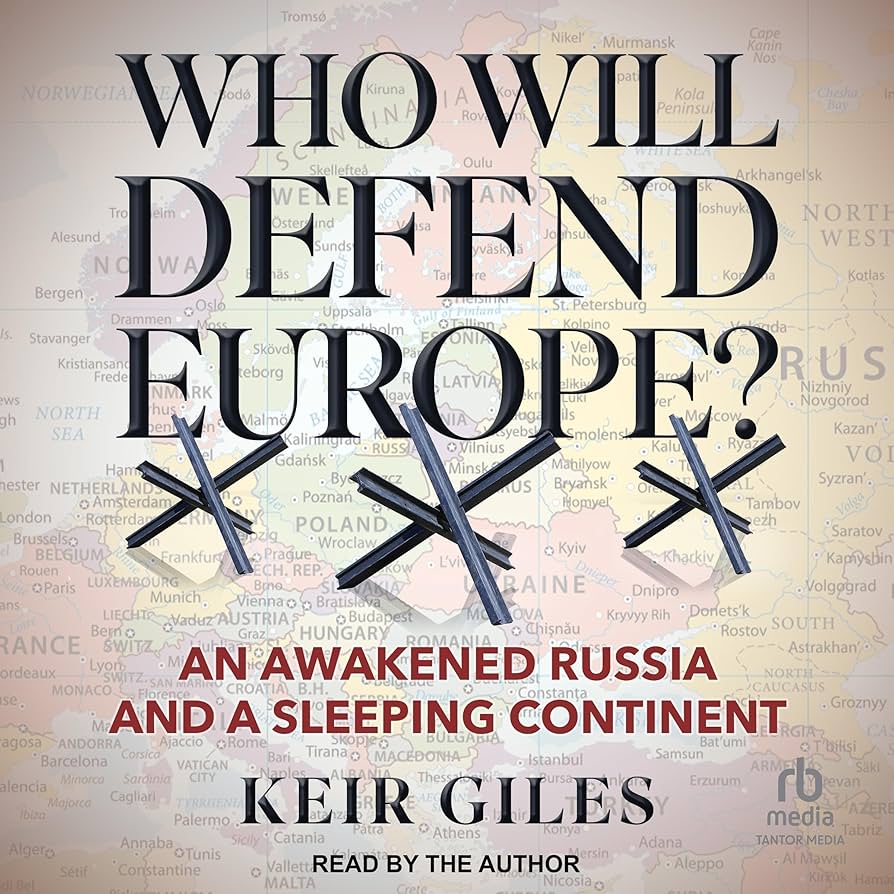
Keir Giles
Who Will Defend Europe? An Awakened Russia and a Sleeping Continent
Hurst & Company, 2024
On February 28, 2025, President Trump and the Vice President met with Ukraine’s President Zelensky in the Oval Office. The meeting ended early and badly. The unstated purpose of the sit-down was to end the Russo-Ukraine War by showing Putin and Russia that the new administration was willing to pressure Ukraine towards a cease fire.Trump’s unfair Oval Office barbs directed at Zelensky gave the Russians an opportunity to seek peace with Ukraine without losing face since the US President was using their talking points, however disingenuously. The Russians, however, did not seek peace, and now it is now painfully clear that Trump couldn’t simply pull a fuse, repeat Russian propaganda, and end the Ukraine War.
Keir Giles is a writer and researcher on Russia. His book Who Will Defend Europe? (2024) describes the military unpreparedness of Europe and how this weakness is failing to deter Russia from ongoing and future aggressive actions. Giles describes the situation in Europe from the perspective of the nations, like Poland, who are closest to Russia. These nations don’t see Russia as a wayward branch of the white race who have unique onion domed churches and epic novelists and poets. They see, and are very close to, Russia’s rape-as-policy military, Asiatic-style corruption, and all around Eurasian viciousness.
Giles was an anti-Russian prophet of doom before the 2022 invasion of Ukraine. He came to those views when studying Russia’s historical relationship with the rest of Europe. He discovered that Russia is an aggressive and expansionist imperial state whose suspicion-soaked mentality is such that when the Russians see a border, they only feel secure if Russian soldiers are posted on both sides of the line. Russian ambitions in Europe are not containable through a natural border, so a compromise in Ukraine or Eastern Europe along the lines of the Cuban Missile Crisis cannot work. Russia must be deterred by genuine military capability and political willingness to use force. Additionally, Russia is never as powerful or as weak as she appears.
The Russian war effort in Ukraine is a perfect example of the strong-weak dichotomy. The Russians were turned back from the very gates of Kiev in 2022. Then the Russians re-adjusted and won a grinding victory in Bakhmut. After that success, they beat back the Ukrainian 2023 Spring Offensive. However, the flamboyant leader of the mercenary force which took Bakhmut, rebelled and so he was killed on Putin’s orders in response. The war has continued on and in 2025, the Ukranians destroyed a good chunk of the Russia’s strategic bomber fleet in a brilliant drone attack.
Giles believes that Putin’s goals are to revive the Russian Empire as its borders were in 1914, which is when their empire included Finland, Poland, and much of Central Asia. This sounds insane to Western ears, but children’s maps are given out in Moscow which show “Our Motherland” with those old boundaries. The Russian’s goal in Ukraine isn’t a Carthaginian profit-or-loss venture, where they carry out a military operation and see what they can get for the least amount of cost, their goal is all-or-nothing. They wish to win the whole of Ukraine and then look to gobble up the next area which was formally part of their empire in 1914.
Russia’s claim their “security needs” are unmet is untrue. Many Genuine Far-Right writers, including myself, have taken Russia’s “security concerns” seriously. But I don’t matter – Giles points out that those who do matter in Western Europe’s various governments have respected the boundaries and security needs of Russia. Additionally, nobody in the West is calling for the return of Konigsberg and Karelia while the Russians are openly declaring for expansion. Perhaps there should be a call for Konigsberg and Karelia to be returned to Germany and Finland respectively.
While this might sound suspiciously like war-propaganda, the Russians have rebuilt their military since the end of the Cold War and are carrying out an enormous domestically targeted metapolitical effort filled with nostalgia for the Second World War, which is when their Lend-Lease aided troops captured half of Europe. They also have invaded Ukraine and there are assassinations and other clandestine operations against people across the world. Normally, these operations are directed against Russian defectors and escaped spies, but there was a plot to place explosives on aircraft that was thwarted. It is time to take the Russian threat seriously.
On the surface, it seems like an expensive ordeal to continue to support Ukraine and re-arm, but Giles points out that,
[…] the balance of investment and risk argues clearly in favor of unstinting support for Ukraine. The costs sound high to European governments unaccustomed to investing in their security. But economist Timothy Ash calculates that annual support of $100 billion to keep Ukraine free and hold back Russia amounts to less than one-fifth of 1% of Western GDP, and less than 10% of NATO’s current defense spending. And in any case, much of that investment would be in the donors’ own economies, funding first arms production and subsequently peacetime industries like construction when the time comes to rebuild Ukraine.
Giles is dismissive of America’s increasing isolationist tendencies. This is unfortunate, all Europeans need to recognize that many Americans are frustrated by the constant and sneering demands for US troops from people who are of the same social set as Hanoi Jane Fonda. Regardless, America’s main contribution to NATO isn’t in its infantry divisions, it is in its technological and logistical forces. Most of the militaries of Europe have totally ignored this critical capability, instead expecting the Americans to always arrive in time. Giles writes:
June 2024 saw very public attention to the problem [of missing transportation capabilities] as the UK’s participation in the 80th anniversary of D-Day was curtailed because there were insufficient RAF aircraft for the scale of the commemorative parachute drop already planned. Supporters of the RAF pointed out, quite correctly, that operational commitments had to take precedence over this non-vital event, but that didn’t address the underlying question: if the RAF does not have the assets to cover events planned years in advance, like D-Day or an exercise in Estonia, what happens when they are called on to do something vital but unexpected, like support the defense of a NATO ally?
So, if the Europeans have ignored the unsexy technical and logistical parts of military operations, have they instead focused on the front-line forces? Giles says no.
In fact it now seems almost routine for MOD announcements on spending, procurement or readiness to be swiftly shown to be deceitful. Seasoned defense commentator Julian Lindley-French observes that every recent “increase” in the UK’s defense budget has seen the British Army reduce in size, so there is a danger that if the British Government “raises” the defense budget any higher the British Army could cease to exist altogether. And a senior military officer, commenting on the need to treat British government announcements on defense with extreme skepticism because of their general failure to tell the truth, told me: “it’s appalling that we are now equating statements from Downing Street and MOD Main Building with those from the Kremlin and North Korea.”
Great Britain is the NATO partner which takes military operations very seriously, but the British government still cuts corners at every opportunity. The same Cyprus-based RAF and Royal Navy units involved in the operations in the Red Sea against the Houthi are also involved in operations in the Black Sea, so the forces are completely overdrawn. In addition to the missing transport aircraft, the RAF also lacks critical airborne command and control aircraft, and the front-line fighters are aging. The UAV/drone revolution hasn’t reduced the need for soldiers, who still must maintain, store, support, and control the robots.
The rest of NATO is in even worst shape. Work ethic at the various NATO headquarters is non-existent. The institutional culture at those locations consists of two-hour lunches where alcohol is imbibed, and most of the staff get an early start on the weekend so offices are empty by early Friday afternoon. NATO forces ignore basic cyber security techniques, and one account was hacked because the password was, “1,2,3,4.” There are no innovations at any NATO headquarters.
It gets worse elsewhere. A leaked report from a Danish military officer exposed the fact that faulty proximity fused shells exploded right out of the muzzle of a ship’s gun and another warship was rendered useless after a known and long-standing software glitch froze the command-and-control system. Europe has plenty of capacity to build shells for Ukraine, but its few factories continue to fill pre-existing orders to militaries whose nations are at peace rather than shift priorities. One planned ammunition factory couldn’t be built because the local electrical grid was entirely focused on supporting a Tik Tok server.
Sweden and Finland have done part of what it takes to deter Russia. Both nations have large reserves of ammunition and a large population which has military experience and can fill the ranks in the event of a crisis. The Finnish also have large stockpiles of food and fuel for its citizens as well as shelter in the event of a crisis. All NATO militaries must have capability depth to counter Russia in the event of an attack – what Giles calls resilience.
While Sweden and Finland are prepared, Ireland (not in NATO), Iceland, and Canada short their military and rely on others for their defense. Ironically, Ireland and Canada’s respective liberal, and self-righteous political elites rely on either the British or the American forces while deliberately cultivating hostility towards their respective neighbors.
While Sweden has the depth to counter Russia, it’s liberal elite has foolishly saddled itself with a large non-white immigrant population which is a fifth column. All the nations of Western Europe have these populations. The mere presence of non-white rioters, welfare users, and community organizers demoralize the native population, increase ordinary crime, and make domestic politics difficult. The fact that Giles points out that non-white immigrants and those of non-white immigrant stock are a problem and a national security threat is an enormous revolution. The idea that post-WWII immigrants have been nothing but trouble across the white world has colonized every serious public policy book. Giles also mentions the problem of Green Marchers: third world people deliberately sent into Europe in Russian-orchestrated migrant flows.
It is also time for Europe’s existing nuclear equipped nations to upgrade and modernize their atomic weapons capabilities and delivery systems. There is no way to counter Russia’s atomic weapons without building up Western atomic weapons. This will be countered by Russian information operations like that which was carried out during the Cold War. In the 1980s, for example, many Germans protested the presence of Pershing Missiles which were sent to Germany to deter Russia from using their weapons which were pointed at the Germans. The anti-Pershing Germans were completely taken in with Soviet (Russian) talking points about “provocations” when the Soviets were, in fact, being deterred by the missiles. Fear of Russian atomic weapons is overblown. The Russians aren’t insane enough to fire nukes provided there is a known counter to their capabilities. The danger is if the West issues an empty threat.
There is also a problem with NATO’s Article 5 – an attack against one is an attack against all. So far, this article has only been invoked by the United States after the 9-11 attacks and that led many NATO nations into a twenty-year quagmire in Afghanistan. In Afghanistan, very few of the NATO militaries did very much, so one can see that national resentments between the Americans and Europeans are fully mature. On top of this anger, Article 5 is not all that well defined. Russia is waging hybrid war, carrying out attacks while claiming the culprits are crime rings or random non-state actors. There is a threat that the ethnic Russian minority in the Baltics can be organized to carve out a new Russian frontier district or be said to be in a secessionist army which in fact, is manned by Russian regular soldiers with no insignias. Should such a hybrid attack occur in Eastern Europe it is not sure if it will trip Article 5 which makes the situation dangerous.
The Russian minority in the Baltics is as much of a fifth column for Europe as the Pakistani groomers are for England. They are deliberately encouraged by the aggrieved by the Russians. This aggrievement exists on Wikipedia, where an article on the Alaskan Russian community who lived in the state since it was colonized by Russia claims Alaskan Russian culture was damaged by American rule after the United States purchased the territory. While treason from Sitka is remote, the problems from the Russians in the Baltics is likely. Encouraging the ethnic Russians there to return to Russia proper is a wise course of action.
The only way to end the war in the Ukraine and secure the situation in Eastern Europe is to have Europe completely re-arm, with American support. The critical ports on the Atlantic, Hamburg, Bremerhaven, and Antwerp must be protected from attack by advanced weapons such as drones and hypersonic missiles. European nations need to invest in more self-propelled artillery and shell production. European militaries need to use interoperable and securable software for their respective military command and control computers.
Europe’s energy policy is also critical. Purchasing oil and liquid natural gas from Russia continues to fund Russia’s war effort. Should the European’s use small, French-style atomic reactors and an integrated electronics grid where electricity can be shifted from low to high demand areas is a fighting-free way to strip Russia of its ability to pay for its war. Europeans and Americans also need to recognize what Russia’s talking points are, and recognize which ones are dishonest or self-serving.
Europeans need to also internally strengthen their societies. British infrastructure is entirely unsecure. Civil defense organizations like the Royal Observer Corps were dismantled at the end of the Cold War. Western Europe’s biggest threat from Russia isn’t the Russians themselves. Instead it is the large collection of non-white troublemakers, such as Pakistani grooming gangs or the Algerian rioters in the Paris suburbs. The book points out this problem but doesn’t focus on it as much as it should. A way to demonstrate resolve against Russia is to create a Royal Remigration Corps – with an activation date on Saint Brice’s Day – and start to remove problem populations.
17 comments
Great article, if only we had listened to Patton instead of letting the jews kill him. 🙃
George Patton was a great general. He had all the required qualities – aggression, great competence, quick thinking, resourcefulness, and (naturally) a big ego. He was right to distrust the USSR, but his hostility went too far. No one wanted another war. I don’t know who killed him. It might have been a car accident, as per the official story.
Read The World Conquerors by Louis Marschalko for a different take on why the jews killed Patton. 🙃
Patton was the proverbial loose cannon, and in Paris he let Eisenhower know that he was not going to toe the Party Line on how the War was conducted. He was also being fed literature by his son-in-law about the origins (Jewish) of communism, before the war he had been mostly apolitical but now he was getting eye opening material. Also, he resigned from the Army and his wife had money so he would have been unfettered in what he said. They tarnished McCarthy but such was Patton’s fearsome reputation that he would not have suffered that fate. And George Patton speaking his mind would have been the last thing they wanted. My guess is they killed him but if they did not they caught a huge break.
Kerry Bolton writes- I believe in his Yockey biography-that Patton’s neck was broken from a projectile by OSS assassin Douglas Barzata and while recovering in an army hospital, was killed by the NKVD after witnessing the Hellstorm atrocities against the Germans and very unpleasant, disgusting truths about jews.
On the night he was leaving for the return trip to the USA, there was an “accident”. It wasn’t severe enough, so on the same night there was another “accident” that got him into the hospital. He got Breitbarted not long after that.
I think Patton was a decent general, lots better than most, although he did not walk on water.
The eponymous 1970 movie with George C. Scott captured him pretty well, although they were far too hard on General Bradley, portrayed by Karl Malden (Sekulovich) as particularly bland.
General Patton was a 1909 graduate of West Point Military Academy, and Generals Bradley and Eisenhower were 1915 graduates. Remember that West Point was a civil engineering and football school. Bradley had gotten all of his teeth knocked out from playing football, and I don’t think I have ever seen a picture of him smiling with dentures.
Certainly Patton had more flair than either Bradley or Eisenhower. But like Erwin Rommel ─ jumped up to Field Marshal largely due to Dr. Goebbels media, and having once served on the Führer’s Army escort battalion, which accompanied Hitler whenever he travelled in enemy territory such as Poland or Russia.
Lieutenant Colonel Rommel, bearer of the Pour le Mérite, had also taught at the War Academy at Potsdam in the 1930s, and in 1937 published a bestselling tactical instruction book about his infantry experiences in World War I, called Infanterie grieft an (Infantry Attacks) which Hitler had studied closely.
I have read the book, and Rommel was an outstanding tactician but not always the best with strategy and grand strategy. When operating in North Africa, he wasn’t really a team player while working with his boss, the Mediterranean theater commander, Generalfeldmarschall Albert Kesselring, an outstanding defensive strategist.
Rommel defeated the Americans in Africa at Kasserine in early 1943. In the 1970 Patton movie, General Patton has now arrived and George C. Scott has him say in triumph about having read Rommel’s book after a subsequent German defeat ─ only to find out that Rommel was not there any longer and actually back home in cardiac care, never to return to Africa.
A big part of General Patton’s dashing image was created by media propaganda as well.
I don’t disagree with Patton’s comments about us having “fought the wrong enemy” in WWII, but we have to realise that most of this is talking smack for the media, who are baiting the peacetime general on, and intentionally making him a parody of himself.
The idea that Patton was assassinated is nonsense.
The argument is that nobody else was injured from a vehicular fender-bender besides Gen. Patton, who suffered a severe cervical spine injury.
As someone who has experienced being hit by a red-light-running motorcar in a crosswalk, I can attest that these kinds of things can go multiple ways. I totalled the car with my body and nearly decapitated the junkie driver and his junkie girlfriend ─ both barely injured ─ and I was thrown forty feet before skidding on the asphalt to cushion my fall. I broke both arms and legs and some ribs, a nice skull fracture, a smashed ankle, shoulder, and dominant hand. No spinal injuries. Lucky!
However, I was on a bicycle so a little higher off the ground during the collision. If I had been a pedestrian, I probably would have gone under the car’s wheels and killed.
So four-star General Patton has survived a minor vehicle accident but he is now in spinal traction with fishooks under his cheekbones. He was left paralyzed below the neck and could barely breathe, and once a bout of pneumonia set in, it was curtains for him twelve days later. In those times they did not have modern respirators, and the general was never put inside an iron lung. He did not want his life prolonged and he passed in late 1945 at the age of 60.
In the Army, you would be surprised at how many injuries are actually the result of stupid things like a tank backing over a squad in their sleeping bags, or soldiers being killed on those death machines called motorcycles while on their way to work in the morning. And you don’t get a Purple Heart medal unless the injury was caused by enemy action somehow.
🙂
Wildly exaggerated and fanciful Russian threat. It is just another border war.
By the way, we have our own border war with the invasion pressure on the US southern border. Trump has a big problem cleaning up after the disastrous Biden years. The War Hawks always, always see some far away threat in the Caucus and demand huge amounts of more military spending, while ignoring any real threat to the US.
I agree. We should give nothing to Ukraine. Let Europe defend itself with its own resources. NATO is long past its expiry date. (And also give nothing to Israel.)
It is a new World War by proxi, the war for the world hegemony. Decadent and rotten Anglo-Saxon Empire struggles to keep the rests of its former power and use Ukrainians as the British cannon fodder. The emerging Greater Chinese Empire, the new world one superpower and the new world cop, will get this power as union of the PRC, Russia, North Korea, Iran, Pakistan and some smaller countries, and is now using Russians. By the way they getting lithium for Chinese electrocars and “One Belt One Road” to import Chinese goods to the West directly without paying for transit to Ukrainians.
Perhaps there should be a call for Konigsberg and Karelia to be returned to Germany and Finland respectively.
Yes, return Ukraine to Russia, sans Galicia. Give Galicia to Poland. Return Eastern Prussia, including Konigsberg, to Germany.
Galicia? That’s in Spain.
LOL, the one with the cities of Lwów and Kraków.
https://en.wikipedia.org/wiki/Galicia_(Eastern_Europe)
🙂
Haha, too many galicias call the policia.
The Irish government’s basic defence strategy is to make it as easy as possible for our eastern neighbour to invade any time they want.
Mr Giles should sit down, take some deep breaths, and relax. Perhaps a nice cup of warm herbal tea would help.
Should Zelensky show at the Trump/Putin summit in Alaska tomorrow, would it be an “unfair barb” to ask him if he really did play a piano with his penis in 2016? That’s what people want to know.
—
Before he was elected President of Ukraine in 2019, Zelensky had a lot of comedy hits, such as that unforgettable time in 2016 when he played the piano with his penis. (See YouTube video of Z’s standup comedy routine: President Volodymyr Zelenskyy plays piano with dick).
—
Morris: On February 28, 2025, President Trump and the Vice President met with Ukraine’s President Zelensky in the Oval Office. The meeting ended early and badly… Trump’s unfair Oval Office barbs directed at Zelensky gave the Russians an opportunity to seek peace with Ukraine without losing face….
Comments are closed.
If you have a Subscriber access,
simply login first to see your comment auto-approved.
Note on comments privacy & moderation
Your email is never published nor shared.
Comments are moderated. If you don't see your comment, please be patient. If approved, it will appear here soon. Do not post your comment a second time.