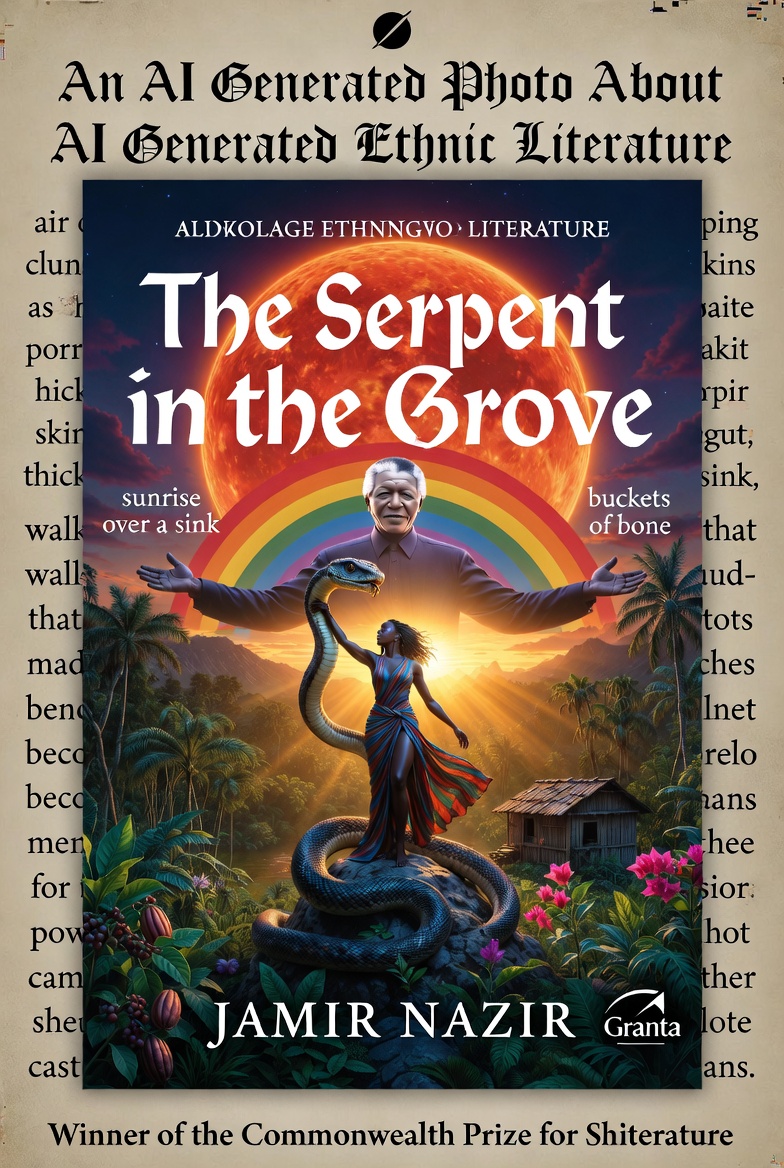
An AI generated photo mocking AI generated ethnic literature.
3,318 words
It turns out AI-generated “literary” slop existed long before there was any real electronic AI around to even generate it—the pre-Chat GPT-era artificial intelligence in question belonging to black and brown people.
In 2005, the prestigious British literary magazine Granta ran an essay by a black Kenyan author with the only seemingly AI-generated name Binyavanga Wainaina. Called How To Write About Africa, it did not consist simply of the single word “DON’T!” but was a long and sarcastic list of literary clichés culled straight from prize-winning pieces about the continent which, in Wainaina’s view, did not deserve to have won any prizes at all. Above all, aspiring Afri-scribes should seek to “keep your descriptions romantic and evocative and unparticular,” the satirist recommended drily, whilst also making sure to “show how Africans have music and rhythm deep in their souls, and eat things no other humans eat,” like each other. In particular, Wainaina advised:
Readers will be put off if you don’t mention the light in Africa. And sunsets, the African sunset is a must. It is always big and red. There is always a big sky.
Of course there is. Didn’t Paul Simon himself once sing about it? And then, in the final chapter of his book, any author worth his ink should, of course, make good use of the following standard and utterly inevitable Afri-lit trope:
Always end your book with Nelson Mandela saying something about rainbows or renaissances. Because you care.
But what if you don’t care? Never mind, just submit your slop anyway. So long as you stick to the above standard guaranteed formula, your prose is bound to get rescued from the publisher’s slush-pile by someone illiterate enough to fall for it all.
Rausing Suspicion
Granta may have accidentally created a rod for its own back with Wainaina’s 2005 essay here. Maybe some of its dimmer readers didn’t understand it was meant to be satire, and viewed it as a serious checklist of the kind of things they really should be including in their stories for submission?
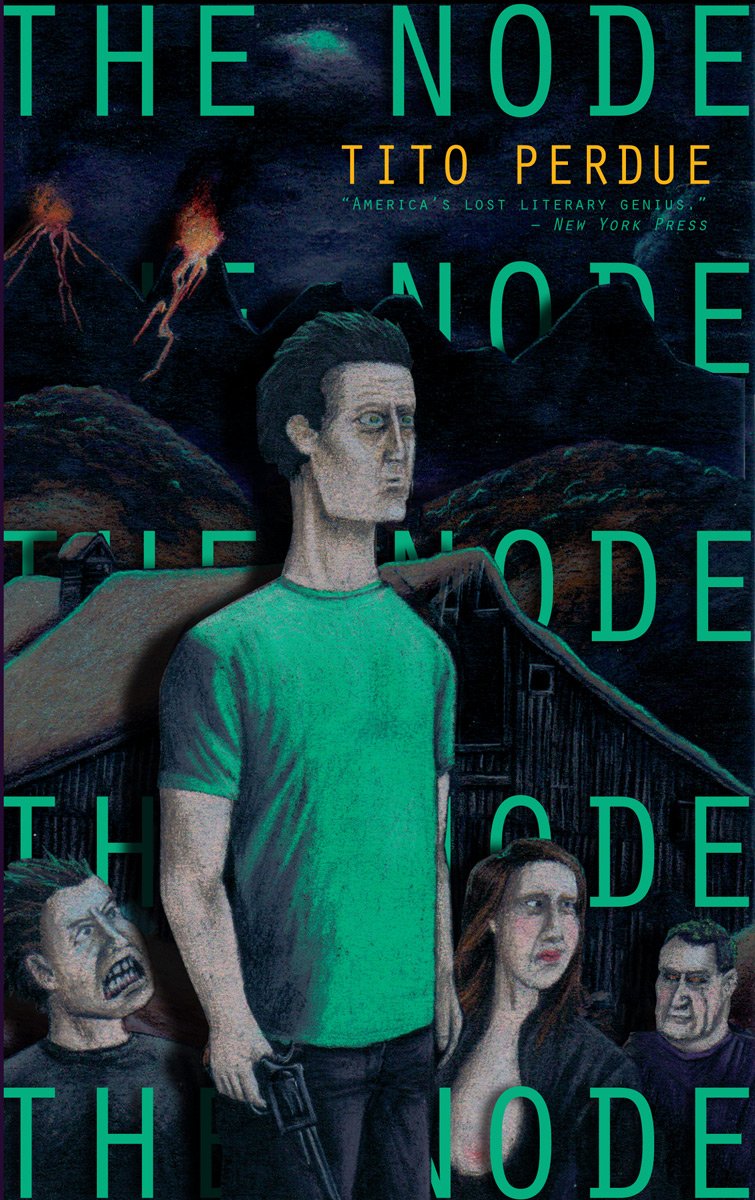
You can buy Tito Perdue’s novel The Node, here.
On May 12 this year, Granta published a short story on its website called The Serpent in the Grove, whose plot is best summed up by asking “It has one?” Purportedly written by a 61-year-old human of part-Indian heritage from Trinidad & Tobago named Jamir Nazir, it was as formulaic as supermarket baby-milk: a landscape so lush it seems alive and conscious; poverty-stricken, uneducated, yet implausibly hardy and wise black female natives; plenty of references to exotic fauna like snakes and lizards, and equally exotic cash-crops like rice, coffee, and cocoa. Admittedly, Nelson Mandela doesn’t appear at the end to say something nice about rainbows, but that’s probably only because he’s dead now. Having read the story, some cruel critics passed it through an online AI-detection program, Pangram, which declared with 100% certainty it had truly been written by a bot. If so, how had the experts at Granta been fooled?
Sigrid Rausing, Granta’s publisher, protested that they hadn’t. It was just that the magazine had a partnership with the annual Commonwealth Short Story Prize obliging it to publish the contest’s annual winners in its pages each year, regardless of whether the Granta staff thought they were good, bad, or even machine-made. As Nazir’s story had won the 2026 Commonwealth Prize for the Caribbean region, Rausing had no choice but to publish and be damned. However, she did sound a slight note of caution, warning that Pangram’s own AI-generated assessment “may conceivably itself reflect AI bias” against non-white authors. How so? Apparently, by recognizing how identikit and talentless they all now are.
Slop Sink
AI is notoriously poor at composing figurative language like similes and metaphors. Hence, if it really was AI-composed, this may be why we get amusingly bad or nonsensical statements in Nazir’s work like the following: “Inside, air clung thick as porridge skin,” “Coffee and cocoa leaned wild on a slope that wanted either rain in teeth or none at all,” “She had the kind of walking that made benches become men,” “The girl smiled like sunrise over a sink,” and my own personal favorite, the description of a character who was “Big in the way of women who never apologize to furniture.”
Parts of it read almost like low-grade Surrealist prose; we never get quite as far as anything described as looking like Lautréamont’s chance encounter between a sewing-machine and an umbrella upon a dissecting table, but we’re not too far away, and at least Lautréamont deliberately meant his analogy to make no sense. What does a sunrise look like over a sink, precisely? Substantially different to one viewed beneath a bathtub or up the u-bend of a toilet? Here’s the end of The Serpent in the Grove, which suddenly and randomly aims for the condition of “poetry” simply by virtue of Nazir hitting the “Return” key and putting each new sentence on a different line, because that will automatically make it all sound Deeply Profound:
The serpent in the grove was never only a snake.
It was the thing in a man that slid along stone for dark, and the thing in a woman that wrapped a vine around herself and climbed.
A story is a well.
It eats sound until somebody throws a rope.
If grace is near and hands hold, something breathing comes up.
Some stories pull buckets of bone.
This one pulled a woman.
I think it pulled buckets of something else myself, personally.
Nazir wasn’t the only Commonwealth Prize for Shiterature winner accused of using AI to write their story for them this year. Once the controversy about The Serpent in the Grove erupted, several other Prize-winning authors of similarly inane works soon felt forced into denying they had used AI to create their own marvelous melanated prose too. They may even have been telling the truth. The sad thing was, even if they had been written by real, non-white human hands, and not by AI, it would have been impossible to tell the difference.
The Unedited Truth
There is a strong suspicion in publishing these days that many of the industry gatekeepers, from agents to readers to commissioning editors, just don’t know what the hell they are doing. Having no sense of what genuine literary quality even is anymore, many of the liberal, upper-middle-class white women and their specially recruited non-white pets who now disproportionately control publishing in the US and UK appear to have decided instead that their true job is simply to promote “marginalized voices” rather than giving the public anything actually worth reading.
Here, for example, is the opinion of Sharma Taylor, award-winning black Jamaican author of Genuine Human Hair, and one of the Commonwealth Prize judges, about The Serpent in the Grove, an opinion which is every bit as meaningless as the abstract notion of a sunrise viewed over a sink, if not more so:
Jamir Nazir’s language is sublime—precise yet richly evocative—conjuring vivid, lush imagery with remarkable economy. Through sharp sensory detail, he renders the Grove as a living presence, where labour, landscape, and memory are intimately entwined. Polished and confident, this is a story with a melodic voice that lingers long after the final line. Jamir Nazir’s prose pulses with a voice of restraint and quiet authority—a beautifully told and assured piece of storytelling.
The sheer paucity of the critical vocabulary here is obvious. It reminds me of the new-fangled computerized school reports I had to use during a former career as a teacher, when it was no longer possible to compose your own personalized descriptions of each individual child, simply to choose from a series of bland, interchangeable niceties on a drop-down menu. No more “Sophie is a little bitch who keeps on firing poisoned darts at me in the classroom through a blow-pipe,” but “Sophie displays immense potential for future improvement in her capacity to conform towards accepted modes of classroom practice.”
Just look at this stuff: “sharp sensory detail,” “richly evocative,” “vivid, lush imagery,” “melodic voice,” and “prose [that] pulses.” It’s as though Orwell’s Politics and the English Language had never been written. Such cookie-cutter phrases float entirely free of the text itself, and could have been applied just as interchangeably to any of the other rubbishy stories which won the 2026 Commonwealth Prize—these are precisely the kind of laudatory yet transposable things the current Regime expects you to say about ethnic literature, whether it’s actually any good or not. Maybe the judges themselves are AI-generated too now, then?
And maybe the prize-winning writers are as well, and not just their prize-winning stories? This is how Jamir Nazir describes himself on the Granta website:
Jamir Nazir is a Trinidadian writer of East Indian heritage whose work explores the cultural intersections of the Caribbean and the Indian diaspora. A prolific poet and author, with books published and others forthcoming, he is particularly known for his love of poetry. His writing draws on the landscapes, histories and emotional rhythms of Trinidad, where memory, heritage and identity converge to shape voice and imagination.
It reads like a parody of exactly the kind of talentless but unchallengeable non-white hack who gets fawned over and published these days—“cultural intersections,” “diaspora,” “emotional rhythms,” “memory, heritage and identity.” Maybe it is.
Author Unknown
If you look up his social media, Nazir’s posts seem to focus mainly upon the issue of AI, a tech of which he enthusiastically approves, almost like a deliberate clue for those with eyes non-woke enough to perceive that his very existence may perhaps be one big joke. Although his new publishers deny it, Jamir’s online photo has itself been alleged to be AI-generated too, looking as it does like someone typed “Draw me an ethnic Sean Connery!” into Dall-E one day.

The name’s Bond – Jamir Bond, license to shill.
This could all be some kind of elaborate hoax being played on the literary establishment. By showing their embarrassing inability to distinguish real-life writing by non-whites from fake writing by non-whites, the possible hoaxer has actually revealed how publishing-world gatekeepers treat Binyavanga Wainaina’s old How To Write About Africa (or, here, about the Caribbean) essay not as satire but as a literal how-to guide.

You can order The Best of Trevor Lynch here
The way AI works when making stories-to-order is to “scrape” millions of words of actual pre-existing genre literature, then splice it all together in new ways to create a cheap pastiche of the real stuff. So, in order for the AI to learn how to write in the above hackneyed fashion, actual non-white humans, like, say, Zadie Smith, Ocean Vuong, Toni Morrison, Maya Angelou, etc. must have been getting away with writing like this for real and being feted as “geniuses” for it for years now anyway. VS Naipul, by contrast, was non-white and genuinely talented, but probably now wouldn’t be published at all, because his idea of How To Write About Africa was to depict it as being full of primitive, violent savages, not Nelson Mandela farting rainbows out of his arse whilst doing a handstand on top of an elephant and singing songs from The Lion King.
All this formulaic crap, filled with juicy mangoes, strong women, big skies and lush rainforests, may be billed as being “diverse” but in truth it is anything but: it is identikit, by-the-numbers, sub-literary trash, every bit as much as the average Mills & Boon novel is, so much so its true genre name should surely be Mills & Coon. All such apparently AI-generated stories as Jamir Nazir’s do is expose the specific nuts-and-bolts on-page elements which are fitted lazily together for what they are—pieces of mere literary Lego, and every bit as plastic.
Any book which ever wins a prize these days is, almost by definition, not worth the reading. Couldn’t modern bookstores have a special section called “Prize Un-Winning Fiction,” where all the good books by dead white men are kept?
ADDENDUM
As a quick test, I went onto ChatGPT myself, and asked it to pen me “a 1,000-word-long generic piece of ethnic literature, in the style of Jamir Nazir, set in the Caribbean.” Below is the purest e-rubbish it vomited back out, in a mere matter of seconds. I actually thought it was better (as in “slightly less worse”) than Nazir’s own effort!
A Sea Is the Memory of a Million Salt Tears
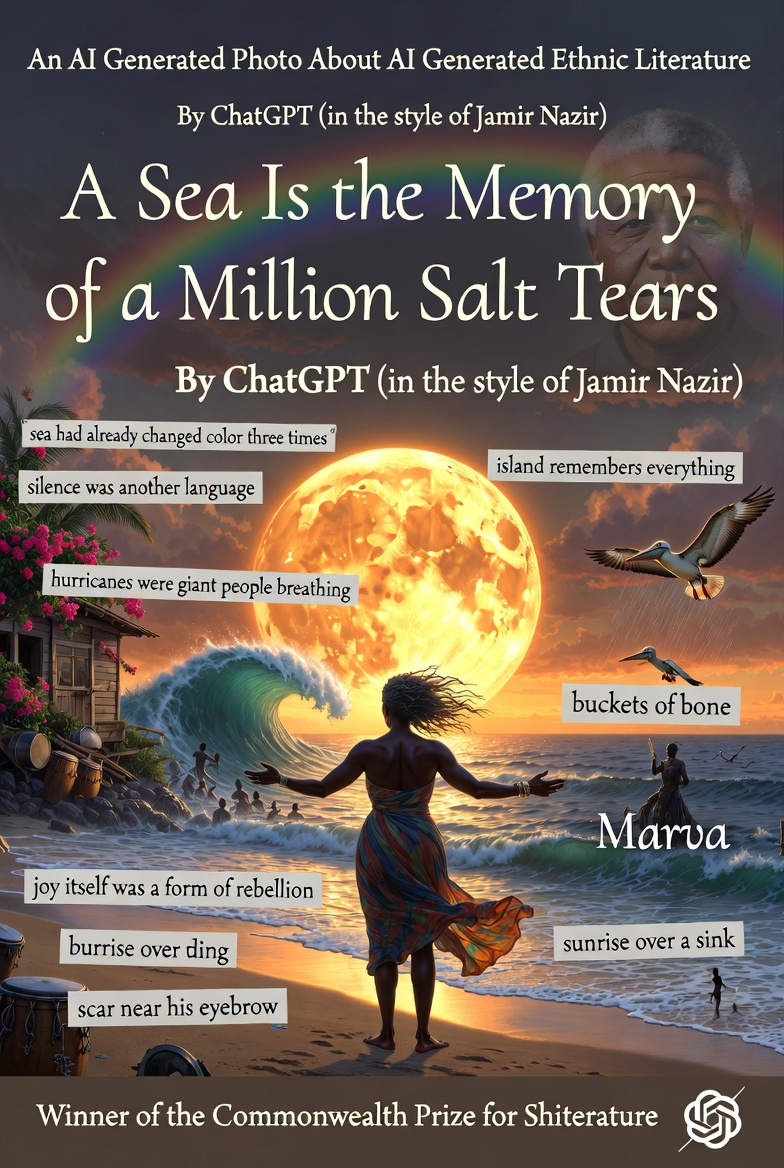 By the time the rain came to Saint Aldren’s Bay, the sea had already changed color three times.
In the morning it was blue like a bruise healing under dark skin. At noon it turned silver beneath the punishing sun, flat and bright as hammered metal. By evening it carried a green-black heaviness, swollen with the promise of storm. The fishermen watched it from the docks without speaking. In the Caribbean, silence was another language entirely. It could mean reverence, warning, resentment, grief.
Marva stood outside her mother’s wooden house with a basket of breadfruit balanced against her hip. The house leaned slightly to one side, as though tired from surviving too many hurricanes. Bougainvillea climbed the fence in purple bursts, and the scent of frying plantain drifted through the yard. Somewhere farther down the road a radio crackled with calypso music from another decade.
“You hear thunder?” her mother called from inside.
Marva listened.
“No,” she answered.
“That is because you don’t know how to hear properly.”
Her mother believed every sound carried history. Rainfall sounded different before death. Dogs barked differently when strangers approached. Even the ocean had moods that could be translated if a person lived long enough beside it.
Marva used to laugh at such things when she was younger. Then her brother drowned two summers ago, and afterward she began listening carefully to everything.
The village of Saint Aldren’s Bay curved around the coast like a bent finger. The roads were narrow and cracked, lined with faded shops painted in turquoise, yellow, and rust-red. Old men played dominoes beneath almond trees while tourists passed through in rented jeeps, chasing beaches they had seen in brochures. The tourists never stayed long enough to understand the island. They photographed fishermen hauling nets but did not smell the diesel on their clothes afterward. They danced to steel drums at night without noticing how many songs carried sorrow inside their rhythm.
Marva worked mornings at a hotel above the cliffs where wealthy visitors drank imported rum while asking local workers whether island life was “simple.” She hated that word.
Simple.
As if poverty were simplicity.
As if surviving heat, storms, debt, and memory required no intelligence.
As if history itself had not carved scars into every sugarcane field stretching inland.
Her grandmother once told her, “This island remembers everything, even when people pretend not to.”
The old woman had skin like folded paper and eyes sharp as fish hooks. Every evening she sat on the veranda cleaning peas into a metal bowl while telling stories that moved between truth and folklore so easily nobody bothered separating them.
She spoke of enslaved ancestors who escaped into the hills and vanished into forests thick with silk-cotton trees. She spoke of women who carried messages in songs while colonial overseers mistook the melodies for entertainment. She spoke of spirits walking shorelines after storms, searching for names stolen from them generations ago.
“People think forgetting keeps them safe,” her grandmother would say. “But forgetting is another kind of drowning.”
After her grandmother died, Marva inherited the stories along with a carved wooden comb and a rusted silver bracelet nobody could date properly. Some nights she wore the bracelet and dreamed of waves swallowing entire plantations while women stood untouched in the surf, their dresses billowing like sails.
The rain arrived just after sunset.
Heavy tropical rain. Sudden and absolute.
It slammed against rooftops and flooded the roadside gutters within minutes. Children shrieked with excitement while adults rushed to secure windows and bring laundry indoors. Lightning fractured the sky over the sea.
Marva sat on the veranda watching the storm advance across the bay.
Her mother emerged carrying two enamel cups of bush tea.
“You thinking about your brother again,” she said quietly.
It was not a question.
Marva nodded.
The storm wind carried salt against their skin.
For a long moment neither woman spoke. Then her mother said, “When your brother was small, he used to believe hurricanes were giant people breathing.”
Marva laughed softly despite herself.
“He said thunder was their footsteps.”
“Maybe he was right.”
The island often blurred the line between superstition and wisdom. People consulted church pastors and herbal healers with equal seriousness. They prayed over fishing boats and poured white rum into the sea for the dead. The old ways survived quietly beneath modern life like roots beneath concrete.
Across the road, Mr. Baptiste hurried to tie down the zinc sheets behind his shop. His grandson followed carrying rope too large for his thin arms. The scent of wet earth rose thick and alive from the ground.
Marva remembered another storm years ago when the river burst its banks and carried goats, chairs, and entire sections of fencing toward the sea. Afterward the village rebuilt itself in stages. Caribbean people were experts at rebuilding. Storms, colonizers, dictatorships, debt—history kept tearing things apart, and still people painted houses bright colors afterward.
Perhaps joy itself was a form of rebellion.
The power went out near midnight.
Darkness folded over the village except for flashes of lightning. Somewhere nearby a woman began singing softly through the storm. An old hymn. The kind sung at funerals and baptisms alike.
Marva closed her eyes.
Rain hammered the roof above them.
And suddenly she remembered the last day she saw her brother alive.
He had been standing barefoot on the dock at dawn, teasing her because she feared deep water. Pelicans drifted low across the horizon while fishermen prepared their boats. He turned once before leaving and shouted something she could no longer fully recall.
Funny how grief erased details while sharpening others.
She remembered the scar near his eyebrow.
The smell of salt.
The color of the sky.
But not the final words.
That absence haunted her more than death itself.
“You know what the sea does?” her mother asked suddenly.
Marva looked over.
“It takes,” her mother continued, “but it also returns.”
The older woman pointed toward the shoreline where waves glimmered faintly in darkness.
“Maybe not always people. Sometimes memory. Sometimes strength.”
The storm slowly weakened after midnight. Rain softened into drizzle. Frogs began singing from flooded ditches, their chorus rising through the humid air.
By morning the island looked washed clean.
Branches littered the roads. Mangoes lay smashed beneath trees. The sea had turned calm again, deceptively gentle under pale sunlight. Neighbors emerged from houses carrying brooms, buckets, and gossip. Someone started music from a battery-powered speaker. Laughter appeared almost immediately, because island people understood something essential: survival deserved celebration.
Marva walked alone toward the dock.
The air smelled of seawater and broken leaves.
At the shoreline she removed her sandals and stepped into the surf. Warm water curled around her ankles. Farther out, fishermen were already returning to sea despite the storm that had passed only hours before.
Life continued here because it had to.
A brown pelican dove suddenly into the water, vanishing beneath the surface before emerging again with a silver fish struggling in its beak.
Marva watched the bird rise into the brightening sky.
For the first time in many months, she felt something inside herself loosen—not disappear, not heal completely, but soften enough to breathe around.
The island remained what it had always been: wounded, beautiful, exhausted, alive.
Behind her, Saint Aldren’s Bay stirred awake beneath the Caribbean sun, carrying its histories forward in music, salt, prayer, and stubborn endurance.
If you have a Subscriber access,
simply login first to see your comment auto-approved.
Note on comments privacy & moderation
Your email is never published nor shared.
Comments are moderated. If you don't see your comment, please be patient. If approved, it will appear here soon. Do not post your comment a second time.