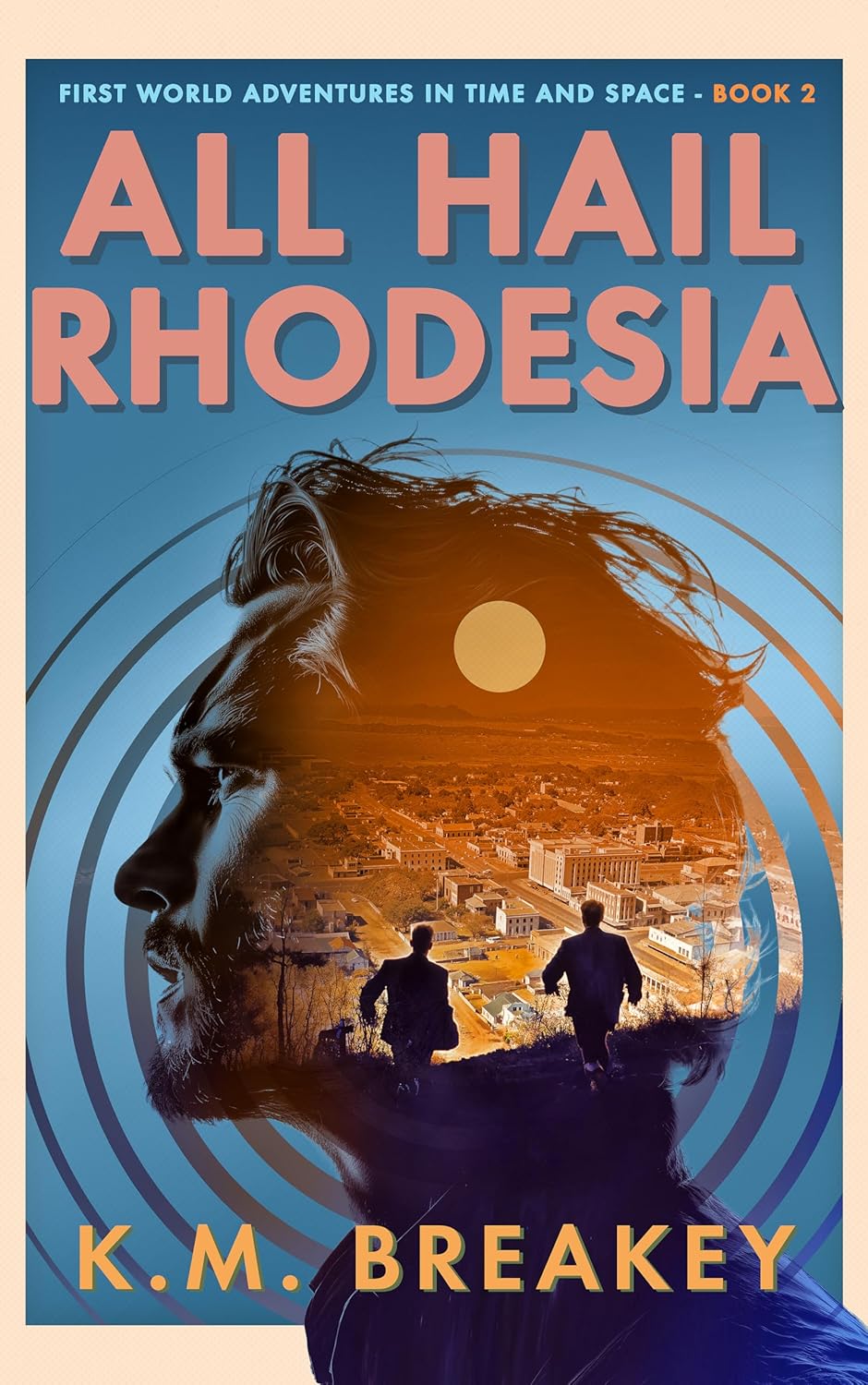
 1,230 words
K.M. Breakey
All Hail Rhodesia
Self-published. 2026.
Available for purchase on Amazon here.
I’m sure quite a few people like to Monday morning quarterback history. When something went wrong in the past, it’s only natural to want to make it right. But what if you could actually go back in time and change things yourself? Who would you meet? What would you do? What would you say? KM Breakey answers these questions and many more in his most recent novel All Hail Rhodesia.
As the sequel to Breakey’s 2025 novel Britain on the Brink, All Hail Rhodesia is book two of his ongoing First World Adventures in Time and Space series. Instead of delving into recent English history, as Britain on the Brink does, All Hail Rhodesia offers the reader a revealing look at a crucial point in the history of the white European presence in southern Africa—that is, when Rhodesian Prime Minister Ian Smith announced Rhodesia’s unilateral independence from Great Britain in 1965.
The story begins with the endearing duo of Jack Campbell and Ozzie Fletcher having a pint in a pub in not-so-merry England. Remembering what we remember from last time, the reader knows that Jack, a former bank executive, somehow has the ability to conjure up visions which allow him to will himself back in time. This miraculous and mysterious ability granted him an audience with Enoch Powell in the first novel. It also caused him to tragically lose his family. Ozzie, on the other hand, is a lovable cockney roustabout with the right instincts for all the important things—such as race and ethnicity—and, shall we say, questionable instincts for the finer things in life—which for Ozzie consist largely of football, beer, and women. This means he’s prone to getting into trouble. Yet he remains lovable, thanks in part to his penchant for colorful slang. For example, “Cor blimey, this is proper rank. Smells like a bleedin’ sewer.”

You can order Spencer J. Quinn;s Critical Daze here.
As of late Jack had been having detailed visions of Rhodesia, the landlocked European enclave nation tucked between South Africa and Mozambique, which became the impoverished black-run basket case nation of Zimbabwe in 1980. He knows that sooner or later his visions are going to take him there. Breakey depicts the Rhodesians as downright heroic as they refused to succumb to globalist, anti-white pressure throughout the late-1960s and 1970s. But sadly, despite winning all the battles in the Bush War against the well-funded and well-supplied black-African Marxist guerrillas, the Rhodies were destined to lose in the end.
But with Jack Campbell traveling through time, maybe not.
He has 15 years in which to save Rhodesia from its fate. Can he do it? Or can he save it only in an alternate timeline? And if so, will this alternate timeline in any way impact the “anchor time” that we all live in today? Even worse, Jack discovers that this time Ozzie really, really wants to come along with him.
I know what you’re thinking—Oh, no. How is Ozzie going to mess things up now?
What I find most endearing about this latest adventure is how history itself becomes the plot. Breakey clearly did his research and takes us believably back in time to Rhodesia to show what a wonderful place it really was. It truly was an outpost of European civilization in the wilds of Africa. And despite sacrificing its sons in the Second World War for the Allied cause, European civilization decided to turn on Rhodesia. This was something the Rhodesian leaders, including Smith, were not quite aware of in 1965. They naively thought that their own race would never betray them. They also naively thought they could eventually incorporate blacks as citizens into their society.
The scene in which Jack and Ozzie try to disabuse them of these conceptions, is revealing to say the least.
Smith focused on his own country. “In Rhodesia, we stand firm for a Christian civilization. We demand standards and decency for our civilization, but whatever your colour, you can participate.”
Ozzie scoffed again, louder this time.
“Furthermore gentlemen,” Smith continued, “If I’m to pursue the path you describe, I’d be voted out.”
“So don’t call an election,” said Jack. “Declare martial law. Do whatever it takes. Let the people know, you’re doing it because you love them.”
“That’s fascism, sir.”
“What’s your point?”
“Again, I remind you. We’re Christians.”
“You’ll be dead Christians,” Jack said. “Or Christians who fled the land. You can stand on your high horse. Or survive. Pick one.”
Another hiccup Jack and Ozzie must overcome is convincing the Rhodesians to not just ally themselves with South Africa, but join the South Africans as part of the same nation. This is where racial identity must trump ethnic identity, which isn’t easily tolerated when bitter memories of the Boer War were still fresh in the minds of many Afrikaner South Africans. Yet in hindsight this is what they must do—something that whites everywhere will have to do sooner or later as well.
In the end however what links the men of the future with the men of the past is race realism:
Rhodies were of generous spirit. They genuinely wanted to lift the Black man. Unfortunately, the Blacks they encountered were stone-age barbarians. A people with no written language, no clocks, no calendars. No wheel. No civilization. They were from a different age. A different epoch. Clearly, incapable of participating in English culture. To think otherwise was silly. To any honest man, Black or White, it was obvious.
Moreover, they were dangerous. They may giggle like children, but savagery was in their blood, and it surfaced occasionally with horrors beyond description. For the Rhodies, standing separate was nothing more than nature unfolding in the wild. There could be no other way.
You can buy Spencer Quinn’s novel White Like You here.
Aside from providing edge-of-your-seat entertainment and an on-point history lesson on the topic of Rhodesia, Breakey does offer more than mere wish-casting. All Hail Rhodesia is extremely savvy when it comes to key tenets of the Dissident Right, and thus will serve multiple purposes for people curious about these circles—especially young people. Themes such as liberalism being a hindrance, controlling propaganda, and conceding nothing to the Left pop up quite often. As the South African Prime Minister defiantly tells the world in 1979: “In terms of our actions in our land, we seek not to commit a genocide, as you have the audacity to insinuate, but to prevent one. Against our people.”
Amen.
In terms of plot, Breakey saves his best stuff for last—and some of it is quite heartbreaking. We experience a farm attack, a head of state assassination, space travel, an alternate timeline Elon Musk, as well as a little romance for Jack Campbell. In the end, the time warp duo becomes a trio. Will Ozzie be next in finding a significant other? By the novel’s end, Jack learns that his visions now project into the future. And what he sees is horrifying. Suffice to say, it involves a black Prime Minister of Britain and the Great Replacement turning into something called the Great Transformation.
Does this mean that the next installment of the series will take us forwards rather than backwards in time? It seems we readers will have to travel into the future one day at a time to find out.
2 comments
Great article! Instead of writing novels about time travelers meeting Enoch Powell, and going back to 1960s Rhodesia, the writer should write a novel in which they go back, and stop the creation of Christianity. 🦈
The author is spot-on with this. Rhodesia did at one time have an offer to join South Africa, but they opted to remain independent, which left them landlocked. Eventually they were surrounded by hostile countries after the leftist revolutions during that time. Then they were c0mpletely isolated after South Africa embargoed them, and they no longer could resist when their supplies were cut off. This happened after Henry Kissinger secretly promised that the USA would stop pressuring the South African government if only they’d cut off Rhodesia. He lied, of course.
Anyway, history would’ve turned out quite differently if one of us could go back in time and warn the Founding Fathers about what was ahead!
If you have a Subscriber access,
simply login first to see your comment auto-approved.
Note on comments privacy & moderation
Your email is never published nor shared.
Comments are moderated. If you don't see your comment, please be patient. If approved, it will appear here soon. Do not post your comment a second time.