 7,688 words
As the Chinese “silent invasion” of Australia, New Zealand, and Canada continues, you may want to learn something about the Western academics who lay the intellectual groundwork for this invasion. In a prior article, “The Transcendental Mind of Europeans Stands Above the Embedded Mind of Asians,” we met two influential scholars calling upon whites to abandon their “failed” attempts to formulate transcendental truths for the sake of the more “profound” contextual approach of Chinese philosophers with their demonstration that all thinking is “embedded” to a time and a place. I argued that the Chinese mind was embedded to its social surrounding in a rather unreflective, unaware manner, as opposed to the white mind, which managed to understand the contextual aspects of its thinking precisely because it came to develop a transcendental capacity freed from any exiting determination other than its own judgement.
But there is another school of thought led by Heiner Roetz, professor of Chinese History and Philosophy at the Ruhr-University Bochum /Germany, which is trying to persuade white students that the Chinese had already managed to formulate transcendental truths well before the modern age. This is the argument of Roetz’s book, Confucian Ethics of the Axial Age (1993). Through a systematic investigation of key Chinese texts, this book seeks to demonstrate that during the Axial Age (600-200 BC) one can detect in China “an epoch of early enlightenment in the sense of a reflective disassociation from everything hitherto valid, and of a breakthrough towards ‘postconventional,’ detached thinking” (6). “Chinese ideas of human dignity, equality, and autonomy were developed in China no less than in the Occident” (5).
There is an uncanny homologous relationship between these two schools of thought and between the two globalist schools from the Left and the Right. While the globalist Left wants to persuade us about the “enriching” qualities of the embedded cultures brought by immigrants, the globalist Right wants to persuade us that humanity has been moving along the same historical path towards the universal values of the Enlightenment. The aim of authors praising the embedded mind of the Chinese is not that Europeans should celebrate their own traditions; it is to persuade whites that they should welcome the invasion of Asians as a culture-enhancing phenomenon teaching whites how to think in multicultural ways. The aim of authors like Roetz is not to affirm the existence of two enlightened civilizations; it is to promote “a mediation between China’s own cultural tradition and ‘Western’ modernity” (xii) right inside the West on the grounds that this is the only way the West can claim to be a truly universal civilization cleansed of any “ethnocentrism.”
Hegelian Synthesis of Sittlichkeit and Moralität
Many on the Dissident Right believe that Western individualism and postconventional thinking are responsible for the lack of ethnic identity among Europeans. They long for a time when Europeans affirmed their collective identities instinctively and without much reflection. They want Europeans to imitate the collectivism of Asians with its emphasis on family, clan, and nation. But this would entail a denial of the immense intellectual richness and reflective self-awareness of Europeans. It is also the case, as Hegel and others have shown, that reflective transcendentalism is compatible with a strong sense of ethnic identity and collectivism.
In the same Hegelian philosophy in which whites reached the highest level of reflection and personal independence, we have a communitarianism that recognizes 1) the substantial unity of the traditional family, 2) the private sphere of markets and the world of civil society in which individuals enjoy “negative liberties” to pursue their own lifestyle, as well as 3) a state which expresses the general will and constitutes the sphere in charge of ensuring both constitutional liberal principles and the “shared” values of a community rooted in history and ancestry. This Hegelian philosophy rejects the excessive individualism of classical liberalism, the alienating world of private pursuits, in favor of a strong national state in charge of giving reflective citizens a sense of affective feelings for their own people, by nurturing their sense of belonging to a common culture and nationality.
Roetz objects to Hegel’s use of the term Sittlichkeit to refer to the way Chinese ethical behavior was grounded in tradition and “still embedded in the unquestioned habits of the community” (46). He thinks the Chinese had reached the level of Moralität, living according to rationally validated values, rather than unquestionably accepted norms. He rejects Hegel’s placement of China at the “unreflected” beginning of world history, in which Chinese individuals, in Hegel’s words, had “no self-cognizance at all in antithesis to the Substantial . . . In China the Universal Will immediately commands what the Individual is to do, and the latter complies and obeys with proportionate renunciation of reflection and personal independence” (7). By “unreflected substantiality,” Hegel means a mind that has not differentiated itself from nature and substances, standing above in the dominion of the mind.
But Roetz claims the Chinese mind did separate itself from substances beyond reason, becoming conscious of itself and taking an independent standpoint against the everyday world of magic, rituals, and habits of thought. To counter Hegel, Roetz brings up Karl Jaspers’ theory of the “Axial Age.” According to Jaspers, between 800 and 200 BC, in the Near East, India, China, and Greece, there were simultaneous breakthroughs in the cognitive development of humans, the emergence of forms of life based on “reflection and transcendence,” overcoming of mythologies coupled with the “discovery of the individual, the questioning of everything previously accepted . . . consciousness of history” (25).
Jaspers proposed this theory in reaction to the divisions of the Second World War, in the hope that humans would overcome national and cultural particularisms by realizing that the major civilizations had a common spiritual origin, “one single origin” and “one goal” for enlightenment and universalism. The aim was to strip the West of its uniqueness, and downplay and hide away the multiple intellectual revolutions the West experienced after the Axial Age. If only Europeans would see themselves as members of a common world with very similar origins and common transcendental goals, Jaspers reasoned, there would be no more wars, and all the peoples would finally realize they are part of a universal historical narrative.
Roetz acknowledges in passing that “a great number of cultures [did] not take part” in the Axial Age. In truth, the only real intellectual competitor the West has witnessed is China, and this competitor is no match. The focus of Roetz is on the moral development of these two civilizations. He brings up Lawrence Kohlberg’s stages of moral reasoning to frame his argument that China, just like the West, had reached the highest level of moral reasoning, “the universal ethical principle.” Globalists with a universalist outlook really like Kohlberg’s stages, because all humans are said to be capable of reaching the highest stage of moral reasoning as long as they experience the proper socialization.

Did Chinese Axial Age philosophers express a new ethic beyond simply serving their own interests or the interests of friends, family, clan and nation?
Although Kohlberg knew that not all cultures had developed at the same pace, he believed that, with industrialization and liberal institutions, all cultures would converge in the highest stage. He observed that in countries with liberal-oriented institutions, there was a tendency for children to mature from the first stages of punishment and obedience orientation, through the stage of satisfying one’s immediate needs, to the conventional stage of law and order, family and state loyalty, through to the level of “anything goes,” to the utilitarian, relativistic social contract orientation, to the post-conventional, universal principle orientation.
In other words, according to Kohlberg, there was a universal tendency among all humans, from childhood to adulthood, to develop along the same moral stages. The cultures of the world were not characterized by “incommensurable normative systems.” Rather, all cultures throughout history, to a higher or lesser degree, depending on circumstantial factors, have moved along the same moral road, each heading towards the final “post-conventional” stage first reached by Europeans. In this final stage, individuals come to rely on abstract and universally valid principles based on their autonomous reason independently of the pressures of in-groups and cultural particularisms.
There are enormous problems with Roetz’s claim that ancient China in the Axial Age had already reached the highest stage of moral reasoning. For Hegel, ancient Greece was a culture still embedded to extra-rational norms, even though he observed a process of separation from nature in the philosophies of the pre-Socratics, the beginnings of a concept of self, and signs of subjective distancing from the conventions of the time in the person of Socrates. All in all, the ancient Greeks lacked a fully articulated concept of moral self-determination. Socrates represented defiance against the gods, but he did not argue that humans have a “natural right” to disagree and oppose the consensus of the city-state, the common will of the polis. It was only in the modern era, during the Enlightenment of the eighteenth century, that Hegel saw the stage of Moralität, or, in Kohlberg’s language, the post-conventional stage. Roetz has to make the most of ancient China because the moral reasoning during this era was never superseded in later centuries. He admits in passing that China experienced “the intellectually most fruitful epoch of her history” (47) during the Axial Age. Confucianism became the orthodoxy during the Han dynasty (221-206 BC), with no original ideas emerging thereafter.
Trying to make the most of ancient Chinese philosophy, trying to argue that China had already reached the highest levels of moral reasoning, strains beyond repair Roetz’s otherwise serious scholarly effort. But before I show that China never made it past the conventional stage, it should be clarified that Kohlberg’s highest stage is akin to the Hegelian concept of Moralität, which refers to the stage of moral reasoning embodied in Kant’s categorical imperative, where the individual will is self-conscious of its ability to generate universal values for itself, and in which the relation of the subject to the world is that of a relation of “ought-to-be,” or a relation in which the subject imposes its own rationally constructed categorical principles upon society. Kant sought a moral law that could be universalized, coming up with the imperative, “Act in such a way that you treat humanity, whether in your own person or in the person of another, always at the same time as an end and never simply as a means.”
But Hegel correctly criticized this categorical law as a purely formal and subjectivist statement in its presumption that the determination of what is right can be a pure act of willing by an abstract agent rather than the achievement of a concrete people. The philosophy of Kant should be seen as a high spiritual expression of the self-knowledge of the European community in the modern era. The self-legislating individual could not have sprung out of Kant’s isolated mind but was constructed out of a historically specific ethical community with a high level of transcendental reflections embodied in the emerging institutions of the modern compassionate family, the modern market, and the modern constitutional state.
Moral principles generated out of the inner reflection of thinkers unaware of the embedded character of their reasoning are always deficient and one-sided in that, on their own, they are willful expressions that cannot but suffer from the elevation of the moral will of particular individuals above the will of the community, the spirit of a people. Only by exercising one’s conscience in concert with the ethical life of the community, which includes reflective institutions, laws, and customs, can the moral will of individuals be permeated with both objectivity and subjectivity. The world to which Kant owed his education was coeval with the French Revolution of 1789, and this revolution institutionalized the Enlightenment discourse of moral autonomy and cultivated a public sphere in which moral norms and political decisions were open to discussion. This synthesis between Moralität and Sittlichkeit means that the norms of the post-Enlightenment era, the state and its institutions, already embodied the self-consciousness of citizens, and thus could no longer be seen as unreflected norms alien to individuals, since individuals are consciously linked with their democratically chosen norms. They are no longer inhabiting a community based on a normative system lacking in reason-giving accounts. The authority of the norms comes from their being grounded in-through thought.
In Hegel’s assessment of European nations in the post-Enlightenment era, this modern community would be one in which the human need to belong to a group or a Volk was recognized in the normative system and the laws. It would be a community in which a nation-state would be seen as the one agent capable of ensuring this need. Hegel offered the best argument reconciling the tendency among Europeans for individual liberty with the need humans have for communitarian values. He specifically set out to solve the problem of how free individuals could create public institutions and a nation-state that would make possible the central value of private freedom (Moralität) while ensuring that the nation would express the collective identity of the people (Sittlichkeit), and would embody their general will as an ethnic group or nation.
Hegel appeals to the idea of national identity as the glue that is capable of binding otherwise rational private citizens by virtue of their belonging, through birth and ethnicity, to a single culture. It is wrong to think that Hegel could not have appealed to a sense of national belonging “akin to bonds of brotherhood” on the grounds that such bonds would be inherently rooted in a “pre-reflective attachment.” Free members of a national culture can consciously endorse, through a process of public reflection, what the common good would be for them and what their national identity should comprise.
Consciously subjecting our laws, customs, and beliefs, to rational debate does not negate the biological realities of human bonding, “the bonds of nature.” The “bonds of love” that unite Western families are not purely “free” and “rational,” even as the union of husband and wife is freely decided rather than coerced by unreflective customs. There is a strong natural bond between parents and children and between men and women as sexual beings who can reproduce children, not to mention the multiple customs that regulate the marriage ceremony and child-rearing. There is also a strong natural (but no longer pre-reflective) bond uniting people with the same historical ancestry, territorial roots, and language within one nation. Thinking critically about “pre-reflective bonds” means that these bonds can no longer be seen as unknowable, mysterious forces that control the affairs of men; it means that we now know their nature and can explain why individuals tend to be attached to people of their own ethnicity and historical lineage. We have rationally explained studies about in-group attachments, biological dispositions, and genetic determinants.
High civilizations, it is true, with a strong centralized order and with monopolized jurisdiction, literacy, division of labor, education, and public law are civilizations that engender quasi-universal values that stand above “group morality,” the control of clans, blood ties, the principles of revenge, and redress in accordance with the lex taliones (an eye for an eye). The Axial Age civilizations (800-200 BC), with their fast-paced developments resulting from the spread of iron technology, migrations, crises, and the breakdown of the old localized religions, gods, and mythologies, did produce new religions and philosophies seemingly speaking for man in general and with a new set of moral ideals (in Confucianism, Daoism, the Hebrew Bible, and Hinduism) that could be contrasted against the everyday comportment of rulers and the immoral realities of the time.
But Roetz’s careful textual effort to show that Chinese philosophers managed to “transcend” the conventions of the time is based on a downgraded and ultimately flawed understanding of the transcendental mind of whites. Just because the Chinese mind conceived the notion of a transcendental Mandate of Heaven or the Tao as the substance and activity of the universe, or the Israelites a transcendent God who is universal and altogether different from everything particular, above, and beyond the time and space of any particular culture and who is the legislator of universal morals, it does not mean that these Axial peoples were in possession of a transcendental mind. They were advocating unconditional obedience to an external power, unreflected substances, in relation to which their minds were subservient. Only when the mind liberates itself from all dogmatically given substances and develops an awareness of itself as the active agent that establishes its own criteria for thinking can one start talking about transcendence.
Roetz does not realize that conventions are not easy to follow, but stand as ideals to which humans have a hard time living up. The Confucians’ statement that “there are many teachers in the world, but only a few of them are humane” should not be taken to be a contrast between a transcendental ideal and the normative conventions of the time, but should be taken to be a statement about the inability of most Confucians to live up to the accepted ideals of Confucianism, an ideology which, as Roetz can’t deny, became an ossified orthodoxy some centuries after the Axial Age. If Roetz wants to tell us that Confucianism and Daoism were less particularistic philosophies that broke away from the transmitted customs of pre-Axial China (forgetting for the moment that these two philosophies never looked forward to an ideal future but back to a pre-existing past), then he is making a plain enough argument. But what he aims to say is that Confucianism was heavily loaded with post-conventional ideals close to what Hegel meant by Moralität.
Kohlberg’s post-conventional stage supposes that Western culture is universalizable and that anyone can be socialized into this stage regardless of ethnicity. Kohlberg’s stage theory, and Jasper’s concept of an Axial Age, should be contextualized as ideological expressions of a post-Second World War era obsessively determined to decouple Western states from any racial context by reinterpreting the Enlightenment as a project for the transformation of Western nations into propositional nations open to hordes of immigrants to be educated in the morals of Kohlberg’s last stage and the “common humanity” of the Axial Age. The uniquely transcendental mind of whites can only be understood in light of the history of whites. The morals of this mind cannot be extended to peoples with inherently embedded minds lacking in transcendental capacity. Let’s investigate Roetz’s case for an “early enlightenment” in ancient China.
“Early Enlightenment” of Axial China
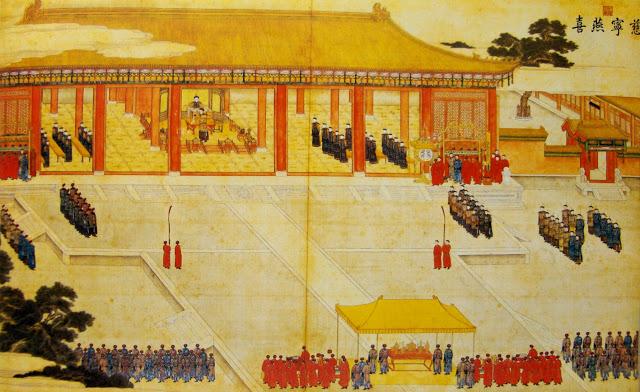
Mandate of Heaven
Essential to his case is that Confucianism and Daoism were in confrontation with the given world in affirming the ideal qualities of the Way, the governing principle of the cosmic and social order, and the “golden past” when the social order was thought to be in perfect harmony with the Way or the Mandate of Heaven. Roetz compiles many sayings by Chinese intellectuals which bespeak of public indictment and personal objection against the political order and the given behavior of men, starting with the “Collected Sayings,” Lunyu, of Confucius, which express “an ideal which contrasts with the reality of the time” (49). He cites passages with words such as these: “There are many rulers in the world, but only few of them are humane . . . Nothing is better than to make Heaven the norm” (57).
Roetz believes that, even though Confucianism became the orthodoxy of the state, this school was “far from advocating unconditional obedience.” Filial piety, a respectful and obliging attitude towards the elders of the family, and dutiful performance of one’s role in the social order were not blindly expected without considering the inner moral attitude of both subordinates and superiors. While Confucians were “far from formulating any alternative to monarchy,” they tried to “make change unnecessary by humanizing the existing system as far as possible and putting strong moral obligations on the powerful” (74-5). “The ideal is a monarchy with a virtuous, benevolently caring ruler who behaves in an exemplary manner” (81). It is not the ruler, however, who determines what is the ideal, but the Dao, and the “Confucian concept of the Dao, like the Daoist one, often refers to something not realized in the given world” (80-1). While Roetz acknowledges that the Chinese never developed a republican conception of government, and that their ideals “projected back to a Golden Age” (81), he believes the concept of the Dao, in itself, was “the most important cipher of the postconventional perspective of classical Chinese philosophy” (80).
Mengzi (Mencius, 372–289 BC), we are told, argued that a ruler is legitimate only insofar as he devotes himself “to the service of the moral possibilities which every human is endowed with by his very nature” (78-9). Roetz thinks that in Mengzi we already find the modern Western principle of natural rights, in view of his argument that rulers must not disregard the “innate good nature conferred to man by Heaven” (85). In Xunzi, or Xun Kuang (310–235 BC), he detects a social contact theory akin to Thomas Hobbes in the argument that hierarchical orders are necessary because this is the only way that the general interest of all men can be satisfied, since a society without different roles and orders would collapse into chaos, leaving men at the mercy of violence without security and livelihood. Mengzi, in giving precedence to the Dao over duty and obligation tied to roles and positions of persons in the community, was implying that “man . . . can in principle choose his way freely” because he is capable of judging the existing order from a detached standing and “of suspending his very interest in self-preservation” by doing what is humane rather than what those in power may prefer (154). He cites Xunzi – “[t]he heart is free and unrestricted in its choices” – as a clear expression of the Chinese belief that the human mind was free to choose and reject according to its own standards (160).
He insists that the Chinese idea of justice and of humaneness – in contrast to the conventional norms of filial loyalty and obedience – are “postconventional in that they do not refer to what is due to the role, but to the organization of the society as a whole” (118). “Humaneness is the higher norm, inasmuch as it helps to keep propriety uncorrupted” (123). “Humaneness is an extension of the natural compassion which every man will feel in view of the hardship and misfortune of others” (131). Roetz thinks that “humaneness represents a basic moral intuition” which transcends any specific cultural norm. The Chinese principles of fairness, the Golden Rule, is also grounded “in a region beyond social and historical values in a timeless formal rationale” (135). The Confucian Golden Rule – if I treat the other well, the other will treat me well too – should “hardly be understood in terms of group morality” because it speaks “in favor of universalism” in the way that it calls upon everyone to put themselves in the place of others, including “barbarians” (135-38). He cites Laozi, the founder of Daoism, or Lao Tzu:
Humaneness means to love others from one’s innermost heart. When a humane person rejoices in the happiness of others and cannot endure misery, then this comes from an uncontrollable emotion (144).
These kinds of expressions about the meaning of humaneness, Roetz says, take “no account of context, status, casuistry, and tradition, and represent the abstraction of the ‘other’ as a being of equal dignity like myself” (148). They are the declarations of “the self-reflected ego . . . and thus comprise the elements of autonomy and freedom” (148).
Insofar as Confucianism advocated “self-respect, self-strengthening, and self-examination,” a moral stand regardless of success or failure, a gentleman’s supreme concern with the Dao over any worldly success in a state of modesty, the Chinese held an ideal of the self standing in moral conviction without being “absorbed by the social environment” (161). Confucius says:
A scholar sets his heart on the Dao. But he who is ashamed of poor food and poor clothes does not deserve to speak with him.
To live on coarse food and water, and to have the bent arm for a neck support – joy is also in this. But wealth and high position, attained by unjust means, for me are like passing clouds (162).
We also hear Xunzi saying that inner conviction through “inner examination,” rather than “any external criterion,” should be the ultimate ground of one’s moral behavior. Mengzi, too, says that “to regard compliance as correct behavior is the way of wives and concubines.” He who dwells in humaneness:
. . . strides his way alone, who cannot be led to dissipation by wealth and high position, led astray by poverty and mean conditions, and bent by authority and power – such a man is called a great fellow (172).
Against Max Weber’s argument that Confucianism was a mere ethics of accommodation which “intentionally left people in their personal relations as naturally grown or given by relations of subordination,” Roetz believes the ideals contained in the principle of Heaven – benevolence, trustworthiness, justice – resembled the Western teaching of “two kingdoms,” the kingdom of God and the kingdom of Man, with the former in a constant state of tension with the latter, representing a critical impulse against unjust authority. We are told that the way Mengzi sets up an idealized concept of human nature “against the brutal politics of his time” is similarly characterized by a tension between the ideal and the real. His claim that human nature is inherently good represented a “challenge to the political institutions” to recognize this goodness and avoid treating humans as evil creatures in need of coercive disciplinary measures (198).
He believes that there is a rationalist mind at work in Xunzi’s argument that we cannot dispense with sage kings, propriety, and state order because human nature is evil. “Reason is the true pivot of Xunzi’s philosophy” in that it distinguishes the rational utility of the state from the natural inclinations of humans to do evil. Xunzi explains the necessity of strong institutions by following through the implications of human evil without a social order. Nature on its own produces chaos; humans agree to create institutions for reasons of social utility, because they calculate that humans without a state order, left on their own, without rules of propriety and hierarchical structures, would be in a state of constant quarrelling. He writes:
Quarrel leads into chaos, and chaos into misery. The early kings hated this chaos. They therefore established propriety and justice, in order to set up a division [of roles between men], meet their desires, and supply their demand (224).
Xunzi’s legitimation of the state was thus based on rationalistic-utilitarian principles similar to the contract social theories produced by modern Europeans. This standpoint, according to Roetz, is akin to the fifth stage in Kohlberg: a post-conventional stage that has not yet reached a universal ethical orientation, but which is nevertheless a rationalist account of the legitimacy of state rule in terms of rational standards agreed upon by individuals.
However, it is in Mo Di’s “utilitarianism” (or Mozi, founder of the Mohist school, 480-397 BC) that Roetz detects a fully developed rational theory of “the authoritarian state” built purely on self-interest and without any Confucian ideas about propriety and moral duty. The dictate of Heaven is for humans to build an authoritarian state, not because such a state is sanctified by tradition, but because it is the only state that is consistent with the self-interest of humans to overcome the chaos of nature, where there is no generally agreed upon distinction between right and wrong. Just as in Hobbes’ theory of the Leviathan state, it is human self-interest to enter into an agreement to live under an authoritarian state. Mo Di was “an uncompromising universalist” in proposing a general theory of the origins of the state that applied to all men, including “barbarians.”
We are told, actually, that Mo Di’s thought “is characterized by a far more radical detachment from tradition and custom than that which we detected in Confucius’s Golden Rule” (242). Mo Di sets up pure rational self-interest against “all established customs”; he sets up a “criteria of validity” for the existence of the state that is anchored on human reason. He is also “the first thinker of the Chinese axial age to recognize the necessity of giving detailed arguments for one’s position,” making him “the most important precursor of Chinese logic” (242-3). Both Mo Di’s and Xunzi’s arguments attribute “reasonable deliberation” to humans as such in their calculated utilitarian decision to agree to be governed by a state (269).

Daoist Temple in sinicized Australia
Roetz classifies “Daoist Naturalism” as “an enlightened postconventional perspective” for its “critique of the given order,” the “ethics of law and order,” and “the cardinal virtues of Confucianism” from the perspective of “an ideal primordial state” in which men were as pure as infants in their closeness to nature, uncorrupted by civilization. The ideal is that of man acting spontaneously and unconsciously in a good way, as an innocent child, without any guidance from conventional norms. Roetz detects in the Daoists the “carefree existence” exemplified in Kohlberg’s early post-conventional stage, the phase of youthful protest characterized by a radical rejection of conventionalism. While the Daoists did not formulate or develop a discourse with an orientation toward universal principles, Roetz thinks that their naturalism “undoubtedly contains the idea of universality” since it renounces the use of all living things as a means to a social end, and acknowledges the right of every living being to express its natural destination” (255).
“Breakthrough towards Enlightenment”?
Hegel was correct in his assessment that the Sittlichkeit, the ethical life of China, was characterized by “unreflected substantiality.” Not humans, but substances lacking in precision, the Mandate of Heaven, the Dao, were in charge of the norms, commanding individuals what to do. Much remains valid as well in Max Weber’s assessment that Confucianism was characterized by a this-worldly orientation sustained by a bureaucratic elite with vested interests in office and prestige, an elite preoccupied with the maintenance of order and the preservation of traditional rituals rather than the transformation of reality according to ideals determined by a transcendental mind. Before elaborating a bit more about the Western transcendental “I” that reflects about the way thinking determines for itself what it is to think, I will go over various qualifications, inconsistencies, and leaks in Roetz’s thesis which seriously weaken his argument.
Thomas Hobbes
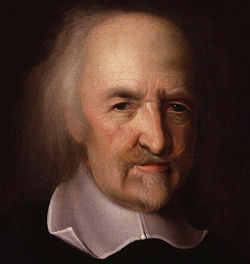
Thomas Hobbes
Roetz admits that in Confucius and his pupils “elaborate argumentation and giving reasons are missing” (47). Mo Di is the first and only thinker “to recognize the necessity of giving detailed arguments for one’s position” (242-3); and, in the end, Roetz admits that Mo Di does not build his case for an authoritarian state from the perspective of free contractual individuals deliberating about universal principles, but from the perspective of what he deems to be the self-interest of humans for order rather than chaos. It is true that Roetz refers primarily to Hobbes’s contractual theory and its appeal to self-interest or self-preservation as the ultimate reason for individuals foregoing their natural freedoms in the brutish state of nature, in the name of a Leviathan that would ensure order and longevity. There is a world of difference, however, between Mo Di and Hobbes.
The Chinese produced some geometrical calculations and showed some interest in spatial ordering, but there was no deductive geometrical thinking in China, whereas Hobbes began his incredible intellectual journey into a true science of politics with a thorough study of Euclid’s Elements. As much as Joseph Needham tried to elevate the mind of the Chinese and identify every contribution they made to mathematics, he could not but conclude that:
. . . there was an absence of the idea of rigorous proof, possibly as a result of the mental outlook which avoided the development of formal logic in China and which allowed associative or organic thinking to dominate (The Shorter Science & Civilization in China, Volume 2: An Abridgement by Colin Ronan of Joseph Needham’s Original Text, Cambridge University Press, 1995: 62).
Euclid impressed upon Hobbes the possibility that one could construct a rigorous argument about politics by building up one’s line of reasoning on the basis of very simple, self-evident propositions. What led Hobbes to his original innovation in political science was his absorption of Galileo’s law of inertia, from which point Hobbes came up with the idea that motion was the natural state of men, and that to develop a science of politics one would have to consider man as one kind of body in motion. He postulated that humans were self-moving creatures consisting of sense organs, muscles, imagination, memory, and reason, driven by the impulse to avoid death and to give satisfaction to their physiological appetite for bodily pleasures, riches, and power, with a rational capacity to deliberate about the best means to gratify one’s appetites. But since the desire or the strength of appetites differed among men, different men exhibited different levels of inclination for pleasure and power. Since every man was impelled to seek some resources and power, and some more than others, there would always be a competitive struggle for riches and power; everyone, including those men with a moderate desire, would be caught up in a perpetual and restless desire to satisfy their appetites.
It was from these two postulates, that every man shuns death, and that men are naturally engaged in an incessant struggle for power, that Hobbes rigorously reasoned that men would live in a state of perpetual conflict in a state of nature in which there was no common authority to restrain this struggle and penalize those who engaged in violent dispossession of others. Only their fear of death persuaded men capable of reasoning about their interest in self-preservation to agree to give up their natural right to pursue power as they pleased and make a contract with a supreme authority delegated with powers to ensure the peaceful pursuit of men’s desires.
There is a world of difference, conceptually, between observing that men prefer order over chaos and employing a method that relies on both inductive generalizations about the behavior of men and on self-evident premises for the deduction of a full-fledged theory about the necessity of an authoritarian state. Hobbes knew what Aristotle had already explained in his Logic that the premises of a science ought to be self-evident and that a deductive argument cannot convey more information than is implied in the premises if the conclusions derived from the premises are to be as self-evident as the premises. Hobbes’ argument was not without flaws. He uses the words “appetites,” “power,” “riches,” and pursuit of “honor” interchangeably. While a reasonable argument can be made for the conflation of the first three words, the pursuit of honor, as we learn from Plato, is not about the satisfaction of a bodily appetite or pleasurable acquisition of riches, but about the spirited side of the soul and its desire for respect and honor as a man and as a member of a group.
Max Weber
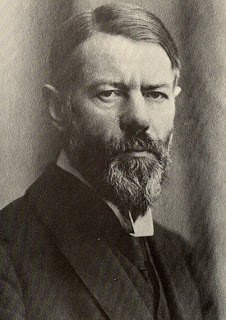
Max Weber, the greatest sociologist
Mengzi’s argument that humans are naturally good is not “equivalent” (78) to the Western concept of natural rights. It is a stretch to extrapolate from Megzi’s argument that humans are born with goodness in their hearts the argument that humans are endowed with natural rights which the state should not violate. Europeans only developed a theory of natural rights in the modern era, out of the Roman concept of natural law. While some Chinese scholars have argued (in ways that are rather contrived and beg questions) that concepts of natural law can be found in Chinese thought, no one has demonstrated that the actual Chinese system of law, rather than a few passages from a few thinkers, contained this concept, never mind the concept of natural rights. While I am aware that scholars have been hard at work trying to demonstrate, for example, that “by the time of the Ch’ing dynasty (1644-1912), China’s legal system approximated Weber’s substantively rational type more than the substantively irrational type,” they can’t explain why such an “approximate” system of rational law could have arisen in a society devoid of any parallel development of Laws of Nature. Roetz, in any case, does not engage with any of these debates, but prefers to cite certain expressions in this or that Chinese thinker with vaporous claims about how they “remind” him of the Western principle of natural rights, going as far as to cite ancient Chinese sayings “reminiscent” (269, 115) of John Rawls’ twentieth-century theory of justice!
It is hard to envision exactly how China produced experts in jurisprudence and rational law when, in the words of Weber’s still valid assessment, “the Chinese examinations did not test any special skills, as do our modern national and bureaucratic examinations regulations for jurists, medical doctors, or technicians” (121). Or when:
Chinese philosophy itself did not have a speculative, systematic character, as Hellenistic philosophy had . . . Chinese philosophy did not have a rational-formalist character, as occidental jurisprudence has . . . Chinese philosophy did not give birth to scholasticism because it was not professionally engaged in logic . . . The very concept of logic remained absolutely alien to Chinese philosophy, which was bound to script, was not dialectical, and remained oriented to purely practical problems (The Religion of China: Confucianism and Taoism, Free Press, 1968: 121, 127).
In recent decades, sinologists have been desperately trying to discredit Weber’s Religion of China (originally published in 1915) while portraying his comparative historical work as an addendum to Marx’s historical materialism. But our sophomoric multicultural academics can’t withstand Weber’s commanding conclusion that in China:
. . . there was no rational science, no rational practice of art, no rational theology, jurisprudence, medicine, natural science or technology; there was neither divine nor human authority which could contest the bureaucracy (The Religion of China, 151).
As it is, Roetz, for all his efforts to the contrary, towards the end of his book confesses that Chinese ideals were merely intended to “safeguard” the “conventional ethos” of the existing order, “not to be played off against” it (123), a view close to Weber’s own assessment. Roetz’s observation that “Confucians typically try simultaneously to keep faith with the conventional ethos and yet not to surrender to it . . . accept the role obligations towards family, community, state, friends, etc., but impose restraints on these to prevent their degeneration into blind conformity” (268), is inconsistent with Weber’s interpretation. For Weber, Chinese ideals were not in a state of confrontation and tension with the conventions of the Chinese order; the Confucian ideal about the perfectibility of the gentleman was not about remaking the world, but about sustaining the ideal qualities of the governing principle of the cosmic order and the golden past. Weber thus wrote about how:
. . . the conventionally educated man will participate in the old ceremonies with due and edifying respect. He controls all his activities, physical gestures, and movements as well with politeness and with grace in accordance with the status mores and the commands of propriety, a basic concept of Confucianism . . . “Cultivated man” . . . is a man who is both inwardly and in relation to society harmonically attuned and poised in all social situations [ . . .] The corresponding individual ideal was the elaboration of the self as a universal and harmoniously balanced personality . . . For the Confucian ideal man, the gentleman, “grace and dignity” were expressed in fulfilling traditional obligations (emphasis mine, The Religion of China, 156, 228).
Roetz wants to force his students to believe that Confucianism was a “postconventional” philosophy, but he can’t deny that “Confucianism accepts the given world,” and that the principle of humaneness was intended to “moderate” the injustices of the government, not question its conventional ethos.
Confucianism cannot really take its leave of the world of subordination and inequality. Wherever necessary it restrains the ruling powers, but it hardly disputes their position which invites abuse. This means that the potential of its postconventional, egalitarian, moral side does not really win out over the conventional side which basically accepts the given structures as they have always been [. . .] This potential is hardly employed to bring about structural change, but primarily to make the given world more human and prevent the necessary fulfilment of customary duties from its degeneration into opportunism and corruption (The Religion of China, 277, 279).
Conclusion: A Note on Transcendentalism
It is impossible to break with unreflected substantiality without reason being aware of itself as that through which all claims must be ascertained. Roetz uses words from Schwartz to define transcendence as “a kind of standing back and looking beyond, a kind of critical, reflective questioning of the actual and a new vision of what lies beyond” (273). But this definition is inadequate. If this “reflective” questioning is based on authoritative precepts which have not been grounded through reason by humans who are consciously aware that they are reason’s own creations, then we can’t talk about transcendence. The history of the uniquely transcendental quality of the white mind has yet to be written, and I am not going to pretend that I have adequate knowledge about it other than to note that the German Idealists have been at the forefront of writing about the “self-grounding” of reason as a form of transcendentalism that is about thought grasping itself as the ultimate legislator of truth for which nothing external (faith, revelation, the Dao, the Mandate of Heaven, poetic inspiration) is authoritative, since only reason can grant authority.
I am thinking of German Idealists such as Kant, Fichte, Schelling, and Hegel. What Hegel observed about Chinese thought is not that it was devoid of reasoning and ideals, but that its thinkers were still absorbed in their natural and social worlds. Chinese thinkers were not self-conscious about their own thoughts, but remained in a state of tutelage following customs, rituals, and mysterious forces in Heaven without being aware of the self-legislating character of reason. Weber did not write about the self-grounding of reason, but he, too, did not say that China was “substantively irrational,” but, rather, that “Confucian rationalism meant rational adjustment to the world” (248), not rational mastery of the world. “The power of logos, of defining and reasoning, has not been accessible to the Chinese” (125). Chinese “intellectual tools remained in the form of parables, reminding us of the means of expression of Indian chieftains rather than of rational argumentation” (127).
Logos comes from a verb meaning “to speak” and refers to the words that a speaker uses to back up a claim in a disputation. It refers to discourse that is backed up by reasons. Logos means “rationale” or “argument.” Much of what Chinese philosophers have said are assertions, not arguments. Aristotle was the highest point of the Greek logos in his systematic efforts to explain what standards must be employed to decide what knowledge is. Knowledge is giving a reason, giving an account of why we believe what we believe, offering premises for a conclusion, and defining the basic terms making up our statements. But it is more than that. It is reason becoming aware of itself as the agent giving the criteria as to what constitutes a rational argument and deciding what is to be truthful.
By the time we get to Kant, we have a philosopher realizing that the “I think” is the agent that accompanies all the experiences and representations of the mind, and that there is nothing underneath or below the “I think” determining what is to be believed, since all representations (substances, premises, faith, received tradition) obtain their authority through the thinking “I.” The categories of Kant’s philosophy are transcendental because they cannot be perceived, but are presupposed by reason independently of experience; they are reason’s own creatures. Kant, however, thought that the categories could not be extended beyond the limits of possible experience, and that we could not, therefore, know things-in-themselves, the ultimate nature of things, or God, the soul, or ultimate causes; not even the transcendental subject could be known, since it is not itself an object of sensory experience, but is something presupposed by the fact that of all the representations of the thinking “I” cannot but be the representations of a thinking “I” conscious of its mental experiences.
But this means that Kant left us with something that is accessible only to thinking, which cannot be defined as an external object in charge of thinking, since it is beyond experience and a creation of the mind. It is the mind that gives itself its criteria for thinking about things, and in thinking about this, the white mind came to grasp itself as the ultimate authoritative agent. This was not the traditional, pre-critical rationalism of Spinoza and Leibniz, since Kant denied that the categories produced by the thinking subject could reveal the nature of reality as such. Kant also argued that freedom could only be attributed to the human person, since only a person can act according to principles uncaused by anything other than his own self-legislating reason against the urging of the senses, received tradition, or any external authority. Only a human being can freely act on self-legislating reasons about what ought to be done. I would add that history demonstrates that only whites have acted in this self-authorizing way because only they became aware – fully after Kant – that their thinking “I” is the only thing in the universe (beside the ultimate cause of all things) that can be unconditioned, and that only the thinking “I” can determine what there is and what can be known, and that nothing can be made true outside the judgements of reason.
Evolutionary psychologists are wrong when they say that thinking must be understood as an activity that is grounded on – or dependent on – outside biological forces, for any appeal to the “objectivity” of natural selection can’t be separated from the inside judgement of reason’s grounding of this theory. This should not be confused with the claim that reason creates the external world. The claim is that our understanding of natural selection and ability to propose morals for action are expressions of the self-conscious nature of white thinking. It was only in the thinking of Europeans that the nature of natural selection emerged and that thought grasped that natural selection, which had hitherto worked blindly and without our awareness, can receive authority only through thinking itself. Nature reached its highest goal of becoming an object of knowledge and learning what it is through the reflections of Europeans.
This article was reproduced from the Council of European Canadians Website.
5 comments
How strange then that China, having supposedly evolved such a refined and superior philosophy, has discarded it in favour of the crudities of Marxism-Leninism.
In a way, Marxism is a perfect fit for them. It reminds me of what Fichte wrote, that it depends on the type of man what sort of philosophy he will embrace – the chief choice being between materialism/determinism and spirit/freedom. The Chinese naturally chooses the former.
—“For Hegel, ancient Greece was a culture still embedded to extra-rational norms….Socrates represented defiance against the gods, but he did not argue that humans have a “natural right” to disagree and oppose the consensus of the city-state, the common will of the polis.”
Yes, but after Socrates, and after the Greek the city-states/polis lost their independence to the Macedonian empire, and afterwards to Rome , we see the rise of “individual-centered” ethical systems, as Stoicism and Epicureanism, which stress precisely the “autonomous reason independently of the pressures of in-groups and cultural particularisms” and base their ethics on the an universal transcendent reason (Logos) which rules all reality and which man’s mind (which is itself a bit of this universal reason) is capable to apprehend and follow.
The Stoics go on to apply these principles to everyone endowed with reason (man or woman, slave or free) and to develop the idea of “the citizen of the world” (cosmopolitanism). The man who is at home everywhere, who is the citizen of all cities and none, since his morality, the way he behaves, is grounded in reason and his ultimate loyalty is to Logos.
This development of the ancient Greek ethical thought is believed to have been forced upon Greeks by the loss of the independent polis (of the political community and thus of the ethics which had the conventions and the good of the community as its ultimate goal- telos).
Stoicism and Epicureanism are apparently opposed each other but their opposition has to do with the lifestyles which they propose. In their premises though they are both individualistic-ethics and they are both meant to help the individual Greek to orient himself morally in the “post-polis” world were he is now alone by himself since he has lost his political community.
Ricardo is a great thinker but Westerners should just read the Analects by Confucius rather than imposing Western understandings on what Confucianism is. The Analects is based on honoring the ancestors and being loyal to family and friends. It’s basic common sense that Westerners should learn from. I don’t even know how Western identitarians could nitpick Chinese people about those habits as if there is something superior that Westerners have been doing recently. Westerners need to learn to be loyal to their families again.
And yet the Chinese civilization was one of most static and stagnant ones in human history. If not for various outside influences, their Confucian empire might as well have been going on substantially unchanged for hundreds of thousands of years… Yes, there is value in loyalty and in honoring the past, but the unquestioning obedience to static outside authority is utterly incompatible with the Promethean/Faustian nature of the Aryan.
Comments are closed.
If you have a Subscriber access,
simply login first to see your comment auto-approved.
Note on comments privacy & moderation
Your email is never published nor shared.
Comments are moderated. If you don't see your comment, please be patient. If approved, it will appear here soon. Do not post your comment a second time.