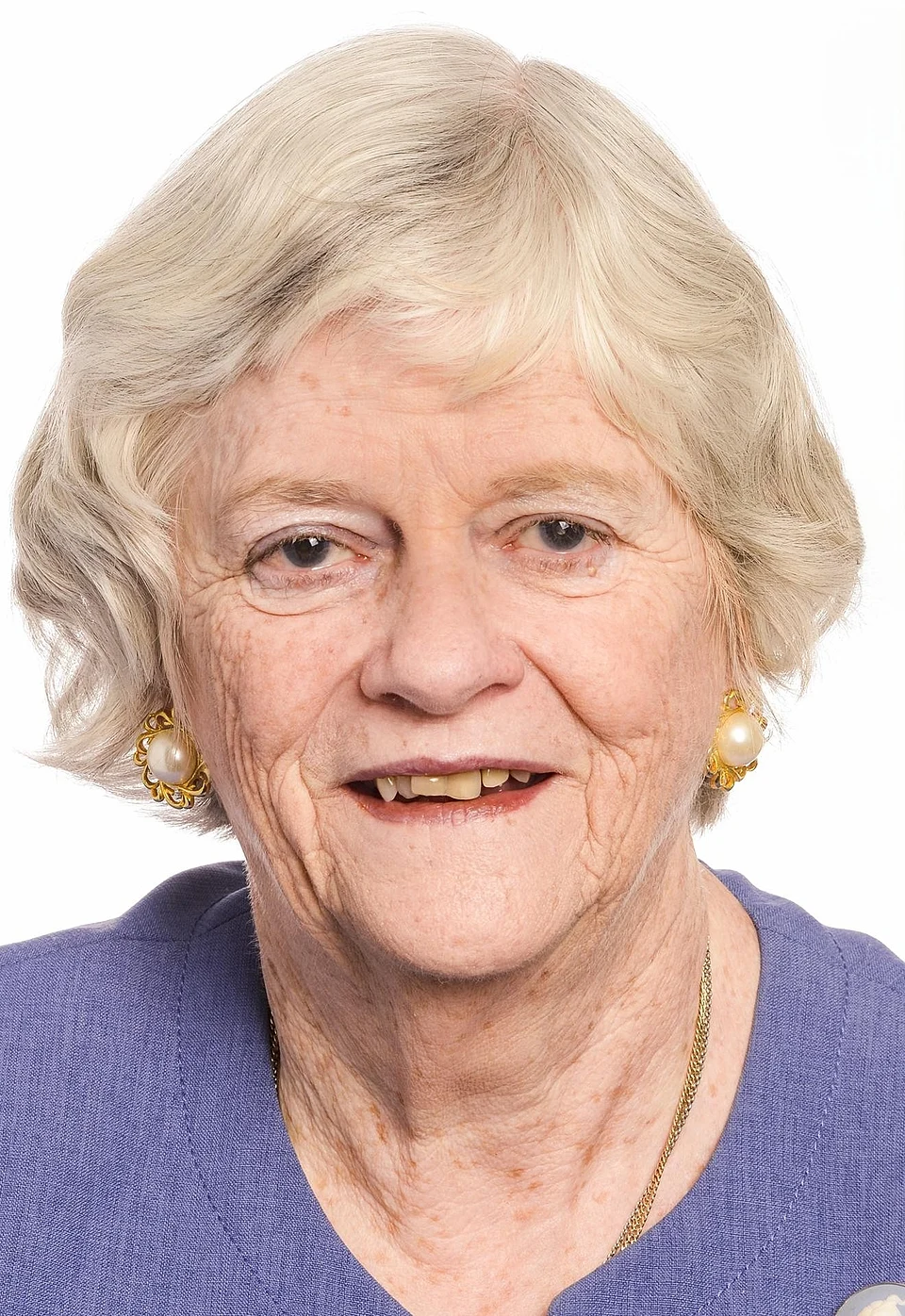
Official Portrait of Ann Widdecombe. EU Parliament, 2019.
1,090 words
Ann Widdecombe is dead, and what has emerged since should unsettle anyone paying attention to the state of political discourse in the West. Her death was confirmed Friday morning by her management, after she was found dead in her isolated rural home near Haytor, on the edge of Dartmoor National Park. Police believe she was attacked around 12:30pm the previous Wednesday, having failed to appear for a scheduled TV interview that afternoon. A 28 year old man was arrested on suspicion of murder in South Yorkshire on Saturday. Initially, police said there was nothing to suggest a terrorism link. That has now changed. Counter Terrorism Policing has taken over the investigation, and the suspect has been re-arrested on suspicion of commission, preparation or instigation of acts of terrorism.
Before she became a fixture of panel shows and reality television, she held real power, and used it in ways that made enemies rather than friends. Elected to the Commons in 1987 for Maidstone, she rose through the Major government to Minister of State for Employment in 1994 and then to the Home Office as prisons minister the following year, a posting that put her in direct confrontation with a boss she came to despise. Michael Howard’s dismissal of prison service chief Derek Lewis, after a string of escapes at Parkhurst, blindsided her, and she resented being made to answer publicly for a decision he had made over her head. When Howard stood for the party leadership after the 1997 defeat, she took her revenge in the Commons, remarking that there was something of the night about him, a single line that stalled his campaign and helped hand the leadership to William Hague instead. It was not a comment made lightly. It came from a minister who had watched a colleague absorb blame while her boss escaped scrutiny, and who decided the ledger needed balancing in public.
Hague brought her back a year later, first as Shadow Health Secretary and then as Shadow Home Secretary, a post she held until Iain Duncan Smith took the leadership in 2001 and she chose the backbenches over a place in his frontbench team. She stayed there until she retired from Parliament in 2010, by which point twenty-three years in the Commons had turned her from a junior minister at Employment into one of the most recognizable Conservatives in the country, admired by people who had never voted Tory and distrusted by some who had.
Widdecombe spent four decades as the person the British Left loved to hate, and she earned the distinction honestly. She never dressed her positions in euphemism. On sexuality she held to a traditional, unfashionable line, and was called homophobic for it more times than she could count. She did not recant. On women’s ordination she made an actual decision rather than a complaint: when the Church of England moved to ordain women priests, she left it, converting to Catholicism rather than staying to fight a battle she considered lost. That is not the behavior of someone looking for a culture-war platform. It is the behavior of someone who took doctrine seriously enough to change churches over it.
She was equally unfashionable on #MeToo. Widdecombe argued that women who associated with men they knew to be predatory, in pursuit of career advancement, had made a choice, and that dignity was something you protected yourself rather than outsourced to public sympathy afterward. It was a brutal argument. It was also, unlike most of what passed for commentary at the time, an argument rather than a mood.
On higher education she was a heretic of a different kind. She opposed the mass conversion of polytechnics into universities and had no patience for grade inflation, on the grounds that a university degree meant nothing once everyone had one. She thought universities existed to educate the genuinely academically gifted, not to serve as a holding pen for eighteen-year-olds with nowhere else to go. It is not a popular position. It has also, twenty years on, aged rather well. She took the same view of welfare, arguing that a system designed to catch people who fall was, in practice, teaching people never to try to stand. She thought dependency bred cowardice rather than resilience, and she said so in exactly those terms.
On energy she was equally out of step with consensus, and vindicated by time in a way most contrarians never live to see. She was one of only five MPs in the Commons to vote against the Climate Change Act 2008, a decision that marked her out then as a crank and looks now like foresight, given that the framework she opposed helped lock Britain into the energy policy that has left the country with some of the highest electricity prices in the developed world and a manufacturing base hollowed out by the cost of power. She did not need twenty years of blackout warnings and shuttered smelters to see it coming. She saw it in 2008, voted accordingly, and was one of five people in the room willing to say so.
In her later years she became one of the most recognizable faces of the Leave campaign, then a Brexit Party and Reform figure, consistent in arguing that immigration policy should be run for Britain’s benefit rather than the applicant’s, admitting people with skills the country was short of and little else. It was the same instinct running through everything: policy should be judged by outcomes, not by how virtuous the stated intention sounded.
None of this made her popular in the rooms that decide who gets called reasonable. It made her essential in the rooms that don’t. She was indefatigable, and she never once apologized for being disliked by people whose good opinion she had no interest in earning.
That a woman who spent her life arguing in public, occasionally viciously, is now dead, and that the news produced celebration in some quarters rather than even a pause, says something about where things stand. A political culture in which a share of the public reaches for glee rather than silence at the news of a violent death is a political culture with something wrong in it.
She was, for what it’s worth, the political love of my life. Contrarian, immovable, occasionally infuriating, and completely without the instinct for self-censorship that has hollowed out most of what passes for conviction now. The argument she spent forty years making, that some things are true whether or not they are welcome, doesn’t die with her. It shouldn’t.
9 comments
I was quite taken aback at the news of Ann Widdecombe’s death that morning as I saw her on TalkTV just a couple of days before and she seemed as healthy and sprightly as ever.
Then came the tragic news of the nature of her death and it sent a chill down my spine, having clicked on Sky News webpage as I do several times a day, I couldn’t believe it.
I mean, why? She was no longer a frontline politician, she was for all intents and purposes retired – though was always willing to lend a hand with a speech for Reform UK wherever in the country it happened to take place – and despite being a somewhat controversial figure for the mainstream sensitivities wasn’t exactly the kind of person any longer that someone would want to target for such violence.
The part of the country she lived in, Dartmoor, is known to be beautiful, peaceful and safe. It beggars belief that something like this could happen there, if you’ll pardon the cliché.
Unfortunately, her address was quite well known in the area and had been pictured in the MSM for a profile on Ann previously. I can’t imagine this is anything like a “robbery gone wrong” scenario given that someone made a trip from South Yorkshire in the North-East of England down to the South-West. I believe this was political.
I’m not one of these people who believes everything is a conspiracy, but some are speculating that she could’ve been “taken out” by the establishment after allegedly claiming there was a power structure of elites above the goverment who really run the country not long before her untimely and brutal demise. RIP Ann.
The “Socialist Workers’ UK ” website have been crowing about this. Whoever did it is immaterial. Can you imagine the last few moments of this poor woman’s life?
I bet she was killed by a black. I hate blacks, don’t you?🦈
Not necessary a black, more likely, a moslem. Their numbers are excessive in current Britain, and kinds of political violence they perpetrate are somewhat different.
If you are not White, you are just another shade of ni@@er as far as I’m concerned. 🦈
For what it’s worth, police have described the suspect as white and British.
Yes. They announced this basically immediately and then arrested a 26-year old White British man and then had to release him the next day which suggests they arrested a man in one of the Whitest parts of England for being a young White man. Absurd, I guess all of us Whites look alike? xD
Excellent article.
Well written. Anne Widdecombe was an embodiment of the true Britain. In a sense this was but a few steps removed from murdering King Charles – an attack on a symbol as much as a person.
But the real question is what’s happening as a result? Are there any retaliatory attacks on leftist scum?
If you have a Subscriber access,
simply login first to see your comment auto-approved.
Note on comments privacy & moderation
Your email is never published nor shared.
Comments are moderated. If you don't see your comment, please be patient. If approved, it will appear here soon. Do not post your comment a second time.