 3,566 words
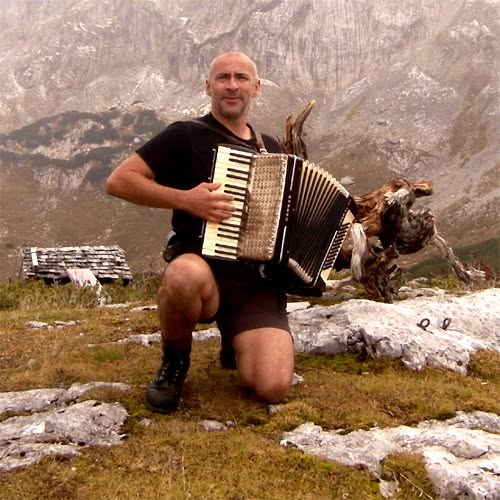
Gerhard Hallstatt is an Upper Austrian musician, photographer, and writer, though he currently focuses primarily on music with his experimental band Allerseelen. He previously served as the publisher of the small but influential underground magazines Aorta and Ahnstern, using the pseudonym Adam Kadmon. These limited-circulation publications focused primarily on esoteric philosophy, magic, sacred architecture, art history, and cultural poetry, as well as half-forgotten National Socialist artists and occultists. In the 1980s, Petak served as the drummer for the ritual-ambient group Zero Kama. He also briefly performed as a drummer with the Orgien Mysterien Theater (Theater of Orgies and Mysteries) of the provocative Austrian avant-garde artist and Viennese Actionist Hermann Nitsch.
He later published a selection of articles and interviews from these magazines in his book Blutleuchte. The book features interviews with Kenneth Anger, Varg Vikernes, and Z’EV. An English translation of the book has been published, and a Russian translation is currently in the works. Let’s hope that a German edition will be published one day as well. Have you ever wondered if men like George Gordon Byron still exist in today’s world? Well, yes, men like that are still among us—you just have to look a little closer. Gerhard is proof of that!
Ondrej Mann: What does your name, Adam Kadmon, mean?
Gerhard Hallstatt: I am no longer using this name nowadays. In my youth, I was fascinated a lot by magic and occultism. I was also fascinated by the Kabbala with its neoplatonic numerology and philosophy of being able to use numbers to understand and also change reality. In a book on Kabbala, I came across the name Adam Kadmon as synonym for a universal man that unites in himself all the contraries and opposites, a manifestation of the coincidentia oppositorum. This idea fascinated me. I chose this as name when I was 19 as I felt that my own character was full of contradictions too. One still may hear this from time to time in my music and read it in my texts. This reminds me of a quotation by Pier Paolo Pasolini, a film-maker and writer I feel close to: “One has to be really contradictory to be really consequent.” Allerseelen is November 2nd, this is the day when Pier Paolo Pasolini was murdered. When I moved to Vienna at an age of 19, almost everybody called me Kadmon. Maybe 19 years later I again started using my real name Gerhard.
OM: I know you enjoy traveling to various sacred places in Europe. What interesting experiences have you had at these places? Do you have any travel stories to share with our readers?
GH: Yes, I visited some wonderful sacred places in several countries. But it would take too much time to talk about all this in detail. I have a lot of handwritten travel diaries—it will take a lot of time to type and edit them for a possible release one day for German and also non-German readers. Kutna Hora in your country for example was a fascinating experience for me which made me think of the Capuchin Crypt in Rome. When I was in Kutna Hora, I took a lot of photographs that I later used for a video for the Allerseelen song “Wo ist das Leben” (Where is Life) based on words by the Austrian painter Alfred Kubin that he had written in his novel Die andere Seite (The Other Side). I also visited a lot of Mithras temples in Austria, Germany, Italy, Slovenia, Croatia and wrote about these in a chapter in the Blutleuchte book. In Ostia Antica, I visited all the Mithras temples there – there are 18 of 20 of them at close range. Actually I intended to sleep at night inside one of the Mithras temples as I love the concept of the temple sleep that was a certain ritual in antiquity. Unfortunately this was not possible as there is a night guard taking care of the site. So I slept outside the Ostia Antica area. I have not yet finished my text about this experience. But when it is finished, it will again have this quality of the coincidentia oppositorum—as most of my texts are a synthesis combining personal impressions with historical facts. They are thus somehow poetical essays. Sometimes I also combine science and fiction. Sometimes I also quote from my dream diaries. Modern Ostia is also the place where Pier Paolo Pasolini was killed—this place also was important for the music group Coil which I appreciate a lot. I also wrote a couple of years ago a narration about the magical Capuchin Crypt in Rome which is quite similar to Kutna Hora. The narration is called Mönch und Mörder (Monk and Murderer). Some time ago I recited this narration and recorded some ritual music for this. This narration is another example of this coincidentia oppositorum combining history, legends, poetry. It will be published soon as Allerseelen recording.
OM: What fascinates you about the light of blood (Blutleuchte), the Aorta (your magazine), and everything related to blood?
GH: I am not fascinated by “everything related to blood” although some might have this impression due to my use of the word Aorta for the Allerseelen record label and the word Blutleuchte as title for my book. In my magazines Aorta and Ahnstern I wrote about a lot of different artists, musicians, myths, rituals, traditions. So when there was the plan to publish all these 29 texts and interviews—20 Aorta issues, 9 Ahnstern issues—in a book it was not easy to find a key word, a kind of “umbrella” that might be an expression for all these manifold interests and topics, these different contents and chapters that again are a manifestation of this coincidentia oppositorum. In these years I was obsessed for weeks or months by a certain theme and then I got obsessed by something else which sometimes was completely contrary. I always liked a specific Friedrich Nietzsche quotation from his Zarathustra that I used several times, also in the booklet of the Allerseelen CD Abenteuerliches Herz (Adventurous Heart): “Of all that is written, I love only what a person hath written with his blood. Write with blood, and thou wilt find that blood is spirit.” As blood plays an essential role in the texts that I wrote about the stigmata of Therese von Konnersreuth, the Good Friday drums of Calanda in Spain, about the Blutleuchte cult by Alfred Schuler and Ludwig Klages in Germany and also in my text about and my interview with Blood Axis, I finally decided to use the word Blutleuchte (Blood Lamp) that is a symbol that was often used by the members of the small Kosmische Runde (Cosmic Circle) in Munich, philosophers and writers that were close to the Stefan George Kreis (Circle). For them, it was a symbol for the mystical and mythical power of life that existed in antiquity and paganism but got almost lost in all these centuries. Especially Alfred Schuler (1865-1923) felt and behaved like a Roman being born in the modern world. He was also buried dressed like a Roman. Rainer Maria Rilke listened to some of his readings and was impressed a lot—and some Blutleuchte ideas also appear in his poems.
OM: Could you elaborate a bit on your relationship with Hermann Nitsch? Did you experience anything interesting with him?
GH: I met the Viennese actionist Hermann Nitsch several times and interviewed him two times, once in a Kaffeehaus in Vienna and once in his castle in Prinzendorf in an area named Weinviertel (Wine Quarter) in Lower Austria that is surrounded by wine yards. He also was a producer of organic wines. I participated also in two performances as drummer and activist. I once had two kettle-drums with me. At the first event there I also met members of Laibach who had been there as guests. I was impressed by his Orgien Mysterien Theater when I was very young. The entrance to these events was usually quite expensive so I liked the idea of participating in some live performances as I then could enter the castle for free. In the first interview I asked him about the importance of art. In the second interview I asked him about enigmatic Rudolf Schwarzkogler, another important Austrian artist who committed suicide at an early age. This interview was printed in my Aorta issue on Schwarzkogler and also in the Blutleuchte book editions. Though Rudolf Schwarzkogler was not a real actionist as he almost never performed in front of an audience but basically worked as photographer in his studio. He was usually behind the camera, the person with the bandages and razors and other objects was Heinz Cibulka who is still alive. Rudolf Schwarzkogler reminds me more of the introvert mystic Austin Osman Spare, whereas Hermann Nitsch makes me think more of an extrovert magician like Aleister Crowley with all his positive and negative aspects. The Orgien Mysterien Theater was and still is—after the death of Hermann Nitsch—an interesting symbiosis of the modern art world and the Dionysian mysteries of antiquity—which fits fine with the combination of blood and wine. It is also a coincidentia oppositorum: On one hand Hermann Nitsch was a revolutionary avantgardist quite close to the Gesamtkunstwerk of Richard Wagner. In his outer appearance and character he was also in my eyes close to the long-bearded Austrian patriarchs, philosophers and visionaries of the nineteenth century. But on the other hand a lot of his performance art—that involved often hundreds of participants and sometimes even a tank that was lent to him by the Austrian army—would not have been possible without public funds from the social-democratic Austrian state. I never wrote about Hermann Nitsch but I wrote about Rudolf Schwarzkogler and interviewed those who knew him well. Especially in-depth was for me the meeting with his girl-friend.
OM: You were the first to put forward the theory in your article: Oskorei that Norwegian black metal marked the awakening of Wotan. It’s a very original theory compared to the Left-wing arguments that social conditions and poverty were to blame. It can easily be refuted. Do you have any thoughts on this? How did you come up with it back then? What was your relationship with Burzum and Varg Vikernes’ writings? You were one of the first people to write about him and his music. . .
GH: As I was born on the country-side in Upper Austria, close to the Alps, I was always fascinated by the dark and sometimes violent fairytales of the Alps. Especially the wild hunt was a phenomenon that was full of mysteries—some researchers thought it to be an allegory of storms, thunderstorms but other researchers had the theory that this wild hunt actually was a secret ceremony of young men in the villages. I also read a very interesting interview with an old man in the Baltic area who had been a werewolf for some decades and spoke about his experiences. When I moved to Vienna, I suddenly had access to dozens of books about Austrian and European folklore and traditions, and I started doing some research on this and the different explanations by different folklorists about this. I felt fascinated by the theory that young men with furs, horns, masks, sometimes sober, sometimes drunk, created in the dark days of winter certain rites that were some kind of psycho-terror and sometimes real terror against the population on the countryside. Basically I listened a lot to industrial music and later ritual music. When I got to know Black Metal, I was impressed by its atmosphere and aura, its synthesis of melancholy and violence. Most black metal compositions are in minor. My first black metal record was Det som engang war by Burzum. In the huge vaults of the Österreichische Nationalbibliothek in Vienna, I came across some books describing similar dark and demonic winter traditions also in Norway in the nineteenth century. Easily I found a lot of analogies between Alpine and Norwegian traditions—and also found a lot of apocalyptic elements that also manifested in Black Metal. When Varg Vikernes of Burzum was in prison because of murder, I contacted him and made a long interview with him via mail. I got his address from Misanthropy Records who released many of his recordings. I knew well the woman who had founded this label: She loved Burzum as much as Allerseelen, so it turned out very easy to get access to his address in prison. This Aorta issue named Oskorei with the Varg Vikernes interview was most probably the best selling of all Aorta issues. The interview turned out very long and very much in-depth. He answered to my questions in two letters. The interview is also enclosed in the Blutleuchte book. When the French edition of the Blutleuchte book was published years later, I sent to his mailbox in France a copy of the English original and the French translation. But I never met him in person.
OM: Michael Moynihan later used this thesis about the awakening of Wotan in his book: Lords of Chaos. Do you have any memories of this book and of this writer and musician?
GH: I read Lords of Chaos a long time ago and appreciated it a lot. Maybe my text was also one of many inspirations for his researches. I know that there is also a movie about the events but I never watched it and very probably will never watch it. I know Michael Moynihan well, we often met when he stayed in Austria. He even was on stage with Allerseelen when we performed live in Seattle in 2003—there were three members of Blood Axis on stage with me, drummer Markus Wolff, bassist Aaron Garland and for some songs also Michael Moynihan with his bodhran drum. Blood Axis and Allerseelen also did a lot of concerts together in several European countries, I also recall well the concert that we did in Prague together although it took place so many years ago. I definitely wrote about this in my travel diaries too.
OM: Why do you use the last name Hallstatt? Does it have anything to do with the Hallstatt culture? I know your albums always have a cohesive story and a concept. What is the concept behind your album Hallstatt? Could you tell us a little about pre-Christian culture in Austria and how it has influenced your music?
GH: Yes, of course. I was born in Upper Austria, in a small town not that far away from Hallstatt. So these are my roots. I was also fascinated by the importance of the Celtic culture named Hallstatt with all its tombs full of burial objects—jewellery, swords, tools—and also the beautiful village surrounded by lakes and mountains which nowadays is unfortunately an incredibly touristic attraction visited by people from all over the world. Someone in China rebuilt Hallstatt – maybe one day I should visit this artificial place. I also was in love with the painted skulls in the ossuary of this little village—for many years the skulls of the dead were painted with flowers or tools or also serpents. There is also a famous finding from Hallstatt—a beautiful artwork of a cow. I used this Hallstatt cow as cover for the Allerseelen white vinyl 7” Edelweiss / tjo tjo tjo di ri. And there is also another interesting reason in choosing this as pseudonym: “Hall” is the German word for “sound,” and “Statt” means “site” or “place”—thus signifying a direct association with the world of music. Hallstatt means a lot of things to me. It would be the perfect name for an Austrian music studio. All these themes—history, tradition, death but also love—are also the spiritual background of the Allerseelen CD Hallstatt. Pre-Christian cultures in Austria did not directly influence the music or lyrics for Allerseelen. But due to my obsession for the demonic masks of the alpine Perchten, I contributed several songs to the alpine folk project Sturmpercht based in the south of Salzburg. Only one or two songs by Allerseelen have a direct connection to these pre-Christian cultures—one example is “Rauhnachtmaske” (Raucous Nigh Mask) For this song I also used the sounds of a dolmen named Klumperplatte in South Tyrol that had been a part of Austria for several centuries.
Allerseelen 7″ Edelweiss tjo tjo tjo di ri
Allerseelen: Rauhnachtmaske (Klumperplatte Remix)
OM: Was there something like a neofolk scene in Austria? Could you describe the main bands and projects? Do you have any memories of Albin Julius and his band Der Blutharsch?
GH: The main bands were and partly still are Der Blutharsch, Novy Svet and Sturmpercht. But Der Blutharsch were never really close to neofolk—in the beginnings, the project was too military and later too much stoner rock. Novy Svet are no longer existing, and Sturmpercht seem to be in a Dornröschenschlaf (Little Briar-Rose Sleep) for a couple of years. There are of course other projects but I cannot describe all of them. Allerseelen is always named in this neofolk context although I do not see a real connection as my main inspiration was industrial music of for example SPK and Throbbing Gristle and the military pop of for example Deutsch Amerikanische Freundschaft. I spent a lot of time with Albin Julius. The Moon Lay Hidden Beneath a Cloud and Allerseelen also performed together in Switzerland and at Wave Gotik Treffen in Leipzig. With Albin I was also on the highest mountain of Lower Austria, the Schneeberg that is 2000 meters high. Unfortunately he died far too young. One day after his death, I met in the woods around Vienna a member of Novy Svet—this was really a strange coincidence as they are no longer living in Vienna. Albin Julius was full of charisma, energy, humor. He also was very idealistic—with his label and his organizing of concerts he did a lot for dozens of other artists and musicians.
OM: I know you admire the life and work of the Austrian artist Alfred Kubin. Have you ever visited his small castle, Kubinhaus, in Zwickledt? What is your relationship to his work?
I visited the Kubinhaus in Zwickledt in the Innviertel region of Upper Austria. Jutta Mairinger, who had met Alfred Kubin when she was just a little girl, gave a tour of the house—and a guided tour of this mysterious artist’s home could not have been more sensitive, knowledgeable, or wonderful. He lived very simply—but his library was truly immense, if only because of the countless copies of the books he had illustrated himself. However, it was no longer possible to enter it; there had been too many thefts in the past. When the “Kubin-Schlößl” had to be restored a few years ago, it was crucial to preserve that decrepit, threadbare, worm-eaten atmosphere in which he had lived and worked—an atmosphere that also shaped his entire body of work. The “dust demons” were not to be driven out—nothing was to be too perfect.
Jutta Mairinger herself oversaw the restoration work, paying close attention to an inner voice she described as “Kubin’s spirit,” which told her and the craftsmen how to repair a particular wall or piece of furniture. However, this voice would sometimes vanish without a trace, apparently having taken off: whenever the craftsmen worked too noisily. In his home, Kubin did not want to be surrounded by his own drawings—for him, they were necessary manifestations of his fears and gloomy moods, from which he wanted to be freed just as much as from those demonic forces that inspired his art. In the village, the locals regarded him as godless because he never went to church—and yet he was bound by a great friendship with the pastor, who visited him from time to time to examine with him the erotic drawings that Kubin kept hidden in a box. Was the pastor a kind of spiritual advisor or even a confessor to Kubin? Perhaps it was the other way around.” (Gerhard Hallstatt, July 6, 1997)
I also used the word “kubingrau” (kubin-grey) in the song “Horusknaben” on the Venezia cd (Horus boys—about falcons that should eat the doves in Venice).
OM: Have you had any interesting experiences with the American artist Charles Krafft?
GH: I met him one or two times when he was in Austria. He had done some researches in Romania on the Iron Guard and also had visited his friends of Laibach and Neue Slowenische Kunst in Slovenia. I also met him two times in Seattle when we performed there in 2003 and 2010 with Allerseelen. He was at both concerts. I was and still am fascinated by all the porcelain artworks that he created—hand grenades, Kalashnikovs, surveillance cameras, skateboards, grave shovels—everything made from porcelain. I was especially in love with his small porcelain hand grenades—what a wonderful idea. He was a great artist and dissident. In 2003 he made an exhibition with his grave shovels on a cemetery in Seattle, there are also photos of Michael Moynihan, me, and others. These grave shovels were of course made of porcelain too. What a surrealistic idea—like many of his ideas. I was also at his flat, there exists also a photo of me with one of his porcelain Kalashnikovs.
END
Links:
https://allerseelen.bandcamp.com/
https://gerhardhallstatt.bandcamp.com/
https://www.discogs.com/seller/Aorta.Mailorder/profile?q=allerseelen
If you have a Subscriber access,
simply login first to see your comment auto-approved.
Note on comments privacy & moderation
Your email is never published nor shared.
Comments are moderated. If you don't see your comment, please be patient. If approved, it will appear here soon. Do not post your comment a second time.