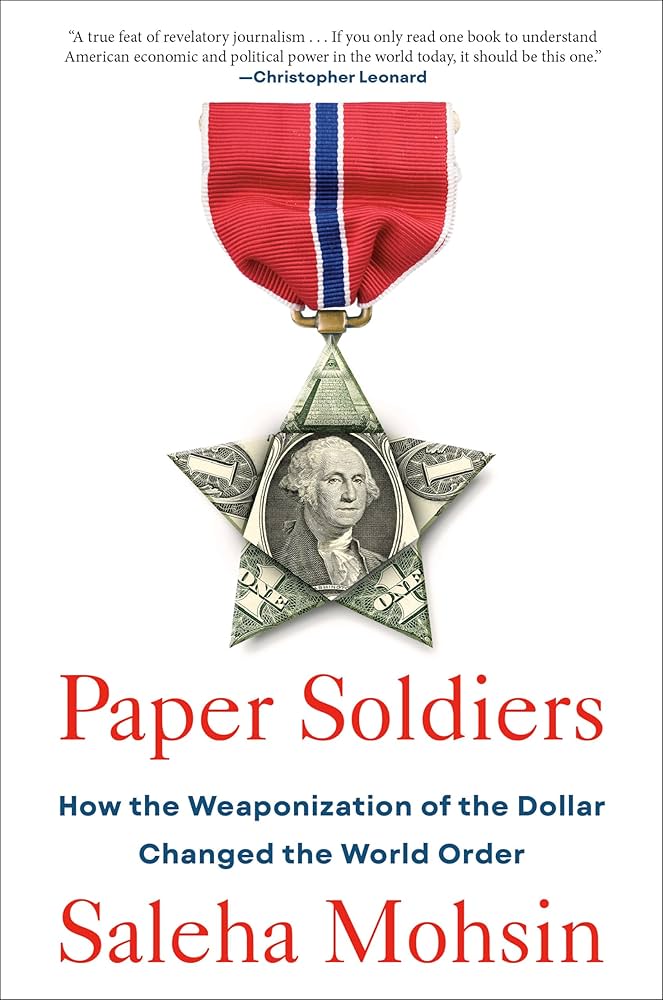
 2,017 words
Saleha Mohsin
Paper Soldiers: How the Weaponization of the Dollar Changed the World Order
New York: Portfolio, 2024
[. . . ] in April 2023, Brazil’s President Luiz Inácio Lula da Silva drew loud applause from an audience of Chinese dignitaries in Shanghai when he heralded the demise of the dollar. “Every night I ask myself why all countries have to base their trade on the dollar. Who was it that decided that the dollar was the currency after the disappearance of the gold standard?” he asked the delighted crowd. And he wasn’t the only one who was asking that question-he was just the loudest in a chorus of rhetoric that had formed among world leaders from Argentina to Saudi Arabia, Malaysia, and India, as each nation came together to look for fresh ideas on how to sidestep the dollar. (p. xvi)
Towards the end of World War II, at a ski resort in New Hampshire, officials from the treasuries of the various Allied nations met to organize the monetary policy of the post-war world. The order which was established had a provision which required the currencies of the participating nations to be convertible into gold-backed US dollars. As a result, the US dollar became the medium of global trade although the Communist Bloc was mostly excluded throughout the Cold War. The US dollar remains the currency of global trade today although the Communist Bloc is gone and the US dollar is no longer backed by gold. Whether the dollar should be on the gold standard or not is beyond the scope of both this review and the book. The book’s focus is on how the US dollar as the medium of global exchange impacts American society and international geopolitical affairs.
The idea of issuing a currency that had its value set by government fiat (or decree) arose during the Civil War. President Lincoln’s Secretary of the Treasury, Salmon P. Chase, paid for the war by issuing paper currency derisively known as “greenbacks.” The value of the greenbacks rose and fell depending on how the Union Army was doing in the field. Despite acquiring passionate supporters, the greenbacks were withdrawn and the United States returned to the gold standard but, writes Mohsin:
Chase’s endeavor to rally government finances during the Civil War put the nation on the path to ruling the world through the power it gives to, and derives from, the dollar. By adopting the once-radical concept of bills representing the promise of payment, American cash became a representation of the full faith and credit of the United States government – not gold, silver, or any other precious metal – just as the nation was set to overtake Great Britain as the largest economy (p. 18).
A key economic circumstance regarding the US dollar is if it is “strong” or “weak.” A strong US dollar means that the dollar’s value is high relative to the value of other currencies. With a strong dollar, Americans vacationing abroad do so at a discount since they get more local money for each exchanged dollar. However, a strong dollar means that American produced goods become more expensive than goods produced elsewhere. With a weak US dollar, the situation is exactly reversed.
In 1985, President Reagan wisely heeded the concerns of industrialists to weaken the dollar to save America’s manufacturing companies. He sent his Treasury Secretary, James A. Baker III, to secretly meet with representatives from West Germany, the UK, and France to drive down the value of the dollar. This deal worked, and American factories remained viable through Reagan’s second term.
You can buy Greg Johnson’s The Year America Died here.
Because the United States came out of the Cold War the winner, the US dollar’s role in the global economy greatly expanded after 1992. Presently, nations conduct trade in US dollars without any American involved. Additionally, investors from every nation put money into loans to the US government called US Treasury Notes or T-Bills which have terms of ten years. The United States won’t default on any of the loans, so it is a safe investment. The US Treasury can print the money to cover the T-Bills if there is a serious crisis, although that would cause inflation. Investment in Treasury Bills gives the US government an easy way to make up for budget shortfalls, although the overall debt piles up.
Meanwhile, George H.W. Bush and his successor Bill Clinton enacted a series of free trade agreements based on neoliberal economic theory which increased the value of the stock market and that greatly pleased international financiers. International bankers were also aided by Bill Clinton’s Secretary of the Treasury, Bob Rubin. Rubin’s driving ethos was that a strong dollar was in the national interest and he never wavered from this idea either by statement or action. The free trade agreements and the consistently strong US dollar destroyed America’s manufacturing industry, however. This destruction was widespread and it left highly skilled adults struggling to find poor paying jobs while holding mortgages, raising children, and caring for aging parents.
A representative town that suffered from this is Weirton, West Virginia, the former home of the Weirton Steel factory which specialized in making “tin cans” to hold and store food. The factory was the economic engine of the town,
But by the late 1990s, the city and its 20,000 inhabitants had come upon hard times. The workforce of the local mill, run by Weirton Steel, was down to 3,500, roughly a quarter of the peak employment. Unemployment averaged about 9 percent in the region. While the preceding decade was celebrated for aggregate growth, broad economic indicators hid the harsh reality of trade deals put together by both the George H.W. Bush and Clinton administrations. NAFTA, along with other similar pacts, led to a difficult period that would hurt the whole town that the steel business supported. It would amount to a class war between what Wall Street wanted from the U.S. government and what the rest of the country needed (p. 57).
Although there were provisions in the various free trade agreements that supposedly prevented dumping artificially cheap goods on the US market, Chinese traders could take advantage of the steadily high US dollar value and export artificially inexpensive goods into America, further disrupting the economy. The Clinton administration did not make this a central issue, nor the follow-on Bush administration. As American manufacturing firms evaporated, China rose in power and wealth. China was becoming a danger.
The US dollar dominance peaked just before the first hijacked jumbo jet crashed into the North Tower of the World Trade Center on September 11, 2001. When the Stock Market reopened nearly a week after the terror attack, more than a trillion US dollars were lost in a flurry of panicked selling. Meanwhile, the first efforts to unravel the Salafi Jihadist terrorist network came out of the US Treasury Department.
As the ruins of lower Manhattan smoldered, US Treasury officials descended upon La Hulpe, Belgium, the headquarters for a banking cooperative called the Society for Worldwide Interbank Financial Telecommunication (SWIFT). There, investigators unraveled the financial network of the hijackers. The attacks on September 11 caused an addition to the overall mission of the Treasury Department. Not only do officials at the Treasury need to protect the US dollar to keep the economy and budget on track; they must also monitor financial transactions everywhere to ensure another attack is not coming.
Then came the Great Recession. Officially, the Great Recession started in 2007, but it was not until October of 2008 that the crash unquestionably arrived. Mohsin doesn’t say much about the cause of the crisis, other than it originated in the overvalued American housing market. The cause of the crash is known, however. The crisis started when the Clinton administration changed investing regulations which allowed banks to make riskier loans. Then the Bush administration pushed to qualify low-IQ non-whites for mortgages which could not ever be paid back. This created a housing price bubble which was bound to collapse. The Great Recession was initially countered by US Treasury Secretary, Hank Paulson, who organized a government bailout for the firms which were heavily involved in bringing about the crisis in the first place.
Foreign nations were frustrated by the American-caused recession. Additionally, many were alarmed by American officials scouring the financial records of SWIFT and other banking institutions. The dangerous entity that is BRICS grew out of this frustration.
Throughout the Great Recession, China continued to manipulate its currency to gain a competitive advantage over America’s industry, and America’s elected officials continued to ignore China’s behavior. The only Treasury official to mention the problem in any way was Under Secretary of the Treasury for International Affairs, Lael Brainard, an Obama appointee. She continuously documented China’s currency manipulation and bad dealings during her time in office from 2010 to 2013. Her warnings were ignored. It wasn’t until Donald Trump came down the escalator in 2015 that the problems of Chinese currency manipulation and deindustrialization entered the top level of the national conversation.
Trump’s political base was made up of the men and women of the mid-sized and smaller towns in the Rust Belt. These are the places which endured the Farm Crisis, and then the steady creep of closing factories. These are the towns whose young men were sent to the Middle East to further the security needs of the so-called state of Israel and defended the industrial superpower that is South Korea. These are the people who rallied to Trump and ignored the anti-Trump media calumny.
You can buy Francis Parker Yockey’s The Enemy of Europe here.
During his first presidency, Donald Trump and his Treasury Secretary Steve Mnuchin supported a weak dollar policy. This angered foreign leaders, especially Germany’s Angela Merkel. Meanwhile, Russian activities were increasingly hostile although Trump paid a significant political price for the sympathy he expressed towards President Putin and Russia. On April 6, 2018, Mnuchin’s Treasury Department placed sanctions on the Russian company Rusal, which manufactured aluminum. The sanctions plunged the commodities markets into turmoil—angering many. Meanwhile, many anti-Russians in Congress and elsewhere were frustrated that the sanctions didn’t go far enough. Trump’s biggest critics came from the former Treasury officials who wanted to keep the US dollar a neutral place to store value for all nations despite the bad-faith actions of countries like Russia and China.
The sanctions against Rusal were effective because the US dollar is the global medium of exchange. Additionally, the mid-grade government officials in the US Treasury Department had figured out how to effectively sanction a nation or entity after September 11. They knew where to look and what to look for.
When the Russians invaded Ukraine in 2022 after a frail and senile President Biden failed to deter them, the only real option for the US government was to double down on what Trump had done when he sanctioned Rusal. However, there were many neutral, “strong” dollar proponents among Biden’s supporters in the Democratic Party including in his Cabinet. Biden’s staff had to organize an appeal from a European leader to the Treasury Secretary, Janet Yellen, to get her onboard with sanctions. Russia was taken out of the SWIFT network entirely.
Currency is now a weapon of war. Many globalists are shocked by this turn of events, but Salmon P. Chase would not be surprised. Sanctions certainly beat atomic warfare. In retrospect, it is also obvious that the “strong” US dollar policy which helped hollow out so much of the American economy was politically unsustainable.
American white advocates should not retreat into the forest and hills to form militias. Instead, it is time to join up. Obviously, the Department of Homeland Security has the most pressing need for recruits, but as young men age and decide running after illegal immigrants is hurting the knees, switching over to the Treasury is a good career move that can make a real difference in reversing the Great Replacement since the same skills used to scope the financial networks of terrorists can be used to pin down migrant smugglers. Additionally, the BRICS coalition is a scorpion. There is no way to avoid conflict with that entity, and future battles will be between banking systems.
2 comments
Great article! Now I understand why the economy experienced such a downturn, beginning with George H. W. Bush. 🙃
The gold standard is absolute garbage. If you want to slice the Achilles tendon of America then succumb to the idiots/russolackeys among the libertarians.
Comments are closed.
If you have a Subscriber access,
simply login first to see your comment auto-approved.
Note on comments privacy & moderation
Your email is never published nor shared.
Comments are moderated. If you don't see your comment, please be patient. If approved, it will appear here soon. Do not post your comment a second time.