Counter-Currents
  • Advertise
  • Private Events
  • T&C
  • About
  • Contact
  • RSS
    • Main feed
    • Podcast feed
    • Videos feed
    • Comments feed
  • Welcome
  • Webzine
  • Books
  • Merch
  • Podcasts
  • Videos
  • Donate
  • Patrons
  • Subscribe
  • Crypto

LEVEL2

Donate Now Mailing list
Upcoming podcasts
  • Rob Rundo on Counter-Currents Radio

    Rob Rundo on Counter-Currents Radio

    Counter-Currents Radio

    06/13/2026 — 3 pm EST / 9 pm CET
  • Daniel Tyrie on Counter-Currents Radio

    Daniel Tyrie on Counter-Currents Radio

    Counter-Currents Radio

    06/20/2026 — 3 pm EST / 9 pm CET

Writers of May

(2 votes) Morris van de Camp David M. Zsutty Derek Stark Jayant Bhandari Greg Johnson

Articles of May

The Lunch Wars by David M. Zsutty Heidegger on Nietzsche, Part One by Collin Cleary 2 votes
  • Welcome
  • Webzine
  • Books
  • Merch
  • Podcasts
  • Videos
  • Donate
  • Patrons
  • Subscribe
  • Crypto
    • The Union Jackal, June 2026

      Mark Gullick

      8

    • The Inferiority Behind Immigrant Superiority

      Jayant Bhandari

      5

    • Counter-Currents Radio Podcast No. 690
      Greg Johnson & David Zsutty Discuss Current Things: AI, Henry Nowak, the Iran Crisis, & More

      Counter-Currents Radio

      2

    • Collin Cleary: What Rome Means to Me

      Collin Cleary

      4

    • Paul Krugman: Closet Bolshevik

      Spencer J. Quinn

      13

    • Fugue of Ideas:
      Ibram X. Kendi’s Chain of Ideas

      Greg Johnson

      15

    • Based Blacks

      Lipton Matthews

      8

    • Black Intellectual Fatigue

      Derek Stark

      34

    • Why White Advocates Should Avoid “Based Blacks”

      Dani Vypont

      20

    • Nietzsche & Race

      Mark Gullick

    • Editor’s Update
      Rob Rundo Rescheduled to Next Week on Counter-Currents Radio;
      Tonight Greg Johnson & David Zsutty Answer Your Questions;
      Fundraiser Update & a New $20,000 Matching Grant

      Greg Johnson

    • The Counter-Currents 2026 Fundraiser
      Lifetime Subscriber Welcome Packages Extended

      Greg Johnson

    • Nationalism This Week
      Who’s Looking Back?

      Greg Johnson

      29

    • China’s Threat to American Security:
      Food, Farmland, Foreign Control, & Energy Policy

      Lipton Matthews

      5

    • The Bitter End of Western Metaphysics:
      Heidegger on Nietzsche, Part Two

      Collin Cleary

      16

    • The Killing of Henry Nowak

      Mark Gullick

      38

    • The Crisis of Chinese Technology Thieves

      Morris van de Camp

      1

    • The Strange World of Gender Bender Fiction:
      & What This Genre Tells Us About Autosexuality

      Dani Vypont

      3

    • Watching the Watchers:
      The Dark Triad Question

      David M. Zsutty

      14

    • The Remigration Movement Solidifies

      F. Roger Devlin

      1

    • Casting Aspersions:
      The Fatal Consequences of Race-Swapped Casting, From Helen of Troy to Henry of Southampton

      Steven Tucker

      20

    • The Murder of Henry Nowak

      Millennial Woes

      23

    • Don’t Forget to Vote in Our Writer & Article of the Month Poll

      Greg Johnson

    • The Robot Hotdog Stand

      Greg Johnson

      37

    • Laughing Our Way to Victory

      Dave Chambers

      7

    • The Zodiac Killer

      Mark Gullick

      11

    • Jared Taylor: What Rome Means to Me

      Jared Taylor

      1

    • An Interview with Endeavour:
      My Way of Life Is an Adventure!

      Ondrej Mann

      6

    • José Pedro Zúquete’s The Identitarians

      Greg Johnson

      3

    • Editor’s Update
      Fundraiser Update & How to Watch the Remigration Summit

      Greg Johnson

      5

    • The Bitter End of Western Metaphysics:
      Heidegger on Nietzsche, Part One

      Collin Cleary

      11

    • Berlin: City of Stones

      Spencer J. Quinn

      6

    • True Folk-Horror Is Horror of Your Own Folk:
      Mark Gatiss vs the Brexit Blind Dead  

      Steven Tucker

      4

    • Counter-Currents Radio Podcast No. 689
      Thomas Massie, the America 2050 Bust, the Need for Whites to Divest from America, the AI Economic Apocalypse, & Pro-White Project Pitches to Billionaires

      Counter-Currents Radio

      7

    • Nationalism This Week
      Remigration is Inevitable, Part 3

      Greg Johnson

      27

    • Why Billionaires Should Fund White Identity Politics

      Lipton Matthews

      8

    • How Cold War Two Came About

      Morris van de Camp

      5

    • Now Available for Pre-Order at a Special Price!
      Greg Johnson’s The Philosopher Is In

      Greg Johnson

    • David Zsutty’s Elevator Pitch to a Billionaire

      David M. Zsutty

      1

    • Headbanging Lite

      Mark Gullick

      5

    • White Advocacy Past and Present

      Peter Bradley

      13

    • The Lunch Wars

      David M. Zsutty

      47

    • The Russians are Coming/The Russians are Coming

      Steven Clark

      1

    • Peak Fatigue in Fort Wayne

      Gabriel Anderson

      24

    • Keith Woods’ Elevator Pitch to a Billionaire

      Keith Woods

    • The Cruelty of Kindness

      Morris van de Camp

      9

    • Predation Wearing the Mask of Civilization

      Jayant Bhandari

      13

    • The Mandalorian & Grogu

      Trevor Lynch

      24

    • Editor’s Update
      Fundraiser Update & a New $20,000 Matching Grant
      Greg Johnson & David Zsutty Discuss Thomas Massie on Counter-Currents Radio

      Greg Johnson

      2

    • How the Jews Defeated Thomas Massie—& Themselves

      David M. Zsutty

      27

    • Will Williams

      Black Intellectual Fatigue

      Bigfoot: June 10, 2026  [Leftkowitz] is a Jew… an academic will sometimes point out the lies of...

    • Malaparte

      Heidegger on Nietzsche, Part Two

      Off topic, but I'm curious if Cleary is familiar with Emanuele Severino?  Bloomsbury has recently...

    • Derek Stark

      The Inferiority Behind Immigrant Superiority

      If you wish to follow the Jew view that there is nothing unique about whites that led them to...

    • E_Perez

      The Union Jackal, June 2026

      Being defeated is difficult for anybody, but nobody could foresee that the British would be treated...

    • Anonymous

      The Inferiority Behind Immigrant Superiority

      One phenomenon I observed on the internet is the phrase 'Proud Indian' proclaimed by many Indians on...

    • Zarathustra

      The Inferiority Behind Immigrant Superiority

      I recently read "Guns, Germs, and Steel" and found its rationale rather convincing.

    • Stronza

      Based Blacks

      Re the killing of Charlie Kirk.  Maybe it's some third party, neither Israel nor Robinson.  Maybe...

    • Will Williams

      Dispatches from the Fallout Shelter

      Gunnar: April 22,2026 ...A ten-day ceasefire was finally declared between Israel and Lebanon....

    • Jank

      Counter-Currents Radio Podcast No. 690

      "I want 40% of the FBI hunting down antifa" Bad News. 40% of the FBI is antifa.

    • John

      Collin Cleary: What Rome Means to Me

      Christianity is universal, unlike Judaism which is racial. What good is a religion if it does not...

    • John

      Collin Cleary: What Rome Means to Me

      “Christianity conflicts with White Nationalism. Returning to a tough muscular christianity would be...

    • Will Williams

      Black Intellectual Fatigue

      TiredofBoomers: June 9, 2026 I checked your 161 page thread on White Biocentrism “Commenting on...

    • Jocelynn Cordes

      Fugue of Ideas: Ibram X. Kendi’s Chain of Ideas

      I don’t know how you are able to exercise such restraint, to first read this insanity and then...

    • Peter Quint

      The Inferiority Behind Immigrant Superiority

      Is that a statue of a monkey man, being propitiated by a squirrel? 🙃

    • Jocelynn Cordes

      Black Intellectual Fatigue

      "The black “intellectuals” are not so far off the mark when they claim that our institutions are...

    • Francis XB

      The Union Jackal, June 2026

      You have to look at the system behind the Henry Nowak killing: _The DEI commissars. _The anti-...

    • Jocelynn Cordes

      Black Intellectual Fatigue

      Lipton Mathews writes structurally perfect essays--a rarity.

    • Derek Stark

      The Inferiority Behind Immigrant Superiority

      Very interesting. I recall Eric Hoffer discussing the two-sided superiority/inferiority complex of...

    • Peter Quint

      The Union Jackal, June 2026

      The very idea that an interjected false accusation of racism could even be considered as exonerating...

    • Fire Walk With Lee

      Based Blacks

      I don’t know, I still think his greatest contribution was the numerous shitty rap songs about the...

    • Earth Day Special

      John Morgan

      12

    • A Robertson Roundup
      Remembering Wilmot Robertson
      (April 16, 1915 – July 8, 2005)

      Margot Metroland

      13

    • The Paranoid Style in White Nationalism

      Greg Johnson

      30

    • Join the Dance!

      Andrew Hamilton

      1

    • We Can’t Save the Earth Without Reducing African Birth Rates

      James Dunphy

      36

    • “I’m Not a Conspiracy Theorist, but . . .”:
      Jeffrey Epstein’s Death Gives New Life to “Conspiracy Theories”

      Greg Johnson

      22

    • Sylvia Plath: Stasis in Darkness

      Vic Olvir

      17

    • Vanguardism, Vantardism, & Mainstreaming

      Greg Johnson

      80

    • Aviation, Geography, & Race

      Charles Lindbergh

      3

    • Some Thoughts on Yule

      Collin Cleary

      4

    • Living in Truth:
      A Yuletide Homily

      Jef Costello

      7

    • John Kennedy Toole’s A Confederacy of Dunces

      Greg Johnson

      20

    • On Aleksandr Solzhenitsyn’s Warning to the West

      Spencer J. Quinn

      7

    • Elitism, British Modernism, & Wyndham Lewis

      Jonathan Bowden

      6

    • Philip K. Dick’s Do Androids Dream of Electric Sheep? as Anti-Semitic/Christian-Gnostic Allegory

      Greg Johnson

      20

    • “Conspiracy Theory” or Conspiracy?

      Andrew Hamilton

      21

    • Remembering H. P. Lovecraft
      (August 20, 1890–March 15, 1937)

      Greg Johnson

      3

    • Who Are We?
      Nordics, Aryans, & Whites

      Greg Johnson

      71

    • Remembering William Gayley Simpson
      (July 23, 1892–December 31, 1990)
      A Pleasant Afternoon with Harriet & Bill Simpson

      Margot Metroland

      18

    • Here are the Young Men
      Remembering Ian Curtis
      (July 15, 1956–May 18, 1980)

      Mark Gullick

      18

    • Percy Grainger
      Artist of the Right

      Alex Graham

      7

    • Remembering Revilo Oliver
      (July 7, 1908–August 20, 1994)

      Greg Johnson

      18

    • The Meaning of July 4th for the White Man

      Gregory Hood

      13

    • The Front National’s Evolution

      Bruno Mégret

    • Merwin K. Hart
      Forgotten American Hero & Man of the Right

      Morris van de Camp

      10

    • George Orwell’s Nineteen Eighty-Four

      Jonathan Bowden

      8

    • Carleton S. Coon
      Scientist & Reluctant White Advocate

      Morris van de Camp

      3

    • The Kwanzaa Absurdity Will Be Dwarfed by Juneteenth

      Robert Hampton

      10

    • Stravinsky

      Alex Graham

      7

    • Like the Roman:
      Remembering Enoch Powell (1912-1998)

      Mark Gullick

      23

    • Neo-Fascism in Film
      Part 5

      Karel Veliky

      15

    • The Game of Tarot

      Mark Gullick

      2

    • Institutions Cannot Be Transplanted

      Jayant Bhandari

      5

    • Jonathan Bowden’s Deliverance
      Part 5

      Jonathan Bowden

    • Crosstown Traffic:
      Jimi Hendrix & The Post-War Rock ‘N’ Roll Revolution

      Mark Gullick

      1

    • Slaves from the North:
      Finns & Karelians in the East European Slave Trade, 900–1600

      Lipton Matthews

      14

    • Neo-Fascism in Film
      Part 4

      Karel Veliky

      2

    • David Lean’s A Passage to India

      Spencer J. Quinn

      1

    • Elites are Essential to Development

      Lipton Matthews

      7

    • Jonathan Bowden’s Deliverance
      Part 4

      Jonathan Bowden

    • Neo-Fascism in Film
      Part 3

      Karel Veliky

      6

    • E. M. Forster’s A Passage to India & the Indian Mentality

      Spencer J. Quinn

      25

    • Jonathan Bowden’s Deliverance
      Part 3

      Jonathan Bowden

    • The Rest Is Silence
      Heidegger’s Quietism

      Mark Gullick

      2

    • Dispelling the Historical Fallacy of Indian Nationalism

      Lipton Matthews

      8

    • Neo-Fascism in Film
      Part 2

      Karel Veliky

      8

    • Jonathan Bowden’s Deliverance
      Part 2

      Jonathan Bowden

    • Life of a Klansman

      Mark Gullick

      8

    • Jonathan Bowden’s Deliverance, Part 1

      Jonathan Bowden

    • Decolonial Ideas are Holding Back Developing Countries

      Lipton Matthews

      8

    • Neo-fascism in Film, Part 1

      Karel Veliky

      21

    • Jonathan Bowden’s Onslaught, Part 8
      Divigations on Decadence

      Jonathan Bowden

    • Jonathan Bowden’s Onslaught, Part 7
      Intrigues in the National Front

      Jonathan Bowden

      1

    • Rotten to the Core

      Mark Gullick

      8

    • Strauss on Husserl’s “Philosophy as Rigorous Science”

      Greg Johnson

    • Jonathan Bowden’s Onslaught, Part 6
      Francis Bacon & Right-Wing Nihilism

      Jonathan Bowden

    • London After (& Before) Midnight:
      Aleister Crowley, The Landlord’s Worst Nightmare

      James J. O'Meara

      2

    • Jonathan Bowden’s Onslaught, Part 5
      The Post-War British Far Right

      Jonathan Bowden

    • No Rules: Rollerball

      Mark Gullick

      4

    • Jonathan Bowden’s Onslaught, Part 3
      Brett Easton Ellis’ American Psycho

      Jonathan Bowden

    • András László
    • Derek Hawthorne
    • Beau Albrecht
    • Alain de Benoist
    • Kerry Bolton
    • Jonathan Bowden
    • Collin Cleary
    • Jef Costello
    • Savitri Devi
    • Julius Evola
    • Jim Goad
    • Gregory Hood
    • Juleigh Howard-Hobson
    • Greg Johnson
    • Charles Krafft
    • Anthony M. Ludovici
    • Trevor Lynch
    • H. L. Mencken
    • J. A. Nicholl
    • James J. O’Meara
    • Christopher Pankhurst
    • Tito Perdue
    • Michael Polignano
    • Spencer J. Quinn
    • Fenek Solère
    • Irmin Vinson
    • Leo Yankevich
    • Francis Parker Yockey
    • Multiple authors
  • Editor-in-Chief

    • Greg Johnson, Ph.D.

    Featured Writers

    • Beau Albrecht
    • Gunnar Alfredsson
    • Collin Cleary, Ph.D.
    • Jef Costello
    • Morris V. de Camp
    • F. Roger Devlin, Ph.D.
    • Stephen Paul Foster, Ph.D.
    • Jim Goad
    • Alex Graham
    • Mark Gullick, Ph.D.
    • Greg Johnson, Ph.D.
    • Travis LeBlanc
    • Trevor Lynch
    • Margot Metroland
    • James J. O’Meara
    • Angelo Plume
    • Spencer J. Quinn
    • Fred Reed
    • Clarissa Schnabel
    • Michael Walker
    • David M. Zsutty

    Frequent Writers

    • Asier Abadroa
    • Aquilonius
    • Alain de Benoist
    • Kerry Bolton, Ph.D.
    • Dave Chambers
    • Steven Clark
    • James Dunphy
    • Endeavour
    • Richard Houck
    • Jason Kessler
    • Titus Livius
    • Ondrej Mann
    • Lipton Matthews
    • Mark Mazari
    • John Morgan
    • Jaroslav Ostrogniew
    • Kathryn S.
    • Christian Secor
    • Anne Wilson Smith
    • Thomas Steuben
    • William De Vere
    • Kenneth Vinther
    • Max West

    Classic Authors

    • Maurice Bardèche
    • Jonathan Bowden
    • Julius Evola
    • Guillaume Faye
    • Ernst Jünger
    • Kevin MacDonald, Ph.D.
    • D. H. Lawrence
    • Charles Lindbergh
    • Jack London
    • H. P. Lovecraft
    • Anthony M. Ludovici
    • Sir Oswald Mosley
    • National Vanguard
    • Friedrich Nietzsche
    • Revilo Oliver
    • William Pierce
    • Ezra Pound
    • Saint-Loup
    • Savitri Devi
    • Carl Schmitt
    • Miguel Serrano
    • Oswald Spengler
    • P. R. Stephensen
    • Jean Thiriart
    • John Tyndall
    • Dominique Venner
    • Leo Yankevich
    • Francis Parker Yockey

    Other Authors

    • Howe Abbott-Hiss
    • Michael Bell
    • Giles Corey
    • Jack Donovan
    • Richardo Duchesne, Ph.D.
    • Emile Durand
    • Guillaume Durocher
    • Mark Dyal
    • Tom Goodroch
    • Andrew Hamilton
    • Robert Hampton
    • Huntley Haverstock
    • Derek Hawthorne
    • Gregory Hood
    • Juleigh Howard-Hobson
    • Alexander Jacob
    • Ruuben Kaalep
    • Tobias Langdon
    • Julian Langness
    • Patrick Le Brun
    • G A Malvicini
    • John Michael McCloughlin
    • Millennial Woes
    • Michael O’Meara
    • Christopher Pankhurst
    • Michael Polignano
    • J. J. Przybylski
    • Quintilian
    • Edouard Rix
    • C. B. Robertson
    • C. F. Robinson
    • Herve Ryssen
    • Alan Smithee
    • Fenek Solere
    • Ann Sterzinger
    • Robert Steuckers
    • Tomislav Sunic
    • Donald Thoresen
    • Marian Van Court
    • Irmin Vinson
    • Book Reviews
    • Movie Reviews
    • TV Reviews
    • Music Reviews
    • Art Criticism
    • Graphic Novels & Comics
    • Video Game Reviews
    • Fiction
    • Poems
    • Interviews
    • Videos
    • English Translations
    • Other Languages
      • Arabic
      • Bulgarian
      • Croatian
      • Czech
      • Danish
      • Dutch
      • Estonian
      • Finnish
      • French
      • German
      • Greek
      • Hungarian
      • Italian
      • Lithuanian
      • Norwegian
      • Polish
      • Portuguese
      • Romanian
      • Russian
      • Slovak
      • Spanish
      • Swedish
      • Ukrainian
    • Commemorations
    • Why We Write
  • Archives
  • Top 100 Commenters
  • The Looney Bin
  • Advertise
  • Private Events
  • T&C
  • About
  • Contact
  • RSS
    • Main feed
    • Podcast feed
    • Videos feed
    • Comments feed
Sponsored Links
Europa.com Above Time Coffee Antelope Hill Publishing Paul Waggener IHR-Store Spencer J. Quinn American Renaissance Jim Goad The Occidental Observer
Print November 7, 2022

Johnny Whistletrigger
Music of the Civil War in Missouri

Steven Clark

3,718 words

“I’ve just got a new record of Civil War music,” my brother recently bragged over the telephone.

He wanted some snappy tunes to listen to, and mentioned that the Nazi marches he is so fond of have been banned from YouTube. “I’ve discovered Italian Fascist marches,” he said. “They’re very melodic and . . . so operatic.” He referred to a long-ago record cover. “They’re so warm.”

“Perhaps smarmy,” I volunteered. Those I’ve listened to have that muzak sound that is absent in the Third Reich’s offerings.

“Well,” he said, “at least I can listen to them. But I’m getting into the Civil War music.”

I assumed the Civil War music he listened to was a collection of brass band marches — the usual panoply of regimental tunes, polkas, waltzes, and so on. Maybe some songs thrown in, à la Stephen Collins Foster and the usual rah-rah stuff like “Battle Hymn of the Republic,” “Marching Through Georgia,” and “Dixie” . . . or maybe not, since Confederates are now proscribed.

I like the music of the era myself, but I go in for a more period sound, such as “The Union Forever” by D. C. Hall’s Quadrille Band. I remember the group in Boston, and I went to concerts and balls where they performed. With a strong tenor in Kevin McDermott, the group offers a lively, period feel to the usual tunes, both martial and sentimental. The dance pieces, such as the Columbia Quadrilles, are also enjoyable because I actually danced to this music at Civil War balls; the only sound missing is the swish of ladies’ satin and taffeta gowns as I danced near them on the floor.

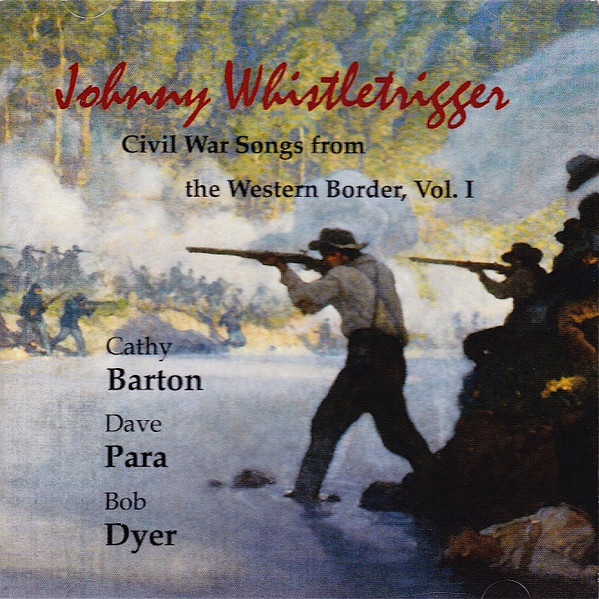
Dave Para, Kathy Barton, & Bob Dyer

But the Civil War in Missouri isn’t quite as nostalgic. Unlike the rest of the country, it was host to a fierce guerrilla war not easily forgotten at war’s end. Indeed, in T. J. Stiles’ Jesse James: The Last Confederate (reviewed here), Stiles argues that the war’s divisions were an active feature of both post-war politics and Jesse’s unsavory career in crime — or retribution. It depends on which side of the fence you squatted. While I was writing my review I returned to my CD collection to visit Johnny Whistletrigger and Rebel in the Woods, remarkable sets of Civil War music related to the war in Missouri that was recorded by the trio of Dave Para, Kathy Barton, and Bob Dyer. They offer a heartfelt and thoughtful retrospective on the period as shown in their music, which was all meticulously researched, and more than once it came into touch with their own families that had been affected by the war.

All three of them lived in Boonville, on the Missouri River, a historic town in its own right. Thespian Hall, the town theater where they often performed, is considered to be the oldest operating theater west of the Mississippi, and its façade is marked by bullet holes from not only one, but two battles fought that were fought in Boonville during the Civil War. Thus, they have a unique historical sense that made them naturals for performing this music.

An earlier recording from 1982, The Ballad of the Boonslick, showed their ability and love for making and preserving historical music from Missouri. The Boonslick refers to the area in central Missouri where there are salt licks once claimed by Daniel Boone’s sons.

This collection of fiddle tunes and songs offers moments of poignancy where older tunes are mixed with modern lyrics and introspections regarding the past and present. In “The Dry Waltz,”composed by Bob Dyer and sung in Cathy’s clear, high voice, love, loss, and the problems of drought intermingle:

I don’t know how long it’s been since we’ve had rain.
And when the love no longer flows,
And the cracks begin to show
I’ll understand, but I just can’t stand the pain.

Dyer expanded upon loss and the caprices of nature in the recording’s signature song, “The Ballad of the Boonslick.” He offers a roll call of the settlers who first came to Missouri and sings of their labor and hopes, and describes how one of their towns, Franklin, “crumbled into the stream” during one of the river’s floods:

They were the pioneers, came here from far and near.
But the river had a will of its own,
And the loss of their town and homes
Was the price that they paid.

Although Franklin crumbled, Boonville took its place and rose to strength in the steamboat days, but both the river and humans are capricious, especially in Boonville’s case:

She was a boom town city on the bluffs above the river
Queen of the steamboat trade
But then the bloody war of the brothers came,
And after she was never the same.

This song echoes Stiles’ description of Missouri’s vibrant self-contained society and economy during the antebellum years, and is a perfect prelude to Johnny Whistletrigger.

The album is less a collection of songs and instrumental pieces than it is a musical journey through the roiling ambiguousness of the Civil War in Missouri. There were no great, fateful battles compared to the southern or eastern theaters of the war, but the passions of that war and the region are captured here, and it is to the credit of the performances and musical synthesis of Para, Barton, and Dyer that the songs are remade in a contemporary way that is meaningful to us today — certainly in Missouri, but also for America.

It begins with “Marmaduke’s Hornpipe,” a rousing fiddle tune named for John Sappington Marmaduke, a Confederate general who became a post-Reconstruction Missouri Governor, capturing the down-home flavor of the border areas. Next, they move to the abolitionist world, where Dyer recites — not sings — “Marais des Cygne,” recalling the 1858 massacre of free-state farmers in Kansas by Missourians:

A stain that shall never
Bleach out in the sun.

The 1858 poem’s religious overtones, which speaks about how “The crown of the harvest / Is life out of death,” leads into an abolitionist hymn and a song about emigrants from Kansas, anti-slavery pioneers whom Missourians saw as a threat to their enclosed, vibrant society. The hymn is sung in shape-note style, also called sacred harp — a style of music very folkish and religious that Dave and Carthy were quite fond of. Here it is used for a Northern theme, but sacred harp was (and is) very popular in the South.
You can buy Tito Perdue’s The Philatelist here.

St. Louis was contested by both sides in the war for its arsenal, and this is depicted in “The Invasion of Camp Jackson,” sung in a semi-comic, sarcastic secessionist’s viewpoint of troops squashing southern attempts to seize the arsenal, leading to subsequent riots where Union troops opened fire on a crowd (or mob; take your pick), and killed two dozen people.

The leader of Union forces was General Franz Sigel, who led a German community that was pro-Union, abolitionist, and crucial to keeping Missouri in the United States. He gets a grand march, ,ut also the grotesque “I Goes to Fight Mit Sigel,” another secessionist squib that mocks the Germans to the tune “The Girl I Left Behind Me”:

But now I march mit musket out to safe dot Yankee Eagle,
Dey dress me up in soldier’s clothes to go and fight mit Sigel

I especially enjoy this song, since it was published in the Missouri history book I studied in high school.

“Johnny Whistletrigger” is the recording’s centerpiece, but it is not exactly a Civil War song, even though the fiddle tune was known then. Dyer recounts the life of John D. Hurt, a Boonville man known by this nickname, and the song is of the type about the robber, rascal, or peasant on the run, the underdog always one step ahead of the man:

He made it to Boonville and looked up his wife.
But early next mornin’ at the break of day
Johnny woke up when he heard his wife say . . .
Run, Johnny Whistletrigger, Federals’ll get you.
Run, Johnny Whistletrigger, better get away.        

It’s a neat introduction to what becomes a major theme of the collection: the bushwhackers, guerrillas who fought and harassed the Union forces and their supporters. They were men who, if forced to live on the sly like Johnny Whistletrigger, were no less determined to keep fighting for Missouri’s freedom.

The chief of these bands was William Quantrill. Quantrill was an enigmatic figure in the border war. Originally a schoolteacher in Kansas who lived amiably among the abolitionists, just after the troubles started he quickly changed sides and became a major thorn in the Union’s side in Kansas and Missouri.

The CD includes a spoken address that was originally given by Sterling Price in 1861, appealing for volunteers. He needed 50,000 and got 5,000. Part of this address was quoted in my review of Stiles’ book. The bushwhackers are a major theme in these recordings. After the Confederate defeat at Pea Ridge in early 1862 (noted in the a cappella “Battle of Pea Ridge”), Union harassment of “Secesh” folk angered many people. In addition to this, Quantrill’s raids caused many young men to “go to the Quantrill side,” as they said. “Quantrill Side” shows this, and another vocal piece, “The Nature of the Guerrilla,” adds to the romance surrounding the bushwhacker. My Jesse James review likewise included a quotation from this piece. The song, interestingly enough, is found in Kansas folksong collections but not in any from Missouri, and its rousing tune and lyrics are definitely pro-Quantrill as it whoops up the joy of burning down Lawrence, Kansas.

A different take on Quantrill is “Kate’s Song,” composed and sang by Cathy, offering a woman’s view both of this enigmatic leader and her choice to join him:

His blue eyes made you think if ice and a chilling winter’s day;
My papa told me eyes were like a window to the soul;
But not so with this handsome man who kept the shutters closed.

As a guerilla’s wife, Kate is described as being on the run but happy, like the heroine in the folk song “Gypsen Davey,” who is also happy with life on the road, on horseback, sharing danger:

Sometimes we’d race till all I knew were pounding hooves and wind,
And it made him smile to see me ride my horse just like a man.

Another rousing campfire song, “Joe Shelby’s Mule,” is a combination of Joseph Leddy’s 1864 lyrics and a minstrel tune. It was a Missouri hit, even overtaking “Dixie.” From this rollicking piece, the album moves to “The Last Great Rebel Raid,” an original song by Bob Dyer recalling the final, doomed Confederate invasion of 1864. Its melodic, quiet defiance leads into “The Knot of Blue and Gray,” a somber traditional song sung to the tune of “The Wearing of the Green,” recalling the loss of brothers in the war. In Cathy’s strong, plain, and retrospective voice, she laments:

But the same sun shines on both their graves,
O’er valley and o’er hill,
And in the darkest of the hours
My brothers they lie still
As the singer wears a broad band of blue and gray.

The song fades into an instrumental rendition of “Hard Times Come Again No More,” the Stephen Collins Foster song that, like so many of his, recalls the loss of the plantation life he seemed to prophesize in his sentimental ballads.

The comingling of suffering and respect on both sides was the traditional way of viewing the Civil War, and is the one I was brought up with. It was recognized that there were bloody differences, but in time both sides reunited and were accepted as one nation again. As a radio piece that was broadcast in my youth put it, there was no more animosity: “Shake hands, Reb. Put ‘er there, Yank.”

This is no longer the case, as the antebellum South and its cause is treated as something demonic, and all the Southern history, statues, and viewpoints are being expunged by . . . the North. Perhaps, as some say, it was a new and blind ideology that emerged as a reaction to Trump’s election, but which had already lying dormant, waiting for the spark: the last roar of Northern supremacy.

* * *

Rebel in the Woods adds texture to the collection and, like the best recordings, doesn’t just offer music but also tells a narrative. “The Call of Quantrill” is a campfire song, sung with a kind of homey feel by the trio, a song said to be much beloved by Jesse James and Bloody Bill Anderson as well as many Confederates who fought on the border. A switch comes in “The War in Missouri in ’61,” a Northern song celebrating (again) the rout at Camp Jackson, sung a cappella as a sturdy, camp-meeting hymn. This underscores the religious overtones that Northerners brought to their cause. The bushwhackers sing of freedom; for a guerrilla, it is wistful, temporal, and may be gone with the next Yankee attack, but it’s there.

“Missouri, Bright Land of the West” is the most ambitious song, recalling a period feel. Sung by a trio accompanied by piano, guitar, and mandolin, it has a real parlor feel to it:

Missouri! Missouri! Oh, where thy proud fame!
Free land of the west, thy once cherished name,
Now trod in the dust by a despot’s command . . .

It restates how the Southerners saw themselves as the ones who had been attacked, while the Northerners believed they were bringing a new world of freedom. The music delineates the camps as those wishing to be left alone and those who want a brave new world . . . of union. The song was composed by Harry MacCarthy, who also composed “The Bonnie Blue Flag,” which was second only to “Dixie” as the Confederacy’s theme song. This song never hit those heights, but nevertheless expresses a genuine desire to preserve a way of life that was imperiled by the needs of a new America.

Immigrants were generally expected to side with the Union, as the Germans did wholeheartedly, but in “Kelly’s Irish Brigade,” set to the tune of “Columbia, the Gem of the Ocean,” we hear of the Irish who joined the loyal Missourians.

“Rebel in the Woods” is a song that evokes the beauty of the land and pleasures of the vernal season:

The winter is gone and the spring has come once more,
The rebels rejoice that the winter is no more,
For now it is spring and the leaves are growing green,
And the rebels rejoice that they cannot be seen.

The bushwhackers are pleased that nature is finally offering cover so that they can raid, ambush, maneuver . . . springtime’s emergent beauty also sums up the natural symbiosis of the people defending their land that will also shield them. And the hope of victory?

And when we are joined in wedlock’s happy band,
Then we never more will take the parting hand.
And at home, soon home, home we will be.

This was a “pome” published in 1863, then put to the tune an old folksong taken from traditional sources.

Songs about various rebel leaders on this album are jaunty and not too far removed from the good old C&W style with popular tunes usually grafted on, but “Daniel Martin” is the opposite: an earthy, a cappella song about a Union soldier recalling his enlistment and then whipping Sterling Price’s forces. It is a compilation of three traditional tunes associated with this determined Arkansan who is ready to whack the “Secesh,” sung in sharp-note style and reinforcing the choral, semi-religious tone the Union songs often have, recalling hymns sung by Puritan soldiers in the English Civil War — of which the American Civil War was often a rehash.

The album’s final four selections are a final coda to the war itself.

“Anderson’s Warning” is an original song composed and performed by Cathy about Bloody Bill Anderson, probably the most notorious bushwhacker, who has been judged by history to have been a ruthless killer. A woman’s voice thus depicts a poignant menace from the past:

I can’t save you traitors from a terrible end,
Like wolves we will hunt you down both me and my men.
Fools that you are, you can’t run and hide;
My eyes will be on you; watch how you decide.

Cathy’s tone is colder than any man’s. A ruthless killer who scalped his enemies? Certainly. Furious at the Union because his sister had died in their forces’ custody, and thus seeking eternal vengeance? Most certainly. Her ballad paints textures of understanding, if not sympathy, for Anderson’s words warn from history, matching his young, cold face staring back in his photograph:

My name’s Captain Anderson; I hunt and kill.
I am a guerrilla. I’m a Devil from Hell.

This leads into “Wakefield,” a rousing fiddle tune celebrating the place where Quantrill was hiding before he was discovered and killed by a Captain Terrell. Terrell had switched sides and had become a ruthless and cruel officer. He died a year after Quantrill, and a Louisville paper noted that “no man ever more richly deserved a torturous death.”

You can buy Tito Perdue’s Love Song of the Australopiths here.

“Wakefield” is fast and furious, set to a frantic rhythm recalling a chase, or a hunt, as the rebels are worn down. It recalls the contra dances I went to, Wakefield begging for caller and dancers to go do-si-do! Circle right! Swing your partner! Interestingly enough, Cathy went to Wakefield to research the tune and discovered that she was a descendant of Terrell. It’s a pulsing tune that leads into “Jesse James,” where Bob sings the original ballad, then Jim Dyer offers his own rendition, and like many songs in this collection it is a blending of old and new, in effect revitalizing history. Dave sings the traditional ballad while Bob’s version offers a deeper commentary on this dark hero of the period.

The collection concludes in an offbeat, thoughtful way with “Gone to Kansas,” a song whose origins lay in one of the usual minstrel numbers about the darkie’s gay life on the plantation. But this setting, in an Irish-like sadness, brings to life the actual situation at the end of the war for the freed slaves who, while now free, drifted aimlessly, many not knowing what their place in the new Yankee world was going to be.

Many black songs of the Civil War were hopeful and jubilant. Henry Clay Work (1832-1884), who wrote “Marching Through Georgia,” also did a tune about an Uncle Joe happily singing “Hail Columby” in celebration of his freedom, and “Kingdom Coming” was another darkie song where Work praises former slaves who watch as their masters flee the Yankees. They sing “De massa run, ha-ha! / De darkie stay ho-ho!,” and help themselves to the booze and ham, toss the overseer in the well, and load up on the food, since it will all be “Cornfiscated when de Linkum soldiers come” — which was basically the truth. It almost sounds — minus the minstrel dialogue — like the slogans of a BLM rally.

It is also interesting to note that while Work always took pride in “Marching Through Georgia,” but whenever William Tecumseh Sherman heard the song, he immediately left the room.

In “Gone to Kansas,” the mood is one of solitary loss and abandonment:

Can’t you hear the owls a-hooting in the darkness of the night?
It brings a drop of sweat on my brow.
Oh, I feel so awful lonesome, I fear I’ll die from fright,
Since the cabins are all empty now.

There were blacks who went to Kansas to try to begin a new life, but many others stayed and began a dislocation that has morphed into the welfare state. As one man I knew put it, “We never had problems with the colored. Everybody got along, but the colored always expected the white folks to take care of them.”

Thus it is the blacks, who were the ostensible reason for the Civil War being fought, who end this collection — not in triumph, but in uncertainty and mordant solitude.

I am impressed with the talent on this album. Dave, Cathy, and Jim have beautiful and natural voices for recalling Missouri’s great war. It is an aural equivalent to Edgar Lee Master’s Spoon River Anthology, where a cemetery brings forth an outpouring of emotion and loss. The Missouri accents can twang and drone, but also be clear and hard when needed. I feel a special link to these people because I knew them, and this is my state’s music. I wish folk music could be better appreciated and utilized by people who want to reassert pride and strength in average people. Folk music is white music, but it can also be a genuine mingling of and borrowing from other cultures and races. Instead, folk has been taken over by the Left. The Right, in many cases, has simply abandoned the traditional arts.

In the sixties, folk was always aimed at the Left. I think of Judy Collin’s “Hey, Nelly Nelly,” singing of the 1850s in a paen to Lincoln:

And says them black folk should all be free
And walk around the same as you and me . . . and it’s 1858.

Well, Lincoln never quite said that at the time. But we move on to 1861 to go fight; then, in 1865, Lincoln is dead and:

I see white folks and colored walkin’ side by side
They’re walkin’ in a column that’s a century wide
It’s still a long and a hard and a bloody ride
In 1963.

Folk therefore has its propaganda value, and it certainly did in the sixties, before it was swallowed by rock.

Too many people have succumbed to rock, pop, and rap, allowing manufactured, corporate music define their taste.

I’ve always felt that rock is defined by the beat, and folk music by the drone. The drone is like a bagpipe, recalling the time when we were tied to the soil and all the pain that entails — a lament, but also lullaby. Rock’s beat is more sexual, pulsing, and sensual, offering youthful freedom and liberty — an internationalized and manufactured format refined and packaged by corporate interests.

Thus I’m very thankful for Johnny Whistletrigger and its music rooted in Missouri, and in the ghosts of the war my ancestors fought in (on both sides). It is the perfect coda to Stiles’ book — a Thomas Hart Benton mural of sound where the past is not forgotten, but a shadow walking alongside you.

* * *

Like all journals of dissident ideas, Counter-Currents depends on the support of readers like you. Help us compete with the censors of the Left and the violent accelerationists of the Right with a donation today. (The easiest way to help is with an e-check donation. All you need is your checkbook.)

GreenPay™ by Green Payment

Select donation type

Select or enter an amount to give

Select or enter an amount to give monthly

For other ways to donate, click here.

Johnny Whistletrigger Music of the Civil War in Missouri

Johnny%20Whistletrigger%20Music%20of%20the%20Civil%20War%20in%20Missouri

Share

  • Gab
  • Music of the Civil War in Missouri &body=%0D%0A%0D%0A%0D%0A%0D%0A%0D%0A%0D%0Ahttps://counter-currents.com/2022/11/johnny-whistletrigger-music-of-the-civil-war-in-missouri/%0D%0A%0D%0A%0D%0A%0D%0A">

Enjoyed this article?

Be the first to leave a tip in the jar!

Instant Echeck GreenPay™

Related

  • The Russians are Coming/The Russians are Coming

  • The Selective Memory of Empire:

  • Le Debacle: Historical Echoes of Zola’s France

  • Neo-Fascism in Film, Part 3

  • E. M. Forster’s A Passage to India & the Indian Mentality

  • Jonathan Bowden’s Deliverance, Part 3

  • The Rest Is Silence: Heidegger’s Quietism

  • Dispelling the Historical Fallacy of Indian Nationalism

Tags

American Civil WarBob DyerBoonvilleCivil War musicDave Paraguerrilla warfareJohn Sappngton MarmadukeJohnny WhistletriggerKathy BartonMissourimusic reviewspaywallRebel in the WoodsslaverySt. LouisStephen Collins FosterSteven Clarkthe Boonslickthe bushwhackersthe Civil War in MissouriWilliam QuantrillWilliam Tecumseh Sherman
Upcoming podcasts
  • Rob Rundo on Counter-Currents Radio

    Rob Rundo on Counter-Currents Radio

    Counter-Currents Radio

    Sat, Jun 13th — 3 pm EST / 9 pm CET
  • Daniel Tyrie on Counter-Currents Radio

    Daniel Tyrie on Counter-Currents Radio

    Counter-Currents Radio

    Sat, Jun 20th — 3 pm EST / 9 pm CET

Writers of May

(2 votes) Morris van de Camp David M. Zsutty Derek Stark Jayant Bhandari Greg Johnson

Articles of May

The Lunch Wars by David M. Zsutty Heidegger on Nietzsche, Part One by Collin Cleary 2 votes
    • The Union Jackal, June 2026

      Mark Gullick

      8

    • The Inferiority Behind Immigrant Superiority

      Jayant Bhandari

      5

    • Counter-Currents Radio Podcast No. 690
      Greg Johnson & David Zsutty Discuss Current Things: AI, Henry Nowak, the Iran Crisis, & More

      Counter-Currents Radio

      2

    • Collin Cleary: What Rome Means to Me

      Collin Cleary

      4

    • Paul Krugman: Closet Bolshevik

      Spencer J. Quinn

      13

    • Fugue of Ideas:
      Ibram X. Kendi’s Chain of Ideas

      Greg Johnson

      15

    • Based Blacks

      Lipton Matthews

      8

    • Black Intellectual Fatigue

      Derek Stark

      34

    • Why White Advocates Should Avoid “Based Blacks”

      Dani Vypont

      20

    • Nietzsche & Race

      Mark Gullick

    • Editor’s Update
      Rob Rundo Rescheduled to Next Week on Counter-Currents Radio;
      Tonight Greg Johnson & David Zsutty Answer Your Questions;
      Fundraiser Update & a New $20,000 Matching Grant

      Greg Johnson

    • The Counter-Currents 2026 Fundraiser
      Lifetime Subscriber Welcome Packages Extended

      Greg Johnson

    • Nationalism This Week
      Who’s Looking Back?

      Greg Johnson

      29

    • China’s Threat to American Security:
      Food, Farmland, Foreign Control, & Energy Policy

      Lipton Matthews

      5

    • The Bitter End of Western Metaphysics:
      Heidegger on Nietzsche, Part Two

      Collin Cleary

      16

    • The Killing of Henry Nowak

      Mark Gullick

      38

    • The Crisis of Chinese Technology Thieves

      Morris van de Camp

      1

    • The Strange World of Gender Bender Fiction:
      & What This Genre Tells Us About Autosexuality

      Dani Vypont

      3

    • Watching the Watchers:
      The Dark Triad Question

      David M. Zsutty

      14

    • The Remigration Movement Solidifies

      F. Roger Devlin

      1

    • Casting Aspersions:
      The Fatal Consequences of Race-Swapped Casting, From Helen of Troy to Henry of Southampton

      Steven Tucker

      20

    • The Murder of Henry Nowak

      Millennial Woes

      23

    • Don’t Forget to Vote in Our Writer & Article of the Month Poll

      Greg Johnson

    • The Robot Hotdog Stand

      Greg Johnson

      37

    • Laughing Our Way to Victory

      Dave Chambers

      7

    • The Zodiac Killer

      Mark Gullick

      11

    • Jared Taylor: What Rome Means to Me

      Jared Taylor

      1

    • An Interview with Endeavour:
      My Way of Life Is an Adventure!

      Ondrej Mann

      6

    • José Pedro Zúquete’s The Identitarians

      Greg Johnson

      3

    • Editor’s Update
      Fundraiser Update & How to Watch the Remigration Summit

      Greg Johnson

      5

    • The Bitter End of Western Metaphysics:
      Heidegger on Nietzsche, Part One

      Collin Cleary

      11

    • Berlin: City of Stones

      Spencer J. Quinn

      6

    • True Folk-Horror Is Horror of Your Own Folk:
      Mark Gatiss vs the Brexit Blind Dead  

      Steven Tucker

      4

    • Counter-Currents Radio Podcast No. 689
      Thomas Massie, the America 2050 Bust, the Need for Whites to Divest from America, the AI Economic Apocalypse, & Pro-White Project Pitches to Billionaires

      Counter-Currents Radio

      7

    • Nationalism This Week
      Remigration is Inevitable, Part 3

      Greg Johnson

      27

    • Why Billionaires Should Fund White Identity Politics

      Lipton Matthews

      8

    • How Cold War Two Came About

      Morris van de Camp

      5

    • Now Available for Pre-Order at a Special Price!
      Greg Johnson’s The Philosopher Is In

      Greg Johnson

    • David Zsutty’s Elevator Pitch to a Billionaire

      David M. Zsutty

      1

    • Headbanging Lite

      Mark Gullick

      5

    • White Advocacy Past and Present

      Peter Bradley

      13

    • The Lunch Wars

      David M. Zsutty

      47

    • The Russians are Coming/The Russians are Coming

      Steven Clark

      1

    • Peak Fatigue in Fort Wayne

      Gabriel Anderson

      24

    • Keith Woods’ Elevator Pitch to a Billionaire

      Keith Woods

    • The Cruelty of Kindness

      Morris van de Camp

      9

    • Predation Wearing the Mask of Civilization

      Jayant Bhandari

      13

    • The Mandalorian & Grogu

      Trevor Lynch

      24

    • Editor’s Update
      Fundraiser Update & a New $20,000 Matching Grant
      Greg Johnson & David Zsutty Discuss Thomas Massie on Counter-Currents Radio

      Greg Johnson

      2

    • How the Jews Defeated Thomas Massie—& Themselves

      David M. Zsutty

      27

    • Will Williams

      Black Intellectual Fatigue

      Bigfoot: June 10, 2026  [Leftkowitz] is a Jew… an academic will sometimes point out the lies of...

    • Malaparte

      Heidegger on Nietzsche, Part Two

      Off topic, but I'm curious if Cleary is familiar with Emanuele Severino?  Bloomsbury has recently...

    • Derek Stark

      The Inferiority Behind Immigrant Superiority

      If you wish to follow the Jew view that there is nothing unique about whites that led them to...

    • E_Perez

      The Union Jackal, June 2026

      Being defeated is difficult for anybody, but nobody could foresee that the British would be treated...

    • Anonymous

      The Inferiority Behind Immigrant Superiority

      One phenomenon I observed on the internet is the phrase 'Proud Indian' proclaimed by many Indians on...

    • Zarathustra

      The Inferiority Behind Immigrant Superiority

      I recently read "Guns, Germs, and Steel" and found its rationale rather convincing.

    • Stronza

      Based Blacks

      Re the killing of Charlie Kirk.  Maybe it's some third party, neither Israel nor Robinson.  Maybe...

    • Will Williams

      Dispatches from the Fallout Shelter

      Gunnar: April 22,2026 ...A ten-day ceasefire was finally declared between Israel and Lebanon....

    • Jank

      Counter-Currents Radio Podcast No. 690

      "I want 40% of the FBI hunting down antifa" Bad News. 40% of the FBI is antifa.

    • John

      Collin Cleary: What Rome Means to Me

      Christianity is universal, unlike Judaism which is racial. What good is a religion if it does not...

    • John

      Collin Cleary: What Rome Means to Me

      “Christianity conflicts with White Nationalism. Returning to a tough muscular christianity would be...

    • Will Williams

      Black Intellectual Fatigue

      TiredofBoomers: June 9, 2026 I checked your 161 page thread on White Biocentrism “Commenting on...

    • Jocelynn Cordes

      Fugue of Ideas: Ibram X. Kendi’s Chain of Ideas

      I don’t know how you are able to exercise such restraint, to first read this insanity and then...

    • Peter Quint

      The Inferiority Behind Immigrant Superiority

      Is that a statue of a monkey man, being propitiated by a squirrel? 🙃

    • Jocelynn Cordes

      Black Intellectual Fatigue

      "The black “intellectuals” are not so far off the mark when they claim that our institutions are...

    • Francis XB

      The Union Jackal, June 2026

      You have to look at the system behind the Henry Nowak killing: _The DEI commissars. _The anti-...

    • Jocelynn Cordes

      Black Intellectual Fatigue

      Lipton Mathews writes structurally perfect essays--a rarity.

    • Derek Stark

      The Inferiority Behind Immigrant Superiority

      Very interesting. I recall Eric Hoffer discussing the two-sided superiority/inferiority complex of...

    • Peter Quint

      The Union Jackal, June 2026

      The very idea that an interjected false accusation of racism could even be considered as exonerating...

    • Fire Walk With Lee

      Based Blacks

      I don’t know, I still think his greatest contribution was the numerous shitty rap songs about the...

    • Earth Day Special

      John Morgan

      12

    • A Robertson Roundup
      Remembering Wilmot Robertson
      (April 16, 1915 – July 8, 2005)

      Margot Metroland

      13

    • The Paranoid Style in White Nationalism

      Greg Johnson

      30

    • Join the Dance!

      Andrew Hamilton

      1

    • We Can’t Save the Earth Without Reducing African Birth Rates

      James Dunphy

      36

    • “I’m Not a Conspiracy Theorist, but . . .”:
      Jeffrey Epstein’s Death Gives New Life to “Conspiracy Theories”

      Greg Johnson

      22

    • Sylvia Plath: Stasis in Darkness

      Vic Olvir

      17

    • Vanguardism, Vantardism, & Mainstreaming

      Greg Johnson

      80

    • Aviation, Geography, & Race

      Charles Lindbergh

      3

    • Some Thoughts on Yule

      Collin Cleary

      4

    • Living in Truth:
      A Yuletide Homily

      Jef Costello

      7

    • John Kennedy Toole’s A Confederacy of Dunces

      Greg Johnson

      20

    • On Aleksandr Solzhenitsyn’s Warning to the West

      Spencer J. Quinn

      7

    • Elitism, British Modernism, & Wyndham Lewis

      Jonathan Bowden

      6

    • Philip K. Dick’s Do Androids Dream of Electric Sheep? as Anti-Semitic/Christian-Gnostic Allegory

      Greg Johnson

      20

    • “Conspiracy Theory” or Conspiracy?

      Andrew Hamilton

      21

    • Remembering H. P. Lovecraft
      (August 20, 1890–March 15, 1937)

      Greg Johnson

      3

    • Who Are We?
      Nordics, Aryans, & Whites

      Greg Johnson

      71

    • Remembering William Gayley Simpson
      (July 23, 1892–December 31, 1990)
      A Pleasant Afternoon with Harriet & Bill Simpson

      Margot Metroland

      18

    • Here are the Young Men
      Remembering Ian Curtis
      (July 15, 1956–May 18, 1980)

      Mark Gullick

      18

    • Percy Grainger
      Artist of the Right

      Alex Graham

      7

    • Remembering Revilo Oliver
      (July 7, 1908–August 20, 1994)

      Greg Johnson

      18

    • The Meaning of July 4th for the White Man

      Gregory Hood

      13

    • The Front National’s Evolution

      Bruno Mégret

    • Merwin K. Hart
      Forgotten American Hero & Man of the Right

      Morris van de Camp

      10

    • George Orwell’s Nineteen Eighty-Four

      Jonathan Bowden

      8

    • Carleton S. Coon
      Scientist & Reluctant White Advocate

      Morris van de Camp

      3

    • The Kwanzaa Absurdity Will Be Dwarfed by Juneteenth

      Robert Hampton

      10

    • Stravinsky

      Alex Graham

      7

    • Like the Roman:
      Remembering Enoch Powell (1912-1998)

      Mark Gullick

      23

    • Neo-Fascism in Film
      Part 5

      Karel Veliky

      15

    • The Game of Tarot

      Mark Gullick

      2

    • Institutions Cannot Be Transplanted

      Jayant Bhandari

      5

    • Jonathan Bowden’s Deliverance
      Part 5

      Jonathan Bowden

    • Crosstown Traffic:
      Jimi Hendrix & The Post-War Rock ‘N’ Roll Revolution

      Mark Gullick

      1

    • Slaves from the North:
      Finns & Karelians in the East European Slave Trade, 900–1600

      Lipton Matthews

      14

    • Neo-Fascism in Film
      Part 4

      Karel Veliky

      2

    • David Lean’s A Passage to India

      Spencer J. Quinn

      1

    • Elites are Essential to Development

      Lipton Matthews

      7

    • Jonathan Bowden’s Deliverance
      Part 4

      Jonathan Bowden

    • Neo-Fascism in Film
      Part 3

      Karel Veliky

      6

    • E. M. Forster’s A Passage to India & the Indian Mentality

      Spencer J. Quinn

      25

    • Jonathan Bowden’s Deliverance
      Part 3

      Jonathan Bowden

    • The Rest Is Silence
      Heidegger’s Quietism

      Mark Gullick

      2

    • Dispelling the Historical Fallacy of Indian Nationalism

      Lipton Matthews

      8

    • Neo-Fascism in Film
      Part 2

      Karel Veliky

      8

    • Jonathan Bowden’s Deliverance
      Part 2

      Jonathan Bowden

    • Life of a Klansman

      Mark Gullick

      8

    • Jonathan Bowden’s Deliverance, Part 1

      Jonathan Bowden

    • Decolonial Ideas are Holding Back Developing Countries

      Lipton Matthews

      8

    • Neo-fascism in Film, Part 1

      Karel Veliky

      21

    • Jonathan Bowden’s Onslaught, Part 8
      Divigations on Decadence

      Jonathan Bowden

    • Jonathan Bowden’s Onslaught, Part 7
      Intrigues in the National Front

      Jonathan Bowden

      1

    • Rotten to the Core

      Mark Gullick

      8

    • Strauss on Husserl’s “Philosophy as Rigorous Science”

      Greg Johnson

    • Jonathan Bowden’s Onslaught, Part 6
      Francis Bacon & Right-Wing Nihilism

      Jonathan Bowden

    • London After (& Before) Midnight:
      Aleister Crowley, The Landlord’s Worst Nightmare

      James J. O'Meara

      2

    • Jonathan Bowden’s Onslaught, Part 5
      The Post-War British Far Right

      Jonathan Bowden

    • No Rules: Rollerball

      Mark Gullick

      4

    • Jonathan Bowden’s Onslaught, Part 3
      Brett Easton Ellis’ American Psycho

      Jonathan Bowden

    • András László
    • Derek Hawthorne
    • Beau Albrecht
    • Alain de Benoist
    • Kerry Bolton
    • Jonathan Bowden
    • Collin Cleary
    • Jef Costello
    • Savitri Devi
    • Julius Evola
    • Jim Goad
    • Gregory Hood
    • Juleigh Howard-Hobson
    • Greg Johnson
    • Charles Krafft
    • Anthony M. Ludovici
    • Trevor Lynch
    • H. L. Mencken
    • J. A. Nicholl
    • James J. O’Meara
    • Christopher Pankhurst
    • Tito Perdue
    • Michael Polignano
    • Spencer J. Quinn
    • Fenek Solère
    • Irmin Vinson
    • Leo Yankevich
    • Francis Parker Yockey
    • Multiple authors
  • Editor-in-Chief

    • Greg Johnson, Ph.D.

    Featured Writers

    • Beau Albrecht
    • Gunnar Alfredsson
    • Collin Cleary, Ph.D.
    • Jef Costello
    • Morris V. de Camp
    • F. Roger Devlin, Ph.D.
    • Stephen Paul Foster, Ph.D.
    • Jim Goad
    • Alex Graham
    • Mark Gullick, Ph.D.
    • Greg Johnson, Ph.D.
    • Travis LeBlanc
    • Trevor Lynch
    • Margot Metroland
    • James J. O’Meara
    • Angelo Plume
    • Spencer J. Quinn
    • Fred Reed
    • Clarissa Schnabel
    • Michael Walker
    • David M. Zsutty

    Frequent Writers

    • Asier Abadroa
    • Aquilonius
    • Alain de Benoist
    • Kerry Bolton, Ph.D.
    • Dave Chambers
    • Steven Clark
    • James Dunphy
    • Endeavour
    • Richard Houck
    • Jason Kessler
    • Titus Livius
    • Ondrej Mann
    • Lipton Matthews
    • Mark Mazari
    • John Morgan
    • Jaroslav Ostrogniew
    • Kathryn S.
    • Christian Secor
    • Anne Wilson Smith
    • Thomas Steuben
    • William De Vere
    • Kenneth Vinther
    • Max West

    Classic Authors

    • Maurice Bardèche
    • Jonathan Bowden
    • Julius Evola
    • Guillaume Faye
    • Ernst Jünger
    • Kevin MacDonald, Ph.D.
    • D. H. Lawrence
    • Charles Lindbergh
    • Jack London
    • H. P. Lovecraft
    • Anthony M. Ludovici
    • Sir Oswald Mosley
    • National Vanguard
    • Friedrich Nietzsche
    • Revilo Oliver
    • William Pierce
    • Ezra Pound
    • Saint-Loup
    • Savitri Devi
    • Carl Schmitt
    • Miguel Serrano
    • Oswald Spengler
    • P. R. Stephensen
    • Jean Thiriart
    • John Tyndall
    • Dominique Venner
    • Leo Yankevich
    • Francis Parker Yockey

    Other Authors

    • Howe Abbott-Hiss
    • Michael Bell
    • Giles Corey
    • Jack Donovan
    • Richardo Duchesne, Ph.D.
    • Emile Durand
    • Guillaume Durocher
    • Mark Dyal
    • Tom Goodroch
    • Andrew Hamilton
    • Robert Hampton
    • Huntley Haverstock
    • Derek Hawthorne
    • Gregory Hood
    • Juleigh Howard-Hobson
    • Alexander Jacob
    • Ruuben Kaalep
    • Tobias Langdon
    • Julian Langness
    • Patrick Le Brun
    • G A Malvicini
    • John Michael McCloughlin
    • Millennial Woes
    • Michael O’Meara
    • Christopher Pankhurst
    • Michael Polignano
    • J. J. Przybylski
    • Quintilian
    • Edouard Rix
    • C. B. Robertson
    • C. F. Robinson
    • Herve Ryssen
    • Alan Smithee
    • Fenek Solere
    • Ann Sterzinger
    • Robert Steuckers
    • Tomislav Sunic
    • Donald Thoresen
    • Marian Van Court
    • Irmin Vinson
    • Book Reviews
    • Movie Reviews
    • TV Reviews
    • Music Reviews
    • Art Criticism
    • Graphic Novels & Comics
    • Video Game Reviews
    • Fiction
    • Poems
    • Interviews
    • Videos
    • English Translations
    • Other Languages
      • Arabic
      • Bulgarian
      • Croatian
      • Czech
      • Danish
      • Dutch
      • Estonian
      • Finnish
      • French
      • German
      • Greek
      • Hungarian
      • Italian
      • Lithuanian
      • Norwegian
      • Polish
      • Portuguese
      • Romanian
      • Russian
      • Slovak
      • Spanish
      • Swedish
      • Ukrainian
    • Commemorations
    • Why We Write
  • Archives
  • Top 100 Commenters
  • The Looney Bin
Sponsored Links
Europa.com Above Time Coffee Antelope Hill Publishing Paul Waggener IHR-Store Spencer J. Quinn American Renaissance Jim Goad The Occidental Observer
Donate Now Mailing list
Books for sale
  • The Philosopher Is In
  • Sexual Utopia in Power (Expanded Edition)
  • In Defense of Prejudice
  • Loving Our Own
  • Tyranny & Wisdom
  • The Populist Moment
  • Is America Doomed?
  • To all books
Copyright © 2026 Counter-Currents Publishing, Ltd.

Paywall Access


Please enter your email address.

Lost your password?

Edit your comment

Writer & Article of the Month May 2026

Voting for this month has concluded. Here are the final results!

Top Writers

  • #1 Morris van de Camp 2 votes
  • #2 David M. Zsutty 2 votes
  • #3 Derek Stark 2 votes
  • #4 Jayant Bhandari 2 votes
  • #5 Greg Johnson 2 votes
  • #6 Jared Taylor 1 vote
  • #7 Collin Cleary 1 vote
  • #8 Spencer J. Quinn 1 vote
  • #9 Mark Gullick 1 vote
  • #10 Lipton Matthews 1 vote
  • #11 Keith Woods 1 vote
  • #12 Steven Tucker 1 vote

Top Articles

  • #1 The Lunch Wars 2 votes
  • #2 Heidegger on Nietzsche, Part One 2 votes
  • #3 Predation Wearing the Mask of Civilization 1 vote
  • #4 Peak Fatigue in Fort Wayne 1 vote
  • #5 Keith Wood's Elevator Pitch to a Billionaire 1 vote
  • #6 Do You Want to Play a Game? 1 vote
  • #7 Why Billionaires Should Fund White Identity Politics 1 vote
  • #8 The 1970s: The Golden Age of Hijacking 1 vote
  • #9 True Folk-Horror Is Horror of Your Own Folk 1 vote
  • #10 Finding Atlantis Part 4 1 vote
  • #11 Berlin: City of Stones 1 vote
  • #12 The Ghost of the Confederacy 1 vote
  • #13 Lothrop Stoddard’s The Revolt Against Civilization 1 vote
  • #14 Could Fascism Work? 1 vote
  • #15 Jared Taylor's Elevator Pitch to a Billionaire 1 vote

Total votes cast: 17