 1,245 words
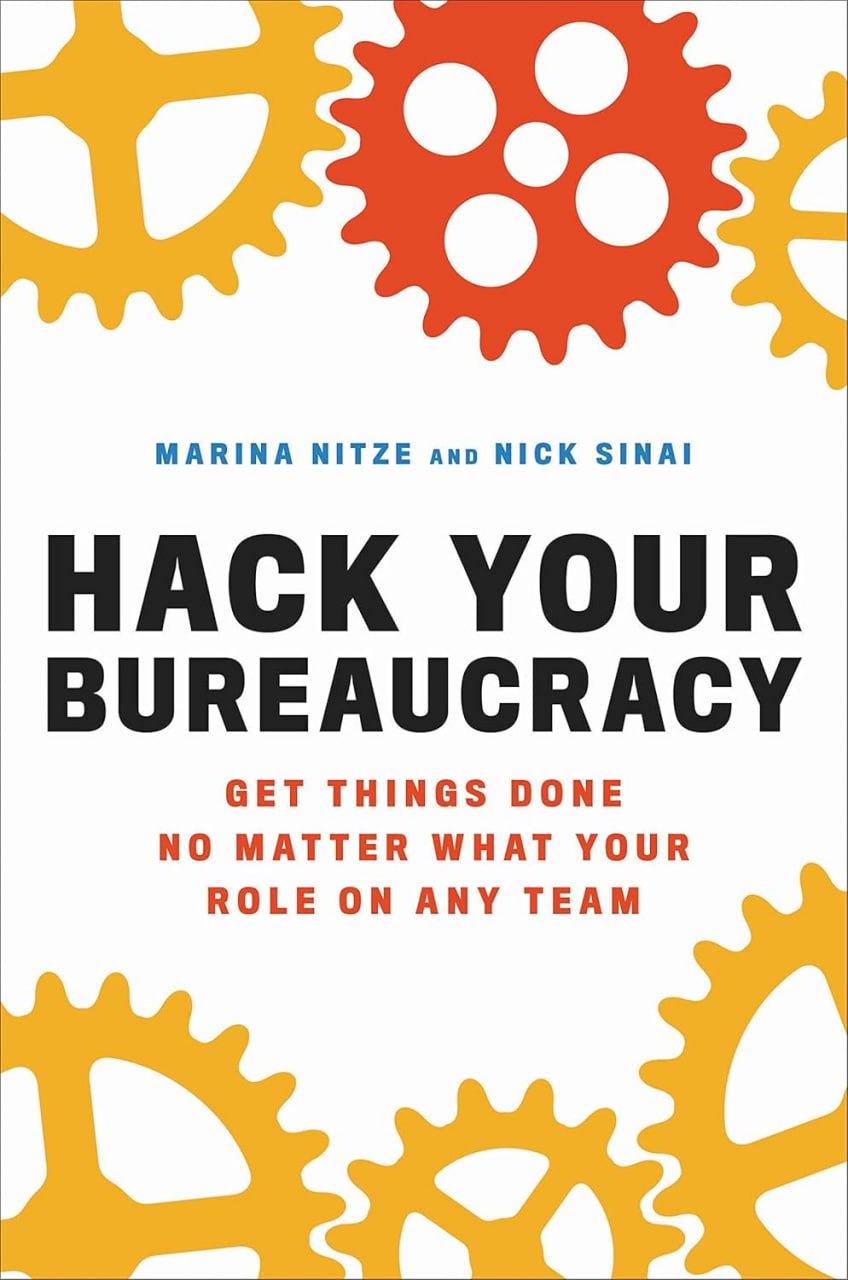
Marina Nitze & Nick Sinai
Hack Your Bureaucracy: Get Things Done No Matter What Your Role on Any Team
New York: Hachette Books, 2022
Bureaucracies have a bad reputation. But they are everywhere, and most of the time they are quietly keeping civilization on track. The waiting room at the Department of Motor Vehicles is a living hell, but the wider bureaucracy that is the DMV tracks and verifies the true ownership of automobiles, provides documents proving a person is who he says he is, and collects revenue to pay for road expansions and repairs.
All private enterprises become a bureaucracy after the business becomes large and its critical revenue generating processes are made routine. While there is a great deal of efficiency in a large organization in the big picture, in the small picture there can be ongoing friction and inefficiencies. Reducing the friction and increasing productivity in a large bureaucracy takes a special set of skills. Hack Your Bureaucracy shows what those skills are and how to acquire them.
Marina Nitze and Nick Sinai learned how to hack bureaucracies while sorting out problems at the Veterans Administration. During the Obama presidency, the VA was overwhelmed with claims. Nitze and Sinai became involved in the reform efforts there. The lessons which they learned have been packaged into an easy-to-read and understand book.
Both worked for the Obama administration so most of the purposes of their efforts won’t be appreciated by readers of this website. One example they use is especially doubtful—the story of the liberal Jewish District Attorney of Philadelphia Larry Krasner. He didn’t believe in “mass incarceration” so he worked years and years to get to the place where he could implement the large-scale release from prison and non-prosecution of sub-Saharan blacks. Crime exploded as a result of this “hack.” Obama’s supporters and staffers were indeed capable, but they collectively had a topsy turvy worldview which holds that crime is good and police are bad, trans-women are women, etc.
One such topsy turvy morality in the book was Obama’s desire to increase the number of refugees admitted into the country. Nitze, Sinai, and the US Digital Service worked out a way to reduce case workers’ respective traveling times by allowing digital signatures for refugees’ paperwork. The case workers were so used to flying back and forth from the refugee camps to sign paperwork on the spot that they didn’t realize there was a better way. Obviously, admitting refugees is a bad thing, but this sort of “hack” can be used in any direction including developing ways to remove refugees quicker. Another hack was also digital. Lawyers looking over claims at the VA had to spend a day downloading all the medical files. When this was discovered, Nitze and Sinai worked with the programmers to add a “download all” button saving critical time.
The pair miss one of the key things to improving a bureaucracy in the book—remove low IQ people who were hired under some sort of diversity, equity, and inclusion effort. There is nothing more frustrating than trying to innovate with such a person in a management role. IQ matters. Additionally, avoid people who don’t have the judgement to avoid catastrophic errors. It is important to recognize and properly react when one sees a man who fails to discern between the trivial and the important, fails to understand abstract concepts, and is unable to recognize when he is in error. In every case I’ve dealt with a poorly functioning colleague who was at the center of a disaster of some sort, there was a foreshadowing demonstration of the aforementioned-problems.
Race is always an issue too. The longstanding diversity quotas and affirmative action hirings have created a warped situation with lower IQ sub-Saharan blacks managing more efficient whites. Obviously, that is a mismatch of strengths, but there are other race-centered problems that I’ve seen in my professional life that largely go unmentioned. There is a subset of whites who claim to be liberal and colorblind but who become insubordinate and problematic around a black manager even when the black is doing the right thing. Then there are people who recognize that there is a problematic non-white DIE hireling, but they don’t confront the DEI person directly. Instead, they batter the whites in that portion of the bureaucracy until the non-white, usually a sub-Saharan black, is removed. Asians are also overrated.
Nitze and Sinai don’t point out what I’ve written about IQ and DEI above—they’re Obama staffers so they can’t go there even if they know its true. But they do teach several valuable lessons. They show that a bureaucracy has many customs that one should understand before attempting to make a big change. Don’t be the proverbial bull in a china shop. Then, don’t expect one’s simplistic idea to work. A newbie who says, “just” do this or “just” do that is going to be wrong. Any obvious-appearing fix has probably already been tried.
Nonetheless being a “newbie” can help. When a person is new to the job, he or she is free to ask basic questions and discover why things are the way they are. Such questions can uncover longstanding inefficiencies. One such place where inefficiencies thrive is between the silos of a bureaucracy. Marina Nitze discovered an inefficiency between two agencies in Rhode Island. One agency thought that the other required paperwork in carbon copies. The other agency didn’t understand why the paperwork wasn’t emailed, assuming the first agency sent over carbon copies for a rational reason. Nitze created a new, electronic business process without the carbon copies.
Nitze also reached out to a parallel bureaucracy to see if they’d found a solution to a problem she was facing. During COVID, foster children in Rhode Island were aging out of the program into a world with lockdowns, no jobs, and a global plague. She consulted the state of Illinois and discovered they’d extended the age for fostering until the pandemic ended. She applied this fix to her own state.
Another idea is to show the bureaucracy a “North Star.” Such a thing is a compelling goal that everyone can work towards. The vision must have enough detail without being overly prescriptive. This balance is known as construal level theory. Another important idea is to socialize the idea across the bureaucracy. Nitze and Sinai recommend the pitch to be put into a one-page paper before socialization. In doing so, the complexities can be simplified and problems exposed beforehand. An on-paper summation is a great clarifying tool. Another recommendation is to not surprise anyone in a meeting, instead use the time between get-togethers to coordinate issues and identify and resolve problems.
Additionally, the structure of bureaucracy can be used for reform. Radical changes can be made if they are put in standard memo form and distributed through the standard channels. Nonetheless, bureaucracies are not forgiving institutions. Nitze and Sinai tell the story of how a Soviet military officer avoided an accidental nuclear exchange during the Cold War but who was cashiered for failing to file the right forms. Life is unfair. Bureaucracies are here to stay unless there is some sort of collapse that the survivalists keep predicting. Chances are you might work for one at some point, so navigating them is a vital skill.
See also: The Challenger Disaster, Landlording, Layoffs, Five Levels of Leadership, Tall Men, Evolution, & Leadership, Leadership at Sea, Tools in the Toolbox, Remote Working & Management Advice
3 comments
There is a subset of whites who claim to be liberal and colorblind but who become insubordinate and problematic around a black manager even when the black is doing the right thing.
Great article. The above said tactic alone may make the book worth buying. 🙃
The libshittery have a quick anger build-up to blurting out “you people!” I’ve seen it and it’s glorious.
“one of the key things to improving a bureaucracy … —remove low IQ people who were hired under some sort of diversity, equity, and inclusion effort. There is nothing more frustrating than trying to innovate with such a person in a management role. IQ matters. Additionally, avoid people who don’t have the judgement to avoid catastrophic errors.”
It’s just that simple. Oh if I understood this forty years ago and didn’t give “the benefit of the doubt,” or “a second chance.” I’m not unhappy with where I’ve landed after fifty years, just can’t not think about where I may have landed with the same, or less, toil and toll.
Comments are closed.
If you have a Subscriber access,
simply login first to see your comment auto-approved.
Note on comments privacy & moderation
Your email is never published nor shared.
Comments are moderated. If you don't see your comment, please be patient. If approved, it will appear here soon. Do not post your comment a second time.