 1,142 words
Spencer Morrison
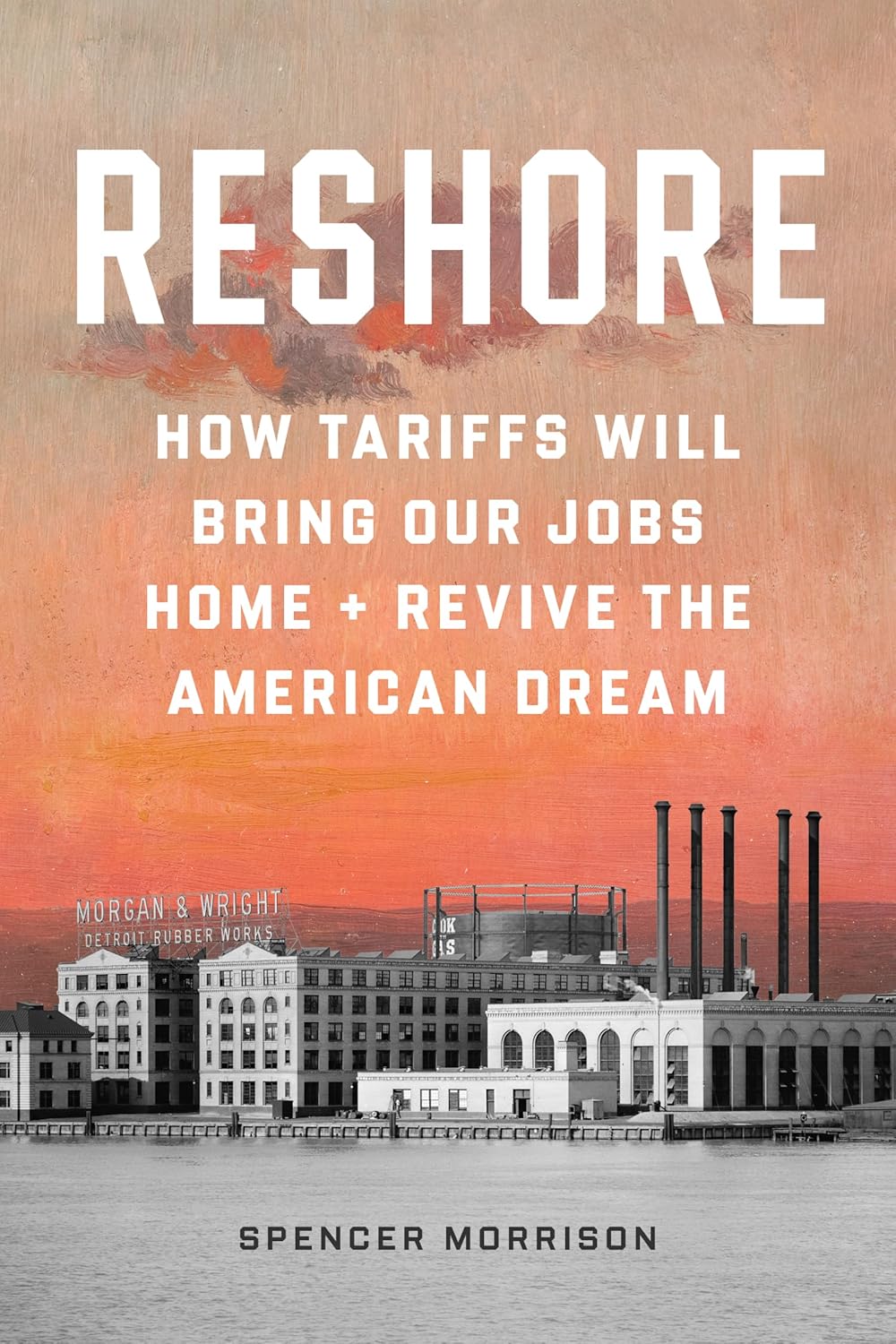
How Tariffs Will Bring Our Jobs Home & Revive the American Dream
Washington, D.C.: Calamo Press, 2025
“In 1721 Prime Minister Robert Walpole instituted a coherent trade policy which was explicitly designed to turn England into the world’s factory. This was based on Walpole’s observation – the same observation made by King Edward III or Queen Elizabeth I before him – that it was far more profitable to sell refined goods than raw goods. It was better to sell cloth than wool, ships than lumber, and swords than iron ingots.”
–Spencer Morrison
Spencer Morrison is an attorney. In that job he routinely deals with divorce. The divorces he handles are not caused by feminist dogma. Instead, they are caused by the unrelenting stress of not enough money coming into the household due to the long-term unemployment or underemployment of the husband. Deindustrialization-caused factory shutdowns are at the root cause of this trend.
In the past, American industrialization was aided by tariffs which were traditionally supported by most presidential administrations as well as by the US Congress. Tariff barriers started to be torn down in 1974 and that is when real wages in the United States began to stagnate. The decline in earnings is serious but has been hidden by several things. In the late 1970s, married women entered the workforce, thus shoring up the family income at the expense of fertility and child rearing. This situation created new stressors that expressed themselves in harmful ways. The moral panics of the 1970s and ‘80s regarding “Satanic” day-cares and unsupervised “latch-key” children becoming psychologically broken by roll-playing games arose out of the deindustrialization-caused economic conditions that required the two-income family structure.

You can buy Greg Johnson’s The Year America Died here.
The economic decline was also masked by hidden inflation. Modern houses are built with cheap and flimsy materials which weather quickly and are prone to burn. Older houses are much better constructed. Appliances are also poorly made, often breaking down after a few years. Items like breakfast cereals are deceptively put in boxes that are mostly empty. Americans have also adjusted their eating habits; most meals have more calories but less nutrition. Being fat is a modern sign of poverty.
The hidden inflation that masked the problems is no longer in the shadows. The crisis has arrived and it must be confronted. In 1973, a house cost 3.2 times the median annual household income. In 2023, the cost of a new house is 5.7 times the median annual household income. The obscenely high housing prices create significant headwinds against marriages. Many young people are therefore stuck in extended adolescence.
With the cupboards bare and the bank account empty, people have turned to drugs and pornography. The dignity of labor is forgotten. Due to the economic grind of deindustrialization, communism has made a shocking political comeback. Deindustrialization in America coupled with foreign industrialization has also turned nations which were harmless into dangerous rivals.
Morrison writes:
As it turns out, manufacturing is the anchor industry which supports the most subsequent economic activity. This is because modern manufacturing is a complicated affair which requires many different materials and components from different suppliers. Therefore, manufacturing supports many different supply chains which form a complicated economic web. Removing the key threads from this web – the factories themselves – causes the entire web to unravel. Economists have tried to quantify this and estimate that each manufacturing job supports between 1.58 and 1.92 other predicate jobs. Therefore, manufacturing job loss is just the frayed end of the…thread. If we pull on the thread a little, we find that our 4 million lost manufacturing jobs would have supported between 6.32 and 7.68 million predicate jobs…Restoring these jobs would provide full-time work for millions of Americans, and would return America’s unemployment rate back to its historical norms. (p. 94)
Deindustrialization has also contributed to the trade deficit. The trade deficit is an economic bleed caused by Americans purchasing more items made abroad than made at home. The economic disruption is covered up by increased government debt and selling valuable assets like farmland around military bases to the Chinese (and other assets to other foreign nations). The trade deficit causes the displacement of between 6.2 and 11.7 million American jobs.
To reverse this, tariffs are needed.
Tariffs work by taxing foreign manufacturers. This tax gives local American industrialists and workers an advantage over foreign competitors. The first tariff that aligned to national economic strategy in the Anglo–Saxon world took place during the reign of King Edward III. He sought to increase England’s ability to compete with Flanders, then the center of the global textile industry. Morrison writes:
King Edward III of England (d.1377) made it a core tenant of his reign to develop an English textile industry. To do this, Edward prohibited imports of Flemish cloth; imposed export duties on raw wool, but not on finished cloth; bribed Flemish machinists to set up shop in England; and he went so far as to wear nothing but English fabric himself so as to set a good example for his people. In short, Edward waged a full-scale trade war against Flanders, and it worked. Edward’s tariffs and other protectionist policies created a domestic market for a domestic textile industry. This allowed English weavers to accumulate the capital they needed to eventually compete with the Flemish on even footing. Consider that England’s cloth production rose from just 5,000 bolts of cloth in 1350 to over 80,000 in 1500. Moreover, these tariffs broke Flanders’ textile monopoly. For example, cloth production in Ypres dropped by 60% between 1312 and 1360. Overall, England’s protectionist policies helped her secure a share of Christendom’s most valuable and technologically advanced industry, and this ultimately set the stage for the Industrial Revolution a few centuries later. (pp. 214/5)
The mainstream economic establishment has been hostile to tariffs for just over fifty years, and the economic establishment has been wrong the whole time. Free trade advocates who claim that the costs of a tariff will be passed on to the consumer are not correctly explaining the situation. A 10% tariff will not increase the price of an item by 10%. Tariffs are a tax only incurred upon the goods sold in bulk by the exporter, the consumer pays a much lower percentage of the cost of the tariff per item and that is a small price compared to the ordinary markup of goods. Consumers pay no tariff on locally manufactured goods.
Tariffs will be a great tool to turn around the dismal economic situation which has been chronic for decades. However, free trade advocates and foreign actors have worked to hinder the protection of domestic industry. It will be hard work to get the tariffs in place and keep them in place, hard work to invest in local American industry, and even harder work to manufacture anything.
Nonetheless, restoring tariffs is one of the challenges of our time and it is time to rise and face the problem directly.
5 comments
Now try explaining that to Joe Sixpack, let alone the garden variety Trump hater.
…free trade advocates and foreign actors have worked to….
Great article! I wonder (((who))) these advocates, and actors could be. 🙃
Thank you for this, Mr. Van de Camp. I have been an admirer of Mr. Morrison’s work for some time now. It’s good to see he’s still trying to get people to understand actual economics instead of jewish snakeoilonmics.
Ultimately, though, Trump’s tariffs are really being implemented to assist ‘homegrown’ industries but to encourage ‘foreign investment’ in the US (i.e. buying up valuable assets and parking money away from their homeland’s tax department).
And additional obstacle to success of Trump’s tariffs is that their implementation is too chaotic to be useful to anyone but insiders. Sure, they raise the cost of imports (and, as you recognize, also raise the price to consumers), which over the long haul *ought* to benefit ‘national industry’ but the net effect isn’t a stable economic barrier but multiple opportunities for ‘rule arbitrage’ that benefit Trump’s preferred constituency (rich jews). Trump created a tariff regime that favors insider trading. It’s a simple as that.
Trump’s job is to take every good idea ever proposed by people outside The Consensus and make it look bad. This is the special role of the GOP: To poison the well for the very policies that would most benefit their beleaguered White constituents.
Whites who care about Whites because they are White will never get anything of value from the GOP or the DNC. But there is a difference between the two parties: The DNC delivers value to their constituencies.
Senator Gene McCarthy of (!) Minnesota’s next-to-last book was A Colony of the World. The title reflects what he did not want the USA to become. It came out in 1992. McCarthy died in 2005, unheeded.
The book is a bit hard to find, but the main points are: “A colony is usually a supplier of raw materials and a purchaser of manufactured goods. Its economy and financial institutions operate within the monetary system of the mother country, controlling nations or institutions.”
“In A Colony of the World, Eugene McCarthy asserts that the United States is now in a colonial, or neocolonial, relationship to a combination of outside and inside forces which impose a colonial status on the country.”
It is a fact that we provide lumber to Japan, which provides the basic consumer electronics to us — that which has not been grabbed by China. As far back as the Reagan presidency, Governor Lamm of Colorado and others were shocked at how much industry the American political and business establishment allowed to go offshore. All of this was before either Mexico or China were industrial entities in a big way.
Gene McCarthy (RIP) was an old-time liberal patriot. Worth a read.
Dear Mr Camp,
I have a book I would recommend that you would enjoy
https://www.amazon.com/Money-America-Struggle-Restoration-After/dp/B0FPTSNM29
https://miasfr.info/
If you have a Subscriber access,
simply login first to see your comment auto-approved.
Note on comments privacy & moderation
Your email is never published nor shared.
Comments are moderated. If you don't see your comment, please be patient. If approved, it will appear here soon. Do not post your comment a second time.