3,294

Sir William Berkeley, Governor of Virginia.
(Read Part 1 here)
War with the Powhatans
As the English presence in the Chesapeake Bay region increased, tensions with the Indians worsened. From the point of view of the English Virginians – the primary Indian enemy was the Powatan Tribe. The Powhatans were not a single tribe, instead the “tribe” was several Algonquin tribes united in a confederacy by Powhatan and his brothers. Tribes joined or left the confederacy through the first half of the seventeenth century.
There was probably no way for the English and Powhatan Indian Confederation to eventually wage large-scale warfare against each other. Powhatan was already quick to employ violence. He had conducted a genocide against the Chesapeake Tribe just before to the arrival of the English. Prior to the genocide of the Chesapeake, warriors from Powhatan’s tribe had destroyed a Spanish mission. The fighting with the English over food was also a problem. There were also continual small and violent clashes with the English over other matters as well as deep economic rifts. These tragic clashes came to be called the First Anglo-Powhatan War, and they ended with a treaty in 1614. Alfred A. Cave writes,
The Virginia tragedy was not simply the result of bad character on either or both sides. Its roots are far deeper, grounded in mutual cultural misunderstanding, suspicion, and intolerance, as well as conflicting economic interests. Both sides assumed the superiority of their own way of life and expected the subordination of the other. [1]
The most important conflicting economic interests was that of tobacco. Virginians started to plant a strain of tobacco which was originally from the West Indies. This tobacco had a good flavor and was in great demand. English settlers fanned out across the James River Valley set up farms dedicated to the crop. It was very profitable, but in pursuit of those profits, the English neglected growing food crops, thinking they’d be able to trade with the Indians for corn and meat continuously.
Meanwhile, Virginia’s leaders did everything possible to ensure that white-red relations remained peaceful. However, the Powhatan Indians, now led by Opechancanough, a younger brother of Powhatan, planned to drive the English away. On 22 March 1622 (Old Style Calendar), Indians streamed into English settlements bearing food, and feigning friendship while most of the whites were eating breakfast. After a signal was given, they attacked, grabbing nearby axes, or pulling hidden knives. Nearly 400 English were killed. Another 500 whites died of starvation or disease after the initial strike. Many of the English survivors retreated to the fort at Jamestown.
The Indian massacre of 1622 ended any chance for peaceful co-existence. The English were shocked by the attack. They understood that they were settling on lands unused by the Powhatan. They’d also paid for the land. The English had also attempted a form of civic nationalism with the Indians, proposing they be made subjects of the English King and convert to Christianity. After the massacre, the English ditched this policy. The director of the Virginia Company, Christopher Brooke, declared,
…Indians had “no character of god in them,” but were “offspring of Hell’s damned brood,” not descended from Adam, but of “a later Brood” not saved in Noah’s Ark, but “since the generall Flood/Sprung up like vermine of an earthly slime.” They were not human beings, but “Rooted in Evill, and oppos’d in good/Errors of Nature, of inhuman Birth/The very dregs, garbage and spawne of Earth…Father’d by Satan, and the sonnes of Hell.” [2]
The idea that the Bible only applies to the “Adamic Race” which is the Caucasian race as found in the Christian Identity movement are resident within this statement. For the time being, Christianity failed to spread to the Indians.
The English rallied after the massacre. The Anglo-Virginians allied with other Indian tribes and made a point of attacking Powhatan villages for the next decade. They made war in the manner of the army of the Roman Republic. Virginia’s militiamen would assemble for battle after the crops were planted and enlistments would end in autumn. The English were also able to acquire better arms with every ship that arrived in England. This series of conflicts has come to be called the Second Anglo-Powhatan War, and it lasted until 1632.
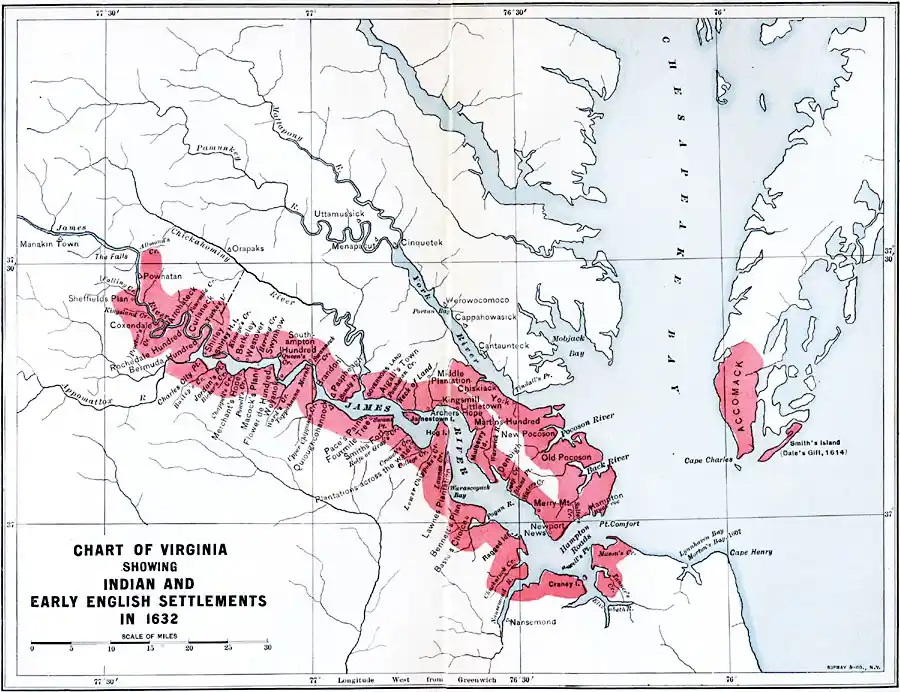
The locations of English settlements in Virginia in 1632.
Meanwhile, the Virginia Company went bankrupt, and Virginia became a possession of the British Crown. In 1641, Sir William Berkeley was appointed governor of Virginia, and he became the most consequential governor of the colony. During this time, domestic political tensions in the British Isles increased to the point that Parliament and the King would go to war. Berkeley was an open Royalist, and he made Virginia a refuge for other Royalists in trouble with Parliament in England. Many distressed Royalists moved to Virginia along with many second sons of British aristocrats who were seeking their fortune.
Virginia also held a large community of Puritans, but they lived on the frontier, south of the James River. There was an especially large settlement on the Nansemond River. To the North of Virginia was Maryland. The colony was a source of frustration for the Virginians. They felt it was their territory and had been snatched away by the King and given to his Catholic friend, Lord Baltimore. The tensions in England between the Royalists usually Anglicans, and Parliament, supported by Puritans spilled over into the colony. Throughout this time, Governor Berkeley encouraged Virginia’s Puritans to move to Maryland or the other northern colonies.
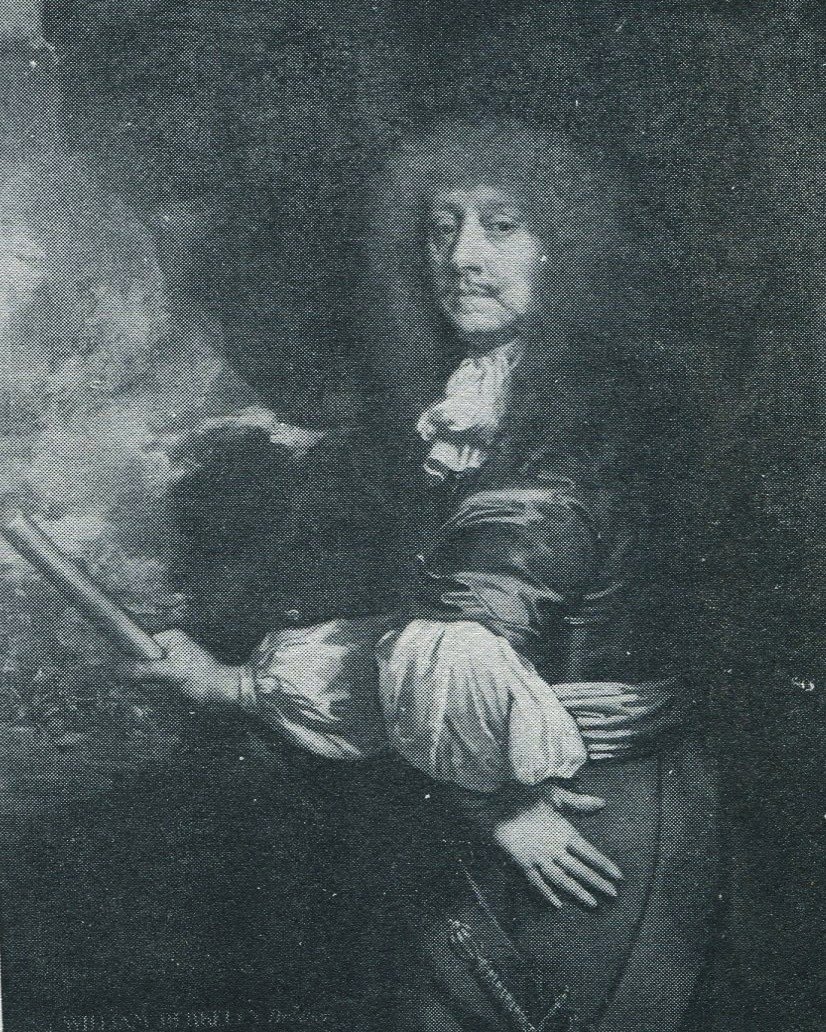
Governor William Berkeley of Virginia. Berkeley’s pose in this portrait is a political declaration indicating he is a Royalist.
The tensions in British society probably became known to Opechancanough. He came up with a strategy to drive the whites away by besieging the colony. In 1644, he struck again. This time, however, his warriors had firearms, which were acquired illicitly. Nearly 500 Englishmen were killed. The Puritans on the southern frontier were attacked but they were prepared so fewer were killed. One of Puritans had seen a vision of blood and gore in a washtub and interpreted it to mean an Indian attack was soon to happen. The Puritans might have been warned by friendly Indians also.
This conflict became known as the Third Anglo-Powhatan War. The Virginians rallied and came together in the face of the threat – to a degree. One Puritan Virginian, William Claiborne led the Virginian army, but after the main Indian attack was thwarted, he went on to attack Catholic Maryland. The Virginians also suffered from a lack of ammunition during the conflict. One planter loaded a ship with tobacco and other goods at his own expense and sailed to the other colonies to purchase powder and lead.
Governor Berkeley went to England to seek more ammunition, but the English Civil War was ongoing so there was none to be had. He returned months later with a charter to secure what ammunition could be had from any passing ship. Meanwhile, Virginia’s acting governor Richard Kemp, had hit upon a wildly successful strategy. He sent the Virginian Army to build a string of forts near the falls of the James River from which they sent parties of Rangers to hunt Indians. The presence of the forts cut off the Powhatan from their farmland and forced them to cease fighting the English in order to focus on hunting and gathering to survive.
In 1645, the Virginians sent an expedition into what is now North Carolina, by sea through the Currituck Inlet. The political purpose of the attack is not entirely clear, but it the Virginians were likely using the war in Virginia to clear Indians from other areas so that poor and lower-class Virginians could raise their status by acquiring land. The Virginians had a major battle, declared victory, and then returned. The Indians probably won, but within three years, English settlers were moving into the area.
As the war continued into 1646, the fighting put the Virginians under severe economic distress. Men serving as soldiers couldn’t plant. The colony therefore couldn’t raise the taxes to pay the army. Private debts couldn’t be paid either so there were lawsuits and attempts to collect, and nothing to be done. Just as things seemed darkest, an opportunity arose to capture Opechancanough. An English trader named Henry Fleet had been captured by the Rappahannock Indians and knew their language and had economic connections with the Indians, the Marylanders, and the Virginians. Fleet proposed a plan to send a force among the Rappahannock – who had defected to the English side – and use that force to negotiate an end to the conflict. At least that’s what historians think, the exact plan is lost to history.
Fleet and his force made it to Rappahannock territory. Once there they were told the location of Opechancanough. Fleet sent a message to Governor Berkeley with the information, and Berkeley led a force of cavalry to capture the old chief. The war was over. Opechancanough was nearly 100 years old by this time and today his legacy can be romanticized, but at the time the Virginians were tired of his violence. They’d had friends killed, economic activity interrupted, piles of debt, and their clothes were rags. He was shot in the back and killed in prison by an English guard.
The Third Anglo-Powhatan War is notable in that it is the first American conflict where black soldiers were used, although not in great numbers. Meanwhile, there was something of a slave rebellion on the Wormley Plantation, although it is uncertain from the records how bad it was. The final peace treaty with the Indians required sub-Saharans with them to be returned. After the war, Indians were not allowed on the Virginia Peninsula – the strip of land between the York and James Rivers which holds the modern cities of Williamsburg and Hampton – unless an Indian was a messenger wearing a special coat. When three Indians did travel into the Peninsula, they were shot.
The Indians were not beaten however, only the Powhatan Confederation. The English started to move into other parts of the Chesapeake Bay and up the rivers towards the west. There, more trouble would come. But the problems were among the whites.
Bacon’s Rebellion: Virginia’s Civil War
By the 1670s, the settlement of Anglo-Saxons in Virginia was proceeding in the way that it had occurred in Britain. The colony was ruled by aristocrats whose ancestors stretched back to the men in William’s Norman Army. The aristocrats in Virginia were leading common Englishmen in an endeavor of racial expansion. The main difference between what happened in Britain and what was happening in Virginia was that in Britain, the Anglo-Saxons eventually adopted the religion and higher cultural practices of the Roman Britons. There was also an absorption of native Roman Britons and Welsh into the Anglo-Saxon social fabric by assimilation and intermarriage, although it was probably different degrees of integration in different places. In Virginia, racial integration was impossible and there was plenty of mutual hostility.
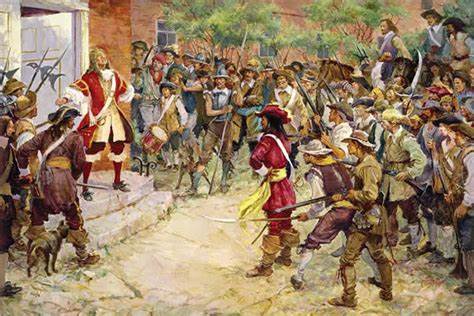
Nathaniel Bacon confronts Governor William Berkeley. The cause of this confrontation is one group of whites benefiting from trade with a group of non-whites while another group of whites were harmed by those same non-whites.
Virginia’s society was tightly controlled by Governor William Berkeley and his cronies, and the hostile Indians were far enough from the settlements on the James River that they were not the existential threat that they’d been in 1622 or in 1644. However, there were Indians around, especially in the frontier north of the Virginia Peninsula, near what is now Fredericksburg. Governor Berkeley and his elite cronies supported those Indians and profitably traded with them – although Berkeley admitted he didn’t trust them. Berkeley and his cronies were also speculating in land in a way which kept many Virginians from getting land of their own. The economic situation was such that “six parts of Seven [of the Virginians] are Poore, Indebted, Discontented and Armed.”
Also in 1675, the Wampanoag Indians attacked the English in New England. The Wampanoag had been “peaceful allies” of the English for decades, however they’d still attacked. The conflict came to be called King Philip’s War, and it was the deadliest American war per capita. The Virginians were aware of the racial holy war in the North and its implications colored their interpretations of Indian attacks in Virginia and the status of the so-called “peaceful” Indians. One Sunday morning in the summer of that year people on the way to church in the settlements on the Potomac River discovered Robert Hen lying mortally wounded across the threshold of his door. He’d been killed by Doeg Indians. Modern historians claim that Mr. Hen had dealt with the Indians unjustly, but this is probably adding the equivalent of the claim that “he/she used epithets” after a white is brutally murdered by a sub-Saharan.
The militia was called out and, to put it simply, the response to Hen’s murder eventually escalated into a large force of Virginians and Marylanders commanded by Colonel John Washington and Colonel Isaac Allerton Jr. besieging a Susquehannock fort in Maryland. The English militia didn’t have artillery, so the militia couldn’t batter down the fort’s walls. The siege lasted for seven weeks. The siege ended after a group of eminent Susquehannock men went to parley with the English, but they were killed on the orders of Washington and Allerton. Because of that outrage, a group of Indians sallied from the fort and killed several sleeping English soldiers. The militia withdrew and Governor Berkeley criticized his colonels for their treacherous killing of the Indian elders under a flag of truce.
Despite Berkeley’s correct read on the laws of land warfare, his statements were like that of an elderly, out-of-touch political leader. Experience showed that neutral or friendly enemies could quickly turn on whites with no provocation. After the militia ended their siege, Indians across the frontier, inspired by the Susquehannock, attacked the frontier Virginians. Two of the men killed where the overseer of Nathaniel Bacon (the Younger) and a servant. Frontier Virginians appealed to Berkeley to raise an army and go on the offence, but he refused. There were suspicions that he wanted to continue to trade with the Indians and did not care about those on the frontier.
Nathaniel Bacon was an aristocrat who left England for Virginia under a cloud. He’d married a woman over the objections of her father and was accused of cheating a young man out of his inheritance. He also arrived in Virginia with connections. He was the nephew of William Berkeley’s wife and had a cousin of Nathaniel Bacon (the Elder) who served in the House of Burgesses.
In addition to the tense social situation in 1675, three bad omens were observed. The first was a comet, the second was the arrival of a large flock of pigeons. The vast numbers of birds alighting on the trees caused the branches to break. Then “flies” the size of an inch emerged from “spigot holes in the earth” and ate the new leaves on the top of the trees then left after a month. The “flies” were identified by biologists in 1898 as cicadas from Brood X.
Nathaniel Bacon would come to be the central figure in a vicious civil war in Virginia, which was triggered by frustration over Governor Berkeley’s economic actions and his naive Indian policy. Bacon had all the makings of a mutineer. His close relationship to Berkeley and his high social status meant that he could see himself as Virginia’s governor and others could see him in that role. Most mutineers are like the rightful ruler rather than an outsider. Bacon had also been involved in questionable dealings prior to his mutiny, so that was a red flag which Berkeley didn’t recognize.
During the Indian uprisings, Bacon was proclaimed a “General” and he organized a force to fight the Indians. He did not, however, have an official commission from the Governor, so he was a rebel at this time. Bacon’s army proceeded south to destroy an Indian fortification on an island probably in the Roanoke River in North Carolina. These Indians were trading with Berkeley but were also presumed to support hostile actions against the frontier whites.
The fortification held two tribes of Indians, Ockinagee, who probably spoke a Siouan Language, and a group of Algonquian-speaking Susquehannocks. Bacon cleverly convinced the Ockinagee to fight the Susquehannock Indians. After the Susquehannock were destroyed by the Ockinagee, Bacon attempted to make peace with the Ockinagee provided they give food to his force, but they resisted, and a battle ensued in which the English triumphed. The left the Indian fort a ruin and any Indian survivors scattered.
Bacon returned to Virgnia, and was elected to the House of Burgesses, he also achieved a pardon from Governor Berkeley. Bacon’s popularity, and military backing allowed him to push through what became Bacon’s Laws, which limited indentured servitude, required government records be made public, and which outlawed trade with the Indians.
Bacon and Berkeley then had a second falling out – they’d never really reconciled. Berkeley retreated to the Eastern Shore and returned after reinforcements arrived from England. The situation shifted from a political disagreement over Indian policy to a genuine civil war. Despite Bacon’s dash and military success, many of the colony’s most prominent citizens stayed loyal to Berkeley. The Governor’s loyalists, plus the reinforcements turned the tide, but not before Jamestown was burned to the ground by Bacon’s forces. Bacon died of dysentery, and Berkeley hanged many of Bacon’s most prominent supporters. Charles II was frustrated by the disorder and replaced Berkeley. The King was said to have remarked, “That old fool has hanged more men in that naked country than I did here for the murder of my father.” Governor Berkeley died in England in 1677.
Bacon’s Rebellion has been interpreted a number of ways by historians. Thomas Jefferson viewed it as a precursor to the American War of Independence. Others interpret it from a “woke” leftist and integrationist view. Among Bacon’s rebels were black slaves. There is also a theological board game created by a Unitarian-Universalist Minister which seeks to put the game’s players into the minds of those involved and “speak truth to power” or something. My spin is that the rebellion was not much different from the Baron’s Revolt, the Monmouth Rebellion, or Simon de Montfort’s Rebellion where upper class Anglo-Normans, along with their tenants, clients, yeomen, and retainers revolt against an unjust King or his unjust advisors.
Both Monmouth and de Montfort’s Rebellion were like Bacon’s Rebellion in that an upper-class Anglo-Norman Englishman revolted due to negative ethno-religious pressure on ordinary Anglo-Saxons. Monmouth revolted in 1685, because he feared that King James II, who was Catholic, would harm English Protestants. In de Montfort’s case, he was violently protesting the abuse of Anglo-Saxons by Jews. In Bacon’s Rebellion, he was violently protesting the Governor’s lenient Indian policy, the logic of which put Anglo-Saxon settlers on the frontier in danger while Berkeley’s cronies profited from trade with those same Indians. In all three cases the rebels were killed, however they were ahead of their time. King James II was later deposed, the Jews were expelled from England, and Virginia’s Indian policy eventually became one of removal – for the safety of both races.
Notes
[1] ibid. p. 114
[2] ibid. p. 121
Bibliography
Lars C. Adams, Breaking the House of Pamunkey, (Crofton, Kentucky: Backintime Publishing, 2017)
Alfred A. Cave, Lethal Encounters: Englishmen and Indians in Colonial Virginia, (Lincoln, Nebraska: University of Nebraska Press, 2013)
R.R. Davies, The First English Empire: Power and Identities in the British Isles 1093 – 1343, (Oxford, England: Oxford University Press, 2000)
Mark Morris, A Great and Terrible King: Edward I and the Forging of Britain (New York: Pegasus Books, 2009)
Mark Morris, The Anglo-Saxons: A History of the Beginnings of England: 400 – 1066 (New York: Pegasus Books, 2021)
Mary Newton Standard, The Story of Bacon’s Rebellion, (Middletown, Delaware: Okitoks Press, 2017)
1 comment
Your shedding light on the struggles and triumphs of the Ango-Saxons from Roman Briton to early colonial America shows the teanacity of the people. May they arise again.
Comments are closed.
If you have a Subscriber access,
simply login first to see your comment auto-approved.
Note on comments privacy & moderation
Your email is never published nor shared.
Comments are moderated. If you don't see your comment, please be patient. If approved, it will appear here soon. Do not post your comment a second time.