 1,982 words
In this edition of Trav’s Time Capsule Classics we’ll be looking at another made-for-TV movie, which while largely forgotten today, was one of the biggest of them all.
If you ask the trivia question “What was the most watched made-for-TV movie of all time?” many will correctly answer that it was the 1983 nuclear war drama The Day After. It was a big deal when broadcast, and its record-breaking viewership was a major news story.
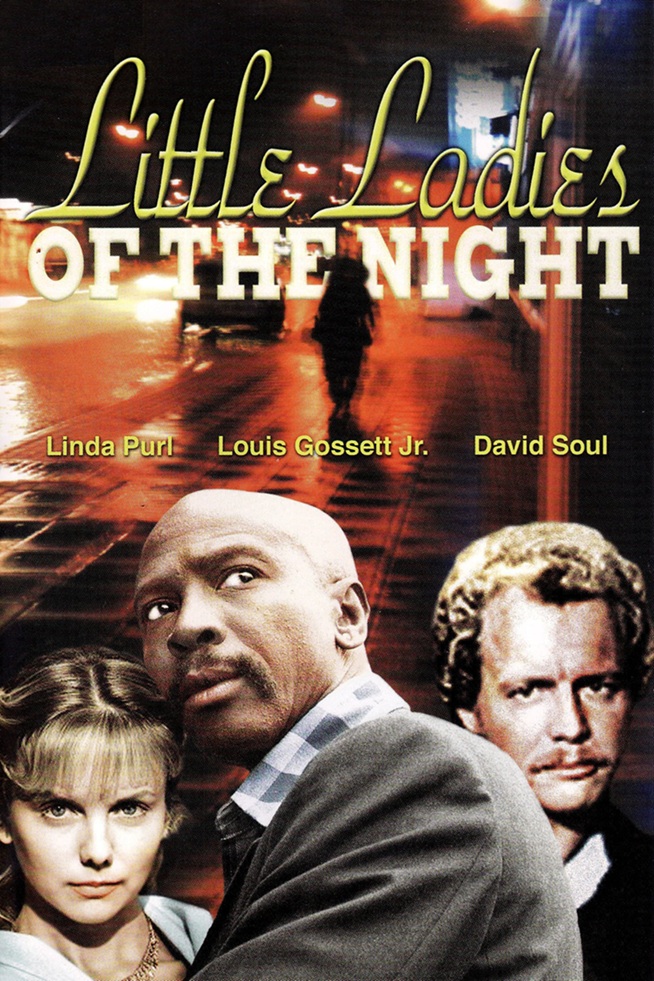
Comparatively fewer would be able to answer the trivia question “What made-for-TV movie was the previous record holder?” The answer is Little Ladies of the Night, the 1977 Aaron Spelling-produced drama about teen prostitution on the streets of Los Angeles.
I enjoy watching time capsule movies as sociological curiosity, not for entertainment. In fact, time capsule movies are rarely good entertainment. The non-negotiable requirement for a movie to be “time capsule” is that it must embody the spirit of the time, but the problem with a zeitgeist is that it rarely ages well. Everything that is new and modern is doomed to be seen as hopelessly outdated as soon as the culture tides change.
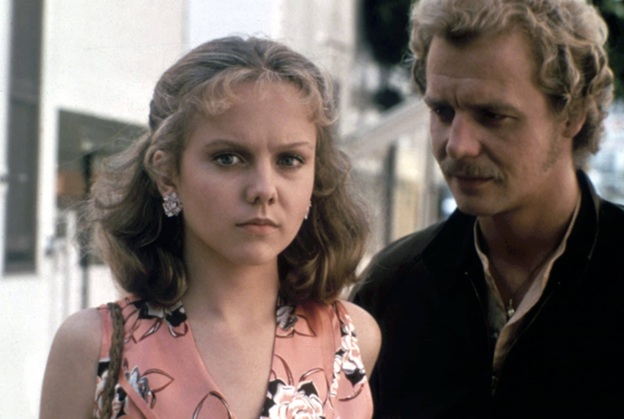
However, within 10 minutes of watching Little Ladies of the Night I found myself enjoying the film more than I usually do. You’ve got girls behaving badly. You see 21-year-old Linda Purl (who manages to convincingly look her character’s 14) breaking into a car with a coat hanger that she found in a garbage can. You hear snappy street-smart dialog as one 15-year-old prostitute tries to hustle money out of a john who turns out to be an undercover cop.
This ain’t a strip show, mister. You’ve got to do a little more than watch.
I didn’t want to rush into thing. I thought that we’d talk a little.
Hey, you wanna talk? Go pay a shrink $50. With me, you get body language for $20.
It’s got jive-talking larger-than-life pimps, villainous femme fatales, and loose street lingo like “Flatbackin’ ain’t the worst thing that can happen to you.” It’s the kind of 1970s movie that you expect Quentin Tarantino to rave about.
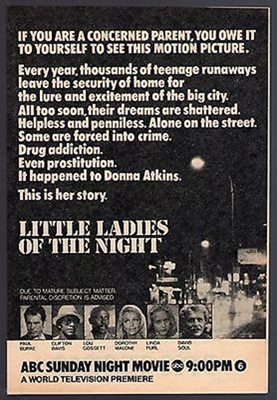 We’re having a bit too much fun here given the subject matter and therein lies the rub. Little Ladies of the Night is what the blogger Cranky Lesbian called “unserious film about a serious topic.”
TV had strict censorship rules in those days regarding sex, drugs, and other taboo subjects, but those rules could be relaxed if it was being shown for educational purposes. Such made-for-tv movies were referred to as “social films.”
I reviewed one such film, the 1974 Linda Blair picture Born Innocent which has a lot of similarities to Little Ladies of the Night in terms of subject matter. They are both about teenaged girls who run away from abusive households who become mixed up in the system. However, in terms of tone, they are worlds apart. Born Innocent deals with the matter with great sensitivity and even the girl-on-girl rape scene is the most unerotic thing I’ve ever seen. Little Ladies of the Night trades gritty realism for sensationalism and titillation, and so a movie about teenaged prostitution at times feels like an exploitation film disguised as a social film.
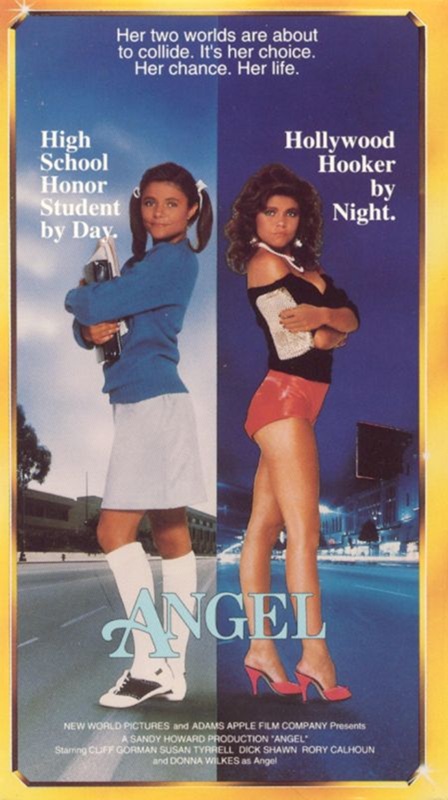 This is what makes Little Ladies of the Night so distasteful. There is a cult movie from 1984 called Angel about a high school student by day and prostitute which is not quite as offensive because it is at least honest about being an exploitation film. If Little Ladies of the Night came out in a grindhouse theater, I could enjoy it for what it is. But the fact that Aaron Spelling and his fellow tribesmen conned the networks into passing off an exploitation film about child prostitution as a serious social film leaves one feeling queasy.
Before going forward, we should look at the historical context of the movie.
In 1976, Martin Scorsese’s Taxi Driver was released. One of the most memorable parts of the movie was Jodie Foster playing an underaged prostitute named Iris. The performance won Foster an Oscar nomination and many left the theater wanting to know more about Iris’ backstory. How did such a pretty, young girl end up as a prostitute on the streets of New York for the benefit of some sleazeball? Where were her parents?
Many pined for a sequel that would answer these questions and Little Ladies of the Night is an attempt to satisfy that demand by telling the tale of an Iris-like character’s descent into flatbackin’. Star Linda Purl as Hailey Atkins bears a vague resemblance to Jodie Foster.
The movie is based largely on a New York Times article also called “Little Ladies of the Night” which was an in depth expose on the epidemic of underaged prostitution among teen runaways in New York. It’s a very interesting and informative article if you are into the sociological history of that era of the United States. Like did you know that the majority of runaways were female?
A national toll‐free runaway switchboard was set up in Chicago; it handles about 1,000 calls a month. It has received calls from 8‐yearolds. It has also drawn up a statistical profile of the runaway: average age, 16; 36 percent male, 64 percent female (this female preponderance is attributed to the fact that many boys aren’t reported).
At first I thought that might be counter-intuitive. You would expect a boy to be more likely to do something impulsive like running away from home. Plus they are stronger and thus safer in some ways. However, girls will run away with older boyfriends who can support them. Sexual abuse is more common with girls which can be a motive for running away. And girls can get into prostitution or find a sugar daddy wherever they go whereas boys would have to resort to stealing to survive, which is more difficult. This part of the article was interesting:
The police have files and photographs of more than 100 midtown pimps, who pay finder’s fees to scouts. They refer to the girls as “packages” or “flatbackers.” The “package” is lonely, doesn’t know anyone in New York, and has no means of support. Nearly all the pimps are black; nearly all the out‐of‐town “packages” are white.
As McGinniss explains it:
The kid has been brought up not to have any racial bias and she is bending over backward to show she’s not prejudiced when she’s accosted by this nicely dressed, sweettalking, perfumed black man; she’s so conscious that she shouldn’t put him down that she forgets she’s being picked up by a street hustler.
So even as far back as 1975, political correctness was greatly disarming whites from predatory blacks.
The two above influences were New York based. However, Little Ladies of the Night is set in Los Angeles. That brings us to the third influence: the notorious 1970s L.A. “baby groupie” scene. Los Angeles became legendary among rock stars for its underaged groupies. David Bowie and Jimmy Page were known to indulge during their visits.
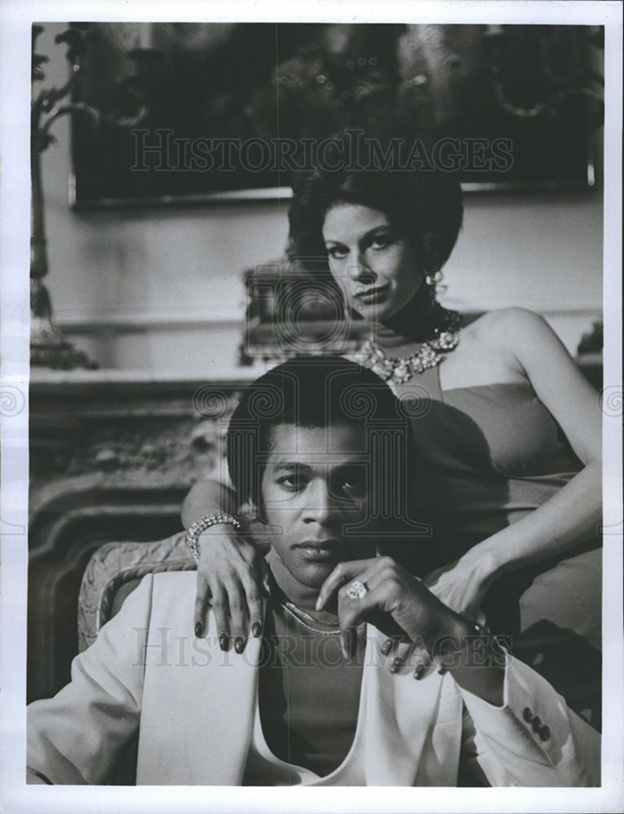 Little Ladies of the Night is true enough to life to make Comfort, the main pimp and primary villain, black. But just so you don’t get the wrong impression that all pimps are black, the primary hero of the movie is a white reformed pimp named Kyle York played by David Soul (Hutch from Starsky and Hutch).
Kyle was a highly respected (in the street cred sense) pimp who saw the light and now works with the Los Angeles police department (headed by a world-weary Lou Gosset, Jr.) to help rehabilitate runaway girls. While Kyle is an ex-pimp, we are reassured that he did not “run any kids.”
Most of the social commentary is crammed into one scene where David Soul and Lou Gossett, Jr testify about the child prostitution epidemic in front of an unspecified government panel. While they are talking about what was a serious issue, there is a lot of liberal woo and environmental determinism thrown in just for the hell of it, but also some interesting concessions.
Several of the government squares make note of the fact that David Soul being a white is unusual, but David Soul assures them “It’s not the color of a man’s skin that sends him out into the street. It’s not black or white. It’s green.”
As Lou Gossett, Jr. explains to the suits:
What I’d really like to say is that these kids aren’t your Mark Twain type characters. They are not your Tom Sawyer or your Beck Thacher who run off to join a circus or see the world with their clothes in a bandana at the end of a pole slung over their shoulder. They could be if anyone showed them they cared a damn. And sure, you’ve got your bad ones. The real rotten ones and there’s no way of making a decent human being out of them no matter what you do but when I see them, I ask myself if they were born that way?
This is why I find time capsule movies valuable. A good one will give you a snapshot of exactly where culture was at a particular time. In Little Ladies of the Night, we get a sense of where liberalism was in 1977.
 A white pimp character would be as ridiculous today as it was in 1977, but in 1977, liberals had enough fealty to reality that they movie has to address the fact it was ridiculous, whereas in a woke movie today, all the characters would act as if the politically correct white pimp was perfectly normal.
While the movie takes a pro-nurture argument, it concedes that nurture has its limits. Some people cannot be reformed. The film merely denies that they were “bad seeds” from the beginning. So the liberals of 1977 were not so far gone as to believe that the gangbanger on the street was a misunderstood poet who could be domesticated through the power of liberal love.
Another thing that stands out about Little Ladies of the Night, and part of what gives it its exploitation vibe, is the emphasis on women in the grooming and abuse process. Hailey’s prostitute friend applies peer pressure on her to stay in the game, and the pimp’s right-hand woman disciplines the girls. When Hailey returns to her pimp after attempting to escape, her punishment is to be beaten up by the other prostitutes. When Hailey is sent to a detention center for girls, she finds it is run by the grandmother from Who’s the Boss?, and she is a child pornographer.
Women are even blamed for Hailey running away. The reason for Hailey’s bad home life is not an abusive father but a resentful and neurotic mother who feels that Hailey is an imposition on her and her husband’s social life.
“Kiss me” she says to her husband “but this time don’t think about Hailey.” This would seem to suggest something more lurid but actually no. The woman resents her husband being to devoted to his role as a father.

You can order The Best of Trevor Lynch here
The one sympathetic woman in the movie is Maggie, the retired hooker with a heart of gold who now runs a bar where the flatbackers hang out at between tricks. Maggie is there to let you know that the movie is not anti-prostitution per se but the exploitative prostitution of minors. Maggie comes from a time when prostitution was still a somewhat noble profession which had fallen into disgrace. She bemoans that in her day, you rarely saw a girl on the street under the age of 20 but now “everyone wants babies.”
It’s a ridiculous film, but it broke broadcast records upon release, and it’s easy to see why. The subject matter was dangerous on its own and is presented as salaciously as 1970s censors would allow. I would not describe it as a “good movie,” but it is worth watching once for academic purposes due to its immense popularity and distinctly 1970s messaging.
9 comments
One thing I remember about the 1970’s is that there was a lot of coordinated media promotion of these sorts of TV programs, as we’ve seen in later decades. Newspapers and Magazines like People, Time, and Newsweek would all push some TV program or movie as the next-big-thing. Invariably it was a liberal/left message that was being promoted. Also, younger teachers would push these TV programs in their classrooms, as they did with Roots. Most people are sheep, so it had an effect, and not for the better.
This happened with Time and Newsweek promoting Bruce Springsteen right around the same time, which made me suspicious of him from early on. My suspicions were confirmed.
It was a little different in earlier decades, when newspapers were the primary news media and there were still a lot of conservative/right-leaning papers, in addition to liberal ones.
Thank God for the Internet.
They must have gone all in on Holocaust the miniseries
There was a big To-Do about it, yes, although I didn’t watch Holocaust. I knew long before then that most TV had gotten very politicized, so I figured that it would be the same. The biases on TV were obvious to me even as a young boy. Before Holocaust, it was Black-People-Good-White-People-Bad, or pro-feminist, or often both.
As a boy I had read a lot about WWII, and watched documentaries. It might seem hard to believe now, but the Holocaust wasn’t presented as the be-all-and-end-all in histories, movies, and programs that it became ca. 1978. In American movies about WWII, there were often sympathetic portrayals of Germans. There was anti-German propaganda going back to the war years, but watch a movie like The Great Escape from 1963, and you’ll see what I mean. My dad was an American combat veteran in the western European theater, and he had no anti-German feeling.
I’ve that Holocaust (1978) was shown in Germany and was pivotal in turning Germany completely apologetic regarding the War, that prior to that there was lingering resistance but James Woods in striped pajamas put an end to that.
Older films about the Holocaust and WWII films in general did not sentimentally emphasize the moral superiority of Jews over Whites. Rather, the “senselessness of Nazi persecution” vs. “democracy” was the main topic. For audiences of the time, filmmakers mainly depicted what could be described as the totalitarian and tyrannical nature of Nazism with its oppressive militarism. Jews were portrayed as essentially random victims whom the tyrannical regime had made into scapegoats. This is also why Jewish characters were mostly played by White non-Jewish actors. It was not perhaps until the late 1990s that films began to be made that seemed to venerate Jewish victims as higher moral beings and focused mainly on “racism” and “antisemitism”as the main evil that “can rear its ugly head again.” At that time, actors of Middle Eastern appearance began to be cast in Jewish roles, and their ethnic, cultural, and religious differences from their fellow citizens before the war began to be emphasized. The tone of films and series began to be incriminating and scolding towards the Gentile White population.
Ive known of far more teenage girls who’ve run away than boys. I think girls are more mature at a given age and hence think they will be able to take care of themselves.
Maggie comes from a time when prostitution was still a somewhat noble profession which had fallen into disgrace.
Great article! There never was a time when prostitution was a noble profession. 🙃
My wife and I recently watched the movie Vice Squad from 1982. I got a chuckle out of the ridiculously psychopathic white pimp named Ramrod while the black pimps were all portrayed as the epitome of cool. Well, except for the gay one played by Rerun.
Yeah, weird movie. As I recall, Siskel & Ebert hated it. White Texas pimp Ramrod castrates Black “sugar pimp” Dorsey. About as stupid as Game of Thrones.
🙂
Comments are closed.
If you have a Subscriber access,
simply login first to see your comment auto-approved.
Note on comments privacy & moderation
Your email is never published nor shared.
Comments are moderated. If you don't see your comment, please be patient. If approved, it will appear here soon. Do not post your comment a second time.