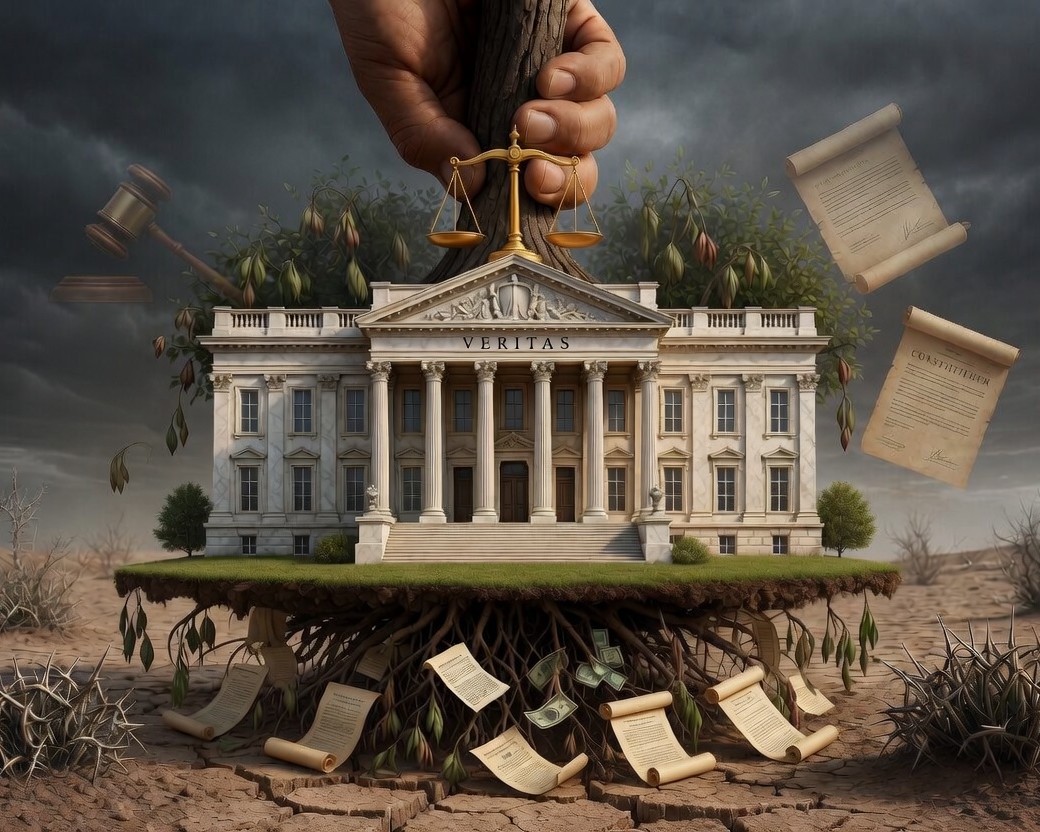
Institutions reveal their true character in two places: in the gray zones where rules are incomplete, ambiguous, or unenforceable, and even more nakedly in broad daylight when those in authority openly violate the clearest rules without shame. In a living civilization, power is restrained by the office it occupies. In a hollowed-out order, the office becomes a license to violate. Authority exists not to uphold rules but to prove exemption from them. That is why law, bureaucracy, and policing expose the moral substrate of a society with merciless clarity. (more…)

Tag: morality
-
Part 2 of 3 (whole series here)
The Idea of a Homeland
One way to reduce resistance to remigration is to base it on the idea of a universal right to a homeland.[1] Every individual and every family should have the right to its own home, a refuge from the world where they can live as they see fit. Likewise, every people should have the right to their own homeland, where they can preserve their unique heritage and ways of life. (more…)
-
Modern development theory rests on a simple assumption: institutions can be transferred from one society to another. If a country adopts the right legal codes, builds courts, trains bureaucrats, and establishes regulatory agencies, it is expected to converge toward the stability and prosperity of developed nations.
This assumption persists not because it is true, but because it appears plausible to those who encounter societies primarily in abstraction. (more…)
-
A society can become technologically modern while remaining intellectually pre-modern. Satellites may be launched into space while superstition governs everyday decisions. The result is not progress but instability—a condition that can be described as second-hand modernity.
How can a society produce seemingly world-class engineers and nuclear scientists while remaining deeply irrational? (more…)
-
Whatever happened to morality? This is not a lament over declining moral standards, or dismay at a rise in immoral behavior. These things are certainly happening, but they are the registration and confirmation of an individual moral standard, usually of a nation, a gauge which changes between cultures, civilizations, and epochs. (more…)
-
The 1957 courtroom drama 12 Angry Men is widely considered to be one of the best films ever made. The movie’s premise is that an 18-year-old boy is on trial in New York City for first-degree murder in the stabbing death of his father. (more…)
-
1,871 words
Part 9 of 14 (Part 1 here, Part 2 here, Part 3 here, Part 4 here, Part 5 here, Part 6 here, Part 7 here, Part 8 here, Part 10 here)
There is a deeper problem with Plato’s account of justice in the Gorgias. He treats it as an art (techne). But is justice really an art like medicine? In such dialogues as the Laches, Charmides, and Euthydemus, Plato explores the problems of treating moral wisdom as a techne. This is the error of the sophists. (more…)
-
3,159 words
Part 5 of 14 (Part 1 here, Part 2 here, Part 3 here, Part 4 here, Part 6 here)
Setting the Stage
Socrates’ conversation with Polus deals with three important philosophical issues.
First, Socrates explains the true nature of rhetoric, which requires that he contrast it with philosophy. This discussion requires several important distinctions: soul vs. body, art vs. quackery, edification vs. corruption, and friendship vs. flattery. (more…)
-
June 17, 2024 Greg Johnson
Notes on Plato’s Gorgias, Part 4
The Master Art1,878 words
Part 4 of 14 (Part 1 here, Part 2 here, Part 3 here, Part 5 here)
Ethics as an Afterthought (456d–457c)
Is Socrates right that sophistry is essentially amoral and technocratic? After all, the sophists were widely seen as not just teachers of rhetoric but also as teachers of morals. However, as we shall see, both Polus and Callicles strongly embrace the amoral and technocratic idea of sophistry. Moreover, in the Meno—which is set in 402 BCE, after the Peloponnesian War and the latest possible date of the Gorgias—Meno tells Socrates: “I admire this most in Gorgias, Socrates, that you would never hear him promising this [to teach virtue]. Indeed, he ridicules the others [other sophists] when he hears them making this claim. He thinks one [the sophists] should [only] make people better speakers” (95c).[1] (more…)
-
4,213 words
Part 1 of 14 (Part 2 here)
An ancient commentator on Aristotle tells a story about a farmer who got ahold of Plato’s Gorgias and was so stunned that he gave up the life of farming, trudged to Athens, looked up Plato, and put his soul in Plato’s care.[1]
Like the Alcibiades I, the Gorgias offers a wonderful argument for pursuing the philosophical life. But there are differences. The Gorgias is twice as long as the Alcibiades I. Instead of speaking to a naïve young man, Socrates faces three formidable opponents, including one of the greatest of all sophists, Gorgias of Leontini, for whom the dialogue is named. But in the end, philosophy wins. Sorry for giving away the ending, but did you imagine it would turn out any other way given that Plato is our author? (more…)
-

You can buy Jim Goad’s Whiteness: The Original Sin here.

You can buy Jim Goad’s Whiteness: The Original Sin here.
321 words / 2:02:40
Pssst — white people! There is no shame in being white. There is only shame in ever thinking there was. In the 50 short, sharp, incisive essays contained in his book Whiteness: The Original Sin, author Jim Goad examines why the idea of being white has become the modern version of the unpardonable sin. On the latest broadcast of Counter-Currents Radio, which was the fifth meeting of the Counter-Currents Book Club, host Greg Johnson was joined by author Jim Goad as well as John Derbyshire and Angelo Plume (Telegram, YouTube) to discuss the book and anti-whiteness more generally. It is now available for download and online listening. (more…)
-
May 7, 2024 Greg Johnson
Nowa Prawica przeciw Starej Prawicy
Rozdział 6: Znaczenie filozofii dla zmiany politycznej3.118 słowa
English original here, French, Spanish
Część 8 (Rozdział 1, Rozdział 5, Rozdział 7)
Obecna wersja tego eseju to przemowa, którą wygłosiłem w Seattle 14.10.2012. Dziękuję wszystkim, którzy byli obecni, za inspirującą dyskusję. Pierwotną wersją tego eseju był wykład otwierający zajęcia ze „Wstępu do filozofii”, które prowadziłem dla studentów studiów licencjackich w latach 1990-tych.
Tytuł tego eseju jest poniekąd mylący, ponieważ zamierzam dowodzić, że filozofia ma znaczenie dla wszelkiej ludzkiej aktywności, nie tylko dla polityki. (more…)
-
2,700 words
Part 1 of 7 (Part 2 here)
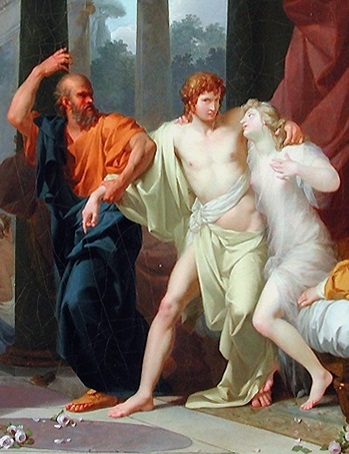
Author’s Note: I am typing up and editing my lecture notes on Plato’s Alcibiades I and Gorgias to incorporate them into a new book tentatively entitled Tyranny and Wisdom: An Introduction to Platonic Philosophy. The Phoenician neoplatonist philosopher Iamblichus (c. 245–c. 325) placed the Alcibiades I first and the Gorgias second in his curriculum of Plato’s dialogues, and with good reason, for together they constitute an excellent introduction to Socratic moral and political philosophy.