
John Terhune (image source: Maine Public)
1,922 words
To say that there’s something wrong with the media is as obvious as saying that water is wet. Good journalists are almost as hard to find as unicorns. The bad ones are Public Enemy Number One. In an article called “America’s 15 Most and Least Trusted Professions,” journalists were rated just ahead of lawyers — ouch! This was according to (ahem) Newsweek. They added in conclusion:
In the 21st century, the 24-hour news cycle, rise of Fox News, and online publications that ape journalistic outlets without adhering to basic standards have blurred the line between pundit and journalist for many Americans.
Well, that was catty!
I’ve had few dealings with these types, fortunately. The last time a soi-disant journalist quizzed me, from his past work I at first thought he was fairly enlightened and independent-minded. As the quizzing continued, I began to suspect otherwise. So I made it clear that my remarks were off the record and I did not give permission for them to be used against me. Later, he badmouthed me in print.
A word to his employers about his peculiar journalistic integrity might well leave the sad sack unemployed. Well, why not then? Frodo’s discussion with Gandalf about Gollum comes to mind:
“What a pity that Bilbo did not stab that vile creature, when he had a chance!”
“Pity? It was Pity that stayed his hand. Pity, and Mercy; not to strike without need.”
After that incident, my reserves of mercy for wormy journalists were fully expended. As far as zany troglodytes are concerned, it’s easier to take pity on Gollum. Like Aleister Crowley said, “Compassion is the vice of kings.”
An Exchange with a Newspaper Reporter
Robert S. Griffin is a former professor and the author of some fine books such as The Fame of a Dead Man’s Deeds and One Sheaf, One Vine. He can add another data point to journalistic behavior these days, as he described a telling incident last year. It begins:
In the first half of May, 2023, I received an email from John Terhune, a reporter for the Portland Press Herald newspaper in Portland, Maine, who was working on a story about White racial activism that resulted in an email exchange between us. I’ve decided what we wrote each other might be of worth to others. John has OK’d my sharing it.
From John Terhune’s opening message:
We’ve heard anecdotal reports of a growing white nationalist movement in Northern New England and we’re looking into whether this is true and, if so, what’s behind it. . . .
Would you be willing to speak with us about white supremacy and the factors that appear to be pushing the philosophy more toward the mainstream? My sense is these ideas are often misunderstood by the general public — I want to make sure I understand them myself so that I can fairly present them to our readers.
Although the reporter pledged to be fair, Griffin clearly suspected an agenda. Early into his reply:
My experience has been that journalists writing about white wellbeing and advocacy stay within the “there’s a menace lurking in the backyard” party line illustrated with a couple of scary anecdotes and fleshed out with quotes from wacko-sounding whites and people hostile to whites, the Southern Poverty Law Center and the Anti-Defamation League prominent among them. Safe (you could get in deep trouble if you come off friendly to white organization and collective action), no heavy lifting, no muss, no fuss.
The way you are framing the article — the rise of white nationalism — sounds like you might be conforming to this pattern. There are white nationalists, but why did you choose this label? And later in your email you use the term “white supremacy.” Those are two tags employed to demonize and marginalize white racial consciousness, advocacy, and activism.
Still, he helpfully provides a dozen links to sober-minded pro-white advocates, including us. That should’ve given John plenty of reading material to absorb and contemplate for a long time.
A few days later, the intrepid reporter replies:
Thanks for your detailed response. I particularly appreciate you pointing out some issues you have with how I framed the landscape of white advocacy –I’m personally very interested in learning more about the differences between how these groups view themselves and how the media presents them. We did decide to look into this story based on anecdotal reports that basically amount to “the menace lurking in the backyard” — but after just scraping the surface of this world, it’s become apparent that things are more complicated than that.

You can buy Greg Johnson’s White Identity Politics here.
So far, so good. It looks then like it’s going to be real reportage and not just a boilerplate hit piece, right? The reporter asks him five further questions, as for example about the difference between the terms “racially conscious” and “racist.”
Griffin answers the following day. First of all, he helpfully warns the reporter that the topic of pro-white advocacy is explosive and will be difficult to discuss objectively as a member of the media, so he should proceed with caution. This begins:
There has been, for decades, a relentless campaign by those in control of the information and idea flow in this country (let’s focus on the U.S.) to demonize, suppress, and silence white people, whom they depict as racist, oppressive, and privileged (theirs is an unearned status). They trash this country that European heritage people founded and developed as evil incarnate. Any problems non-whites display result from whites’ historic and current injustices. Any manifestation of white racial pride and concern, any identification of collective interests, any emergence of white leadership or hint of white organization and collective action is ignorant, evil, and forbidden. If you take exception to any of that, you’d better keep your mouth shut if you know what’s good for you.
He then discusses possible approaches to the subject. For example:
An obvious way to clamp down on white organization and action is to punch up examples of it that can be portrayed as nutty and scary and use them to characterize the whole of white racial activism as beyond the pale. If you believe in your heart that that’s the ethical course to take with this article, that’s what you should do.
That much seems intended as a challenge to break free of the usual journalistic bugaboos about the subject. After all, cherry-picking things to make white advocacy look weird and menacing isn’t an example of the sort of objective reporting that Terhune said he was intending to do.
After that, in several more paragraphs Griffin answers the five questions that the reporter asked. All told, the reply added up to 1,281 words. That was a lot to work with — lots of well-written, quotable material — and a journalist could hardly ask for anything better.
What were the results?
After getting this prompt and lengthy reply, John didn’t write back. Following two months of radio silence, Robert e-mails him to see what’s up with the feature. The reporter replies briefly:
I was thinking of emailing you the other day to give you an update. Our story came out today. I ended up getting busy with another project, so I largely took a back seat on this one — some of my reporting, including our exchange, did not make it into final piece.
You can feel free to share our initial email exchange with your readers. Thanks for your patience and for waiting to post until we finished our story.
As for the finished product, it’s behind a paywall, but here’s Robert’s description:
The article, “Hate Groups Are on the March in Maine,” is online — very long, eleven pictures, dominates the front page, five hundred comments at this writing. . . . John is the second-listed co-author, who is also White. The subtitle material gets at the thrust of the article: “A three-month investigation by the Portland Press Herald/Maine reveals that white nationalist groups are increasing their presence in Maine. Ignoring them would be a mistake, experts say.” I wasn’t among the experts cited in the article (you might be able to guess who some of them are), and nothing from my emails to John made the cut.
In other words, Robert was wasting his time with all that correspondence and his lucid, well-considered replies. The article turned out to be yet another “there’s a menace lurking in the backyard” boilerplate hit piece. In terms of this final result, John’s stated intent from the beginning — “I want to make sure I understand [these ideas] myself so that I can fairly present them to our readers” — turned out not to be worth the electrons they were printed on. Robert’s conclusion begins:
It’d be easy and play well if I went into a from-on-high scold: “Hate groups on the march? You took a back seat? Come on, John, you caved. Where’s your integrity?”
Then he decides not to press it. He figures that the reporter was under political constraints, and had his livelihood at stake. Besides, Robert remembered spending much of his own life unthinkingly spouting the Party Line. Finally:
All I can say is that I’m not going to finger point around this recent exchange with John and the resulting article. I’m going to use what went on to try to be kinder and more understanding and more helpful to good, decent White people like John and, I suspect, the co-author of his article.
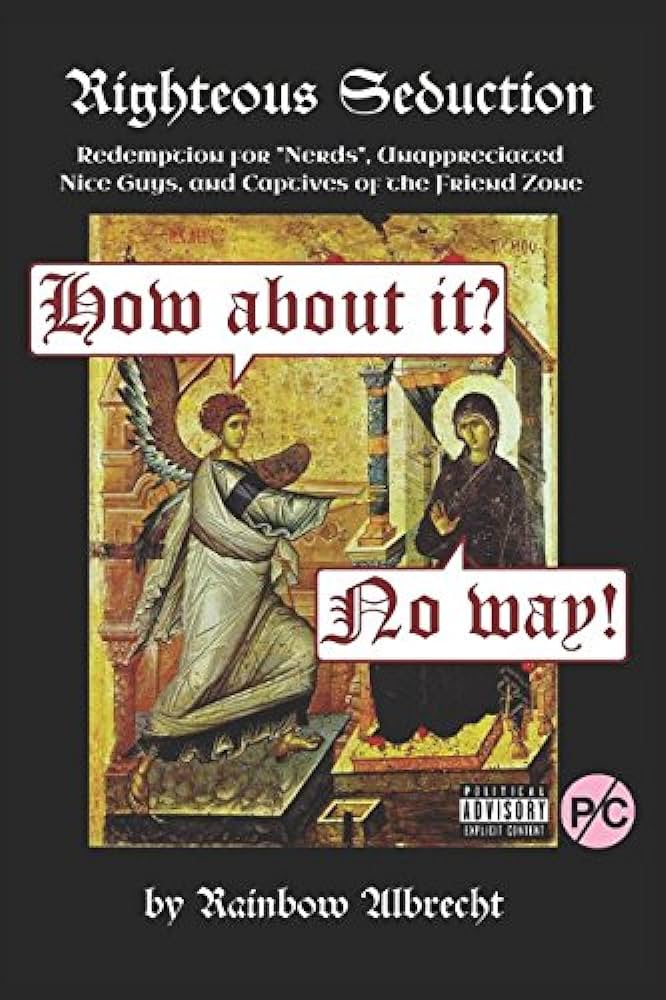
You can buy Beau Albrecht’s Righteous Seduction here.
My take is somewhat less charitable. (Again, like Uncle Aleister said, compassion is the vice of kings!) To me, the lack of even a terse apology speaks volumes, though really something of this magnitude merits sackcloth and ashes. Whether John was sincere all along but lost creative control, or if he caved in to political pressure, or if he was insincere about his stated intention of being objective, the results are the same: It was a formulaic hit piece that delegitimizes white advocacy. If John felt that the article egregiously misrepresented his efforts at reporting, then he could’ve asked to be removed from the byline. Instead, he still has co-author credit for “Hate Groups Are on the March in Maine,” another feather in the cap for any mainstream media journalist.
Robert stipulates that John is a decent white person, and figures that the co-author is, too. Whether or not this is true, these reporters collaborated with The System. In this instance, their scare story helped advance the usual sort of moldy double standard. That is to say, identity politics as practiced by white people is wrong, unlike among all other races. This wasn’t merely a betrayal of Robert’s trust. Since these reporters are white, then not only are they collaborators, they’re like chickens voting for Colonel Sanders. The consequences aren’t just personal; that type of rhetoric ultimately serves to delegitimize political representation for their own extended family.
Conclusion
Q) What do you call 10,000 mainstream media journalists at the bottom of the ocean?
A) A good start!
More seriously, there’s no likely benefit to be derived from talking to reporters, unless it’s someone who has an impeccable track record of objectivity and the publisher is certain not to tamper with the story. You’re more likely to encounter your fairy godmother, though. Why help the mainstream media write their stories? It will serve only to legitimize them and give them grist for their propaganda mills. Don’t feed the bears! At best, your time will be wasted — and at worst, your words will be twisted. Or to adapt the refrain from a 400-year-old song: “Take heed, trust not a reporter.”
11 comments
As the kind of person who is just waiting for his chance to do jury duty, I don’t think I’d be able to resist talking to a journalist either. Perhaps it’s best that I’ve never been asked to do either…
Funny thing, I’ve been summoned for jury duty five times, but each time it was called off for one reason or another. The closest one involved someone who got busted for smuggling a kilo of coke. When he saw that the trial was about to begin, he copped a plea at the last minute. Wise move – I loathe coke pushers and would’ve been happy to send him to the pound-me-in-the-@$$ prison for the next 20 years.
If you called that journalist a two-faced, duplicitous, disingenuous, race baiting low life, he’d reply, ‘Thank you, I thought for a second there you were about to insult me’. What a scumbag.
The sad thing is that he’s an angel compared to Krugman.
Mr A, they are all and I mean all cultural bedwetters. More concerned with ideology than legitimate discourse. Prof Griffin entered into that conversation in good faith. The left, Antifa, woke, progressives et al, have no good faith. They have no faith, ultimately and are ultimately bereft of decency or honesty. I repeat, would rather piss their own bed and wallow in urine than even contemplate another perspective.
It happens to the best of us. If I recall correctly something similar happened to Jared Taylor. He thought he was being interviewed by a media outlet legitimately interested in his organization but instead was for a hit piece against him that lumped him up with unsavory characters.
Well, bless their hearts.
It can be very satisfying to lay out your arguments and criticism of Leftist journalism in a clear and patient manner. Unfortunately it too often accomplishes nothing, except perhaps re-clarifying for yourself why you think the way you do. “Bogeymen in the backyard” stories like the ones Robert Griffin describes should be understood as quasi-fictional narratives, a form of entertainment that newspapers indulge in because without the bogeyman angle there’s no story there, at least nothing you can pass off as a feature in a newspaper.
And there really aren’t that many bogeyman narratives available and printable. The closest thing would be a well-worn tale of a serial murderer or mad bomber, or some old crime that can always get dusted off again because it’s supposed to carry a moral lesson. For example the deathless Emmett Till story; or Boston’s Charles Stuart tale from 1989, which the Boston Globe recently dusted off for the umpteenth time, because it gave an opportunity tell once again how bad race relations were in 1989 (regardless of the fact that it now appears the story that the media has told for 35 years is essentially untrue).
Indeed, there’s a “moral panic” element in those kinds of stories. Other than that, there’s a lot of stitching together of certain tropes. The bad news is that this isn’t about telling an entertaining story, but rather about smearing our efforts at ethnic self-advocacy.
If journalists were worried about white nationalists being misrepresented, they’d publish op-eds from white nationalists so they can speak for themselves.
Whenever you’re contacted for quotes, counteroffer with “I can’t provide any quotes right now, but I’d make time to write an op-ed.” See how far you get.
In the unlikely event they agree, there’d have to be a bulletproof agreement that they can’t editorially “improve” the submission.
Comments are closed.
If you have a Subscriber access,
simply login first to see your comment auto-approved.
Note on comments privacy & moderation
Your email is never published nor shared.
Comments are moderated. If you don't see your comment, please be patient. If approved, it will appear here soon. Do not post your comment a second time.