 2,055 words
Richard W. Maass
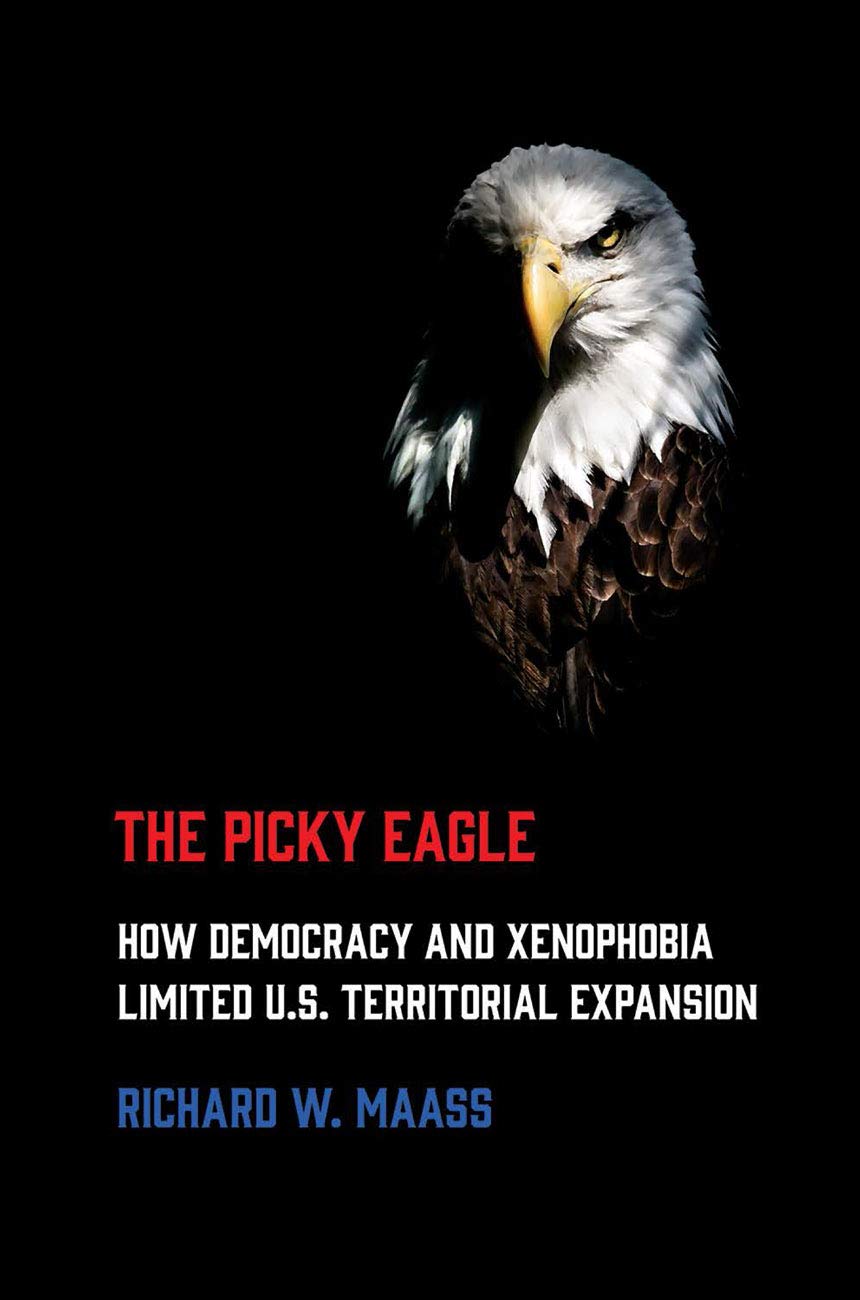
The Picky Eagle: How Democracy and Xenophobia Limited US Territorial Expansion
Ithaca, NY: Cornell University Press, 2020
Along with supporting or joining the Department of Homeland Security and working to end the 1964 Civil Rights Act and the 1965 Immigration Act, American white advocates should do everything possible to ensure Greenland is NOT annexed by the United States. Military bases in Greenland, yes! Greenland in the domestic political system, no! The problem with Greenland is that it is filled with more than 50,000 Wild Indians who aren’t going anywhere. Should the various tribes of Greenland be absorbed, they will be just another non-white group gumming up the system.
Passing up the opportunity of ruling a large foreign population is, in fact, the American Way. This traditional American trend is historically and internationally unusual. Normally, when powerful countries expand, they take over the most populated and wealthy regions to extract as much profit as possible—like the British in India, the Dutch in the East Indies, and the Mongols in China. Instead, America expanded by injecting Anglo-Americans into mostly empty areas which required enormous amounts of labor and capital to make productive.
Richard W. Maass has described this situation in his book The Picky Eagle (2020).
U.S. foreign policy today continues to feature other forms of expansionism, including diplomacy, foreign aid, sanctions, military occupation, regime change, and (in a mostly informal way) imperialism. Its military reaches all corners of the globe, yet the U.S. domestic political system remains limited to part of North America, seemingly invalidating Joseph Stalin’s mantra that “everyone imposes his own system as far as his army can reach.” For all their rhetoric about creating an “empire of liberty” and fulfilling their “manifest destiny,” U.S. leaders annexed far less territory than was feared by neighbors who quaked before the “northern colossus” and European leaders who assumed that further U.S. territorial expansion was “written in the Book of Fate.” (p. 5)
The reason for this is what Maass calls domestic impact theory. Because the United States is a representative democracy rather than an empire ruled by a tyrant, all new additions to the Union have an impact on how things play out in domestic politics. As soon as the Constitution was ratified, lawmakers realized that new acquisitions carried a danger of upsetting the internal order.
The first addition to the new United States was the trans-Appalachia region that included the Gulf Coast save Florida, extended north to the southern banks of the Great Lakes, and ended at the east bank of the Mississippi River. Trans-Appalachia contained a few tiny French settlements and more Indian tribes, but the number of Indians was small, and Americans had established procedures for removing Indians in colonial times. Anglo-Americans were also expanding into the area before and during the Revolution. Point Pleasant, West Virginia was fortified and settled during Lord Dunmore’s War in 1774, so the first American annexation was into a region which was already quickly becoming Anglo-American.
The next major annexation was New Orleans. The Americans were bound to come into conflict with whichever foreign power owned the city since all trans-Appalachian commerce passed through the mouth of the Mississippi. Capturing the town was not controversial, but giving American citizenship to the existing Cajun, Indian, and Mulatto population was. Maass writes:
Many U.S. leaders agreed with former Massachusetts Congressman Fisher Ames that this “Gallo-Hispano-Indian omnium gatherum of savages and adventurers” was as worthy of citizenship as “otters in the wilderness,” yet their sparse numbers rendered them vulnerable to marginalization via post-expansion policies. (p. 48)
The Louisiana Purchase worked because native Anglo-Americans had enough of a population eager to move to the area and develop it. The Anglo-Americans demographically overwhelmed those who were already in Louisiana territory. The modern state of Louisiana remains somewhat dysfunctional, however. Its politics are driven by a conflict between French and Catholics in the southern part of the state and an Anglo-Protestant north as well as a more intractable conflict between sub-Saharan blacks and whites.
During the War of 1812—which actually was an America First war—the United States did seek to capture Lower Canada, but only to use as diplomatic leverage in peace negotiations with the British. By 1812, the American political elite recognized that the French Canadians and Canadian Loyalists were not likely to be eager participants in the American system.
After 1814, American expansionist efforts into what is now Canada were only aimed at the western parts which were not densely settled. Americans also expanded into Florida, but that Spanish-ruled territory was mostly empty. The same is true of California and Oregon. California was part of Mexico, but Mexico was losing its grip on its northern area. Anglo-American settlers took sparsely populated Texas out of Mexico in 1836. The Texans immediately petitioned the United States for entry into the Union, but this was delayed and domestic impact theory explains why. Texas was a slave state and admitting it would threaten free state Northerners.
Eventually, Texas was admitted into the Union. To get that done, the Texans created several metapolitical narratives—one for the North and the second for the South—which explained how Texas statehood would benefit the different regions. After Texas was admitted, the Polk administration engineered a war with Mexico in 1846 which was quickly won. The US Army’s march to Mexico City was an exercise in military excellence.
Then came the question as to what America should do with its conquests. There was an “all of Mexico” political movement for a time, but racial issues intersected with domestic impact theory and the top politicians of the day, led by Senator John C. Calhoun, opted to only take the lightly settled areas that now make up the American Southwest. Senator Lewis Cass said it best:
We do not want the people of Mexico, either as citizens or subjects. All we want is a portion of territory, which they nominally hold, generally uninhabited, or, where inhabited at all, sparsely so, and with a population, which would soon recede, or identify itself with ours.
You can buy Greg Johnson’s Against Imperialism here.
Although the territory captured or gained from Mexico through the Gadsden Purchase would later be filled with Anglo-Saxons, there was a domestic impact to integrating the territories gained by the Mexican War that led to the Civil War. This could have been avoided had the anti-slavery/anti-sub-Saharan Wilmot Proviso been made law, but no one in power recognized the Proviso’s brilliance until after slavery was ended by means of an appalling catastrophe.
In the aftermath of the Civil War, the ruler of the Dominican Republic presented President Grant an offer to purchase his country. The people there had been briefly occupied by Haiti and didn’t wish to repeat that, so they were looking to join the Union. Grant took the offer seriously and proposed acquiring the best part of Hispaniola, but he was met with ferocious resistance in Congress. Maass writes:
[Grant’s] gambit failed. […] Charles Sumner, reported the treaty on March 15[, 1870] with a scathing condemnation that ranked among the most powerful speeches of his career. Although it was delivered in executive session, newspapers reported that his primary argument centered on the Dominican population, including remarks that “the character of the people would render acquisition of their country undesirable” and that “the negro and foreign populations there would not be desirable citizens.” Proclaiming that the United States was “an Anglo-Saxon republic, and would ever remain so by the preponderance of that race,” he declared, “To the African belongs the equatorial belt and he should enjoy it undisturbed.” […] In the days that followed word spread that the House Appropriations Committee “appeared to be unanimous in opposition to recommending an appropriation for the purchase should the Senate ratify the treaty.” (p. 169)
Grant’s plan to acquire the Dominican Republic had problems in the Senate too. Maass writes:
The most eloquent opposition in this instance came from Missouri’s Carl Schurz, who declared, “If you incorporate those tropical countries with the republic of the United States, you will have to incorporate their people too… You cannot exterminate them all; you must try to incorporate them with our political system.” Schurz saw only two possible outcomes, both abhorrent to his mind. The first, permanent imperialism, would produce “satrapies … nurseries of rapacity, extortion, plunder, oppression and tyranny, which will, with the certainty of fate, demoralize and corrupt our political life beyond any degree yet conceived of, and impart to our government a military character most destructive of its republican attributes.” The second option involved granting a large alien population representation in the federal government, a prospect he considered equally undesirable: “Fancy the senators and representatives of ten or twelve millions of tropical people… people who… have neither language nor traditions nor habits nor political institutions nor morals in common with us; fancy them sitting in the halls of Congress, throwing the weight of their intelligence, their morality, their political notions and habits, their prejudices and passions, into the scale of the destinies of this republic… fancy this, and then tell me, does not your imagination recoil from the picture?” (p. 171)
Both Sumner and Schurz had been radical abolitionists before and during the Civil War but had drifted towards pro-white ethnonationalism as they matured. Perhaps many of the young whites attending Black Lives Matter rallies and protesting ICE today will change their views too.
The Spanish-American War was also an expansionary moment, and the expansion went along the lines that domestic impact theory would predict. According to Maass, the war’s purpose was not outright imperialism, but a humanitarian mission to rid Cuba of unjust Spanish rule. American policy towards Cuba before, during, and after the conflict was to support the island’s independence. The Americans also captured the Philippine Islands. There was also never a policy to absorb the Philippines into the United States. Instead, the Philippines were occupied with the mind to make the archipelago independent as soon as it could reasonably secure itself from a conquest by a different empire—the most threatening being that of Japan’s. Puerto Rico was majority white—albeit Spanish and Catholic. It was not immediately made a state because Congress did not want to set any precedents which could be used to bring the Philippines into the Union.
Hawaii was also acquired during the Spanish-American War, but the timing of that annexation was coincidental. The politics behind Hawaii’s annexation were of an entirely different origin. American Yankee missionaries had gone to Hawaii in the early nineteenth century and had come to dominate the kingdom’s economy and institutions. In 1893, due to several bad decisions by the Queen of Hawaii, the Yankees overthrew the kingdom and ruled it themselves. They were partially aided by US forces, who had established a coaling station at Pearl Harbor in 1887. Proponents of Hawaiian annexation argued that the state would become an Anglo-Saxon outpost, to put it simply. This only partially happened. Hawaii was made a state, but it is filled with hostile, anti-white groups and unassimilable Asian elements.
Maass also writes about the Indian Removal policies of the US government, which were most seriously carried out by the Andrew Jackson administration. The Indians were removed over the strenuous objections of a small but elite and well-connected group of Anglo-American whites. Jackson’s team overwhelmed the pro-Indian whites by gathering a large base of supporters who out voted the pro-Indian faction. The same thing can happen regarding the removal of non-whites today provided white advocates work hard and remain involved.
The American way of expansion has shaped the present global order. In 1900, most of the planet was ruled by a few empires. After Americans gained the upper hand, the number of independent states increased. Maass points out that this is in large part due to domestic impact theory within the US political system and Anglo-American xenophobia:
[National] Leaders who see alien peoples as fundamentally inferior are more likely to brand them as unfit to join their state. Psychological experiments have shown that individuals consistently favor their own group over others regardless of how group identities were formed, and those identities grow more salient when facing important decisions. Where annexation would alter the demographic future of their country, xenophobia drives leaders to judge kindred populations as bettering their state but alien populations as worsening it. Domestic impact theory thus [argues] that xenophobia obstructs irredentism […] “Hate may actually produce peace.” (p. 36)
7 comments
I still think Hawaii should be granted independence and NATO membership in order to stash the UN there.
Great article! So, our so called political leaders do not want to annex territory, because they see the non-White indigenous populations as incompatible with our Anglo-Saxon domestic political order, but they have no problem with leaving our borders unguarded for hundreds of years, so that any non-White who has a hankering can just stroll right in. Huh? 🙃
The open-borders dogma is comparatively recent, going back about 65 years to the times of Camelot.
Previously, President Eisenhower had been sending Wetbacks home.
At the behest of the ADL, Senator J. F. Kennedy laid out his infamous plan for the future in 1958 with: A Nation of Immigrants.
🙂
“At the behest of the ADL, Senator J. F. Kennedy laid out his infamous plan for the future in 1958 with: A Nation of Immigrants.”
I had not even heard of that, thanks!
This is, at first glance, a fairly strong connection between the future Kennedy-Johnson ticket and an infamous ethnic organization.
Ethnic nationalism as a bulwark against Imperialism is a major selling point for the (real) Right – “We only want to rule our people, while they are cosmopolitan cause they want to enslave everyone, regardless of color”. Or better: “We want fellow citizens that can be true companions so we are picky, they only want subjects and human ressources, so they’ll take anyone”
We must develop a vicious counter-slander against them that cuts deep with brutal truth, a distillation of the best meems to bludgeon the left and cuckservayid right with over and over. The sportsball normies are attracted to a high-flying offense that racks up points. Defense (I’m not a racist/my friend is black…) bores them and signals weakness.
But the empire is liquidating its founding/core stock and wholesale replacing them with aliens for every land on the globe. It seems that domestic impact has long since been scrapped in favor of domestic annihilationism.
Comments are closed.
If you have a Subscriber access,
simply login first to see your comment auto-approved.
Note on comments privacy & moderation
Your email is never published nor shared.
Comments are moderated. If you don't see your comment, please be patient. If approved, it will appear here soon. Do not post your comment a second time.