
Dilbert attempts in vain to reason with his boss.
2,347 words
Dilbert creator Scott Adams died of prostate cancer on January 13th at the age of 68. He was an outspoken Trump supporter and the author of numerous books, including Win Bigly which analyzed the president’s successful persuasion techniques. It was unfortunately only after his death that I became familiar with an animated series he had developed based on the comic strip. Much like the comics, it was neither especially hilarious nor especially bad, but certainly worth paying attention to.
Scott Adams adapted his cartoons for television with the help of Larry Charles, one of the original team of writers for Seinfeld. It was aired on an obscure network called UPN, beginning the year after the finale of the famous sitcom, although it unfortunately only ran for two seasons. As Adams explained in a short documentary included with the DVD set, the characters in Dilbert are largely based on his coworkers while employed by California telephone company Pacific Bell and his own unhappy experience as an engineer.
I can vaguely remember a time many years ago when it was customary to read the newspaper. I rarely read the articles myself, but I did read the comics section, including Dilbert, and even acquired two collections of the strip. Unlike other cartoons at the time, which seemed to take mundane things from everyday life and go to some effort to make them even uglier, Dilbert always had an appealing aesthetic, somewhat like The Simpsons but without the strange yellow skin tone. This has thankfully been preserved in the animated series.
Other than the portly engineer himself, the first character we are introduced to is his canine companion Dogbert. In an uncharacteristic moment of humility, Dogbert has agreed to wake the hero up in the morning by making a buzzing sound. Unfortunately, he has lied about when exactly he will do this, and mocks Dilbert for taking his word for it. He next amuses himself by manipulating Dilbert into exposing himself to freezing and boiling water, and this prefigures his behavior throughout the series.
Adams has explained that Dogbert is an expression of his own suppressed inclinations, although this may be overly self-deprecating; Dogbert is after all often deceptive and completely egotistical, hoping to be worshipped as king of the world. The series’ opening sequence depicts the progress of evolution from lower organisms to sea creatures which then move onto land, one of which ultimately becomes Dilbert. Dogbert, however, undergoes no apparent development and simply appears in his current form alongside the dinosaurs. The message seems to be that before man was, Dogbert waited for him.
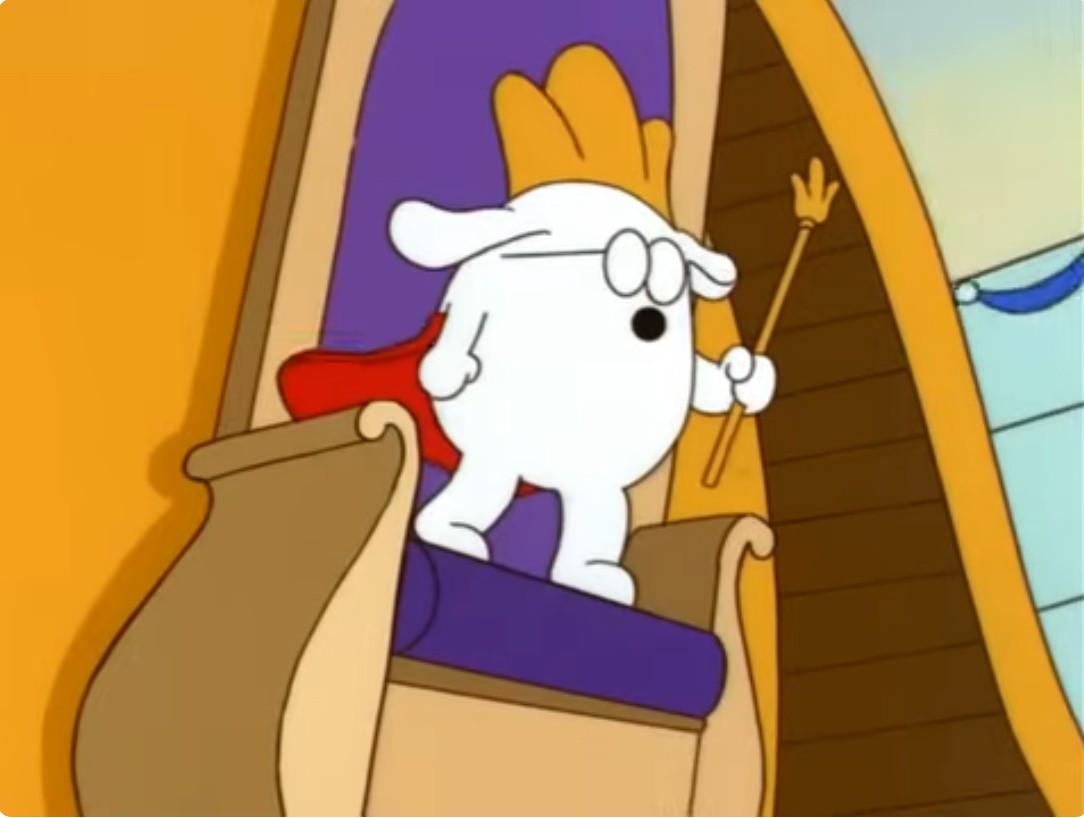
Dogbert directs a float on a holiday glorifying himself, which he has lobbied Congress to introduce.
Like the comic strip, the series mainly takes place at the office, where Dilbert is the frustrated voice of reason. He is often in conflict with his comically ignorant yet confident boss, who as Adams explains has never been given a name so that fans can more easily imagine him as their own employer. While Dilbert has a humble hairstyle, depicted with the same color as his skin like that of Bart Simpson, the boss has two dark towers of hair which give the impression of horns.
The idea that personality is shown in hair physiognomy is further supported by the case of Alice, Dilbert’s vindictive coworker. Her hair seems to have been constructed to house a pharaoh’s remains, and accordingly, she has a pre-Christian concept of justice. She is repeatedly shown either committing or fantasizing about assault, and her love of violence even extends to her taste in men. She marries two convicted murderers immediately before they are electrocuted, but her feelings for the second one change when she realizes he is innocent.
Most of the series avoids politics, but there is an interesting depiction of charity and international relations. In one episode, Dilbert is sent to oversee production in his company’s sweatshop, located in an impoverished country known as Elbonia. Dogbert jokes about the natives’ lack of a written language, but Dilbert assures him proudly that the nation has been transformed by capitalism; the leading cause of death is no longer the black plague, but the much more modern suicide by firearm. Their garbage man, an inexplicably educated man who often offers wise counsel, warns Dogbert that if Dilbert takes pity on the Elbonians and attempts to intervene, the results could be disastrous. He explains that Dilbert will need the assistance of someone “incapable of sympathy, someone so cynical that the suffering of others is nothing but a source of cheap entertainment.” Dogbert, of course, volunteers for the role.

Alice soon loses patience with the Elbonian infants she hopes to fundraise for.
Upon arriving in Elbonia, where the people are waist-deep in mud, the characters’ contrasting attitudes toward foreign cultures immediately become apparent. Dogbert has acquired diplomatic immunity, which he uses to force an Elbonian officer to tear up and eat a parking ticket, then dance while he fires a machine gun at his feet. Dilbert’s coworker Wally, a balding indolence enthusiast, puts on a false beard to fit in with the natives and begins preaching a mud-centric version of the gospel. The pointy-haired boss persists in taking pictures of the natives, even after he is warned that they believe this will steal their souls. Alice is appalled by the conditions in the factory and decides to adopt one of the toddlers she finds working there. She even attempts to film a televised appeal for charity, but abandons the effort after facing the insolence and coordinated vomiting of the children.
Dilbert himself attempts to lead the workers on a strike to demand better conditions, which quickly becomes a riot. After unsuccessfully negotiating with an Elbonian general who seems to be head of state, he is arrested. Since the Elbonians have not yet developed rights or a court system, he is immediately sentenced to death by firing squad. Luckily the natives are so incompetent that their bullets all miss him and hit each other instead. Facing an even more terrifying death by means of a giant ball of mud, Dilbert is saved at the last moment by Dogbert, who again invokes diplomatic immunity to order the general to resign and hand over power to him. He pardons Dilbert and decrees that the workers’ demands be met.

Through the power of diplomatic immunity, Dogbert seizes power from the dictator of Elbonia.
The episode ends with the workers being downsized as the factory is now automated, and Dogbert is extracting the mud from Elbonia for the supposed benefit of the natives. The implication is that it was foolish for Westerners to intervene in an unfamiliar culture, putting themselves at risk while changing little for the foreigners. The pointy-haired boss later announces that Elbonia has been elevated from a “fourth-world” country to a “three-and-three-quarter-world” country.
Another episode makes a similar point. Dilbert has become the “foster parent” of a supposed poor Elbonian child named Petrunyik Vlastominitz. He receives a letter explaining that his regular donation has led to the child’s vision being restored and even allowed him to purchase a shoe. The letter includes a checklist where the writer can check off flood, famine, volcanic eruptions, plague, or war(s), and apparently after two false starts he has chosen famine, asking his benefactor to visit him when this crisis is over.
Dilbert has been working on a genetic engineering project which he imagines will end this famine, namely a hybrid of a tomato and a cow. He calls his spotted rectangular creation the tomeato, and presents it at a company meeting. The other employees respond that the food is revolting, and the marketing department suggests that he should travel to Elbonia and grow it there, which would at least provide the opportunity to import it as an exotic food.
Once in Elbonia, Dilbert finds the local people eating mud, but they deny that there is any famine. He shows a local resident a picture of the starving child he imagines he is helping, but the man explains that the photo depicts the richest man in Elbonia, who lives in a mansion and collects donations from numerous gullible benefactors. Dilbert introduces the tomeato crop, which grows quickly, but is unappetizing to the locals. Soon he has created a new disaster; the plant has sucked all the nutrients from the mud, which had been serving as a satisfying food source. The Elbonians, now truly starving, begin to flee the country.
Dilbert meets with Vlastominitz and attempts to explain the situation, but he seems unsympathetic. Wally suggests that the tomeato be used as a building material, since it has been designed to stack easily, and Vlastominitz agrees. Unfortunately, since the new bricks are largely meat and not being refrigerated, they soon rot and explode.
Their newfound knowledge of the tomeato’s explosive potential leads the Elbonians to use it as a weapon, and they begin to extort money out of neighboring countries with their “tomeatos of mass destruction.” Dilbert attempts to reason with the Elbonians, but to no avail, so Dogbert is forced to have the engineer’s mother airdropped into the country. The Dilmom, as she is known, finally solves the problem by demonstrating that with proper cooking and seasoning, the tomeato can be made edible, and even the Elbonian mud can become palatable again with the addition of vanilla bean extract.
As one Elbonian puts it, they will now once again become “the backward and inconsequential country [they] once were.” The implication is again that it was foolish for Americans to interfere in the affairs of a foreign nation, as their efforts to uplift them have come to nothing.
The series says little about race, as almost every character is white, with one important exception. Dilbert works with a young intern named Asok, a gifted immigrant from India. In the comic strip it is made more apparent that Asok is far more capable than his coworkers, but due to his unworldly nature has never advanced beyond the rank of intern. Wally attempts to explain the harsh realities of office life to him, but with little success. He appears in the show only briefly, mainly to make light of his poverty, which is so severe that he subsists on a diet including sponges and dishwater. He can only afford to take his vacations inside the building, so at one point he sets up a hammock in an exotic bathroom.

Asok the intern enjoys the balmy climate of the fifth-floor men’s bathroom.
Despite all this, he remains polite and eloquent, and in most cases even cheerful. Dilbert is baffled by this and asks for an explanation, but Asok can only say that he knows his family in India is thinking about him every day. He brings to mind the most naïve white man’s view of India, a land of enlightened beings who are only poor due to their wise renunciation of worldly things and can remain centered in the worst of circumstances. What did Scott Adams mean by this?
In his annotated Dilbert collection Seven Years of Highly Defective People, Adams explains that he developed Asok in response to the numerous interns who wrote to him demanding representation for the intern community. As he puts it, “the world is far too sensitive to let me get away with a highly flawed minority member,” and highly flawed characters are the only kind he enjoys, so he initially made all of his characters white. The introduction of Asok was “as cautious as you can get” in that his only flaw is his naïveté, but Adams was still berated for his “negative stereotype of people from India.”
The show suffers from a shortage of Ratbert, an escaped lab rat who has come to live with Dilbert and was possibly the most entertaining character in the comic strip. Like the pointy-haired boss, he is not encumbered with a thought process, but has never let this hold him back in life. Through no skill of his own, he has become a wealthy rodent, serving as a vice president of marketing and even a CEO at one point. He only rarely appears in the TV series and we learn little about him when he does, beyond the fact of his brainless enthusiasm.
The series will inevitably be compared to Seinfeld, not only due to Larry Charles being involved with both, but due to its general focus. There are certainly fantasy and science fiction elements in Dilbert, such as talking animals, contact with aliens, and even a man getting pregnant in one episode. But the focus of both shows is still essentially on everyday life in the real world. Dilbert did not do this as creatively as Seinfeld, though, and it is easy to see how the latter was more popular.
Much of Dilbert’s humor is what is sometimes called “too on-the-nose,” including very blunt condemnation of those in management, marketing, accounting, and human resources. At times it comes across as similar to the character of Mugatu in Zoolander yelling “doesn’t anyone notice this? I feel like I’m taking crazy pills!” Indeed, Dilbert himself seems to stand out more for his sanity in an insane world than his creativity, and the same could be said for Scott Adams.
I recommend this series for anyone who enjoyed the comic strip. The show is at least as enjoyable, and as faithful to the source material, as Dilbert’s Desktop Games, which came out two years earlier. It is a great relief from the bad aesthetics that prevail today, and certainly more honest and sane than the vast majority of recent entertainment, in any medium.
7 comments
Great article! Elbonians sounds like a brand of pasta. 🙃
I liked the comic strip and many of the Dilbert books. I particularly enjoyed “Dogbert, Evil HR Director.”
Dilbert was up there along with Calvin & Hobbes and The Far Side.
The animated Dilbert TV show was a bit disappointing, however.
🙂
It’s sad to see him go. He was a voice of reason standing up to a sea of corporate asshattery.
I was obsessed with these books in the 90’s. Especially Alice’s “fist of death”, which I can still relate to on a daily basis at work. Glad to see Adam’s being open to Jesus Christ in his last days.
Not mentioned in this very fine piece is my all-time favorite, Catbert, the evil HR Director, who purrs loudly when creating hateful policy. Catbert also put Asok in his cat box once and covered him in litter. So there’s that about our Indian friend.
I’ve never seen the animated series and will now seek it out. I was worried it would wreck my established ideas about what the characters would sound like.
Catbert only appears in one or two episodes, unfortunately. The voice actor is Jason Alexander (George from Seinfeld) though.
The show seemed a bit strange to me, having read the comic strip first. It felt very different in tone. I later found out that the animated series was a more true to the tone of earlier Dilbert comics. Gradually over the 90s the relatable “my boss is such an idiot” humor got more and popular and so eventually the strip became that exclusively, but earlier Dilbert is a bit stranger and similar to the show (though done in four panels rather than 22 animated minutes). It was not my cup of tea, though.
Comments are closed.
If you have a Subscriber access,
simply login first to see your comment auto-approved.
Note on comments privacy & moderation
Your email is never published nor shared.
Comments are moderated. If you don't see your comment, please be patient. If approved, it will appear here soon. Do not post your comment a second time.