 7,002 words
Europeans were the first – and are still the only – race to become conscious of their consciousness, to identify the faculty of thinking as the point from which all knowledge must proceed in separation from all extra-intellectual sources and inclinations, be they conventions of the time, religious mandates, or emotional inclinations.
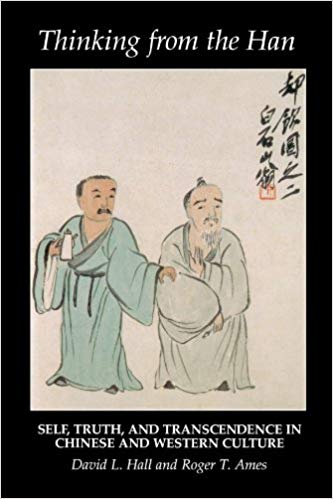
This outrageous statement cannot be articulated in a persuasive way in a short article. What follows should be taken as a series of developing notes focused on a close reading of a book, Thinking from the Han: Self, Truth, and Transcendence in Chinese and Western Culture (1998), which effectively draws a fundamental contrast between the “transcendentalism” of European thinkers and the “embeddedness” of Chinese thinkers. It is not surprising that the authors, David L. Hall and Roger T. Ames, side with the Chinese, on the commonly accepted grounds that our philosophical outlooks can never transcend the cultural setting from which they originated. I will reverse this argument with the claim that our ability to understand other cultures presupposes a transcendental self capable of identifying and reflecting upon its own activity of thinking apart from its contextual setting.
The advocates of cross-cultural dialogue, anthropologists generally, and the multicultural West, think that understanding other cultures entails adopting the other culture’s perspective, putting oneself inside the shoes of the other inhabitants, by bracketing one’s own particular perspective. Westerners, they insist, must let go of their own cultural presuppositions, their individualistic and rationalistic outlooks, if they are to grasp the perspective of the Other. The Western worldview is only one among many, and using this perspective is bound to obfuscate matters, resulting in the imposition of one’s concepts upon the Other.
What cultural relativists have failed to understand is that only the West developed appropriate philosophies, disciplines (ethnography, anthropology), and methodologies (pragmatism, historicism, hermeneutics) to understand other cultures and other historical epochs, because only the West produced a transcendental mind able to stand outside its own cultural norms and understand how it is bounded by a particular context. In this respect, insofar as the Western self learned to grasp the limitations of its thinking, it learned to stand above any limiting context, and thus demonstrate its unconditional character.
The inhabitants of advanced civilizations such as China and India did exhibit, during the Axial Age, inklings of a reflective mode of thinking, a mode of critiquing their rulers and norms on the basis of higher moral principles. But the Confucian and Daoist stance, as well as the Indian Buddhist and Hindu beliefs, were stalled in their development, eventually degenerating into mere custom and acceptance of what was asserted by the ancients, without developing a clear distinction between the thinking I and the not-I, without developing the type of reflective subjectivity witnessed in the West.
Academics today, however, are instructing their white students that Westerners must become more like the cultural beings of other civilizations, and give up the pretension that their rational minds can think outside its cultural setting. They are instructing white students to embrace the outlooks of the East, where the thinking self is inescapably embedded in a social context.
The authors of Thinking from the Han thus tell us that we must overcome the Western notion of the individual abstracted from any context if we are to understand the uniqueness of Chinese culture, with its notion of the self “embedded within a ceaseless process of social, cultural, and natural changes,” in which self and society are never disjointed from each other, but are always seen as “mutually entailing and interdependent correlatives” (27). They don’t realize that only the Western transcendental ego could have generated the ideas and methodologies necessary to apprehend Chinese ways, whereas the Chinese are not self-conscious of the ways in which their selves are embedded within a ceaseless process of powers and forces outside them, because they failed to differentiate the thinking mind from its surroundings.
The transcendental West invented the pragmatic method & hermeneutics
Hall and Ames have dedicated their lives to the understanding of Chinese culture. They open this book in agreement with Alasdair MacIntyre’s view that it is a mistake to believe “that there are universally human, culturally neutral grounds to which we can appeal as a basis of comparison” of particular cultures. They agree with MacIntyre that there is no “neutral vantage-point from which to evaluate competing theories” since any account will necessarily “presuppose something of the theoretical stance of the tradition from which the analysis and evaluation begins” (xii). They welcome MacIntyre’s sincere effort to “understand the other on the other’s terms,” his cultural sensibility to the ways and values of other cultures, his awareness of the inherent conceptual limitations within one’s own culture, and his call for an open conversation between different cultural traditions.
But they then observe that MacIntyre ironically falls into the trap of relying on “Aristotelian assumptions about conceptual schemes and standards of evidence” for his framework of cultural comparisons.
MacIntyre’s insistence upon rational engagement as the sine qua non of responsible philosophy and his dismissal of any alternatives to rational engagement as a blanket “pragmatic aestheticism” stops any fair comparison with the Confucian tradition dead in its tracts (xiv).
They argue that only a “pragmatic method” provides us with an escape from the Western arrogance of a “disembedded” or detached “I” capable of adjudicating over different traditions. Pragmatic thinkers such as George Herbert Mead, John Dewey, and Richard Rorty provide us with an appropriate vocabulary for understanding how the self is socially constituted. This method fits right in with the Chinese perspective that the person can never be identified in abstraction from the social roles that define and constitute the person. Mead was correct in writing that “the unity of the self is constituted by the unity of the entire relational pattern of social behavior and experience in which the individual is implicated” (cited on p. 42). Mead’s notion of the self “as a field of social relations constituting and constituted by the person is fundamental to our understanding of Chinese conceptions of self-hood” (43).
They don’t fully explain, but we can reasonably infer, that Hall and Ames think the neo-Aristotelian argument of MacIntyre is inadequate for the understanding of non-Western cultures. Even though MacIntyre rejects the Enlightenment effort to reach a universal account of moral rationality, and calls for morals that are consciously embedded in historically grounded social practices, Hall and Ames, it would seem, find MacIntyre’s Aristotelian preoccupation with the “internal end,” or telos of communities, too Western-centric, too focused upon the supposed inclination humans as such have for the expression of what is best in their nature. We can’t frame Chinese culture in terms of Aristotelian “goods of excellence.” Hall and Ames believe that only a pragmatic method can allow the Chinese worldview to come through on its own terms, with its own language and its own practices, with the least possible interference from Western concepts.
Besides pragmatism, Hall and Ames mention philosophical positions such as hermeneutics and poststructuralism as forms of thinking that allow us to overcome the dualistic thinking of the West with its separation of mind and matter, self and society, and its pretensions to a view that is objectively valid, stable and directly meaningful, through an independent subject that is somehow able to produce truths above any historically specific conditions.
Don’t these two academics know that pragmatism, hermeneutics, and poststructuralism are Western products? They do acknowledge this in a sort of low-key way, stating that these schools of thought arose late in Western history; and yet while they also happily note that these schools of thought have displaced the old dualistic narratives, including the Enlightenment view that we can come up with universal morals and truths, their entire argument is that Westerners have been unable to understand Chinese thinking because they have relied on dualistic ways of thinking. They believe their pragmatic and “historicist” method is the best way to apprehend the meanings of Chinese words and Chinese writings against Western-centric readings, which judge other cultures in terms of such Western concepts as “mind,” “self,” “transcendence,” “person,” “subject,” and “object,” which lack corresponding terms in the Chinese language or have very different meanings within Chinese culture. So, implicitly, without wanting to draw attention to the irony of it all, and perhaps without even knowing what they are doing, Hall and Ames rely on Western schools of thought to criticize Western-centric readings of Chinese culture.
What Hall and Ames have done in their book, Thinking from the Han, is not incidental but a prevailing dogma in academia today. Academics in Western universities believe they have deconstructed Western thinking, the Western scientific idea that we can formulate concepts that capture the essence of reality, what is real and substantial behind the appearances, and the Western idea that we can produce concepts about the best political society for humans generally. The reviews I have read of this book praise the efforts of the authors to think about China in-through Chinese ways of thinking, rather than through Western concepts. Yet, when we examine the schools of thought these academics have relied upon, pragmatism, hermeneutics, postmodernism – all of them grew inside the West.
The very academics who claim that we need to contextualize our thinking, because it is impossible to have a view from nowhere, fail to contextualize this way of thinking. There is a strange lack of self-awareness about the Western contextual origins of the ideas which have allowed current academics to contextualize ideas.
The bibliography of Thinking from the Han lists about 260 sources, of which only 36 are from Chinese authors; and if we account for the obvious use of primary Chinese sources or authors, such as Confucius and Mencius, there are only 12 books listed by Chinese academics. We are dealing here with an outstanding lapse in interpretative self-awareness that is pervasive in current academia. How is it that in the same vein as we are told that we must try to think from the perspective of the Han people, the sources relied upon are overwhelmingly Western? The short answer to this is that almost all the knowledge, ideas, concepts, and methodologies originated with whites.
Yet, what makes this all the odder and culturally bizarre is that Hall and Ames argue that if we think in-through Chinese ways of thinking, we will learn that it was the Chinese who produced pragmatic and hermeneutical ways of thinking. Before Westerners even had a clue, apparently, the Chinese were already saying that you can’t think of isolated individuals “I think, therefore I am,” because persons are “radically situated as persons-in-context, inhering in a world defined by specific social, cultural, and natural conditions” (264). We are supposed to believe that the Chinese were always aware that it is not possible to draw an artificial divide between subject and object, individual and society, mind and matter, and that only the invention of a pragmatic method by whites in the nineteenth century finally allowed them to see how profoundly ahead the Chinese were in their pragmatic and hermeneutical thinking since ancient times.
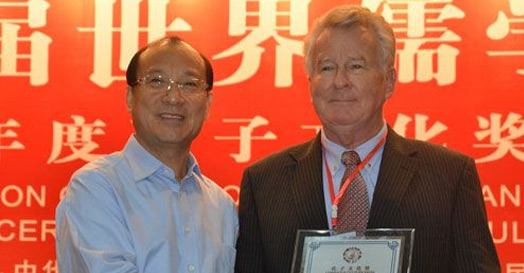
Roger Ames wins the Confucius Culture Award (2013) for teaching that China was always intellectually superior.
What Hall and Ames fail to realize – including every Western academic condemning Western logocentrism – while praising the “more liberating and friendly vocabulary” (230) of the Chinese, is that the Chinese have never self-consciously thought about the way knowledge is context-bound, the way the “consciousness,” “will,” “desires,” and “ideas” of individuals are culturally situated. The Chinese mind has been too absorbed by its surroundings, the conventions of the time, and its Chinese context to understand that it is culturally situated.
Hall and Ames know that China’s is culturally situated only because they have employed a Western method of reading non-Western texts which has taught them of the ways in which thinking is influence by historically specific situations. The Chinese have always been context-bound without being aware of it. The Western mind was able to develop methodologies to understand texts from different eras and different cultures, because this is the only culture that learned how to draw ontological distinctions between mind and matter, individual and society, the three parts of the soul, and so on, in the course of which this mind eventually developed particular sciences, physics, chemistry, biology, botany, sociology, economics . . . to explain different aspects of reality and newly emerging properties, while also realizing that there is no such thing as “man in general,” but that humans always exist as determinate social beings.
Pragmatism presupposes a transcendental mind
The pragmatic turn – the development of hermeneutics by whites – became possible because of the prior ability of whites to discover the distinctiveness of the faculty of the mind, the distinction between physis (nature) and nomos (law or custom). The confusion or lack of awareness exhibited by Hall and Ames, and all postmodern multiculturalists, is that they can’t psychologically admit the vast intellectual superiority of the West, and they can’t understand that knowing about the ways our thinking is culturally situated presupposes the uniquely transcendental capacities of the Western mind.
This transcendental capacity does not come out of the “human mind” as such; and, in this respect, this capacity is not unconditioned, out of this world, and universalizable. It is an acquired capacity peculiar to a people, although certain products of this particular mind have been appropriated by non-Western peoples, the scientific methodologies of the West. It is the product of a culturally specific mind, which can only be understood by situating it within this specific background. But it is still transcendental, the one mind that has brought to the highest level the potentialities of the “human mind” insofar as it has attained the highest level of reflective self-consciousness about itself, as an agent in its own right and the ultimate adjudicator of what is truthful.
Below I will try to elucidate what I mean by way of textual examples from Thinking from the Han, citing passages from this book and then showing the ways in which Western “pragmatic” or “hermeneutical” thinking is itself limited insofar as it refuses to understand that if reason understands the way it is historically and socially conditioned, it means that reason is responsible for settings its own limits, which means that reason has a transcendental capacity.
The beginnings of this transcendental capacity are to be found in ancient Greece, when the “mind” was identified as a distinctive faculty in distinction from everything else, and when Greek philosophers began to reflect self-consciously about differences between weaker and stronger arguments. Through a long historical course, Westerners also came to understand the limitations of reason and the ways in which thinking is always embedded, with Kant claiming that there are things that lie beyond reason, things-in-themselves, and thus implicitly saying that reason is aware of its limits, leading Hegel to argue that insofar as reason can think about its limits, it actually is able to think outside its limits. It will be suggested that this capacity for transcendence is a crucial factor in the far higher levels of intellectual truthfulness achieved in the West.
Dialogue with Hall and Ames
H&A: [A] historicist reading of both the Chinese and Western cultural narratives . . . requires that we explain the presence of ideas and institutions by appeal to specific social and historical circumstances. [O]ne of the most striking features of Chinese intellectual culture from the perspective of the Western interpreter is the absence of transcendence in the articulation of its spiritual, moral, and political sensibilities . . . As applied to the Deity, transcendence usually indicates “independence from the created order” . . . [T]he sense of transcendence expressing effective independence and self-sufficiency has been most influential in shaping the character of Western culture . . . God’s unqualified independence of the created order. God affects the world but is in no way affected by it. Thus God transcends the world . . . but the world does not transcend God . . . This sense of transcendence did not begin with Judeo-Christian theology. The Greek philosophical tradition implicitly appealed in various ways to transcendence. . . . Leucippus and Democritus developed the notion of “atoms” as the basic building blocks of the world. These were eternal unchanging bits of matter that were independent of, and unaffected by, both that which they comprised, and one another as well. At the opposite end of the theoretical spectrum, Plato proposed a world of unchanging forms that were independent of and unaffected by the things that they in-formed . . . To the extent that impersonal reason is guided by necessary rules or laws associated with logic, and to the extent that it discovers the permanent, unchanging laws or essences, which serve as guides and models of the world, reason itself is strictly transcendent (189-192).
RD: Hall and Ames go on to criticize scholars who have applied the Western concept of transcendence to interpret such Chinese terms as “Heaven” and “the Way.” The Chinese concept of a cosmic order, they argue, cannot be conceived as a transcendent ruler, since the Confucian concept of “Heaven” or the Daoist concept of “the Way” are “this-worldly,” referring to the world as a whole, not outside spirits who created the universe, but indwelling within nature and man. Since the natural and the human are continuous in Chinese thinking, it is misleading to apply Western dualistic concepts such as “mind” and “matter,” “man” and “society,” “God” and “Nature.” Heaven and the Way are the world rather than independent forces responsible for creating the world. In China, they argue, there is no rational “view from nowhere,” no ultimate essences, no Being. The thinking subject is always embedded within the world he is interpreting, and so he cannot know the “objective truth” (247). Hall and Ames believe that this Chinese outlook is “more liberating and friendly.” They argue that transcendentalism eventually declined in the West, replaced by pragmatic, postmodernist, historicist outlooks. Westerners came to the realization that science can operate without any transcendent standards about the ultimate essence of things, and that what matters is an appropriate methodology to predict natural events and make useful things. Westerners finally realized that their cultural outlooks are one among many, each a concrete expression of a historically specific people. The Chinese always knew this, and so there is much to be learned from Chinese ways of thinking.
The obvious dilemma in this account is that all the sciences developed by Europeans have been assimilated by non-Europeans, which shows that there is a universalizability in the sciences of the West, a transcendental aspect, even if we reject the idea that the sciences can ever apprehend the ultimate nature of things, what is Being, and even if we notice that whites are really the ones who are conducting most of the research about why things are the way they are, rather than merely using science to make things. The second obvious dilemma is that it was Europeans who developed self-conscious philosophies examining the ways in which thinking is contextualized. The major Chinese outlooks of Confucianism, Legalism, and Daoism developed in ancient times without major alterations or new philosophical outlooks emerging thereafter, and without anyone consciously explaining how these outlooks were context-bound. It is not enough to say that all knowledge is historically situated and the expression of a particular people. If all knowledge is contextual, then all knowledge claims are equally valid. We have to ask why the West developed all the theories about how knowledge is context-bound, and why the West produced all the modern sciences. Self-conscious cultural relativism – a relativism in which subjects are not completely absorbed by their culturally specific worldviews – presupposes a subject that has come to a transcendental understanding of the relativistic views of other cultures, and is thus able to understand its own relativism, and in this way transcend it and understand that it is the measure of all other cultures. The key to this transcendental standpoint is no longer a belief in a God standing outside as creator of the universe, or a belief in unchanging essences determining what there is, or a belief that reason can come up with moral principles for all cultures. Whenever we talk about a transcendental being uncaused by nothing other than itself, or about natural rights inhering in all humans outside time and outside any social order, or about natural (transcendent) laws regulating the universe, we are inescapably talking about a historically situated European human who is positing these transcendental ideas. There can be no proper comparative cultural assessments without a conscious acknowledgment of a European transcendental self, aware of its presuppositions and aware that its consciousness – not any Natural Law, and not any God – is the ultimate adjudicator of knowledge.
H&A: [T]he Chinese have traditionally affirmed as the ground of their intellectual and institutional harmony . . . the recognition of the co-presence of a plurality of significances with which any given term might easily resonate. The difference is that the Chinese understanding of the self is not threatened, but deepened by this fact (4-5).
RD: The Chinese recognition of a plurality of significances is not a result of having struggled with multiple efforts at finding ultimate principles, and having failed at finding absolutely fundamental entities or causes upon which all else ontologically depends. The Chinese simply did not set out to explain the why of things, and they barely offered criteria as to what makes an argument weaker or stronger, since they barely developed any logic and metaphysics about the causes of things and the essence of things. The Mohist school discussed valid inference and the conditions of correct conclusions, but it was mostly about rhetorical analogies. The Chinese mind did not rise above the concrete operational stage, that is, the third stage in Piaget’s theory of cognitive development. It only reached the lower levels of the fourth stage, the stage of formal operational thinking. The ideas espoused in The Analects of Confucius, for example, are tied to actual historical times and personalities. As Burton Watson notes:
In the Analects, therefore, the reader will find no lengthy discussions of terminology or expositions of ideas. Instead, moral and political concepts are presented in terms of particular individuals, the teacher Confucius and the disciple or other person with whom he is conversing and the particular circumstances under discussion (“Introduction” in The Analects of Confucius, Columbia University Press, 2007, p. 7).
Like the concrete operational child, the Chinese mind was limited to thought concerning things that were available to immediate perception about past virtuous rulers; it did not consider possibilities for the best society set by thought alone, or based on principles certified by rational criteria alone, but instead it put forward ideals of the virtuous ruler in terms of what had already been done in the past. They did not draw an ontological distinction between self and non-self since they did not have a sense of self outside their concrete Chinese context, in contrast to the ancient Greeks, who were continually engaged in ethnographic observations about the ways of others and about the limitations of their own ways while engaged in theoretical possibilities about the best society, without reference to any historically specific order. It was ancient Greece that produced the allegory of the cave, of a thinking being who walks out of any prior determination, any context, in order to find universally truthful ideas, rather than merely trying to elucidate what are the roles and rituals the self must follow in order to fit in properly within the established ideals of what constitutes proper behavior.
H&A: In the Chinese model where the self is contextual, it is shared consciousness of one’s roles and relationships. One’s “inner” and “outer” selves are inseparable. Here, one is self-conscious, not in the sense of being able to isolate and objectify one’s essential self, but in the sense of being aware of oneself as a locus of observation by others. The locus of self-consciousness is not in the “I” detached from the “me”, but in the consciousness of the “me” (26).
RD: Hall and Ames rely on George Herbert Mead‘s vocabulary, the “I” and the “me,” to illuminate what the Chinese sense of self is. While the “I” is the active, creative agency, the “me” is the socialized aspect of the person. Mead believed that the “I” only acts within the context of the “me.” The “me” refers to what the “I” has internalized from society. As much as Mead may say that we can’t talk about the “I” outside a social context, that the “I” is always fused with the society within which the person is socialized, Mead can’t deny that he was socialized by a transcendental culture in which the inner “I” was aware of the outer social context, and thus able to identify what was specific about the thinking “I” and differentiate the mind from everything outside it, while eventually elucidating the many ways in which the “I” is constructed by the outside, which is itself a form of self-conscious awareness of what is outside and what impacts the “I.” The Chinese person, however, has always been embedded within society, unable to separate the “I” analytically as an entity that is capable of thinking about what is outside.
H&A: [They cite Jacques Gernet] Not only was the substantial opposition between the soul and the body something quite unknown to the Chinese, all souls being, in their view, destined to be dissipated sooner or later, but so was the distinction, originally inseparable from it, between the sensible and the rational. The Chinese never believed in the existence of a sovereign and independent faculty of reason. The concept of a soul endowed with reason and capable of acting freely for good or for evil, which is so fundamental to Christianity, was alien to them (29).
RD: Hall and Ames agree with Gernet that the Chinese language does not have correlates for the words “mind” and “rationality.” Gernet is right that the Chinese never conceived “of a sovereign and independent faculty of reason.” It is crucial to make a distinction here between what Mead says and what was going on inside the mind of the Chinese, if we can even use the word “mind” here. To be sure, it is only in ancient Greece that humans identified the faculty of reason as that part of the soul responsible for knowledge and truth. The Chinese did not manage to identify the faculty of reason, as is evident in their concept of “heart-mind,” because whenever they wrote or thought about the act of thinking, or the act of knowing what is proper behavior, they thought of the heart as well. Truth was “set in one’s heart.” The Greeks, by contrast, identified the “mind” as the purely cognitive side of humans and as the faculty that allows humans to think rationally, that is, to think by using one’s mind without allowing extra-mental forces to interfere. This does not mean the Greeks were isolated individuals existing outside Greek society; and it does not mean that if we believe in the reality of this faculty, it follows that this faculty manifested itself without any prior historical preconditions. Westerners have identified the transcendental ego, and they have also come to understand that this ego can only develop intersubjectively, without a cultural setting. Hall and Ames can explain the Chinese mind by relying on the self-consciousness of Western culture about the situatedness of knowledge.
H&A: Chinese reasoning is radically situated and cannot be interpreted as residing in a transcendental or superordinated self . . . Thinking and feeling are not separate, but occur together as the concrete human expression of the resolutely contextualized “heart-mind.” Zhi, like li and xin, is thus radically situated, integrating the human world and its natural, social, and cultural environments . . . [I]n classical China, human realization is the fashioning and configurating of one’s entire person (30-2).
RD: Academics love this stuff about feelings, and about integrating the human and the natural. But if one’s reasoning is radically situated, and if a culture does not have a word for reason, but rather something that translates as “heart-mind,” then we are talking about a culture in which the mind has no identity of its own but is subsumed by the enveloping world of feelings and natural forces, indistinguishable from each other. No wonder the Chinese did not develop any of the sciences, since the development of clearly identifiable fields of knowledge requires a mind that makes analytical distinctions and demarcations in the real world, even though all things are interrelated.
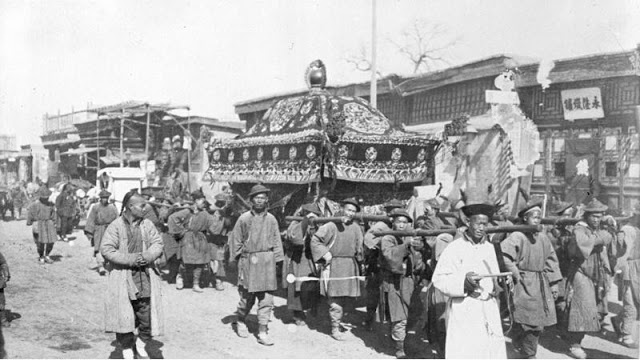
According to Hall and Ames, the Chinese express a higher form of individual uniqueness in their rituals than Europeans.
H&A: Ritual practices . . . have a significant creative dimension since what distinguishes ritual from rule or principle as a source of order is that ritual practices not only inform the participant of what is proper, they are also performed by them. They are formal structures that, to be efficacious, must be personalized to accommodate the uniqueness and the quality of each participant. In this sense, ritual actions are a pliant body of codes for registering, developing, and displaying one’s own sense of importance . . . [T]he creative product is the consequence of the play between one’s personal uniqueness and some continuing historical structure or aesthetic convention. New cultural models are continually emerging as qualitatively achieved persons who personalize formal ritual practices, write commentary on some canonical text, or create some particular variation on a conventional example of calligraphy or a painting prized by the tradition . . . What is most fundamentally and significantly human in the Confucian tradition are the seemingly indeterminate possibilities for growth, cultivation, and refinement (32-4).
RD: Hall and Ames know about the “centrality of ritual” in Confucian culture, and they know that rituals bespeak of a very traditional or fixed way of thinking and behaving. They also know that the performance of rituals don’t allow for individual uniqueness, but are intended to enforced conformity. Rituals can be beautifully performed, and I understand the simple point Hall and Ames are making about how there is room for individuals to self-express themselves through rituals. Europeans were very ritualistic until recent times, even though China is the ritualistic culture par excellence. But I don’t buy the effort by Hall and Ames to portray the Chinese as a highly creative people, unique in their ritualistic behaviors in ways more profound than Western individuals. If the Chinese were so creative, and “new cultural models” were “continually emerging,” why did China remain stuck in Confucian ritualism until whites shook them out of their slumbering ways in the modern era? Why did Westerners produce almost all the greatest thinkers in human history, and the major historical epochs after the Bronze Age?
H&A: The classical Chinese language tends to locate action within a situation as a whole, rather than within a discrete unit or agency (38).
RD: There is no concept of “free will” outside the West, and this is why debates about whether humans have free will or not are uniquely Western. Only whites write books about free will. There are no correlatives in the Chinese language for the words “free” and “will.”
H&A: Mead’s notion . . . of the self as a field of social relations constituting and constituted by the person is fundamental to our understanding of Chinese conceptions of selfhood (43).
RD: Right – without Westerners teaching Hall and Ames about how the self is embedded, they would not have been able to understand the Chinese conception of selfhood, because Chinese thinkers have never explained what this conception is. The Chinese have never argued about it in explicitly self-conscious ways because the Chinese mind is absorbed by its surroundings, immersed “within a situation as a whole” without clear distinctions between what is peculiar to the self, mind, and society.
H&A: In classical Chinese culture . . . there is no fundamental mind-body dualism with which to contend. After all, it is this dualism that sets up the principal conflict within the self between reason, on the one hand, and the affective and volitional components, on the other . . . The principal reason the Chinese self is not internally conflicted is that there is nothing strictly internal to the self. The Daoist self is a function of its relations with its world. Just as the Confucian self is determined by deferential activity guided by ritually structured roles and relationships, so is the Daoist self determined by its deferential activities guided by wuzhi, wuwei, and wuyu [. . .]The Chinese do not “slice the pie” as is done in the West; effectively, there are no faculties of knowing, doing, and feeling that can be distinguished one from the other; and there is no division between modalities of reason on the one hand, and appetite and will on the other (48-9).
RD: The Chinese self is dormant; in fact, it does not exist. “There is nothing internal to the self” which can be said to be a contribution of the self as a self, since the self only exists within the “we” of society and the we of “ritually structured roles and relationships,” where it finds the room to be “unique” and “creative” by avoiding any expression of self other than what has already been prescribed by society. The ancient Greeks drew a distinction between different parts of the soul: Plato’s tripartite distinction between reason, will/passion, and bodily appetites. This distinction was an expression of the growing rational consciousness of the Greeks, and their realization that reason must be at the helm in the pursuit of truth. Whites were responsible for the origins of psychology precisely because they drew such distinctions, whereas the Chinese, with their harmonious unified vision, can hardly be said to be responsible for the development of a single disciplinary field. Character development in Western literature has been unsurpassed; the West is responsible for the invention of the novel and the greatest array of literary characters.
H&A: Beyond the confusions introduced by language, and by our distorted perceptions and tendentious categorizations, there is a real world . . . It is a constantly transforming set of events or processes that belie the sorts of discrimination that would permit a final inventory of the furniture of the world [. . .] The Daoist celebrates the bottomless complexity of particulars [. . .] without making invidious distinctions . . . With no Being behind the beings of the world, the way of things is both continuous and radically perspectival. There can be no standards such as the “Great Chain of Being,” or the “Ladder of Perfection” establishing ontological hierarchies. What we have is both the uniqueness of each perspective and parity among them (55-65).

“Invidious distinctions” of the white mind.
RD: The wonderful Chinese people make no “invidious distinctions” and hierarchies – never mind their ritualistic obsession with the enforcement and replication of distinctions and hierarchies between classes. It was the Western drive for “tendentious categorizations” that made possible the invention of the periodic table, without which China would have remained in a state of permanent Malthusian crises. Without invidious distinctions, there would have been no intellectual history of botany and zoology. The “bottomless complexity of particulars” Hall and Ames celebrate amount to leaving the world as it is without trying to understand it, passively accepting one’s ignorance. The “Great Chain of Being” was one of the most fruitful intellectual pathways of the West. The claim that the “nonassertive action, and objectless desire” of the Chinese “enrich the world by allowing the process to unfold spontaneously on its own terms” (57) simply means the Chinese don’t question the world. It does not mean they have allowed nature to be itself: throughout history, the Chinese have been the biggest destroyers of the environment and the biggest exterminators of living forms. As Mark Elvin has carefully documented in in his extensive work, The Retreat of Elephants: An Environmental History of China (2006):
Elvin chronicles the spread of the Chinese style of farming that eliminated the habitat of the elephants that populated the country alongside much of its original wildlife; the destruction of most of the forests; the impact of war on the environmental transformation of the landscape; and the re-engineering of the countryside through water-control systems, some of gigantic size. He documents the histories of three contrasting localities within China to show how ecological dynamics defined the lives of the inhabitants. And he shows that China in the eighteenth century, on the eve of the modern era, was probably more environmentally degraded than northwestern Europe around this time.
H&A: The dominant sensibility of Western philosophy is imbued with a commitment to a single-ordered world, hierarchically arranged . . . The high seriousness of the Western person is an appropriate response to the fixed and permanent status of his world. If chaos is the indeterminant element [in the Daoist way] that guarantees novelty and uniqueness, disciplining it through [Western] imposition of a single order would make life repetitive and predictable . . . [Daoist] lightheartedness is an essential means of teasing one into the recognition of the variety of perspectives permitted by the totality of existing things (68, 66, 74).
RD: Can’t these two sinologists ask a simple question: If Western culture is “single-ordered” and “fixed and permanent,” whereas Chinese culture “guarantees novelty and uniqueness” and “variety of perspectives,” why did China’s intellectual life barely change beyond the ancient outlooks of Confucianism, Daoism, Mohism, and Legalism? Why were there no novelties in China after the Tang era (618–907) other than mere demographic expansion, ruthless colonization of non-Han peoples, and intensification of farming with the same technologies? Why was the West responsible for all the technological novelties of the world after the 1500s? Ignoring these obvious realities shows how stupid Western academics have become in their eagerness to put down their own culture while sheepishly eulogizing other cultures.
H&A: [W]ith respect to the mainstream of Chinese cultural self-articulation, there is a tacit rejection of those characteristics that define the maleness of Western philosophy in favor of what at least initially seems to be those same themes defining of a female ethic. Ren, the central virtue of Confucianism, asserts the relationality and interdependence of human beings . . . [I]t can be fairly argued that the development of Chinese culture has been strongly colored by feminine gender characteristics. (84-5).
RD: There has never been a matriarchal order, but it is true that Chinese culture is more feminine, and that femininity is about asserting the “relationality and interdependence of humans.” A transcendental view – the separation of the knower from what is known, the courage to elevate consciousness above all other external determinations, to free the mind from the envelopment of the womb and the world – requires a masculine mind. The prehistoric, warlike Indo-Europeans were hyper-patriarchal, a precondition for the elevation of humans above the indignities of cultures dedicated to prostration and subservience in the face of make-believe mysterious spirits and demons. It was this European transcendental spirit that brought about the elevation of European women, in contrast to Chinese foot-binding.
H&A: [T]he reason the biological sciences never developed in China as they did in the West is that the Westerner, encountering a strange plant or animal will ask “How may I classify this?” while the Chinese will immediately ask “How may this be cooked?” . . . For the Chinese knowledge is not abstract, but concrete; it is not representational, but performative and participatory . . . (104)
RD: That’s right, biology and all the sciences in human history were singularly developed by Europeans: geology, geography, climatology, organic chemistry, paleontology, archaeology. The Chinese mind barely developed beyond the concrete operational stage. Chinese do eat everything.
H&A: It is most certainly American pragmatism that provides the best resource for understanding Chinese approaches to the issue of truth [. . .] This pragmatic, nonobjectivist, theory of society operates without any transcendent standards of rationality, without any final conception of human nature (111, 218).
RD: American pragmatism developed in-through the incredibly rich background of Western transcendent standards of rationality. There is no such thing as Chinese “pragmatism”; we can only attribute pragmatic standards to China in-through American pragmatism. The Chinese were not self-consciously aware of their “pragmatism.” They were not self-consciously advocating contextual, historicist reasoning, but were simply unconsciously immersed in the customs and ways of thinking of their time. Not only did Dewey develop his pragmatism in-through Hegel’s transcendentalism, but we know that Dewey did not break completely with Hegel because, I would argue, Hegel himself had already formulated a philosophy that acknowledged the requirement of transcendentalism while pushing for a contextual view that recognized the sociality of reason.
H&A: . . . the discouragement of contentious arguments . . . argumentation must be a cooperative affair . . . Chinese reflections and conversations were conducted without the benefits of those sorts of distinctions that identify logical or grammatical relations . . . In China, arguments are ultimately aimed at demonstrating conformity with the acknowledged excellences of tradition (130-1, 134).
RD: Emasculated Western academics have been pushing for cooperative arguments in the education of children and university students since the 1960s. Discouragement of contentious arguments (not to be equated with the hysterical, irrational reactions of academics against critics of Diversity) are now the prevailing norm. In the all-male world of early academia, things were vastly different. Here is Walter Ong in his book, Fighting for Life: Contest, Sexuality, and Consciousness (1981):
In the West, the agonistic tradition of formal education was already deeply rooted in Greek antiquity . . . It persisted not merely through medieval dialectic and disputation and Renaissance scholarly polemic, but with remarkable vigor well into the eighteenth century . . . with still significant strength in certain sectors even into the mid-twentieth century . . . Young men at Harvard College in the 17th century . . . learned subjects largely by fighting over them [. . .] The academic world was . . . strictly a male world . . . It was profoundly agonistic, and its agonistic structures registered masculine needs . . . The entrance of women onto the academic scene everywhere marked the beginning of the end of the agonistic structures . . . Agonia lies at the heart of the evolution of consciousness, not merely in academia but throughout life [. . .] The most striking example of the influence of disputatious style on subject matter is the case of formal logic, absolutely crucial to Western academic development . . . This seemingly most neutral and objective of subjects, developed to pure structure . . . had its origins not in isolated scholarly musing but in the analysis of dispute.
Could it be that the words “masculinity,” “agonistic,” “logic,” and “dialectic” are inseparable from the word “truth”?
This article was reproduced from the Council of European Canadians Website.
14 comments
The ancient Greek and Roman cultures were indeed ‘contest cultures’ and an honor cultures.
“The desire for honor and glory set men on fire.” –Cicero…That was true at least during the independent period of the Greek city-states, and during the Republican times in the case of Romans. “With what earnestness they pursue their rivalries! How fierce their contests! What exaltation they feel when they win, and what shame when they are beaten! How they dislike reproach! How they yearn for praise! What labors will they not undertake to stand first among their peers!”-Cicero …“To men like these no ordeal was unfamiliar, no position rough or difficult, no armed foe formidable; their courage conquered all obstacles. But the greatest competition for glory was amongst themselves; each rushed to be the first to strike an enemy, to climb a wall, to be conspicuous in action.”-Sallust
But is this ancient (Indo-European, we also see it later in the case of the Anglo-Saxons -Beowulf) sort of ‘individualism’ which seeks fame and distinction the same as the modern (liberal, western) type of ‘individualism’ ?
The ancient type of ‘individualism’ assumed a background culture and society to whom the individual belonged and from whom it sought recognition. The modern type seems assumes that individual dissociates himself (is dissociated) from society.
The ancient type sought distinction, appreciation, . The modern type seeks, it seeks independence from society, it entails (and even exalts) the rejection of the norms, the ethical and aesthetical standards and expectations, of the society.
Not necessarily… Ancient heroic archetype also included negation of established norms but this is absolutely natural as otherwise you wouldn’t have any sort of societal growth.
Very interesting article.
The development of spiritual consciousness and conscientiousness is key to Western civilization. We saw the very Eastern ideology of Communism forced on Europeans in Russia, Ukraine, Poland and other European nations. One of its keys was to destroy our spiritual, transcendental mind. While researching the Western spirit under Communism I ran across this film here: https://www.celtic-films.com/gulag-vorkuta-2016/ It was revealing in that it was a film based on the Western spirit, the ability to transcend and see much larger pictures.
“Without invidious distinctions, there would have been no intellectual history of botany and zoology.”
This is a good point. You’d think with the Chinese traveling/trading with foreigners, they’d have a good number of racial taxonomist like Europe has. But nope.
From the latest blockbuster of human evolution:
“all Asian and Oceanian populations, including East Asians, received an introgression from an unknown extinct archaic hominin population” that split from the main line of hominids a staggering 1.4 MILLION (!) years ago.
https://doi.org/10.1038/s41467-018-08089-7
Need I say more? No, but I will.
Paragraph 5 above: “China and India did exhibit, during the Axial Age, inklings of a reflective mode of thinking”
Even then it is related to the ARYAN expansion. Chinese civilization evolves at the time metal and chariots arrive from the west, likely from the Afanasievo culture. In 1700 BC a migratory Aryan elite took over the Indus river valley, a primacy they held until the Battle of Kuru ~ 1050 +- 50 BC.
Later, SidArta developed a re-aryaned religion which was brought to China by the “blue-eyed barbarian” Bodhidarma.
What isn’t Aryan in this world?
I find the article (or printed debate)
weak. Many good points, but, several gross and wrong generalisations, also some errors of fact, logic and association.
E.g., the state never had a matriarchal order, but one of the more interesting minorities in the S.E. of the P.R.C. did, and, many users of the early pockebell (pager, only more interesting, and not primarily biz.) and early cellular phone networks (to early 2000s) in Japan, learnt and used it.
Secret languages are always fun!
There is another phonetic system for representation of Chinese without latin alphabet, from ROC, but it seems nobody is using it any more.
Anyway, from what I hear of Canadian speech rules etc., it is difficult to trust anything on such topics from there.
The stupid former Royal Navy submarine captain, Gavin I-forget-his-surname , receives awards from PRC academia, even though they know he is talking wind from his anus, half the time: the Ming did have huge littoral fleets, and they would also raid the shore, if returns were not sufficient.
The key point is littoral.
Such talk as the above attempts at metaphysics, always difficult, but the fact is, most majority peoples in east and s-e asia, remain comfortably majorities.
The elevated consciousness hinted at in this dialogue seems only to lead to disaster.
I do agree with three of the comments from 1 to 4.
Fantastic article. I was immediately reminded of “The Brain that Changes Itself” by Norman Doidge, PhD. In the appendices this pop-sci introduction to neuro-plasticity Doidge makes a clear distinction between the compartmentalization of the Western mind versus the holistic thinking of Chinese thought. One must bear in mind that the understanding of a transcendental mind is what inspired Western doctors to try to communicate with bed-ridden folks in their seemingly vegetative or physically damaged state. There was still a mind in there, inside of those patients. That inspiration led to the healing methods described in Doidge’s book.
The Chinese have contributed nothing of distinction to this field.
Great article. I feel compelled to comment as a Heideggerian.
It’s undeniable that the extent of our ability to decontextualize entities and study them as objects with properties is unique, and it’s amazing that the world is able to ignore that we’re behind pretty much all scientific progress. That being said, I would stress that what makes us different isn’t just that we’re transcendental while others are embedded, but rather that we are both embedded and transcendental while others are merely embedded.
I think it’s important to recognize our embedded nature so that our transcendental explorations are rooted in what serves as as a people, and don’t just become transcendental meanderings that place science and technology at the center of everything. We should be Promethean and bring the fire back home.
The article argues that “we are both embedded and transcendental while others are merely embedded,” adding that we can’t know we are embedded unless we first reach a transcendental level of cognition.
Agreed. I didn’t mean to sound like I’m presenting a counter-argument or adding something that was neglected in Ricardo’s article, just to stress that we’re both because I think people (not the author) tend to read about transcendence and then go all-in with reckless abandon.
beautifully put, Luke.
Ricardo is of course right about the fact that those authors in their ability to critisize western ‘centrism’ when judging other cultures, are effectively proving the uniquely transcendental nature of western thought which has allowed them to critisize their own civilization, the west, in the first place.
but then again, just as you said, that does NOT mean that this amazing ability to trancsend and self-reflect should render our coexistent particular/specific western nature and embeddedness untended for and abandoned.
westerners cannot be chameleons or gods pulling the strings inconsequentialy detached from the world.
for better or for worse, westerners, whites, are participants playing an active role in this world and therefore have to maintain a traditional or charachteristic quility/qualities of some sort that are special to them (other than the ability to transcend).
westerns should cultivate and perfect themselves and their future, and not let their unique talent to transcend and self-reflect eliminate their own sense of self and ego.
for lack of a better way to put it, at some point one can become too smart and sympathetic for his own good, in a detrimental way.
westerners should become more self-interested and machiavellian.
Well this is a really interesting and thought provoking article.
On one level this is an excellent deconstruction of a piece of puerile posturing by a couple of anti-white Orient fetishists, presumably their premise is how ‘better’, civilized and ‘rich’ Chinese thinking and culture is, compared to stuffy old white bigoted thinking/culture. And of course, *they* are the ones who will demonstrate how enlightened they are by explaining it for us whites who would be too dumb to understand it otherwise.
It’s a kind of typical fantasy about the Other isn’t it ? That the Other has some hidden mysterious insight that we don’t have, that white European bigotry makes invisible, but it must be there.
Anyway, the particular arguments in the article about embedded/transcendental are very interesting, but there’s another aspect to this essay.
When we think about blacks for instance, about modeling black cognition you have a situation that’s so utterly bleak and hopeless, where so many words (concepts) are simply missing from African languages one wouldn’t even know where to begin. And what you see with blacks is an absence of morality, remorse and educability , where there is no filter, including on senseless savage violence. There’s a weak concept of time, and very little sense of future.
Adult blacks’ concept of self is something more like a 6 month old baby’s. You could go on and on.
At some point you have to start questioning whether that cognition is human at all.
Of course, Africa has remained the basket case of the world because of this.
One of the worst crimes against us is when whites are told that different Third World groups being shoveled into our homelands (that see and respond to the world differently) are equal to our own. That we have to accept our white-centric values are no more valid than those of other groups.
But we can only establish functional healthy civilizations, healthy outcomes through our ’embedded’ sense of whiteness. Consenting to diversity, to accept the cognition of the Other, is to negate one’s own value system. For those whites who champion diversity or ‘refugees welcome’ they are renouncing their own value system, their own cognition.
I can’t think of a bigger sin than renouncing one’s own value system, renouncing one’s own cognition, but that is what the masters of diversity are telling whites to do.
That last paragraph with the quote from Walter Ong rung a bell with me.
I noticed in engineering (in college) that all the math (Calculus, Diff Eqs, Probability, Statistics) and the vast majority of Physics and of Chemistry was worked out, figured out, fleshed out by the (round about) year 1900. A nice even year; the start of a century. All you have to do is find the names of the men who came up with the math/science concepts inside the textbooks and look up their biographies. It shows they lived and did their thing before the year 1900. What little in today’s college textbooks that came after 1900 certainly came before the year 1950 which is a year most can agree wide spread attendance in college was underway.
It is stRiki-Eiking and mystifying that the last couple of generations of college graduates have not added anything to the West’s math/science. The last couple of generations of Whites have had more “smart” people due to law of large numbers. There has been unparalleled transportation opportunities to get the smart person to a college. Generous gov’t funding to get them through college to graduation. There has been many employment opportunities in modern society to make use of the math/science education. So, no one has much danger of being relegated, as in previous centuries, to farming, mining, picking cotton etc. This happened to unknown numbers of smart people throughout human history. Yet, not much to show for it. Hmmm???
But when one considers the life of a scientist back before modern technological society, it shows that a person who wanted to pursue some science matter would face a long and solitary quest,
forgo financial health, family/friend relationships, no social standing, no glory of much note.
These experiences required the person to be not only smart but driven, methodical, purposeful, creative, imaginative, inventive, stick-to-it, see it through to the end, don’t be blinded by emotions. Those clearly are masculine traits. Or the best place, by far, to find them is in the masculine mind. That is only found in males whereas feminine mind is found in females and not a few males.
Back to the 20th century, females proliferated in colleges after 1950 (maybe a bit before) and have slowly via threat of legal sanction and now due to political correctness found their way into college administrative ranks. It is no surprise that a female attitude now permeates colleges, college life and graduates. This would explain the paucity of real/genuine scientific advance (not to be confused with tech advance which is simply making use of the science i.e. how nature works) as well as the shenanigans that go on inside campuses like the social justice warrior nonsense.
Females in section 8 housing projects do much the same kind of thing. Ghettos are overwhelmingly female-head-of-household. In other words, females in charge/command. And look at the lack of education ability, social manners, and other attitudes good for life success. Plus the social pathos of that environment; killing over shoes, which has female written all over it.
Females, no matter how high or low IQ, when in control/in command/in charge will cause a shrinking of ability and increase in pathos.
Comments are closed.
If you have a Subscriber access,
simply login first to see your comment auto-approved.
Note on comments privacy & moderation
Your email is never published nor shared.
Comments are moderated. If you don't see your comment, please be patient. If approved, it will appear here soon. Do not post your comment a second time.