Counter-Currents
  • Advertise
  • Private Events
  • T&C
  • About
  • Contact
  • RSS
    • Main feed
    • Podcast feed
    • Videos feed
    • Comments feed
  • Welcome
  • Webzine
  • Books
  • Merch
  • Podcasts
  • Videos
  • Donate
  • Patrons
  • Subscribe
  • Crypto

LEVEL2

Donate Now Mailing list
Upcoming podcasts
  • Rob Rundo on Counter-Currents Radio

    Rob Rundo on Counter-Currents Radio

    Counter-Currents Radio

    06/13/2026 — 3 pm EST / 9 pm CET

Writers of May

(2 votes) Morris van de Camp David M. Zsutty Derek Stark Jayant Bhandari Greg Johnson

Articles of May

Heidegger on Nietzsche, Part One by Collin Cleary The Lunch Wars by David M. Zsutty 2 votes
  • Welcome
  • Webzine
  • Books
  • Merch
  • Podcasts
  • Videos
  • Donate
  • Patrons
  • Subscribe
  • Crypto
    • Editor’s Update
      Rob Rundo on Counter-Currents Radio, Fundraiser Update, & a New $20,000 Matching Grant

      Greg Johnson

    • The Bitter End of Western Metaphysics:
      Heidegger on Nietzsche, Part Three

      Collin Cleary

      7

    • Uncivil War

      Mark Gullick

      28

    • Exclusive Interview with Karel Veliky:
      The Final Chapter in the Film Series! Part II

      Ondrej Mann

      2

    • Happy Birthday to Us!

      Greg Johnson

      6

    • Zsutty’s Maximum

      David M. Zsutty

      15

    • Exclusive Interview with Karel Veliky:
      The Final Chapter in the Film Series! Part I

      Ondrej Mann

      2

    • The Union Jackal, June 2026

      Mark Gullick

      23

    • The Inferiority Behind Immigrant Superiority

      Jayant Bhandari

      15

    • Counter-Currents Radio Podcast No. 690
      Greg Johnson & David Zsutty Discuss Current Things: AI, Henry Nowak, the Iran Crisis, & More

      Counter-Currents Radio

      5

    • Collin Cleary: What Rome Means to Me

      Collin Cleary

      4

    • Paul Krugman: Closet Bolshevik

      Spencer J. Quinn

      19

    • Fugue of Ideas:
      Ibram X. Kendi’s Chain of Ideas

      Greg Johnson

      18

    • Based Blacks

      Lipton Matthews

      12

    • Black Intellectual Fatigue

      Derek Stark

      37

    • Why White Advocates Should Avoid “Based Blacks”

      Dani Vypont

      26

    • Nietzsche & Race

      Mark Gullick

    • Editor’s Update
      Rob Rundo Rescheduled to Next Week on Counter-Currents Radio;
      Tonight Greg Johnson & David Zsutty Answer Your Questions;
      Fundraiser Update & a New $20,000 Matching Grant

      Greg Johnson

    • The Counter-Currents 2026 Fundraiser
      Lifetime Subscriber Welcome Packages Extended

      Greg Johnson

    • Nationalism This Week
      Who’s Looking Back?

      Greg Johnson

      29

    • China’s Threat to American Security:
      Food, Farmland, Foreign Control, & Energy Policy

      Lipton Matthews

      5

    • The Bitter End of Western Metaphysics:
      Heidegger on Nietzsche, Part Two

      Collin Cleary

      16

    • The Killing of Henry Nowak

      Mark Gullick

      38

    • The Crisis of Chinese Technology Thieves

      Morris van de Camp

      1

    • The Strange World of Gender Bender Fiction:
      & What This Genre Tells Us About Autosexuality

      Dani Vypont

      3

    • Watching the Watchers:
      The Dark Triad Question

      David M. Zsutty

      14

    • The Remigration Movement Solidifies

      F. Roger Devlin

      1

    • Casting Aspersions:
      The Fatal Consequences of Race-Swapped Casting, From Helen of Troy to Henry of Southampton

      Steven Tucker

      20

    • The Murder of Henry Nowak

      Millennial Woes

      23

    • Don’t Forget to Vote in Our Writer & Article of the Month Poll

      Greg Johnson

    • The Robot Hotdog Stand

      Greg Johnson

      37

    • Laughing Our Way to Victory

      Dave Chambers

      7

    • The Zodiac Killer

      Mark Gullick

      11

    • Jared Taylor: What Rome Means to Me

      Jared Taylor

      1

    • An Interview with Endeavour:
      My Way of Life Is an Adventure!

      Ondrej Mann

      6

    • José Pedro Zúquete’s The Identitarians

      Greg Johnson

      3

    • Editor’s Update
      Fundraiser Update & How to Watch the Remigration Summit

      Greg Johnson

      5

    • The Bitter End of Western Metaphysics:
      Heidegger on Nietzsche, Part One

      Collin Cleary

      12

    • Berlin: City of Stones

      Spencer J. Quinn

      6

    • True Folk-Horror Is Horror of Your Own Folk:
      Mark Gatiss vs the Brexit Blind Dead  

      Steven Tucker

      4

    • Counter-Currents Radio Podcast No. 689
      Thomas Massie, the America 2050 Bust, the Need for Whites to Divest from America, the AI Economic Apocalypse, & Pro-White Project Pitches to Billionaires

      Counter-Currents Radio

      7

    • Nationalism This Week
      Remigration is Inevitable, Part 3

      Greg Johnson

      27

    • Why Billionaires Should Fund White Identity Politics

      Lipton Matthews

      8

    • How Cold War Two Came About

      Morris van de Camp

      5

    • Now Available for Pre-Order at a Special Price!
      Greg Johnson’s The Philosopher Is In

      Greg Johnson

    • David Zsutty’s Elevator Pitch to a Billionaire

      David M. Zsutty

      1

    • Headbanging Lite

      Mark Gullick

      5

    • White Advocacy Past and Present

      Peter Bradley

      13

    • The Lunch Wars

      David M. Zsutty

      47

    • The Russians are Coming/The Russians are Coming

      Steven Clark

      1

    • I Do Not Surrender, My Hand Is Red.

      Uncivil War

      This is very good advice Joe. Very good.

    • NIdahoOrthodox

      Uncivil War

      How many tens of thousands of automatic weapons and tons of Semtex are in hidden caches in the North...

    • kolokol

      Uncivil War

      Stephen Ogilvie is the latest example of a decent, hard-working White person, killed by a useless...

    • Dr. X

      Uncivil War

      Great writeup. One error- I doubt the Republic of Ireland police (Garda) were responding on the...

    • kolokol

      Uncivil War

      This is a very good start. May it continue and accelerate, until all the invaders have been expelled...

    • Observer

      Heidegger on Nietzsche Part Three

      Ouch. Well, I had used the bullet formatting in the text box to break it up a bit... but it looks...

    • Gabe

      Uncivil War

      Scots-Irish is an American term. It's true that Presbyterians and others came from Scotland to...

    • Gabe

      Uncivil War

      I was just going to write that myself. The Garda Siochána, or guards, is a term they use in the...

    • Ondrej Mann

      Exclusive Interview with Karel Veliky Part 2

      Thanks for the cultural tip. I’m currently preparing an interview for CC with the Austrian band...

    • Observer

      Heidegger on Nietzsche Part Three

      Also, a semi-related topic, but have you read Darren Beattie's Heidegger PhD thesis? I know that it...

    • Observer

      Heidegger on Nietzsche Part Three

      My mood is always improved by a fresh Cleary article. Great work as always. It's always fun to see...

    • Joe Gould

      Zsutty’s Maximum

      "That Whites are the only racial ingroup in which there seems to be any significant number of...

    • Nicholas

      Paul Krugman: Closet Bolshevik

      https://youtu.be/02MV3DD5pFc This is the link I intended to share. Let's hope this works.

    • Greg Johnson

      Zsutty’s Maximum

      All groups are mean to one another, to some extent. The question is whether this level of ingroup...

    • Joe Gould

      Uncivil War

      For Whites, one of the goals of philosophy, and of education in general, has to be this: we must...

    • Dani Vypont

      Uncivil War

      Northern Ireland has been in a civil war, both hot and cold, for decades. This religiously and...

    • David M. Zsutty

      Zsutty’s Maximum

      That Whites can be very mean to each other is a correct observation. However, this is a case of...

    • Scott

      Why White Advocates Should Avoid “Based Blacks”

      Will Williams wrote: "Scott, it’s interesting that you call George Stephanopoulos a “Clinton...

    • Scott

      Paul Krugman: Closet Bolshevik

      Yeah, Trump is the most Kosher President to come down the pike ─ except for the last one, and the...

    • C#

      Heidegger on Nietzsche Part Three

      Well, that was depressing. Enlightening, but depressing. Personally, I suffer from the baggage of...

    • Earth Day Special

      John Morgan

      12

    • A Robertson Roundup
      Remembering Wilmot Robertson
      (April 16, 1915 – July 8, 2005)

      Margot Metroland

      13

    • The Paranoid Style in White Nationalism

      Greg Johnson

      30

    • Join the Dance!

      Andrew Hamilton

      1

    • We Can’t Save the Earth Without Reducing African Birth Rates

      James Dunphy

      36

    • “I’m Not a Conspiracy Theorist, but . . .”:
      Jeffrey Epstein’s Death Gives New Life to “Conspiracy Theories”

      Greg Johnson

      22

    • Sylvia Plath: Stasis in Darkness

      Vic Olvir

      17

    • Vanguardism, Vantardism, & Mainstreaming

      Greg Johnson

      80

    • Aviation, Geography, & Race

      Charles Lindbergh

      3

    • Some Thoughts on Yule

      Collin Cleary

      4

    • Living in Truth:
      A Yuletide Homily

      Jef Costello

      7

    • John Kennedy Toole’s A Confederacy of Dunces

      Greg Johnson

      20

    • On Aleksandr Solzhenitsyn’s Warning to the West

      Spencer J. Quinn

      7

    • Elitism, British Modernism, & Wyndham Lewis

      Jonathan Bowden

      6

    • Philip K. Dick’s Do Androids Dream of Electric Sheep? as Anti-Semitic/Christian-Gnostic Allegory

      Greg Johnson

      20

    • “Conspiracy Theory” or Conspiracy?

      Andrew Hamilton

      21

    • Remembering H. P. Lovecraft
      (August 20, 1890–March 15, 1937)

      Greg Johnson

      3

    • Who Are We?
      Nordics, Aryans, & Whites

      Greg Johnson

      71

    • Remembering William Gayley Simpson
      (July 23, 1892–December 31, 1990)
      A Pleasant Afternoon with Harriet & Bill Simpson

      Margot Metroland

      18

    • Here are the Young Men
      Remembering Ian Curtis
      (July 15, 1956–May 18, 1980)

      Mark Gullick

      18

    • Percy Grainger
      Artist of the Right

      Alex Graham

      7

    • Remembering Revilo Oliver
      (July 7, 1908–August 20, 1994)

      Greg Johnson

      18

    • The Meaning of July 4th for the White Man

      Gregory Hood

      13

    • The Front National’s Evolution

      Bruno Mégret

    • Merwin K. Hart
      Forgotten American Hero & Man of the Right

      Morris van de Camp

      10

    • George Orwell’s Nineteen Eighty-Four

      Jonathan Bowden

      8

    • Carleton S. Coon
      Scientist & Reluctant White Advocate

      Morris van de Camp

      3

    • The Kwanzaa Absurdity Will Be Dwarfed by Juneteenth

      Robert Hampton

      10

    • Stravinsky

      Alex Graham

      7

    • Like the Roman:
      Remembering Enoch Powell (1912-1998)

      Mark Gullick

      23

    • Jonathan Bowden’s Deliverance
      Part 6

      Jonathan Bowden

    • Do You Want to Play a Game?

      Mark Gullick

      1

    • Sexually Incontinent on the Indian Subcontinent:
      Who Rapes More Animals, Indians or Pakistanis? The Battle Continues!

      Steven Tucker

      3

    • Neo-Fascism in Film
      Part 5

      Karel Veliky

      15

    • The Game of Tarot

      Mark Gullick

      2

    • Institutions Cannot Be Transplanted

      Jayant Bhandari

      5

    • Jonathan Bowden’s Deliverance
      Part 5

      Jonathan Bowden

    • Crosstown Traffic:
      Jimi Hendrix & The Post-War Rock ‘N’ Roll Revolution

      Mark Gullick

      1

    • Slaves from the North:
      Finns & Karelians in the East European Slave Trade, 900–1600

      Lipton Matthews

      14

    • Neo-Fascism in Film
      Part 4

      Karel Veliky

      2

    • David Lean’s A Passage to India

      Spencer J. Quinn

      1

    • Elites are Essential to Development

      Lipton Matthews

      7

    • Jonathan Bowden’s Deliverance
      Part 4

      Jonathan Bowden

    • Neo-Fascism in Film
      Part 3

      Karel Veliky

      6

    • E. M. Forster’s A Passage to India & the Indian Mentality

      Spencer J. Quinn

      25

    • Jonathan Bowden’s Deliverance
      Part 3

      Jonathan Bowden

    • The Rest Is Silence
      Heidegger’s Quietism

      Mark Gullick

      2

    • Dispelling the Historical Fallacy of Indian Nationalism

      Lipton Matthews

      8

    • Neo-Fascism in Film
      Part 2

      Karel Veliky

      8

    • Jonathan Bowden’s Deliverance
      Part 2

      Jonathan Bowden

    • Life of a Klansman

      Mark Gullick

      8

    • Jonathan Bowden’s Deliverance, Part 1

      Jonathan Bowden

    • Decolonial Ideas are Holding Back Developing Countries

      Lipton Matthews

      8

    • Neo-fascism in Film, Part 1

      Karel Veliky

      21

    • Jonathan Bowden’s Onslaught, Part 8
      Divigations on Decadence

      Jonathan Bowden

    • Jonathan Bowden’s Onslaught, Part 7
      Intrigues in the National Front

      Jonathan Bowden

      1

    • Rotten to the Core

      Mark Gullick

      8

    • Strauss on Husserl’s “Philosophy as Rigorous Science”

      Greg Johnson

    • Jonathan Bowden’s Onslaught, Part 6
      Francis Bacon & Right-Wing Nihilism

      Jonathan Bowden

    • London After (& Before) Midnight:
      Aleister Crowley, The Landlord’s Worst Nightmare

      James J. O'Meara

      2

    • András László
    • Derek Hawthorne
    • Beau Albrecht
    • Alain de Benoist
    • Kerry Bolton
    • Jonathan Bowden
    • Collin Cleary
    • Jef Costello
    • Savitri Devi
    • Julius Evola
    • Jim Goad
    • Gregory Hood
    • Juleigh Howard-Hobson
    • Greg Johnson
    • Charles Krafft
    • Anthony M. Ludovici
    • Trevor Lynch
    • H. L. Mencken
    • J. A. Nicholl
    • James J. O’Meara
    • Christopher Pankhurst
    • Tito Perdue
    • Michael Polignano
    • Spencer J. Quinn
    • Fenek Solère
    • Irmin Vinson
    • Leo Yankevich
    • Francis Parker Yockey
    • Multiple authors
  • Editor-in-Chief

    • Greg Johnson, Ph.D.

    Featured Writers

    • Beau Albrecht
    • Gunnar Alfredsson
    • Collin Cleary, Ph.D.
    • Jef Costello
    • Morris V. de Camp
    • F. Roger Devlin, Ph.D.
    • Stephen Paul Foster, Ph.D.
    • Jim Goad
    • Alex Graham
    • Mark Gullick, Ph.D.
    • Greg Johnson, Ph.D.
    • Travis LeBlanc
    • Trevor Lynch
    • Margot Metroland
    • James J. O’Meara
    • Angelo Plume
    • Spencer J. Quinn
    • Fred Reed
    • Clarissa Schnabel
    • Michael Walker
    • David M. Zsutty

    Frequent Writers

    • Asier Abadroa
    • Aquilonius
    • Alain de Benoist
    • Kerry Bolton, Ph.D.
    • Dave Chambers
    • Steven Clark
    • James Dunphy
    • Endeavour
    • Richard Houck
    • Jason Kessler
    • Titus Livius
    • Ondrej Mann
    • Lipton Matthews
    • Mark Mazari
    • John Morgan
    • Jaroslav Ostrogniew
    • Kathryn S.
    • Christian Secor
    • Anne Wilson Smith
    • Thomas Steuben
    • William De Vere
    • Kenneth Vinther
    • Max West

    Classic Authors

    • Maurice Bardèche
    • Jonathan Bowden
    • Julius Evola
    • Guillaume Faye
    • Ernst Jünger
    • Kevin MacDonald, Ph.D.
    • D. H. Lawrence
    • Charles Lindbergh
    • Jack London
    • H. P. Lovecraft
    • Anthony M. Ludovici
    • Sir Oswald Mosley
    • National Vanguard
    • Friedrich Nietzsche
    • Revilo Oliver
    • William Pierce
    • Ezra Pound
    • Saint-Loup
    • Savitri Devi
    • Carl Schmitt
    • Miguel Serrano
    • Oswald Spengler
    • P. R. Stephensen
    • Jean Thiriart
    • John Tyndall
    • Dominique Venner
    • Leo Yankevich
    • Francis Parker Yockey

    Other Authors

    • Howe Abbott-Hiss
    • Michael Bell
    • Giles Corey
    • Jack Donovan
    • Richardo Duchesne, Ph.D.
    • Emile Durand
    • Guillaume Durocher
    • Mark Dyal
    • Tom Goodroch
    • Andrew Hamilton
    • Robert Hampton
    • Huntley Haverstock
    • Derek Hawthorne
    • Gregory Hood
    • Juleigh Howard-Hobson
    • Alexander Jacob
    • Ruuben Kaalep
    • Tobias Langdon
    • Julian Langness
    • Patrick Le Brun
    • G A Malvicini
    • John Michael McCloughlin
    • Millennial Woes
    • Michael O’Meara
    • Christopher Pankhurst
    • Michael Polignano
    • J. J. Przybylski
    • Quintilian
    • Edouard Rix
    • C. B. Robertson
    • C. F. Robinson
    • Herve Ryssen
    • Alan Smithee
    • Fenek Solere
    • Ann Sterzinger
    • Robert Steuckers
    • Tomislav Sunic
    • Donald Thoresen
    • Marian Van Court
    • Irmin Vinson
    • Book Reviews
    • Movie Reviews
    • TV Reviews
    • Music Reviews
    • Art Criticism
    • Graphic Novels & Comics
    • Video Game Reviews
    • Fiction
    • Poems
    • Interviews
    • Videos
    • English Translations
    • Other Languages
      • Arabic
      • Bulgarian
      • Croatian
      • Czech
      • Danish
      • Dutch
      • Estonian
      • Finnish
      • French
      • German
      • Greek
      • Hungarian
      • Italian
      • Lithuanian
      • Norwegian
      • Polish
      • Portuguese
      • Romanian
      • Russian
      • Slovak
      • Spanish
      • Swedish
      • Ukrainian
    • Commemorations
    • Why We Write
  • Archives
  • Top 100 Commenters
  • The Looney Bin
  • Advertise
  • Private Events
  • T&C
  • About
  • Contact
  • RSS
    • Main feed
    • Podcast feed
    • Videos feed
    • Comments feed
Sponsored Links
Europa.com Above Time Coffee Antelope Hill Publishing Paul Waggener IHR-Store Spencer J. Quinn American Renaissance Jim Goad The Occidental Observer
Print July 3, 2024 5 comments

A Career Worth Reviewing
The Life of Lieutenant General George Van Horn Moseley, Part 2

Morris van de Camp

George Moseley (right) testifies before the Dies Committee on May 31, 1939. (Image source: Wikimedia Commons)

3,716 words

Part 2 of 2 (Part 1 here)

The Crisis Years

The Roaring Twenties ended with a tremendous economic collapse which lasted for more than a decade. But all was not lost. Old-stock American patriots had been able to enact the 1924 Immigration Act, which cut off immigration and protected the demographic makeup of the country for the following 40 years. Those foreign whites who were alienated from American society returned home, and those who remained mostly assimilated save for the Jews. The existing racial problems were temporarily forgotten amidst breadlines, foreclosures, and the Dust Bowl.

George Moseley was also involved in one of the disasters of the Hoover administration: the removal of the Bonus Marchers from Anacostia Park in Washington, DC in the summer of 1932. The Bonus Marchers were a group of First World War veterans who were out of work and desperate. They were led by a man named Walter W. Waters, who had served in the war as a Sergeant and whose ancestors had fought in the American Revolution. The Bonus Marchers demanded early payment of the bonuses they had been promised when they enlisted. For reasons I cannot fathom, the Hoover administration refused to do this despite the fact that the economic situation was dire.

The particulars of what followed are murky. Accusations and counteraccusations were thrown at all involved. Many, allegedly including Moseley, thought that the Bonus Marchers were under the influence of the Bolsheviks. Eventually, the Hoover administration decided to use the US Army to remove the Bonus Marchers by force. The US Army’s then-Chief of Staff, Douglas MacArthur, personally led this distasteful effort. When the President realized how bad of a look the incident would be, he sent Lieutenant General Moseley to MacArthur with orders to stop the attack. MacArthur carried out the removal regardless.

MacArthur’s legendary insubordination was plain for all to see as early as 1932. Hoover decided not to make an issue out of him disobeying orders at that time because it would have demonstrated for all to see that his administration couldn’t control the military. The removal of the Bonus Marchers was one of many factors which doomed Hoover’s reelection chances.

Franklin Delano Roosevelt took office in 1933 with a mandate to do “something” about the economic crisis. He injected socialist policies into the nation to “save capitalism.” In doing so, he made the best out of a bad situation. But after the Second World War, the economic inefficiencies that had been introduced by his policies started to be corrected.

Roosevelt was something of a white advocate. He was an old-stock American of mostly New England Yankee ancestry. His base of support consisted of Southern Protestant whites, and he could also rely on the Irish Catholic vote in the Northern US as well as considerable parts of the white electorate elsewhere. But Roosevelt also had many extremely Left-wing, pro-“civil rights” advocates in his inner circle, including his wife Eleanor. Roosevelt’s supporters also included outright Communists, many of whom supported the Soviet Union in various ways. Some of Roosevelt’s Leftist supporters were in fact paid spies for the Soviet Union, such as the Jew Samuel Dickstein, a Congressman who served on the House Un-American Activities Committee.

Roosevelt’s victory meant that genuine white advocates elsewhere were voted out of office since many opportunists in the Democratic Party were able to ride Roosevelt’s coattails into Congress. This included knocking Congressman Albert Johnson, who co-authored the 1924 Immigration Act, out of the House of Representatives. Although un-noticed at the time, cutting off genuine white advocates such as Johnson from elected office meant that their pro-white arguments and ideas atrophied. Additionally, malignant actors in elected offices were free to shape institutions through their hiring and firing policies.

Throughout this time, Moseley served in high-ranking jobs in the Army, commanding local “corps areas” in the continental United States. He eventually commanded the Third Army. Moseley was apolitical while on active duty and served his commander-in-chief faithfully. He was especially supportive of the Civilian Conservation Corps, where young men worked on projects across the country, such as drilling wells on the Western Prairie. As for the commander-in-chief, Roosevelt, he was a high-functioning sociopath hiding behind a façade of charm and warmth.

One interesting event occurred during this time that foreshadowed Moseley’s later break with President Roosevelt. On September 4, 1935, an astrologer named Marian Tetreau wrote Eleanor Roosevelt a letter in which she claimed that Lieutenant General Moseley was backed by “prominent financiers” who hoped to install Moseley as dictator if he was made the Army’s Chief of Staff. FDR took the information with a grain of salt but directed the FBI’s chief, J. Edgar Hoover, to investigate. FDR orders to Hoover dated September 26, 1935, stated:

I think, of course, that there is nothing to this but I am inclined to think there is something that you should look into for the lady.

By the end of October 1935, both the FBI and Roosevelt concluded that the accusations were meritless, however it should be noted that Roosevelt certainly felt a sense of danger emanating from prominent Old-Stock Americans rather than immigrant Bolsheviks or ethnonationalist Jews. For his part, Moseley was concerned about refugees from Europe, often Jews or Bolsheviks, fleeing the consequences of their own revolutions.

Moseley’s Truly Important Work

Moseley retired from the Army in October of 1938, and he entered politics with his retirement speech in which he said:

We have merely to vote increased government responsibility for our individual lives, increased government authority over our daily habits, and the resultant Federal paternalism will inevitably become dictatorship.

Moseley’s statements don’t seem so radical from a post–Reagan administration vantage point, however the Roosevelt administration saw the comments as an attack.

Moseley was merely honestly facing the conditions as they existed, however. By the late 1930s Moseley had served in four different types of conflict, the Yankee-Hispanicized Tagalog part of the Philippine Insurrection which was honorably waged and fairly concluded. He’d seen the vicious Pulahan rebellion on Samar and fought a battle in Leyte. He was aware of the sub-Saharan problems in the military, he understood the problems between the Christian and Islamic worlds by seeing the conflicts in the Philippines and Armenia. He was near Russia during the Bolshevik Revolution and recognized that ethnonationalist Jews were the key drivers of the bloodshed. Both Elizabeth Dilling and William Dudley Pelly noticed this also. He was also aware of immigration issues and had read Madison Grant’s books.
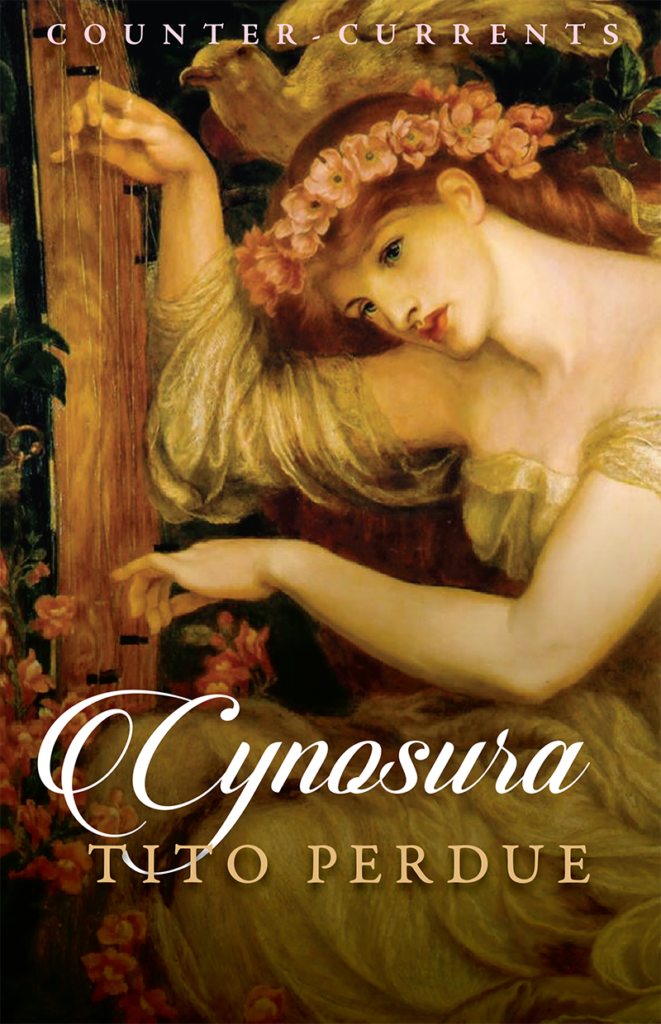
You can buy Tito Perdue’s novel Cynosura here.

Moseley’s career as an activist for his own people came at a time when most of the media was supportive of President Roosevelt and controlled by Jews. At the same time, the media had successfully shed its reputation for Yellow Journalism and appeared ethical and objectively neutral. The journalists were not truthful, but the pretense was widely believed until President Nixon’s second term. The media was also restricted to a limited number of outlets who summarized Moseley’s ideas through a liberal Jewish filter.

As a result, Moseley’s full statements had to be distributed through various pro-white networks with high printing and postage costs and it was difficult for a causal reader to stumble upon his ideas and become converted. Moseley’s papers are at the Library of Congress, but he has no biography. Most of the internet accessible copies of his work are summations of his ideas made by hostile ethnonationalist Jewish groups such as the Anti-Defamation League.

His most important statement upon becoming a white advocate was made on 1 June 1938 to the Dies Committee at the Capital. Moseley was able to make this statement through the help of Congressman Jacob Thorkelson of Montana who fully understood the Jewish Problem. The members of the Committee were hostile from the get-go. Mosley explained his activism which can be summarized thusly:

The problems facing the United States in 1939 was, “…the battle for honorable peace and the elimination of the campaign of international hate,” as well as “the battle within our gates at home to overcome…subversive influences…”

For the rest of his statement, Moseley laid out how the organized Jewish community supported the Bolsheviks and wherever the Bolsheviks took power, such as in Hungary in 1919, bloodshed and bad government followed. He cited mainstream media articles and government reports from several European countries. He also included some of his correspondence to demonstrate his motives and intellectual journey. In a letter Mosley wrote on April 21, 1939 to Brigadier General Walter A. DeLamater he wrote:

Initially I never mentioned the word, ‘Jew’, in any statement, except once in New York City, (actually in Indianapolis, Indiana) when I made an appeal to the Jews to help us lick. Communism. From that moment they have attacked me at every turn in the road. In their publications they call me a Fascist, something I am not; and as far as I know, I have never seen a Fascist. I belong to no organization. The Jews ‘have forced’ me to discuss the problem of the Jew in self-defense. They are doing everything in their power in an effort to intimidate me and force me into the camp of their enemies.

The members of the Dies Committee listened to Moseley’s remarks and then struck them from the Congressional record. In doing so, Moseley’s ideas were fully suppressed. His remarks were only able to get out through expensive printing and mailings and then only to people who already understood the issue.

The Second World War

Obviously, Moseley’s attempt took keep America out of the Second World War failed miserably. The isolationists were finally outmaneuvered when the Japanese attacked the American fleet in Hawaii. It is certain that the Roosevelt sought to “make an incident,” but the Japanese did choose to attack. Additionally, Hitler’s Germany declared war on the United States, had Germany not declared war, it is possible that war resources set to Britian would have ceased and America would have only fought in the Pacific.

Two of Moseley’s oldest sons (the ones by Alice) served in the War. Francis joined the Signal Corps, then switched to the Army Air Corps and became a pilot, rising to the rank of lieutenant colonel. Moseley’s son George commanded the 502nd US Parachute Infantry Regiment and jumped into Normandy. He was injured in the jump, so he commanded the regiment from a wheelbarrow pushed by his bodyguards. He was partially portrayed by John Wayne in the film The Longest Day. John Wayne’s character was a composite of several actual people.

Moseley was a public political enemy to the Roosevelt administration, however two of his sons served as officers under Roosevelt’s command in the conflict in dangerous roles. This fact emphasizes the political genius of the Franklin and Eleanor Roosevelt. Eleanor, for example, was able to blunt Moseley’s message with kindness. In a letter to Moseley dated 5 September 1946, she wrote,

I think you are unfair to the Jewish people. There are, of course, lower class Jews who because of persecution and difficulties of survival, have developed certain traits of character which are hard for us, who have had easier lives, to accept. However, I know many Jews who are far more disinterested citizens and who take more interest in education and the arts in their communities than many people of other religions and nationalities. They are by far the most responsive to appeals for welfare and civic interests. It is true that you can find Jews in all the bad situations you speak of, but you can also find Gentiles. The division is pretty equal. I disagree with you because I believe our strength in this country has come from the great difference in back grounds which have been assimilated here into a type which is an American type.

Eleanor is obviously naïve. However, she was able to outmaneuver Moseley’s warnings with the assertation that Jews had assimilated, and she did this as though she was talking to a beloved grumpy older brother.

“Civil Rights” and the Radicals of the Establishment

The sub-Saharan enlisted men of the segregated 24th US Infantry went on a rampage in Japan just prior to shipping out to Korea – where the regiment did so poorly that it was recommended to be disbanded. Moseley would have known there was a risk for this behavior and had previously warned about using large numbers of sub-Saharan troops.

Meanwhile Moseley kept working on pro-white activities. By this time, immigration was not an issue since the 1924 restrictions were in place, however “civil rights” was becoming a problem as well as communist subversion during the Cold War. In the early 1950s, Moseley supported the “draft MacArthur” for president movement. His support explains why the organized Jewish community was so alarmed by MacArthur in the early 1950s. If MacArthur did become president in 1952, then he would have had a base of supporters who were aware of the Jewish Problem, and they would have gone on to jobs in various agencies – thereby reducing the malignant Jewish control of the American government considerably. Moseley did know the man elected president in 1952 – Dwight Eisenhower – but there is no evidence Eisenhower was swayed by his ideas.

You can buy Fenek Solère’s Resistance here.

After MacArthur decided to “never die” and just “fade away.” Moseley attempted to shift the liberal “civil rights” culture in universities by teaming up with the Wealthy Texan George Washington Armstrong (1866 – 1954) to give talks and donations.

The Moseley – Armstrong team made little headway throughout the 1950s. The “civil rights” supporters and Zio-Leftists formed a cohesive group which captured the highpoints of society, advancing behind the cover of Franklin Delano Roosevelt’s Protestant White Southerner and Catholic Irish supporters. The New Deal Establishment had also created a youth wing of compliant Leftist pseudo-rebels who dominated culture by the late 1940s. Moseley’s talks were protested, and Armstrong’s money was returned. Cancel culture was fully in place by 1951.

Moseley continued to support segregation throughout his remaining days. He had the same views as the white advocate Earnest Sevier Cox on Latin Americans. He viewed them as whites, just not Anglo-Saxons. His ideas on that count should be revisited, there really isn’t a “Black-Hispanic” coalition and many “Hispanics” are as white as any other European. Moseley also worked in other groups including the Americans for Constitutional Action, which supported conservative causes, but made little headway in breaking down the Zionist and “civil rights” paradigm.

The Flying Saucer Craze and the Dispossessed Majority

Moseley’s two oldest sons were serious men who saw their duty and did it throughout their lives. The children of Moseley’s older sons were also serious people who accomplished much in their respective lives and who also went on to have families of their own. Moseley’s youngest son by his second wife, “James W. “Jim” Moseley, had an interesting career, to put it mildly. While his career was not the cause of the ongoing dispossession of American whites, the field in which he labored was due to the dispossession, at least in part.

In his autobiography, co-written with Karl T. Pflock, Jim didn’t say much about his father other than the fact the man knew Eisenhower, had received a letter on US government stationary cautioning him about his political statements while drawing an army pension, and his father had separated from his mother shortly after he was born. Jim’s mother passed away when he was just nineteen and she left him so much money he didn’t need to work. After getting tired of “recreational drinking,” Jim became interested in antiquities and flying saucers, or “Unidentified Flying Objects” (UFOs).

In 1953, Jim wrote a series of “Philosophical Outlines,” the seventh of which was related to the “flying saucer” craze which started in 1947, when a private pilot saw fast moving objects that looked like saucers. Jim believed that given the number of stars with planets it was likely that other worlds contain intelligent life, and it was only a matter of time before individuals from such worlds traveled into space. He further reasoned that 25% of the flying saucers seen by the public were genuine.

So, Jim dedicated his life to researching UFOs. He documented the mass sightings, called “flaps,” in a ‘zine called Saucer News. In the mid-1960s, just as the craze seemed to be on the way of being a faddish a relic of the 1950s, it took off again – with embellishments – including the tales of abductions, obviously dubious explanations from the government about “swamp gas,” a flying saucer crash in Roswell, New Mexico, and spin off stories about Mothman, Bigfoot, and other creatures.

Jim became an expert on UFO sightings and other mysteries, but his investigations were tainted by cynicism and immaturity on his part. He feuded with a UFO researcher named George Adamski, who saw the phenomenon from a religious point of view that ran close to the theology of Theosophy. During the feud, Jim sent fake letters to Adamski about UFOs allegedly from “the government” that purported to confirm what Adamski believed. Adamski thought the letters were real and he showed them to prove his theories. Jim used Adamski’s response to the letters to demonstrate the latter’s credulity. Jim also created a fake UFO film to use as part of his lectures.

Jim hosted well-attended conferences for UFO enthusiasts which occasionally drew television celebrities. Eventually, the UFO researchers, abductees, and eyewitnesses became celebrities in their own right. In 1976, Jim created a ‘zine called Saucer Smear which investigated the phenomenon and provided information and gossip about the personalities in the movement. The ‘zine ran until his death in 2012.

Jim was a liberal Democrat. He disliked the segregationist governor of Georgia, Lester Maddox, for example and he seemed to not recognize racial differences in crime or IQ that brought about the political demand for people like Governor Maddox. He also implied that George Adamski was an “anti-Semite” during his feud with the man. In other words, UFOlogy etherized American whites while genuinely hostile races cut into white society. Jim’s career was an amusement which missed out on far more serious concerns.

Throughout the time that Jim investigated flying saucers and gossiped about his colleagues, a mostly Jewish New Left bombed and burned buildings, the Israelis attacked the USS Liberty, Jews such as Jonathan Pollard passed classified information to Israel, and American Marines were bombed in Beirut because they were sent to give Israel a strategic victory in a conflict Israel couldn’t win. Jews also pressured lawmakers to relax immigration controls to the point every migrant is now part of a genocide just by crossing the border. Lax immigration also allowed for 9-11 which gave the opportunity to Israel First Jews to stampede America into war. Of the two Moseleys, George was certainly the more serious man.

The Great Replacement & the Incompetent Military

George Van Horn Mosely was the last of a breed. He was part of a generation of career military men who learned from officers who served in the Civil War. He served at the tail end of the Indian Wars, and he fought in an army that won a difficult insurgency as well as a World War against the greatest military power in Europe.

Moseley shaped the leaders who “won” World War II for the United States. Since, 1945 however, the American military has been a disappointment. The Americans withdrew in humiliation from Saigon in 1975 and Kabul in 2021. Other deployments have been unnecessary debacles, such as those to Somalia and Iraq. Perhaps the most shameful episode was the military’s inability to provide law and order during the Antifa/BLM rebellion in 2020. In 2024, the American military was again humiliated when a floating pier on the beach of Gaza was damaged during an ordinary storm.

There are many reasons for this downward trend. One possible reason is the Jewish establishment’s reaction to the career of George Van Horn Moseley. Every type of government runs the risk of being overthrown its military. One way to prevent this is to have a military made of foreign soldiers – such as the Janissary Corps of the Ottoman Empire. While this policy can work on the domestic scene, the policy fails when such an army is facing a real enemy.

The Philippine Insurrection was won, in part because the elite of both nations were able to come to an accommodation which amounted to an agreement between Old-Stock Americans with roots in New England and Hispanicized Tagalog Filipinos. The Old-Stock American officers were able to work out an acceptable compromise because they sat comfortably within American culture and were part of the same ethic group as the American political elite and most of the enlisted soldiers. They understood the hearts, minds, and aspirations of those in their society. The same could be said for the Hispanicized Tagalog leaders.

It’s not that way today. American senior leaders claim, at least, to be baffled by “white rage.” Moseley’s political activism created a demand on the part of the liberal-minority-Jewish hostile political elite to put foreign mercenaries in top spots. Consider the following senior officers; Colin Powell (Jamaican), John Shalikashvili (Georgian), Eric Shinseki (Japanese). Colin Powell described his alienation from whites in his autobiography, the others must have felt their foreignness also. An institution which is infected with this virus will have senior leaders who don’t identify with the historical American cavalrymen on the frontier posts but can be compliant warriors for a hostile elite to be used against the population.

Bibliography

James R. Arnold, The Moro War: How American Battled a Muslim Insurgency in the Philippine Jungle, 1902-1913 (New York: Bloomsbury Press, 2011)

Henry Blaine Davis, Jr., Generals in Khaki (Raleigh, N. C.: Pentland Press, Inc., 1998

John Morgan Gates, Schoolbooks and Krags (Westport, Conn.: Greenwood Press, Inc., 1973)

Madison Grant, The Passing of the Great Race, or The Racial Basis of European History (New York: Charles Scribner’s Sons, 1918)

Frederic Cople Jaher, Review of Anti-Semitism in the American Army by Joseph W. Bendersky, Reviews in American History 30, no. 1 (2002): 132–35

Brian McAllister Linn, The Philippine War 1899-1902, (Lawrence, Kans.: University of Kansas Press, 2000)

Brian McAllister Linn, “The Pulahan Campaign: A Study in US Pacification,” War in History 6, no. 1 (1999): 45–71

George Van Horn Moseley, Mandatory Over Armenia, Document No. 281 (1919)

James W. Moseley & Karl T. Pflock, Shockingly Close to the Truth!: Confessions of a Grave-Robbing Ufologist (Amherst, NY: Prometheus Publishing, 2002)

Robert D. Ramsey III, A Masterpiece of Counterguerrilla Warfare: BG Franklin Bell in the Philippines, 1901-1902 (Fort Leavenworth, Kans.: Combat Studies Institute Press, US Army Combined Arms Center, 2007)

A Career Worth Reviewing The Life of Lieutenant General George Van Horn Moseley, Part 2

A%20Career%20Worth%20Reviewing%0AThe%20Life%20of%20Lieutenant%20General%20George%20Van%20Horn%20Moseley%2C%20Part%202%0A

Share

  • Gab

Enjoyed this article?

Be the first to leave a tip in the jar!

Instant Echeck GreenPay™

*  *  *

Counter-Currents has extended special privileges to those who donate at least $10/month or $120/year.

  1. Donors will have immediate access to all Counter-Currents posts. Everyone else will find that one post a day, five posts a week will be behind a “paywall” and will be available to the general public after 30 days. Naturally, we do not grant permission to other websites to repost paywall content before 30 days have passed.
  2. Paywall member comments will appear immediately instead of waiting in a moderation queue. (People who abuse this privilege will lose it.)
  3. Paywall members have the option of editing their comments.
  4. Paywall members get an Badge badge on their comments.
  5. Paywall members can “like” comments.
  6. Paywall members can “commission” a yearly article from Counter-Currents. Just send a question that you’d like to have discussed to [email protected]. (Obviously, the topics must be suitable to Counter-Currents and its broader project, as well as the interests and expertise of our writers.)

To get full access to all content behind the paywall, please visit our redesigned Paywall page. 

Related

  • The Crisis of Chinese Technology Thieves

  • The Robot Hotdog Stand

  • Berlin: City of Stones

  • How Cold War Two Came About

  • The Cruelty of Kindness

  • Lothrop Stoddard’s The Revolt Against Civilization

  • Lewis Strauss Did Nothing Wrong:

  • The 1970s: The Golden Age of Hijacking

Tags

CommunismCommunism in the United StatesDies CommitteeDouglas MacArthurFranklin Delano RooseveltGeorge Van Horn MoseleyMorris van de CamppaywallRoosevelt administrationthe Second World WarUS militaryWorld War II

5 comments

  1. Scott says:
    July 8, 2024 at 6:44 am

    “Additionally, Hitler’s Germany declared war on the United States, had Germany not declared war, it is possible that war resources set to Britian would have ceased and America would have only fought in the Pacific.”

    Maybe. How much is too much?

    After calling the Munich Agreement “Appeasement” and doing everything possible to sabotage a peaceful agreement with Poland over Danzig, which everybody already agreed was German, what was left besides war?

    Furthermore, Slovakia and Romania appealed to Hitler for protection. Finland appealed for Allied protection from Soviet aggression, but this fell upon deaf ears. Wrong enemy.

    Ogden Nash no ditties; the Soviets, they’s only frenemies.

    Even after Hitler only took half of France to improve the German strategic position on the continent pending a final peace treaty, the dastardly British rebuffed any peace overtures and righteously proceeded to sink the entire French fleet that had escaped Hitler to Algeria, thus killing over 1,300 French sailors (LINK).

    Albion didn’t need no stinking peace with Germany so long as Hitler was alive.

    And the Americans were willing to write them a blank check not to come to terms with the Germans. Eventually this became an Unconditional Surrender policy, which is certainly not how the “Free World” fought the Communists in Korea or Vietnam.

    Pulling the English fat out of the fire would not be free, however; the Roosevelt cabal expected to inherit the Global British Empire cheaply, for the price of a little Anglo desperation that only the Germans could provide.

    Roosevelt traded fifty outdated American destroyers from the Great War for the titles to British overseas bases (LINK). The new Imperialism ─ or turning whole nations into economic colonies ─ we call Globalism today. And who but crass financial elites and Happy Merchants benefit from it?

    By March of 1941, Congress had voted to Lend-Lease all the war materiel that the Allies (and soon the Soviets) could take, including fissile materials and atomic bomb technology.

    In one of his Fireside Chats, Roosevelt warmly explained to the nation’s radio listeners behind wooden cabinets with warm glowing filaments, that Lend-lease was just like lending your fire hose to a friend to put out a big fire.

    The Isolationist Senator Robert Alphonso Taft (R-OH) who was the son of the former President and Supreme Court Chief Justice, ruefully observed that lending war materiel was like lending chewing gum, “you don’t want it back.”

    Also, long before Pearl Harbor, the U.S. Navy began clandestinely escorting Allied merchants-of-death convoys to their destinations, and issuing shoot-on-sight orders against German warships.

    It wasn’t Hiter doing the war mongering.

    German warships, on the other hand, had strict orders to leave the American ships alone. When the U-552 sank the USS Reuben James near Iceland, the American ship had not been flying an American ensign ─ but the U-boat skipper, Käpitanleutnant Erich Topp was court martialed by the German Kriegsmarine (Navy) for engaging a “neutral” American ship.

    Topp’s defense was compelling ─ that he thought the Reuben James was indeed an Allied ship since it had been depth-charging another U-boat. Erich Topp sank 35 ships during he war and became an Admiral in the postwar German Bundesmarine.

    The Japanese were an unknown quantity. They had bested the Russian fleet in the 1905 war which had not happened to a White superpower by a hued race in living memory, establishing the Japanese as players. In the long ramping to World War II, the Japs were  aggressive in China and Indonesia, and when shooting was involved, the had the Western colonial powers on the run.

    True, the Japanese Army had not done so well in border skirmishes against the Soviets at Khalkhin Gol, but this was not a negligible hazard along the Manchurian-Monglolian sector that was far from burgeoning European conflicts.

    Hitler would have certainly welcomed a stout military response by the Japanese against the Soviet Union in the Far-East.

    It might have been fair for the Germans to assume that if it came to war with the United States, a good 80 percent of American efforts would be allocated to fighting the Rising Sun ─ and thus leaving only 20 percent to engage the European Axis.

    The reality was that 80 percent of the American war-effort was devoted to fighting Germany ─ and anything over 5 percent almost guaranteed a German defeat.

    So while it seemed wise that showing solidarity with Japan by declaring war on the USA a few days after Pearl Harbor, other than being good for German morale, did not actually help the strategic military situation ─ despite the fact that the Americans wanted war with Germany and would have it in some way soon enough.

    Also, Germany was not obliged to declare war on the United States simply because they had only a defensive pact with Japan ─ and it was Japan that had attacked the Americans at Pearl Harbor.

    Likewise, the Japanese were not obliged to declare war against the Soviet Union in June of 1941 when Germany attacked. Had they done so instead of bringing the Americans into the war, it might have been helpful for the Axis.

    This is a good reason to carefully evaluate all of your entangling alliances.

    The American economy had been depressed financially after the 1929 stock market crash, and unemployment remained high ─ but putting some of the surplus work force into uniform, and underwriting contracts that came with war-mobilization, energized industry and agriculture and produced an economic powerhouse the size of which no European could have sanely imagined prior to Pearl Harbor.

    Even if Hitler could have maintained peace with the Soviets and the Americans, he could not have done so for very much longer.

    War with Germany had been in the cards ever since Stalin’s Socialism In One Country (LINK), which was an apocalyptic arms buildup dating back to 1928 that had Germany’s name all over it.

    🙂

    0
    0
  2. Geraldine Mullen says:
    August 4, 2024 at 6:48 pm

    Roosevelt was a well known crypto Jew.and his administration was full of Jewish communists. White advocate pfft.

    0
    0
  3. Will Williams says:
    August 5, 2024 at 2:52 am

    Moseley understood the JQ yet allowed his sons to fight and kill their German cousins. Toothless opposition. Compare the General to Trump who also gets the JQ but allowed his daughter to marry an Hasidic Jew, convert and give him Jewish grandchildren.


    —

    Scott: July 8, 2024 …It wasn’t Hitler doing the war mongering.


    Duh! Hitler wanted peace.

    It was organized Jewry pushing to exterminate their primary enemy, “Germanism and its carriers.” Fact! Churchill , surrounded and used by Jews, was the primary Gentile war monger in the first half of the 20th century, joined by Wilson to get the U.S. into WWI, then by FDR to get the U.S. int WWII — both arguably leading to the eventual end of the Anglo-Saxon race. Consider this lovely piece of work by Roosevelt’s Manhattan-born Jew and member of his so-called Brain Trust, Theodore Nathan Kaufman in his book, Germany Must Perish:

    Since Germans are the perennial disturbers of the world’s peace… they must be dealt with like any homicidal criminals. But it is unnecessary to put the whole German nation to the sword. It is more humane to sterilize them… The population of Germany, excluding conquered and annexed territories, is about 70,000,000, almost equally divided between male and female. To achieve the purpose of German extinction it would be necessary to only sterilize some 48,000,000 — a figure which excludes, because of their limited power to procreate, males over 60 years of age, and females over 45… taking 20,000 surgeons as an arbitrary number and on the assumption that each will perform a minimum number of 25 operations daily, it would take no more than one month, at the maximum, to complete their sterilization… The balance of the male civilian population of Germany could be treated within three months. Inasmuch as sterilization of women needs somewhat more time, it may be computed that the entire female population of Germany could be sterilized within a period of three years or less… Of course, after complete sterilization, there will cease to be a birth rate in Germany. At the normal death rate of 2 percent per annum, German life will diminish at the rate of 1,500,000 yearly. Accordingly, in the span of two generations that which cost millions of lives and centuries of useless effort, namely, the elimination of Germanism and its carriers, will have been an accomplished task.

    Source: The Myth of German Villainy, 2023 edition available here: “The Myth of German Villainy by Benton Bradbury” at cosmotheistchurch.org.

    High schools don’t teach that in American History. Maybe they should. What a great textbook Myths would be for White American youth.


    0
    0
  4. Will Williams says:
    August 6, 2024 at 4:10 am

    Will Williams: August 5, 2024 Moseley understood the JQ yet allowed his sons to fight and kill their German cousins. Toothless opposition. 

    —


    I should clarify a bit. Any military man who speaks out with truth about Jewry, even a General with three stars, will not last long. “Moseley was apolitical while on active duty.” Once retired, he spoke his mind, but in half measures.  He did not go “the final length.”

    I had just read Douglas Mercer’s fine piece, “Denouement” at National Vanguard.org, put up this weekend. He discusses the relationship/friendship between Wagner and Nietzsche, comparing them to Hitler and National Socialism. Their comparison to Mr. Hitler leaves them wanting.

    In response to an erudite commenter under “Denouement” yesterday Douglas has this to say:

    Yes, Nietzsche will always be a hero of mine, he was a seer and prophet, with an intelligence and writing ability that remains unmatched. That he was unable to see the pure evil of the Jews with an implacable clarity is unfortunate. In a way his pet notion of being a “good European,” coupled with the materialism of Bismarck’s Germany gave him a hatred of nationalism which for him was wrapped up with anti-Semitism. His teacher Jacob Burckhardt thought that Europe needed the Jews to “leaven” it, not seeing that the leaven was poison. As for Ezra Pound he is a hero of mine as well, and I posted an essay about him on the White Biocentrism site. (“Ezra Pound” at White Biocentrism.com, posted yesterday)

    Reading this piece on Pound prompted me to comment about Moseley as I did. Pound’s moral courage and his telling vital truths about Jewry and how they were behind Churchill/Roosevelt’s manipulating the British and American people into the genocide of their German cousins, and never backing down from those truths, cannot be compared to Moseley’s half measures.

    The incomparably great Ezra Pound is a hero who went the final length. Both sides of Pound’s family came to America in the 17th century so he was of the oldest stock of our people. By 1925 he was the very heart of European culture, acknowledged by everyone as the great mind of Modernism with his exhortation to “make it new.” Yet though his spirit was sailing to the edges of the future it did not blind him as to the past, and when he saw the wicked, usurious, rank, insipid and cheap world the Jews were creating (what another noble anti-Semite T.S. Eliot called the twittering world) he stood on the barricades like the Knights of old and put his life on the line. He went on Italian radio and he attacked the United States, Roosevelt, Roosevelt’s family, Churchill, and the Jews. He praised Hitler, recommended eugenics to conserve the best of the race, and referred to Jews as filth. After the final tragedy the Americans put him in a 6 foot by 6 foot cage in the searing Italian heat and kept him awake at night by floodlights. When they removed him he was delirious and they could call him “mad.” There was no way the Americans were going to give the most eloquent man on the planet a treason trial where his fellow countrymen would be forced to hear the truth unvarnished truth so they locked him up in St. Elizabeth’s, safely labeled “insane.” They say when he went back to Italy in 1958 when he stepped onto land he gave a Roman salute, and may all of us do the same in his memory and for the honor of our people.

    0
    0
  5. Will Williams says:
    August 10, 2024 at 8:34 pm

    Moseley wrote on April 21, 1939 to Brigadier General Walter A. DeLamater :

    Initially I never mentioned the word, ‘Jew’, in any statement, except once in New York City, (actually in Indianapolis, Indiana) when I made an appeal to the Jews to help us lick Communism. From that moment they have attacked me at every turn in the road. In their publications they call me a Fascist, something I am not; and as far as I know, I have never seen a Fascist. I belong to no organization. The Jews ‘have forced’ me to discuss the problem of the Jew in self-defense. They are doing everything in their power in an effort to intimidate me and force me into the camp of their enemies. 

    *  *  *  *

    “The war now proposed is for the purpose of establishing Jewish hegemony throughout the world.” -Major General George Van Horn Moseley, U.S. Army (Ret.), speech at the National Defense Meeting (March 29, 1939)

    This second quote by Moseley, reportedly made a month earlier, is found in the 2023 updated, revised edition of The Myth of German Villainy (page 431) that I just finished reading. Available here: cosmotheistchurch.org

    If Moseley was already retired in October 1938 as a Major General (2 stars), I’m not sure when he could have been promoted to Lieutenant General (3 stars), unless his permanent rank was reduced to Major General after retirement?

    0
    0

Comments are closed.

If you have a Subscriber access,
simply login first to see your comment auto-approved.

Note on comments privacy & moderation

Your email is never published nor shared.

Comments are moderated. If you don't see your comment, please be patient. If approved, it will appear here soon. Do not post your comment a second time.

Upcoming podcasts
  • Rob Rundo on Counter-Currents Radio

    Rob Rundo on Counter-Currents Radio

    Counter-Currents Radio

    Sat, Jun 13th — 3 pm EST / 9 pm CET

Writers of May

(2 votes) Morris van de Camp David M. Zsutty Derek Stark Jayant Bhandari Greg Johnson

Articles of May

Heidegger on Nietzsche, Part One by Collin Cleary The Lunch Wars by David M. Zsutty 2 votes
    • Editor’s Update
      Rob Rundo on Counter-Currents Radio, Fundraiser Update, & a New $20,000 Matching Grant

      Greg Johnson

    • The Bitter End of Western Metaphysics:
      Heidegger on Nietzsche, Part Three

      Collin Cleary

      7

    • Uncivil War

      Mark Gullick

      28

    • Exclusive Interview with Karel Veliky:
      The Final Chapter in the Film Series! Part II

      Ondrej Mann

      2

    • Happy Birthday to Us!

      Greg Johnson

      6

    • Zsutty’s Maximum

      David M. Zsutty

      15

    • Exclusive Interview with Karel Veliky:
      The Final Chapter in the Film Series! Part I

      Ondrej Mann

      2

    • The Union Jackal, June 2026

      Mark Gullick

      23

    • The Inferiority Behind Immigrant Superiority

      Jayant Bhandari

      15

    • Counter-Currents Radio Podcast No. 690
      Greg Johnson & David Zsutty Discuss Current Things: AI, Henry Nowak, the Iran Crisis, & More

      Counter-Currents Radio

      5

    • Collin Cleary: What Rome Means to Me

      Collin Cleary

      4

    • Paul Krugman: Closet Bolshevik

      Spencer J. Quinn

      19

    • Fugue of Ideas:
      Ibram X. Kendi’s Chain of Ideas

      Greg Johnson

      18

    • Based Blacks

      Lipton Matthews

      12

    • Black Intellectual Fatigue

      Derek Stark

      37

    • Why White Advocates Should Avoid “Based Blacks”

      Dani Vypont

      26

    • Nietzsche & Race

      Mark Gullick

    • Editor’s Update
      Rob Rundo Rescheduled to Next Week on Counter-Currents Radio;
      Tonight Greg Johnson & David Zsutty Answer Your Questions;
      Fundraiser Update & a New $20,000 Matching Grant

      Greg Johnson

    • The Counter-Currents 2026 Fundraiser
      Lifetime Subscriber Welcome Packages Extended

      Greg Johnson

    • Nationalism This Week
      Who’s Looking Back?

      Greg Johnson

      29

    • China’s Threat to American Security:
      Food, Farmland, Foreign Control, & Energy Policy

      Lipton Matthews

      5

    • The Bitter End of Western Metaphysics:
      Heidegger on Nietzsche, Part Two

      Collin Cleary

      16

    • The Killing of Henry Nowak

      Mark Gullick

      38

    • The Crisis of Chinese Technology Thieves

      Morris van de Camp

      1

    • The Strange World of Gender Bender Fiction:
      & What This Genre Tells Us About Autosexuality

      Dani Vypont

      3

    • Watching the Watchers:
      The Dark Triad Question

      David M. Zsutty

      14

    • The Remigration Movement Solidifies

      F. Roger Devlin

      1

    • Casting Aspersions:
      The Fatal Consequences of Race-Swapped Casting, From Helen of Troy to Henry of Southampton

      Steven Tucker

      20

    • The Murder of Henry Nowak

      Millennial Woes

      23

    • Don’t Forget to Vote in Our Writer & Article of the Month Poll

      Greg Johnson

    • The Robot Hotdog Stand

      Greg Johnson

      37

    • Laughing Our Way to Victory

      Dave Chambers

      7

    • The Zodiac Killer

      Mark Gullick

      11

    • Jared Taylor: What Rome Means to Me

      Jared Taylor

      1

    • An Interview with Endeavour:
      My Way of Life Is an Adventure!

      Ondrej Mann

      6

    • José Pedro Zúquete’s The Identitarians

      Greg Johnson

      3

    • Editor’s Update
      Fundraiser Update & How to Watch the Remigration Summit

      Greg Johnson

      5

    • The Bitter End of Western Metaphysics:
      Heidegger on Nietzsche, Part One

      Collin Cleary

      12

    • Berlin: City of Stones

      Spencer J. Quinn

      6

    • True Folk-Horror Is Horror of Your Own Folk:
      Mark Gatiss vs the Brexit Blind Dead  

      Steven Tucker

      4

    • Counter-Currents Radio Podcast No. 689
      Thomas Massie, the America 2050 Bust, the Need for Whites to Divest from America, the AI Economic Apocalypse, & Pro-White Project Pitches to Billionaires

      Counter-Currents Radio

      7

    • Nationalism This Week
      Remigration is Inevitable, Part 3

      Greg Johnson

      27

    • Why Billionaires Should Fund White Identity Politics

      Lipton Matthews

      8

    • How Cold War Two Came About

      Morris van de Camp

      5

    • Now Available for Pre-Order at a Special Price!
      Greg Johnson’s The Philosopher Is In

      Greg Johnson

    • David Zsutty’s Elevator Pitch to a Billionaire

      David M. Zsutty

      1

    • Headbanging Lite

      Mark Gullick

      5

    • White Advocacy Past and Present

      Peter Bradley

      13

    • The Lunch Wars

      David M. Zsutty

      47

    • The Russians are Coming/The Russians are Coming

      Steven Clark

      1

    • I Do Not Surrender, My Hand Is Red.

      Uncivil War

      This is very good advice Joe. Very good.

    • NIdahoOrthodox

      Uncivil War

      How many tens of thousands of automatic weapons and tons of Semtex are in hidden caches in the North...

    • kolokol

      Uncivil War

      Stephen Ogilvie is the latest example of a decent, hard-working White person, killed by a useless...

    • Dr. X

      Uncivil War

      Great writeup. One error- I doubt the Republic of Ireland police (Garda) were responding on the...

    • kolokol

      Uncivil War

      This is a very good start. May it continue and accelerate, until all the invaders have been expelled...

    • Observer

      Heidegger on Nietzsche Part Three

      Ouch. Well, I had used the bullet formatting in the text box to break it up a bit... but it looks...

    • Gabe

      Uncivil War

      Scots-Irish is an American term. It's true that Presbyterians and others came from Scotland to...

    • Gabe

      Uncivil War

      I was just going to write that myself. The Garda Siochána, or guards, is a term they use in the...

    • Ondrej Mann

      Exclusive Interview with Karel Veliky Part 2

      Thanks for the cultural tip. I’m currently preparing an interview for CC with the Austrian band...

    • Observer

      Heidegger on Nietzsche Part Three

      Also, a semi-related topic, but have you read Darren Beattie's Heidegger PhD thesis? I know that it...

    • Observer

      Heidegger on Nietzsche Part Three

      My mood is always improved by a fresh Cleary article. Great work as always. It's always fun to see...

    • Joe Gould

      Zsutty’s Maximum

      "That Whites are the only racial ingroup in which there seems to be any significant number of...

    • Nicholas

      Paul Krugman: Closet Bolshevik

      https://youtu.be/02MV3DD5pFc This is the link I intended to share. Let's hope this works.

    • Greg Johnson

      Zsutty’s Maximum

      All groups are mean to one another, to some extent. The question is whether this level of ingroup...

    • Joe Gould

      Uncivil War

      For Whites, one of the goals of philosophy, and of education in general, has to be this: we must...

    • Dani Vypont

      Uncivil War

      Northern Ireland has been in a civil war, both hot and cold, for decades. This religiously and...

    • David M. Zsutty

      Zsutty’s Maximum

      That Whites can be very mean to each other is a correct observation. However, this is a case of...

    • Scott

      Why White Advocates Should Avoid “Based Blacks”

      Will Williams wrote: "Scott, it’s interesting that you call George Stephanopoulos a “Clinton...

    • Scott

      Paul Krugman: Closet Bolshevik

      Yeah, Trump is the most Kosher President to come down the pike ─ except for the last one, and the...

    • C#

      Heidegger on Nietzsche Part Three

      Well, that was depressing. Enlightening, but depressing. Personally, I suffer from the baggage of...

    • Earth Day Special

      John Morgan

      12

    • A Robertson Roundup
      Remembering Wilmot Robertson
      (April 16, 1915 – July 8, 2005)

      Margot Metroland

      13

    • The Paranoid Style in White Nationalism

      Greg Johnson

      30

    • Join the Dance!

      Andrew Hamilton

      1

    • We Can’t Save the Earth Without Reducing African Birth Rates

      James Dunphy

      36

    • “I’m Not a Conspiracy Theorist, but . . .”:
      Jeffrey Epstein’s Death Gives New Life to “Conspiracy Theories”

      Greg Johnson

      22

    • Sylvia Plath: Stasis in Darkness

      Vic Olvir

      17

    • Vanguardism, Vantardism, & Mainstreaming

      Greg Johnson

      80

    • Aviation, Geography, & Race

      Charles Lindbergh

      3

    • Some Thoughts on Yule

      Collin Cleary

      4

    • Living in Truth:
      A Yuletide Homily

      Jef Costello

      7

    • John Kennedy Toole’s A Confederacy of Dunces

      Greg Johnson

      20

    • On Aleksandr Solzhenitsyn’s Warning to the West

      Spencer J. Quinn

      7

    • Elitism, British Modernism, & Wyndham Lewis

      Jonathan Bowden

      6

    • Philip K. Dick’s Do Androids Dream of Electric Sheep? as Anti-Semitic/Christian-Gnostic Allegory

      Greg Johnson

      20

    • “Conspiracy Theory” or Conspiracy?

      Andrew Hamilton

      21

    • Remembering H. P. Lovecraft
      (August 20, 1890–March 15, 1937)

      Greg Johnson

      3

    • Who Are We?
      Nordics, Aryans, & Whites

      Greg Johnson

      71

    • Remembering William Gayley Simpson
      (July 23, 1892–December 31, 1990)
      A Pleasant Afternoon with Harriet & Bill Simpson

      Margot Metroland

      18

    • Here are the Young Men
      Remembering Ian Curtis
      (July 15, 1956–May 18, 1980)

      Mark Gullick

      18

    • Percy Grainger
      Artist of the Right

      Alex Graham

      7

    • Remembering Revilo Oliver
      (July 7, 1908–August 20, 1994)

      Greg Johnson

      18

    • The Meaning of July 4th for the White Man

      Gregory Hood

      13

    • The Front National’s Evolution

      Bruno Mégret

    • Merwin K. Hart
      Forgotten American Hero & Man of the Right

      Morris van de Camp

      10

    • George Orwell’s Nineteen Eighty-Four

      Jonathan Bowden

      8

    • Carleton S. Coon
      Scientist & Reluctant White Advocate

      Morris van de Camp

      3

    • The Kwanzaa Absurdity Will Be Dwarfed by Juneteenth

      Robert Hampton

      10

    • Stravinsky

      Alex Graham

      7

    • Like the Roman:
      Remembering Enoch Powell (1912-1998)

      Mark Gullick

      23

    • Jonathan Bowden’s Deliverance
      Part 6

      Jonathan Bowden

    • Do You Want to Play a Game?

      Mark Gullick

      1

    • Sexually Incontinent on the Indian Subcontinent:
      Who Rapes More Animals, Indians or Pakistanis? The Battle Continues!

      Steven Tucker

      3

    • Neo-Fascism in Film
      Part 5

      Karel Veliky

      15

    • The Game of Tarot

      Mark Gullick

      2

    • Institutions Cannot Be Transplanted

      Jayant Bhandari

      5

    • Jonathan Bowden’s Deliverance
      Part 5

      Jonathan Bowden

    • Crosstown Traffic:
      Jimi Hendrix & The Post-War Rock ‘N’ Roll Revolution

      Mark Gullick

      1

    • Slaves from the North:
      Finns & Karelians in the East European Slave Trade, 900–1600

      Lipton Matthews

      14

    • Neo-Fascism in Film
      Part 4

      Karel Veliky

      2

    • David Lean’s A Passage to India

      Spencer J. Quinn

      1

    • Elites are Essential to Development

      Lipton Matthews

      7

    • Jonathan Bowden’s Deliverance
      Part 4

      Jonathan Bowden

    • Neo-Fascism in Film
      Part 3

      Karel Veliky

      6

    • E. M. Forster’s A Passage to India & the Indian Mentality

      Spencer J. Quinn

      25

    • Jonathan Bowden’s Deliverance
      Part 3

      Jonathan Bowden

    • The Rest Is Silence
      Heidegger’s Quietism

      Mark Gullick

      2

    • Dispelling the Historical Fallacy of Indian Nationalism

      Lipton Matthews

      8

    • Neo-Fascism in Film
      Part 2

      Karel Veliky

      8

    • Jonathan Bowden’s Deliverance
      Part 2

      Jonathan Bowden

    • Life of a Klansman

      Mark Gullick

      8

    • Jonathan Bowden’s Deliverance, Part 1

      Jonathan Bowden

    • Decolonial Ideas are Holding Back Developing Countries

      Lipton Matthews

      8

    • Neo-fascism in Film, Part 1

      Karel Veliky

      21

    • Jonathan Bowden’s Onslaught, Part 8
      Divigations on Decadence

      Jonathan Bowden

    • Jonathan Bowden’s Onslaught, Part 7
      Intrigues in the National Front

      Jonathan Bowden

      1

    • Rotten to the Core

      Mark Gullick

      8

    • Strauss on Husserl’s “Philosophy as Rigorous Science”

      Greg Johnson

    • Jonathan Bowden’s Onslaught, Part 6
      Francis Bacon & Right-Wing Nihilism

      Jonathan Bowden

    • London After (& Before) Midnight:
      Aleister Crowley, The Landlord’s Worst Nightmare

      James J. O'Meara

      2

    • András László
    • Derek Hawthorne
    • Beau Albrecht
    • Alain de Benoist
    • Kerry Bolton
    • Jonathan Bowden
    • Collin Cleary
    • Jef Costello
    • Savitri Devi
    • Julius Evola
    • Jim Goad
    • Gregory Hood
    • Juleigh Howard-Hobson
    • Greg Johnson
    • Charles Krafft
    • Anthony M. Ludovici
    • Trevor Lynch
    • H. L. Mencken
    • J. A. Nicholl
    • James J. O’Meara
    • Christopher Pankhurst
    • Tito Perdue
    • Michael Polignano
    • Spencer J. Quinn
    • Fenek Solère
    • Irmin Vinson
    • Leo Yankevich
    • Francis Parker Yockey
    • Multiple authors
  • Editor-in-Chief

    • Greg Johnson, Ph.D.

    Featured Writers

    • Beau Albrecht
    • Gunnar Alfredsson
    • Collin Cleary, Ph.D.
    • Jef Costello
    • Morris V. de Camp
    • F. Roger Devlin, Ph.D.
    • Stephen Paul Foster, Ph.D.
    • Jim Goad
    • Alex Graham
    • Mark Gullick, Ph.D.
    • Greg Johnson, Ph.D.
    • Travis LeBlanc
    • Trevor Lynch
    • Margot Metroland
    • James J. O’Meara
    • Angelo Plume
    • Spencer J. Quinn
    • Fred Reed
    • Clarissa Schnabel
    • Michael Walker
    • David M. Zsutty

    Frequent Writers

    • Asier Abadroa
    • Aquilonius
    • Alain de Benoist
    • Kerry Bolton, Ph.D.
    • Dave Chambers
    • Steven Clark
    • James Dunphy
    • Endeavour
    • Richard Houck
    • Jason Kessler
    • Titus Livius
    • Ondrej Mann
    • Lipton Matthews
    • Mark Mazari
    • John Morgan
    • Jaroslav Ostrogniew
    • Kathryn S.
    • Christian Secor
    • Anne Wilson Smith
    • Thomas Steuben
    • William De Vere
    • Kenneth Vinther
    • Max West

    Classic Authors

    • Maurice Bardèche
    • Jonathan Bowden
    • Julius Evola
    • Guillaume Faye
    • Ernst Jünger
    • Kevin MacDonald, Ph.D.
    • D. H. Lawrence
    • Charles Lindbergh
    • Jack London
    • H. P. Lovecraft
    • Anthony M. Ludovici
    • Sir Oswald Mosley
    • National Vanguard
    • Friedrich Nietzsche
    • Revilo Oliver
    • William Pierce
    • Ezra Pound
    • Saint-Loup
    • Savitri Devi
    • Carl Schmitt
    • Miguel Serrano
    • Oswald Spengler
    • P. R. Stephensen
    • Jean Thiriart
    • John Tyndall
    • Dominique Venner
    • Leo Yankevich
    • Francis Parker Yockey

    Other Authors

    • Howe Abbott-Hiss
    • Michael Bell
    • Giles Corey
    • Jack Donovan
    • Richardo Duchesne, Ph.D.
    • Emile Durand
    • Guillaume Durocher
    • Mark Dyal
    • Tom Goodroch
    • Andrew Hamilton
    • Robert Hampton
    • Huntley Haverstock
    • Derek Hawthorne
    • Gregory Hood
    • Juleigh Howard-Hobson
    • Alexander Jacob
    • Ruuben Kaalep
    • Tobias Langdon
    • Julian Langness
    • Patrick Le Brun
    • G A Malvicini
    • John Michael McCloughlin
    • Millennial Woes
    • Michael O’Meara
    • Christopher Pankhurst
    • Michael Polignano
    • J. J. Przybylski
    • Quintilian
    • Edouard Rix
    • C. B. Robertson
    • C. F. Robinson
    • Herve Ryssen
    • Alan Smithee
    • Fenek Solere
    • Ann Sterzinger
    • Robert Steuckers
    • Tomislav Sunic
    • Donald Thoresen
    • Marian Van Court
    • Irmin Vinson
    • Book Reviews
    • Movie Reviews
    • TV Reviews
    • Music Reviews
    • Art Criticism
    • Graphic Novels & Comics
    • Video Game Reviews
    • Fiction
    • Poems
    • Interviews
    • Videos
    • English Translations
    • Other Languages
      • Arabic
      • Bulgarian
      • Croatian
      • Czech
      • Danish
      • Dutch
      • Estonian
      • Finnish
      • French
      • German
      • Greek
      • Hungarian
      • Italian
      • Lithuanian
      • Norwegian
      • Polish
      • Portuguese
      • Romanian
      • Russian
      • Slovak
      • Spanish
      • Swedish
      • Ukrainian
    • Commemorations
    • Why We Write
  • Archives
  • Top 100 Commenters
  • The Looney Bin
Sponsored Links
Europa.com Above Time Coffee Antelope Hill Publishing Paul Waggener IHR-Store Spencer J. Quinn American Renaissance Jim Goad The Occidental Observer
Donate Now Mailing list
Books for sale
  • The Philosopher Is In
  • Sexual Utopia in Power (Expanded Edition)
  • In Defense of Prejudice
  • Loving Our Own
  • Tyranny & Wisdom
  • The Populist Moment
  • Is America Doomed?
  • To all books
Copyright © 2026 Counter-Currents Publishing, Ltd.

Paywall Access


Please enter your email address.

Lost your password?

Edit your comment

Writer & Article of the Month May 2026

Voting for this month has concluded. Here are the final results!

Top Writers

  • #1 Morris van de Camp 2 votes
  • #2 David M. Zsutty 2 votes
  • #3 Derek Stark 2 votes
  • #4 Jayant Bhandari 2 votes
  • #5 Greg Johnson 2 votes
  • #6 Jared Taylor 1 vote
  • #7 Collin Cleary 1 vote
  • #8 Spencer J. Quinn 1 vote
  • #9 Mark Gullick 1 vote
  • #10 Lipton Matthews 1 vote
  • #11 Keith Woods 1 vote
  • #12 Steven Tucker 1 vote

Top Articles

  • #1 Heidegger on Nietzsche, Part One 2 votes
  • #2 The Lunch Wars 2 votes
  • #3 The Ghost of the Confederacy 1 vote
  • #4 Lothrop Stoddard’s The Revolt Against Civilization 1 vote
  • #5 Could Fascism Work? 1 vote
  • #6 Jared Taylor's Elevator Pitch to a Billionaire 1 vote
  • #7 Predation Wearing the Mask of Civilization 1 vote
  • #8 Peak Fatigue in Fort Wayne 1 vote
  • #9 Keith Wood's Elevator Pitch to a Billionaire 1 vote
  • #10 Do You Want to Play a Game? 1 vote
  • #11 Why Billionaires Should Fund White Identity Politics 1 vote
  • #12 The 1970s: The Golden Age of Hijacking 1 vote
  • #13 True Folk-Horror Is Horror of Your Own Folk 1 vote
  • #14 Finding Atlantis Part 4 1 vote
  • #15 Berlin: City of Stones 1 vote

Total votes cast: 17