 3,652 words
Richard Wolstencroft is a 56-year-old Australian film director, writer, film festival organiser (Melbourne Underground Film Festival), former nightclub promoter, thinker, philosopher, and podcaster. He has directed eight feature films and twenty short films, including music videos.
He founded a nightclub called The Hellfire Club, which was very successful in the 1990s and early 2000s. In 2000, he founded the Melbourne Underground Film Festival (MUFF) and has been its director ever since. So he has been organising events in Melbourne continuously for about 35 years. Richard became famous when he made a film with Boyd Rice, a Right-wing counterculture musician popular in Dissident Right-wing circles, called Pearls Before Swine. The film was shot in 1996 and completed in 1999. The film has been screened at many international festivals, such as the Stockholm International Film Festival, Sitges, Puchon in Korea, and Ajijic in Mexico, which Richard attended as a guest, and in Korea with Boyd in attendance.
Richard has been Right-wing since he read Nietzsche as a teenager. He has a degree in political philosophy from La Trobe University in Australia. His thesis dealt with an idea he called “transcendental fascism”—he was inspired by thinkers such as Hegel, Nietzsche, Heidegger, Jung and others. It was something like the Alternative Right before the Alternative Right existed, but more meta focused.
Around 2014, he began writing for the Alternative Right website, founded by Richard Spencer, and published about 40 to 50 essays there when Colin Liddell and Andy Nowicki were editors from 2014 to 2020. Over the years, he has participated in various interviews and discussions with people from the Alternative Right, the Dissident Right, and more recently, the freedom and anti-vax movements. “I have always been quite positive about Trump, even though I knew that Trump was being blackmailed by Israel and Jewish circles. Which is Trump’s fatal flaw and mistake. But he is far from the only one in American politics who suffers from this situation.” he says. Two years ago, he became a regular guest on the podcast You Can’t Be Serious with Sam Newman, a well-known and very popular Australian sports hero (Australian football) and public figure. Every two weeks, he participates in a program where he discusses politics and current events.
Richard believes that the politics of the New Right, the Dissident Right, are growing and could become the dominant politics of the next 20 years and beyond. Richard is a chauvinist of Western Civilization, he hates mass immigration, globalists, Israel, wars in the Middle East, and everything related to it. He does not think climate change is a big problem and shares the concerns of many Right-wing politicians on various issues of sexuality and gender, etc.
Richard is a politically conscious artist/film-maker with a wide interest in film, music, and literature. He is a culture enthusiast, a book collector, and enjoys being provocative and controversial when the discussion takes that turn. In this climate, he has, of course, been “canceled” several times for his views, but he has survived these Maoist Cultural Revolution-style attacks.
OM: You are a natural provocateur and nonconformist. Where does that come from?
RW: In Aussie lingo—“I enjoy being a cunt.”
But more seriously—I’ve always enjoyed being non-conformist. Since school—asking questions teachers didn’t like and such. In some senses I like some conformity as a Right-winger—in others I enjoy rebellion. My own exact brand of what Right-wing is, is a dialectical mixture of a number of different things ranging from fascism to libertarianism, to conservatism to libertinage—the nightclub I ran was a sado-masochistic nightclub—that was all the rage in the 90s. It was mainly straight people but certainly gay friendly. It was hardly conservative—so, I admit I’m an unusual mix. The politics of the New Right—Right-wing populism is my favourite brand of politically viable politics that’s around at the moment—Trump, Farage, LePen, Orbán, Putin, and Pauline Hanson locally in Australia. But I think things may have to go further to truly save or secure The West.
OM: You already mentioned something about your school. What was it like when you were young?
RW: I attended Ivanhoe Grammar School. A mid-tier private boys’ school. It wasn’t Scotch or Melbourne Grammar but wasn’t that far behind. It was very pro-white people back then—very pro all things British. The world I grew up in was Anglo-Australia of the 70s and 80s. Anyone who wasn’t Anglo-Australian was foreign and considered just not quite right, though my best friend growing up was the son of a Ukrainian immigrant. I was pretty easygoing as a child and young man. Loved books and TV sci-fi shows like Dr. Who and Space 1999. I was attracted to creativity: When I turned 11 in 1980, I made my parents get me a super-8 camera and began making films and haven’t stopped since.
OM: Which films influenced you the most?
RW: The book Kubrick by Michel Ciment sealed my fate—I got it at around 8 or 9 and was just fascinated. So I love Kubrick. Still. My favourite film-makers outside of him are David Lynch, David Cronenberg, Werner Herzog, Terrence Malick, Ken Russell, Michael Mann, Lars Von Trier, Kenneth Anger (who I met), Roman Polanski (who I also met), and probably Tarantino and Paul Thomas Anderson—most of their films, not all. For example, One Battle After Another was a real mess recently, but The Christmas Adventurer’s Club was fun, as was Sean Penn.
Top films: Barry Lyndon, Blue Velvet, Texas Chainsaw Massacre, Salo, Videodrome, Pat Garrett and Billy the Kid, 2001, Clockwork Orange, Heat, Manhunter, To live and die in LA, The Exorcist, The Godfather 1 and 2, Apocalypse Now, Crash, The Devils, Breaking the Waves, Manderlay, There will be Blood, Jackie Brown, At Close Range, Deer Hunter, Dead Zone, Taxi Driver, Casino, Goodfellas, and many others.
I like cinematic violence and surrounding topics. I also like fashy films like Mishima, Comfort of Strangers, The Conformist, Fight Club, and German, Italian, and Japanese Cinema of the 20s, 30s, and early 40s.
OM: Which authors have influenced you the most?
RW: Bret Easton Ellis—who I’ve met. James Ellroy, Celine, Mishima, F. Scott Fitzgerald (I adapted his novel The Beautiful and Damned in 2008, attended the F. Scott Fitzgerald conference in Baltimore in 2010 to play it), Samuel Taylor Coleridge, Yeats, T.S. Eliot, William Burroughs, J. G. Ballard, Houllebecq, Bukowski, Crowley, Kerouac, Evola, Carl Schmitt, Heidegger, Nietzsche, Jung, D.H. Lawrence, Camus, D’Annunzio, Schopenhauer, Kant, Barthes, Deleuze, Zizek and many others
OM: Why did you choose Boyd Rice as the main character in your film Pearls Before Swine, and not another neo-folk musician, such as Douglas Pierce (Death in June) or David Tibet (Current 93)?
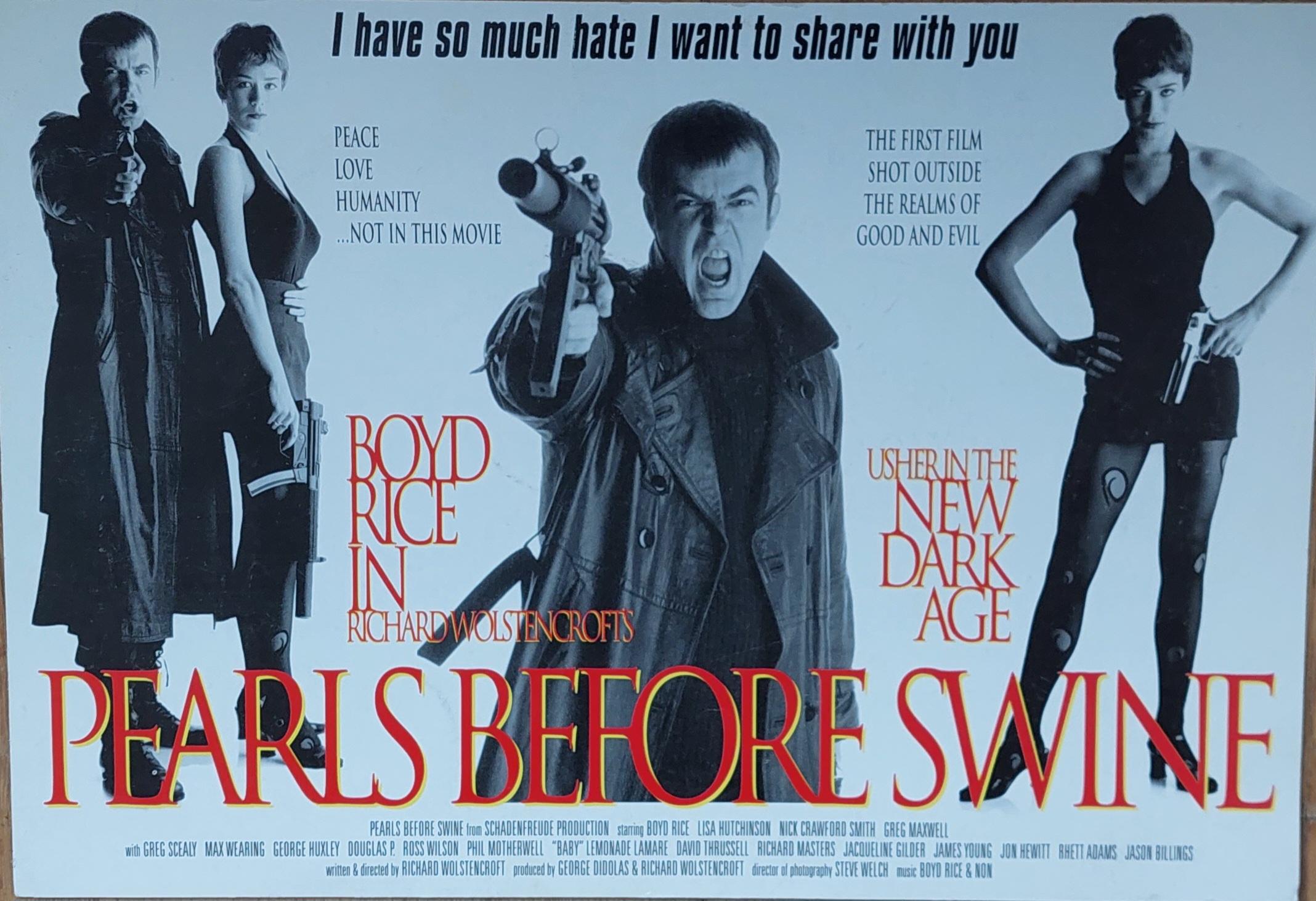
RW: Douglas P. is also in the movie Pearls Before Swine. I got to know Boyd from Jim Goad’s Answer me magazine and Re/Search. He was at Doug‘s in Adelaide so I went and hung out with him for four days and pitched the movie to him. Boyd accepted the lead, and Doug has a good cameo scene. Both have music in the film, but mainly Boyd with David Thrussell, my Aussie friend who provided some other music. Boyd came and stayed in Melbourne for five weeks while we made the movie. I put on a Non and Death in June gig in Melbourne at The Mansion—the only such performance ever held in Australia.
We are friendly for 20 years—he acted in my film The Second Coming—a slightly more avant- garde kind of film from me—it’s divided in to parts 1 and 2–at 80 mins each—and is about warring black and white magicians trying to bring on the end of the world. Shot from 2010 to 2014. Now it seems pretty prophetic.
OM: Do you have any personal memories of Boyd Rice and his infamous humor?
RW: Lots. One of the funniest and funnest people I’ve met.
Boyd and I met around 1994, he was in his mid to late 40s. Like David Lynch, he has a relaxing all-American Jimmy Stewart type quality, with expressions like “Fab” and “Gee Whiz,” other American things like that. And like Lynch, there was certainly a dark side. Boyd presented fairly deeply misanthropic and fascistic type views of the world in a very cheerful light. I was feeling this way at the time and used some of his ideas in the film, so that was fairly collaborative. Though his ideas would be very black, they often seemed correct. He had great humour with them, he seemed to think most people just won‘t accept the truth about themselves and their natures, and about humanity in general. He often found this amusing. He loved droll stories illustrating people’s stupidity and hypocrisy. He had a vast array of bizarre things he was interested in, from Barbie Dolls to ancient Merovingian kings to strange authors of the occult and Satanism to serial killers (he knew Manson in the 80s, and was a regular visitor of his in prison) and to fascist and Nazi figures of all types. He was notoriously funny and loved pranks. He would mock people openly to their face, he would take jokes way too far, where they went in to painful territory—but then emerged out again in to humour. While his ideas could present as being ill-humoured, he didn’t present that way in person. He was usually very polite to most people in restaurants and so on, and was nice to family and friends of mine who he met. I was running my Hellfire Club at the time, my nightclub and was experimenting with drugs, especially the drugs E and coke. We, my girlfriend Lisa and I, got Boyd high on E one night for a laugh—and yes he was indeed much more “lovey dovey” than usual and talked about his emotions and recent break up with Lisa Carver, etc.—which is not exactly like him. I thought it was nice to see that. He loved a good time, he loved fun. He also loved drinking in that period. And did so. I was never that big a drinker. He would sometimes be hungover when I got him on set for the film in the morning. But it was no big deal. I think maybe one day he got too out of it the night before and we didn’t shoot, postponed a day. That was all. Mostly he was a total pro— nice to other actors and funny and charming to them. He was great to work with, an open and friendly collaborator.
OM: How did the filming of Pearls Before Swine go? Did Boyd like the film?
RW: It went well, Boyd liked it. I think he still likes it today. Doug played the film before concerts, and so did Boyd for many years, maybe they still do? Both used images and footage from the film for their performances. They both liked it a lot at the time, in the 90s. The film has its flaws—but it has its charm. Roman Polanski saw it at the Stockholm Film Festival—after the screening of Fight Club at the same Festival, where we were both guests. He said it was like a low-budget Fight Club—when I met him at the after-party following the awards ceremony. We also had a big chat about his views of Fight Club.
OM: Why did you start The Melbourne Underground Film Festival (MUFF)?
RW: My film Pearls Before Swine was rejected from the Melbourne International Film Festival (MIFF) after playing four equal size festivals overseas. So I thought, f— them. I’m starting my own film festival. At the time the two underground films festivals in the world were New York and Chicago. After I started MUFF they began popping up all over the world. New York Underground film festival shut down in the 2000s. Chicago is now the oldest underground film festival—MUFF is second oldest, I believe—if Chicago shuts down—we will be the oldest—hope, hope. Lol.
OM: How did the last edition of your MUFF film festival go?
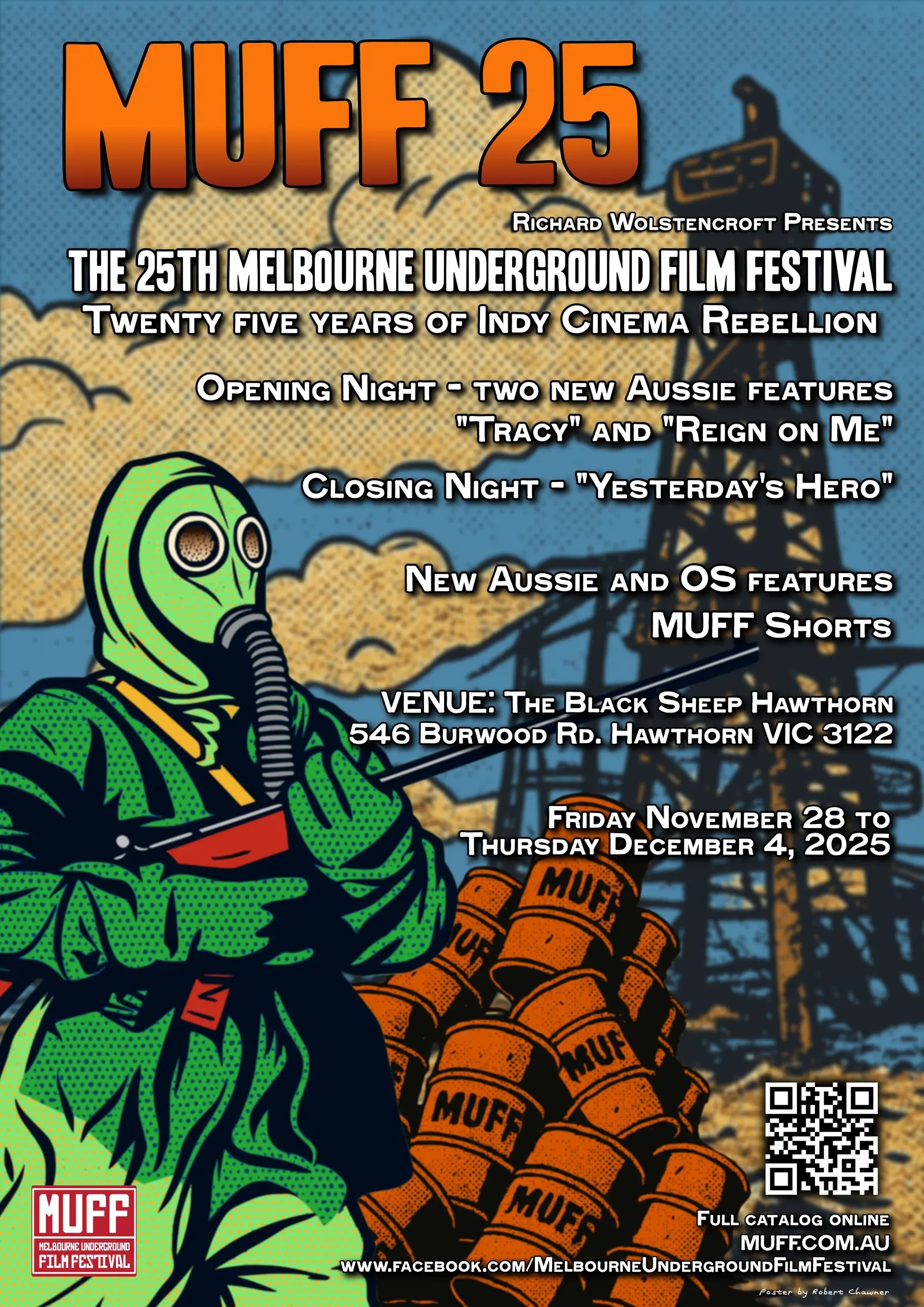 RW: MUFF is known for its radical, adventurous, and iconoclastic programming and its support for different voices in independent and underground film and video worldwide. The festival focuses on both Australian and international cinema, and is a vocal critic of the staid and endlessly failing Australian film industry. Now in its 25th year, MUFF has been the launch-pad and incubator for many talented filmmakers including the likes of: James Wan, Patrick Hughes, Scott Ryan, Jenna Fisher, Jim VanBebber, Bruce LaBruce, Stuart Simpson, Shannon Young, Kel Dolen, Steven Kastrissios, Ivan Kavanagh, Jon Hewitt, Mark Savage, Anna Brownfield, Jeremy DeCeglie, Gregory Pakis, Christoper Lee Sun, Paul Moder, Michael Tierney, and many, many others.
OM: In the film world, it is possible to succeed even as a complete outsider. How do you explain the success of your film festival?
RW: Outsider art is always interesting and I’ve enjoyed making it. I would like to make insider art—but, sadly, no producer with a bigger budget has ever backed one of my ideas—I have many great ones, with two new projects ready to go. So if there is any Right-leaning producer out there—get in touch—I can make a feature for 50K. I’m going to keep trying to produce new work and grow as a filmmaker. I’m very exited about two new crime projects I’m developing, one dealing with immigrant crime and related issues told in a narrative setting. So, any like minded producers get in touch. CC will pass on my contact info.
OM: What is your opinion on low-budget films?
RW: I like all kinds of movies from Kubrick to Ed Wood. I like the passion for cinema someone displays—not the budget. I like interesting ideas in cinema—I like cinema that is subversive and confrontational. While I like some commercial cinema most stuff I like is indy, underground, arthouse or edgy in some way. I do like genre cinema though—especially crime films and horror films that seem to speak to my darker view of humanity.
OM: What are the best low-budget films you’ve seen?
RW: I love most Indy cinema—the early work of Lynch, John Waters, Kenneth Anger, Herzog, Ray Dennis Steckler, and Russ Meyer. Some of the best indy films from MUFF are: Tin Can Man, Ivan’s XTC, Razor Eaters, Charlie Casanova, Jugular, LIE, The Magician by Scott Ryan and Stygian by James Wan—all MUFF alumni.
I make my feature-films cheaply—between 30 and 80 grand Australian. That’s usually about 20 to 50 grand US dollars. I want to make more. Jon Hewitt and I would like to do a sequel to Bloodlust, also. We have kicked around some vampire ideas. I’m sure Boyd and I could be talked into doing something like Pearls Before Swine or similar. If someone gave me 50 grand a year, I’d make a film every single year, like some of my favourite, more prolific film-makers. I’m not sure why a bigger producer has never given me a guernsey—given me a go. But I live in hope that some day, someone out there still likes truly controversial and confronting cinema wishes to collaborate. I enjoy being collaborative.
OM: How do you rate the films Nekromantik, LA Zombie, Salò, or the 120 Days of Sodom?
RW: The last film, Salò, is a masterpiece. That’s Epstein island the movie, isn’t it? 50 years before they busted that Nigga. So it’s been going on awhile. . .
LA Zombie I liked and I defended the film in court—Bruce LaBruce was a past MUFF guest—we did cocaine together when he came out to Australia and talked cinema. Like I did with Bret Easton Ellis on his Imperial Bedrooms Aussie book tour a few years back.
Nekromantik is good confronting horror—Jorg was on my Facebook page for a while—he either unfriended me or it was from one of my old cancelled accounts, and I just never re-friended him. I like Jim Van Bebber’s films also, a past MUFF guest and top guy—we partied the whole week of that festival, dear God. I did that with Gene Gregorits also—who had a wild time in Australia, before having troubles when he got back to the States.
Recent contemporary film-makers I like? I like Sean Baker, the Safdie Brothers, that Yorgos Lanthomos from Greece, Paul Thomas Anderson, Chris Nolan, QT, Osgood Perkins, Ari Aster and filmmakers like that. Though I don’t always like every film they make, I didn’t like Beau is Afraid for example, but I loved Eddington.
OM: So what would you recommend watching from the horror genre?
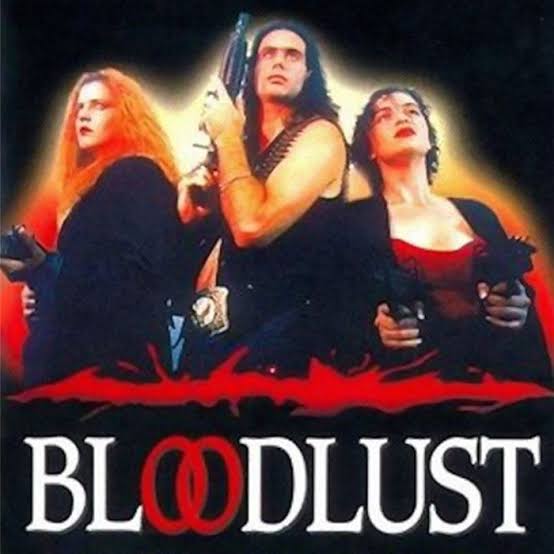 RW: Dawn of the Dead, The Keep, The Shining, Dead Zone, The Thing, Halloween, They Live, Last House on the Left, Last House on Dead End Street, Hammer Horror, Tigon horror films, Roger Corman horror of the 60s, Christine, Scanners, Let’s scare Jessica to Death, Death Weekend, Marauders—by my friend Mark Savage—and my film Bloodlust.
OM: What are the worst woke movies you’ve seen?
RW: Jesus—One Battle After Another (2025) the first 40 minutes annoyed the shit out of me with the ugly black woman as the love interest of both DiCaprio and Sean Penn—it’s ridiculous. I mean cast Halle Berry and maybe it’s believable. I tend to avoid woke movies. Sometimes I find them funny. Sometimes they annoy the shit out of me, like the Star Wars sequels. I mean, you had the three main cast still alive at the start—you have a female Mary Sue, a black storm trooper who’s a moron, and a Mexican pilot. They hung a new Star Wars trilogy on that weak casting. They killed Han Solo—Luke is a cowardly recluse and Leia is an inefficient technocrat. They deliberately fucked that up—to destroy Lucas’s Myth of the Hero complex. It was deliberate cultural sabotage from the usual suspects at Disney.
OM: How would you rate the Australian nationalist film Summer Nationals (2025)?
RW: I haven’t seen it—got a trailer or link? I would have played it at MUFF.
OM: What do you like about the Alt-Right?
RW: Well I don’t like names—I know that terminology has fallen out of vogue of late—it was hot for a while—while it was hot, I liked it. I like the terms New Right, Right-wing populism, and the Dissident Right these days. They can all have slightly different meanings. I like almost Right-wing philosophies. I don’t like every conservative philosophy—I mean I’m libertarian and a libertine on some things. I used to run an S&M nightclub called The Hellfire Club, after all. But I don’t anymore, I guess I have become more socially conservative now than in my 20s.
I believe in Right-wing unity, though—from a mild centre conservative like Jordan Peterson to Nick Fuentes and beyond—I don’t really care if they don’t get along or contradict, Tucker and Candace and others etc. I don’t like the in-fighting, though, it’s silly. I always look for exciting dialectics and synthesis.
OM: Do you think Boyd Rice, Michael Moynihan, Jim Goad, and Adam Parfrey were the godfathers of the Alt-Right? Could you tell us something about that?
RW: I think they definitely were. “Politics is downstream of culture” Andrew Breitbart (via Gramsci) said—I think they were the avant- garde of the Alt-Right, 100%. Like the Futurists and D’Annunzio were to Mussolini and pals.
I would humbly place myself as a fellow-traveller to all that, one who had crossed over into politically supporting the various iterations of the New Right/Dissident Right. I find it all enjoyable and fun and the future of humanity, if it has one.
European civilisation is civilisation—without us it all goes away—so all ethnic minorities should support White Nationalism—as they will eventually benefit from our rule of the planet. As they have for the last 2,500 years of progress from Ancient Greece and Rome until now!
We are alpha and the omega. The first beginning and the second! We are The New Dawn! Without European man and woman, it is darkness for humanity, a new dark age.
OM: What do you like to read on the CC website?
RW: I’ve read many articles over the years there. Jim Goad is there now or was, yes? Always like him. He was in my film The Second Coming, which also had Boyd Rice in it.
I like Greg Johnson’s work. I know he’s the founder/runner of the website. John Morgan is great, also. Other writers there. I like Arktos. Some people like to get into silly arguments within the New Right. I’ve really never liked that and always promoted getting along. I’m not interested in anyone trying to be perfectly pure, purity spiralling etc. I see the Dissident Right as a broad church.
OM: What would you recommend to young directors who want to make original films without political correctness? And to directors who are fed up with the current Jewish film mafia?
RW: Well, given new technology you can make new content reasonably easy if you have passion and a will to power just do what you like—don’t EVER let people tell you no—struggle and fight and defend yourself and people will begin to notice your work. Start your own screening events, do a podcast. Make more movies. Doing it—that’s the key—even though it’s sometimes hard and you have to do other things to support yourself. That’s some of my advice. And send the results to MUFF; we will play them, our new call for entires is on now!
Richard is on Instagram and Facebook. His weekly video political rants Report from Tiger Mountain can be found on YouTube and The Unshackled website. The You Can’t Be Serious podcast with Sam Newman can be found on Podbaen and Youtube. His feature-films can be bought from Redemption, Soleilmoon, Monster Pictures, and Amazon Prime. The Film Festival MUFF’s website is: www.muff.com.au and he can be contacted at [email protected].
8 comments
Hello Ondrej,
Interesting interview.
I don’t know much about this Wolstencroft fellow, but I’ve seen ‘Pearls Before Swine’ many times, being the Boyd Rice and DI6 appreciator that I am. You can also hear some of Albin Julius’ music in the movie as well.
The vast majority of his cultural taste doesn’t resonate with me (Tarantino, Kubrik and Lynch for example) . but at least he is a non-conformist in his own way and doesn’t give two shits about offending people; which is of paramount importance.
Richard is a great individualist; he chooses from a large number of unrelated things that he likes and appreciates. He is an artistic soul at heart, which is why he chose this unorthodox approach. I also like neofolk and things related to it. Something tells me that you will enjoy a few of my articles on neofolk and similar topics this year. Boyd Rice is one of the most interesting contemporary artists.
I certainly do like neo-folk and just about anything associated with it. All the Von Thronstahl and Deniere Volonte martial industrial as well. Looking forward to your forth-coming articles and interviews. Maybe you can track down Boyd for an interview, eh?
I meant to ask, have you seen the Boyd Rice documentary entitled, “Iconoclast”?
I have read dozens of interviews with Boyd Rice. I have also seen the film Pearls Before Swine and the documentary Iconoclast. Boyd is a very talented and interesting person.
This guy is a clown who might be funny sometimes, but offers nothing useful to WN.
He seems like one of those 90’s “edge-lords” that I used to hear about back then, but didn’t really know what they were on about. However, anything that gets good ideas across in some way, shape, or form to different kinds of people who may be receptive to these good ideas is good, eh?
I like his films, and he is an interesting person without political correctness. He deserves space on CC.
Comments are closed.
If you have a Subscriber access,
simply login first to see your comment auto-approved.
Note on comments privacy & moderation
Your email is never published nor shared.
Comments are moderated. If you don't see your comment, please be patient. If approved, it will appear here soon. Do not post your comment a second time.