 2,895 words
Many dismiss Atlantis as merely a myth or allegory by Plato. The theosophists and other peddlers of pop culture esotericism embrace the myth and embroider it, for instance, claiming that Atlantis had flying machines. I have always taken the radical centrist stance that Atlantis existed, minus the fantastical claims. It was probably a settlement in North Africa that was advanced for its time, like Göbekli Tepe in Anatolia.
The only two primary sources on Atlantis are Plato’s Timaeus and Critias which are sequels to The Republic.[1] But modern myth mongers rarely examine them, even in passing. A close reading of them suggests that the Greeks remembered Homer’s Troy but not Solon’s Atlantis because it was closer in time with fewer intervening disasters and because Homer could devote his attention to poetry while Solon could not. The Critias ends abruptly mid-sentence with a council of the gods to echo the start of the Odyssey, further emphasizing the comparison to Homer’s Troy.
Plato was probably highly skeptical of Atlantis but still considered it less fantastic than the Trojan War. Plato was infamous for questioning myth, convention, and Homeric values. But Heinrich Schliemann excavated Troy in 1873, and there are several archaeological candidates for Atlantis, with North Africa being the strongest. Thus, Plato’s skepticism has been proven wrong.
Whether Atlantis existed or not, and in what form, is not the main point Plato is trying to make. Plato uses the possibility of Atlantis and its ambiguous nature to inspire the reader to ask several questions. Those questions have even more relevance to modern politics than they did to ancient Athenian politics. I will discuss them in Part Two.
Timaeus begins with Socrates counting the number present. Timaeus, Critias, and Hermocrates are present, but an unnamed fourth man is absent. Who is the fourth man? Timaeus claims that the absent man wouldn’t miss their gathering voluntarily. Thus he must be sick. It is likely that the missing man is someone like the other three: an adept in war, politics, and philosophy. Pericles is a strong candidate because he was experienced in war and politics and knowledgeable of philosophy. Also, because he presided over the disastrous Peloponnesian War, which mirrored the fall of Atlantis, he could have benefited from being present. The mention of sickness could be a foreshadowing of how Pericles would die of the plague. Note: The Republic is set about 408 BC before the war, whereas Pericles died about 430 BC.
Another candidate is Alcibiades, who led Athens to ruin with the disastrous expedition to Syracuse and repeatedly switched sides.
Ultimately, however, I think the main point of the absent man is to begin Timaeus with an omission to highlight how Critias ends abruptly mid-sentence with a council of the gods, which is another type of omission. The ancient Greeks would have instantly connected that council of the gods to the one at the start of the Odyssey.
Hermocrates barely speaks at all in either dialogue. His silence is probably connected to the fact that he is from Athen’s enemy, Syracuse. He might be enjoying the parallels between the fall of Atlantis and the defeat of Athens in the Peloponnesian War to emphasize historical parallelism. That, or for political sensitivity as the philosophers were frequently accused of having foreign sympathies. Regardless, Syracuse looms ominously in the background.
The next topic is a quick summary of the ideal state discussed in The Republic. It seems like a hyperbolic parody of Sparta and everything that contemporary Athens was not. It has holding property in common, division of labor, and female warriors which is especially ludicrous in hoplite warfare. This implies that the ideal state is only suited for a radically different type of human which no longer exists. It just so happens that Atlantis, along with primordial Athens, will be described as that ideal state.
Socrates asks for a story showing the ideal state in action in war and diplomacy against other states, like how it is more beautiful and informative to see animals in action rather than lying at rest or in pictures. He also praises the others as being well suited to the task given their experience in politics and philosophy. In contrast, poets would do a poor job because they are too rooted in the surroundings they were brought up, while sophists have the opposite problem of wandering about too much.
This again ties into Solon versus Homer. Homer was a poet, while Solon was skilled in politics and war. Solon was also the foundational law giver of Athens and thus had practical experience in applying philosophy. There are two ways of looking at this. First, Plato is implying that Solon’s Atlantis story is at least as credible, if not more so, than the Iliad and Odyssey. The second is that Homer should not be considered any more credible than the long chain of hearsay for Atlantis. I think Plato is doing both to some extent.
Plato was highly critical of Homer and poetry in general and claimed that Homer taught the wrong values. This was tantamount to questioning the Bible and part of why Socrates was accused of impiety. I vehemently disagree with Plato’s criticism of Homer. But agree or disagree, the comparison should be sparking questions.
Socrates says that the illustrative story doesn’t have to be true. This is what modern nerds lean on in claiming that Atlantis is pure fiction. But Critias then says he has a story that is “very strange” “but entirely true.” Is Critias joking or being ironic? I don’t think so, as Critias’s tone is sincere throughout.
Critias claims that his grandfather, another Critias (names often skipped generations) told him a story from his father Dropides who heard it from his very good friend and relative, Solon. This happened at a festival when young Critias was about ten years old and the elder ninety years old. Another man, either because it was his real opinion or because he was being polite, had remarked that Solon had been the wisest of all men in things other than poetry and had been the most “independent minded” of the ancient poets. “Independent minded” sounds philosophical and not overly rooted in one’s surroundings and social conventions.
Elder Critias replies that Solon would have surpassed Homer and Hesiod if he hadn’t treated poetry as a hobby because he had to focus on politics. And especially if he had finished the Atlantis story he brought back from Egypt.
Solon learned the story from the priests of Neith at Sais, the former capital of Egypt. Neith was identified with Athena, and so the local priests treated Solon with great respect as an Athenian. When Solon told them his oldest legend of Deucalion and Pyrrha surviving the Great Flood, one of the priests said “you Greeks are always children, and in Greece there is no one who is old.” The priest explains that there are periodic destructive events, mainly by water or fire, such as when Phaethon scorched the earth with his father’s chariot. The priest explained that the Phaethon incident was due to a periodic deviation in heavenly bodies. For instance, some speculate that a solar super flare caused a decades long drought sometime between 2200 and 2000 BCE.
According to the priest, most places are vulnerable to water or fire, even if they are resistant to one. Egypt is one of the few places resistant to destruction by water and fire, thus has the longest historical memory. Everyone else periodically starts over again with no memory of what happened in their lands or others. While it was by military action and not by water or fire, the ancient Greeks did lose knowledge of their own writing, Linear B, during the Bronze Age Collapse.
The Athenians had forgotten that they had once been a master race who lived according to Athena’s laws. Their priests and warriors were focused entirely on their arts and there was a strict division of labor among craftsmen, as in Egypt at Plato’s time.
Of all the great deeds the Athenians had forgotten, the greatest was how they defeated Atlantis. The Atlantean Empire extended to Libya and Tyrrhenia, aka Etruria, and they planned to conquer all of Europe and Asia. The Athenians stood alone against Atlantis but do not remember it because their army was destroyed along with it.
So, is any of this credible? Critias heard it from the elder Critias who heard it from his father who heard it from Solon who heard it from an Egyptian priest. That’s layer upon layer of hearsay. But I do think that somebody, whether that’s Plato, Solon, or someone else, did in fact hear something about Atlantis from an Egyptian.
The strongest evidence is geological. In Timaeus, the way Atlantis is described with concentric rings closely resembles the Richat Structure in the middle of a plain in the Mauritanian desert near the Atlas mountains. The Richat Structure is a purely natural phenomenon and not Atlantis. But if the Egyptians remembered Atlantis as being somewhere in North Africa, it would have made sense if someone saw the structure, and when they told the Egyptians about it, for them to attribute it to Atlantis. And there would probably have to be an Egyptian link for that story to reach Plato.
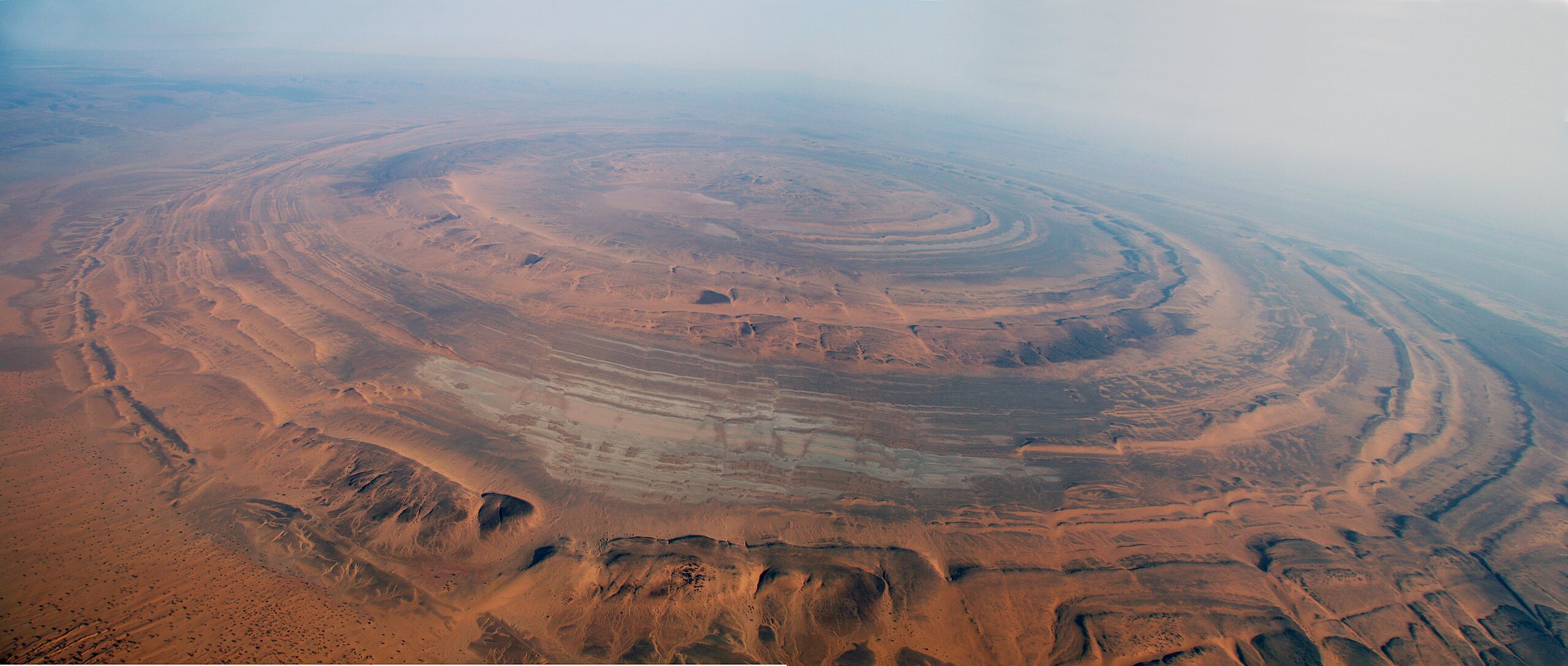
The Richat Structure, courtesy of Wikimedia Commons.
Further evidence for Atlantis being in North Africa rather than in the Atlantic can be found in The Atlantis Puzzle (2024), a documentary by Jack Kelley, featuring independent researcher George Sarantitis. To summarize, much of the endless and oftentimes silly speculation which surrounds Atlantis is due to how few modern people understand ancient Greek well enough to accurately translate Plato with nuance. The Pillars of Heracles were originally not identified with the Strait of Gibraltar but were somewhere along the coast of North Africa. The pillars becoming impassable due to mud doesn’t correspond to Gibraltar, but it would to an inlet in North Africa as the climate changed. Atlantis was located past the pillars in a pelagos, not a thalassa. The Saharan Desert used to be lush wetlands and the verb used to describe Atlantis’s destruction isn’t “sink” but rather “covered up” which indicates something like a mudslide, not sinking into the ocean.
That a Greek heard something about Atlantis from an Egyptian is buttressed by Plato’s text. The younger Critias says that he was amazed to realize that “by some divine chance” much of the ideal state discussed in The Republic corresponded to Solon’s story. Critias and/or Plato might be speaking ironically to show how easy myth can be spun. But Critias also says that after yesterday’s discussion he concentrated on recalling the Atlantis story during the night. If he has to recall it, that means he’s not making it up. He’s also honest that he couldn’t recall all of it. And everything he says after that speaks to sincerity. He mentions that it’s common for adults to clearly remember things from their childhood but that he would struggle to remember everything said yesterday.
“…I kept asking one question after another, so that the story has stayed with me like the indelible markings of a picture with the colors burnt into it” doesn’t sound ironic. Plato seems to be signaling that even if he questions the other levels of hearsay, he believes that Critias is telling the truth as best he can.
When Critias asks Socrates if Atlantis meets the requirement for the story he wants, he says yes because its connected to Athena which the present festival is for and “the fact that it is not a made-up story but a true account is all-important, I suppose.” But Socrates had said earlier that whether the illustrative story of the ideal state is true or not was irrelevant. As I discuss here, contradictions, like omissions, are something to look out for in esoteric writing. Is it all-important for Critias, for Socrates, or for the reader? Or is Plato having Socrates speak in an ironic tone? Or just indulging Critias’s enthusiasm?
The modern cynics will point at this as simple irony. I disagree. Rather, Plato is highlighting the ambiguity of Atlantis to spark questions. It is indeed “all-important,” but for collateral matters. And those matters are the true purpose of Timaeus and Critias, rather than the ideal city which was already discussed at length in The Republic. Here, the ideal city is meant to serve as a springboard for other questions.
At this point, Timaeus ends and Critias begins. Much of it can be briefly summarized.
Critias explains that different gods influenced different regions through influencing the minds of men rather than brute force. Names persist over successive disasters, but not customs, although this raises the question of why the gods don’t instruct humans again. Critias describes how Athena influenced primordial Athens so that it was the ideal state. There was division of labor, male and female warriors, no metal currency, and the Guardians lived separately with a middle-class lifestyle between extravagance and servility. Thus, due to practicing justice under Athena’s laws the ancient Athenians became beautiful in body and sharp in mind. Ancient Greece was also less rugged before it suffered several floods and earthquakes.
Critias then says that he will “publicly hand over” as “common property” what he knows unless he forgot it since he was a child. The allusions to how property is held in common in the ideal state further reinforces how Socrates and/or Plato at least trust Critias’s sincerity.
But there is a major issue which impeaches Critias’s testimony. He was the cruelest of the Thirty Tyrants from whom Plato would distance himself, not just to protect himself but from genuine disillusion. There’s an intentional juxtaposition between the recounting of sweet childhood stories and the Thirty’s reign of terror which killed one out of every twenty citizens in Athens. Plato might want us to question Critias, but I do not. It is possible for a man of learning and culture to be ruthless, like Mussolini. What did Plato think taming the democracy that destroyed Athens would entail? Vibes, papers, dialogues?
But another fact which undermines Critias’s credibility is how he learned the story at the tribal Apatouria festival. One translation is “the festival of deceit” because it celebrated how an Athenian named Melanthos (dark haired) defeated a Boeotian named Xanthos (blonde) in a duel using trickery. This suggests that Critias is more of a poster boy of Athenian corruption than its enemy.
Warman Welliver argues that Critias is rude, domineering, speaks out of order, and is trying to show up Timaeus.[2] Welliver even argues that the performance of the ideal state which Socrates finds satisfying is actually the attack that the hubristic Athenian Critias launches against the virtuous Timaeus which mirrors Atlantis and Persia attacking Athens and Athens attacking Sparta. While he overstates his case, there is something headstrong about Critias.
Having weighed the factors for and against Critias’s credibility, I still think he can be believed. At the very least he is not completely lying, and someone heard something about Atlantis from an Egyptian.
Critias’s physical description of Atlantis is discussed at length in the aforementioned documentary. Its political and cultural description matches the ideal state. Bull sacrifice was important and, given that bulls were a common motif in ancient and prehistoric Spain and North Africa, further buttresses its location in North Africa.
Due to miscegenation between divine and mortal blood which was inevitable without inbreeding, Atlantis degenerates into greed and attempts to conquer the world. There is an obvious parallel with how Athens degenerated from the time it vanquished the Persians in a defensive war to wrecking itself in the Peloponnesian War. That parallel is further reinforced by how Critias says there was something barbaric about the appearance of the temple of Poseidon in Atlantis. “Barbaric” means non-Greek and was more often applied to decadent Persians than to austere tribes.
Zeus summons a council of the gods to decide how to punish Atlantis “to render them self-controlled and more harmonious.” That implies rehabilitation rather than total destruction, which would be more in line with a mudslide than with a continent sinking. Zeus is cut off mid-sentence declaring something. But knowing what we have read, it’s reasonable to assume the Atlanteans would continue to exist and keep their names but would forget their own history. That, or Critias is who is reporting what Zeus said about Atlantis, and is stunned to realize its applicability to Athens. That would explain why he went full Right Wing Death Squads if he saw it as the only way to save Athens from a similar fate.
The story of Atlantis ends the same way that Homer begins the Iliad. The parallels between Troy and Atlantis imply that Atlantis is at least as believable as Troy. One interpretation is that Plato is using Atlantis to deconstruct Homer and myth in general. Even if that is Plato’s intent, we’re free to disagree with him. He would not want us to unquestioningly follow him. In attacking Troy with Atlantis, he inadvertently proves Atlantis while leaving Troy unscathed.
But the existence of Troy and Atlantis are secondary to the questions which they are supposed to inspire, which I will reveal in Part Two.
Notes
[1] Plato. Platonis Opera. Edited by John Burnet, vol. 4, Oxford UP, 1902. Oxford Classical Texts.
[2] Welliver, Warman. Character, Plot and Thought in Plato’s Timaeus-Critias. E. J. Brill, 1977. Philosophia Antiqua, vol. 32.
10 comments
I’ll put the index of this excellent text that came out in 2025 and that I’ll never stop recommending Caranzano It talks about the White Indians of America and therefore we can frame it among ours
Aztlan. The Myth of Atlantis Becomes Reality
https://www.ilgiardinodeilibri.it/libri/__aztlan-mito-atlantide-diventa-realta-massimiliano-caranzano-libro.php?id=205136
I hope it will also be translated into English.
Despite the clear indications left by Plato, in the second half of the 19th century, some geologists took radical and unjustified positions on the search for Atlantis. They categorically rejected the possibility of a continent submerged in the waters of the Atlantic Ocean, thus dismissing the search as a work of fiction.
Plato’s description of the location of Atlantis in the Timaeus and the Critias is so precise and consistent with the reconstruction of the planet’s geology as it existed 11,600 years ago that it’s truly difficult to look elsewhere.
The countless geological publications for nearly a century and a half have only confirmed that the Atlantis described by Plato not only existed, but lies at the bottom of the Atlantic Ocean… at least, almost entirely.
The debate over Atlantis is certainly not its geographical location, but rather understanding the shocking geological mechanisms that sank a vast expanse of land thousands of meters deep into the ocean.
Science is not the result of what scientists say, but is built on the scientific method.
Some priests, disguised as scientists, have hidden reality for half a century, ignoring the extraordinary multidisciplinary evidence supporting the veracity of Plato’s words.
We are born from the ashes of Atlantis: we are children of that advanced antediluvian civilization that existed before us; we are all children of Atlantis.
“In AzTLAN, I will lead you hand in hand through the extraordinary evidence that geology, paleoclimatology, oceanography, myths, “linguistics,” symbolism, cultures, botany, paleontology, biology, archaeology, and astronomy have provided us to support what is a conclusion as solid as it is obvious: Plato told us the truth!”
Massimiliano Caranzano
With this book, you’ll discover:
The search for the lost continent, starting from Plato’s indications
What geology tells us about the lost continent
Where Atlantis really is
…and much more.
Table of Contents
Introduction
1 Plato’s Scientific Truths
2 In the Mid-Atlantic Ocean
The Pillars of Hercules
The Kingdom of Eumelus
3 Twenty Thousand Leagues Under the Sea
Passage to the Americas
The Deep: An Inconvenient Truth
The Atlantean Continent
Hyperborea
Atlantean Deeps
4 The Myths
AzTLAN
The White Indians of America
The Papyrus of the Shipwrecked Sailor
The Adantian Texts of Edfu
The Eye of Sound and Atlantean Technology
The Rebirth of the Eye of Sound
5 Descent into the Deep
12,850 B.P.: Earth’s Crust Sliding
Atlantis in the Younger Dryas
Atlantis Sinks
The Final Blow
6 Conclusion
To be integrated with the essentials
To be integrated with the essential
https://www.ereticamente.net/strade-del-nord-il-tema-delle-origini-boreali-in-herman-wirth-e-negli-altri-parte-1-michele-ruzzai/
Atlantis? I refer you to several works by Juergen Spanuth. Once I had read them, the issue was settled for me. His case is totally convincing.
By the way, Spanuth and Verhagen argued, that the Near-Eastern peoples counted not years, but months, so 9000 years before Solon could be in reality 9000 months, i.e. 750 years. It is much more realistic, because the descripted Atlantis is not a primitive state of the Stone Age, but civilized state of the Bronze Age. And people could keep in mind, at least in legends and myths, what happened 750 years before, but they could not remember what was 9000 years before them.
I liked the hypothesis of German author Juergen Spanuth, later supported by Britta Verhagen (Alberta Rommel), about the North European Atlantis in the German Ocean, there, where the Island of Helgoland lies now. For Herrn Spanuth and Frau Verhagen the Atlantis was a part of the North European civilisation of Bronze Age.
The fact that the British occupation force in Northern Germany instigated a smear campaign by German scholars against Spanuth (remember, this was the time of the total swine Sefton Delmer) is a badge of honour to Spanuth. Curiously enough, I spent the first few months of 2025 studying Spanuth‘s works and was surprised how meticulously he addressed every single aspect of the Atlantis saga and how it fit into the North Sea/Doggerland/Heligoland hypothesis
Even if the civilisation on Dogger Bank and in German Ocean was not THE Atlantis, it is worth to study anyway, but the official historical scholarship someway still does not want to do it, so it stays the task of amateurs like Spanuth (a priest) or Verhagen (author of novels for children).
The British almost destroyed Helgoland with its Sprengladungen, and this was already after the war. And then they simply temporarily annexed the island.
Much has changed, and there have been many sensational discoveries recently in archaeology, anthropology, and astronomy—the Dryas impact and the Guanche pyramids, to name a few.
I must kindly ask you to be patient and translate these excellent articles by Ruzzai,
which explain the various migrations from Hyperborea and Atlantis in three phases, and which gave rise to our race as we know it.
You can start here, where you’ll find the complete index of articles and links to download the PDF version.
https://www.ereticamente.net/strade-del-nord-il-tema-delle-origini-boreali-in-herman-wirth-e-negli-altri-parte-1-michele-ruzzai/
Here’s the section that might interest you Americans.
Pre-Nordics in America and Atlantis …………………………………………. 53
https://www.ereticamente.net/strade-del-nord-il-tema-delle-origini-boreali-in-herman-wirth-e-negli-altri-parte-20-michele-ruzzai/
Full collection in PDF
https://www.dropbox.com/scl/fi/p1hvhkrw0g850qgle8ipx/STRADE-DEL-NORD-Ruzzai-2023.docx?rlkey=g331jx6ig36sqotmt5nksg1bw&e=1&dl=0
Thank you for your attention
Schliemann has explored some settlement in Hisarlık. There are no convincing evidences that this really was Troy. Maybe yes, maybe no. Schliemann was not a scholar, but a rich merchant, his approach was absolutely unscientifical (well, the archeology was not a science then at all). He found the Priam’s Treasure without witnesses. Many scholars do not believe in Hisarlik as Troy, because it seems that the explored settlement is much older than Troy should be. Maybe Troy was built later on the same site. Maybe it was elsewhere. We do not know. As an attraction for tourists Hisarlik-Troy is OK.
Comments are closed.
If you have a Subscriber access,
simply login first to see your comment auto-approved.
Note on comments privacy & moderation
Your email is never published nor shared.
Comments are moderated. If you don't see your comment, please be patient. If approved, it will appear here soon. Do not post your comment a second time.